
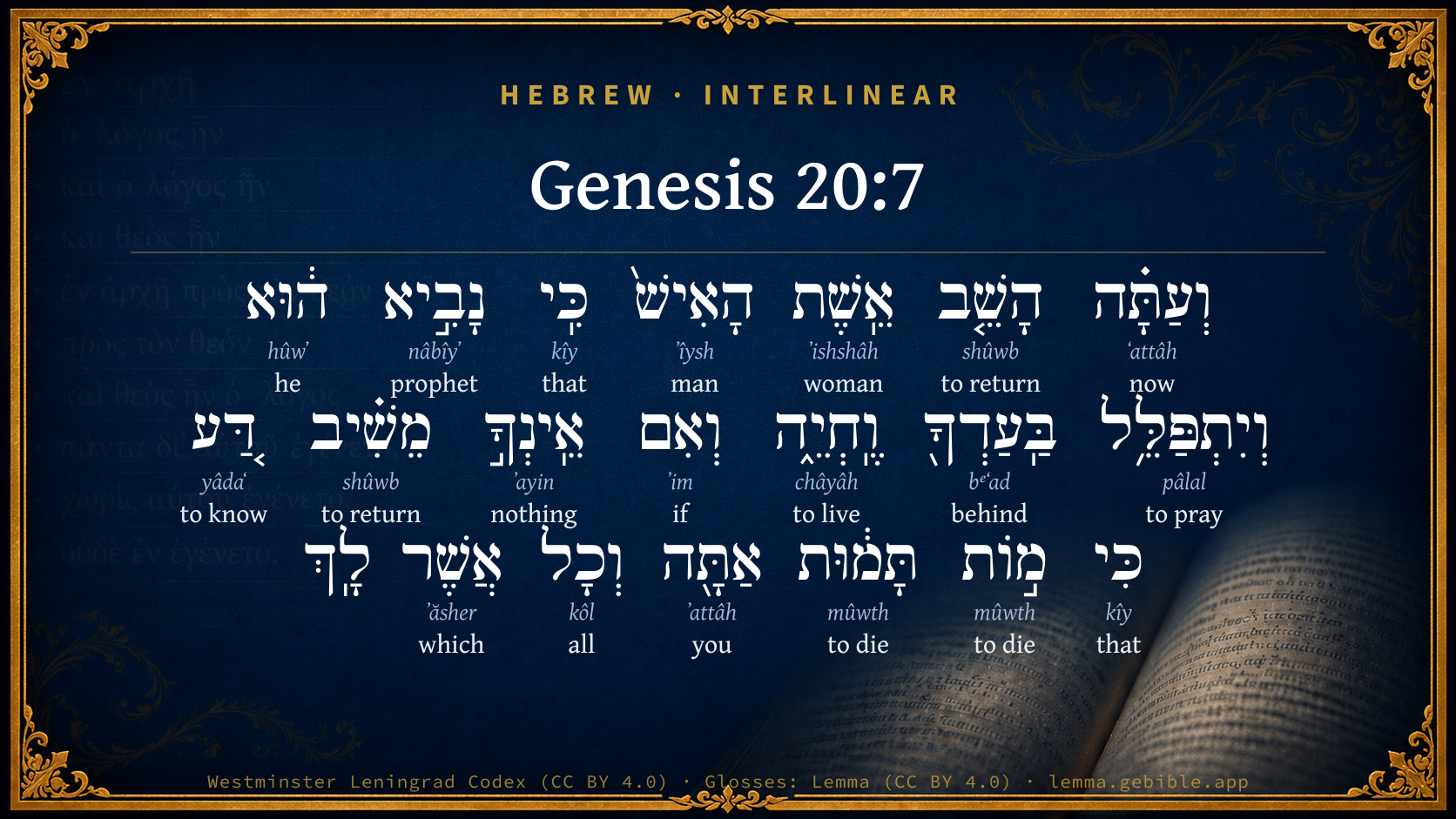
Genesis 20:7

Hebrew (Westminster Leningrad Codex) Genesis 20:7 appears in the Hebrew Old Testament. The text above is from the Westminster Leningrad Codex. Each word links to its Strong’s number, a concise gloss, and parsing drawn from the Open Scriptures Hebrew Bible morphology. Click any word for its full Brown-Driver-Briggs (BDB) entry.
Download image
Cite this verse

Genesis 20:7 (World English Bible). Public Domain. Lemma interlinear Bible study tool, https://lemma.gebible.app/v/genesis/20/7.

Show BibTeX & RIS
BibTeX
RIS
English Translation
Now therefore, restore the man's wife. For he is a prophet, and he will pray for you, and you will live. If you don't restore her, know for sure that you will die, you, and all who are yours."
World English Bible · Public Domain
Highlights
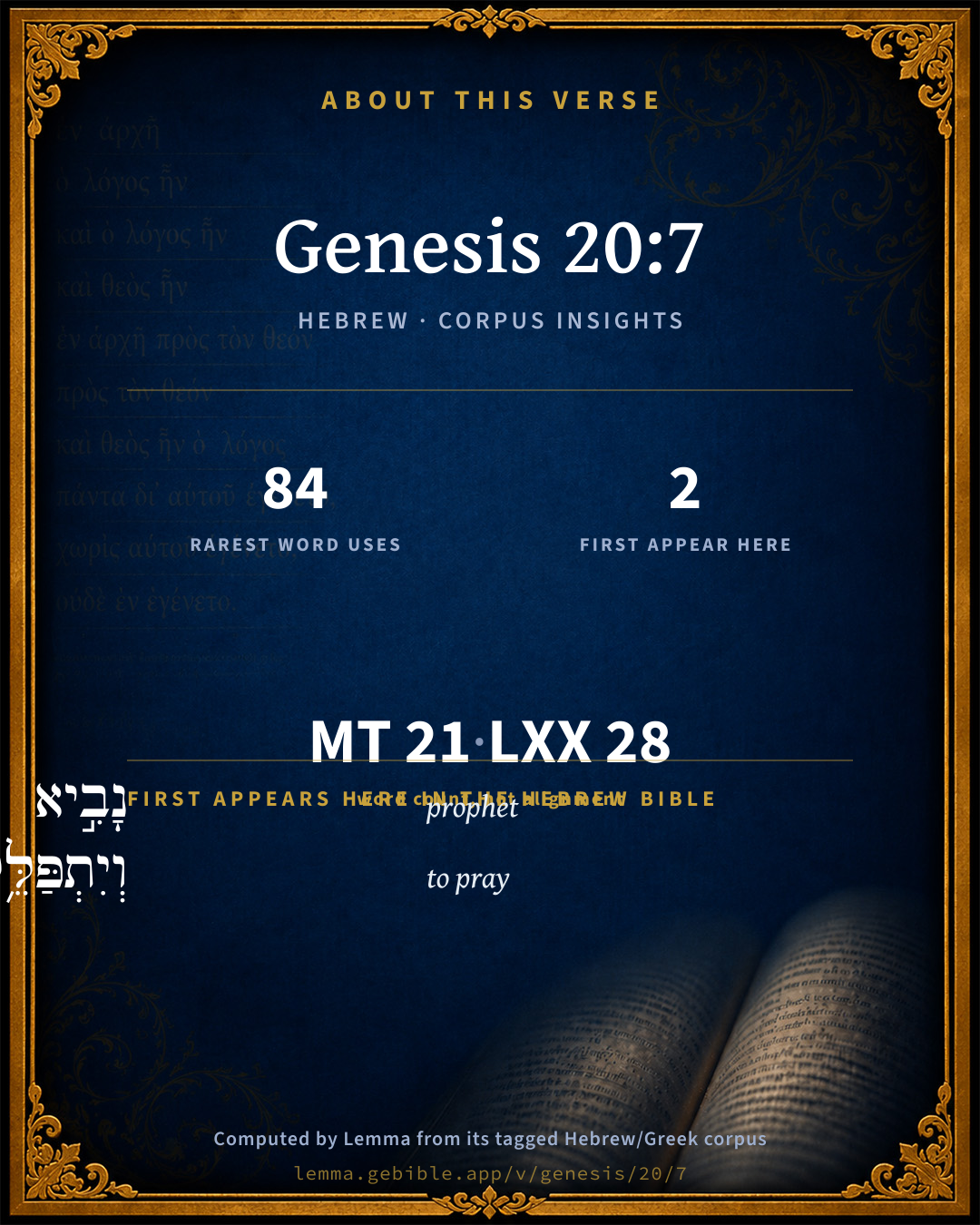
  • 2 first appearances in the Hebrew Bible
Full analysis ↓
Download a study sheet

One document with this verse’s original text, its word-by-word gloss line, the meaning frame, cross-references with their text, attributed commentary, and full source and license credits — printable, and it pastes into notes with its structure intact.

This verse Autodidact and up

Study sheet (.html) Plain text (.txt)

A passage Seminary Student

Up to 50 verses in one chapter. A passage sheet keeps up to 6 commentary sources and 12 cross-references per verse, in the order this page ranks them, and says so on the sheet whenever that leaves anything out. Ask for a single verse and you get the Autodidact verse sheet above.

Everything on this page stays free to read, with no account — the sheet is a download of what is already on screen, not access to it.

Want to remove ads? Support Godless Engineer
Compare translations 3

The same verse in 3 English versions, stacked beneath the original-language interlinear above. Click any original word for its lexicon entry.

Each is an independent rendering of the whole verse — the interlinear is not word-aligned to these translations.

Highlighted words mark where these versions differ — a whole-verse word diff, not a word-by-word alignment.

  • World English Bible Public Domain
    Now therefore, restore the man's wife. For he is a prophet, and he will pray for you, and you will live. If you don't restore her, know for sure that you will die, you, and all who are yours."
  • King James Version Public Domain
    Now therefore restore the man his wife; for he is a prophet, and he shall pray for thee, and thou shalt live: and if thou restore her not, know thou that thou shalt surely die, thou, and all that are thine.
  • unfoldingWord Literal Text CC BY-SA 4.0
    So now, return the wife of the man because he a prophet, and he will pray for you, and you will live. But if you do not return her, know that you will surely die, you and all who to you!”

unfoldingWord Literal Text — © unfoldingWord, licensed CC BY-SA 4.0. Word-aligned USFM3 via Door43 (git.door43.org/unfoldingWord/en_ult).

Versions to compare (up to 4)

3 of 4 selected

Show all 18 translations

Every available English version of this verse, each an independent rendering of the whole verse.

  • World English Bible Public Domain
    Now therefore, restore the man's wife. For he is a prophet, and he will pray for you, and you will live. If you don't restore her, know for sure that you will die, you, and all who are yours."
  • Berean Standard Bible Public Domain
    Now return the man’s wife, for he is a prophet; he will pray for you and you will live. But if you do not restore her, be aware that you will surely die—you and all who belong to you.”
  • Majority Standard Bible Public Domain
    Now return the man’s wife, for he is a prophet; he will pray for you and you will live. But if you do not restore her, be aware that you will surely die—you and all who belong to you.”
  • King James Version Public Domain
    Now therefore restore the man his wife; for he is a prophet, and he shall pray for thee, and thou shalt live: and if thou restore her not, know thou that thou shalt surely die, thou, and all that are thine.
  • American Standard Version (1901) Public Domain
    Now therefore restore the man's wife. For he is a prophet, and he shall pray for thee, and thou shalt live. And if thou restore her not, know thou that thou shalt surely die, thou, and all that are thine.
  • Revised Version (1885) Public Domain
    Now therefore restore the man’s wife; for he is a prophet, and he shall pray for thee, and thou shalt live: and if thou restore her not, know thou that thou shalt surely die, thou, and all that are thine.
  • Geneva Bible (1599) Public Domain
    Now then deliuer the man his wife againe: for he is a Prophet, and he shall pray for thee that thou mayest liue: but if thou deliuer her not againe, be sure that thou shalt die the death, thou, and all that thou hast.
  • Douay-Rheims (1899) Public Domain
    Now therefore restore the man his wife, for he is a prophet: and he shall pray for thee, and thou shalt live: but if thou wilt not restore her, know that thou shalt surely die, thou and all that are thins.
  • Young's Literal Translation Public Domain
    and now send back the man's wife, for he `is' inspired, and he doth pray for thee, and live thou; and if thou do not send back, know that dying thou dost die, thou, and all that thou hast.'
  • Literal Standard Version CC BY-SA 4.0
    and now send back the man’s wife, for he [is] inspired, and he prays for you, and you live; and if you do not send back, know that dying you die, you and all that you have.”
  • Unlocked Literal Bible CC BY-SA 4.0
    Therefore, return the man's wife, for he is a prophet. He will pray for you, and you will live. But if you do not restore her, know that you and all who are yours will surely die.”
  • unfoldingWord Literal Text CC BY-SA 4.0
    So now, return the wife of the man because he a prophet, and he will pray for you, and you will live. But if you do not return her, know that you will surely die, you and all who to you!”
  • Darby Bible Public Domain
    And now, restore the man's wife; for he is a prophet, and will pray for thee, that thou mayest live. And if thou do not restore [her], know that thou shalt certainly die, thou and all that is thine.
  • World Messianic Bible Public Domain
    Now therefore, restore the man’s wife. For he is a prophet, and he will pray for you, and you will live. If you don’t restore her, know for sure that you will die, you, and all who are yours.”
  • Webster's Bible Public Domain
    Now therefore restore to the man his wife, for he is a prophet, and he shall pray for thee, and thou shalt live: and if thou shalt not restore her, know thou that thou shalt surely die, thou and all that are thine.
  • Free Bible Version CC BY-SA 4.0
    Send the man's wife back to him. He's a prophet. He will pray for you, and you will live. But if you don't send her back to him, you should know for sure that you and all your family will die.”
  • Bible in Basic English Public Domain
    So now, give the man back his wife, for he is a prophet, and let him say a prayer for you, so your life may be safe: but if you do not give her back, be certain that death will come to you and all your house.
  • JPS Tanakh (1917) Public Domain
    Now therefore restore the man's wife; for he is a prophet, and he shall pray for thee, and thou shalt live; and if thou restore her not, know thou that thou shalt surely die, thou, and all that are thine.'

Literal Standard Version (2020), Covenant Press — licensed CC BY-SA 4.0. Text via the HelloAO Bible API (eBible.org). Unlocked Literal Bible (unfoldingWord) — licensed CC BY-SA 4.0. Text via the HelloAO Bible API (eBible.org). unfoldingWord Literal Text — © unfoldingWord, licensed CC BY-SA 4.0. Word-aligned USFM3 via Door43 (git.door43.org/unfoldingWord/en_ult). Free Bible Version, Dr. Jonathan Gallagher — licensed CC BY-SA 4.0. Text via the HelloAO Bible API (eBible.org).

Word by word

More ways to search: Search by grammar → Find every occurrence → Compare this word →

Practice this passage: Drill this verse → Learn its vocabulary →

וְיִתְפַּלֵּ֥ל
pâlal
H6419
“and · to pray”
Conjunction + Verb, Hithpael, Imperfect, 3rd Person, Masculine, Singular
Part of Speech
Conjunction + Verb
Stem
Hithpael
Form
Imperfect
Person
3rd Person
Gender
Masculine
Number
Singular
Full BDB Definition

Origin: a primitive root

TWOT: 1776

to intervene, interpose, pray - (Piel) to mediate, judge - (Hithpael) - to intercede - to pray
  1. וְעַתָּ֗ה ʻattâh H6258 “and · now” Conjunction + Adverb
  2. הָשֵׁ֤ב shûwb H7725 “return” Verb, Hiphil, Imperative, 2nd Person, Masculine, Singular
  3. אֵֽשֶׁת ʼishshâh H802 “woman of” Noun, Common, Feminine, Singular, Construct
  4. הָאִישׁ֙ ʼîysh H376 “the · man” Particle, Definite Article + Noun, Common, Masculine, Singular, Absolute
  5. כִּֽי kîy H3588 “that” Conjunction
  6. נָבִ֣יא nâbîyʼ H5030 “prophet” Noun, Common, Masculine, Singular, Absolute
  7. ה֔וּא hûwʼ H1931 “he” Pronoun, Personal, 3rd Person, Masculine, Singular
  8. בַּֽעַדְךָ֖ bᵉʻad H1157 “behind · you” Preposition + Suffix, Personal, 2nd Person, Masculine, Singular
  9. וֶֽחְיֵ֑ה châyâh H2421 “and · live” Conjunction + Verb, Qal, Imperative, 2nd Person, Masculine, Singular
  10. וְאִם ʼim H518 “and · if” Conjunction + Conjunction
  11. אֵֽינְךָ֣ ʼayin H369 “nothing · you” Particle, Negative + Suffix, Personal, 2nd Person, Masculine, Singular
  12. מֵשִׁ֗יב shûwb H7725 “returning” Verb, Hiphil, Participle Active, Masculine, Singular, Absolute
  13. דַּ֚ע yâdaʻ H3045 “know” Verb, Qal, Imperative, 2nd Person, Masculine, Singular
  14. כִּי kîy H3588 “that” Conjunction
  15. מ֣וֹת mûwth H4191 “to die” Verb, Qal, Infinitive Absolute
  16. תָּמ֔וּת mûwth H4191 “to die” Verb, Qal, Imperfect, 2nd Person, Masculine, Singular
  17. אַתָּ֖ה ʼattâh H859 “you” Pronoun, Personal, 2nd Person, Masculine, Singular
  18. וְכָל kôl H3605 “and · all of” Conjunction + Noun, Common, Masculine, Singular, Construct
  19. אֲשֶׁר ʼăsher H834 “which” Particle, Relative

About this verse

These counts appear in no published source. They are computed here, from the morphology-tagged text and Lemma’s own curated glosses. What Lemma adds →

21
words
17
distinct lemmas
Pentateuch
section

First appearance in Scripture

These words make their first canonical appearance in the Hebrew Bible here:

  • נָבִ֣יא prophet H5030
  • וְיִתְפַּלֵּ֥ל to pray H6419

Grammatical profile

  • 7 verbs
  • 4 nouns
  • 2 pronouns
  • 2 prepositions
  • 3 conjunctions
  • 1 adverb
  • 2 particles

Verb forms

  • הָשֵׁ֤ב Hiphil · Imperative
  • וְיִתְפַּלֵּ֥ל Hithpael · Imperfect
  • וֶֽחְיֵ֑ה Qal · Imperative
  • מֵשִׁ֗יב Hiphil · Participle Active
  • דַּ֚ע Qal · Imperative
  • מ֣וֹת Qal · Infinitive Absolute
  • תָּמ֔וּת Qal · Imperfect

Repetition

Words recur within this verse — often emphatic in Hebrew:

  • הָשֵׁ֤ב to return H7725 ×2
  • מ֣וֹת to die H4191 ×2
  • כִּֽי that H3588 ×2

Hebrew & Septuagint length

In English translation the verse runs 39 words from the Hebrew and 35 from the Septuagint (LXX English) — closely comparable.

A rough comparison of the two English renderings, which tokenize alike — not a word-level alignment.

Word counts can differ between the Hebrew and the Greek without any difference in meaning — e.g. the Hebrew direct-object marker אֵת has no separate Greek word, and Greek often adds the article ὁ.

In the original languages it is 21 Hebrew tokens and 28 Greek tokens — but the two are counted differently (Hebrew bundles its prefixes and suffixes into one token; the Greek is in lemma form), so that isn’t a like-for-like length.

Cross-references

37

Topical passages linked to Genesis 20:7 in the Treasury of Scripture Knowledge — connected by theme and wording, ordered by reader-vote popularity; previews shown in the World English Bible.

  • Job 42:8 Now therefore, take to yourselves seven bulls and seven rams, and go to my servant Job, and offer up for yourselves a burnt offering; and my servant Job shall pray for you, for I will accept him, that I not deal with you according to your folly. For you have not spoken of me the thing that is right, as my servant Job has."
  • 1 Samuel 7:5 Samuel said, Gather all Israel to Mizpah, and I will pray for you to Yahweh.
  • Hebrews 13:4 Let marriage be held in honor among all, and let the bed be undefiled: but God will judge the sexually immoral and adulterers.
  • 2 Samuel 24:17 David spoke to Yahweh when he saw the angel who struck the people, and said, Behold, I have sinned, and I have done perversely; but these sheep, what have they done? Please let your hand be against me, and against my father's house.
  • Numbers 16:32–33 and the earth opened its mouth, and swallowed them up, and their households, and all the men who appertained to Korah, and all their goods.
  • 1 Kings 13:6 The king answered the man of God, Entreat now the favor of Yahweh your God, and pray for me, that my hand may be restored me again. The man of God entreated Yahweh, and the king's hand was restored him again, and became as it was before.
  • 2 Kings 5:11 But Naaman was angry, and went away, and said, Behold, I thought, He will surely come out to me, and stand, and call on the name of Yahweh his God, and wave his hand over the place, and recover the leper.
  • 1 Chronicles 16:22 [Saying], Don't touch my anointed ones, Do my prophets no harm.
  • Revelation 11:5–6 If anyone desires to harm them, fire proceeds out of their mouth and devours their enemies. If anyone desires to harm them, he must be killed in this way.
  • Genesis 2:17 but of the tree of the knowledge of good and evil, you shall not eat of it: for in the day that you eat of it you will surely die."
  • Genesis 12:15 The princes of Pharaoh saw her, and praised her to Pharaoh; and the woman was taken into Pharaoh's house.
  • Genesis 12:17 Yahweh plagued Pharaoh and his house with great plagues because of Sarai, Abram's wife.
  • Genesis 20:18 For Yahweh had closed up tight all the wombs of the house of Abimelech, because of Sarah, Abraham's wife.
  • Exodus 4:16 He will be your spokesman to the people; and it will happen, that he will be to you a mouth, and you will be to him as God.
  • Exodus 7:1 Yahweh said to Moses, "Behold, I have made you as God to Pharaoh; and Aaron your brother shall be your prophet.
  • Exodus 12:1–3 Yahweh spoke to Moses and Aaron in the land of Egypt, saying,
  • Exodus 18:17 Moses' father-in-law said to him, "The thing that you do is not good.
  • Leviticus 6:4 then it shall be, if he has sinned, and is guilty, he shall restore that which he took by robbery, or the thing which he has gotten by oppression, or the deposit which was committed to him, or the lost thing which he found,
  • Leviticus 6:7 The priest shall make atonement for him before Yahweh, and he will be forgiven concerning whatever he does to become guilty."
  • 1 Samuel 7:8 The children of Israel said to Samuel, "Don't cease to cry to Yahweh our God for us, that he will save us out of the hand of the Philistines."
  • 1 Samuel 12:19 All the people said to Samuel, Pray for your servants to Yahweh your God, that we not die; for we have added to all our sins [this] evil, to ask us a king.
  • 1 Samuel 12:23 Moreover as for me, far be it from me that I should sin against Yahweh in ceasing to pray for you: but I will instruct you in the good and the right way.
  • 1 Kings 18:1–46 It happened after many days, that the word of Yahweh came to Elijah, in the third year, saying, Go, show yourself to Ahab; and I will send rain on the earth.
  • 2 Kings 19:2–4 He sent Eliakim, who was over the household, and Shebna the scribe, and the elders of the priests, covered with sackcloth, to Isaiah the prophet the son of Amoz.
  • Job 34:19 Who doesn't respect the persons of princes, Nor regards the rich more than the poor; For they all are the work of his hands.
  • Psalms 25:14 The friendship of Yahweh is with those who fear him. He will show them his covenant.
  • Psalms 105:9–15 The covenant which he made with Abraham, His oath to Isaac,
  • Jeremiah 14:11 Yahweh said to me, Don't pray for this people for [their] good.
  • Jeremiah 15:1 Then said Yahweh to me, Though Moses and Samuel stood before me, yet my mind would not be toward this people: cast them out of my sight, and let them go forth.
  • Jeremiah 27:18 But if they be prophets, and if the word of Yahweh be with them, let them now make intercession to Yahweh of Hosts, that the vessels which are left in the house of Yahweh, and in the house of the king of Judah, and at Jerusalem, don't go to Babylon.
  • Ezekiel 3:18 When I tell the wicked, You shall surely die; and you give him no warning, nor speak to warn the wicked from his wicked way, to save his life; the same wicked man shall die in his iniquity; but his blood will I require at your hand.
  • Ezekiel 33:8 When I tell the wicked, O wicked man, you shall surely die, and you don't speak to warn the wicked from his way; that wicked man shall die in his iniquity, but his blood will I require at your hand.
  • Ezekiel 33:14–16 Again, when I say to the wicked, You shall surely die; if he turn from his sin, and do that which is lawful and right;
  • 1 Corinthians 14:4 He who speaks in another language edifies himself, but he who prophesies edifies the assembly.
  • Hebrews 1:1 God, having in the past spoken to the fathers through the prophets at many times and in various ways,
  • James 5:14–16 Is any among you sick? Let him call for the elders of the assembly, and let them pray over him, anointing him with oil in the name of the Lord,
  • 1 John 5:16 If anyone sees his brother sinning a sin not leading to death, he shall ask, and God will give him life for those who sin not leading to death. There is a sin leading to death. I don't say that he should make a request concerning this.

Cross-references courtesy of OpenBible.info (CC BY 4.0).

Hebrew and Greek witnesses Masoretic Hebrew ↔ Greek Septuagint

The same verse in the two great witnesses to the Old Testament, shown verse-for-verse.

These are two independent witnesses, not word-aligned to each other, and the Septuagint is shown in lemma (dictionary) form.

Hebrew Genesis 20:7 Masoretic · Westminster Leningrad Codex

וְעַתָּ֗ה הָשֵׁ֤ב אֵֽשֶׁת הָאִישׁ֙ כִּֽי נָבִ֣יא ה֔וּא וְיִתְפַּלֵּ֥ל בַּֽעַדְךָ֖ וֶֽחְיֵ֑ה וְאִם אֵֽינְךָ֣ מֵשִׁ֗יב דַּ֚ע כִּי מ֣וֹת תָּמ֔וּת אַתָּ֖ה וְכָל אֲשֶׁר לָֽךְ

Now therefore, restore the man's wife. For he is a prophet, and he will pray for you, and you will live. If you don't restore her, know for sure that you will die, you, and all who are yours."

World English Bible · Public Domain

Greek LXX Genesis 20:7 Septuagint · lemma form

νῦν δέ ἀποδίδωμι ὁ γυνή ὁ ἄνθρωπος ὅτι προφήτης εἰμί καί προςεὔχομαι περί σύ καί ζάω εἰ δέ μή ἀποδίδωμι γιγνώσκω ὅτι ἀποθνήσκω σύ καί πᾶς ὁ σός

But now return the man his wife; for he is a prophet, and shall pray for you, and you shall live; but if you restore her not, know that you shall die and all your.

LXX2012 (modern English Septuagint) · Public Domain

Hebrew: Westminster Leningrad Codex (CC BY 4.0). Greek: Septuagint (public domain); English from LXX2012 (modern English Septuagint) (Public Domain). How the Septuagint differs from the Hebrew →

Targum (Aramaic paraphrase)

2

The Targum is the ancient Jewish Aramaic paraphrase of the Hebrew Scriptures — an interpretive translation, not the Hebrew text itself. Onkelos (literal) and Pseudo-Jonathan (expansive) render the Torah, and Jonathan the Prophets. Coverage is partial: where no permissively-licensed English translation exists for a verse, only the Aramaic is shown. This is verse-level text, not a word-by-word alignment to the Hebrew.

  1. Targum Onkelos Torah (Genesis–Deuteronomy)
    וּכְעַן אֲתֵיב אִתַּת גַּבְרָא אֲרֵי נְבִיָּא הוּא וִיצַלֵּי עֲלָךְ וּתְחֵי וְאִם לֵיתָךְ מֵתֵיב דַּע אֲרֵי מֵימַת תְּמוּת אַתְּ וְכָל דִּי לָךְ

    (no public-domain English translation for this verse)

    Targum Onkelos — Aramaic: “Onkelos Genesis” (public domain); “Onkelos Exodus” (public domain); “Onkelos Leviticus” (public domain); “Onkelos Numbers” (public domain); “Onkelos Deuteronomy” (public domain). English: “Sefaria Community Translation” (CC0 1.0 (public-domain dedication)); “J.W. Etheridge. The Targums of Onkelos and Jonathan Ben Uzziel on the Pentateuch. London: Longmans, Green, 1862” (public domain). Text via Sefaria.

  2. Targum Pseudo-Jonathan Torah (Genesis–Deuteronomy)
    וּכְעַן אָתִיב אִיתַּת גְבַר אֲרוּם נְבִיָא הוּא וְיַצְלִי עֲלָךְ וְתֵחֵי וְאִין לֵיתָךְ מֵתִיב דַע אֲרֵי מֵימְמַת תְּמוּת אַנְתְּ וְכָל דִילָךְ

    And now let the wife of the man return; for he is a prophet; he will pray for thee, and thou shalt live: but if thou wilt not let her return, know that dying thou shalt die, thou and all who are thine.

    Targum Pseudo-Jonathan — Aramaic: “Targum Jonathan on Genesis” (public domain); “Targum Jonathan on Exodus” (public domain); “Targum Jonathan on Leviticus” (public domain); “Targum Jonathan on Numbers” (public domain); “Targum Jonathan on Deuteronomy” (public domain). English: “The Targum of Jonathan ben Uzziel, trans. J. W. Etheridge, London, 1862” (public domain). Text via Sefaria.

Commentary

Notes on Genesis 20:7 from classic Christian and Jewish commentators (each source and its license shown beneath its notes). The classic Christian expositions comment on the surrounding passage and are grouped to its opening verse, so a note may address several verses; the Jewish commentaries on the Tanakh (Rashi and others) are per-verse, so they appear only where the commentator wrote on this verse.

Lemma curates 59 commentaries, every one of them public domain or Creative Commons licensed, each selected and text-cleaned for this edition rather than reprinted as found. About our sources →

Trapp's Complete Commentary

John Trapp

Gen 20:7 Now therefore restore the man [his] wife; for he [is] a prophet, and he shall pray for thee, and thou shalt live: and if thou restore [her] not, know thou that thou shalt surely die, thou, and all that [are] thine.

Ver. 7. Now therefore restore.] Let knowledge reform what ignorance offended in. "The times of ignorance God winked at, but now commandeth all men everywhere to repent". {Act 17:30} As a master, when he sets up his servant a double light, expects more work and better. We have a privilege not only above the blind Ethnics, but above the Church of the Old Testament. The sea about the altar was brazen; {1Ki 7:23} and what eyes could pierce through it? Now our sea about the throne is glassy, {Rev 4:6} "like unto crystal," clearly conveying the light and sight of God to our eyes. God hath "destroyed the face of the covering cast over all people". {Isa 25:7} "And we all with open face beholding, as in a glass, the glory of the Lord," must see to it, that we be "changed into the same image, from glory to glory". {2Co 3:18} If those good souls passed "from strength to strength," {Psa 84:7} travelling many a weary step, to see the face of God in Sion, in the obscure glass of the ceremonies; voe torpori nostro , woe to us, if, now that such a light is sprung up, we walk not as children of that light! To know heavenly things, is to "ascend into heaven". {Pro 30:3-4} And to know our Master’s will is a great talent; of all other, there is a "much" in that. {Luk 12:48} But then, not to do his will so known, is to "be beaten with many stripes." None so deep in hell, as your knowing men, {a} because they "imprisoned the truth" (which is as a prophet from God) "in unrighteousness"; {Rom 1:18} they kept it in their heads, as rain in the middle region, not suffering it to warm their hearts, or work upon their affections; therefore came wrath upon them to the utmost. None are oftener drowned than they that have most skill in swimming. So none sooner miscarry than men of greatest parts.

For he is a prophet, and he shall pray for thee.] The proper work of a prophet. "If they be prophets, let them entreat the Lord": {Jer 27:18} they shall be heard, when others shall not; as the father’s blessing is most effectual; as the child could not be raised till Elisha came himself, nor the sick be healed, till the elders of the Church be called for. {Jas 5:14} The apostles divided their time between praying and preaching. {Act 6:4} So did the priests of the Old Testament; "They shall teach Jacob thy judgments, they shall put incense before thee". {Deu 33:10} As with every sacrifice there was incense, so should every ministerial duty be performed with prayer. St Paul begins his Epistles with prayer, and proceeds and ends in like manner. What is it that he would have every of his Epistles stamped with by his own hand, but prayer for all his people. {2Th 3:17-18}

Thou shalt surely die.] So dear to God are his saints, that he grievously punisheth even kings for their sakes; as Jehoram "in his bowels with an incurable disease," {2Ch 21:18} the two Herods by the lousy malady. {b} Maximinus the emperor, a cruel persecutor, cast upon his bed of sickness by God, was glad to crave the prayers of the Church, as Eusebius relates it. Valens being to subscribe an order for the banishment of Basil, was smitten with a sudden trembling of his hand, that he could not. Afterward he was burned to death by the Goths, whom he had corrupted by sending them Arian teachers. {c} The putting out of that French king’s eyes, which promised {d} before with his eyes to see Anne du Bourg (one of God’s true servants) burned, who seeth not to be the stroke of God’s own hand? Then, his son Francis, not regarding his father’s stripe, would needs yet proceed in the burning the same man. And did not the same God give him such a blow on the ear as cost him his life? As for Charles IX, author of the French massacre, though he were wittily warned by Beza to beware (upon occasion of that new star appearing in Cassiopeia, Nov. 1572, which he applied to that star at Christ’s birth, and to the infanticide then) with, Tu vero, Herodes sanguinolente, time ; yet because he repented not, God gave him blood to drink, as he was worthy; for the fifth month after the vanishing of this star, Constans fama est illum, dum e variis corporis partibus sanguis emanaret, in lecto saepe volutatum, inter terribilium blasphemiarum diras tantam sanguinis vim proiecisse, ut paucas post horas, mortuus fuerit .{ e} This Charles IX, in the massacre of Paris, beholding the bloody bodies of the butchered Protestants, and feeding his eye upon that woeful spectacle, is said to have breathed out this bloody speech, Quam bonus est odor hostis mortui !{ f} Another great queen, seeing the ground covered with naked carcasses of her Protestant subjects said, {g} that it was the bravest piece of tapestry that ever she beheld; {h} but it was not long that she beheld it. Our Queen Mary, though non natura sed Pontificiorum arte ferox - ipsa solum nomen regium ferebat, coeterum omnem regni petestatem Pharisaei possidebant - died {i} of a tympany, or, as some (by her much sighing before her death) supposed, she died of thought and sorrow, either for the loss of Calais, or for the departure of King Philip. This king, going from the Low Countries by sea into Spain, with resolution never to remove thence, fell into a storm, in which almost all the fleet was wrecked, his household stuff of very great value lost, and himself hardly escaped. He said he was delivered by the singular providence of God, to root out Lutheranism, which he presently began to do, protesting that he had rather have no subjects, than Lutheran subjects, {j} Whether it was this Philip or his successor, I cannot certainly tell. But Carolus Scribanius tells a lamentable story of one of those two Philips. {k} Hear him else, Ulcerum magnitudinem, multitudinem, acerbitatem, foetorem, lecto tanquam durae cruci, anno integro, affixionem, ut in nullam prope commoveri partem possit, acres continuosque annorum sex podagrae dolores, febrim hecticam cum duplici per annos duos, tertiuna intima, adeoque et ossium medullas, depascentem gravissimam 22. dierum dysenteriam, quae nec moram daret, nec detersionem admitteret, perpetua stomachi fastidia, nullo potu sitim medicandam, capitis et oculorum insanos dolores, ingentem puris ex ulceribus redundantiam, quae binas indies scutellas divite paedore impleret: inter haec, malignissimi odoris gravitatem, quae omnem illi somnum ademerat; haec inquam, rex potentissimus longo tempore prepessus’ est . So true is that of an ancient, Potentes potenter torquebuntur ." Be wise now, therefore, O ye kings: kiss the Son, lest he be angry". {Psa 2:12} He can soon break men with his iron mace, and dash them in pieces as a potter’s vessel. Ingentia beneficia, ingentia flagitia, ingentia supplicia , as the Centurists have it. Christ shall reign, when kings and Caesars shall lie in the dust. His name is "King of kings, and Lord of lords"; {Rev 19:16} and this name is written "upon his vesture," that all creatures may see his power, and "upon his thigh," to show the eternity of his monarchy, in his children and posterity. This "everlasting Father" shall have an endless government. {Isa 9:6-7} "He shall see his seed," the fruit of his thigh; "he shall prolong his days, and the pleasure of the Lord shall prosper in his hands". {Isa 53:10} I shut up this discourse with the story of Ladislaus, king of Bohemia and Hungary, who most unjustly had caused Ladislaus, son to Hunniades, to be beheaded; and together with many other Popish princes, had conspired to root out the true Christians in Bohemia; which should have been put in execution at the time of his marriage; immediately before, in the midst of his great preparations he fell sick, and within thirty-six hours died of a pestilent sore in his groin. {l} Like as Attilas, {m} that king of the Huns, and scourge of Christendom, had died before, being suffocated in his own blood, at such a time as he celebrated his wedding, having distempered his body with excess in wine and venery, adeo ut proverbio de eo dictum sit, eum per eandem partem animam profudisse, per quam acceperat ,{ n} He went out of the world the same way that he came into it, and sent his soul as a harbinger to the devil to provide room for his body.

{a} Sapientes sapienter descendunt in infernum . - Bern.

{b} Non desunt qui ad phthiriasin referunt, quo avus quoque ipius Herod. Mag. periit. - Beza Annot. in Acts xii

{c} Orosius.

{d} He protested, Siquam sui corporu partem Lutherianismo sciret infectam revulsurum illico, ne longius serperet . - Sleid Comment. lib. ix.

{e} Act. and Mon., 1914. - Camden’s Elis., fol. 165. - Act. and Mon., fol. 1949.

{f} Spec. Bel. Sac., p. 248.

{g} M. Newcomen, Fast Serm., 27.

{h} Like Hannibal’s O Formosum Spectaculum .

{i} De Alexandra Josephus. - Act. and Mon., fol. 1901.

{j} Hist. of Coun. of Trent, 417.

{k} Carol. Scriban., Instit. Princip., cap. 20.

{l} Bucholcer.

{m} Paul. Jovius.

{n} Jacob. Revius.

John Trapp, A Commentary or Exposition upon All the Books of the Old and New Testament (1647–1656) — public domain. Text from a community e-Sword module.

Joseph Benson's Commentary

Gen 20:7. He is a prophet — A person favoured with peculiar intercourse with God, who is made acquainted with his will and purposes in an extraordinary way, and is the interpreter of that will, and the revealer of those purposes to others. This seems to be the meaning of the appellation prophet, first, as we here see, given to Abraham in the Scriptures.

Gen 20:9-10. Thou hast done deeds that ought not to be done — Equivocation and dissimulation, however they may be palliated, are very ill things, and by no means to be admitted in any case. He takes it as a very great injury to himself and his family, that Abraham had thus exposed them to temptation and sin. What have I offended thee? — If I had been thy worst enemy thou couldest not have done me a worse turn, nor taken a more effectual course to be revenged on me. He challenges him to assign any just cause he had to suspect them as a dangerous people for an honest man to live among. What sawest thou that thou hast done this thing? — What reason hadst thou to think, that if we had known her to be thy wife, thou wouldest have been exposed to any danger by it?

Joseph Benson's Commentary on the Old and New Testaments (1811–1818) — public domain. Text from a community e-Sword module.

Tyndale Open Study Notes

Tyndale Open Resources

20:7 Abraham’s prayer saved the king’s life and restored his family (20:17-18). Abimelech learned that Abraham’s God was sovereign, and that Abraham, God’s prophet, had received God’s revelation and would intercede for others (see Num 12:13; Deut 9:20), even if he did not always live up to the office.

Tyndale Open Study Notes — © Tyndale Open Resources, licensed CC BY-SA 4.0. Text via the HelloAO Bible API.

Geneva Bible (1599)

Geneva Bible translators

For the prayer of the godly is of force towards God.

That is, one, to whom God revealeth himself familiarly.

Geneva Bible (1599) marginal notes — public domain. Text via Bolls.life.

Adam Clarke's Commentary

Verse 7. He is a prophet, and he shall pray for thee] The word prophet, which we have from the Greek προφητες, and which is compounded of προ, before, and φημι, I speak, means, in its general acceptation, one who speaks of things before they happen, i.e., one who foretells future events. But that this was not the original notion of the word, its use in this place sufficiently proves. Abraham certainly was not a prophet in the present general acceptation of the term, and for the Hebrew נביא nabi, we must seek some other meaning. I have, in a discourse entitled "The Christian Prophet and his Work," proved that the proper ideal meaning of the original word is to pray, entreat, make supplication, c., and this meaning of it I have justified at large both from its application in this place, and from its pointed use in the case of Saul, mentioned 1 Samuel 10, and from the case of the priests of Baal, 1 Kings 18, where prophesying most undoubtedly means making prayer and supplication. As those who were in habits of intimacy with God by prayer and faith were found the most proper persons to communicate his mind to man, both with respect to the present and the future, hence, נביא nabi, the intercessor, became in process of time the public instructer or preacher, and also the predicter of future events, because to such faithful praying men God revealed the secret of his will. Hence St. Paul, 1Co 14:3, seems to restrain the word wholly to the interpreting the mind of God to the people, and their instruction in Divine things, for, says he, he that prophesieth speaketh unto men to edification and exhortation and comfort. See the discourse on this text referred to above. The title was also given to men eminent for eloquence and for literary abilities hence Aaron, because he was the spokesman of Moses to the Egyptian king, was termed נביא nabi, prophet; Ex 4:16; Ex 7:1. And Epimenides, a heathen poet, is expressly styled προφητης, a prophet, by St. Paul, Tit 1:12, just as poets in general were termed vates among the Romans, which properly signifies the persons who professed to interpret the will of the gods to their votaries, after prayers and sacrifices duly performed. In Arabic the word [Arabic] naba has nearly the same meaning as in Hebrew, but in the first conjugation it has a meaning which may cast light upon the subject in general. It signifies to itinerate, move from one place or country to another, compelled thereto either by persecution or the command of God; exivit de una regione in aliam. - [Arabic] migrans de loco in locum. - GOLIUS. Hence Mohammed was called [Arabic] an nabi, because of his sudden removeal from Mecca to Medina, when, pretending to a Divine commission, his townsmen sought to take away his life: e Mecca exiens Medinam, unde Muhammed suis [Arabic] Nabi Allah dictus fuit. - GOLIUS. If this meaning belonged originally to the Hebrew word, it will apply with great force to the case of Abraham, whose migratory, itinerant kind of life, generally under the immediate direction of God, might have given him the title nabi. However this may be, the term was a title of the highest respectability and honour, both among the He brews and Arabs, and continues so to this day. And from the Hebrews the word, in all the importance and dignity of its meaning, was introduced among the heathens in the προφητης and vates of the Greeks and Romans. See Clarke on Ge 15:1.

Adam Clarke's Commentary on the Bible (1810–1826) — public domain. Text from a community e-Sword/MySword module.

John Calvin's Commentaries

7. Now therefore, restore the man his wife. God does not now speak of Abraham as of a common man, but as of one who is so peculiarly dear unto himself, that He undertakes the defense of his conjugal bed, by a kind of privilege. He calls Abraham a prophet, for the sake of honor; as if he were charging Abimelech with having injured a man of great and singular excellence; that he might not wonder at the greatness of the punishment inflicted upon him. And although the word prophet is properly the name of an office; yet I think it has here a more comprehensive import, and that it is put for a chosen man, and one who is familiar with God. For since at that time, no Scripture was in existence, God not only made himself known by dreams and visions but chose also to himself rare and excellent men, to scatter abroad the seed of piety, by which the world would become more inexcusable. But since Abraham is a prophet, he is constituted, as it were, a mediator between God and Abimelech. Christ, even then, was the only Mediator; but this was no reason why some men should not pray for others; especially they who excelled in holiness, and were accepted by God; as the Apostle teaches, that

‘the fervent prayers of a righteous man avail much.’ (James 5:16.)

And we ought not, at this day, to neglect such intercession, provided it does not obscure the grace of Christ, nor lead us away from Him. But that, under this pretext, the Papists resort to the patronage of the dead, is absurd. For as the Lord does not here send the king of Gerar to Noah, or to any one of the dead fathers, but into the presence of the living Abraham; so the only precept we have on this subject is, that, by mutually praying for each other, we should cultivate charity among ourselves.

And if thou restore her not. Hence we are to learn, the intention of those threats and denunciations with which God terrifies men; namely, forcibly to impel those to repentance, who are too backward. In the beginning of this discourse, it had been absolutely declared, ‘Thou art a dead man;’ now the condition is added, ‘Unless thou restore her.’ Yet the meaning of both expressions is the same; though at first God speaks more sharply, that he may inspire the offender with the greater terror. But now, when he is subdued, God expresses his intention more clearly, and leaves him the hope of pardon and salvation. Thus is the knot untied, with which many entangle themselves, when they perceive that God does not always, or instantly, execute the punishments which he has denounced; because they deem it a sign, either that God has changed his purpose, or that he pretends a different thing by his word, from that which he has secretly decreed. He threatens destruction to the Ninevites, by Jonah, and afterwards spared them. (Jonah 3:4.) The unskilful do not perceive how they can escape from one of two absurdities; namely, that God has retracted his sentence; or that he had feigned himself to be about to do what he really did not intend. But if we hold fast this principle, that the inculcation of repentance is included in all threats, the difficulty will be solved. For although God, in the first instance, addresses men as lost; and, therefore, penetrates them with the present fear of death, still the end is to be regarded. For if he invites them to repentance, it follows, that the hope of pardon is left them, provided they repent.

John Calvin's Commentaries (1540-1563) — public domain. Text from the Calvin Translation Society English edition (1840s-50s) via the Christian Classics Ethereal Library (ccel.org). Calvin's coverage is partial (roughly two-thirds of the Bible); uncommented books and verses are honest gaps, never fabricated. The 19th-century editor's footnotes and remarks are omitted so the notes are faithfully Calvin's own voice.

Ellicott's Commentary for English Readers

(7) He is a prophet.—This is not said as an aggravation of Abimelech’s sin, but as an encouragement to him to restore Sarah. It is therefore rightly joined with the words “He shall pray for thee.” For the word prophet is used here in its old sense of spokesman (comp. Exod. Gen_7:1, with Gen_4:16), and especially of such an one as mediates between God and man. There was a true feeling that God in His own nature is beyond the reach of man (Job_9:32-33; Job_16:21; 1Ti_6:16); and this in heathen nations led to men peopling their heavens with a multitude of minor deities. In Israel, after the founding of the prophetic schools by Samuel, the prophets became an order, whose office it was partly to enliven the services of the Temple with sacred minstrelsy (1Ch_25:1), but chiefly to be God’s spokesmen, both declaring His will to Jew and Gentile ( Jer_1:5), and also maintaining religion and holiness by earnest preaching and other such means. In this way they were forerunners, and even representatives, of Christ, who is the one true and only Mediator between God and man. Not only Abraham, therefore, but the patriarchs generally are called “Christs and prophets (Psa_105:15), as being speakers for God to man, and for man to God, until the true Christ and prophet came. Abimelech, moreover, is thus taught that he does not himself hold a near relation to God, but requires some one to speak for him; perhaps, too, he would gather from it that he had need of fuller instruction, and that he ought to try to attain to a higher level, and that Abraham would become a prophet to him in its other sense of being a teacher. (For the prophet as an intercessor, see Exo_8:28-29; Deu_9:19-20; 1Sa_7:5; 1Sa_12:19; 1Sa_12:23; 1Ki_13:6; Job_42:8.)

A Bible Commentary for English Readers, edited by Charles John Ellicott (1878–1897) — public domain. Text from a community e-Sword module.

The Cambridge Bible for Schools and Colleges

gen. ed. J. J. S. Perowne

7. for he is a prophet] Abraham is here given the title of “prophet,” or “nâbî” (the first occurrence of it in Scripture). The prophet—the one who utters or pours forth—is one who is in intimate relations with God, moved by His Spirit, protected by His Power. From 1Sa_9:9 we learn the nabi was in old times called roeh, or Seer. To call Abraham a “prophet” (nâbî) is, therefore, an anachronism, indicating the atmosphere of the monarchical period. The prophet was one who was privileged to have intercourse with God, and was bound to communicate “the word” to his own kith and kin (Gen_18:19). He was their representative, their intercessor, their spokesman. He who has the vision, rô’eh, must declare the message, nâbî.

A comment on this passage is supplied by Psa_105:14-15, “he suffered no man to do them wrong … and do my prophets no harm.” Perhaps the prophets of Israel traced their “guild” back to Abraham as their founder, as well as to Moses, their greatest leader (Deu_34:10).

pray] i.e. intercede. For the efficacy of a “prophet’s” intercession, cf. Deu_9:20; 1Sa_7:5; 1Sa_12:19; 1Sa_12:23; Jer_7:16.

The Cambridge Bible for Schools and Colleges (gen. ed. J. J. S. Perowne; Cambridge University Press, 1878–1918) — public domain. Text from a community e-Sword module.

John Gill's Exposition

Now therefore restore the man his wife,.... Which will be a full proof and evidence to all of the integrity of thy heart, and the innocence of thine hands, which thou pleadest, and which I own:

for he is a prophet; familiar with God, dear unto him, a friend of his, to whom he communicates his secrets; is able to foretell things to come, as well as to interpret the mind of God, and instruct in the knowledge of divine things, all which agrees with Abraham's character; and he is the first man that is dignified in Scripture with the title of a prophet; so he is called in the Apocrypha:"Beware of all whoredom, my son, and chiefly take a wife of the seed of thy fathers, and take not a strange woman to wife, which is not of thy father's tribe: for we are the children of the prophets, Noe, Abraham, Isaac, and Jacob: remember, my son, that our fathers from the beginning, even that they all married wives of their own kindred, and were blessed in their children, and their seed shall inherit the land.'' (Tobit 4:12)Jarchi thinks this is observed to encourage Abimelech to return his wife to him, because being a prophet he knew he had not touched her, and therefore would receive her more readily, and entertain no ill opinion of her; but rather it is mentioned for the reason following:

and he shall pray for thee, and thou shalt live; it being one part of the business of a prophet to pray for others, and make intercession for them, especially in any distress or trouble, see Jer 27:18. Prophets were praying persons, had usually a great gift in prayer, and great power with God, and prevailed with him for the good of others; and such an one was Abraham; and it is here intimated, that upon the restoration of his wife to him, as he was familiar with God, and had an interest with him, he would make use of it, and pray for Abimelech, that whatsoever offence he had been guilty of to God or men, it might be forgiven, and that he might be healed of the disease with which he was smitten, and so recover of it, and live in health and happiness:

and if thou restore her not, know thou, that thou shalt surely die,

thou, and all that are thine: if he proceeded to take her to be his wife, and defile her, he is strongly assured that he should die, death being the punishment for adultery before the law of Moses, see Gen 38:24; and not only he, but all his family, especially such who had been, or would be accessory to this affair, and even all who might he justly punished of God for other sins they had committed; and Abimelech being punished, both in his own person, and in his servants and subjects, the greater his punishment was, the greater abhorrence and detestation was shown to the sin he would be guilty of, to deter him from which this threatening is given out.

John Gill's Exposition of the Whole Bible (1746–1763) — public domain (CC PDM 1.0). Text via the HelloAO Bible API.

Haydock's Catholic Bible Commentary

A prophet. One under my particular care, to whom I reveal many things. --- He shall pray for thee. Behold, God will sometimes grant, at the request of his saints, what he would deny even such as Abimelech or the friends of Job. Is not this sufficient encouragement for us, to have recourse to the intercession of the saints? And can any one be so foolish as to pretend this is making gods of them, and shewing them an idolatrous worship? (Haydock)

George Leo Haydock (1774–1849), Haydock's Catholic Family Bible and Commentary, 1859 edition — public domain. Excludes Psalms (Douay-Rheims chapter numbering differs from Protestant) and Deuterocanonical books (Catholic canon only).

Matthew Poole's English Annotations

He is a prophet, a person very dear to me, and familiarly acquainted with me, and therefore the injuries done to him I take as done to myself. See Psa 105:15.

He shall pray for thee, which is one part of a prophet’s work, Jer 14:11; 15:1.

Thou shalt surely die, thou, and all that are thine; which was not unjust, because they all had sins of their own, for which they deserved death whensoever God thought fit to inflict it; and God might take this occasion to do it, that in punishing them he might also punish the king, whose subjects they were.

Matthew Poole's English Annotations on the Holy Bible (1683–1685) — public domain. Text from a community e-Sword/MySword module.

Whedon's Commentary on the Bible

Daniel D. Whedon

7. He is a prophet — Here the word prophet first occurs, but the spirit of prophecy had been abroad long before, speaking though Enoch and Noah. A prophet, נביא, is one who announces a divine message. The message itself may refer to things past, present, or future, so that prediction, or foretelling of events, is only incidental to prophecy, not its leading idea. On the distinction between the names prophet and seer, see note on 1Sa_9:9. Abraham was a prophet to Abimelech, and sent to pray for him; for prayer and praise were elements of prophesying. In the offering of sacrifices and in his intercession for Sodom, he appeared as priest. In his battles with the eastern kings, and in his disposal of the spoil, he appeared as king; so that in the father of the faithful we may see these several offices combined.

Daniel D. Whedon (gen. ed.), Commentary on the Old and New Testaments (1874–1909) — public domain. Text from a community e-Sword module.

The Pulpit Commentary

Now therefore restore the man his wife. Literally, the wife of the man, God now speaking of Abraham non tanquam de homine quolibet, sod peculiariter sibi charum (Calvin). For he is a prophet Nabi, from naba, to cause to bubble up; hence to pour forth, applied to one who speaks by a Divine afflatus (Deu_13:2; Jud_1:6:8; 1Sa_9:9; 1Ki_22:7) The office of the Nabi was twofold to announce the will of God to melt, (Exo_4:15 Exo_7:1) and also to intercede with God for men. (Ver. 7; Jer_7:16 Jer_11:14 Jer_14:11) The use of the term Nabi in this place neither proves that the spirit of prophecy had not existed from the beginning, (cf. Gen_9:25-27) nor shows that the Pentateuch, which always uses this term, cannot be of greater antiquity than the time of Samuel, before which, according to 1Sa_9:9, the prophet was called a seer (Bohlen, Hartmann) As used in the Pentateuch the term describes the recipient of Divine revelations, and as such it was incorporated in the Mosaic legislation. During the period of the Judges the term Roeh appears to have come into use, and to have held its ground until the reformation of Samuel, when the older theocratic term was again reverted to (vide Havernick, And he shall pray for thee (vide supra), and thou shalt live. Literally, live thou, the imperative being used for the future in strong prophetic assurances. (cf. Psa_128:5; vide Gesenius, And if thou restore her not, know thou that thou shalt surely die, literally, dying thou shalt die (cf. Gen_2:17) thou, and all that are thine.

The Pulpit Commentary (1880–1919), ed. H.D.M. Spence-Jones & Joseph S. Exell — public domain. Text from a community e-Sword module.

Rashi

Rabbi Shlomo Yitzchaki (Rashi)

השב אשת האיש RESTORE THE MAN’S WIFE and do not think that she will be repulsive in his eyes and that he will not take her back or that he will hate you and will not pray for you

כי נביא הוא FOR HE IS A PROPHET and he knows that you have not touched her (Genesis Rabbah 52:8); therefore—ויתפלל בעדך HE WILL PRAY FOR THEE.

Rashi on the Tanakh — English translations: “The Judaica Press complete Tanach with Rashi, translated by A. J. Rosenberg” (CC BY 4.0); “Pentateuch with Rashi's commentary by M. Rosenbaum and A.M. Silbermann, 1929-1934” (public domain); “The Metsudah Tanach series, Lakewood, N.J” (CC BY 4.0); and “The Book of Joshua, Metsudah Publications, 1997” (CC BY 4.0). Text via Sefaria.

Radak

Rabbi David Kimhi (Radak)

. ועתה...כי נביא הוא. He is therefore close to Me, and I am close to him, willing to respond favourably to his prayer. I will not forgive you even when you give back this man’s wife to him, until he manages to pacify me by means of his prayer. Then I will forgive you, and you will know this when all the afflicted people will have been cured from their affliction. The fact that Sarah was married is not the only consideration in this affair. The fact that you took her against her will is a sin of violence, a very severe sin, all the more so seeing that she is the sister of such a righteous man as Avraham. Violating the feelings of such a man constitutes a sin in its own right. You are guilty of punishment, even if not of the death penalty.

וחיה, as if the Torah had written ותחיה “and you will live.” The construction is parallel to Genesis 12,3 והיה ברכה, “you will become a source of blessing. The verb ותרפא is in a “weak” mode as in Joshua 5,8 עד חיותם, ”until they have re- covered.” We find a similar construction in Isaiah 38,21 וימרחו על השחין ויחי, “if they will smear it on the rash he will recover.”

וכל אשר לך, the reason why they have all be stricken is that they all approved of what you did and no one suggested that you give back Sarah to Avraham.

Radak on the Tanakh — English translations: “Sefaria Community Translation” (CC0 1.0 (public-domain dedication)); “Eliyahu Munk, HaChut Hameshulash” (CC BY 4.0); “Rabbi Mike Feuer, Jerusalem Anthology” (CC BY 4.0); and “R. David Kimhi on the first book of Psalms, Translated by R.G. Finch, London, 1919” (public domain). Text via Sefaria.

Lesson kit

Teaching starters — assembled from the data on this page, not authored interpretation. Every prompt links to the verse data it draws on. Edit before teaching.

Genesis, in the Pentateuch, opens this verse with 21 words (17 distinct Hebrew lemmas). Its most distinctive word is pâlal (“to pray”). A historical commentator’s framing appears above. Read the whole chapter for the surrounding context.

Discussion questions

  1. What does “to pray” (pâlal) contribute to the verse as a whole?
  2. 2 words make their first appearance in Scripture here. What does this debut establish?
  3. How does Job 42:8, which shares this passage’s theme, read alongside this verse?
  4. What does the repetition of “to return” (2× in this one verse) do in this verse?
  5. These translations render this verse differently; the difference is in the English rendering, not the original. What questions does that raise?
  6. «הָשֵׁ֤ב» is a Hiphil Imperative verb. How does that grammatical form shape the action described?
  7. Compare how Trapp's Complete Commentary and Joseph Benson's Commentary read this verse. Where do they agree or differ?

Things to notice

Reading settings

Reading text

Shown beneath each verse's original-language words.

Old Testament
Old Testament edition

Read the OT as the Masoretic Hebrew (MT) or the Greek Septuagint (LXX).

English shown for the Greek Septuagint (in the Hebrew ↔ Greek comparison).

Comparing translations? Open the Compare panel on any verse page to stack up to four side by side.