Exodus 16:18

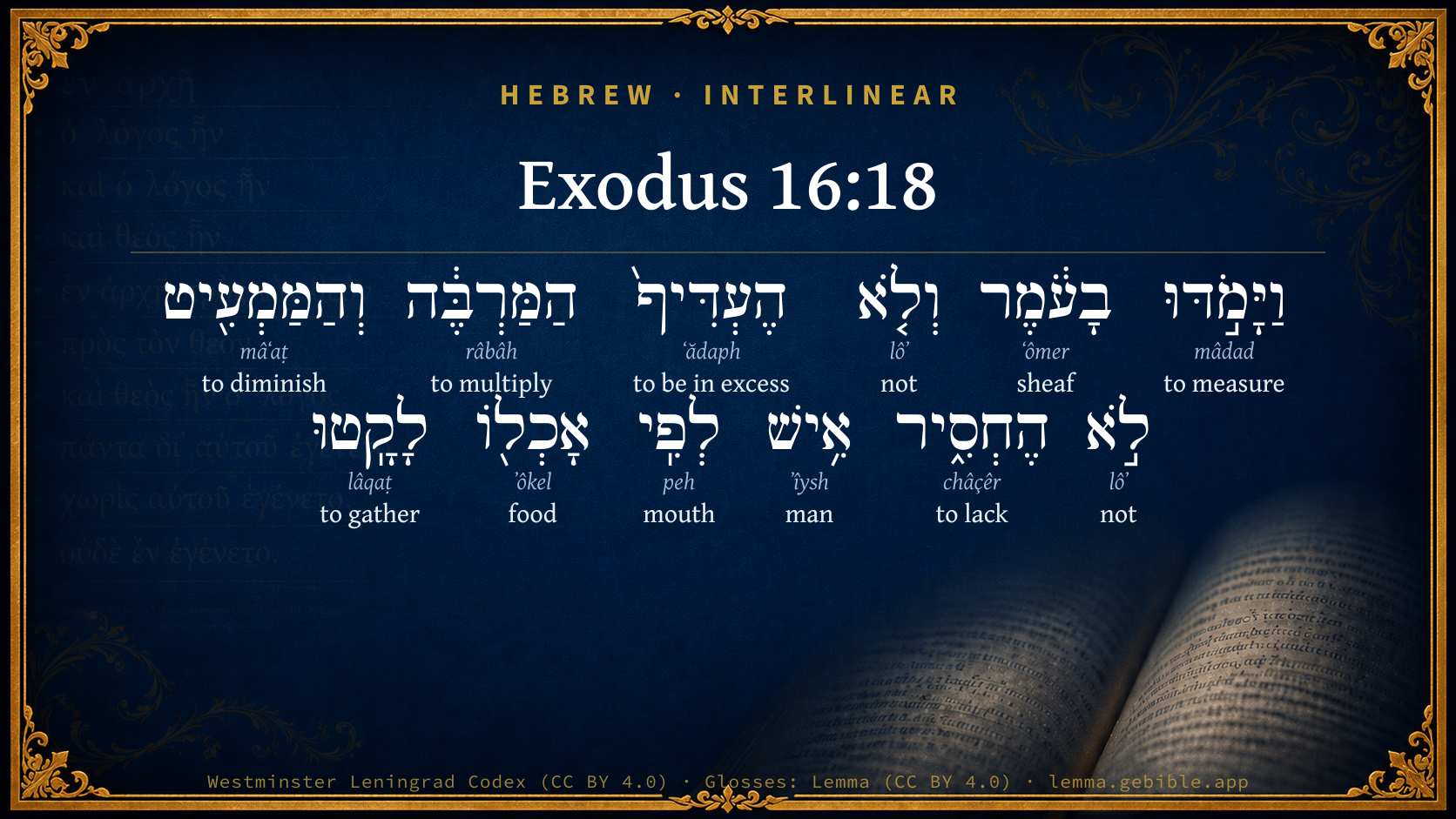
Hebrew (Westminster Leningrad Codex) Exodus 16:18 appears in the Hebrew Old Testament. The text above is from the Westminster Leningrad Codex. Each word links to its Strong’s number, a concise gloss, and parsing drawn from the Open Scriptures Hebrew Bible morphology. Click any word for its full Brown-Driver-Briggs (BDB) entry.
Download image
Cite this verse

Exodus 16:18 (World English Bible). Public Domain. Lemma interlinear Bible study tool, https://lemma.gebible.app/v/exodus/16/18.

Show BibTeX & RIS
BibTeX
RIS
English Translation
When they measured it with an omer, he who gathered much had nothing over, and he who gathered little had no lack. They gathered every man according to his eating.
World English Bible · Public Domain
Highlights
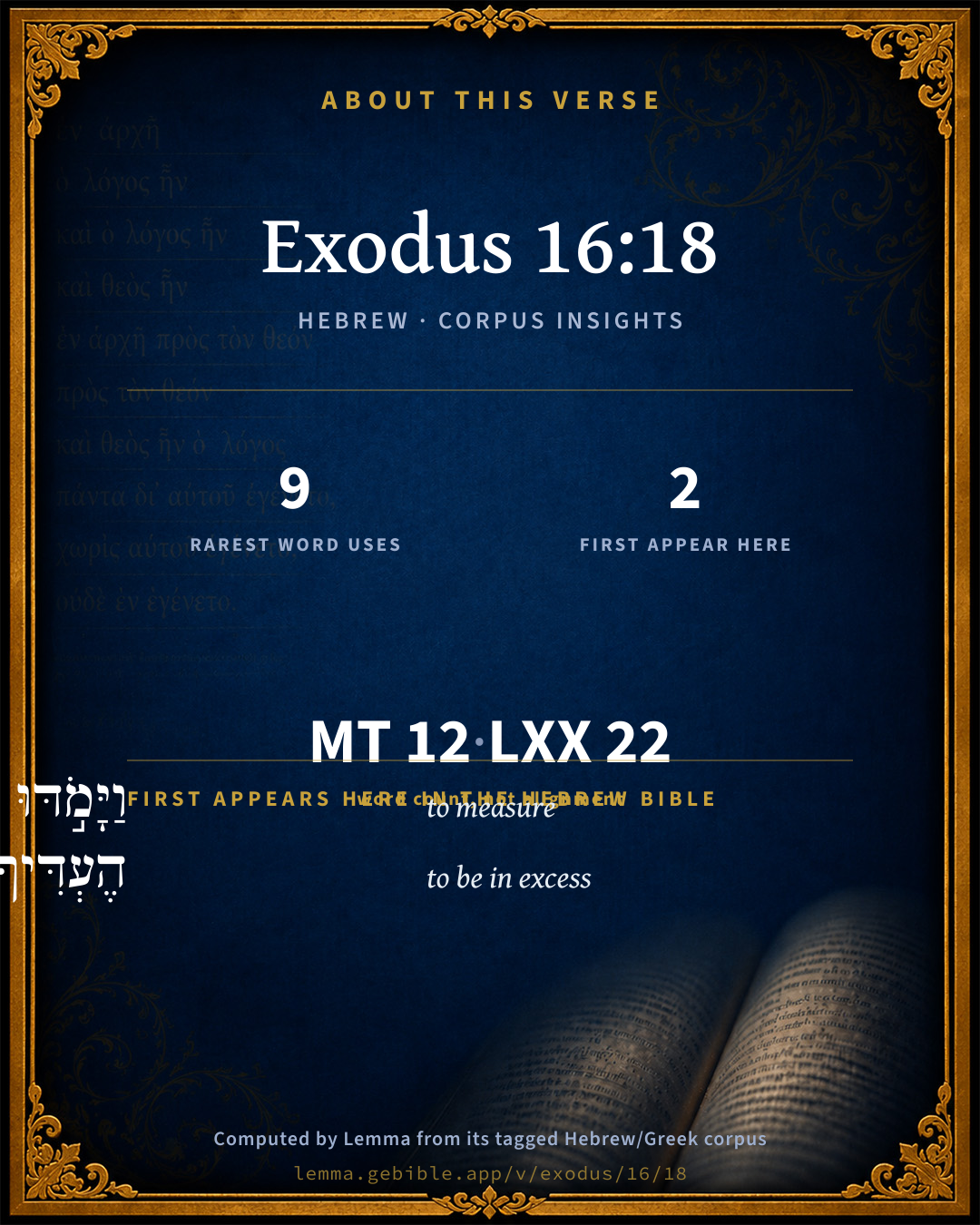
  • 2 first appearances in the Hebrew Bible
Full analysis ↓
Download a study sheet

One document with this verse’s original text, its word-by-word gloss line, the meaning frame, cross-references with their text, attributed commentary, and full source and license credits — printable, and it pastes into notes with its structure intact.

This verse Autodidact and up

Study sheet (.html) Plain text (.txt)

A passage Seminary Student

Up to 50 verses in one chapter. A passage sheet keeps up to 6 commentary sources and 12 cross-references per verse, in the order this page ranks them, and says so on the sheet whenever that leaves anything out. Ask for a single verse and you get the Autodidact verse sheet above.

Everything on this page stays free to read, with no account — the sheet is a download of what is already on screen, not access to it.

Want to remove ads? Support Godless Engineer
Compare translations 3

The same verse in 3 English versions, stacked beneath the original-language interlinear above. Click any original word for its lexicon entry.

Each is an independent rendering of the whole verse — the interlinear is not word-aligned to these translations.

Highlighted words mark where these versions differ — a whole-verse word diff, not a word-by-word alignment.

  • World English Bible Public Domain
    When they measured it with an omer, he who gathered much had nothing over, and he who gathered little had no lack. They gathered every man according to his eating.
  • King James Version Public Domain
    And when they did mete it with an omer, he that gathered much had nothing over, and he that gathered little had no lack; they gathered every man according to his eating.
  • unfoldingWord Literal Text CC BY-SA 4.0
    and they measured it by omer. And there was no extra for those with much, and no lack for those with little. Each man gathered according to what he needed to eat.

unfoldingWord Literal Text — © unfoldingWord, licensed CC BY-SA 4.0. Word-aligned USFM3 via Door43 (git.door43.org/unfoldingWord/en_ult).

Versions to compare (up to 4)

3 of 4 selected

Show all 18 translations

Every available English version of this verse, each an independent rendering of the whole verse.

  • World English Bible Public Domain
    When they measured it with an omer, he who gathered much had nothing over, and he who gathered little had no lack. They gathered every man according to his eating.
  • Berean Standard Bible Public Domain
    When they measured it by the omer, he who gathered much had no excess, and he who gathered little had no shortfall. Each one gathered as much as he needed to eat.
  • Majority Standard Bible Public Domain
    When they measured it by the omer, he who gathered much had no excess, and he who gathered little had no shortfall. Each one gathered as much as he needed to eat.
  • King James Version Public Domain
    And when they did mete it with an omer, he that gathered much had nothing over, and he that gathered little had no lack; they gathered every man according to his eating.
  • American Standard Version (1901) Public Domain
    And when they measured it with an omer, he that gathered much had nothing over, and he that gathered little had no lack; they gathered every man according to his eating.
  • Revised Version (1885) Public Domain
    And when they did mete it with an omer, he that gathered much had nothing over, and he that gathered little had no lack; they gathered every man according to his eating.
  • Geneva Bible (1599) Public Domain
    And when they did measure it with an Omer, hee that had gathered much, had nothing ouer, and he that had gathered litle, had no lacke: so euery man gathered according to his eating.
  • Douay-Rheims (1899) Public Domain
    And they measured by the measure of a gomor: neither had he more that had gathered more: nor did he find less that had provided less: but every one had gathered, according to what they were able to eat.
  • Young's Literal Translation Public Domain
    and they measure with an omer, and he who is `gathering' much hath nothing over, and he who is `gathering' little hath no lack, each according to his eating they have gathered.
  • Literal Standard Version CC BY-SA 4.0
    and they measure with an omer, and he who is [gathering] much has nothing over, and he who is [gathering] little has no lack, each according to his eating they have gathered.
  • Unlocked Literal Bible CC BY-SA 4.0
    When they measured it with an omer measure, those who had gathered much had nothing left over, and those who had gathered little had no lack. Each person gathered enough to meet their need.
  • unfoldingWord Literal Text CC BY-SA 4.0
    and they measured it by omer. And there was no extra for those with much, and no lack for those with little. Each man gathered according to what he needed to eat.
  • Darby Bible Public Domain
    And they measured with the omer: then he that gathered much had nothing over, and he that gathered little wanted nothing: they had gathered every man according to the measure of his eating.
  • World Messianic Bible Public Domain
    When they measured it with an omer, he who gathered much had nothing over, and he who gathered little had no lack. They each gathered according to his eating.
  • Webster's Bible Public Domain
    And when they measured it with an omer, he that gathered much had nothing over, and he that gathered little had no lack: they gathered every man according to his eating.
  • Free Bible Version CC BY-SA 4.0
    But when they measured it out in omers, those who had collected a lot didn't have any left over, while those who had only collected a little still had enough. Each person collected as much as they needed to eat.
  • Bible in Basic English Public Domain
    And when it was measured, he who had taken up much had nothing over, and he who had little had enough; every man had taken what he was able to make use of.
  • JPS Tanakh (1917) Public Domain
    And when they did mete it with an omer, he that gathered much had nothing over, and he that gathered little had no lack; they gathered every man according to his eating.

Literal Standard Version (2020), Covenant Press — licensed CC BY-SA 4.0. Text via the HelloAO Bible API (eBible.org). Unlocked Literal Bible (unfoldingWord) — licensed CC BY-SA 4.0. Text via the HelloAO Bible API (eBible.org). unfoldingWord Literal Text — © unfoldingWord, licensed CC BY-SA 4.0. Word-aligned USFM3 via Door43 (git.door43.org/unfoldingWord/en_ult). Free Bible Version, Dr. Jonathan Gallagher — licensed CC BY-SA 4.0. Text via the HelloAO Bible API (eBible.org).

Word by word

More ways to search: Search by grammar → Find every occurrence → Compare this word →

Practice this passage: Drill this verse → Learn its vocabulary →

הֶעְדִּיף֙
ʻădaph
H5736
“to be in excess”
Verb, Hiphil, Perfect, 3rd Person, Masculine, Singular
Part of Speech
Verb
Stem
Hiphil
Form
Perfect
Person
3rd Person
Gender
Masculine
Number
Singular
Full BDB Definition

Origin: a primitive root

TWOT: 1569

to remain over, be in excess - (Qal) - to be in excess - excess (substantive) - surplus (participle) - (Hiphil) to have a surplus
  1. וַיָּמֹ֣דּוּ mâdad H4058 “and · to measure” Conjunction + Verb, Qal, Sequential Imperfect, 3rd Person, Masculine, Plural
  2. בָעֹ֔מֶר ʻômer H6016 “in/at · sheaf” Preposition + Noun, Common, Masculine, Singular, Absolute
  3. וְלֹ֤א lôʼ H3808 “and · not” Conjunction + Particle, Negative
  4. הַמַּרְבֶּ֔ה râbâh H7235 “the · multiplying” Particle, Definite Article + Verb, Hiphil, Participle Active, Masculine, Singular, Absolute
  5. וְהַמַּמְעִ֖יט mâʻaṭ H4591 “and · the · diminishing” Conjunction + Particle, Definite Article + Verb, Hiphil, Participle Active, Masculine, Singular, Absolute
  6. לֹ֣א lôʼ H3808 “not” Particle, Negative
  7. הֶחְסִ֑יר châçêr H2637 “to lack” Verb, Hiphil, Perfect, 3rd Person, Masculine, Singular
  8. אִ֥ישׁ ʼîysh H376 “man” Noun, Common, Masculine, Singular, Absolute
  9. לְפִֽי peh H6310 “to/for · mouth of” Preposition + Noun, Common, Masculine, Singular, Construct
  10. אָכְל֖וֹ ʼôkel H400 “food · his” Noun, Common, Masculine, Singular, Construct + Suffix, Personal, 3rd Person, Masculine, Singular
  11. לָקָֽטוּ lâqaṭ H3950 “to gather” Verb, Qal, Perfect, 3rd Person, Common, Plural

About this verse

These counts appear in no published source. They are computed here, from the morphology-tagged text and Lemma’s own curated glosses. What Lemma adds →

12
words
11
distinct lemmas
Pentateuch
section

Notable vocabulary

The rarest word here is הֶעְדִּיף֙ to be in excess H5736 — appearing just 9 times in the whole Hebrew Bible.

First appearance in Scripture

These words make their first canonical appearance in the Hebrew Bible here:

  • וַיָּמֹ֣דּוּ to measure H4058
  • הֶעְדִּיף֙ to be in excess H5736

Shared distinctive vocabulary

הֶעְדִּיף֙ to be in excess H5736 occurs in 8 verses of the Hebrew Bible. Also found in:

Grammatical profile

  • 6 verbs
  • 4 nouns
  • 2 particles

Verb forms

  • וַיָּמֹ֣דּוּ Qal · Sequential Imperfect
  • הֶעְדִּיף֙ Hiphil · Perfect
  • הַמַּרְבֶּ֔ה Hiphil · Participle Active
  • וְהַמַּמְעִ֖יט Hiphil · Participle Active
  • הֶחְסִ֑יר Hiphil · Perfect
  • לָקָֽטוּ Qal · Perfect

Repetition

A word recurs within this verse — often emphatic in Hebrew:

  • וְלֹ֤א not H3808 ×2

Hebrew & Septuagint length

In English translation the verse runs 30 words from the Hebrew and 34 from the Septuagint (LXX English) — closely comparable.

A rough comparison of the two English renderings, which tokenize alike — not a word-level alignment.

Word counts can differ between the Hebrew and the Greek without any difference in meaning — e.g. the Hebrew direct-object marker אֵת has no separate Greek word, and Greek often adds the article ὁ.

In the original languages it is 12 Hebrew tokens and 22 Greek tokens — but the two are counted differently (Hebrew bundles its prefixes and suffixes into one token; the Greek is in lemma form), so that isn’t a like-for-like length.

Cross-references

1

Topical passages linked to Exodus 16:18 in the Treasury of Scripture Knowledge — connected by theme and wording, ordered by reader-vote popularity; previews shown in the World English Bible.

  • 2 Corinthians 8:14–15 but for equality. Your abundance at this present time supplies their lack, that their abundance also may become a supply for your lack; that there may be equality.

Cross-references courtesy of OpenBible.info (CC BY 4.0).

Hebrew and Greek witnesses Masoretic Hebrew ↔ Greek Septuagint

The same verse in the two great witnesses to the Old Testament, shown verse-for-verse.

These are two independent witnesses, not word-aligned to each other, and the Septuagint is shown in lemma (dictionary) form.

Hebrew Exodus 16:18 Masoretic · Westminster Leningrad Codex

וַיָּמֹ֣דּוּ בָעֹ֔מֶר וְלֹ֤א הֶעְדִּיף֙ הַמַּרְבֶּ֔ה וְהַמַּמְעִ֖יט לֹ֣א הֶחְסִ֑יר אִ֥ישׁ לְפִֽי אָכְל֖וֹ לָקָֽטוּ

When they measured it with an omer, he who gathered much had nothing over, and he who gathered little had no lack. They gathered every man according to his eating.

World English Bible · Public Domain

Greek LXX Exodus 16:18 Septuagint · lemma form

καί μετρέω ὁ γομορ οὐ πλεονάζω ὁ ὁ πολύς καί ὁ ὁ ἐλαχύς οὐ ἐλαττονέω ἕκαστος εἰς ὁ καταἥκω παρά ἑαυτοῦ συνλέγω

And having measured the homer full, he that gathered much had nothing over, and he that had gathered less had no lack; each gathered according to the need of those who belonged to him.

LXX2012 (modern English Septuagint) · Public Domain

Hebrew: Westminster Leningrad Codex (CC BY 4.0). Greek: Septuagint (public domain); English from LXX2012 (modern English Septuagint) (Public Domain). How the Septuagint differs from the Hebrew →

Targum (Aramaic paraphrase)

2

The Targum is the ancient Jewish Aramaic paraphrase of the Hebrew Scriptures — an interpretive translation, not the Hebrew text itself. Onkelos (literal) and Pseudo-Jonathan (expansive) render the Torah, and Jonathan the Prophets. Coverage is partial: where no permissively-licensed English translation exists for a verse, only the Aramaic is shown. This is verse-level text, not a word-by-word alignment to the Hebrew.

  1. Targum Onkelos Torah (Genesis–Deuteronomy)
    וּכְלוֹ בְעוּמְרָא וְלָא אוֹתַר דְאַסְגֵי וּדְאַזְעֵר לָא חַסִיר גְבַר לְפוּם מֵיכְלֵהּ לְקָטוּ:

    (no public-domain English translation for this verse)

    Targum Onkelos — Aramaic: “Onkelos Genesis” (public domain); “Onkelos Exodus” (public domain); “Onkelos Leviticus” (public domain); “Onkelos Numbers” (public domain); “Onkelos Deuteronomy” (public domain). English: “Sefaria Community Translation” (CC0 1.0 (public-domain dedication)); “J.W. Etheridge. The Targums of Onkelos and Jonathan Ben Uzziel on the Pentateuch. London: Longmans, Green, 1862” (public domain). Text via Sefaria.

  2. Targum Pseudo-Jonathan Torah (Genesis–Deuteronomy)
    וְאָכִילוּ בְּעוּמְרָא לָא אִישְׁתַּיֵּיר מִן מְכִילְתָּא מַאן דְּאַסְגֵי לְמִלְקַט וּדְאַזְעֵר לְמִילְקַט לָא חָסֵר מִן מְכִילְתָּא גְּבַר לְפוּם מֵיכְלֵיהּ לְקִיטוּ

    but when they measured by the homer, nothing remained above the measure of him who had gathered much; and he who had gathered little, wanted nothing of the measure: every man according to the mouth of his eating, so they gathered.

    Targum Pseudo-Jonathan — Aramaic: “Targum Jonathan on Genesis” (public domain); “Targum Jonathan on Exodus” (public domain); “Targum Jonathan on Leviticus” (public domain); “Targum Jonathan on Numbers” (public domain); “Targum Jonathan on Deuteronomy” (public domain). English: “The Targum of Jonathan ben Uzziel, trans. J. W. Etheridge, London, 1862” (public domain). Text via Sefaria.

Commentary

Notes on Exodus 16:18 from classic Christian and Jewish commentators (each source and its license shown beneath its notes). The classic Christian expositions comment on the surrounding passage and are grouped to its opening verse, so a note may address several verses; the Jewish commentaries on the Tanakh (Rashi and others) are per-verse, so they appear only where the commentator wrote on this verse.

Lemma curates 59 commentaries, every one of them public domain or Creative Commons licensed, each selected and text-cleaned for this edition rather than reprinted as found. About our sources →

Trapp's Complete Commentary

John Trapp

Exo 16:18 And when they did mete [it] with an omer, he that gathered much had nothing over, and he that gathered little had no lack; they gathered every man according to his eating.

Ver. 18. He that gathered much.] {See Trapp on "2Co 8:15"}

John Trapp, A Commentary or Exposition upon All the Books of the Old and New Testament (1647–1656) — public domain. Text from a community e-Sword module.

Joseph Benson's Commentary

Exo 16:18. He that gathered much had nothing over — Commentators interpret this in different ways. Some suppose that God wrought a miracle in this case, and so ordered it, that when they came to measure what they had gathered, the store of him that had gathered too much was miraculously diminished to the exact number of omers he ought to have gathered, and the store of him who had not gathered the due quantity, was miraculously increased. Houbigant, however, supposes that this was only applicable to the first time of gathering, “God admonishing them, by this event, that they should afterward do that which he himself had now perfected by his own immediate agency.” But others suppose, that had this been the case, as it was an equal miracle with any other recorded, it would have been mentioned that the Lord had done it. And they think, therefore, all that is meant is, that he who had not gathered a sufficient quantity to make an omer for every one in his family, had it made up to him out of what others had gathered, who had more than enough, and that they charitably assisted each other. This sense of the passage seems to be countenanced by St. Paul, 2Co 8:13-15. If understood in the first-mentioned sense, the apostle, in the application of it as an argument to encourage charity, must be considered as signifying that God, in an extraordinary manner, in the course of his providences, will bless and prosper those who in charity assist their brethren.

Joseph Benson's Commentary on the Old and New Testaments (1811–1818) — public domain. Text from a community e-Sword module.

Geneva Bible (1599)

Geneva Bible translators

God is a rich feeder of all, and none can justly complain.

Geneva Bible (1599) marginal notes — public domain. Text via Bolls.life.

Adam Clarke's Commentary

Verse 18. He that gathered much had nothing over] Because his gathering was in proportion to the number of persons for whom he had to provide. And some having fewer, others more in family, and the gathering being in proportion to the persons who were to eat of it, therefore he that gathered much had nothing over, and he that gathered little had no lack. Probably every man gathered as much as he could; and then when brought home and measured by an omer, if he had a surplus, it went to supply the wants of some other family that had not been able to collect a sufficiency, the family being large, and the time in which the manna might be gathered, before the heat of the day, not being sufficient to collect enough for so numerous a household, several of whom might be so confined as not to be able to collect for themselves. Thus there was an equality, and in this light the words of St. Paul, 2Co 8:15, lead us to view the passage. Here the 36th verse should come in: Now an omer is the tenth part of an ephah.

Adam Clarke's Commentary on the Bible (1810–1826) — public domain. Text from a community e-Sword/MySword module.

Ellicott's Commentary for English Readers

(18) When they did mete it with an omer.—Each Israelite gathered what he supposed would be about an omer for each member of his family. Some naturally made an over, some an under estimate; but whatever the quantity collected, when it came to be measured in the camp, the result was always the same—there was found to be just an omer for each. This result can only have been miraculous.

A Bible Commentary for English Readers, edited by Charles John Ellicott (1878–1897) — public domain. Text from a community e-Sword module.

The Cambridge Bible for Schools and Colleges

gen. ed. J. J. S. Perowne

18. They gathered, as well as they could judge roughly, according to the size of their families; when they afterwards measured what they had gathered, they found to their surprise that they had each gathered exactly an omer a head. The verse is quoted in 2Co_8:15.

mete] An archaism for ‘measure’: Mat_7:1 al.

had … over] The Heb. verb is unusual, and found only in P (v. 23, Exo_26:12-13, Lev_25:27, Num_3:46; Num_3:48-49†).

The Cambridge Bible for Schools and Colleges (gen. ed. J. J. S. Perowne; Cambridge University Press, 1878–1918) — public domain. Text from a community e-Sword module.

John Gill's Exposition

And Moses said unto them,.... At the same time he gave the direction to them about gathering it, and measuring out to every man an omer:

let no man leave of it until the morning; not that every man was bound to eat up the quantity distributed to him; he might give what he could not eat to those that could eat more, if there were any such; or he might give it to his cattle, or cast it away, but he was not to reserve it until the next day for his use; which was to teach him that God would bestow this benefit and blessing on him daily, and he might expect it, whose mercies are new every morning; and to instruct him to live every day upon the providence of God for his daily food; as indeed every man ought to do so, let his circumstances be ever so affluent; and, in a more spiritual and evangelic sense, it teaches believers to live continually every day by faith on Christ, and to say day by day, Lord, evermore give us this bread, Joh 6:34.

John Gill's Exposition of the Whole Bible (1746–1763) — public domain (CC PDM 1.0). Text via the HelloAO Bible API.

Albert Barnes' Notes on the Bible

Had nothing over - Whatever quantity each person had gathered, when he measured it in his tent, he found that he had just as many omers as he needed for the consumption of his family.

Albert Barnes' Notes on the Bible (1834–1885) — public domain. Text from a community e-Sword/MySword module.

Haydock's Catholic Bible Commentary

Eat. Each one’s provision was just enough to fill a gomor; (Menochius) or those who had collected more, gave to those who wanted, 2 Corinthians viii. 15. Any one might take less. (Calmet)

George Leo Haydock (1774–1849), Haydock's Catholic Family Bible and Commentary, 1859 edition — public domain. Excludes Psalms (Douay-Rheims chapter numbering differs from Protestant) and Deuterocanonical books (Catholic canon only).

Matthew Poole's English Annotations

All that was gathered by the members of one family was put into a heap, and then distributed to each person an omer, neither more nor less; to which St. Paul alludes, 2Co 8:13, &c.

Matthew Poole's English Annotations on the Holy Bible (1683–1685) — public domain. Text from a community e-Sword/MySword module.

The Pulpit Commentary

When they did mete it with an omer. On returning to their tents, with the manna which they had collected, the Israelites proceeded to measure it with their own, or a neighbour"s, omer measure, when the wonderful result appeared, that, whatever the quantity actually gathered by any one, the result of the measurement showed, exactly as many omers as there were persons in the family. Thus, he that had gathered much found that he had nothing over, and he that had gathered little found that he had no lack.

The Pulpit Commentary (1880–1919), ed. H.D.M. Spence-Jones & Joseph S. Exell — public domain. Text from a community e-Sword module.

Lesson kit

Teaching starters — assembled from the data on this page, not authored interpretation. Every prompt links to the verse data it draws on. Edit before teaching.

Exodus, in the Pentateuch, opens this verse with 12 words (11 distinct Hebrew lemmas). Its most distinctive word is ʻădaph (“to be in excess”). A historical commentator’s framing appears above. Read the whole chapter for the surrounding context.

Discussion questions

  1. The word ʻădaph carries the sense “to be in excess.” How does it shape the verse?
  2. 2 words here appear for the first time in Scripture. What is being introduced at this debut?
  3. Exodus 16:23 shares the word «to be in excess» with this verse. How do the two illuminate each other?
  4. “not” occurs 2× in this one verse. What is the effect of the repetition?
  5. The translations on this page render this verse differently — a whole-verse word diff, not a word-by-word alignment. What might account for the different wordings?
  6. The verb «וַיָּמֹ֣דּוּ» is Qal Sequential Imperfect. How does its form color the action?
  7. Reading how Trapp's Complete Commentary and Joseph Benson's Commentary read this verse, where do the two commentators agree and where do they part?

Things to notice

Reading settings

Reading text

Shown beneath each verse's original-language words.

Old Testament
Old Testament edition

Read the OT as the Masoretic Hebrew (MT) or the Greek Septuagint (LXX).

English shown for the Greek Septuagint (in the Hebrew ↔ Greek comparison).

Comparing translations? Open the Compare panel on any verse page to stack up to four side by side.