
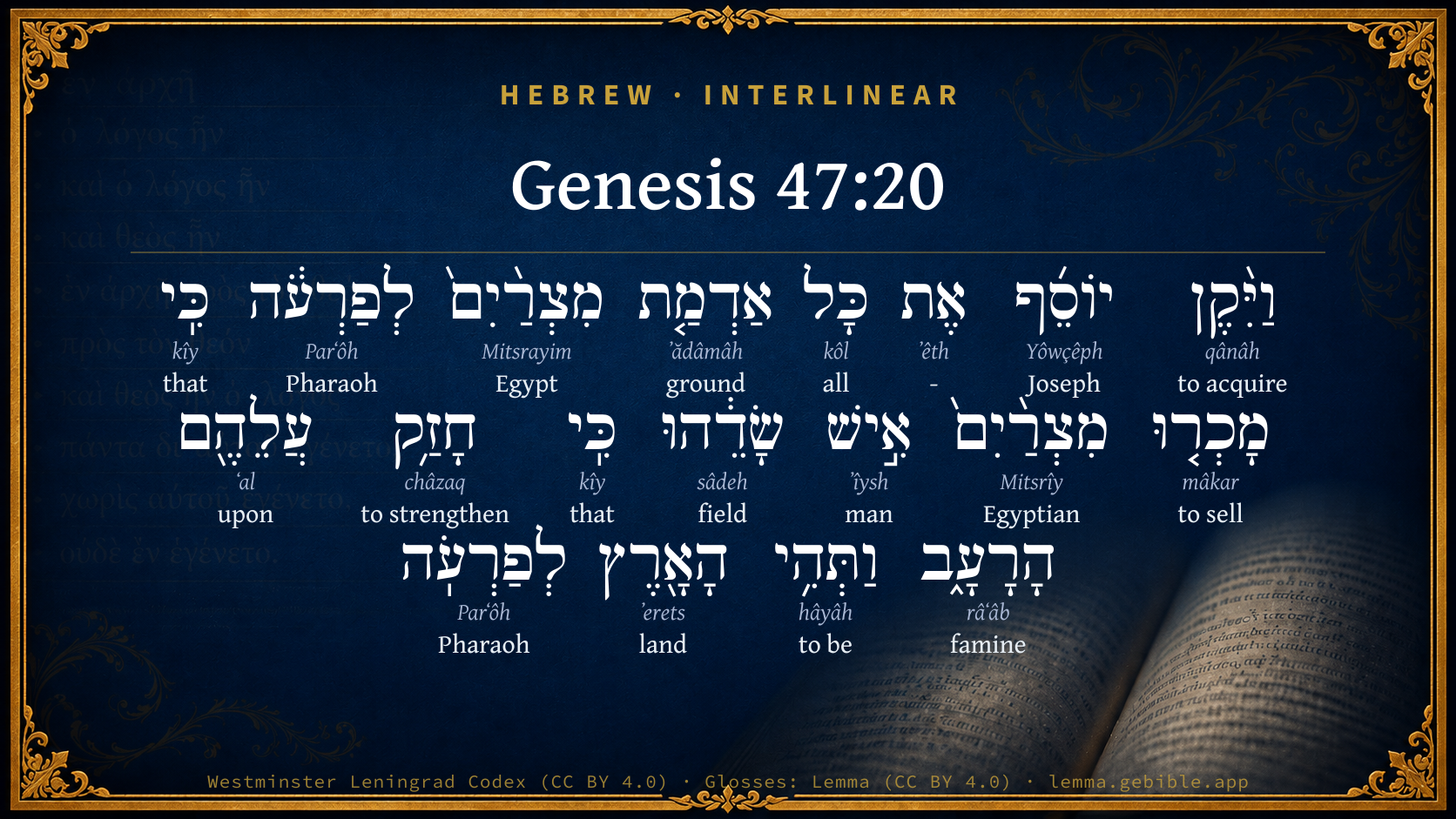
Genesis 47:20

Hebrew (Westminster Leningrad Codex) Genesis 47:20 appears in the Hebrew Old Testament. The text above is from the Westminster Leningrad Codex. Each word links to its Strong’s number, a concise gloss, and parsing drawn from the Open Scriptures Hebrew Bible morphology. Click any word for its full Brown-Driver-Briggs (BDB) entry.
Download image
Cite this verse

Genesis 47:20 (World English Bible). Public Domain. Lemma interlinear Bible study tool, https://lemma.gebible.app/v/genesis/47/20.

Show BibTeX & RIS
BibTeX
RIS
English Translation
So Joseph bought all the land of Egypt for Pharaoh, for the Egyptians sold every man his field, because the famine was severe on them, and the land became Pharaoh's.
World English Bible · Public Domain
Download a study sheet

One document with this verse’s original text, its word-by-word gloss line, the meaning frame, cross-references with their text, attributed commentary, and full source and license credits — printable, and it pastes into notes with its structure intact.

This verse Autodidact and up

Study sheet (.html) Plain text (.txt)

A passage Seminary Student

Up to 50 verses in one chapter. A passage sheet keeps up to 6 commentary sources and 12 cross-references per verse, in the order this page ranks them, and says so on the sheet whenever that leaves anything out. Ask for a single verse and you get the Autodidact verse sheet above.

Everything on this page stays free to read, with no account — the sheet is a download of what is already on screen, not access to it.

Want to remove ads? Support Godless Engineer
Compare translations 3

The same verse in 3 English versions, stacked beneath the original-language interlinear above. Click any original word for its lexicon entry.

Each is an independent rendering of the whole verse — the interlinear is not word-aligned to these translations.

Highlighted words mark where these versions differ — a whole-verse word diff, not a word-by-word alignment.

  • World English Bible Public Domain
    So Joseph bought all the land of Egypt for Pharaoh, for the Egyptians sold every man his field, because the famine was severe on them, and the land became Pharaoh's.
  • King James Version Public Domain
    And Joseph bought all the land of Egypt for Pharaoh; for the Egyptians sold every man his field, because the famine prevailed over them: so the land became Pharaoh's.
  • unfoldingWord Literal Text CC BY-SA 4.0
    Then Joseph bought all the land of Egypt for Pharaoh, because every Egyptian sold his field, because the famine was heavy for them. So the land became Pharaoh’s.

unfoldingWord Literal Text — © unfoldingWord, licensed CC BY-SA 4.0. Word-aligned USFM3 via Door43 (git.door43.org/unfoldingWord/en_ult).

Versions to compare (up to 4)

3 of 4 selected

Show all 18 translations

Every available English version of this verse, each an independent rendering of the whole verse.

  • World English Bible Public Domain
    So Joseph bought all the land of Egypt for Pharaoh, for the Egyptians sold every man his field, because the famine was severe on them, and the land became Pharaoh's.
  • Berean Standard Bible Public Domain
    So Joseph acquired for Pharaoh all the land in Egypt; the Egyptians, one and all, sold their fields because the famine was so severe upon them. The land became Pharaoh’s,
  • Majority Standard Bible Public Domain
    So Joseph acquired for Pharaoh all the land in Egypt; the Egyptians, one and all, sold their fields because the famine was so severe upon them. The land became Pharaoh’s,
  • King James Version Public Domain
    And Joseph bought all the land of Egypt for Pharaoh; for the Egyptians sold every man his field, because the famine prevailed over them: so the land became Pharaoh's.
  • American Standard Version (1901) Public Domain
    So Joseph bought all the land of Egypt for Pharaoh; for the Egyptians sold every man his field, because the famine was sore upon them: and the land became Pharaoh's.
  • Revised Version (1885) Public Domain
    So Joseph bought all the land of Egypt for Pharaoh; for the Egyptians sold every man his field, because the famine was sore upon them: and the land became Pharaoh’s.
  • Geneva Bible (1599) Public Domain
    So Ioseph bought all the lande of Egypt for Pharaoh: for the Egyptians solde euery man his ground because the famine was sore vpon the: so the land became Pharaohs.
  • Douay-Rheims (1899) Public Domain
    So Joseph bought all the land of Egypt, every man selling his possessions, because of the greatness of the famine. And he brought it into Pharao's hands:
  • Young's Literal Translation Public Domain
    And Joseph buyeth all the ground of Egypt for Pharaoh, for the Egyptians have sold each his field, for the famine hath been severe upon them, and the land becometh Pharaoh's;
  • Literal Standard Version CC BY-SA 4.0
    And Joseph buys all the ground of Egypt for Pharaoh, for the Egyptians have each sold his field, for the famine has been severe on them, and the land becomes Pharaoh’s;
  • Unlocked Literal Bible CC BY-SA 4.0
    So Joseph bought all the land of Egypt for Pharaoh. For every Egyptian sold his field, because the famine was very severe. In this way, the land became Pharaoh's.
  • unfoldingWord Literal Text CC BY-SA 4.0
    Then Joseph bought all the land of Egypt for Pharaoh, because every Egyptian sold his field, because the famine was heavy for them. So the land became Pharaoh’s.
  • Darby Bible Public Domain
    And Joseph bought all the soil of Egypt for Pharaoh; for the Egyptians sold every man his field, because the famine prevailed over them; and the land became Pharaoh's.
  • World Messianic Bible Public Domain
    So Joseph bought all the land of Egypt for Pharaoh, for every man of the Egyptians sold his field, because the famine was severe on them, and the land became Pharaoh’s.
  • Webster's Bible Public Domain
    And Joseph bought all the land of Egypt for Pharaoh; for the Egyptians sold every man his field, because the famine prevailed over them: so the land became Pharaoh's.
  • Free Bible Version CC BY-SA 4.0
    So Joseph bought all the land in Egypt for Pharaoh. Each and every Egyptian sold their fields, because the famine was hurting them so badly. The land ended up being owned by Pharaoh,
  • Bible in Basic English Public Domain
    So Joseph got all the land in Egypt for Pharaoh; for every Egyptian gave up his land in exchange for food, because of their great need; so all the land became Pharaoh's.
  • JPS Tanakh (1917) Public Domain
    So Joseph bought all the land of Egypt for Pharaoh; for the Egyptians sold every man his field, because the famine was sore upon them; and the land became Pharaoh's.

Literal Standard Version (2020), Covenant Press — licensed CC BY-SA 4.0. Text via the HelloAO Bible API (eBible.org). Unlocked Literal Bible (unfoldingWord) — licensed CC BY-SA 4.0. Text via the HelloAO Bible API (eBible.org). unfoldingWord Literal Text — © unfoldingWord, licensed CC BY-SA 4.0. Word-aligned USFM3 via Door43 (git.door43.org/unfoldingWord/en_ult). Free Bible Version, Dr. Jonathan Gallagher — licensed CC BY-SA 4.0. Text via the HelloAO Bible API (eBible.org).

Word by word

More ways to search: Search by grammar → Find every occurrence → Compare this word →

Practice this passage: Drill this verse → Learn its vocabulary →

מִצְרַ֨יִם֙
Mitsrîy
H4713
“Egyptian”
Noun, Proper
Part of Speech
Noun
Type
Proper
Full BDB Definition

Origin: from H4714

TWOT: None

Egyptian = see Egypte " double straits" - Egyptian - an inhabitant or citizen of Egypt - an Egyptian - the Egyptian
  1. וַיִּ֨קֶן qânâh H7069 “and · to acquire” Conjunction + Verb, Qal, Sequential Imperfect, 3rd Person, Masculine, Singular
  2. יוֹסֵ֜ף Yôwçêph H3130 “Joseph” Noun, Proper
  3. אֶת ʼêth H853 “-” Particle, Direct Object
  4. כָּל kôl H3605 “all of” Noun, Common, Masculine, Singular, Construct
  5. אַדְמַ֤ת ʼădâmâh H127 “ground of” Noun, Common, Feminine, Singular, Construct
  6. מִצְרַ֨יִם֙ Mitsrayim H4714 “Egypt” Noun, Proper
  7. לְפַרְעֹ֔ה Parʻôh H6547 “to/for · Pharaoh” Preposition + Noun, Proper
  8. כִּֽי kîy H3588 “that” Conjunction
  9. מָכְר֤וּ mâkar H4376 “to sell” Verb, Qal, Perfect, 3rd Person, Common, Plural
  10. אִ֣ישׁ ʼîysh H376 “man” Noun, Common, Masculine, Singular, Absolute
  11. שָׂדֵ֔הוּ sâdeh H7704 “field · his” Noun, Common, Masculine, Singular, Construct + Suffix, Personal, 3rd Person, Masculine, Singular
  12. כִּֽי kîy H3588 “that” Conjunction
  13. חָזַ֥ק châzaq H2388 “to strengthen” Verb, Qal, Perfect, 3rd Person, Masculine, Singular
  14. עֲלֵהֶ֖ם ʻal H5921 “upon · them” Preposition + Suffix, Personal, 3rd Person, Masculine, Plural
  15. הָרָעָ֑ב râʻâb H7458 “the · famine” Particle, Definite Article + Noun, Common, Masculine, Singular, Absolute
  16. וַתְּהִ֥י hâyâh H1961 “and · to be” Conjunction + Verb, Qal, Sequential Imperfect, 3rd Person, Feminine, Singular
  17. הָאָ֖רֶץ ʼerets H776 “the · land” Particle, Definite Article + Noun, Common, Both, Singular, Absolute
  18. לְפַרְעֹֽה Parʻôh H6547 “to/for · Pharaoh” Preposition + Noun, Proper

About this verse

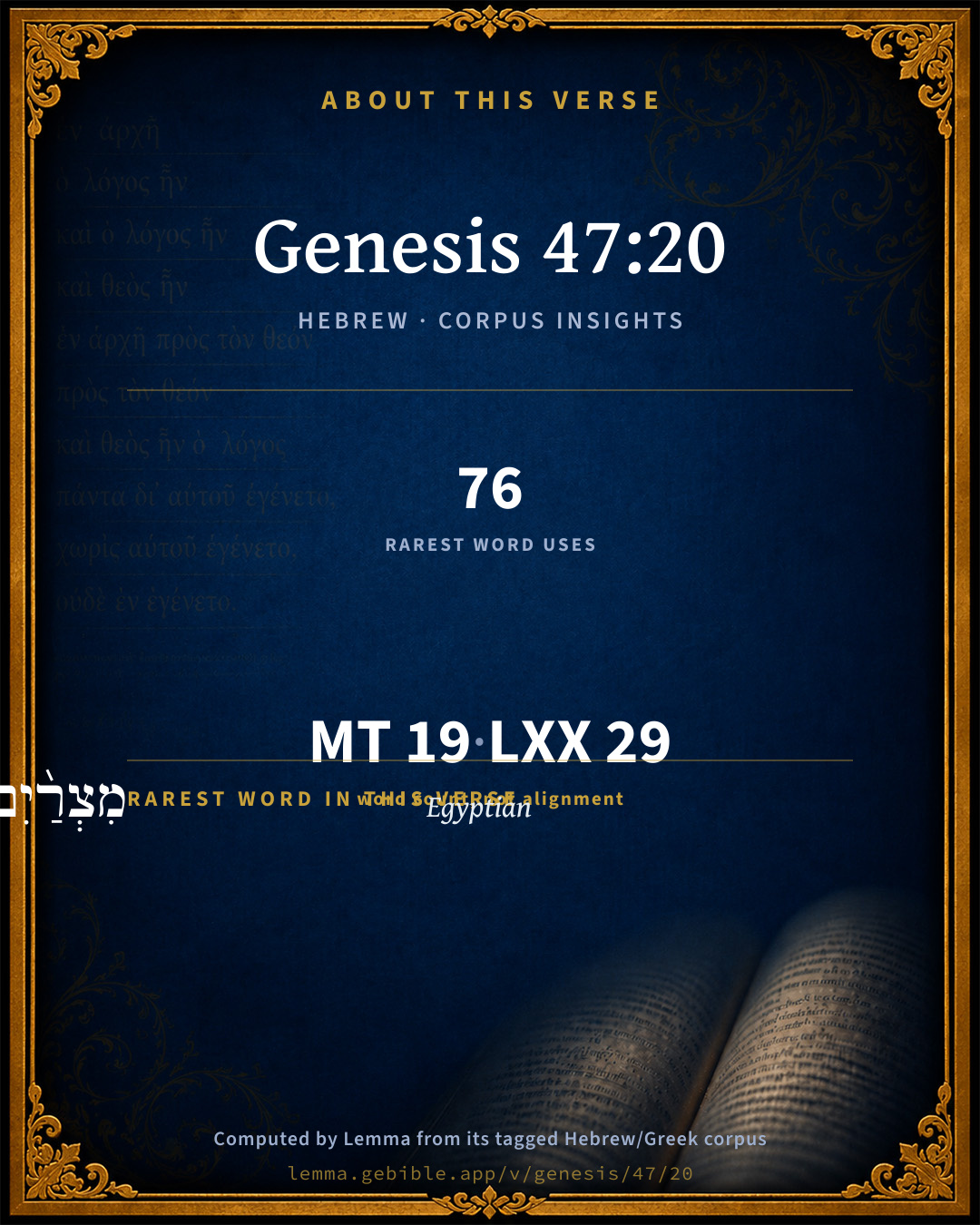
These counts appear in no published source. They are computed here, from the morphology-tagged text and Lemma’s own curated glosses. What Lemma adds →

19
words
17
distinct lemmas
Pentateuch
section

Grammatical profile

  • 4 verbs
  • 11 nouns
  • 1 preposition
  • 2 conjunctions
  • 1 particle

Verb forms

  • וַיִּ֨קֶן Qal · Sequential Imperfect
  • מָכְר֤וּ Qal · Perfect
  • חָזַ֥ק Qal · Perfect
  • וַתְּהִ֥י Qal · Sequential Imperfect

Repetition

Words recur within this verse — often emphatic in Hebrew:

  • לְפַרְעֹ֔ה Pharaoh H6547 ×2
  • כִּֽי that H3588 ×2

Hebrew & Septuagint length

In English translation the verse runs 30 words from the Hebrew and 30 from the Septuagint (LXX English) — the same length.

A rough comparison of the two English renderings, which tokenize alike — not a word-level alignment.

Word counts can differ between the Hebrew and the Greek without any difference in meaning — e.g. the Hebrew direct-object marker אֵת has no separate Greek word, and Greek often adds the article ὁ.

In the original languages it is 19 Hebrew tokens and 29 Greek tokens — but the two are counted differently (Hebrew bundles its prefixes and suffixes into one token; the Greek is in lemma form), so that isn’t a like-for-like length.

Hebrew and Greek witnesses Masoretic Hebrew ↔ Greek Septuagint

The same verse in the two great witnesses to the Old Testament, shown verse-for-verse.

These are two independent witnesses, not word-aligned to each other, and the Septuagint is shown in lemma (dictionary) form.

Hebrew Genesis 47:20 Masoretic · Westminster Leningrad Codex

וַיִּ֨קֶן יוֹסֵ֜ף אֶת כָּל אַדְמַ֤ת מִצְרַ֨יִם֙ לְפַרְעֹ֔ה כִּֽי מָכְר֤וּ מִצְרַ֨יִם֙ אִ֣ישׁ שָׂדֵ֔הוּ כִּֽי חָזַ֥ק עֲלֵהֶ֖ם הָרָעָ֑ב וַתְּהִ֥י הָאָ֖רֶץ לְפַרְעֹֽה

So Joseph bought all the land of Egypt for Pharaoh, for the Egyptians sold every man his field, because the famine was severe on them, and the land became Pharaoh's.

World English Bible · Public Domain

Greek LXX Genesis 47:20 Septuagint · lemma form

καί κτάομαι ιωσηφ πᾶς ὁ γῆ ὁ αἰγύπτιος ὁ φαραώ ἀποδίδωμι γάρ ὁ αἰγύπτιος ὁ γῆ αὐτός ὁ φαραώ ἐπικρατέω γάρ αὐτός ὁ λιμός καί γίγνομαι ὁ γῆ φαραώ

And Joseph bought all the land of the Egyptians, for Pharao; for the Egyptians sold their land to Pharao; for the famine prevailed against them, and the land became Pharao's.

LXX2012 (modern English Septuagint) · Public Domain

Hebrew: Westminster Leningrad Codex (CC BY 4.0). Greek: Septuagint (public domain); English from LXX2012 (modern English Septuagint) (Public Domain). How the Septuagint differs from the Hebrew →

Targum (Aramaic paraphrase)

2

The Targum is the ancient Jewish Aramaic paraphrase of the Hebrew Scriptures — an interpretive translation, not the Hebrew text itself. Onkelos (literal) and Pseudo-Jonathan (expansive) render the Torah, and Jonathan the Prophets. Coverage is partial: where no permissively-licensed English translation exists for a verse, only the Aramaic is shown. This is verse-level text, not a word-by-word alignment to the Hebrew.

  1. Targum Onkelos Torah (Genesis–Deuteronomy)
    וּקְנָא יוֹסֵף יָת כָּל אַרְעָא דְמִצְרַיִם לְפַרְעֹה אֲרֵי זַבִּינוּ מִצְרַיִם גְּבַר חַקְלֵהּ אֲרֵי תְקֵיף עֲלֵיהוֹן כַּפְנָא וַהֲוַת אַרְעָא לְפַרְעֹה

    (no public-domain English translation for this verse)

    Targum Onkelos — Aramaic: “Onkelos Genesis” (public domain); “Onkelos Exodus” (public domain); “Onkelos Leviticus” (public domain); “Onkelos Numbers” (public domain); “Onkelos Deuteronomy” (public domain). English: “Sefaria Community Translation” (CC0 1.0 (public-domain dedication)); “J.W. Etheridge. The Targums of Onkelos and Jonathan Ben Uzziel on the Pentateuch. London: Longmans, Green, 1862” (public domain). Text via Sefaria.

  2. Targum Pseudo-Jonathan Torah (Genesis–Deuteronomy)
    וּקְנָא יוֹסֵף יַת כָּל אַרְעָא דְמִצְרָאֵי לְפַרְעה אֲרוּם זַבִּינוּ מִצְרָאֵי גְבַר חַקְלֵיהּ אֲרוּם תַּקִיף עֲלֵיהוֹן כַּפְנָא וַהֲוַת אַרְעָא חֲלִיטָא לְפַרְעה

    And Joseph bought all the land of Mizraim for Pharoh; for the Mizraee sold every man his portion, because the famine prevailed over them, and the land became the property of Pharoh.

    Targum Pseudo-Jonathan — Aramaic: “Targum Jonathan on Genesis” (public domain); “Targum Jonathan on Exodus” (public domain); “Targum Jonathan on Leviticus” (public domain); “Targum Jonathan on Numbers” (public domain); “Targum Jonathan on Deuteronomy” (public domain). English: “The Targum of Jonathan ben Uzziel, trans. J. W. Etheridge, London, 1862” (public domain). Text via Sefaria.

Commentary

Notes on Genesis 47:20 from classic Christian and Jewish commentators (each source and its license shown beneath its notes). The classic Christian expositions comment on the surrounding passage and are grouped to its opening verse, so a note may address several verses; the Jewish commentaries on the Tanakh (Rashi and others) are per-verse, so they appear only where the commentator wrote on this verse.

Lemma curates 59 commentaries, every one of them public domain or Creative Commons licensed, each selected and text-cleaned for this edition rather than reprinted as found. About our sources →

Trapp's Complete Commentary

John Trapp

Gen 47:20 And Joseph bought all the land of Egypt for Pharaoh; for the Egyptians sold every man his field, because the famine prevailed over them: so the land became Pharaoh’s.

Ver. 20. So the land became Pharaoh’s.] Regi acquisivit imperium despoticum. This the Egyptians would never have yielded unto, but that stark hunger drove the wolf out of the wood, as the proverb is. Philo Judaeus reports of a heathenish people who in their wars used only this expression, to put spirit into their soldiers; estote viri, libertas agitur. The contention was hot in this land between prince and people for fourscore years together, about liberty and property; and ceased not till the great charter, made to keep the beam right between sovereignty and subjection, was in the maturity of a judicial prince, Edward I, freely ratified. {a}

{a} Dan., Hist. of Engl.

John Trapp, A Commentary or Exposition upon All the Books of the Old and New Testament (1647–1656) — public domain. Text from a community e-Sword module.

John Calvin's Commentaries

20. And Joseph bought all the land. Any one might suppose it to be the height of cruel and inexplicable avarice, that Joseph should take away from the miserable husband men, the very fields, by the produce of which they nourished the kingdom. But I have before showed, that unless every kind of purchase is to be condemned, there is no reason why Joseph should be blamed. If any one should say that he abused their penury; this alone would suffice for his excuse, that no wiles of his, no circumvention, no force, no threats, had reduced the Egyptians to this necessity. He transacted the king’s business with equal fidelity and industry; and fulfilled the duties of his office, without resorting to violent edicts. When the famine became urgent, it was lawful to expose wheat to sale, as well to the rich as to the poor: afterwards it was not less lawful to buy the cattle; and now, at last, why should it not be lawful to acquire the land for the king, at a just price? To this may be added, that he extorted nothing, but entered into treaty with them, at their own request. I confess, indeed, that it is not right to take whatever may be offered without discrimination: for if severe necessity presses, then he who wishes, by all means, to escape it, will submit to hard conditions. Therefore, when any one thus invites us, to defraud him, we are not, by his necessities, rendered excusable. But I do not defend Joseph, on this sole ground, that the Egyptians voluntarily offered him their lands, as men who were ready to purchase life, at any price; but I say, this ought also to be considered, that he acted with equity, even though he left them nothing. The terms would have been more severe, if they themselves had been consigned to perpetual slavery; but he now concedes to them personal liberty, and only covenants for their fields, which, perhaps, the greater part of the people had bought from the poor. If he had stripped of their clothing those whom he was feeding with corn, this would have been to put them indirectly and slowly to death. For what difference does it make, whether I compel a man to die by hunger or by cold? But Joseph so succors the Egyptians, that in future they should be free, and should be able to obtain a moderate subsistence by their labor. For though they might have to change their abode, yet they are all made stewards of the king: and Joseph restores to them, not only the lands, but the implements which he had bought. Whence it appears that he had used what clemency he was able, in order to relieve them. Meanwhile, let those who are too intent on wealth beware lest they should falsely employ Joseph’s example as a pretext: because it is certain that all contracts, which are not formed according to the rule of charity, are vicious in the sight of God; and that we ought, according to that equity which is inwardly dictated to us by a secret instinct of nature, so to act towards others, as we wish to be dealt with ourselves.

John Calvin's Commentaries (1540-1563) — public domain. Text from the Calvin Translation Society English edition (1840s-50s) via the Christian Classics Ethereal Library (ccel.org). Calvin's coverage is partial (roughly two-thirds of the Bible); uncommented books and verses are honest gaps, never fabricated. The 19th-century editor's footnotes and remarks are omitted so the notes are faithfully Calvin's own voice.

Ellicott's Commentary for English Readers

(20) So the land became Pharaoh’s.—Joseph has been accused of reducing a free people to slavery by his policy. Undoubtedly he did vastly increase the royal power; but from what we read of the vassalage under which the Egyptians lived to a multitude of petty sovereigns, and also to their wives, their priests, and their embalmers, an increase in the power of the king, so as to make it predominant, would be to their advantage. The statement made here that the land in Egypt belonged entirely to the king is confirmed by Herodotus and other Greek authorities. The same is the case in India at this day; only, instead of the rent being a fifth part of the produce, it is in India a fixed annual sum, which is settled at comparatively distant intervals. In Burmah the agriculturists hold their land directly from the Crown.

A Bible Commentary for English Readers, edited by Charles John Ellicott (1878–1897) — public domain. Text from a community e-Sword module.

The Cambridge Bible for Schools and Colleges

gen. ed. J. J. S. Perowne

20. Joseph bought all the land] This transaction, by which, at a single stroke of business, Joseph, the Hebrew, was said to have purchased for Pharaoh the whole land of Egypt, and all the people to be Pharaoh’s slaves, as the price of seed corn (cf. 23), probably sounded in the ears of an ancient Oriental people a masterpiece of cleverness. In our days it would rank as an outrageous piece of tyranny, that the king’s Grand Vizier, taking advantage of his own monopoly in corn and of the people’s destitution, should deprive them of the last shreds of their independence.

The Cambridge Bible for Schools and Colleges (gen. ed. J. J. S. Perowne; Cambridge University Press, 1878–1918) — public domain. Text from a community e-Sword module.

John Gill's Exposition

And as for the people, he removed them,.... From the places where they dwelt, that it might appear they had no more property there, and might forget it, and be more willing to pay rent elsewhere; and their posterity hereafter could have no notion of its being theirs, or plead prescription; and besides, by such a removal and separation of the inhabitants of cities, some to one place, and some to another, sedition and mutiny might be prevented: he had them

to cities, from one end of the borders of Egypt, even unto the other end thereof; according to the Targums of Jonathan and Jerusalem, those that dwelt in provinces, or in country towns and villages, he removed to cities, and those that dwelt in cities he removed into provinces, and placed them at the utmost distance from their former habitations, for the reasons before given; and the above Targums suggest another reason, to teach the Egyptians not to reproach the Israelites with being exiles and strangers, when they were all of them removed from their native places, and were strangers, where they were.

John Gill's Exposition of the Whole Bible (1746–1763) — public domain (CC PDM 1.0). Text via the HelloAO Bible API.

Whedon's Commentary on the Bible

Daniel D. Whedon

20. The land became Pharaoh’s — He thus became absolute owner of the soil, and this enabled Joseph freely and without opposition to take the measures and enact the law described in Gen_47:23-26.

Daniel D. Whedon (gen. ed.), Commentary on the Old and New Testaments (1874–1909) — public domain. Text from a community e-Sword module.

The Pulpit Commentary

And Joseph bought all the land of Egypt for Pharaoh; for the Egyptians sold every man his field, because the famine prevailed over them: so (literally, and) the land became Pharaoh"s. From this it may be concluded that originally Pharaoh had no legal claim to the soil, but that the people had a valid title to its absolute possession, each man being regarded as the legitimate proprietor of the portion on which he had expended the labor of cultivation.

The Pulpit Commentary (1880–1919), ed. H.D.M. Spence-Jones & Joseph S. Exell — public domain. Text from a community e-Sword module.

unfoldingWord translationNotes

Door43 World Missions Community

In this way, the land became Pharaoh's

"So the land became Pharaoh's"

It was only the land of the priests that Joseph did not buy

"But he did not buy the land of the priests"

the priests were given an allowance

An "allowance" is an amount of money or food that someone regularly gives to another person. This can be stated in active form. AT: "Pharaoh gave the priests a certain amount of food each day" (See: Active or Passive)

They ate from the allotment which Pharaoh gave them

"They ate from what Pharaoh gave them"

translationWords

Egypt

Pharaoh

famine

servant

priest

unfoldingWord translationNotes — © Distant Shores Media and the Door43 World Missions Community, licensed CC BY-SA 4.0. Source: git.door43.org/Door43/en_tn.

Rashi

Rabbi Shlomo Yitzchaki (Rashi)

ותהי הארץ לפרעה SO THE LAND BECAME PHARAOH’S — possessed by him.

Rashi on the Tanakh — English translations: “The Judaica Press complete Tanach with Rashi, translated by A. J. Rosenberg” (CC BY 4.0); “Pentateuch with Rashi's commentary by M. Rosenbaum and A.M. Silbermann, 1929-1934” (public domain); “The Metsudah Tanach series, Lakewood, N.J” (CC BY 4.0); and “The Book of Joshua, Metsudah Publications, 1997” (CC BY 4.0). Text via Sefaria.

Lesson kit

Teaching starters — assembled from the data on this page, not authored interpretation. Every prompt links to the verse data it draws on. Edit before teaching.

Genesis, in the Pentateuch, opens this verse with 19 words (17 distinct Hebrew lemmas). Its most distinctive word is Mitsrîy (“Egyptian”). A historical commentator’s framing appears above. Read the whole chapter for the surrounding context.

Discussion questions

  1. What does “Egyptian” (Mitsrîy) contribute to the verse as a whole?
  2. What does the repetition of “Pharaoh” (2× in this one verse) do in this verse?
  3. These translations render this verse differently; the difference is in the English rendering, not the original. What questions does that raise?
  4. «וַיִּ֨קֶן» is a Qal Sequential Imperfect verb. How does that grammatical form shape the action described?
  5. Compare how Trapp's Complete Commentary and John Calvin's Commentaries read this verse. Where do they agree or differ?

Things to notice

Reading settings

Reading text

Shown beneath each verse's original-language words.

Old Testament
Old Testament edition

Read the OT as the Masoretic Hebrew (MT) or the Greek Septuagint (LXX).

English shown for the Greek Septuagint (in the Hebrew ↔ Greek comparison).

Comparing translations? Open the Compare panel on any verse page to stack up to four side by side.