Genesis 43:5

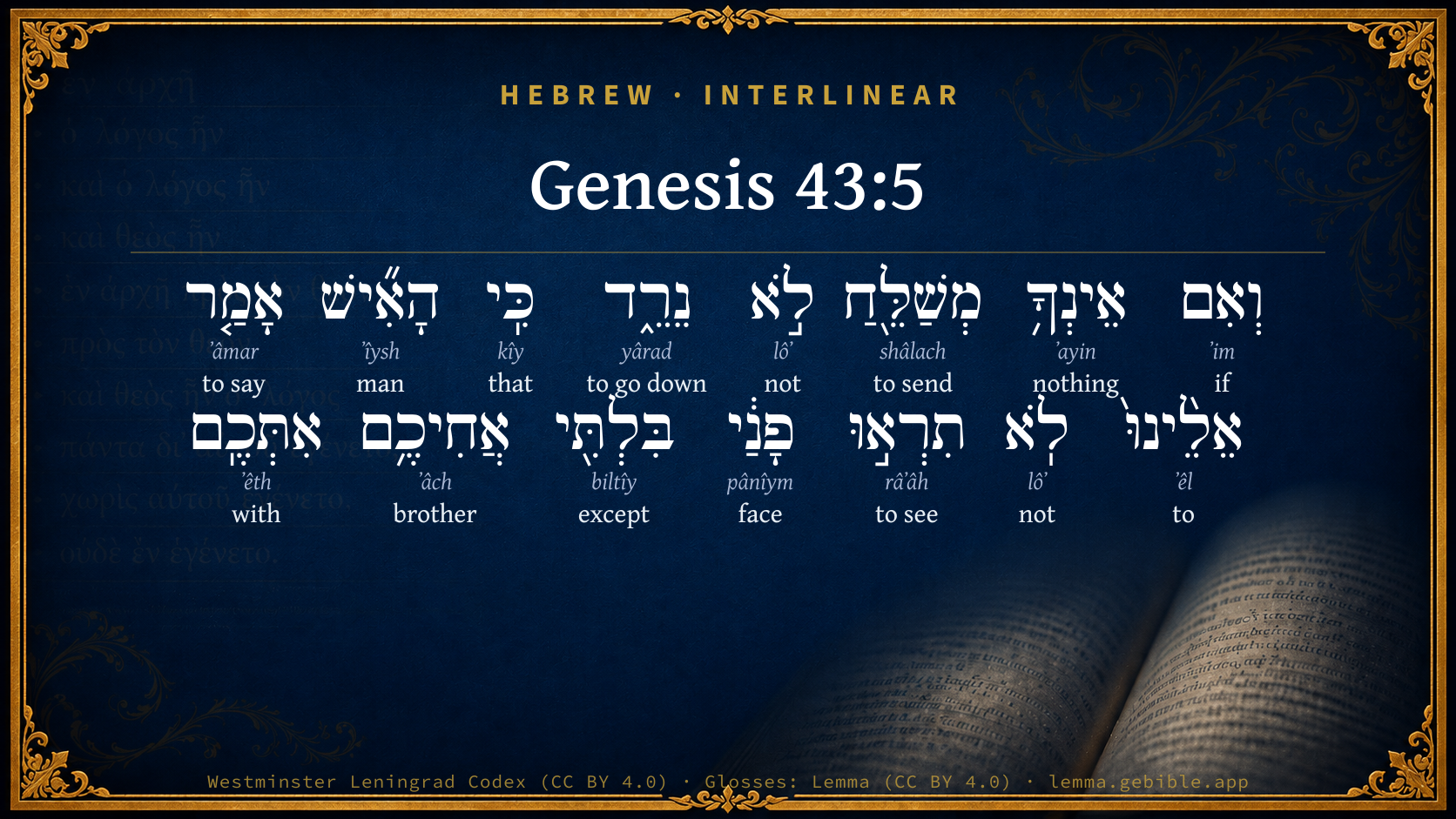
Hebrew (Westminster Leningrad Codex) Genesis 43:5 appears in the Hebrew Old Testament. The text above is from the Westminster Leningrad Codex. Each word links to its Strong’s number, a concise gloss, and parsing drawn from the Open Scriptures Hebrew Bible morphology. Click any word for its full Brown-Driver-Briggs (BDB) entry.
Download image
Cite this verse

Genesis 43:5 (World English Bible). Public Domain. Lemma interlinear Bible study tool, https://lemma.gebible.app/v/genesis/43/5.

Show BibTeX & RIS
BibTeX
RIS
English Translation
but if you will not send him, we will not go down, for the man said to us, 'You shall not see my face, unless your brother is with you.'"
World English Bible · Public Domain
Download a study sheet

One document with this verse’s original text, its word-by-word gloss line, the meaning frame, cross-references with their text, attributed commentary, and full source and license credits — printable, and it pastes into notes with its structure intact.

This verse Autodidact and up

Study sheet (.html) Plain text (.txt)

A passage Seminary Student

Up to 50 verses in one chapter. A passage sheet keeps up to 6 commentary sources and 12 cross-references per verse, in the order this page ranks them, and says so on the sheet whenever that leaves anything out. Ask for a single verse and you get the Autodidact verse sheet above.

Everything on this page stays free to read, with no account — the sheet is a download of what is already on screen, not access to it.

Want to remove ads? Support Godless Engineer
Compare translations 3

The same verse in 3 English versions, stacked beneath the original-language interlinear above. Click any original word for its lexicon entry.

Each is an independent rendering of the whole verse — the interlinear is not word-aligned to these translations.

Highlighted words mark where these versions differ — a whole-verse word diff, not a word-by-word alignment.

  • World English Bible Public Domain
    but if you will not send him, we will not go down, for the man said to us, 'You shall not see my face, unless your brother is with you.'"
  • King James Version Public Domain
    But if thou wilt not send him, we will not go down: for the man said unto us, Ye shall not see my face, except your brother be with you.
  • unfoldingWord Literal Text CC BY-SA 4.0
    But if you will not send, we will not go down, because the man said to us, ‘You will not see my face unless your brother with you!’”

unfoldingWord Literal Text — © unfoldingWord, licensed CC BY-SA 4.0. Word-aligned USFM3 via Door43 (git.door43.org/unfoldingWord/en_ult).

Versions to compare (up to 4)

3 of 4 selected

Show all 18 translations

Every available English version of this verse, each an independent rendering of the whole verse.

  • World English Bible Public Domain
    but if you will not send him, we will not go down, for the man said to us, 'You shall not see my face, unless your brother is with you.'"
  • Berean Standard Bible Public Domain
    But if you will not send him, we will not go; for the man told us, ‘You will not see my face again unless your brother is with you.’”
  • Majority Standard Bible Public Domain
    But if you will not send him, we will not go; for the man told us, ‘You will not see my face again unless your brother is with you.’”
  • King James Version Public Domain
    But if thou wilt not send him, we will not go down: for the man said unto us, Ye shall not see my face, except your brother be with you.
  • American Standard Version (1901) Public Domain
    but if thou wilt not send him, we will not go down; for the man said unto us, Ye shall not see my face, except your brother be with you.
  • Revised Version (1885) Public Domain
    but if thou wilt not send him, we will not go down: for the man said unto us, Ye shall not see my face, except your brother be with you.
  • Geneva Bible (1599) Public Domain
    But if thou wilt not send him, we wil not go downe: for the man said vnto vs, Looke me not in the face, except your brother be with you.
  • Douay-Rheims (1899) Public Domain
    But if thou wilt not, we will not go: for the man, as we have often said, declared unto us, saying: You shall not see my face without your youngest brother.
  • Young's Literal Translation Public Domain
    and if thou art not sending -- we do not go down, for the man said unto us, Ye do not see my face without your brother `being' with you.'
  • Literal Standard Version CC BY-SA 4.0
    and if you are not sending—we do not go down, for the man said to us, You do not see my face without your brother [being] with you.”
  • Unlocked Literal Bible CC BY-SA 4.0
    But if you do not send him, we will not go down. For the man said to us, 'You will not see my face unless your brother is with you.'”
  • unfoldingWord Literal Text CC BY-SA 4.0
    But if you will not send, we will not go down, because the man said to us, ‘You will not see my face unless your brother with you!’”
  • Darby Bible Public Domain
    but if thou do not send [him], we will not go down, for the man said to us, Ye shall not see my face, unless your brother be with you.
  • World Messianic Bible Public Domain
    but if you don’t send him, we won’t go down, for the man said to us, ‘You shall not see my face, unless your brother is with you.’”
  • Webster's Bible Public Domain
    \\43:6\\And Israel said, Why dealt ye so ill with me, as to tell the man whether ye had yet a brother?
  • Free Bible Version CC BY-SA 4.0
    But if you won't send him, then we won't go, because the man was very clear, ‘I won't even see you unless your brother is with you.’”
  • Bible in Basic English Public Domain
    And Israel said, Why were you so cruel to me as to say to him that you had a brother?
  • JPS Tanakh (1917) Public Domain
    but if thou wilt not send him, we will not go down, for the man said unto us: Ye shall not see my face, except your brother be with you.'

Literal Standard Version (2020), Covenant Press — licensed CC BY-SA 4.0. Text via the HelloAO Bible API (eBible.org). Unlocked Literal Bible (unfoldingWord) — licensed CC BY-SA 4.0. Text via the HelloAO Bible API (eBible.org). unfoldingWord Literal Text — © unfoldingWord, licensed CC BY-SA 4.0. Word-aligned USFM3 via Door43 (git.door43.org/unfoldingWord/en_ult). Free Bible Version, Dr. Jonathan Gallagher — licensed CC BY-SA 4.0. Text via the HelloAO Bible API (eBible.org).

Word by word

More ways to search: Search by grammar → Find every occurrence → Compare this word →

Practice this passage: Drill this verse → Learn its vocabulary →

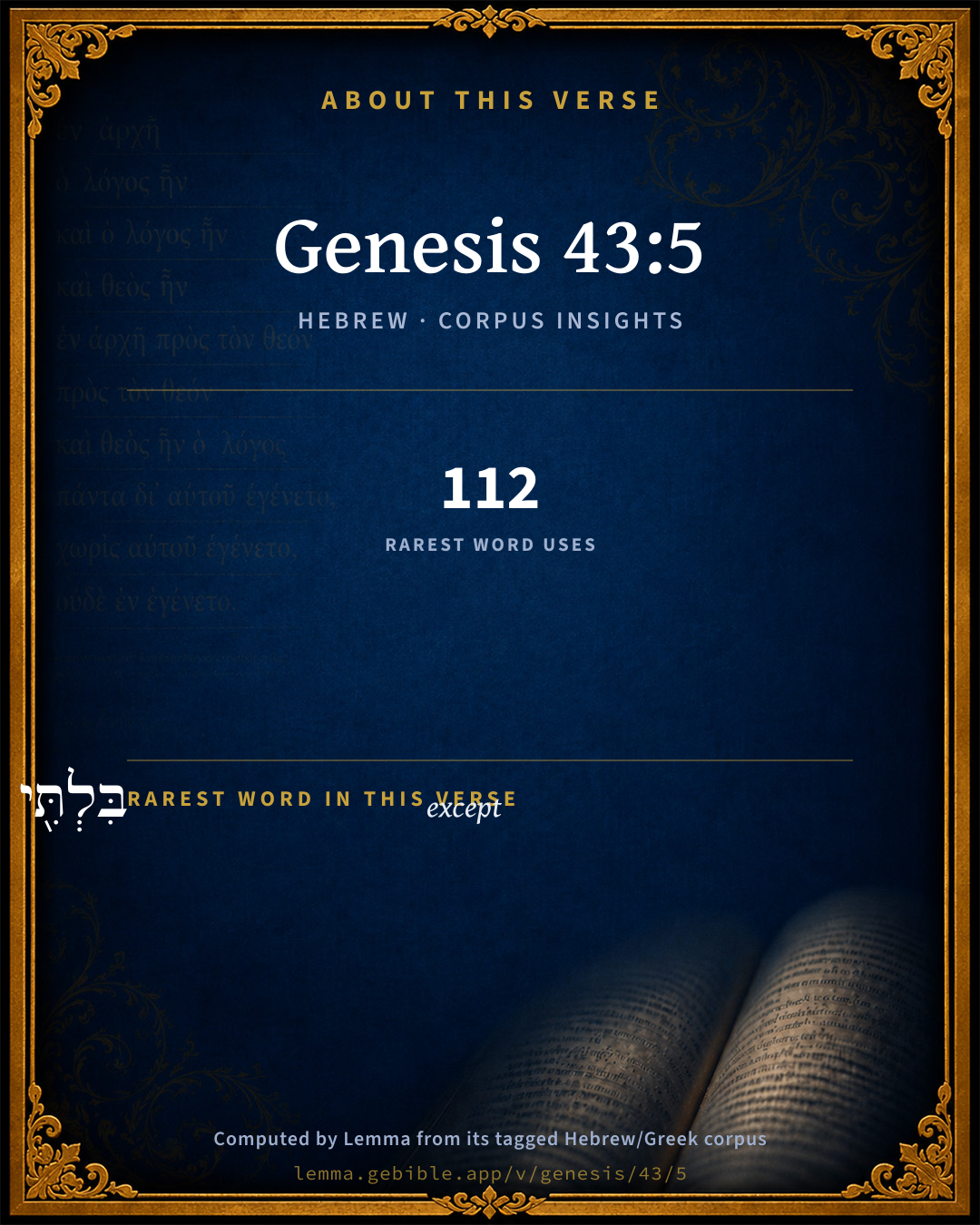
בִּלְתִּ֖י
biltîy
H1115
“except”
Conjunction
Part of Speech
Conjunction
Full BDB Definition

Origin: constructive fem. of H1086 (equivalent to H1097 )

TWOT: 246i

not, except (substantive) - not (adverb) - except (after preceding negation) (adverb) - except (after an implied or expressed negation) (conjunction) - so as not, in order not (with preposition) - an account of not, because...not (with preposition) - until not (with preposition)
  1. וְאִם ʼim H518 “and · if” Conjunction + Conjunction
  2. אֵינְךָ֥ ʼayin H369 “nothing · you” Particle, Negative + Suffix, Personal, 2nd Person, Masculine, Singular
  3. מְשַׁלֵּ֖חַ shâlach H7971 “sending” Verb, Piel, Participle Active, Masculine, Singular, Absolute
  4. לֹ֣א lôʼ H3808 “not” Particle, Negative
  5. נֵרֵ֑ד yârad H3381 “to go down” Verb, Qal, Imperfect, 1st Person, Common, Plural
  6. כִּֽי kîy H3588 “that” Conjunction
  7. הָאִ֞ישׁ ʼîysh H376 “the · man” Particle, Definite Article + Noun, Common, Masculine, Singular, Absolute
  8. אָמַ֤ר ʼâmar H559 “to say” Verb, Qal, Perfect, 3rd Person, Masculine, Singular
  9. אֵלֵ֨ינוּ֙ ʼêl H413 “to · us” Preposition + Suffix, Personal, 1st Person, Common, Plural
  10. לֹֽא lôʼ H3808 “not” Particle, Negative
  11. תִרְא֣וּ râʼâh H7200 “to see” Verb, Qal, Imperfect, 2nd Person, Masculine, Plural
  12. פָנַ֔י pânîym H6440 “face(s) · my” Noun, Common, Both, Plural, Construct + Suffix, Personal, 1st Person, Common, Singular
  13. אֲחִיכֶ֥ם ʼâch H251 “brother · your” Noun, Common, Masculine, Singular, Construct + Suffix, Personal, 2nd Person, Masculine, Plural
  14. אִתְּכֶֽם ʼêth H854 “with · you” Preposition + Suffix, Personal, 2nd Person, Masculine, Plural

About this verse

These counts appear in no published source. They are computed here, from the morphology-tagged text and Lemma’s own curated glosses. What Lemma adds →

15
words
14
distinct lemmas
Pentateuch
section

Grammatical profile

  • 4 verbs
  • 3 nouns
  • 2 prepositions
  • 3 conjunctions
  • 3 particles

Verb forms

  • מְשַׁלֵּ֖חַ Piel · Participle Active
  • נֵרֵ֑ד Qal · Imperfect
  • אָמַ֤ר Qal · Perfect
  • תִרְא֣וּ Qal · Imperfect

Repetition

A word recurs within this verse — often emphatic in Hebrew:

Hebrew & Septuagint length

In English translation the verse runs 30 words from the Hebrew and 33 from the Septuagint (LXX English) — closely comparable.

A rough comparison of the two English renderings, which tokenize alike — not a word-level alignment.

Word counts can differ between the Hebrew and the Greek without any difference in meaning — e.g. the Hebrew direct-object marker אֵת has no separate Greek word, and Greek often adds the article ὁ.

Cross-references

3

Topical passages linked to Genesis 43:5 in the Treasury of Scripture Knowledge — connected by theme and wording, ordered by reader-vote popularity; previews shown in the World English Bible.

  • Genesis 42:38 He said, "My son shall not go down with you; for his brother is dead, and he only is left. If harm happens to him by the way in which you go, then you will bring down my gray hairs with sorrow to Sheol."
  • Genesis 44:26 We said, 'We can't go down. If our youngest brother is with us, then will we go down: for we may not see the man's face, unless our youngest brother is with us.'
  • Exodus 20:12 "Honor your father and your mother, that your days may be long in the land which Yahweh your God gives you.

Cross-references courtesy of OpenBible.info (CC BY 4.0).

Hebrew and Greek witnesses Masoretic Hebrew ↔ Greek Septuagint

The same verse in the two great witnesses to the Old Testament, shown verse-for-verse.

These are two independent witnesses, not word-aligned to each other, and the Septuagint is shown in lemma (dictionary) form.

Hebrew Genesis 43:5 Masoretic · Westminster Leningrad Codex

וְאִם אֵינְךָ֥ מְשַׁלֵּ֖חַ לֹ֣א נֵרֵ֑ד כִּֽי הָאִ֞ישׁ אָמַ֤ר אֵלֵ֨ינוּ֙ לֹֽא תִרְא֣וּ פָנַ֔י בִּלְתִּ֖י אֲחִיכֶ֥ם אִתְּכֶֽם

but if you will not send him, we will not go down, for the man said to us, 'You shall not see my face, unless your brother is with you.'"

World English Bible · Public Domain

Greek LXX Genesis 43:5 Septuagint · lemma form

εἰ δέ μή ἀποστέλλω ὁ ἀδελφός ἐγώ μετά ἐγώ οὐ πορεύομαι ὁ γάρ ἄνθρωπος εἶπον ἐγώ λέγω οὐ ὁράω ἐγώ ὁ πρόσωπον ἐάν μή ὁ ἀδελφός σύ ὁ νέος μετά σύ εἰμί

but if you send not our brother with us, we will not go: for the man spoke to us, saying, You⌃ shall not see my face, unless your younger brother be with you.

LXX2012 (modern English Septuagint) · Public Domain

Hebrew: Westminster Leningrad Codex (CC BY 4.0). Greek: Septuagint (public domain); English from LXX2012 (modern English Septuagint) (Public Domain). How the Septuagint differs from the Hebrew →

Targum (Aramaic paraphrase)

2

The Targum is the ancient Jewish Aramaic paraphrase of the Hebrew Scriptures — an interpretive translation, not the Hebrew text itself. Onkelos (literal) and Pseudo-Jonathan (expansive) render the Torah, and Jonathan the Prophets. Coverage is partial: where no permissively-licensed English translation exists for a verse, only the Aramaic is shown. This is verse-level text, not a word-by-word alignment to the Hebrew.

  1. Targum Onkelos Torah (Genesis–Deuteronomy)
    וְאִם לֵיתָךְ מְשַׁלַּח לָא נֵיחוֹת אֲרֵי גַּבְרָא אֲמַר לָנָא לָא תֶחֱזוּן אַפַּי אֶלָּהֵין כַּד אֲחוּכוֹן עִמְּכוֹן

    (no public-domain English translation for this verse)

    Targum Onkelos — Aramaic: “Onkelos Genesis” (public domain); “Onkelos Exodus” (public domain); “Onkelos Leviticus” (public domain); “Onkelos Numbers” (public domain); “Onkelos Deuteronomy” (public domain). English: “Sefaria Community Translation” (CC0 1.0 (public-domain dedication)); “J.W. Etheridge. The Targums of Onkelos and Jonathan Ben Uzziel on the Pentateuch. London: Longmans, Green, 1862” (public domain). Text via Sefaria.

  2. Targum Pseudo-Jonathan Torah (Genesis–Deuteronomy)
    וְאִין לַיְיתָךְ מְשַׁדֵר לָא נֵיחוֹת אֲרוּם גַבְרָא אָמַר לָנָא לָא תֵיחְמוֹן סְבַר אַפַּיי בִּדְלֵית אֲחוּכוֹן עִמְכוֹן

    but if thou wilt not send (him), we will not go down; for the man told us, You shall not see the sight of my face unless your brother be with you.

    Targum Pseudo-Jonathan — Aramaic: “Targum Jonathan on Genesis” (public domain); “Targum Jonathan on Exodus” (public domain); “Targum Jonathan on Leviticus” (public domain); “Targum Jonathan on Numbers” (public domain); “Targum Jonathan on Deuteronomy” (public domain). English: “The Targum of Jonathan ben Uzziel, trans. J. W. Etheridge, London, 1862” (public domain). Text via Sefaria.

Commentary

Notes on Genesis 43:5 from classic Christian and Jewish commentators (each source and its license shown beneath its notes). The classic Christian expositions comment on the surrounding passage and are grouped to its opening verse, so a note may address several verses; the Jewish commentaries on the Tanakh (Rashi and others) are per-verse, so they appear only where the commentator wrote on this verse.

Lemma curates 59 commentaries, every one of them public domain or Creative Commons licensed, each selected and text-cleaned for this edition rather than reprinted as found. About our sources →

The Cambridge Bible for Schools and Colleges

gen. ed. J. J. S. Perowne

5. we will not go down] They know that corn must be got. They are forcing Jacob to give way. The J narrative is not cognisant of the Simeon incident.

The Cambridge Bible for Schools and Colleges (gen. ed. J. J. S. Perowne; Cambridge University Press, 1878–1918) — public domain. Text from a community e-Sword module.

John Gill's Exposition

And Israel said,.... In answer to the speech of Judah:

wherefore dealt ye so ill with me; had done that which brought so much evil upon him, gave him so much grief and trouble, and threw him into such perplexity and distress, that he knew not what to do, or course to take:

as to tell the man whether ye had yet a brother? which he thought was done imprudently and unadvisedly, and that there was no need of it; which, had it not been done, would have prevented this anxiety of mind he was now in, and the mischief he feared would follow.1

John Gill's Exposition of the Whole Bible (1746–1763) — public domain (CC PDM 1.0). Text via the HelloAO Bible API.

Haydock's Catholic Bible Commentary

My face, in peace. Joseph had told them they should be considered as spies, if they did not produce their youngest brother. (Menochius)

George Leo Haydock (1774–1849), Haydock's Catholic Family Bible and Commentary, 1859 edition — public domain. Excludes Psalms (Douay-Rheims chapter numbering differs from Protestant) and Deuterocanonical books (Catholic canon only).

Matthew Poole's English Annotations

We will not go down, because we shall both lose the end of our journey, viz. the getting of corn, and run the utmost hazard of all our lives.

Matthew Poole's English Annotations on the Holy Bible (1683–1685) — public domain. Text from a community e-Sword/MySword module.

Lesson kit

Teaching starters — assembled from the data on this page, not authored interpretation. Every prompt links to the verse data it draws on. Edit before teaching.

Genesis, in the Pentateuch, opens this verse with 15 words (14 distinct Hebrew lemmas). Its most distinctive word is biltîy (“except”). A historical commentator’s framing appears above. Read the whole chapter for the surrounding context.

Discussion questions

  1. What does “except” (biltîy) contribute to the verse as a whole?
  2. Genesis 42:38 shares this passage’s theme. How do the two illuminate each other?
  3. “not” occurs 2× in this one verse. What is the effect of the repetition?
  4. These translations render this verse differently. What is at stake in choosing one wording over another?
  5. The verb «מְשַׁלֵּ֖חַ» is Piel Participle Active. How does its form color the action?
  6. Reading how The Cambridge Bible for Schools and Colleges and John Gill's Exposition read this verse, where do the two commentators agree and where do they part?

Things to notice

Reading settings

Reading text

Shown beneath each verse's original-language words.

Old Testament
Old Testament edition

Read the OT as the Masoretic Hebrew (MT) or the Greek Septuagint (LXX).

English shown for the Greek Septuagint (in the Hebrew ↔ Greek comparison).

Comparing translations? Open the Compare panel on any verse page to stack up to four side by side.