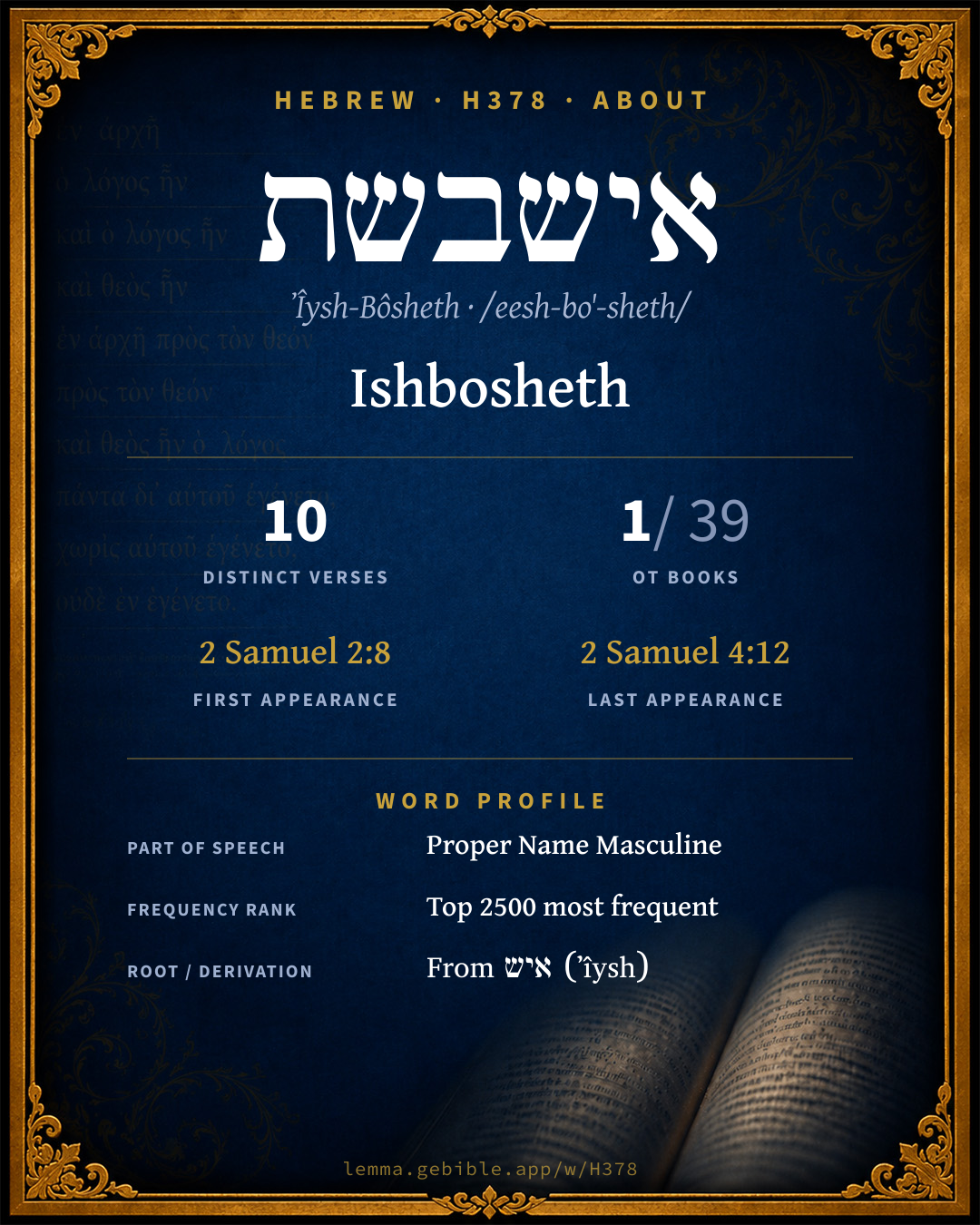
אִישׁ־בֹ֫שֶׁת
Ishbosheth
BDB lists 2 entries for ‘Ishbosheth’ fuller range ↓
Full lexicon entry — Brown-Driver-Briggs (BDB)
From Brown-Driver-Briggs (BDB)
Where this word appears
Grammar key — what these labels mean
Part of speech
- Noun
- A naming word — a person, place, thing, or idea.
Noun type
- Proper
- A name of a specific person, place, or people (e.g. Abraham, Zion, Israel).
- Common
- A common noun — a general class of person, place, or thing (“king,” “city,” “water”), not a specific name.
State
- Construct
- A noun bound to a following noun in a possessive / “of” relationship (the construct chain).
Gender
- Masculine
- Grammatically masculine.
Number
- Singular
- One.
Grammatical forms
- Noun, Proper 21 times (95%)
- Noun, Common, Masculine, Singular, Construct 1 time (5%)
Parsed forms decoded from the imported morphology (morphhb / Westminster Leningrad Codex — WLC text public domain, morphhb tagging CC BY 4.0), counted across 22 parsed occurrences — not distinct verses.
Every verse where H378 appears — 10 distinct verses across 1 book. Click any verse to open its interlinear word-by-word view. Verse text shown in the World English Bible for context — . Each verse’s Hebrew form is shown with its reference; the English is not keyword-highlighted, since the data carries no word-level English alignment. Use “Compare translations” on any verse to read it across multiple English versions. This concordance covers the Hebrew Bible; Septuagint (Greek Old Testament) occurrences are not indexed here.
2 Samuel 10 verses
- 2 Samuel 2:8 אִ֥ישׁ בֹּ֨שֶׁת֙ n Proper n Proper Now Abner the son of Ner, captain of Saul's host, had taken Ish-bosheth the son of Saul, and brought him over to Mahanaim;
- 2 Samuel 2:10 אִֽישׁ בֹּ֣שֶׁת n Proper n Proper Ish-bosheth, Saul's son, was forty years old when he began to reign over Israel, and he reigned two years. But the house of Judah followed David.
- 2 Samuel 2:12 אִֽישׁ בֹּ֣שֶׁת n Proper n Proper Abner the son of Ner, and the servants of Ish-bosheth the son of Saul, went out from Mahanaim to Gibeon.
- 2 Samuel 2:15 וּ/לְ/אִ֥ישׁ בֹּ֨שֶׁת֙ conj + prep + n Proper n Proper Then they arose and went over by number: twelve for Benjamin, and for Ish-bosheth the son of Saul, and twelve of the servants of David.
- 2 Samuel 3:8 אִֽישׁ בֹּ֗שֶׁת n Proper n Proper Then was Abner very angry for the words of Ish-bosheth, and said, Am I a dog's head that belongs to Judah? This day do I show kindness to the house of Saul your father, to his brothers, and to his friends, and have not delivered you into the hand of David; and yet you charge me this day with a fault concerning this woman.
- 2 Samuel 3:14 אִֽישׁ בֹּ֥שֶׁת n Proper n Proper David sent messengers to Ish-bosheth, Saul's son, saying, Deliver me my wife Michal, whom I pledged to be married to me for one hundred foreskins of the Philistines.
- 2 Samuel 3:15 אִ֣ישׁ בֹּ֔שֶׁת n Proper n Proper Ish-bosheth sent, and took her from her husband, even from Paltiel the son of Laish.
- 2 Samuel 4:5 אִ֣ישׁ בֹּ֑שֶׁת n Proper n Proper The sons of Rimmon the Beerothite, Rechab and Baanah, went, and came about the heat of the day to the house of Ish-bosheth, as he took his rest at noon.
- 2 Samuel 4:8 אִֽישׁ בֹּ֥שֶׁת אִֽישׁ בֹּ֗שֶׁת n c ms cs n Proper n Proper n Proper They brought the head of Ish-bosheth to David to Hebron, and said to the king, Behold, the head of Ish-bosheth, the son of Saul, your enemy, who sought your life; and Yahweh has avenged my lord the king this day of Saul, and of his seed.
- 2 Samuel 4:12 אִֽישׁ בֹּ֨שֶׁת֙ n Proper n Proper David commanded his young men, and they killed them, and cut off their hands and their feet, and hanged them up beside the pool in Hebron. But they took the head of Ish-bosheth, and buried it in the grave of Abner in Hebron.
About this entry
At a glance — auto-summarized from this page’s data, not written by a person. Every figure links to its source below. This summary describes the numbers; it doesn’t interpret them.
אישבשת (ʼÎysh-Bôsheth) is a Hebrew name most often rendered “Ishbosheth.” It clusters heavily in 2 Samuel, which alone accounts for 100% of its uses. With 10 verses in 1 book, it is an uncommon word in the Hebrew Bible. It first appears in 2 Samuel 2:8. The sections below give every occurrence and version rendering.
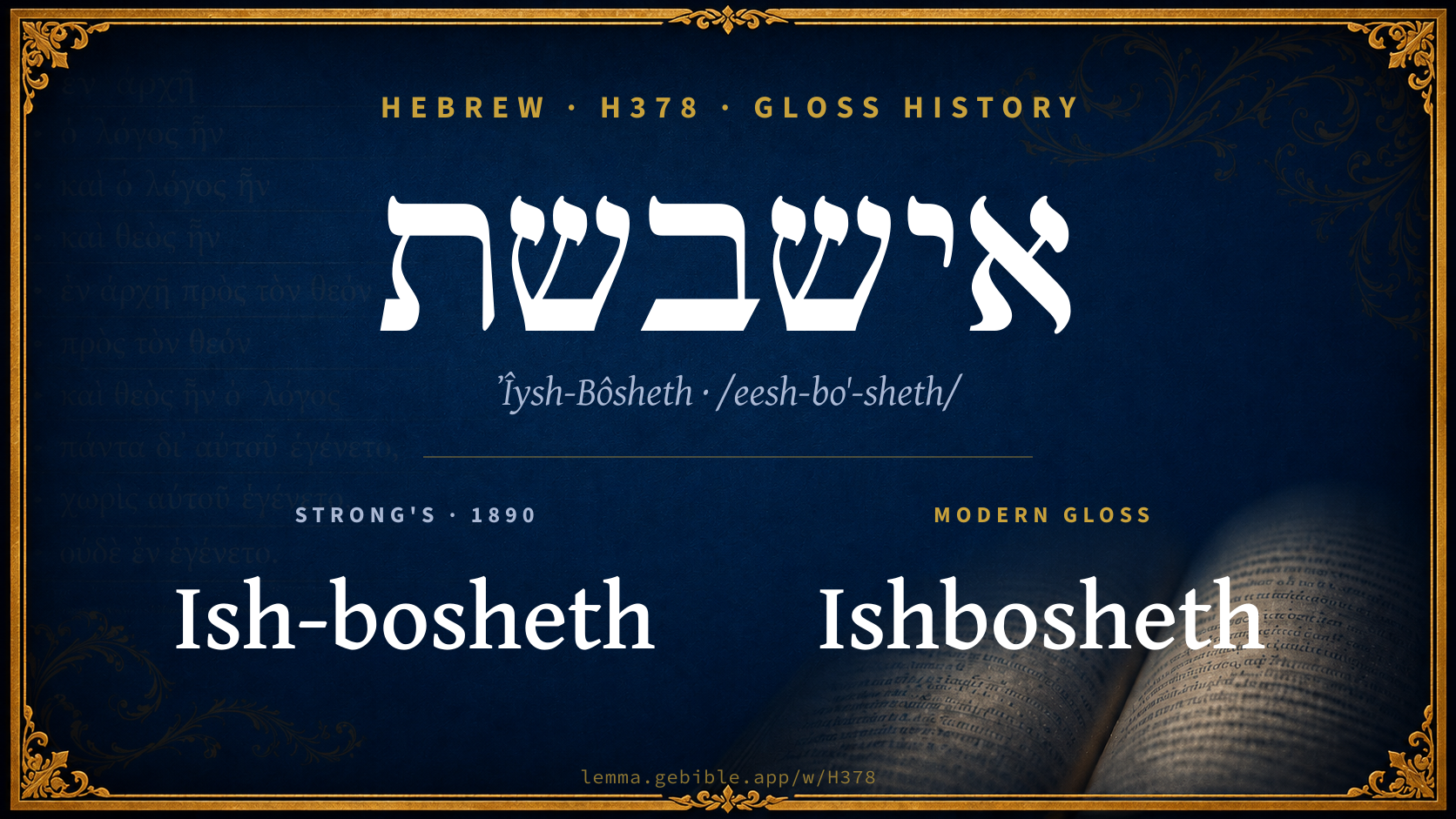
Gloss history
Strong's 1890 vs modern scholarship
About this word
Strong's H378 catalogs a Hebrew word from the Hebrew Old Testament.
These counts are not copied from any lexicon or concordance. They are computed here, from the morphology-tagged Hebrew Old Testament. What Lemma adds →
- 10
- distinct verses
- The word appears in 10 distinct verses.
- 1 / 39
- OT books
- The word appears in 1 of 39 Old Testament books.
- #1,412
- by frequency
- Top 2500 most frequent Hebrew words (rank 1,412 of 8,640 Hebrew words by occurrence).
View all 10 occurrences in the concordance →
Most concentrated in
- 2 Samuel 10 verses 100%
By section of the Old Testament
By traditional corpus
Conventional, traditional groupings — biblical authorship is debated, so this is a traditional corpus grouping, not an authorship claim. Each share is this word’s portion of its verses in that division of the Hebrew canon. Each figure is a share of the word’s 10 distinct verses.
- Prophets (Nevi'im) 10 verses · 100%
How translations render this word
Counts come from each version’s own published word-to-Strong’s tagging or interlinear alignment — an approximate guide to how each version renders this word, not a word-level alignment the data otherwise carries. Because each total is that version’s own tagged count, the per-version totals vary from one another and need not match the appearance or distinct-verse counts above. These counts may also differ from a printed concordance because Lemma counts each distinctly tagged rendering and does not collapse phrase taggings into a single head-word total. This is a fixed set of word-tagged versions (KJV, ASV, BSB, ULT) and does not change with the reading translation you choose elsewhere. Each version’s license is shown beside its name below (and on Sources).
- King James Version: Ishbosheth 10×
- American Standard Version: Ish-bosheth 10×
- Berean Standard Bible: Ish-bosheth 10×
- unfoldingWord Literal Text: Bosheth 9×, Ish 9×, Ish bosheth 4×
King James Version Public Domain
Renders H378 across 11 tagged occurrences — most commonly:
Plus 1 rendering that appears only once — usually multi-word phrases or single function words the recovered tagging swept in, not distinct renderings.
American Standard Version Public Domain
Renders H378 across 11 tagged occurrences — most commonly:
Plus 1 rendering that appears only once — usually multi-word phrases or single function words the recovered tagging swept in, not distinct renderings.
Berean Standard Bible Public Domain
Renders H378 across 11 tagged occurrences — most commonly:
Plus 1 rendering that appears only once — usually multi-word phrases or single function words the recovered tagging swept in, not distinct renderings.
unfoldingWord Literal Text CC BY-SA 4.0
Renders H378 across 22 tagged occurrences — most commonly:
Senses in the full BDB
What do BDB’s symbols mean?
BDB uses these scholarly abbreviations:
| Symbol | Meaning |
|---|---|
| 𝔊 | the Septuagint (the ancient Greek translation, LXX) |
| 𝔙 | the Vulgate (the Latin translation) |
| 𝔖 | the Syriac version (the Peshitta) |
| 𝔗 | the Targum (the Aramaic translation) |
| ψ | the Psalms |
| √ | root (the underlying root or stem) |
| ‖ | parallel passage (a synonymous or contrasted parallel) |
| † | the dagger: every passage where the word occurs is cited |
The 2 senses and sub-senses the full Brown-Driver-Briggs lexicon distinguishes for this word, in lexicon order (not ranked by frequency), with BDB’s own verbatim wording and sub-sense lettering. Shown in Hebrew script with BDB’s own scholarly abbreviations. The condensed entry is in the Lexicon Entry tab. See also the Forms in the corpus table below.
- 1. son of Saul, & king of Isr., with David as rival
- 2. one of Dvd’s heroes
Senses from the full Brown-Driver-Briggs lexicon (Brown, Driver, Briggs; Oxford 1906 — public domain), digitized via Sefaria, supplemented by the OpenScriptures HebrewLexicon (CC BY 4.0). Full attribution on Sources.
Word origin
Derived from איש (ʼîysh) (H376) — man.
Forms in the corpus
The 10 distinct written forms H378 takes in the Hebrew Bible, most frequent first — each parse links to that state’s occurrences in the concordance. Hebrew forms include their vowel points and cantillation, so a single lemma takes many written forms.
| Form | Parsing | Example | Uses |
|---|---|---|---|
| אִֽישׁ | Noun, Proper | 2 Samuel 2:10 | 7 |
| בֹּ֨שֶׁת֙ | Noun, Proper | 2 Samuel 2:8 | 3 |
| אִ֣ישׁ | Noun, Proper | 2 Samuel 3:15 | 2 |
| בֹּ֗שֶׁת | Noun, Proper | 2 Samuel 3:8 | 2 |
| בֹּ֣שֶׁת | Noun, Proper | 2 Samuel 2:10 | 2 |
| בֹּ֥שֶׁת | Noun, Proper | 2 Samuel 3:14 | 2 |
| אִ֥ישׁ | Noun, Proper | 2 Samuel 2:8 | 1 |
| בֹּ֑שֶׁת | Noun, Proper | 2 Samuel 4:5 | 1 |
| בֹּ֔שֶׁת | Noun, Proper | 2 Samuel 3:15 | 1 |
| וּ/לְ/אִ֥ישׁ | Noun, Proper | 2 Samuel 2:15 | 1 |
Same root — word family
Other BDB entries built from the same root as H378, grouped by Strong’s listed origin. These share a root / origin per the lexicon — not necessarily a shared meaning. Each links to that word’s own entry.
Derives from
Shares the same root
- איש ʼîysh H377 to be a man
- אישון ʼîyshôwn H380 pupil
- אישחיל ʼÎysh-Chayil H381 a mighty man, valiant man
- אשה ʼishshâh H802 woman
Proper names from this root
People and places named from this root — a name, not an additional meaning of the word.
- אישהוד ʼÎyshᵉhôwd H379 Ishod
- אישטוב ʼÎysh-Ṭôwb H382 Ish-tob
- אשבעל ʼEshbaʻal H792 Eshbaal
- בןימיני Ben-yᵉmîynîy H1145 Benjamite
Compare all same-root words → Showing 4 of 10 — not the complete family. 4 of the same-root words are proper names (people or places). They share a root, not necessarily a meaning.
Bible dictionary
Public-domain dictionary articles matched to this entry by name (Ishbosheth). A biblical name can be shared by more than one person or place, so an article may treat several.
Easton's Bible Dictionary · M. G. Easton, 1897
Man of shame or humiliation, the youngest of Saul's four sons, and the only one who survived him (2 Sam. 2-4). His name was originally Eshbaal (1 Chr. 8:33; 9:39). He was about forty years of age when his father and three brothers fell at the battle of Gilboa. Through the influence of Abner, Saul's cousin, he was acknowledged as successor to the throne of Saul, and ruled over all Israel, except the tribe of Judah (over whom David was king), for two years, having Mahanaim, on the east of Jordan, as his capital (2 Sam. 2:9). After a troubled and uncertain reign he was murdered by his guard, who stabbed him while he was asleep on his couch at mid-day (2 Sam. 4:5-7); and having cut off his head, presented it to David, who sternly rebuked them for this cold-blooded murder, and ordered them to be immediately executed (9-12).
Smith's Bible Dictionary · William Smith, 1863
(man of shame) the youngest of Saul's four sons, and his legitimate successor. (B.C. 1068.) Ish-bosheth was "forty years old when he began to reign over Israel, and reigned two years." (2 Samuel 3:10) During these two years he reigned at Mahanaim, though only in name. The wars and negotiations with David were entirely carried on by Abner (2 Samuel 2:12; 3:6,12) The death of Abner deprived the house of Saul of its last remaining support. When Ish-bosheth heard of it, "his hands were feeble, and all the Israelites were troubled." He was murdered in his bed.
Hitchcock's Bible Names Dictionary · Roswell D. Hitchcock, 1869
a man of shame
Classic public-domain reference works; full attribution on Sources.
Septuagint verse parallels
This word appears in 10 verses that also exist in the Greek Old Testament (Septuagint), out of the 10 Hebrew verses it occurs in. You can read those verses in Greek by switching the Old Testament edition to the Septuagint.
Read these verses in the Septuagint
This is a verse-level parallel only — the same verses exist in both the Hebrew and Greek Old Testaments. No word-level Hebrew↔Greek correspondence is claimed: the data carries no such alignment, so no Greek word is shown as this Hebrew word’s translation. Coverage is not total — the Septuagint omits the deuterocanon and renumbers the Psalms, so some Hebrew verses have no direct Greek parallel.