Genesis 12:20

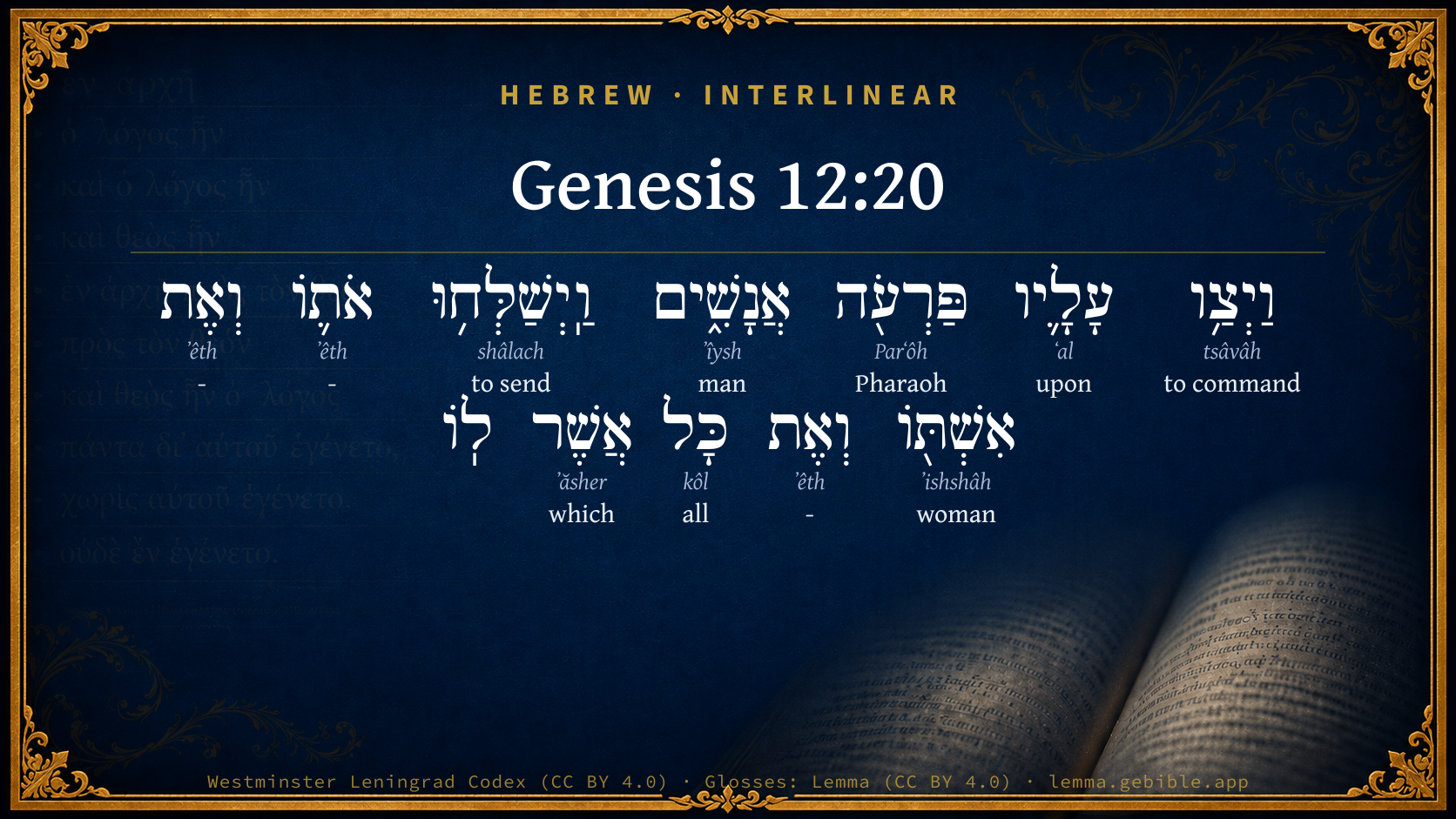
Hebrew (Westminster Leningrad Codex) Genesis 12:20 appears in the Hebrew Old Testament. The text above is from the Westminster Leningrad Codex. Each word links to its Strong’s number, a concise gloss, and parsing drawn from the Open Scriptures Hebrew Bible morphology. Click any word for its full Brown-Driver-Briggs (BDB) entry.
Download image
Cite this verse

Genesis 12:20 (World English Bible). Public Domain. Lemma interlinear Bible study tool, https://lemma.gebible.app/v/genesis/12/20.

Show BibTeX & RIS
BibTeX
RIS
English Translation
Pharaoh gave men charge concerning him: and they brought him on the way, and his wife, and all that he had.
World English Bible · Public Domain
Download a study sheet

One document with this verse’s original text, its word-by-word gloss line, the meaning frame, cross-references with their text, attributed commentary, and full source and license credits — printable, and it pastes into notes with its structure intact.

This verse Autodidact and up

Study sheet (.html) Plain text (.txt)

A passage Seminary Student

Up to 50 verses in one chapter. A passage sheet keeps up to 6 commentary sources and 12 cross-references per verse, in the order this page ranks them, and says so on the sheet whenever that leaves anything out. Ask for a single verse and you get the Autodidact verse sheet above.

Everything on this page stays free to read, with no account — the sheet is a download of what is already on screen, not access to it.

Want to remove ads? Support Godless Engineer
Compare translations 3

The same verse in 3 English versions, stacked beneath the original-language interlinear above. Click any original word for its lexicon entry.

Each is an independent rendering of the whole verse — the interlinear is not word-aligned to these translations.

Highlighted words mark where these versions differ — a whole-verse word diff, not a word-by-word alignment.

  • World English Bible Public Domain
    Pharaoh gave men charge concerning him: and they brought him on the way, and his wife, and all that he had.
  • King James Version Public Domain
    And Pharaoh commanded his men concerning him: and they sent him away, and his wife, and all that he had.
  • unfoldingWord Literal Text CC BY-SA 4.0
    Then Pharaoh commanded his men concerning him, and they sent him away and his wife and everything that to him.

unfoldingWord Literal Text — © unfoldingWord, licensed CC BY-SA 4.0. Word-aligned USFM3 via Door43 (git.door43.org/unfoldingWord/en_ult).

Versions to compare (up to 4)

3 of 4 selected

Show all 18 translations

Every available English version of this verse, each an independent rendering of the whole verse.

  • World English Bible Public Domain
    Pharaoh gave men charge concerning him: and they brought him on the way, and his wife, and all that he had.
  • Berean Standard Bible Public Domain
    Then Pharaoh gave his men orders concerning Abram, and they sent him away with his wife and all his possessions.
  • Majority Standard Bible Public Domain
    Then Pharaoh gave his men orders concerning Abram, and they sent him away with his wife and all his possessions.
  • King James Version Public Domain
    And Pharaoh commanded his men concerning him: and they sent him away, and his wife, and all that he had.
  • American Standard Version (1901) Public Domain
    And Pharaoh gave men charge concerning him: and they brought him on the way, and his wife, and all that he had.
  • Revised Version (1885) Public Domain
    And Pharaoh gave men charge concerning him: and they brought him on the way, and his wife, and all that he had.
  • Geneva Bible (1599) Public Domain
    And Pharaoh gaue men commandement concerning him: and they conueyed him forth, and his wife, and all that he had.
  • Douay-Rheims (1899) Public Domain
    And Pharao gave his men orders concerning Abram: and they led him away, and his wife, and all that he had.
  • Young's Literal Translation Public Domain
    And Pharaoh chargeth men concerning him, and they send him away, and his wife, an all that he hath.
  • Literal Standard Version CC BY-SA 4.0
    And Pharaoh charges men concerning him, and they send him away, and his wife, and all that he has.
  • Unlocked Literal Bible CC BY-SA 4.0
    Then Pharaoh gave orders to his men concerning him, and they sent him away, along with his wife and all that he had.
  • unfoldingWord Literal Text CC BY-SA 4.0
    Then Pharaoh commanded his men concerning him, and they sent him away and his wife and everything that to him.
  • Darby Bible Public Domain
    And Pharaoh commanded [his] men concerning him, and they sent him away, and his wife, and all that he had.
  • World Messianic Bible Public Domain
    Pharaoh commanded men concerning him, and they escorted him away with his wife and all that he had.
  • Webster's Bible Public Domain
    And Pharaoh commanded his men concerning him: and they sent him away, and his wife, and all that he had.
  • Free Bible Version CC BY-SA 4.0
    Pharaoh ordered his guards to expel him and his wife from the country, along with everyone with them and all their possessions.
  • Bible in Basic English Public Domain
    And Pharaoh gave orders to his men, and they sent him on his way, with his wife and all he had.
  • JPS Tanakh (1917) Public Domain
    And Pharaoh gave men charge concerning him; and they brought him on the way, and his wife, and all that he had.

Literal Standard Version (2020), Covenant Press — licensed CC BY-SA 4.0. Text via the HelloAO Bible API (eBible.org). Unlocked Literal Bible (unfoldingWord) — licensed CC BY-SA 4.0. Text via the HelloAO Bible API (eBible.org). unfoldingWord Literal Text — © unfoldingWord, licensed CC BY-SA 4.0. Word-aligned USFM3 via Door43 (git.door43.org/unfoldingWord/en_ult). Free Bible Version, Dr. Jonathan Gallagher — licensed CC BY-SA 4.0. Text via the HelloAO Bible API (eBible.org).

Word by word

More ways to search: Search by grammar → Find every occurrence → Compare this word →

Practice this passage: Drill this verse → Learn its vocabulary →

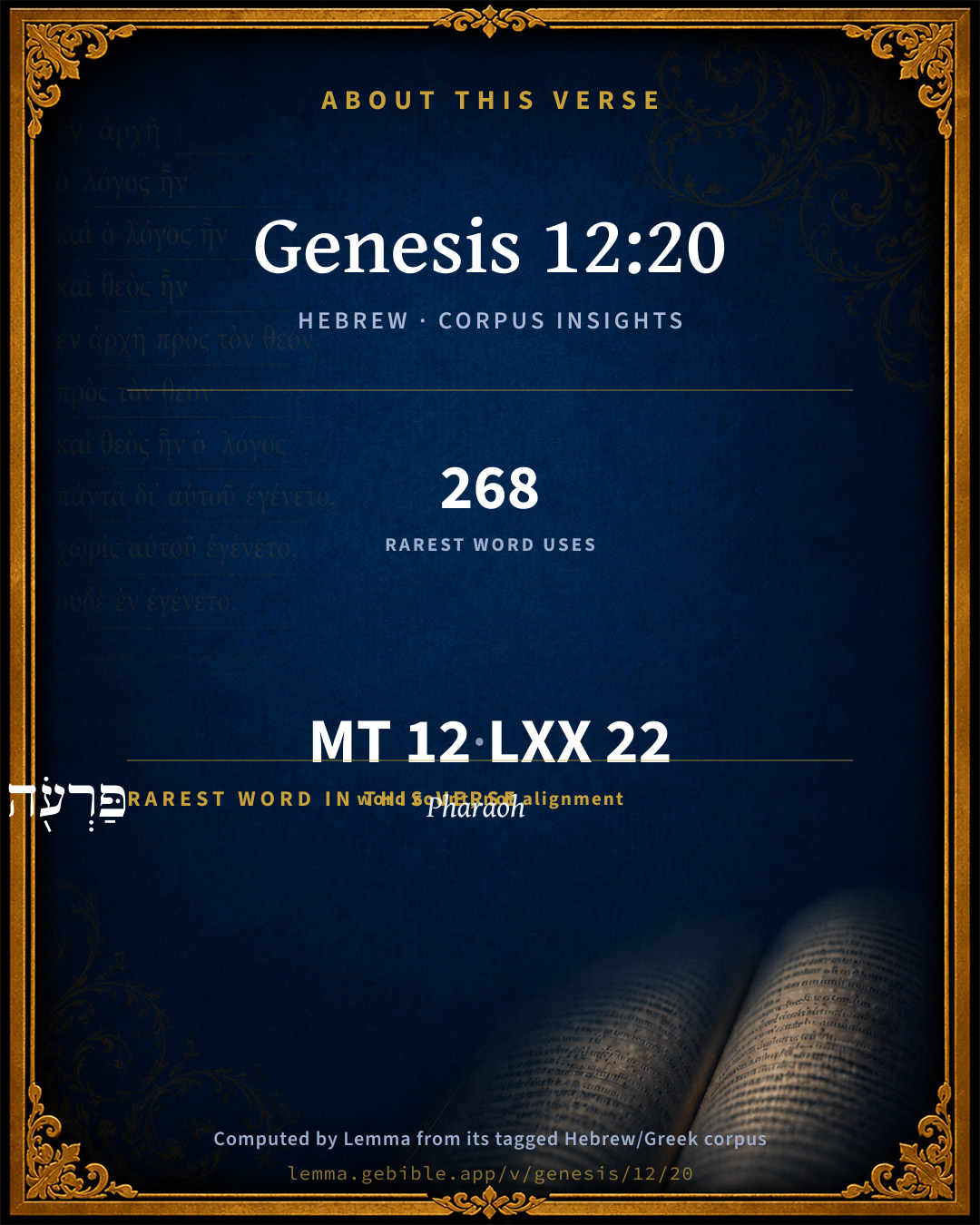
פַּרְעֹ֖ה
Parʻôh
H6547
“Pharaoh”
Noun, Proper
Part of Speech
Noun
Type
Proper
Full BDB Definition

Origin: of Egyptian derivation

TWOT: 1825

Pharaoh = "great house" - the common title of the king of Egypt
  1. וַיְצַ֥ו tsâvâh H6680 “and · to command” Conjunction + Verb, Piel, Sequential Imperfect, 3rd Person, Masculine, Singular
  2. עָלָ֛יו ʻal H5921 “upon · him” Preposition + Suffix, Personal, 3rd Person, Masculine, Singular
  3. אֲנָשִׁ֑ים ʼîysh H376 “men” Noun, Common, Masculine, Plural, Absolute
  4. וַֽיְשַׁלְּח֥וּ shâlach H7971 “and · to send” Conjunction + Verb, Piel, Sequential Imperfect, 3rd Person, Masculine, Plural
  5. אֹת֛וֹ ʼêth H853 “- · him” Particle, Direct Object + Suffix, Personal, 3rd Person, Masculine, Singular
  6. וְאֶת ʼêth H853 “and · -” Conjunction + Particle, Direct Object
  7. אִשְׁתּ֖וֹ ʼishshâh H802 “woman · his” Noun, Common, Feminine, Singular, Construct + Suffix, Personal, 3rd Person, Masculine, Singular
  8. וְאֶת ʼêth H853 “and · -” Conjunction + Particle, Direct Object
  9. כָּל kôl H3605 “all of” Noun, Common, Masculine, Singular, Construct
  10. אֲשֶׁר ʼăsher H834 “which” Particle, Relative

About this verse

These counts appear in no published source. They are computed here, from the morphology-tagged text and Lemma’s own curated glosses. What Lemma adds →

12
words
9
distinct lemmas
Pentateuch
section

Grammatical profile

  • 2 verbs
  • 4 nouns
  • 2 prepositions
  • 4 particles

Verb forms

  • וַיְצַ֥ו Piel · Sequential Imperfect
  • וַֽיְשַׁלְּח֥וּ Piel · Sequential Imperfect

Hebrew & Septuagint length

In English translation the verse runs 21 words from the Hebrew and 22 from the Septuagint (LXX English) — closely comparable.

A rough comparison of the two English renderings, which tokenize alike — not a word-level alignment.

Word counts can differ between the Hebrew and the Greek without any difference in meaning — e.g. the Hebrew direct-object marker אֵת has no separate Greek word, and Greek often adds the article ὁ.

In the original languages it is 12 Hebrew tokens and 22 Greek tokens — but the two are counted differently (Hebrew bundles its prefixes and suffixes into one token; the Greek is in lemma form), so that isn’t a like-for-like length.

Cross-references

4

Topical passages linked to Genesis 12:20 in the Treasury of Scripture Knowledge — connected by theme and wording, ordered by reader-vote popularity; previews shown in the World English Bible.

  • Psalms 105:14–15 He allowed no one to do them wrong. Yes, he reproved kings for their sakes,
  • Proverbs 21:1 The king's heart is in Yahweh's hand like the watercourses. He turns it wherever he desires.
  • Exodus 18:27 Moses let his father-in-law depart, and he went his way into his own land.
  • 1 Samuel 29:6–11 Then Achish called David, and said to him, As Yahweh lives, you have been upright, and your going out and your coming in with me in the host is good in my sight; for I have not found evil in you since the day of your coming to me to this day: nevertheless the lords don't favor you.

Cross-references courtesy of OpenBible.info (CC BY 4.0).

Hebrew and Greek witnesses Masoretic Hebrew ↔ Greek Septuagint

The same verse in the two great witnesses to the Old Testament, shown verse-for-verse.

These are two independent witnesses, not word-aligned to each other, and the Septuagint is shown in lemma (dictionary) form.

Hebrew Genesis 12:20 Masoretic · Westminster Leningrad Codex

וַיְצַ֥ו עָלָ֛יו פַּרְעֹ֖ה אֲנָשִׁ֑ים וַֽיְשַׁלְּח֥וּ אֹת֛וֹ וְאֶת אִשְׁתּ֖וֹ וְאֶת כָּל אֲשֶׁר לֽוֹ

Pharaoh gave men charge concerning him: and they brought him on the way, and his wife, and all that he had.

World English Bible · Public Domain

Greek LXX Genesis 12:20 Septuagint · lemma form

καί ἐντέλλομαι φαραώ ἀνήρ περί αβραμ συν προπέμπω αὐτός καί ὁ γυνή αὐτός καί πᾶς ὅσος εἰμί αὐτός καί λωτ μετά αὐτός

And Pharao gave charge to men concerning Abram, to join in sending him forward, and his wife, and all that he had.

LXX2012 (modern English Septuagint) · Public Domain

Hebrew: Westminster Leningrad Codex (CC BY 4.0). Greek: Septuagint (public domain); English from LXX2012 (modern English Septuagint) (Public Domain). How the Septuagint differs from the Hebrew →

Targum (Aramaic paraphrase)

2

The Targum is the ancient Jewish Aramaic paraphrase of the Hebrew Scriptures — an interpretive translation, not the Hebrew text itself. Onkelos (literal) and Pseudo-Jonathan (expansive) render the Torah, and Jonathan the Prophets. Coverage is partial: where no permissively-licensed English translation exists for a verse, only the Aramaic is shown. This is verse-level text, not a word-by-word alignment to the Hebrew.

  1. Targum Onkelos Torah (Genesis–Deuteronomy)
    וּפַקִּיד עֲלוֹהִי פַּרְעֹה גּוּבְרִין וְאַלְוִיאוּ יָתֵהּ וְיָת אִתְּתֵהּ וְיָת כָּל דִילֵהּ

    And Pharaoh instructed the men concerning him, and they, conducted him away, and his wife, and all that he had.

    Targum Onkelos — Aramaic: “Onkelos Genesis” (public domain); “Onkelos Exodus” (public domain); “Onkelos Leviticus” (public domain); “Onkelos Numbers” (public domain); “Onkelos Deuteronomy” (public domain). English: “Sefaria Community Translation” (CC0 1.0 (public-domain dedication)); “J.W. Etheridge. The Targums of Onkelos and Jonathan Ben Uzziel on the Pentateuch. London: Longmans, Green, 1862” (public domain). Text via Sefaria.

  2. Targum Pseudo-Jonathan Torah (Genesis–Deuteronomy)
    וּפַקֵיד עִילוֹי פַרְעה גוּבְרִין וְאַלְוִיאוּ יָתֵיהּ וְיַת אִנְתְּתֵיהּ וְיַת כָּל דִילֵיהּ

    And Pharoh commanded men concerning him, and they led him forth, and his wife, and all that he had.

    Targum Pseudo-Jonathan — Aramaic: “Targum Jonathan on Genesis” (public domain); “Targum Jonathan on Exodus” (public domain); “Targum Jonathan on Leviticus” (public domain); “Targum Jonathan on Numbers” (public domain); “Targum Jonathan on Deuteronomy” (public domain). English: “The Targum of Jonathan ben Uzziel, trans. J. W. Etheridge, London, 1862” (public domain). Text via Sefaria.

Commentary

Notes on Genesis 12:20 from classic Christian and Jewish commentators (each source and its license shown beneath its notes). The classic Christian expositions comment on the surrounding passage and are grouped to its opening verse, so a note may address several verses; the Jewish commentaries on the Tanakh (Rashi and others) are per-verse, so they appear only where the commentator wrote on this verse.

Lemma curates 59 commentaries, every one of them public domain or Creative Commons licensed, each selected and text-cleaned for this edition rather than reprinted as found. About our sources →

Trapp's Complete Commentary

John Trapp

Gen 12:20 And Pharaoh commanded [his] men concerning him: and they sent him away, and his wife, and all that he had.

Ver. 20. And Pharaoh commanded.] Thus God comes, as it were, out of an engine, {a} and helps his people at a pinch. Abram had brought himself into the briars, and could find no way out. Many a heavy heart he had, no doubt, for his dear wife (who suffered by his default), and she again for him. God, upon their repentance, provides graciously for them both: she is kept undefiled, he greatly enriched for her sake; and now they are both secured, and dismissed with the king’s safeconduct. Oh, who would not serve such a God, as turns our errors and evil counsels to our great good, as the Athenians dreamed their goddess Minerva did for them!

John Trapp, A Commentary or Exposition upon All the Books of the Old and New Testament (1647–1656) — public domain. Text from a community e-Sword module.

Tyndale Open Study Notes

Tyndale Open Resources

12:20 No answer to Pharaoh’s questions (12:18-19) was needed, because the rebuke was followed by expulsion. Pharaoh’s command paralleled God’s command to Abram (12:1), but Pharaoh’s demand brought shame and disgrace. God was faithful in preserving his promise.

Tyndale Open Study Notes — © Tyndale Open Resources, licensed CC BY-SA 4.0. Text via the HelloAO Bible API.

Geneva Bible (1599)

Geneva Bible translators

To the intent that none should hurt him either in his person or goods.

Geneva Bible (1599) marginal notes — public domain. Text via Bolls.life.

Adam Clarke's Commentary

Verse 20. Commanded his men concerning him] Gave particular and strict orders to afford Abram and his family every accommodation for their journey; for having received a great increase of cattle and servants, it was necessary that he should have the favour of the king, and his permission to remove from Egypt with so large a property; hence, a particular charge is given to the officers of Pharaoh to treat him with respect, and to assist him in his intended departure.

THE weighty and important contents of this chapter demand our most attentive consideration. Abram is a second time called to leave his country, kindred, and father's house, and go to a place he knew not. Every thing was apparently against him but the voice of God. This to Abram was sufficient; he could trust his Maker, and knew he could not do wrong in following his command. He is therefore proposed to us in the Scriptures as a pattern of faith, patience, and loving obedience. When he received the call of God, he spent no time in useless reasonings about the call itself, his family circumstances, the difficulties in the way, c., c. He was called, and he departed, and this is all we hear on the subject. Implicit faith in the promise of God, and prompt obedience to his commands, become us, not only as HIS creatures, but as sinners called to separate from evil workers and wicked ways, and travel, by that faith which worketh by love, in the way that leads to the paradise of God.

How greatly must the faith of this blessed man have been tried, when, coming to the very land in which he is promised so much blessedness, he finds instead of plenty a grievous famine! Who in his circumstances would not have gone back to his own country, and kindred? Still he is not stumbled prudence directs him to turn aside and go to Egypt, till God shall choose to remove this famine. Is it to be wondered at that, in this tried state, he should have serious apprehensions for the safety of his life? Sarai, his affectionate wife and faithful companion, he supposes he shall lose her beauty, he suspects, will cause her to be desired by men of power, whose will he shall not be able to resist. If he appear to be her husband, his death he supposes to be certain; if she pass for his sister, he may be well used on her account; he will not tell a lie, but he is tempted to prevaricate by suppressing a part of the truth. Here is a weakness which, however we may be inclined to pity and excuse it, we should never imitate. It is recorded with its own condemnation. He should have risked all rather than have prevaricated. But how could he think of lightly giving up such a wife? Surely he who would not risk his life for the protection and safety of a good wife, is not worthy of one. Here his faith was deficient. He still credited the general promise, and acted on that faith in reference to it; but he did not use his faith in reference to intervening circumstances, to which it was equally applicable. Many trust God for their souls and eternity, who do not trust in him for their bodies and for time. To him who follows God fully in simplicity of heart, every thing must ultimately succeed. Had Abram and Sarai simply passed for what they were, they had incurred no danger; for God, who had obliged them to go to Egypt, had prepared the way before them. Neither Pharaoh nor his courtiers would have noticed the woman, had she appeared to be the wife of the stranger that came to sojourn in their land. The issue sufficiently proves this. Every ray of the light of truth is an emanation from the holiness of God, and awfully sacred in his eyes. Considering the subject thus, a pious ancient spoke the following words, which refiners in prevarication have deemed by much too strong: "I would not," said he, "tell a lie to save the souls of the whole world." Reader, be on thy guard; thou mayest fall by comparatively small matters, while resolutely and successfully resisting those which require a giant's strength to counteract them. In every concern God is necessary; seek him for the body and for the soul; and do not think that any thing is too small or insignificant to interest him that concerns thy present or eternal peace.

Adam Clarke's Commentary on the Bible (1810–1826) — public domain. Text from a community e-Sword/MySword module.

John Calvin's Commentaries

20. And Pharaoh commanded his men. In giving commandment that Abram should have a safe-conduct out of the kingdom, Pharaoh might seem to have done it, for the sake of providing against danger; because Abram had stirred up the odium of the nation against himself, as against one who had brought thither the scourge of God along with him; but as this conjecture has little solidity, I give the more simple interpretation, that leave of departure was granted to Abram with the addition of a guard, lest he should be exposed to violence. For we know how proud and cruel the Egyptians were; and how obnoxious Abram was to envy, because having there become suddenly rich, he would seem to be carrying spoil away with him.

John Calvin's Commentaries (1540-1563) — public domain. Text from the Calvin Translation Society English edition (1840s-50s) via the Christian Classics Ethereal Library (ccel.org). Calvin's coverage is partial (roughly two-thirds of the Bible); uncommented books and verses are honest gaps, never fabricated. The 19th-century editor's footnotes and remarks are omitted so the notes are faithfully Calvin's own voice.

The Cambridge Bible for Schools and Colleges

gen. ed. J. J. S. Perowne

20. they brought him on the way] i.e. they escorted him to the frontier, treating with respect and honour a man of wealth and substance, and a foreigner whose God had been a protection to himself and a peril to the Egyptian royal family. Abram apparently retained the wealth that he had procured on false pretences. For the word rendered “bring on the way,” in the sense of “escort,” cf. Gen_18:16, Gen_31:27 (“sent away”).

On this narrative, see the remarks of J. G. Frazer in Psyche’s Task, p. 40, “among many savage races breaches of the marriage laws are believed to draw down on the community public calamities of the most serious character … in particular they are thought to blast the fruits of the earth through excessive rain or excessive drought. Traces of similar beliefs may perhaps be detected among the civilised races of antiquity.” Frazer quotes, in illustration, Job_31:11 sq., and the two narratives of Gen_12:10-20; Gen_20:1-18. “These narratives,” he says, “seem to imply that adultery, even when it is committed in ignorance, is a cause of plague and especially of sterility among women.”

The Cambridge Bible for Schools and Colleges (gen. ed. J. J. S. Perowne; Cambridge University Press, 1878–1918) — public domain. Text from a community e-Sword module.

John Gill's Exposition

And Pharaoh commanded his men concerning him,.... His courtiers and servants, not to do him any hurt or injury in his person or substance; who he might suppose would be enraged at hearing how the king and they had been imposed upon and deceived; he ordered a guard about him while he was there, and to conduct him, and all that belonged to him, safely out of his dominions, as appears by what follows: but Dr. Lightfoot (m) is of opinion, that he gave charge to the Egyptians, making it as it were a law for the time to come, that they should not converse with Hebrews, nor with foreign shepherds, in any so near familiarity, as to eat or drink with them, which the Egyptians observed strictly ever after, Gen 43:32.

and they sent him away, and his wife, and all that he had; they did not drive him out by force, or in any disgraceful manner, but being committed to a guard of men, appointed by the king, he had safe conduct out of the land, with his family, and all that he had; all that he brought with him, and all the increase he had made there, and all the gifts he had received of the king. The Jews (n) interpret it of the writings and gifts he had given to Sarai; and they (o) observe a great likeness between Abram's descent into Egypt, his being there, and departure out of it, and that of his posterity in later times; as that they both went thither on account of a famine; that they both went down to sojourn there; and that they both went out with great substance; with other particulars observed by them.

(m) See his Works, vol. 1. p. 694. (n) Pirke Eliezer, c. 26. (o) Bereshit Rabba, sect. 40. fol. 35. 3.

Next: Genesis Chapter 13

John Gill's Exposition of the Whole Bible (1746–1763) — public domain (CC PDM 1.0). Text via the HelloAO Bible API.

Haydock's Catholic Bible Commentary

Led him away: perhaps without allowing him time to vindicate his conduct, and with a degree of contumely, to shew the king’s displeasure; who durst not, however, injure Abraham in his effects, nor suffer any of his subjects to hurt him. The holy patriarch received his wife untouched, and departed with joy. (Haydock)

George Leo Haydock (1774–1849), Haydock's Catholic Family Bible and Commentary, 1859 edition — public domain. Excludes Psalms (Douay-Rheims chapter numbering differs from Protestant) and Deuterocanonical books (Catholic canon only).

Matthew Poole's English Annotations

Pharaoh gave them a charge concerning him for his safe conduct whither he pleased.

Matthew Poole's English Annotations on the Holy Bible (1683–1685) — public domain. Text from a community e-Sword/MySword module.

Whedon's Commentary on the Bible

Daniel D. Whedon

20. Sent him away — The language implies an honourable escort, and a safe conduct out of Egypt. “It deserves to be noticed that throughout the history of the chosen race, Egypt was to them the scene of spiritual danger, of covetousness and love of riches, of worldly security, of temptation to rest on man’s arm and understanding, and not on God only. All this appears from the very first, in Abram’s sojourn there, Sarai’s danger, and their departure full of wealth and prosperity.” — Speaker’s Commentary.

Daniel D. Whedon (gen. ed.), Commentary on the Old and New Testaments (1874–1909) — public domain. Text from a community e-Sword module.

The Pulpit Commentary

And Pharaoh commanded his men (i.e. certain officers designated for the purpose) concerning him (to see to his departure): and they seat him away, and his wife, and all that he had.

The partitionists assign this entire section to the Jehovist.

HOMILIES BY W. ROBERTS Ver. 20.

Abram and Israel; a parallel.

1. Both were driven into Egypt by a famine.

2. To both the land of Egypt proved a house of bondage.

3. In each case the Pharaoh of the time was subjected to plagues.

4. Both were sent away by the alarmed monarchs who were made to suffer for their sakes.

5. Both went up from Egypt laden with the spoils of those among whom they had sojourned.

6. On leaving Egypt both directed their steps to Canaan. W.

The Pulpit Commentary (1880–1919), ed. H.D.M. Spence-Jones & Joseph S. Exell — public domain. Text from a community e-Sword module.

John Wesley's Explanatory Notes

And Pharaoh commanded his men concerning him - That is, he charged them not to injure him in any thing. And he appointed them, when Abram was disposed to return home, after the famine, to conduct him safe out of the country, as his convoy.

John Wesley, Explanatory Notes Upon the Whole Bible (1754–1765) — public domain. Text via the GEBible commentary corpus.

Rashi

Rabbi Shlomo Yitzchaki (Rashi)

ויצו עליו AND PHARAOH GAVE COMMAND CONCERNING HIM— עליו means for his sake — to escort him and to protect him.

וישלחו AND THEY ACCOMPANIED HIM — as the Targum has it: they gave him an escort.)

Rashi on the Tanakh — English translations: “The Judaica Press complete Tanach with Rashi, translated by A. J. Rosenberg” (CC BY 4.0); “Pentateuch with Rashi's commentary by M. Rosenbaum and A.M. Silbermann, 1929-1934” (public domain); “The Metsudah Tanach series, Lakewood, N.J” (CC BY 4.0); and “The Book of Joshua, Metsudah Publications, 1997” (CC BY 4.0). Text via Sefaria.

Radak

Rabbi David Kimhi (Radak)

ויצו עליו פרעה אנשים, to protect both him and his wife, so that the Egyptians would not molest them.

וישלחו אותו, as far as the border of the country.

Radak on the Tanakh — English translations: “Sefaria Community Translation” (CC0 1.0 (public-domain dedication)); “Eliyahu Munk, HaChut Hameshulash” (CC BY 4.0); “Rabbi Mike Feuer, Jerusalem Anthology” (CC BY 4.0); and “R. David Kimhi on the first book of Psalms, Translated by R.G. Finch, London, 1919” (public domain). Text via Sefaria.

Lesson kit

Teaching starters — assembled from the data on this page, not authored interpretation. Every prompt links to the verse data it draws on. Edit before teaching.

Genesis, in the Pentateuch, opens this verse with 12 words (9 distinct Hebrew lemmas). Its most distinctive word is Parʻôh (“Pharaoh”). A historical commentator’s framing appears above. Read the whole chapter for the surrounding context.

Discussion questions

  1. The word Parʻôh carries the sense “Pharaoh.” How does it shape the verse?
  2. How does Psalms 105:14–15, which shares this passage’s theme, read alongside this verse?
  3. These translations render this verse differently; the difference is in the English rendering, not the original. What questions does that raise?
  4. «וַיְצַ֥ו» is a Piel Sequential Imperfect verb. How does that grammatical form shape the action described?
  5. Compare how Trapp's Complete Commentary and Tyndale Open Study Notes read this verse. Where do they agree or differ?

Things to notice

Reading settings

Reading text

Shown beneath each verse's original-language words.

Old Testament
Old Testament edition

Read the OT as the Masoretic Hebrew (MT) or the Greek Septuagint (LXX).

English shown for the Greek Septuagint (in the Hebrew ↔ Greek comparison).

Comparing translations? Open the Compare panel on any verse page to stack up to four side by side.