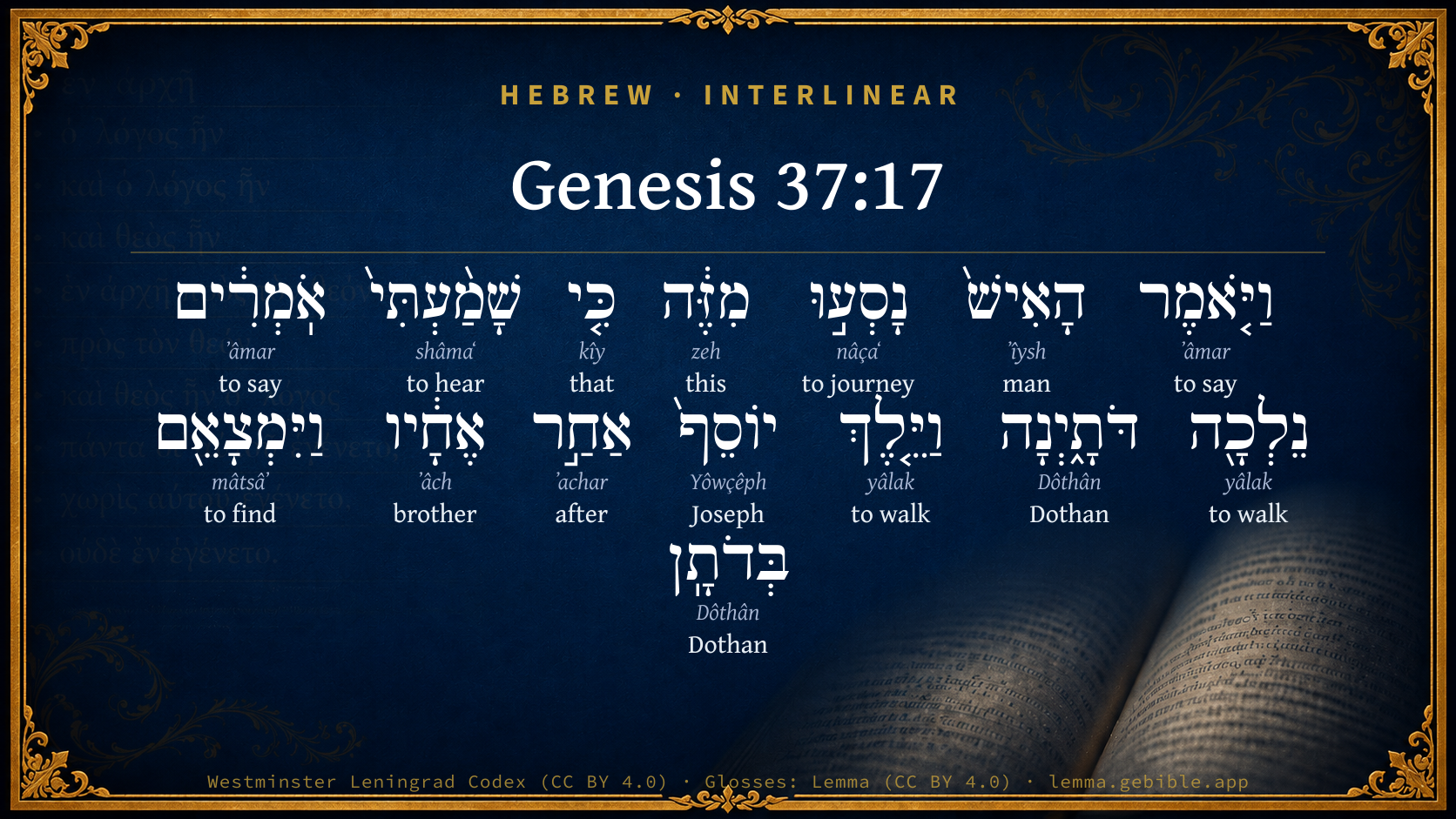
Genesis 37:17

Hebrew (Westminster Leningrad Codex) Genesis 37:17 appears in the Hebrew Old Testament. The text above is from the Westminster Leningrad Codex. Each word links to its Strong’s number, a concise gloss, and parsing drawn from the Open Scriptures Hebrew Bible morphology. Click any word for its full Brown-Driver-Briggs (BDB) entry.
Download image
Cite this verse

Genesis 37:17 (World English Bible). Public Domain. Lemma interlinear Bible study tool, https://lemma.gebible.app/v/genesis/37/17.

Show BibTeX & RIS
BibTeX
RIS
English Translation
The man said, "They have left here, for I heard them say, 'Let us go to Dothan.'" Joseph went after his brothers, and found them in Dothan.
World English Bible · Public Domain
Highlights
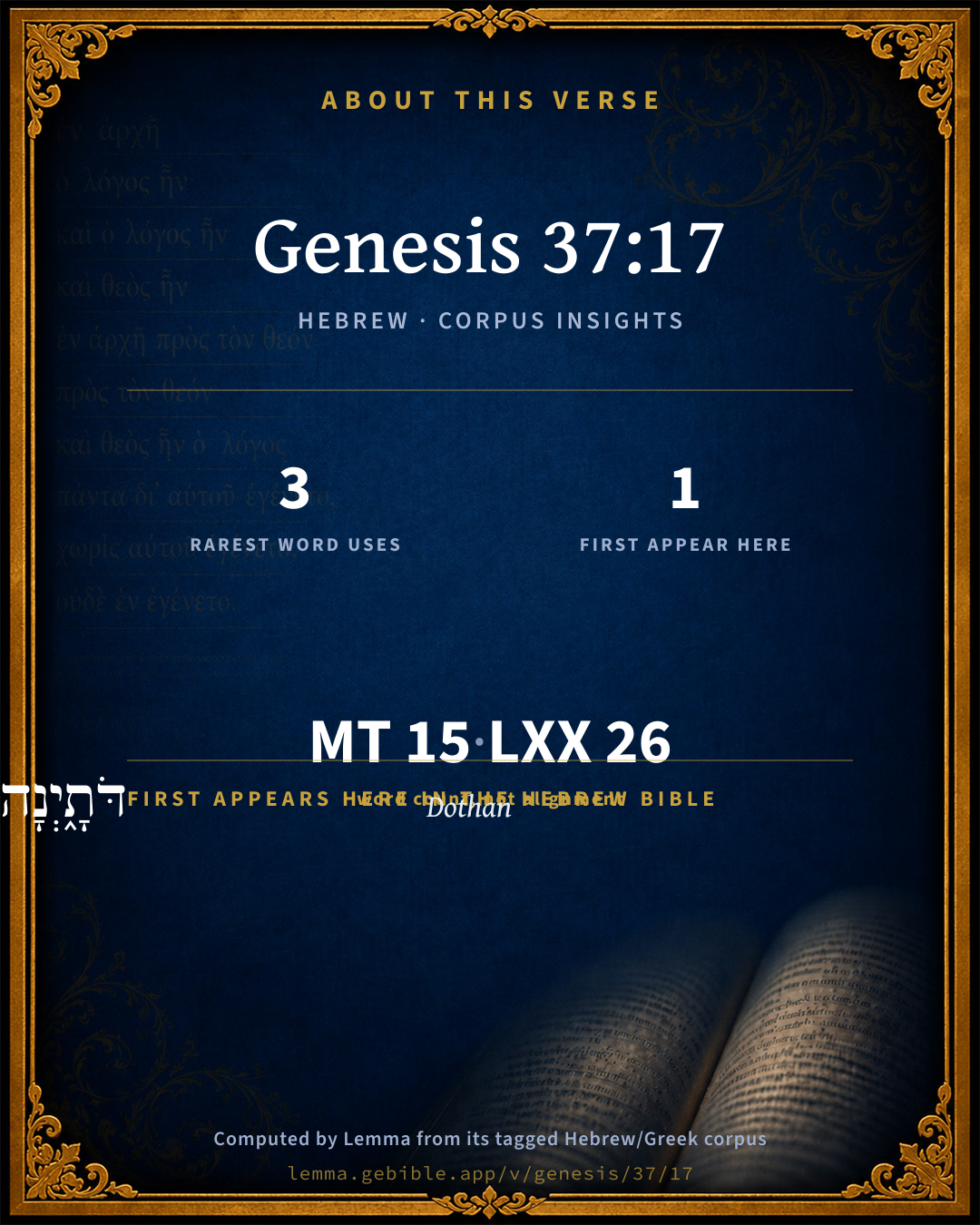
  • 1 first appearance in the Hebrew Bible
Full analysis ↓
Download a study sheet

One document with this verse’s original text, its word-by-word gloss line, the meaning frame, cross-references with their text, attributed commentary, and full source and license credits — printable, and it pastes into notes with its structure intact.

This verse Autodidact and up

Study sheet (.html) Plain text (.txt)

A passage Seminary Student

Up to 50 verses in one chapter. A passage sheet keeps up to 6 commentary sources and 12 cross-references per verse, in the order this page ranks them, and says so on the sheet whenever that leaves anything out. Ask for a single verse and you get the Autodidact verse sheet above.

Everything on this page stays free to read, with no account — the sheet is a download of what is already on screen, not access to it.

Want to remove ads? Support Godless Engineer
Compare translations 3

The same verse in 3 English versions, stacked beneath the original-language interlinear above. Click any original word for its lexicon entry.

Each is an independent rendering of the whole verse — the interlinear is not word-aligned to these translations.

Highlighted words mark where these versions differ — a whole-verse word diff, not a word-by-word alignment.

  • World English Bible Public Domain
    The man said, "They have left here, for I heard them say, 'Let us go to Dothan.'" Joseph went after his brothers, and found them in Dothan.
  • King James Version Public Domain
    And the man said, They are departed hence; for I heard them say, Let us go to Dothan. And Joseph went after his brethren, and found them in Dothan.
  • unfoldingWord Literal Text CC BY-SA 4.0
    Then the man said, “They set out from here. For I heard them say, ‘Let us go to Dothan.’” Then Joseph went after his brothers and found them at Dothan.

unfoldingWord Literal Text — © unfoldingWord, licensed CC BY-SA 4.0. Word-aligned USFM3 via Door43 (git.door43.org/unfoldingWord/en_ult).

Versions to compare (up to 4)

3 of 4 selected

Show all 18 translations

Every available English version of this verse, each an independent rendering of the whole verse.

  • World English Bible Public Domain
    The man said, "They have left here, for I heard them say, 'Let us go to Dothan.'" Joseph went after his brothers, and found them in Dothan.
  • Berean Standard Bible Public Domain
    “They have moved on from here,” the man answered. “I heard them say, ‘Let us go to Dothan.’” So Joseph set out after his brothers and found them at Dothan.
  • Majority Standard Bible Public Domain
    “They have moved on from here,” the man answered. “I heard them say, ‘Let us go to Dothan.’” So Joseph set out after his brothers and found them at Dothan.
  • King James Version Public Domain
    And the man said, They are departed hence; for I heard them say, Let us go to Dothan. And Joseph went after his brethren, and found them in Dothan.
  • American Standard Version (1901) Public Domain
    And the man said, They are departed hence; for I heard them say, Let us go to Dothan. And Joseph went after his brethren, and found them in Dothan.
  • Revised Version (1885) Public Domain
    And the man said, They are departed hence: for I heard them say, Let us go to Dothan. And Joseph went after his brethren, and found them in Dothan.
  • Geneva Bible (1599) Public Domain
    And the man said, they are departed hece: for I heard them say, Let vs goe vnto Dothan. Then went Ioseph after his brethren, and found them in Dothan.
  • Douay-Rheims (1899) Public Domain
    And the man said to him: They are departed from this place: for I heard them say: Let us go to Dothain. And Joseph went forward after his brethren, and found them in Dothain.
  • Young's Literal Translation Public Domain
    And the man saith, `They have journeyed from this, for I have heard some saying, Let us go to Dothan,' and Joseph goeth after his brethren, and findeth them in Dothan.
  • Literal Standard Version CC BY-SA 4.0
    And the man says, “They have journeyed from this, for I have heard some saying, Let us go to Dothan,” and Joseph goes after his brothers, and finds them in Dothan.
  • Unlocked Literal Bible CC BY-SA 4.0
    The man said, “They left this place, for I heard them say, 'Let us go to Dothan.'” Joseph went after his brothers and found them at Dothan.
  • unfoldingWord Literal Text CC BY-SA 4.0
    Then the man said, “They set out from here. For I heard them say, ‘Let us go to Dothan.’” Then Joseph went after his brothers and found them at Dothan.
  • Darby Bible Public Domain
    And the man said, They have removed from this; for I heard them say, Let us go to Dothan. And Joseph went after his brethren, and found them at Dothan.
  • World Messianic Bible Public Domain
    The man said, “They have left here, for I heard them say, ‘Let’s go to Dothan.’” Joseph went after his brothers, and found them in Dothan.
  • Webster's Bible Public Domain
    And the man said, They have departed hence: for I heard them say, Let us go to Dothan. And Joseph went after his brethren and found them in Dothan.
  • Free Bible Version CC BY-SA 4.0
    “They've already left,” the man replied. “I heard them say, ‘Let's go to Dothan.’” So Joseph followed his brothers and caught up with them at Dothan.
  • Bible in Basic English Public Domain
    And the man said, They have gone away from here, for they said in my hearing, Let us go to Dothan. So Joseph went after them and came up with them at Dothan.
  • JPS Tanakh (1917) Public Domain
    And the man said: 'They are departed hence; for I heard them say: Let us go to Dothan.' And Joseph went after his brethren, and found them in Dothan.

Literal Standard Version (2020), Covenant Press — licensed CC BY-SA 4.0. Text via the HelloAO Bible API (eBible.org). Unlocked Literal Bible (unfoldingWord) — licensed CC BY-SA 4.0. Text via the HelloAO Bible API (eBible.org). unfoldingWord Literal Text — © unfoldingWord, licensed CC BY-SA 4.0. Word-aligned USFM3 via Door43 (git.door43.org/unfoldingWord/en_ult). Free Bible Version, Dr. Jonathan Gallagher — licensed CC BY-SA 4.0. Text via the HelloAO Bible API (eBible.org).

Word by word

More ways to search: Search by grammar → Find every occurrence → Compare this word →

Practice this passage: Drill this verse → Learn its vocabulary →

דֹּתָ֑יְנָה
Dôthân
H1886
“Dothan · toward”
Noun, Proper + Suffix, Demonstrative
Part of Speech
Noun
Type
Proper
Full BDB Definition

Origin: of uncertain derivation

TWOT: None

Dothan = "two wells" - a place in northern Palestine, 12 miles north of Samaria, the home of Elisha
  1. וַיֹּ֤אמֶר ʼâmar H559 “and · to say” Conjunction + Verb, Qal, Sequential Imperfect, 3rd Person, Masculine, Singular
  2. הָאִישׁ֙ ʼîysh H376 “the · man” Particle, Definite Article + Noun, Common, Masculine, Singular, Absolute
  3. נָסְע֣וּ nâçaʻ H5265 “to journey” Verb, Qal, Perfect, 3rd Person, Common, Plural
  4. מִזֶּ֔ה zeh H2088 “from · this” Preposition + Pronoun, Demonstrative, Masculine, Singular
  5. כִּ֤י kîy H3588 “that” Conjunction
  6. שָׁמַ֨עְתִּי֙ shâmaʻ H8085 “to hear” Verb, Qal, Perfect, 1st Person, Common, Singular
  7. אֹֽמְרִ֔ים ʼâmar H559 “saying” Verb, Qal, Participle Active, Masculine, Plural, Absolute
  8. נֵלְכָ֖ה yâlak H3212 “to walk” Verb, Qal, Cohortative, 1st Person, Common, Plural
  9. וַיֵּ֤לֶךְ yâlak H3212 “and · to walk” Conjunction + Verb, Qal, Sequential Imperfect, 3rd Person, Masculine, Singular
  10. יוֹסֵף֙ Yôwçêph H3130 “Joseph” Noun, Proper
  11. אַחַ֣ר ʼachar H310 “after” Preposition
  12. אֶחָ֔יו ʼâch H251 “brothers · his” Noun, Common, Masculine, Plural, Construct + Suffix, Personal, 3rd Person, Masculine, Singular
  13. וַיִּמְצָאֵ֖ם mâtsâʼ H4672 “and · to find · them” Conjunction + Verb, Qal, Sequential Imperfect, 3rd Person, Masculine, Singular + Suffix, Personal, 3rd Person, Masculine, Plural
  14. בְּדֹתָֽן Dôthân H1886 “in/at · Dothan” Preposition + Noun, Proper

About this verse

These counts appear in no published source. They are computed here, from the morphology-tagged text and Lemma’s own curated glosses. What Lemma adds →

15
words
12
distinct lemmas
Pentateuch
section

Notable vocabulary

The rarest word here is דֹּתָ֑יְנָה Dothan H1886 — appearing just 3 times in the whole Hebrew Bible.

First appearance in Scripture

This word makes its first canonical appearance in the Hebrew Bible here:

  • דֹּתָ֑יְנָה Dothan H1886

Shared distinctive vocabulary

דֹּתָ֑יְנָה Dothan H1886 occurs in 2 verses of the Hebrew Bible. Also found in:

Grammatical profile

  • 7 verbs
  • 5 nouns
  • 1 pronoun
  • 1 preposition
  • 1 conjunction

Verb forms

  • וַיֹּ֤אמֶר Qal · Sequential Imperfect
  • נָסְע֣וּ Qal · Perfect
  • שָׁמַ֨עְתִּי֙ Qal · Perfect
  • אֹֽמְרִ֔ים Qal · Participle Active
  • נֵלְכָ֖ה Qal · Cohortative
  • וַיֵּ֤לֶךְ Qal · Sequential Imperfect
  • וַיִּמְצָאֵ֖ם Qal · Sequential Imperfect

Repetition

Words recur within this verse — often emphatic in Hebrew:

  • וַיֹּ֤אמֶר to say H559 ×2
  • נֵלְכָ֖ה to walk H3212 ×2
  • דֹּתָ֑יְנָה Dothan H1886 ×2

Hebrew & Septuagint length

In English translation the verse runs 27 words from the Hebrew and 31 from the Septuagint (LXX English) — closely comparable.

A rough comparison of the two English renderings, which tokenize alike — not a word-level alignment.

Word counts can differ between the Hebrew and the Greek without any difference in meaning — e.g. the Hebrew direct-object marker אֵת has no separate Greek word, and Greek often adds the article ὁ.

In the original languages it is 15 Hebrew tokens and 26 Greek tokens — but the two are counted differently (Hebrew bundles its prefixes and suffixes into one token; the Greek is in lemma form), so that isn’t a like-for-like length.

Cross-references

1

Topical passages linked to Genesis 37:17 in the Treasury of Scripture Knowledge — connected by theme and wording, ordered by reader-vote popularity; previews shown in the World English Bible.

  • 2 Kings 6:13 He said, Go and see where he is, that I may send and get him. It was told him, saying, Behold, he is in Dothan.

Cross-references courtesy of OpenBible.info (CC BY 4.0).

Hebrew and Greek witnesses Masoretic Hebrew ↔ Greek Septuagint

The same verse in the two great witnesses to the Old Testament, shown verse-for-verse.

These are two independent witnesses, not word-aligned to each other, and the Septuagint is shown in lemma (dictionary) form.

Hebrew Genesis 37:17 Masoretic · Westminster Leningrad Codex

וַיֹּ֤אמֶר הָאִישׁ֙ נָסְע֣וּ מִזֶּ֔ה כִּ֤י שָׁמַ֨עְתִּי֙ אֹֽמְרִ֔ים נֵלְכָ֖ה דֹּתָ֑יְנָה וַיֵּ֤לֶךְ יוֹסֵף֙ אַחַ֣ר אֶחָ֔יו וַיִּמְצָאֵ֖ם בְּדֹתָֽן

The man said, "They have left here, for I heard them say, 'Let us go to Dothan.'" Joseph went after his brothers, and found them in Dothan.

World English Bible · Public Domain

Greek LXX Genesis 37:17 Septuagint · lemma form

εἶπον δέ αὐτός ὁ ἄνθρωπος ἀποαἴρω ἐντεῦθεν ἀκούω γάρ αὐτός λέγω πορεύομαι εἰς δωθαϊμ καί πορεύομαι ιωσηφ κατόπισθεν ὁ ἀδελφός αὐτός καί εὑρίσκω αὐτός ἐν δωθαϊμ

And the man said to him, They have departed hence, for I heard them saying, Let us go to Dothaim; and Joseph went after his brethren, and found them in Dothaim.

LXX2012 (modern English Septuagint) · Public Domain

Hebrew: Westminster Leningrad Codex (CC BY 4.0). Greek: Septuagint (public domain); English from LXX2012 (modern English Septuagint) (Public Domain). How the Septuagint differs from the Hebrew →

Targum (Aramaic paraphrase)

2

The Targum is the ancient Jewish Aramaic paraphrase of the Hebrew Scriptures — an interpretive translation, not the Hebrew text itself. Onkelos (literal) and Pseudo-Jonathan (expansive) render the Torah, and Jonathan the Prophets. Coverage is partial: where no permissively-licensed English translation exists for a verse, only the Aramaic is shown. This is verse-level text, not a word-by-word alignment to the Hebrew.

  1. Targum Onkelos Torah (Genesis–Deuteronomy)
    וַאֲמַר גַּבְרָא נְטָלוּ מִכָּא אֲרֵי שְׁמָעִית דְּאָמְרִין נֵיזֵל לְדֹתָן וַאֲזַל יוֹסֵף בָּתַר אֲחוֹהִי וְאַשְׁכְּחִנּוּן בְּדֹתָן

    (no public-domain English translation for this verse)

    Targum Onkelos — Aramaic: “Onkelos Genesis” (public domain); “Onkelos Exodus” (public domain); “Onkelos Leviticus” (public domain); “Onkelos Numbers” (public domain); “Onkelos Deuteronomy” (public domain). English: “Sefaria Community Translation” (CC0 1.0 (public-domain dedication)); “J.W. Etheridge. The Targums of Onkelos and Jonathan Ben Uzziel on the Pentateuch. London: Longmans, Green, 1862” (public domain). Text via Sefaria.

  2. Targum Pseudo-Jonathan Torah (Genesis–Deuteronomy)
    וַאֲמַר גַבְרָא נַטְלַן מִיכַּן אֲרוּם שְׁמָעִית מִבָּתַר פַּרְגוֹדָא דְהָא אִישְׁתְּרֵי מִן יוֹמָא דֵין שִׁעֲבּוּד מִצְרָאֵי וְאִתְאַמַר לְהוֹם בִּנְבוּאָה דְחִיוָאֵי בָּעַן לִמְסַדְרָא עִמְהוֹן סִדְרָא קְרָבָא בְּגִין כֵּן הֲווֹ אָמְרִין נֵיזַל לְדוֹתָן וַאֲזַל יוֹסֵף בָּתַר אָחוֹי וְאַשְׁכְּחִינוּן בְּדוֹתָן

    And the man said, They have journeyed hence: for I heard beyond the Veil, that behold from today would begin the servitude to the Mizraee; and it was said to them in prophecy, Hivaee would seek to set battle in array against them. Therefore said they, we will go unto Dothan.

    Targum Pseudo-Jonathan — Aramaic: “Targum Jonathan on Genesis” (public domain); “Targum Jonathan on Exodus” (public domain); “Targum Jonathan on Leviticus” (public domain); “Targum Jonathan on Numbers” (public domain); “Targum Jonathan on Deuteronomy” (public domain). English: “The Targum of Jonathan ben Uzziel, trans. J. W. Etheridge, London, 1862” (public domain). Text via Sefaria.

Commentary

Notes on Genesis 37:17 from classic Christian and Jewish commentators (each source and its license shown beneath its notes). The classic Christian expositions comment on the surrounding passage and are grouped to its opening verse, so a note may address several verses; the Jewish commentaries on the Tanakh (Rashi and others) are per-verse, so they appear only where the commentator wrote on this verse.

Lemma curates 59 commentaries, every one of them public domain or Creative Commons licensed, each selected and text-cleaned for this edition rather than reprinted as found. About our sources →

Trapp's Complete Commentary

John Trapp

Gen 37:17 And the man said, They are departed hence; for I heard them say, Let us go to Dothan. And Joseph went after his brethren, and found them in Dothan.

Ver. 17. And found them in Dothan.] That is, In Defection. So found our Saviour his lost sheep, in utter defection, both of doctrine and manners: some four, or fewer, "that looked for the consolation of Israel."

John Trapp, A Commentary or Exposition upon All the Books of the Old and New Testament (1647–1656) — public domain. Text from a community e-Sword module.

Jamieson, Fausset & Brown

Robert Jamieson, A. R. Fausset & David Brown

Joseph went after his brethren, and found them in Dothan--Hebrew, Dothaim, or "two wells," recently discovered in the modern "Dothan," situated a few hours' distance from Shechem.

Jamieson, Fausset & Brown — Commentary Critical and Explanatory on the Whole Bible (1871) — public domain (CC PDM 1.0). Text via the HelloAO Bible API.

Ellicott's Commentary for English Readers

(17) Dothan.—This town was twelve miles north of Shechem, and is famous as being the place where Elisha struck the Syrian army with blindness (2Ki_6:13-23) It is situated in a small but fertile valley, and Jacob’s sons, having exhausted the produce of the larger plain round Shechem, had moved northward thither. Not having found them at Shechem, Joseph did not know where to go, but wandered about “in the field”—the open downs—till he met some one who could give him information. Had he been a practised hunter, like Esau, he would have followed them by the tracks of the cattle.

A Bible Commentary for English Readers, edited by Charles John Ellicott (1878–1897) — public domain. Text from a community e-Sword module.

The Cambridge Bible for Schools and Colleges

gen. ed. J. J. S. Perowne

17. Dothan] Familiar to us as the name of the city in which Elisha was beset by foes and divinely protected (2Ki_6:13-15). The modern Tel Dothan probably preserves the site, a hill on the S. side of the plain of Jezreel, and some 15 miles N. of Shechem. It is mentioned frequently in the book of Judith. Modern writers speak of its rich pasturage.

The Cambridge Bible for Schools and Colleges (gen. ed. J. J. S. Perowne; Cambridge University Press, 1878–1918) — public domain. Text from a community e-Sword module.

John Gill's Exposition

And when they saw him afar off,.... They knew him as soon as they saw him, by his stature, his gesture or manner of walking, and especially by his coat of various colours he now had on, Gen 37:23,

even before he came near unto them; the distance he was from them when they first spied him is particularly remarked and repeated, not to show the quickness of their sight, but for the sake of what follows; to observe how soon their passions were raised, how intense and prepense their malice, and which put them upon devising ways and means to destroy him, for it follows:

they conspired against him, to slay him; they entered into a consultation, and devised the most crafty methods they could think of to take away his life, and yet conceal the murder.

John Gill's Exposition of the Whole Bible (1746–1763) — public domain (CC PDM 1.0). Text via the HelloAO Bible API.

Haydock's Catholic Bible Commentary

Dothain: twelve miles to the north of Samaria. (Eusebius)

George Leo Haydock (1774–1849), Haydock's Catholic Family Bible and Commentary, 1859 edition — public domain. Excludes Psalms (Douay-Rheims chapter numbering differs from Protestant) and Deuterocanonical books (Catholic canon only).

Matthew Poole's English Annotations

Dothan a place not very far from Shechem, where afterwards a city was built. See 2Ki 6:13.

Matthew Poole's English Annotations on the Holy Bible (1683–1685) — public domain. Text from a community e-Sword/MySword module.

Whedon's Commentary on the Bible

Daniel D. Whedon

17. To Dothan — “About seventeen miles farther north. Dothan, or Dothaim, (two wells,) is situated just south of the great plain of Esdraelon, from which it is separated only by two or three low swells of ground, the name being still attached to a fine green knoll, from the base of which springs a fountain. The pasturage being exhausted in the valley of Shechem, the shepherds had moved northwards to richer grazing grounds, on the margin of the great plain that has always been the granary of Palestine.” — Newhall.

Daniel D. Whedon (gen. ed.), Commentary on the Old and New Testaments (1874–1909) — public domain. Text from a community e-Sword module.

The Pulpit Commentary

And the man said, They are departed hence; for I heard them say, Let us go to DothanDothaim, "the Two ells," a place twelve miles north of Samaria in the direction of the plain of Esdraelon, situated on the great caravan road from Mount Gilead to Egypt, the scene of one of the greatest miracles of Elisha the prophet, (2Ki_6:13-18) and, though now a deserted ruin, still called by its ancient name. And Joseph went after his brethren, and found them in Dothan. "Just beneath Tell Dothan, which still preserves its name, is the little oblong plain, containing the best pasturage in the country, and well chosen by Jacob"s sons when they had exhausted for a time the wider plain of Shechem" (Tristram, "Land of Israel," p. 132; cf. Thomson, " Land and Book," p. 466).

The Pulpit Commentary (1880–1919), ed. H.D.M. Spence-Jones & Joseph S. Exell — public domain. Text from a community e-Sword module.

Rashi

Rabbi Shlomo Yitzchaki (Rashi)

נסעו מזה THEY HAVE JOURNEYED HENCE — they have departed from all feeling of brotherhood.

נלכה דתינה LET US GO TO DOTHAN — “let us go to seek some legal (דתות) pretexts” to put you to death. According to the literal sense, however, it is the name of place, and Scripture never really loses its literal sense (Shabbat 63a).

Rashi on the Tanakh — English translations: “The Judaica Press complete Tanach with Rashi, translated by A. J. Rosenberg” (CC BY 4.0); “Pentateuch with Rashi's commentary by M. Rosenbaum and A.M. Silbermann, 1929-1934” (public domain); “The Metsudah Tanach series, Lakewood, N.J” (CC BY 4.0); and “The Book of Joshua, Metsudah Publications, 1997” (CC BY 4.0). Text via Sefaria.

Ramban (Nachmanides)

Rabbi Moshe ben Nachman (Ramban / Nachmanides)

THEY HAVE JOURNEYED HENCE. “They have departed from any feeling of brotherhood. ‘Let us go to Dothan, that is, let us go to seek pretexts of dathoth (laws) with which to put you to death.’ According to the literal sense, however, Dothan is the name of a place, and Scripture never sheds its literal sense.” This is Rabbi Shlomo’s [Rashi’s] language.Now it was not the intent of our Rabbis to say that the man expressly told him, “They have departed hence from any feeling of brotherhood, and they have gone to stir up charges and pretexts against you,” for if so, he would have avoided going there and would not have endangered himself. Instead, their intent is to say that “the man” — Gabriel — who told it to him told the truth, but he spoke words having a double meaning, both of them true. Joseph, however, did not grasp the hidden meaning therein, and he followed the obvious. He thus followed his brothers and found them in Dothan, as he had told him. The Rabbis expounded this on the basis of the fact that the “man” referred to was an angel, and if so, he knew where the brothers were. Why then did he not say, “They are in Dothan,” instead of speaking as if he was in doubt, i.e., that he heard from them that they were going to Dothan but he does not know where they are at present. It is for this reason that they expounded the above Midrash concerning his words.

FOR I HEARD THEY ARE SAYING. “I heard that they were saying.”, literally, “I heard they are saying,” is as if it were written, shamati shehayu omrim, “I heard that they were saying,” thus referring to a past event. Similarly the expression, Rebekah hears, means that she heard. It is possible that he is saying: “The shepherds have gone from here for I heard people saying, ‘Let us go to Dothan.’ Perhaps they were your brothers.” The man thus spoke with him as if he were avoiding the subject.

Ramban (Nachmanides) on the Tanakh — English translation: “Commentary on the Torah by Ramban (Nachmanides). Translated and annotated by Charles B. Chavel. New York, Shilo Pub. House, 1971-1976” (CC BY 4.0). Text via Sefaria.

Radak

Rabbi David Kimhi (Radak)

מזה, from this area. We find the expression used in a similar meaning in 38,21 לא היתה בזה, “there was no (prostitute) in this location.”

כי שמעתי אומרים, “that they were saying, etc.”

Radak on the Tanakh — English translations: “Sefaria Community Translation” (CC0 1.0 (public-domain dedication)); “Eliyahu Munk, HaChut Hameshulash” (CC BY 4.0); “Rabbi Mike Feuer, Jerusalem Anthology” (CC BY 4.0); and “R. David Kimhi on the first book of Psalms, Translated by R.G. Finch, London, 1919” (public domain). Text via Sefaria.

Lesson kit

Teaching starters — assembled from the data on this page, not authored interpretation. Every prompt links to the verse data it draws on. Edit before teaching.

Genesis, in the Pentateuch, opens this verse with 15 words (12 distinct Hebrew lemmas). Its most distinctive word is Dôthân (“Dothan”). A historical commentator’s framing appears above. Read the whole chapter for the surrounding context.

Discussion questions

  1. The word Dôthân carries the sense “Dothan.” How does it shape the verse?
  2. The word “Dothan” first appears here in Scripture. What is being introduced at this debut?
  3. 2 Kings 6:13 shares the word «Dothan» with this verse. How do the two illuminate each other?
  4. “to say” occurs 2× in this one verse. What is the effect of the repetition?
  5. These translations render this verse differently; the difference is in the English rendering, not the original. What questions does that raise?
  6. The verb «וַיֹּ֤אמֶר» is Qal Sequential Imperfect. How does its form color the action?
  7. Reading how Trapp's Complete Commentary and Jamieson, Fausset & Brown read this verse, where do the two commentators agree and where do they part?

Things to notice

Reading settings

Reading text

Shown beneath each verse's original-language words.

Old Testament
Old Testament edition

Read the OT as the Masoretic Hebrew (MT) or the Greek Septuagint (LXX).

English shown for the Greek Septuagint (in the Hebrew ↔ Greek comparison).

Comparing translations? Open the Compare panel on any verse page to stack up to four side by side.