
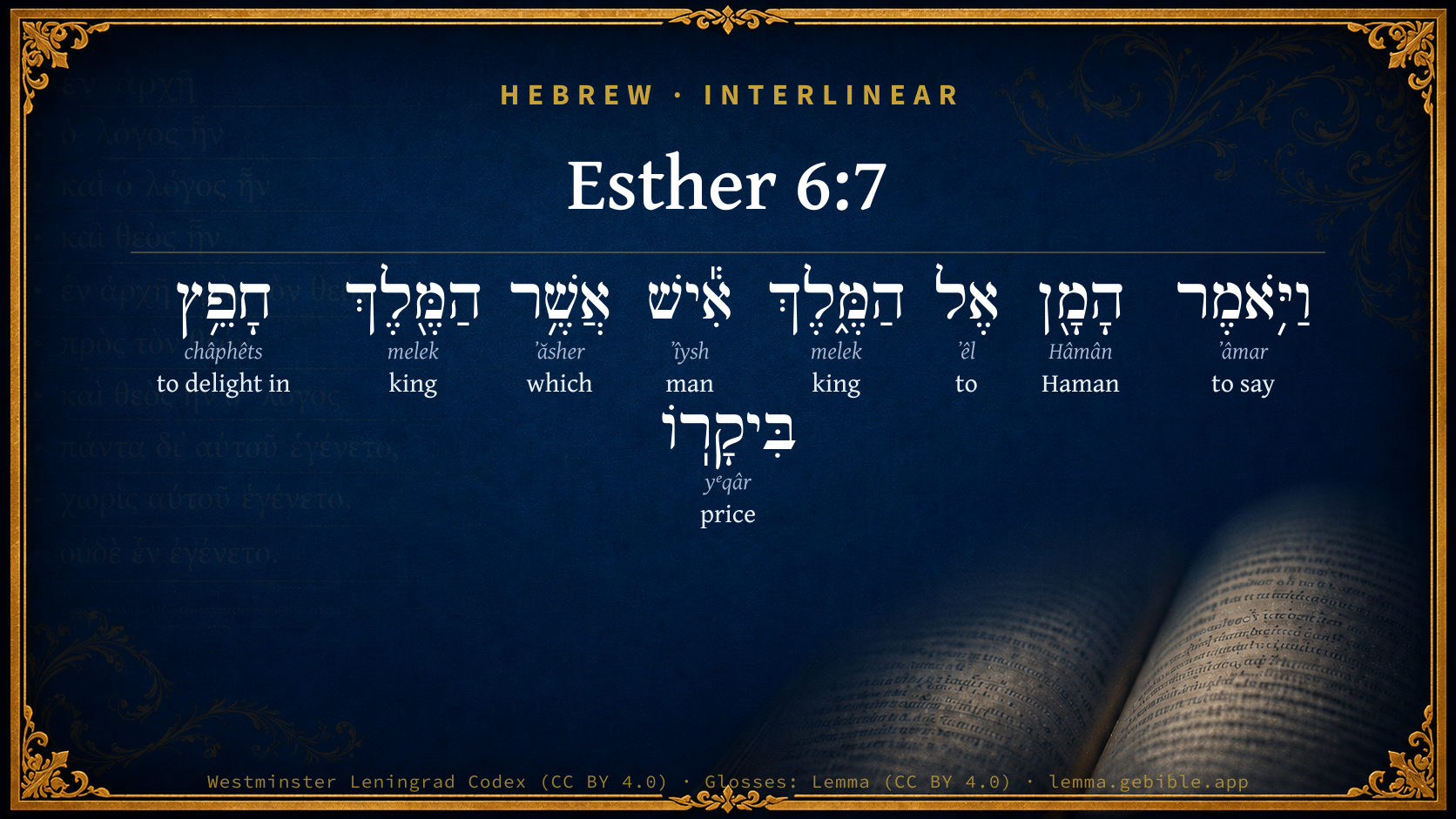
Esther 6:7

Hebrew (Westminster Leningrad Codex) Esther 6:7 appears in the Hebrew Old Testament. The text above is from the Westminster Leningrad Codex. Each word links to its Strong’s number, a concise gloss, and parsing drawn from the Open Scriptures Hebrew Bible morphology. Click any word for its full Brown-Driver-Briggs (BDB) entry.
Download image
Cite this verse

Esther 6:7 (World English Bible). Public Domain. Lemma interlinear Bible study tool, https://lemma.gebible.app/v/esther/6/7.

Show BibTeX & RIS
BibTeX
RIS
English Translation
Haman said to the king, For the man whom the king delights to honor,
World English Bible · Public Domain
Download a study sheet

One document with this verse’s original text, its word-by-word gloss line, the meaning frame, cross-references with their text, attributed commentary, and full source and license credits — printable, and it pastes into notes with its structure intact.

This verse Autodidact and up

Study sheet (.html) Plain text (.txt)

A passage Seminary Student

Up to 50 verses in one chapter. A passage sheet keeps up to 6 commentary sources and 12 cross-references per verse, in the order this page ranks them, and says so on the sheet whenever that leaves anything out. Ask for a single verse and you get the Autodidact verse sheet above.

Everything on this page stays free to read, with no account — the sheet is a download of what is already on screen, not access to it.

Want to remove ads? Support Godless Engineer
Compare translations 3

The same verse in 3 English versions, stacked beneath the original-language interlinear above. Click any original word for its lexicon entry.

Each is an independent rendering of the whole verse — the interlinear is not word-aligned to these translations.

Highlighted words mark where these versions differ — a whole-verse word diff, not a word-by-word alignment.

  • World English Bible Public Domain
    Haman said to the king, For the man whom the king delights to honor,
  • King James Version Public Domain
    And Haman answered the king, For the man whom the king delighteth to honour,
  • unfoldingWord Literal Text CC BY-SA 4.0
    And Haman said to the king, “For a man whom the king delights to honor:

unfoldingWord Literal Text — © unfoldingWord, licensed CC BY-SA 4.0. Word-aligned USFM3 via Door43 (git.door43.org/unfoldingWord/en_ult).

Versions to compare (up to 4)

3 of 4 selected

Show all 18 translations

Every available English version of this verse, each an independent rendering of the whole verse.

  • World English Bible Public Domain
    Haman said to the king, For the man whom the king delights to honor,
  • Berean Standard Bible Public Domain
    And Haman told the king, “For the man whom the king is delighted to honor,
  • Majority Standard Bible Public Domain
    And Haman told the king, “For the man whom the king is delighted to honor,
  • King James Version Public Domain
    And Haman answered the king, For the man whom the king delighteth to honour,
  • American Standard Version (1901) Public Domain
    And Haman said unto the king, For the man whom the king delighteth to honor,
  • Revised Version (1885) Public Domain
    And Haman said unto the king, For the man whom the king delighteth to honour,
  • Geneva Bible (1599) Public Domain
    And Haman answered the King, The man whome the King would honour,
  • Douay-Rheims (1899) Public Domain
    Answered: The man whom the king desireth to honour,
  • Young's Literal Translation Public Domain
    And Haman saith unto the king, `The man in whose honour the king hath delighted,
  • Literal Standard Version CC BY-SA 4.0
    And Haman says to the king, “The man in whose honor the king has delighted,
  • Unlocked Literal Bible CC BY-SA 4.0
    Haman said to the king, “For the man whom the king takes pleasure in honoring,
  • unfoldingWord Literal Text CC BY-SA 4.0
    And Haman said to the king, “For a man whom the king delights to honor:
  • Darby Bible Public Domain
    And Haman answered the king, For the man whom the king delights to honour,
  • World Messianic Bible Public Domain
    Haman said to the king, “For the man whom the king delights to honor,
  • Webster's Bible Public Domain
    And Haman answered the king, For the man whom the king delighteth to honor,
  • Free Bible Version CC BY-SA 4.0
    So Haman said to the king, “A man whom the king wants to honor
  • Bible in Basic English Public Domain
    And Haman, answering the king, said, For the man whom the king has delight in honouring,
  • JPS Tanakh (1917) Public Domain
    And Haman said unto the king: 'For the man whom the king delighteth to honour,

Literal Standard Version (2020), Covenant Press — licensed CC BY-SA 4.0. Text via the HelloAO Bible API (eBible.org). Unlocked Literal Bible (unfoldingWord) — licensed CC BY-SA 4.0. Text via the HelloAO Bible API (eBible.org). unfoldingWord Literal Text — © unfoldingWord, licensed CC BY-SA 4.0. Word-aligned USFM3 via Door43 (git.door43.org/unfoldingWord/en_ult). Free Bible Version, Dr. Jonathan Gallagher — licensed CC BY-SA 4.0. Text via the HelloAO Bible API (eBible.org).

Word by word

More ways to search: Search by grammar → Find every occurrence → Compare this word →

Practice this passage: Drill this verse → Learn its vocabulary →

בִּיקָרֽוֹ
yᵉqâr
H3366
“in/at · price · his”
Preposition + Noun, Common, Masculine, Singular, Construct + Suffix, Personal, 3rd Person, Masculine, Singular
Part of Speech
Preposition + Noun
Type
Common
Gender
Masculine
Number
Singular
State
Construct
Full BDB Definition

Origin: from H3365

TWOT: 905b

price, value, preciousness, honour, splendour, pomp - preciousness - price - honour, esteem
  1. וַיֹּ֥אמֶר ʼâmar H559 “and · to say” Conjunction + Verb, Qal, Sequential Imperfect, 3rd Person, Masculine, Singular
  2. הָמָ֖ן Hâmân H2001 “Haman” Noun, Proper
  3. אֶל ʼêl H413 “to” Preposition
  4. הַמֶּ֑לֶךְ melek H4428 “the · king” Particle, Definite Article + Noun, Common, Masculine, Singular, Absolute
  5. אִ֕ישׁ ʼîysh H376 “man” Noun, Common, Masculine, Singular, Absolute
  6. אֲשֶׁ֥ר ʼăsher H834 “which” Particle, Relative
  7. הַמֶּ֖לֶךְ melek H4428 “the · king” Particle, Definite Article + Noun, Common, Masculine, Singular, Absolute
  8. חָפֵ֥ץ châphêts H2654 “to delight in” Verb, Qal, Perfect, 3rd Person, Masculine, Singular

About this verse

These counts appear in no published source. They are computed here, from the morphology-tagged text and Lemma’s own curated glosses. What Lemma adds →

9
words
8
distinct lemmas
Historical
section

Notable vocabulary

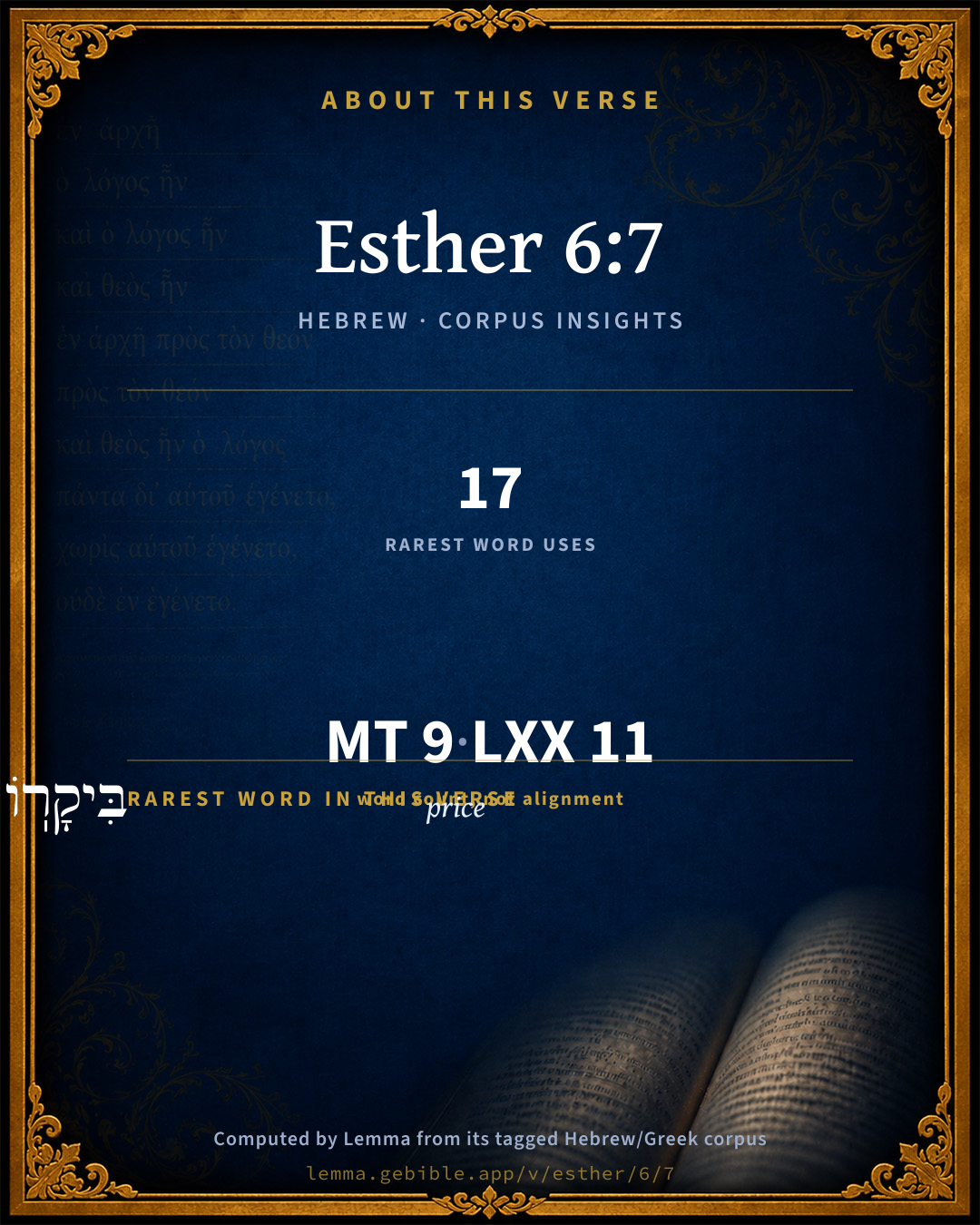
The rarest word here is בִּיקָרֽוֹ price H3366 — appearing just 17 times in the whole Hebrew Bible.

Shared distinctive vocabulary

בִּיקָרֽוֹ price H3366 occurs in 15 verses of the Hebrew Bible. Also found in:

Grammatical profile

  • 2 verbs
  • 5 nouns
  • 1 preposition
  • 1 particle

Verb forms

  • וַיֹּ֥אמֶר Qal · Sequential Imperfect
  • חָפֵ֥ץ Qal · Perfect

Repetition

A word recurs within this verse — often emphatic in Hebrew:

  • הַמֶּ֑לֶךְ king H4428 ×2

Hebrew & Septuagint length

In English translation the verse runs 14 words from the Hebrew and 16 from the Septuagint (LXX English) — closely comparable.

A rough comparison of the two English renderings, which tokenize alike — not a word-level alignment.

Word counts can differ between the Hebrew and the Greek without any difference in meaning — e.g. the Hebrew direct-object marker אֵת has no separate Greek word, and Greek often adds the article ὁ.

In the original languages it is 9 Hebrew tokens and 11 Greek tokens — but the two are counted differently (Hebrew bundles its prefixes and suffixes into one token; the Greek is in lemma form), so that isn’t a like-for-like length.

Cross-references

2

Topical passages linked to Esther 6:7 in the Treasury of Scripture Knowledge — connected by theme and wording, ordered by reader-vote popularity; previews shown in the World English Bible.

  • Esther 6:11 Then took Haman the clothing and the horse, and arrayed Mordecai, and caused him to ride through the street of the city, and proclaimed before him, Thus shall it be done to the man whom the king delights to honor.
  • Esther 6:9 and let the clothing and the horse be delivered to the hand of one of the king's most noble princes, that they may array the man therewith whom the king delights to honor, and cause him to ride on horseback through the street of the city, and proclaim before him, Thus shall it be done to the man whom the king delights to honor.

Cross-references courtesy of OpenBible.info (CC BY 4.0).

Hebrew and Greek witnesses Masoretic Hebrew ↔ Greek Septuagint

The same verse in the two great witnesses to the Old Testament, shown verse-for-verse.

These are two independent witnesses, not word-aligned to each other, and the Septuagint is shown in lemma (dictionary) form.

Hebrew Esther 6:7 Masoretic · Westminster Leningrad Codex

וַיֹּ֥אמֶר הָמָ֖ן אֶל הַמֶּ֑לֶךְ אִ֕ישׁ אֲשֶׁ֥ר הַמֶּ֖לֶךְ חָפֵ֥ץ בִּיקָרֽוֹ

Haman said to the king, For the man whom the king delights to honor,

World English Bible · Public Domain

Greek LXX Esther 6:7 Septuagint · lemma form

εἶπον δέ πρός ὁ βασιλεύς ἄνθρωπος ὅς ὁ βασιλεύς θέλω δοξάζω

and he said to the king, As for the man whom the king wishes to honor,

LXX2012 (modern English Septuagint) · Public Domain

Hebrew: Westminster Leningrad Codex (CC BY 4.0). Greek: Septuagint (public domain); English from LXX2012 (modern English Septuagint) (Public Domain). How the Septuagint differs from the Hebrew →

Commentary

Notes on Esther 6:7 from classic Christian and Jewish commentators (each source and its license shown beneath its notes). The classic Christian expositions comment on the surrounding passage and are grouped to its opening verse, so a note may address several verses; the Jewish commentaries on the Tanakh (Rashi and others) are per-verse, so they appear only where the commentator wrote on this verse.

Lemma curates 59 commentaries, every one of them public domain or Creative Commons licensed, each selected and text-cleaned for this edition rather than reprinted as found. About our sources →

Trapp's Complete Commentary

John Trapp

Est 6:7 And Haman answered the king, For the man whom the king delighteth to honour,

Ver. 7. And Haman answered the king] After a short pause, he had his answer ready; but making a bridge of his own shadow, he soon fell into the brook. Ambition rideth without reins, and like those horses, Amo 6:11 runneth upon the rocks, where first she breaks her hoofs, and then her neck. It seemeth, by that which followeth, that Haman aspired to the kingdom: why, else did he ask the crown royal, and the kings horse? &c. When David would declare Solomon his successor in the kingdom, he set him upon his own mule, 1Ki 1:33. But Haman little thought that his high hopes should end in a rope. So did Hanno’s, the Carthaginian, and Roger Mortimer’s in King Edward II’s time, and the false Edric in King Canute’s days; and lastly, Hadrian de Castello, an Italian legate, made by King Henry VII bishop of Hereford, who conspired with Alphonso Petruccio, and other sacred cardinals, to murder Pope Leo X, induced thereunto by the suggestion of a witch, who foretold to him, that one Hadrian, an old man of mean parentage, of great learning and wisdom, should succeed in the Papacy, the man, Haman-like, thought it must needs be himself; but another Hadrian, schoolmaster to Charles V, proved to be the man: and this our Hadrian lost by deprivation all his promotions whatsoever (for his life could not be come at) for his nefarious attempt (Paul Jovius).

For the man whom the king delighteth to honour] Heb. In whose honour the king delighteth. And what will not delight do, whether in good or evil? {See Trapp on "Mic 7:18"}

John Trapp, A Commentary or Exposition upon All the Books of the Old and New Testament (1647–1656) — public domain. Text from a community e-Sword module.

Joseph Benson's Commentary

Est 6:7-8. Haman answered, Let the royal apparel, &c. — Concluding he himself was the favourite intended, he prescribes the highest instances of honour that could for once be bestowed upon a subject; nay, he names honours too great to be conferred on any subject. Which the king useth to wear, &c. — Namely, the king’s outward garment, which was made of purple, interwoven with gold, as Justin and Curtius relate. To form a notion of that height of pride and arrogance at which Haman, who thought all the honours he specified were designed for himself, was arrived, we may observe, that for any one to put on the royal robe without the privity and consent of the king was among the Persians accounted a capital crime. And the horse that the king rideth upon — Namely, usually; which was well known, both by his excellence, and especially by his peculiar trappings and ornaments. And the crown royal which is set upon his head — Upon the king’s head. Thus he wished him to appear in all the pomp and grandeur of the king himself, only not to carry the sceptre, the emblem of power.

Joseph Benson's Commentary on the Old and New Testaments (1811–1818) — public domain. Text from a community e-Sword module.

Tyndale Open Study Notes

Tyndale Open Resources

6:7-9 Haman delighted in public acclaim and recognition. He wanted to be honored as the king, to wear kingly attire, and to ride the king’s horse; in other words, he wanted to be king for a day. • Haman thought another one of the king’s most noble officials would honor him through the streets of Susa. Instead, Haman himself would fill that role for Mordecai (6:10).

Tyndale Open Study Notes — © Tyndale Open Resources, licensed CC BY-SA 4.0. Text via the HelloAO Bible API.

The Cambridge Bible for Schools and Colleges

gen. ed. J. J. S. Perowne

7. For the man etc.] lit. The man etc., the broken character of the sentence shewing Haman’s eagerness and excitement.

The Cambridge Bible for Schools and Colleges (gen. ed. J. J. S. Perowne; Cambridge University Press, 1878–1918) — public domain. Text from a community e-Sword module.

John Gill's Exposition

And Haman answered the king,.... At once, being very prompt to suggest the honours he hoped to have done to himself:

for the man whom the king delighteth to honour; let the following things be done.

John Gill's Exposition of the Whole Bible (1746–1763) — public domain (CC PDM 1.0). Text via the HelloAO Bible API.

unfoldingWord translationNotes

Door43 World Missions Community

let royal robes be brought

This can be stated in active form. AT: "let someone bring royal robes" or "tell your servants to bring royal robes" (See: Active or Passive)

on whose head is the royal crest

The word "whose" refers to the horse. The royal crest is a special symbol that represents the king's family.

Then let the robes and the horse be given

This can be stated in active form. AT: "Then let them give the robes and the horse" or "Then tell them to give the robes and the horse" (See: Active or Passive)

Let them dress ... in honoring, and let them lead him

"Tell them to dress ... in honoring and to lead him"

Let them proclaim

"Tell the noble official and servants to proclaim"

translationWords

honor

royal

robe

horse

noble

preach

unfoldingWord translationNotes — © Distant Shores Media and the Door43 World Missions Community, licensed CC BY-SA 4.0. Source: git.door43.org/Door43/en_tn.

Lesson kit

Teaching starters — assembled from the data on this page, not authored interpretation. Every prompt links to the verse data it draws on. Edit before teaching.

Esther, in the Historical, opens this verse with 9 words (8 distinct Hebrew lemmas). Its most distinctive word is yᵉqâr (“price”). A historical commentator’s framing appears above. Read the whole chapter for the surrounding context.

Discussion questions

  1. The word yᵉqâr carries the sense “price.” How does it shape the verse?
  2. Esther 1:4 shares the word «price» with this verse. How do the two illuminate each other?
  3. “king” occurs 2× in this one verse. What is the effect of the repetition?
  4. These translations render this verse differently; the difference is in the English rendering, not the original. What questions does that raise?
  5. The verb «וַיֹּ֥אמֶר» is Qal Sequential Imperfect. How does its form color the action?
  6. Reading how Trapp's Complete Commentary and Joseph Benson's Commentary read this verse, where do the two commentators agree and where do they part?

Things to notice

Reading settings

Reading text

Shown beneath each verse's original-language words.

Old Testament
Old Testament edition

Read the OT as the Masoretic Hebrew (MT) or the Greek Septuagint (LXX).

English shown for the Greek Septuagint (in the Hebrew ↔ Greek comparison).

Comparing translations? Open the Compare panel on any verse page to stack up to four side by side.