
Exodus 21:16

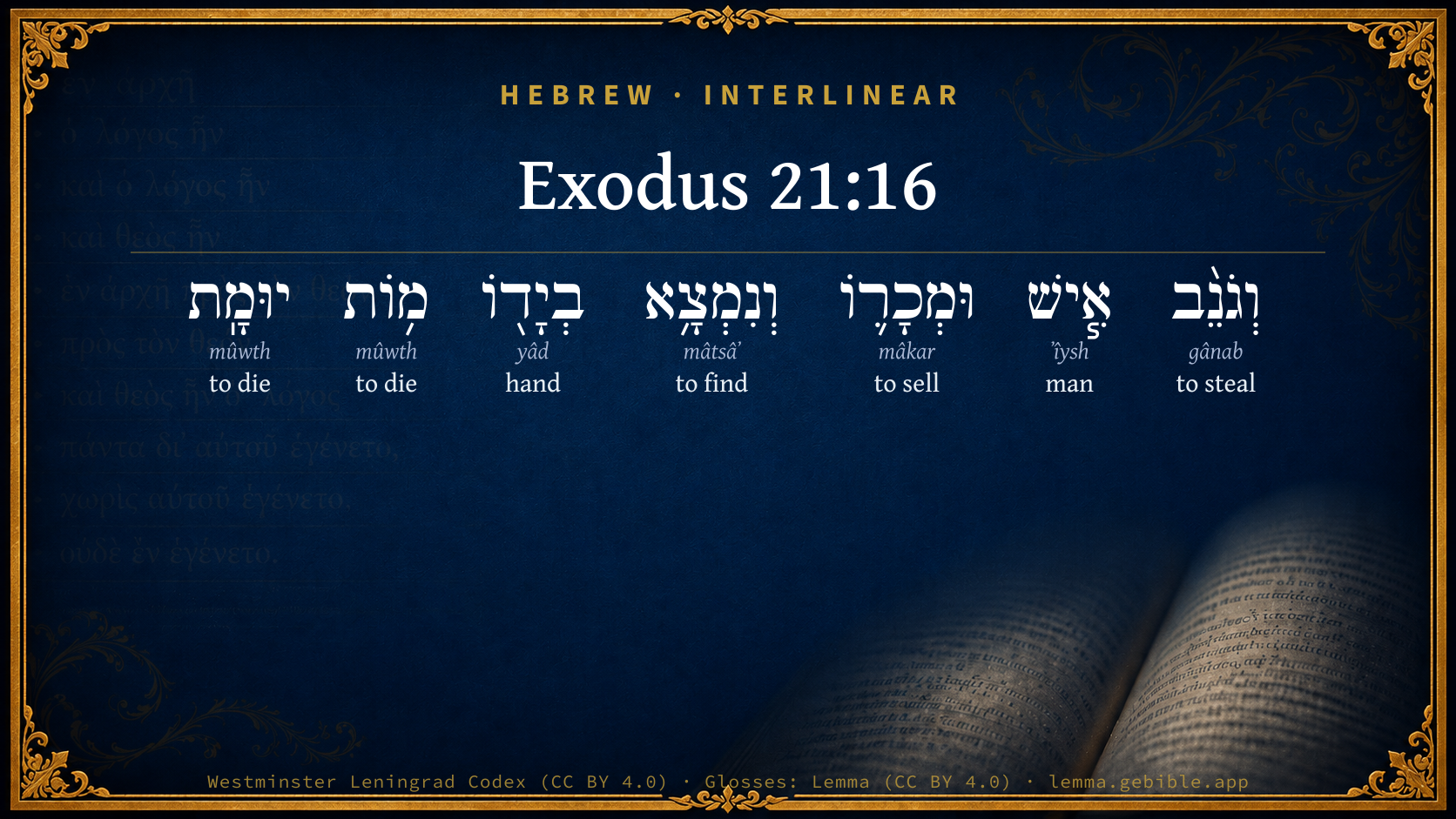
Hebrew (Westminster Leningrad Codex) Exodus 21:16 appears in the Hebrew Old Testament. The text above is from the Westminster Leningrad Codex. Each word links to its Strong’s number, a concise gloss, and parsing drawn from the Open Scriptures Hebrew Bible morphology. Click any word for its full Brown-Driver-Briggs (BDB) entry.
Download image
Cite this verse

Exodus 21:16 (World English Bible). Public Domain. Lemma interlinear Bible study tool, https://lemma.gebible.app/v/exodus/21/16.

Show BibTeX & RIS
BibTeX
RIS
English Translation
"Anyone who kidnaps someone and sells him, or if he is found in his hand, he shall surely be put to death.
World English Bible · Public Domain
Download a study sheet

One document with this verse’s original text, its word-by-word gloss line, the meaning frame, cross-references with their text, attributed commentary, and full source and license credits — printable, and it pastes into notes with its structure intact.

This verse Autodidact and up

Study sheet (.html) Plain text (.txt)

A passage Seminary Student

Up to 50 verses in one chapter. A passage sheet keeps up to 6 commentary sources and 12 cross-references per verse, in the order this page ranks them, and says so on the sheet whenever that leaves anything out. Ask for a single verse and you get the Autodidact verse sheet above.

Everything on this page stays free to read, with no account — the sheet is a download of what is already on screen, not access to it.

Want to remove ads? Support Godless Engineer
Compare translations 3

The same verse in 3 English versions, stacked beneath the original-language interlinear above. Click any original word for its lexicon entry.

Each is an independent rendering of the whole verse — the interlinear is not word-aligned to these translations.

Highlighted words mark where these versions differ — a whole-verse word diff, not a word-by-word alignment.

  • World English Bible Public Domain
    "Anyone who kidnaps someone and sells him, or if he is found in his hand, he shall surely be put to death.
  • King James Version Public Domain
    And he that stealeth a man, and selleth him, or if he be found in his hand, he shall surely be put to death.
  • unfoldingWord Literal Text CC BY-SA 4.0
    Whoever steals a man—whether he sells him, or he is found in his hand—he shall surely be put to death.

unfoldingWord Literal Text — © unfoldingWord, licensed CC BY-SA 4.0. Word-aligned USFM3 via Door43 (git.door43.org/unfoldingWord/en_ult).

Versions to compare (up to 4)

3 of 4 selected

Show all 18 translations

Every available English version of this verse, each an independent rendering of the whole verse.

  • World English Bible Public Domain
    "Anyone who kidnaps someone and sells him, or if he is found in his hand, he shall surely be put to death.
  • Berean Standard Bible Public Domain
    Whoever kidnaps another man must be put to death, whether he sells him or the man is found in his possession.
  • Majority Standard Bible Public Domain
    Whoever kidnaps another man must be put to death, whether he sells him or the man is found in his possession.
  • King James Version Public Domain
    And he that stealeth a man, and selleth him, or if he be found in his hand, he shall surely be put to death.
  • American Standard Version (1901) Public Domain
    And he that stealeth a man, and selleth him, or if he be found in his hand, he shall surely be put to death.
  • Revised Version (1885) Public Domain
    And he that stealeth a man, and selleth him, or if he be found in his hand, he shall surely be put to death.
  • Geneva Bible (1599) Public Domain
    And he that stealeth a man, and selleth him, if it be founde with him, shall die the death.
  • Douay-Rheims (1899) Public Domain
    He that shall steal a man, and sell him, being convicted of guilt, shall be put to death.
  • Young's Literal Translation Public Domain
    `And he who stealeth a man, and hath sold him, and he hath been found in his hand, is certainly put to death.
  • Literal Standard Version CC BY-SA 4.0
    And he who steals a man, and has sold him, and he has been found in his hand, is certainly put to death.
  • Unlocked Literal Bible CC BY-SA 4.0
    Whoever kidnaps a person—whether the kidnapper sells him, or that person is found in his hand—that kidnapper must be put to death.
  • unfoldingWord Literal Text CC BY-SA 4.0
    Whoever steals a man—whether he sells him, or he is found in his hand—he shall surely be put to death.
  • Darby Bible Public Domain
    And he that stealeth a man, and selleth him, or if he be found in his hand, he shall certainly be put to death.
  • World Messianic Bible Public Domain
    “Anyone who kidnaps someone and sells him, or if he is found in his hand, he shall surely be put to death.
  • Webster's Bible Public Domain
    And he that stealeth a man, and selleth him, or if he shall be found in his hand, he shall surely be put to death.
  • Free Bible Version CC BY-SA 4.0
    Anyone who kidnaps someone else must be executed, whether the victim is sold or is still in their possession.
  • Bible in Basic English Public Domain
    Any man who gets another into his power in order to get a price for him is to be put to death, if you take him in the act.
  • JPS Tanakh (1917) Public Domain
    And he that stealeth a man, and selleth him, or if he be found in his hand, he shall surely be put to death.

Literal Standard Version (2020), Covenant Press — licensed CC BY-SA 4.0. Text via the HelloAO Bible API (eBible.org). Unlocked Literal Bible (unfoldingWord) — licensed CC BY-SA 4.0. Text via the HelloAO Bible API (eBible.org). unfoldingWord Literal Text — © unfoldingWord, licensed CC BY-SA 4.0. Word-aligned USFM3 via Door43 (git.door43.org/unfoldingWord/en_ult). Free Bible Version, Dr. Jonathan Gallagher — licensed CC BY-SA 4.0. Text via the HelloAO Bible API (eBible.org).

Word by word

More ways to search: Search by grammar → Find every occurrence → Compare this word →

Practice this passage: Drill this verse → Learn its vocabulary →

וְגֹנֵ֨ב
gânab
H1589
“and · stealing”
Conjunction + Verb, Qal, Participle Active, Masculine, Singular, Absolute
Part of Speech
Conjunction + Verb
Stem
Qal
Form
Participle Active
Gender
Masculine
Number
Singular
State
Absolute
Full BDB Definition

Origin: a primitive root

TWOT: 364

to steal, steal away, carry away - (Qal) to steal - (Niphal) to be stolen - (Piel) to steal away - (Pual) to be stolen away, be brought by stealth - (Hithpael) to go by stealth, steal away
  1. אִ֧ישׁ ʼîysh H376 “man” Noun, Common, Masculine, Singular, Absolute
  2. וּמְכָר֛וֹ mâkar H4376 “and · to sell · him” Conjunction + Verb, Qal, Sequential Perfect, 3rd Person, Masculine, Singular + Suffix, Personal, 3rd Person, Masculine, Singular
  3. וְנִמְצָ֥א mâtsâʼ H4672 “and · to find” Conjunction + Verb, Niphal, Sequential Perfect, 3rd Person, Masculine, Singular
  4. בְיָד֖וֹ yâd H3027 “in/at · hand · his” Preposition + Noun, Common, Both, Singular, Construct + Suffix, Personal, 3rd Person, Masculine, Singular
  5. מ֥וֹת mûwth H4191 “to die” Verb, Qal, Infinitive Absolute
  6. יוּמָֽת mûwth H4191 “to die” Verb, Hophal, Imperfect, 3rd Person, Masculine, Singular

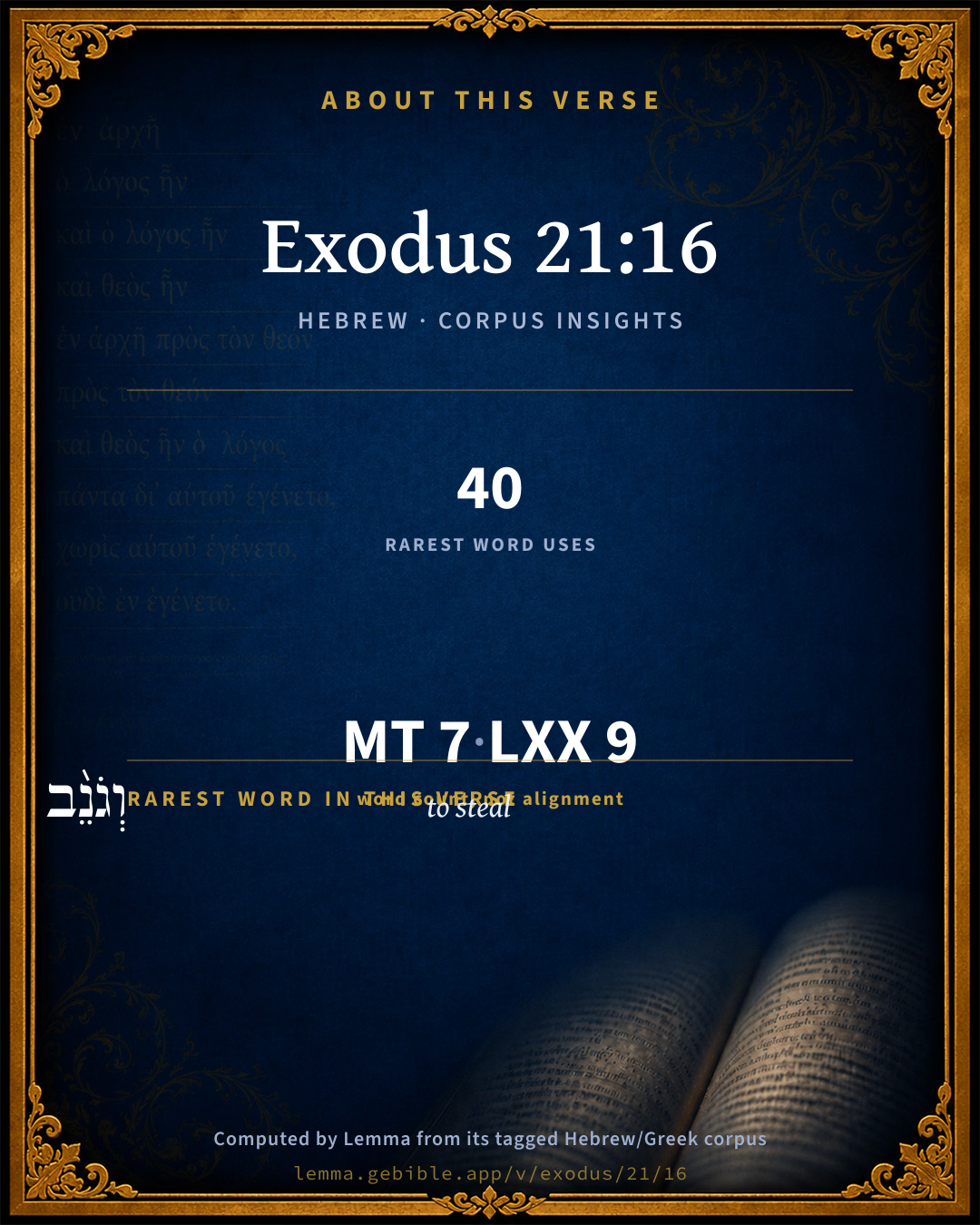
About this verse

These counts appear in no published source. They are computed here, from the morphology-tagged text and Lemma’s own curated glosses. What Lemma adds →

7
words
6
distinct lemmas
Pentateuch
section

Shared distinctive vocabulary

וְגֹנֵ֨ב to steal H1589 occurs in 36 verses of the Hebrew Bible. Also found in:

Grammatical profile

  • 5 verbs
  • 2 nouns

Verb forms

  • וְגֹנֵ֨ב Qal · Participle Active
  • וּמְכָר֛וֹ Qal · Sequential Perfect
  • וְנִמְצָ֥א Niphal · Sequential Perfect
  • מ֥וֹת Qal · Infinitive Absolute
  • יוּמָֽת Hophal · Imperfect

Repetition

A word recurs within this verse — often emphatic in Hebrew:

  • מ֥וֹת to die H4191 ×2

Hebrew & Septuagint length

In English translation the verse runs 22 words from the Hebrew and 11 from the Septuagint (LXX English) — the Septuagint runs noticeably shorter here. See the side-by-side →

A rough comparison of the two English renderings, which tokenize alike — not a word-level alignment.

Word counts can differ between the Hebrew and the Greek without any difference in meaning — e.g. the Hebrew direct-object marker אֵת has no separate Greek word, and Greek often adds the article ὁ.

In the original languages it is 7 Hebrew tokens and 9 Greek tokens — but the two are counted differently (Hebrew bundles its prefixes and suffixes into one token; the Greek is in lemma form), so that isn’t a like-for-like length.

Cross-references

5

Topical passages linked to Exodus 21:16 in the Treasury of Scripture Knowledge — connected by theme and wording, ordered by reader-vote popularity; previews shown in the World English Bible.

  • Deuteronomy 24:7 If a man be found stealing any of his brothers of the children of Israel, and he deal with him as a slave, or sell him; then that thief shall die: so shall you put away the evil from the midst of you.
  • 1 Timothy 1:10 for the sexually immoral, for homosexuals, for slave-traders, for liars, for perjurers, and for any other thing contrary to the sound doctrine;
  • Genesis 37:28 Midianites who were merchants passed by, and they drew and lifted up Joseph out of the pit, and sold Joseph to the Ishmaelites for twenty pieces of silver. They brought Joseph into Egypt.
  • Exodus 22:4 If the stolen property is found in his hand alive, whether it is ox, donkey, or sheep, he shall pay double.
  • Genesis 40:15 For indeed, I was stolen away out of the land of the Hebrews, and here also have I done nothing that they should put me into the dungeon."

Cross-references courtesy of OpenBible.info (CC BY 4.0).

Hebrew and Greek witnesses Masoretic Hebrew ↔ Greek Septuagint

The same verse in the two great witnesses to the Old Testament, shown verse-for-verse.

Here the Septuagint runs noticeably shorter than the Hebrew — LXX2012 (modern English Septuagint) 11 words vs World English Bible 22. A rough length comparison of the two English translations, not a word-level alignment — read both below.

These are two independent witnesses, not word-aligned to each other, and the Septuagint is shown in lemma (dictionary) form.

Hebrew Exodus 21:16 Masoretic · Westminster Leningrad Codex

וְגֹנֵ֨ב אִ֧ישׁ וּמְכָר֛וֹ וְנִמְצָ֥א בְיָד֖וֹ מ֥וֹת יוּמָֽת

"Anyone who kidnaps someone and sells him, or if he is found in his hand, he shall surely be put to death.

World English Bible · Public Domain

Greek LXX Exodus 21:16 Septuagint · lemma form

ὁ κακολογέω πατήρ αὐτός ἤ μήτηρ αὐτός τελευτάω θάνατος

He that reviles his father or his mother shall surely die.

LXX2012 (modern English Septuagint) · Public Domain

On this verse, The Cambridge Bible for Schools and Colleges discusses the Septuagint’s reading. Read the note in Commentary ↓

Hebrew: Westminster Leningrad Codex (CC BY 4.0). Greek: Septuagint (public domain); English from LXX2012 (modern English Septuagint) (Public Domain). How the Septuagint differs from the Hebrew →

Targum (Aramaic paraphrase)

2

The Targum is the ancient Jewish Aramaic paraphrase of the Hebrew Scriptures — an interpretive translation, not the Hebrew text itself. Onkelos (literal) and Pseudo-Jonathan (expansive) render the Torah, and Jonathan the Prophets. Coverage is partial: where no permissively-licensed English translation exists for a verse, only the Aramaic is shown. This is verse-level text, not a word-by-word alignment to the Hebrew.

  1. Targum Onkelos Torah (Genesis–Deuteronomy)
    וְדִיִגְנוּב נַפְשָׁא מִן בְּנֵי יִשְׂרָאֵל וִיזַבְּנִנֵהּ וְיִשְׁתְּכַח בִּידֵהּ אִתְקְטָלָא יִתְקְטֵל:

    (no public-domain English translation for this verse)

    Targum Onkelos — Aramaic: “Onkelos Genesis” (public domain); “Onkelos Exodus” (public domain); “Onkelos Leviticus” (public domain); “Onkelos Numbers” (public domain); “Onkelos Deuteronomy” (public domain). English: “Sefaria Community Translation” (CC0 1.0 (public-domain dedication)); “J.W. Etheridge. The Targums of Onkelos and Jonathan Ben Uzziel on the Pentateuch. London: Longmans, Green, 1862” (public domain). Text via Sefaria.

  2. Targum Pseudo-Jonathan Torah (Genesis–Deuteronomy)
    וּדְיִגְנוֹב נֶפֶשׁ מִבְּנֵי יִשְרָאֵל וִיזַבְּנִינֵיהּ וְיִשְׁתַּכַּח בִּרְשׁוּתֵיהּ אִתְקְטָלָא יִתְקְטֵיל בְּשִׁינוּקָא דְסוּדְרָא

    And he who stealeth a soul of the children of Israel, and selleth him, or if he be found in his possession, shall die by strangling.

    Targum Pseudo-Jonathan — Aramaic: “Targum Jonathan on Genesis” (public domain); “Targum Jonathan on Exodus” (public domain); “Targum Jonathan on Leviticus” (public domain); “Targum Jonathan on Numbers” (public domain); “Targum Jonathan on Deuteronomy” (public domain). English: “The Targum of Jonathan ben Uzziel, trans. J. W. Etheridge, London, 1862” (public domain). Text via Sefaria.

Commentary

Notes on Exodus 21:16 from classic Christian and Jewish commentators (each source and its license shown beneath its notes). The classic Christian expositions comment on the surrounding passage and are grouped to its opening verse, so a note may address several verses; the Jewish commentaries on the Tanakh (Rashi and others) are per-verse, so they appear only where the commentator wrote on this verse.

Lemma curates 59 commentaries, every one of them public domain or Creative Commons licensed, each selected and text-cleaned for this edition rather than reprinted as found. About our sources →

Trapp's Complete Commentary

John Trapp

Exo 21:16 And he that stealeth a man, and selleth him, or if he be found in his hand, he shall surely be put to death.

Ver. 16. He that stealeth a man.] Akin to these are they that steal other men’s books, and father them, setting them out in their own names. Diagoras was so served by a plagiary, which, when he saw, and that the thief was not presently struck with a thunderbolt, he, out of stomach, turned atheist. Thus, of late, Fabricius stole Tremelius’s Syriac translation. Villavincentius stole Hyperius’s treatise, "De Ratione Studii Theologici." And Possevinus stole Dr James’s "Cyprianus Redivivus."

John Trapp, A Commentary or Exposition upon All the Books of the Old and New Testament (1647–1656) — public domain. Text from a community e-Sword module.

The Biblical Illustrator

Joseph S. Exell

Exo_21:16

He that stealeth a man.

About kidnapping

The same law is repeated in Deu_24:7; from which passage it is evident that it treats of kidnapping a Hebrew. And thus the severity of the punishment, death, without the possibility of redemption, cannot appear surprising. For all Israelites are considered as free citizens with inalienable and equal rights, of which they can never be entirely divested. Now it is natural that he who steals an Israelite will, in the rarest cases, keep him as his slave or sell him to an Israelite, as the injured person could, in the Holy Land, easily find means to inform the authorities of his fate, and thus cause the punishment of his criminal master. The latter, therefore, generally sold the kidnapped individual to foreign merchants into distant lands, either to Egyptians, who commanded the land commerce to the south, or to Phoenicians, who influenced the trade to the west; and opportunities of selling must have easily offered themselves, as Palestine was situated in the exact centre of the commerce of the East. But by such sale, free Israelites became permanent slaves; they forfeited with their liberty their chief characteristic as Hebrews, and were thus lost to the Hebrew community, the more so, as the exclusive intercourse with pagans must necessarily defile the purity of their faith, and gradually accustom their thoughts to idolatry. For this reason it was in the Mosaic law, interdicted to sell even thieves into foreign countries, because thereby souls are, as it were, extirpated from Israel. Thus he who kidnapped Israelites and sold them to other countries justly deserved death, especially if we consider the most melancholy and bitter lot to which the slaves of heathen nations were generally doomed. (M. M. Kalisch, P h. D.)

Unrighteousness of slave holding

At the time slaves were held in the State of New York, one of them, escaping into Vermont, was captured and taken before the court at Middlebury by his owner, who asked the court to give him possession of his slave property. Judge Harrington listened attentively to the proofs of ownership, but said that he was not convinced that the title was perfect. Then the counsel asked what more was required. Until you bring me a bill of sale from God Almighty you cannot have this man. (J. Swinton.)

The Biblical Illustrator, edited by Joseph S. Exell (c. 1880s–1900s) — public domain. Text from a community e-Sword module.

Joseph Benson's Commentary

Exo 21:16. He that stealeth a man — Whether he keep him in his own hands for his own use, or sell him, still it is a theft of a heinous kind, and the man-stealer deserves death. It appears from 1Ti 1:9-10, that this law was not meant to be of a merely temporary nature, but of standing force.

Joseph Benson's Commentary on the Old and New Testaments (1811–1818) — public domain. Text from a community e-Sword module.

Adam Clarke's Commentary

Verse 16. He that stealeth a man] By this law every man-stealer, and every receiver of the stolen person, should lose his life; no matter whether the latter stole the man himself, or gave money to a slave captain or negro-dealer to steal him for him.

Adam Clarke's Commentary on the Bible (1810–1826) — public domain. Text from a community e-Sword/MySword module.

The Cambridge Bible for Schools and Colleges

gen. ed. J. J. S. Perowne

16. Man-stealing. Cf. Deu_24:7, where the present law is merely expanded, and recast in Deuteronomic phraseology.

a man] in Deu_24:7, expressly limited to an Israelite: so LXX Targ. add here, ‘of the children of Israel.’ No doubt this interprets correctly the intention of the law.

and selleth him] into a foreign country is probably what is thought (cf. v. 8). This would not only sever the victim cruelly from his own people, and his own religion (1Sa_26:19), but also expose him to many risks of death. The Phoenicians (Amo_1:9, and, at a later time, Joe_3:4-6), to say nothing of other nations (Gen_37:36), would be ready purchasers of slaves.

or if he be found in his hand] i.e. if he has not yet actually sold him.

shall be put to death] The same punishment in Ḥamm. § 14. At Athens, the ἀνδραποδιστής, who enslaved a free man, or enticed away another person’s slave, was punished with death (Hermann, Griech. Antiq. iii. §§ xii. 12; lxii. 12: cf. Demosth. Phil. i. p. 53 end, § 47; Xen. Memor. i. 2. 62): among the Romans both the seller and the buyer of a free-born citizen were punished with death (Kn.).

The Cambridge Bible for Schools and Colleges (gen. ed. J. J. S. Perowne; Cambridge University Press, 1878–1918) — public domain. Text from a community e-Sword module.

John Gill's Exposition

And he that stealeth a man, and selleth him,.... One of the children of Israel, as the Targums of Onkelos and Jonathan, and so the Septuagint version: but though this law was given to the Israelites primarily, yet was made for men stealers in general, as the apostle observes, who plainly has reference to it, Ti1 1:9,

or if he be found in his hand; before the selling of him, as Jarchi notes, since he stole him in order to sell him, he was guilty of death, as follows:

he shall surely be put to death; with strangling, as the same Jewish writer remarks, as on the preceding verse; and Jarchi sets it down as a rule, that all death in the law, simply expressed, is strangling.

John Gill's Exposition of the Whole Bible (1746–1763) — public domain (CC PDM 1.0). Text via the HelloAO Bible API.

Matthew Poole's English Annotations

i.e. In the manstealer’s hand; q.d. though he keep him in his own hands for his own use; for still it is a theft, and he is made that man’s slave, and it is in his power to sell him to another when he pleaseth, and therefore deserves death.

Matthew Poole's English Annotations on the Holy Bible (1683–1685) — public domain. Text from a community e-Sword/MySword module.

Whedon's Commentary on the Bible

Daniel D. Whedon

16, 17. Stealeth a man — Note that manstealing was placed on the same plane with the crime of murder. Cursing a parent was also treated as a capital offence.

Daniel D. Whedon (gen. ed.), Commentary on the Old and New Testaments (1874–1909) — public domain. Text from a community e-Sword module.

The Pulpit Commentary

He that stealeth a man. Kidnapping, or stealing men to make them slaves, was a very early and very wide-spread crime. Joseph"s brothers must be regarded as having committed it; (Gen_37:28) and there are many traces of it in the remains of antiquity. (See Heb 4:183; Strab. 7. p. 467; Sueton. Octav. etc.) Most kidnapping was of foreigners; and this was a practice of which the laws of states took no cognizance, though a certain disrepute may have attached to it. But the kidnapping of a fellow-country-man was generally punished with severity. At Athens it was a capital offence. At Rome it made a man infamous. We may gather from Deu_24:7, that the Mosaic law was especially levelled against this lena of the crime, though the words of the present passage are general, and forbid the crime altogether. Man-stealing, in the general sense, is now regarded as an offence by the chief civilised states of Europe and America, and is punished by confiscation of the stolen goods, and sometimes by imprisonment of the man-stealers.

The crime of man-stealing.

To steal the purse of a man is a trivial crime; to filch his good name is a serious one; but the worst robbery of all is to steal his person. Civilised, refined, polished, intellectual men, happy in the enjoyment of freedom, wealth, honour, domestic happiness, have gone to sleep in comfort, peace, and fancied security, to wake up in the grip of lawless man-stealers, who have bound them and carried them into a hopeless captivity, far from any relative or friend, to become familiar with every sort of ill-usage and indignity. Cilician and other pirates did this in the olden time; Norman sea-kings in the middle ages; Algerine corsairs so late as the last century. The blood boils when we think of the sufferings inflicted on thousands of our species by these fiends in human shape, without pity, without conscience, without remorse. Death was certainly a punishment not one whit too severe for this atrocious crime, by which the happiest of the human race might become suddenly one of the most wretched. In modern times, the conscience of mankind, enlightened by eighteen centuries of Christianity, has revolted against the enormity long committed with impunity on the negro races of Western Africa, and the slave-trade has been proclaimed a form of piracy. Yet the accursed traffic still continues in the centre and in the east of the "Dark Continent;" still quiet villagers are awakened in the dead of night by the news that the kidnapper is upon them; harmless, peaceable men, together with their wives and children, are carried off in hundreds by Arab and sometimes by so-called Christian traders, driven to the coast in gangs, shipped in crowded dhows, and sold to the best bidder in the marts of Arabia and Persia. It is a subject well worthy the consideration of Christian governments, whether a revival of the Mosaic enactment is not required, to stop a trade the profits of which are so enormous, that nothing short of death is likely to deter avaricious men from engaging in it.

The Pulpit Commentary (1880–1919), ed. H.D.M. Spence-Jones & Joseph S. Exell — public domain. Text from a community e-Sword module.

Rashi

Rabbi Shlomo Yitzchaki (Rashi)

וגנב איש ומכרו AND HE THAT STEALETH A MAN, AND SELLETH HIM, [AND HE BE PREVIOUSLY FOUND IN HIS HAND, HE SHALL SURELY BE PUT TO DEATH] — Why is this statement made (how does the particular form of words used here tell us some point of law which is not contained in another text bearing upon the same subject)? Since it is said, (Deuteronomy 24:7) “If a man be found stealing any of his brethren … [then that thief shall die]”, I might say that I have here only the law that a man who stole a person is punishable with death. Whence, however, do I know that this is also the case if a woman or a person whose sex is not distinguishable or a hermaphrodite (טומטום ואנדרונינוס) has stolen a person? Scripture therefore states here: “Whosoever stealeth a man and selleth him”. — And again, since Scripture states here: “He that stealeth a man [shall be put to death]”, I might say that I have here only the law that if one steals a man he is punishable with death. Whence do I know that this is also the case if he has stolen a woman? Therefore Scripture states, (Deuteronomy 24:7) “[If a man be found] stealing any person [he shall be put to death]”. Consequently both verses are necessary: what the one omits the other tells us (Mekhilta; Sanhedrin 85b).

ונמצא בידו implies that witnesses have seen him stealing and also saw him selling the person, and that he has been found in his possession before he had sold him (Mekhilta).

מות יומת HE SHALL SURELY BE PUT TO DEATH — by strangulation. Wherever the death-penalty is mentioned in Scripture without being precisely defined strangulation is intended (Mekhilta; Sanhedrin 84b). [It should be noted that Scripture interrupted the context by writing “Whosoever stealeth etc.” between the passages, “He that smiteth his father etc.” and “He that curseth his father etc.”, which passages ought on account of their contents to follow one after the other. I think that this gave rise to the difference of opinion found in Sanhedrin 85a where one Rabbi holds that we must put “smiting” on an equality with “cursing”, in spite of the text being interrupted by the verse וגונב, which, however, is placed between them only to teach that in some respects “smiting” and “cursing” have not the same law, — that after the death of the parents “cursing” them is punishable whilst “smiting” them is not; whilst another bolds that since the two verses have been disconnected “smiting” can by no means be put on an equality with, and have the same legal consequenses as, “cursing” (cf. Sanhedrin 85b)].

Rashi on the Tanakh — English translations: “The Judaica Press complete Tanach with Rashi, translated by A. J. Rosenberg” (CC BY 4.0); “Pentateuch with Rashi's commentary by M. Rosenbaum and A.M. Silbermann, 1929-1934” (public domain); “The Metsudah Tanach series, Lakewood, N.J” (CC BY 4.0); and “The Book of Joshua, Metsudah Publications, 1997” (CC BY 4.0). Text via Sefaria.

Ramban (Nachmanides)

Rabbi Moshe ben Nachman (Ramban / Nachmanides)

AND HE THAT STEALETH A MAN, AND SELLETH HIM, AND HE BE FOUND IN HIS HAND — “previously, before the sale.” This is Rashi’s language. But I have not understood it., it would appear that the fact that the witnesses saw him in his possession constitutes their proof that the holder stole him. On this, Ramban asked: could you possibly think that the thief be subject to death without the witnesses having seen the actual theft and the sale? Their having seen him in the thief’s possession is in fact no proof at all that he had stolen him (Nimukei Shmuel). If Rashi means that witnesses must have seen him [the stolen person] in the thief’s possession before he had sold him — could it even enter your mind that the thief be subject to the death penalty without witnesses having seen him stealing and also seeing him selling! It would therefore have been sufficient if Scripture were to say: “and he that stealeth a man and selleth him”. Further, his being found in the thief’s possession is no real proof that he stole him! Rather, this verse is the source for that which we have been taught in a Mishnah: “He that steals a person is not liable to the punishment unless he brings him into his own possession,” and in a Beraitha the Rabbis have said: “If he stole him but did not sell him, or if he sold him but he is still in his [the thief’s], possession, he is free [from the death penalty].” The meaning of this is to teach us that the law applying to the thief of a human being is [in one respect] similar to that of thieves of other, i.e., monetary, matters; namely, that if a thief killed or sold [an ox or a sheep] within the domain of the owner, he is free [from paying five oxen for an ox and four sheeps for a sheep], but if he lifted them up [thereby acquiring possession of them], or removed them from the domain of the owner, he is liable to pay. Similarly, this thief of a human being must first have brought the stolen person into his own domain [in order to be liable to death]. Likewise if he lifted the lad upon his shoulder, and sold him to another person, he is liable to the death penalty, because this too is called if he be found in his hand, since it is not logical that a man’s ground should have a greater power of taking possession of a thing for the owner, than his own hand has. In a similar way, that which the Rabbis said [in the Beraitha mentioned above]: “or if he sold him but he is still in his [the thief’s] possession etc.,” means that the buyer did not remove him at all from the thief’s domain, even though he paid him the money, and since he did not remove him from there, the thief is free [from the death penalty]. Now I do not know whether this is to say that [in order to make the thief of a human being liable to the death penalty] the buyer must perform a formal act of acquisition, as is the law in other transactions, that the buyer does not take ownership of the article until he draws it from the domain of the seller into a simta, [an alley adjoining an open place] or until he lifts it [even within the domain of the seller] — or it may be that it is a special Scriptural decree in the case of the sale of a stolen human being, that even if the sale has been finalized between them, and the buyer has taken ownership from the seller by lifting him or by drawing him along in ground which belongs to both of them, [in which case usually the act of drawing the purchased article is a valid act of acquisition even if not done in a simta], that the thief is nonetheless free from the death penalty until the stolen person goes out from his domain into the domain of the buyer. And so indeed it would appear to be [as the latter exposition].Now Rashi in his commentaries there in the Gemara explained [the phrase of the Beraitha]: “if he sold him but he is still in his possession” as meaning “if he is still in the stolen person’s domain,. in which case the thief is free from punishment because there has been no real theft at all.” But if so, nothing new has been established here which is unlike the ordinary law of theft in monetary matters! However, it may be, the words of the verse [to be interpreted properly, must be transposed as follows]: “and he that stealeth a man, and he be found in his hand, and he selleth him, he shall surely be put to death.” But it is still possible that the verse may be explained properly in the order it is written in. Thus: And he that stealeth a man, and selleth him, and he be found in the hand of the buyer [he — the thief — shall surely be put to death]; for if he stole a human being and brought him to his house, and then he brought the buyer there and sold him without the buyer taking him out from there, the thief is not liable, because the sale has not been completed between them, or even if the sale has been completed, he is still free of the death penalty, as I have written above.

Ramban (Nachmanides) on the Tanakh — English translation: “Commentary on the Torah by Ramban (Nachmanides). Translated and annotated by Charles B. Chavel. New York, Shilo Pub. House, 1971-1976” (CC BY 4.0). Text via Sefaria.

Lesson kit

Teaching starters — assembled from the data on this page, not authored interpretation. Every prompt links to the verse data it draws on. Edit before teaching.

Exodus, in the Pentateuch, opens this verse with 7 words (6 distinct Hebrew lemmas). Its most distinctive word is gânab (“to steal”). The Greek Septuagint runs shorter here. A historical commentator’s framing appears above. Read the whole chapter for the surrounding context.

Discussion questions

  1. The word gânab carries the sense “to steal.” How does it shape the verse?
  2. Genesis 30:33 shares the word «to steal» with this verse. How do the two illuminate each other?
  3. “to die” occurs 2× in this one verse. What is the effect of the repetition?
  4. Compared with the Hebrew, the Septuagint runs shorter here. What questions does that raise?
  5. The translations on this page render this verse differently — a whole-verse word diff, not a word-by-word alignment. What might account for the different wordings?
  6. The verb «וְגֹנֵ֨ב» is Qal Participle Active. How does its form color the action?
  7. Reading how Trapp's Complete Commentary and The Biblical Illustrator read this verse, where do the two commentators agree and where do they part?

Things to notice

Reading settings

Reading text

Shown beneath each verse's original-language words.

Old Testament
Old Testament edition

Read the OT as the Masoretic Hebrew (MT) or the Greek Septuagint (LXX).

English shown for the Greek Septuagint (in the Hebrew ↔ Greek comparison).

Comparing translations? Open the Compare panel on any verse page to stack up to four side by side.