Exodus 18:16

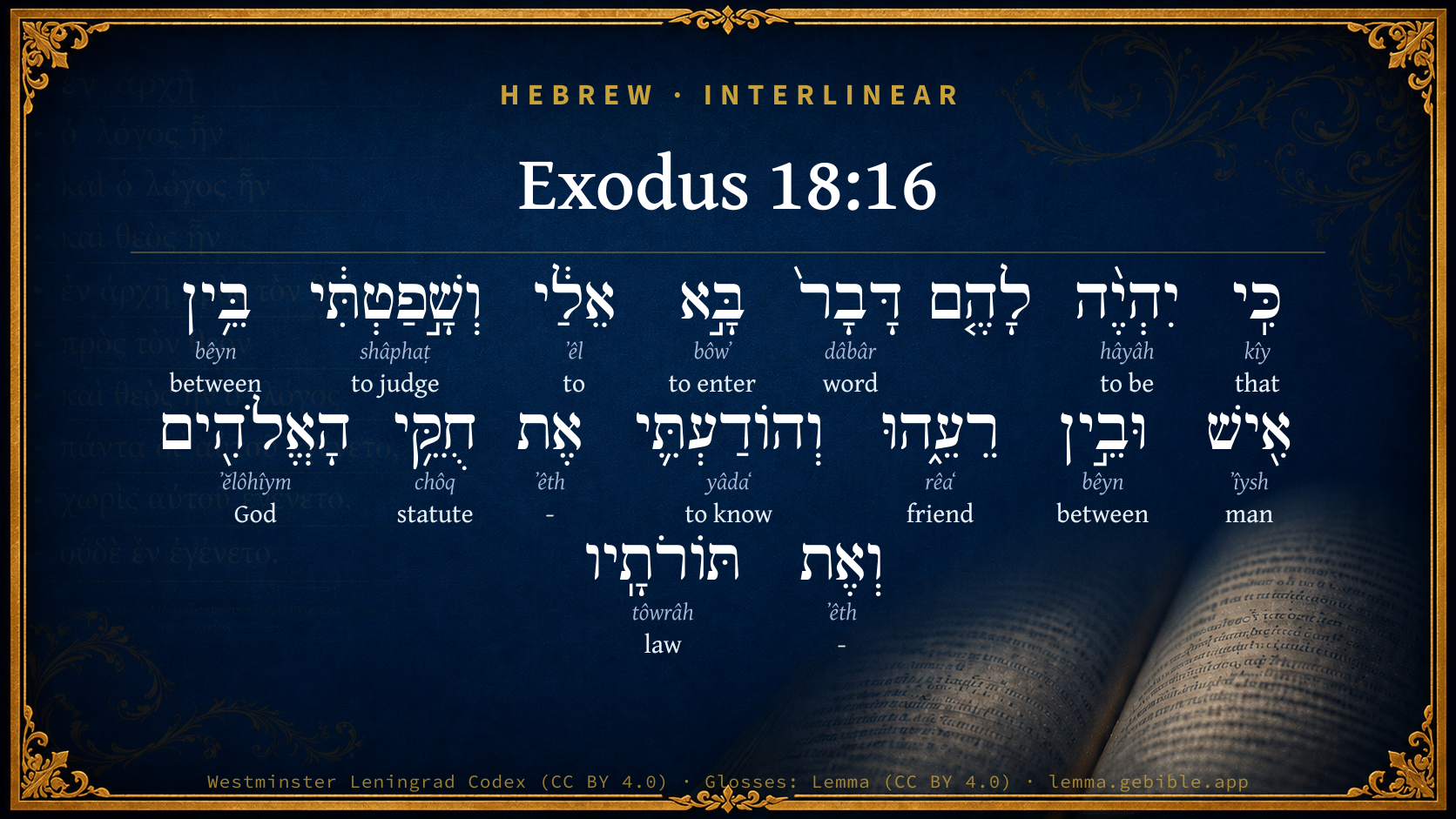
Hebrew (Westminster Leningrad Codex) Exodus 18:16 appears in the Hebrew Old Testament. The text above is from the Westminster Leningrad Codex. Each word links to its Strong’s number, a concise gloss, and parsing drawn from the Open Scriptures Hebrew Bible morphology. Click any word for its full Brown-Driver-Briggs (BDB) entry.
Download image
Cite this verse

Exodus 18:16 (World English Bible). Public Domain. Lemma interlinear Bible study tool, https://lemma.gebible.app/v/exodus/18/16.

Show BibTeX & RIS
BibTeX
RIS
English Translation
When they have a matter, they come to me, and I judge between a man and his neighbor, and I make them know the statutes of God, and his laws."
World English Bible · Public Domain
Download a study sheet

One document with this verse’s original text, its word-by-word gloss line, the meaning frame, cross-references with their text, attributed commentary, and full source and license credits — printable, and it pastes into notes with its structure intact.

This verse Autodidact and up

Study sheet (.html) Plain text (.txt)

A passage Seminary Student

Up to 50 verses in one chapter. A passage sheet keeps up to 6 commentary sources and 12 cross-references per verse, in the order this page ranks them, and says so on the sheet whenever that leaves anything out. Ask for a single verse and you get the Autodidact verse sheet above.

Everything on this page stays free to read, with no account — the sheet is a download of what is already on screen, not access to it.

Want to remove ads? Support Godless Engineer
Compare translations 3

The same verse in 3 English versions, stacked beneath the original-language interlinear above. Click any original word for its lexicon entry.

Each is an independent rendering of the whole verse — the interlinear is not word-aligned to these translations.

Highlighted words mark where these versions differ — a whole-verse word diff, not a word-by-word alignment.

  • World English Bible Public Domain
    When they have a matter, they come to me, and I judge between a man and his neighbor, and I make them know the statutes of God, and his laws."
  • King James Version Public Domain
    When they have a matter, they come unto me; and I judge between one and another, and I do make them know the statutes of God, and his laws.
  • unfoldingWord Literal Text CC BY-SA 4.0
    When a situation comes up among them, someone comes to me. And I judge between a man and his associate, and I help them understand the statutes of God and his laws.”

unfoldingWord Literal Text — © unfoldingWord, licensed CC BY-SA 4.0. Word-aligned USFM3 via Door43 (git.door43.org/unfoldingWord/en_ult).

Versions to compare (up to 4)

3 of 4 selected

Show all 18 translations

Every available English version of this verse, each an independent rendering of the whole verse.

  • World English Bible Public Domain
    When they have a matter, they come to me, and I judge between a man and his neighbor, and I make them know the statutes of God, and his laws."
  • Berean Standard Bible Public Domain
    “Whenever they have a dispute, it is brought to me to judge between one man and another, and I make known to them the statutes and laws of God.”
  • Majority Standard Bible Public Domain
    “Whenever they have a dispute, it is brought to me to judge between one man and another, and I make known to them the statutes and laws of God.”
  • King James Version Public Domain
    When they have a matter, they come unto me; and I judge between one and another, and I do make them know the statutes of God, and his laws.
  • American Standard Version (1901) Public Domain
    when they have a matter, they come unto me; and I judge between a man and his neighbor, and I make them know the statutes of God, and his laws.
  • Revised Version (1885) Public Domain
    when they have a matter, they come unto me; and I judge between a man and his neighbour, and I make them know the statutes of God, and his laws.
  • Geneva Bible (1599) Public Domain
    When they haue a matter, they come vnto me, and I iudge betweene one and another, and declare the ordinances of God, and his lawes.
  • Douay-Rheims (1899) Public Domain
    And when any controversy falleth out among them, they come to me to judge between them, and to shew the precepts of God, and his laws.
  • Young's Literal Translation Public Domain
    when they have a matter, it hath come unto me, and I have judged between a man and his neighbour, and made known the statutes of God, and His laws.'
  • Literal Standard Version CC BY-SA 4.0
    when they have a matter, it has come to me, and I have judged between a man and his neighbor, and made known the statutes of God, and His laws.”
  • Unlocked Literal Bible CC BY-SA 4.0
    When they have a dispute, they come to me. I decide between one person and another, and I teach them God's statutes and laws.”
  • unfoldingWord Literal Text CC BY-SA 4.0
    When a situation comes up among them, someone comes to me. And I judge between a man and his associate, and I help them understand the statutes of God and his laws.”
  • Darby Bible Public Domain
    When they have a matter, they come to me, and I judge between one and another; and I make known [to them] the statutes of God, and his laws.
  • World Messianic Bible Public Domain
    When they have a matter, they come to me, and I judge between a man and his neighbor, and I make them know the statutes of God, and his laws.”
  • Webster's Bible Public Domain
    When they have a matter, they come to me, and I judge between one and another, and I make them know the statutes of God, and his laws.
  • Free Bible Version CC BY-SA 4.0
    “When they argue over something, the case is brought before me to decide between them, and I explain to them God's laws and regulations.”
  • Bible in Basic English Public Domain
    And if they have any question between themselves, they come to me, and I am judge between a man and his neighbour, and I give them the orders and laws of God.
  • JPS Tanakh (1917) Public Domain
    when they have a matter, it cometh unto me; and I judge between a man and his neighbour, and I make them know the statutes of God, and His laws.'

Literal Standard Version (2020), Covenant Press — licensed CC BY-SA 4.0. Text via the HelloAO Bible API (eBible.org). Unlocked Literal Bible (unfoldingWord) — licensed CC BY-SA 4.0. Text via the HelloAO Bible API (eBible.org). unfoldingWord Literal Text — © unfoldingWord, licensed CC BY-SA 4.0. Word-aligned USFM3 via Door43 (git.door43.org/unfoldingWord/en_ult). Free Bible Version, Dr. Jonathan Gallagher — licensed CC BY-SA 4.0. Text via the HelloAO Bible API (eBible.org).

Word by word

More ways to search: Search by grammar → Find every occurrence → Compare this word →

Practice this passage: Drill this verse → Learn its vocabulary →

חֻקֵּ֥י
chôq
H2706
“statutes of”
Noun, Common, Masculine, Plural, Construct
Part of Speech
Noun
Type
Common
Gender
Masculine
Number
Plural
State
Construct
Full BDB Definition

Origin: from H2710

TWOT: 728a

statute, ordinance, limit, something prescribed, due - prescribed task - prescribed portion - action prescribed (for oneself), resolve - prescribed due - prescribed limit, boundary - enactment, decree, ordinance - specific decree - law in general - enactments, statutes - conditions - enactments - decrees - civil enactments prescribed by God
  1. כִּֽי kîy H3588 “that” Conjunction
  2. יִהְיֶ֨ה hâyâh H1961 “to be” Verb, Qal, Imperfect, 3rd Person, Masculine, Singular
  3. דָּבָר֙ dâbâr H1697 “word” Noun, Common, Masculine, Singular, Absolute
  4. בָּ֣א bôwʼ H935 “to enter” Verb, Qal, Perfect, 3rd Person, Masculine, Singular
  5. אֵלַ֔י ʼêl H413 “to · me” Preposition + Suffix, Personal, 1st Person, Common, Singular
  6. וְשָׁ֣פַטְתִּ֔י shâphaṭ H8199 “and · to judge” Conjunction + Verb, Qal, Sequential Perfect, 1st Person, Common, Singular
  7. בֵּ֥ין bêyn H996 “between” Preposition
  8. אִ֖ישׁ ʼîysh H376 “man” Noun, Common, Masculine, Singular, Absolute
  9. וּבֵ֣ין bêyn H996 “and · between” Conjunction + Preposition
  10. רֵעֵ֑הוּ rêaʻ H7453 “friend · his” Noun, Common, Masculine, Singular, Construct + Suffix, Personal, 3rd Person, Masculine, Singular
  11. וְהוֹדַעְתִּ֛י yâdaʻ H3045 “and · to know” Conjunction + Verb, Hiphil, Sequential Perfect, 1st Person, Common, Singular
  12. אֶת ʼêth H853 “-” Particle, Direct Object
  13. הָאֱלֹהִ֖ים ʼĕlôhîym H430 “the · God(s)” Particle, Definite Article + Noun, Common, Masculine, Plural, Absolute
  14. וְאֶת ʼêth H853 “and · -” Conjunction + Particle, Direct Object
  15. תּוֹרֹתָֽיו tôwrâh H8451 “laws · his” Noun, Common, Feminine, Plural, Construct + Suffix, Personal, 3rd Person, Masculine, Singular

About this verse

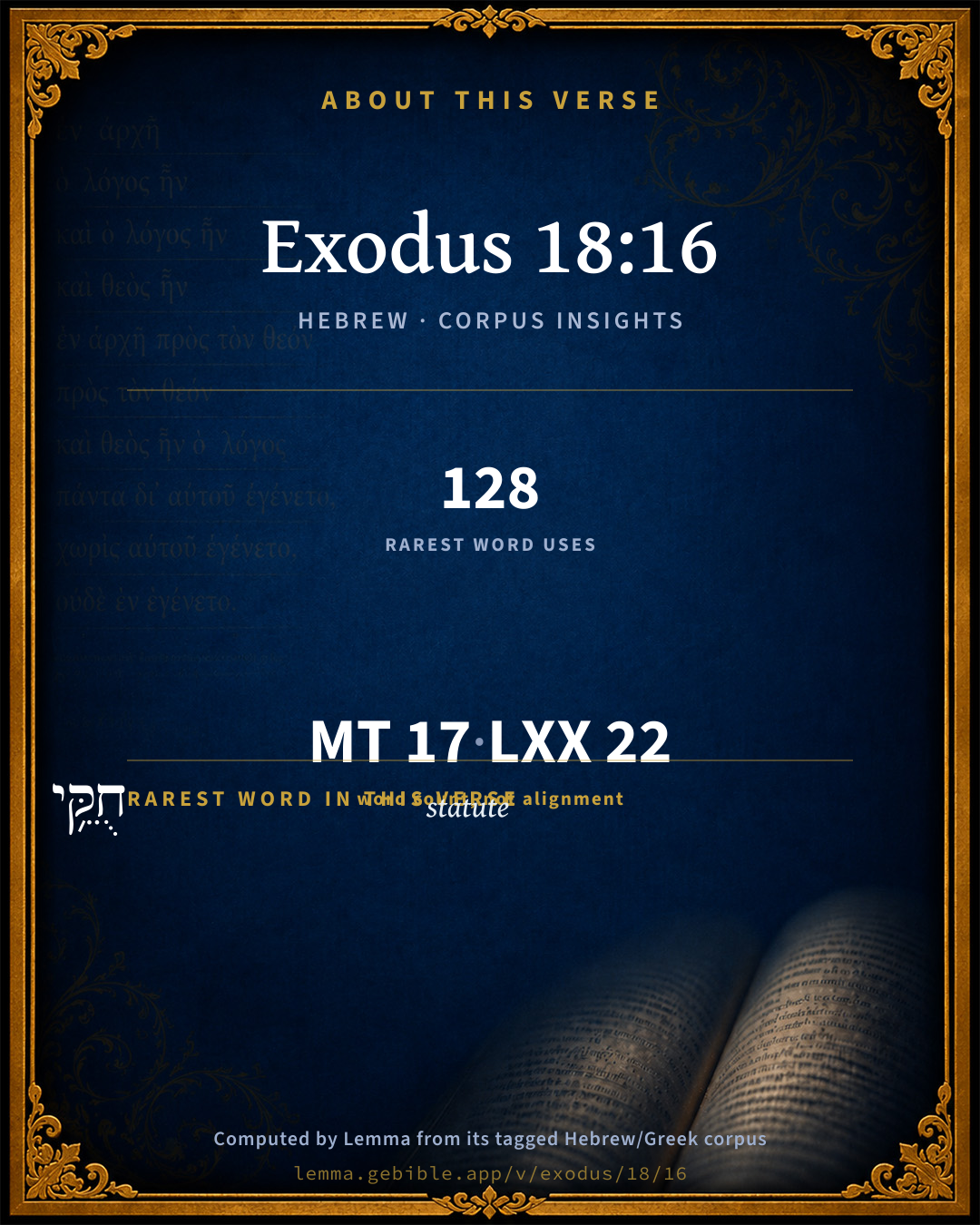
These counts appear in no published source. They are computed here, from the morphology-tagged text and Lemma’s own curated glosses. What Lemma adds →

17
words
14
distinct lemmas
Pentateuch
section

Grammatical profile

  • 4 verbs
  • 6 nouns
  • 4 prepositions
  • 1 conjunction
  • 2 particles

Verb forms

  • יִהְיֶ֨ה Qal · Imperfect
  • בָּ֣א Qal · Perfect
  • וְשָׁ֣פַטְתִּ֔י Qal · Sequential Perfect
  • וְהוֹדַעְתִּ֛י Hiphil · Sequential Perfect

Repetition

A word recurs within this verse — often emphatic in Hebrew:

  • בֵּ֥ין between H996 ×2

Hebrew & Septuagint length

In English translation the verse runs 30 words from the Hebrew and 29 from the Septuagint (LXX English) — closely comparable.

A rough comparison of the two English renderings, which tokenize alike — not a word-level alignment.

Word counts can differ between the Hebrew and the Greek without any difference in meaning — e.g. the Hebrew direct-object marker אֵת has no separate Greek word, and Greek often adds the article ὁ.

In the original languages it is 17 Hebrew tokens and 22 Greek tokens — but the two are counted differently (Hebrew bundles its prefixes and suffixes into one token; the Greek is in lemma form), so that isn’t a like-for-like length.

Cross-references

18

Topical passages linked to Exodus 18:16 in the Treasury of Scripture Knowledge — connected by theme and wording, ordered by reader-vote popularity; previews shown in the World English Bible.

  • Exodus 24:14 He said to the elders, "Wait here for us, until we come again to you. Behold, Aaron and Hur are with you. Whoever is involved in a dispute can go to them."
  • Deuteronomy 4:5 Behold, I have taught you statutes and ordinances, even as Yahweh my God commanded me, that you should do so in the midst of the land where you go in to possess it.
  • Deuteronomy 5:1 Moses called to all Israel, and said to them, Hear, Israel, the statutes and the ordinances which I speak in your ears this day, that you may learn them, and observe to do them.
  • 2 Samuel 15:3 Absalom said to him, Behold, your matters are good and right; but there is no man deputized of the king to hear you.
  • 1 Corinthians 6:1 Dare any of you, having a matter against his neighbor, go to law before the unrighteous, and not before the saints?
  • Exodus 2:13 He went out the second day, and, behold, two men of the Hebrews were fighting with each other. He said to him who did the wrong, "Why do you strike your fellow?"
  • Exodus 23:7 "Keep far from a false charge, and don't kill the innocent and righteous: for I will not justify the wicked.
  • Leviticus 24:15 You shall speak to the children of Israel, saying, 'Whoever curses his God shall bear his sin.
  • Numbers 15:35 Yahweh said to Moses, The man shall surely be put to death: all the congregation shall stone him with stones outside of the camp.
  • Numbers 27:6–11 Yahweh spoke to Moses, saying,
  • Numbers 36:6–9 This is the thing which Yahweh does command concerning the daughters of Zelophehad, saying, Let them be married to whom they think best; only into the family of the tribe of their father shall they be married.
  • Deuteronomy 6:1 Now this is the commandment, the statutes, and the ordinances, which Yahweh your God commanded to teach you, that you might do them in the land where you go over to possess it;
  • Deuteronomy 17:8–12 If there arise a matter too hard for you in judgment, between blood and blood, between plea and plea, and between stroke and stroke, being matters of controversy within your gates; then shall you arise, and go up to the place which Yahweh your God shall choose;
  • 1 Samuel 12:23 Moreover as for me, far be it from me that I should sin against Yahweh in ceasing to pray for you: but I will instruct you in the good and the right way.
  • Job 31:13 "If I have despised the cause of my man-servant Or of my maid-servant, When they contended with me;
  • Matthew 28:20 teaching them to observe all things that I commanded you. Behold, I am with you always, even to the end of the age." Amen.
  • Acts 18:14–15 But when Paul was about to open his mouth, Gallio said to the Jews, "If indeed it were a matter of wrong or of wicked crime, you Jews, it would be reasonable that I should bear with you;
  • 1 Thessalonians 4:1–2 Finally then, brothers, we beg and exhort you in the Lord Jesus, that as you received from us how you ought to walk and to please God, that you abound more and more.

Cross-references courtesy of OpenBible.info (CC BY 4.0).

Hebrew and Greek witnesses Masoretic Hebrew ↔ Greek Septuagint

The same verse in the two great witnesses to the Old Testament, shown verse-for-verse.

These are two independent witnesses, not word-aligned to each other, and the Septuagint is shown in lemma (dictionary) form.

Hebrew Exodus 18:16 Masoretic · Westminster Leningrad Codex

כִּֽי יִהְיֶ֨ה לָהֶ֤ם דָּבָר֙ בָּ֣א אֵלַ֔י וְשָׁ֣פַטְתִּ֔י בֵּ֥ין אִ֖ישׁ וּבֵ֣ין רֵעֵ֑הוּ וְהוֹדַעְתִּ֛י אֶת חֻקֵּ֥י הָאֱלֹהִ֖ים וְאֶת תּוֹרֹתָֽיו

When they have a matter, they come to me, and I judge between a man and his neighbor, and I make them know the statutes of God, and his laws."

World English Bible · Public Domain

Greek LXX Exodus 18:16 Septuagint · lemma form

ὅταν γάρ γίγνομαι αὐτός ἀντιλογία καί ἔρχομαι πρός ἐγώ διακρίνω ἕκαστος καί συνβιβάζω αὐτός ὁ πρόσταγμα ὁ θεός καί ὁ νόμος αὐτός

For whenever there is a dispute among them, and they come to me, I give judgment upon each, and I teach them the ordinances of God and his law.

LXX2012 (modern English Septuagint) · Public Domain

Hebrew: Westminster Leningrad Codex (CC BY 4.0). Greek: Septuagint (public domain); English from LXX2012 (modern English Septuagint) (Public Domain). How the Septuagint differs from the Hebrew →

Targum (Aramaic paraphrase)

2

The Targum is the ancient Jewish Aramaic paraphrase of the Hebrew Scriptures — an interpretive translation, not the Hebrew text itself. Onkelos (literal) and Pseudo-Jonathan (expansive) render the Torah, and Jonathan the Prophets. Coverage is partial: where no permissively-licensed English translation exists for a verse, only the Aramaic is shown. This is verse-level text, not a word-by-word alignment to the Hebrew.

  1. Targum Onkelos Torah (Genesis–Deuteronomy)
    כַּד הֲוֵי לְהוֹן דִינָא אָתָן לְוָתִי וְדָאִינְנָא בֵּין גַבְרָא וּבֵין חַבְרֵהּ וּמְהוֹדַעְנָא לְהוֹן יָת קְיָמַיָא דַיְיָ וְיָת אוֹרָיָתֵהּ:

    (no public-domain English translation for this verse)

    Targum Onkelos — Aramaic: “Onkelos Genesis” (public domain); “Onkelos Exodus” (public domain); “Onkelos Leviticus” (public domain); “Onkelos Numbers” (public domain); “Onkelos Deuteronomy” (public domain). English: “Sefaria Community Translation” (CC0 1.0 (public-domain dedication)); “J.W. Etheridge. The Targums of Onkelos and Jonathan Ben Uzziel on the Pentateuch. London: Longmans, Green, 1862” (public domain). Text via Sefaria.

  2. Targum Pseudo-Jonathan Torah (Genesis–Deuteronomy)
    אֲרוּם יְהֵי לְהוֹן דִּינָא אָתָאָן לְוָותִי וְדַיֵּינָא בֵּין גַּבְרָא וּבֵין חַבְרֵיהּ וּמְהוֹדַעְנָא לְהוֹן יַת קְיָמַיָא דַיְיָ וְיַת אוֹרַיְיתֵיהּ

    When they have a matter for judgment, they come to me, and I judge between a man and his fellow, and make them to know the statutes and the law of the Lord.

    Targum Pseudo-Jonathan — Aramaic: “Targum Jonathan on Genesis” (public domain); “Targum Jonathan on Exodus” (public domain); “Targum Jonathan on Leviticus” (public domain); “Targum Jonathan on Numbers” (public domain); “Targum Jonathan on Deuteronomy” (public domain). English: “The Targum of Jonathan ben Uzziel, trans. J. W. Etheridge, London, 1862” (public domain). Text via Sefaria.

Commentary

Notes on Exodus 18:16 from classic Christian and Jewish commentators (each source and its license shown beneath its notes). The classic Christian expositions comment on the surrounding passage and are grouped to its opening verse, so a note may address several verses; the Jewish commentaries on the Tanakh (Rashi and others) are per-verse, so they appear only where the commentator wrote on this verse.

Lemma curates 59 commentaries, every one of them public domain or Creative Commons licensed, each selected and text-cleaned for this edition rather than reprinted as found. About our sources →

Trapp's Complete Commentary

John Trapp

Exo 18:16 When they have a matter, they come unto me; and I judge between one and another, and I do make [them] know the statutes of God, and his laws.

Ver. 16. When they have a matter.] In our ordinary suits there is, for the most part, more malice than matter. The late Judge Dier, if there came any such trifling controversies to be tried before him, would usually say, that either the parties are wilful, or their neighbours without charity; because their suits were not quietly compromised.

John Trapp, A Commentary or Exposition upon All the Books of the Old and New Testament (1647–1656) — public domain. Text from a community e-Sword module.

Joseph Benson's Commentary

Exo 18:16-17. I judge between one another — And if the people were as quarrelsome one with another as they were with God, he had many causes brought before him, and the more because their trials put them to no expense. Not good — Not convenient either for thee or them.

Joseph Benson's Commentary on the Old and New Testaments (1811–1818) — public domain. Text from a community e-Sword module.

Adam Clarke's Commentary

Verse 16. I do make them know the statutes of God, and his laws.] These words are so very particular that they leave little room for doubt that the law had been given. Such words would scarcely have been used had not the statutes and laws been then in existence. And this is one of the proofs that the transaction mentioned here stands out of its due chronological order; See Clarke on Ex 18:5.

Adam Clarke's Commentary on the Bible (1810–1826) — public domain. Text from a community e-Sword/MySword module.

The Cambridge Bible for Schools and Colleges

gen. ed. J. J. S. Perowne

16. a matter] i.e. a matter in dispute, cf. Exo_22:9, Exo_24:14. So vv. 22, 26 (‘cause’ in vv. 19, 26, is also the same Heb.: lit. word).

the statutes of God and his directions] ‘ “Statutes” (ḥuḳḳîm) were definite rules, stereotyped and permanent; “laws” (tôrôth) were “directions” or pronouncements delivered as special circumstances required them [see p. 161]. The present passage must belong to the period after Moses received the divine statutes on the mountain [cf. p. 162]’ (McNeile). Observe that the decisions of Moses on civil disputes are here called distinctly the ‘directions (tôrôth) of God’ (cf. on v. 15, and pp. 161, 162).

The Cambridge Bible for Schools and Colleges (gen. ed. J. J. S. Perowne; Cambridge University Press, 1878–1918) — public domain. Text from a community e-Sword module.

John Gill's Exposition

And Moses's father in law said unto him,.... Having observed what he did, and heard his answer to the question he put to him:

the thing that thou doest is not good; not meaning that it was not morally good, or that it was morally evil; for it was certainly a good thing to inquire of the mind and will of God for the people, and to hear and decide matters in controversy between them, and do justice to both parties; but it was not good for the health of Moses; it was not commodious and convenient for him; it was not for his bodily welfare; it was too much for him, as he explains himself in the next verse.

John Gill's Exposition of the Whole Bible (1746–1763) — public domain (CC PDM 1.0). Text via the HelloAO Bible API.

Haydock's Catholic Bible Commentary

CHAPTER XVIII.

George Leo Haydock (1774–1849), Haydock's Catholic Family Bible and Commentary, 1859 edition — public domain. Excludes Psalms (Douay-Rheims chapter numbering differs from Protestant) and Deuterocanonical books (Catholic canon only).

Matthew Poole's English Annotations

i.e. Do interpret and apply them to their several cases and circumstances.

Matthew Poole's English Annotations on the Holy Bible (1683–1685) — public domain. Text from a community e-Sword/MySword module.

Whedon's Commentary on the Bible

Daniel D. Whedon

16. A matter — A matter of controversy requiring the intervention of a judge.

I do make them know the statutes of God, and his laws — The statutes and laws (torahs) are not naturally understood of such enactments and “judgments” as Moses is commanded, in Exo_21:1, to set before the people. As matters of dispute arose, the judgments sought of Moses afforded him a most fitting opportunity to communicate to the people such statutes and laws as many of those recorded in chaps. 21 and 22. The people observed that Jehovah talked from heaven with their great leader, (Exo_20:18-22,) and would thenceforth accept his word as a God-given oracle. Compare Exo_18:15. The way in which Moses in this verse speaks of his judging the people, and making them know the laws, implies something that had already become habitual with him — a thing hardly supposable before their arrival at Sinai. This passage also suggests how Moses may have orally set forth many statutes and ordinances both before and after he had written them in a book.

Daniel D. Whedon (gen. ed.), Commentary on the Old and New Testaments (1874–1909) — public domain. Text from a community e-Sword module.

The Pulpit Commentary

I judge and I do make them know the statutes of God. As the Israelites were, up to this time, without any code of written laws, Moses took the opportunity furnished by such cases as came before him, to lay down principles of law, and enjoin them upon the people; thus making them to know the statutes of God and his eternal unwritten laws. Such a practice would not have been necessary after the giving of the law on Mount Sinai; and its existence at the time of Jethro"s visit helps to fix that visit as occurring before the giving of the law.

The Pulpit Commentary (1880–1919), ed. H.D.M. Spence-Jones & Joseph S. Exell — public domain. Text from a community e-Sword module.

John Wesley's Explanatory Notes

I judge between one and another - And if the people were as quarrelsome one with another as they were with God, he had many causes brought before him, and the more because their trials put them to no expence.

John Wesley, Explanatory Notes Upon the Whole Bible (1754–1765) — public domain. Text via the GEBible commentary corpus.

Rashi

Rabbi Shlomo Yitzchaki (Rashi)

כי יהיה להם דבר בא WHEN THEY HAVE A MATTER THEY COME (lit., “he comes”) — “He”, viz., who has the matter comes to me.

Rashi on the Tanakh — English translations: “The Judaica Press complete Tanach with Rashi, translated by A. J. Rosenberg” (CC BY 4.0); “Pentateuch with Rashi's commentary by M. Rosenbaum and A.M. Silbermann, 1929-1934” (public domain); “The Metsudah Tanach series, Lakewood, N.J” (CC BY 4.0); and “The Book of Joshua, Metsudah Publications, 1997” (CC BY 4.0). Text via Sefaria.

Lesson kit

Teaching starters — assembled from the data on this page, not authored interpretation. Every prompt links to the verse data it draws on. Edit before teaching.

Exodus, in the Pentateuch, opens this verse with 17 words (14 distinct Hebrew lemmas). Its most distinctive word is chôq (“statute”). A historical commentator’s framing appears above. Read the whole chapter for the surrounding context.

Discussion questions

  1. What does “statute” (chôq) contribute to the verse as a whole?
  2. Exodus 24:14 shares this passage’s theme. How do the two illuminate each other?
  3. “between” occurs 2× in this one verse. What is the effect of the repetition?
  4. The translations on this page render this verse differently — a whole-verse word diff, not a word-by-word alignment. What might account for the different wordings?
  5. The verb «יִהְיֶ֨ה» is Qal Imperfect. How does its form color the action?
  6. Reading how Trapp's Complete Commentary and Joseph Benson's Commentary read this verse, where do the two commentators agree and where do they part?

Things to notice

Reading settings

Reading text

Shown beneath each verse's original-language words.

Old Testament
Old Testament edition

Read the OT as the Masoretic Hebrew (MT) or the Greek Septuagint (LXX).

English shown for the Greek Septuagint (in the Hebrew ↔ Greek comparison).

Comparing translations? Open the Compare panel on any verse page to stack up to four side by side.