Genesis 26:31

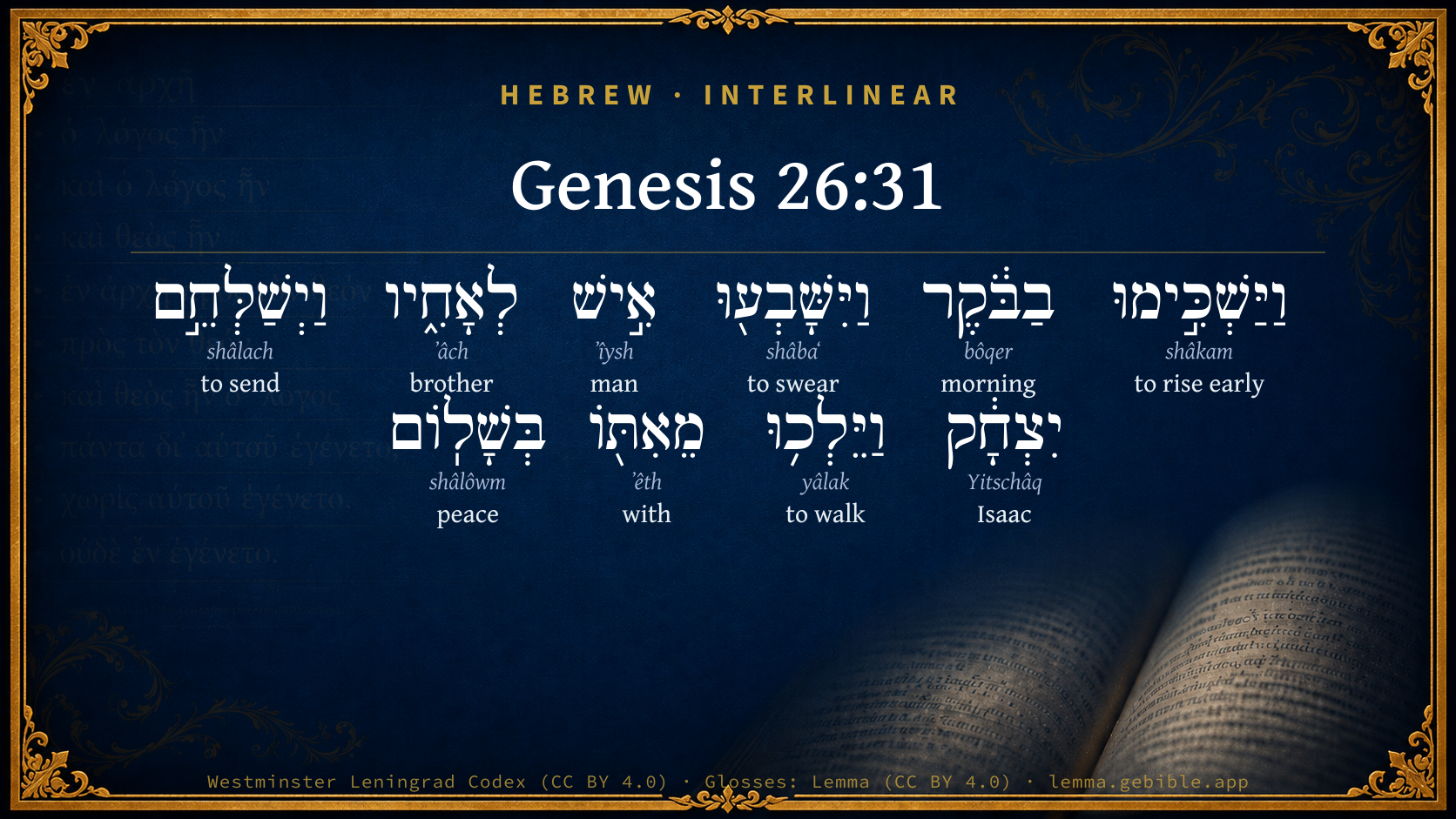
Hebrew (Westminster Leningrad Codex) Genesis 26:31 appears in the Hebrew Old Testament. The text above is from the Westminster Leningrad Codex. Each word links to its Strong’s number, a concise gloss, and parsing drawn from the Open Scriptures Hebrew Bible morphology. Click any word for its full Brown-Driver-Briggs (BDB) entry.
Download image
Cite this verse

Genesis 26:31 (World English Bible). Public Domain. Lemma interlinear Bible study tool, https://lemma.gebible.app/v/genesis/26/31.

Show BibTeX & RIS
BibTeX
RIS
English Translation
They rose up some time in the morning, and swore one to another. Isaac sent them away, and they departed from him in peace.
World English Bible · Public Domain
Download a study sheet

One document with this verse’s original text, its word-by-word gloss line, the meaning frame, cross-references with their text, attributed commentary, and full source and license credits — printable, and it pastes into notes with its structure intact.

This verse Autodidact and up

Study sheet (.html) Plain text (.txt)

A passage Seminary Student

Up to 50 verses in one chapter. A passage sheet keeps up to 6 commentary sources and 12 cross-references per verse, in the order this page ranks them, and says so on the sheet whenever that leaves anything out. Ask for a single verse and you get the Autodidact verse sheet above.

Everything on this page stays free to read, with no account — the sheet is a download of what is already on screen, not access to it.

Want to remove ads? Support Godless Engineer
Compare translations 3

The same verse in 3 English versions, stacked beneath the original-language interlinear above. Click any original word for its lexicon entry.

Each is an independent rendering of the whole verse — the interlinear is not word-aligned to these translations.

Highlighted words mark where these versions differ — a whole-verse word diff, not a word-by-word alignment.

  • World English Bible Public Domain
    They rose up some time in the morning, and swore one to another. Isaac sent them away, and they departed from him in peace.
  • King James Version Public Domain
    And they rose up betimes in the morning, and sware one to another: and Isaac sent them away, and they departed from him in peace.
  • unfoldingWord Literal Text CC BY-SA 4.0
    Then they got up early in the morning and swore to each other. Then Isaac sent them on their way, and they left from him in peace.

unfoldingWord Literal Text — © unfoldingWord, licensed CC BY-SA 4.0. Word-aligned USFM3 via Door43 (git.door43.org/unfoldingWord/en_ult).

Versions to compare (up to 4)

3 of 4 selected

Show all 18 translations

Every available English version of this verse, each an independent rendering of the whole verse.

  • World English Bible Public Domain
    They rose up some time in the morning, and swore one to another. Isaac sent them away, and they departed from him in peace.
  • Berean Standard Bible Public Domain
    And they got up early the next morning and swore an oath to each other. Then Isaac sent them on their way, and they left him in peace.
  • Majority Standard Bible Public Domain
    And they got up early the next morning and swore an oath to each other. Then Isaac sent them on their way, and they left him in peace.
  • King James Version Public Domain
    And they rose up betimes in the morning, and sware one to another: and Isaac sent them away, and they departed from him in peace.
  • American Standard Version (1901) Public Domain
    And they rose up betimes in the morning, and sware one to another. And Isaac sent them away, and they departed from him in peace.
  • Revised Version (1885) Public Domain
    And they rose up betimes in the morning, and sware one to another: and Isaac sent them away, and they departed from him in peace.
  • Geneva Bible (1599) Public Domain
    And they rose vp betimes in the morning, and sware one to another: then Izhak let them go, and they departed from him in peace.
  • Douay-Rheims (1899) Public Domain
    Arising in the morning, they swore one to another: and Isaac sent them away peaceably to their own home.
  • Young's Literal Translation Public Domain
    and rise early in the morning, and swear one to another, and Isaac sendeth them away, and they go from him in peace.
  • Literal Standard Version CC BY-SA 4.0
    and rise early in the morning, and swear to one another, and Isaac sends them away, and they go from him in peace.
  • Unlocked Literal Bible CC BY-SA 4.0
    They rose early in the morning and swore an oath with each other. Then Isaac sent them away, and they left him in peace.
  • unfoldingWord Literal Text CC BY-SA 4.0
    Then they got up early in the morning and swore to each other. Then Isaac sent them on their way, and they left from him in peace.
  • Darby Bible Public Domain
    And they rose early in the morning, and swore one to another; and Isaac sent them away, and they departed from him in peace.
  • World Messianic Bible Public Domain
    They rose up some time in the morning, and swore an oath to one another. Isaac sent them away, and they departed from him in peace.
  • Webster's Bible Public Domain
    And they rose betimes in the morning, and swore one to another: and Isaac sent them away, and they departed from him in peace.
  • Free Bible Version CC BY-SA 4.0
    and got up early in the morning and they each swore oaths to one other. Then Isaac sent them on their way, and they left in peace.
  • Bible in Basic English Public Domain
    And early in the morning they took an oath one to the other: then Isaac sent them away and they went on their way in peace.
  • JPS Tanakh (1917) Public Domain
    And they rose up betimes in the morning, and swore one to another; and Isaac sent them away, and they departed from him in peace.

Literal Standard Version (2020), Covenant Press — licensed CC BY-SA 4.0. Text via the HelloAO Bible API (eBible.org). Unlocked Literal Bible (unfoldingWord) — licensed CC BY-SA 4.0. Text via the HelloAO Bible API (eBible.org). unfoldingWord Literal Text — © unfoldingWord, licensed CC BY-SA 4.0. Word-aligned USFM3 via Door43 (git.door43.org/unfoldingWord/en_ult). Free Bible Version, Dr. Jonathan Gallagher — licensed CC BY-SA 4.0. Text via the HelloAO Bible API (eBible.org).

Word by word

More ways to search: Search by grammar → Find every occurrence → Compare this word →

Practice this passage: Drill this verse → Learn its vocabulary →

וַיַּשְׁכִּ֣ימוּ
shâkam
H7925
“and · to rise early”
Conjunction + Verb, Hiphil, Sequential Imperfect, 3rd Person, Masculine, Plural
Part of Speech
Conjunction + Verb
Stem
Hiphil
Form
Sequential Imperfect
Person
3rd Person
Gender
Masculine
Number
Plural
Full BDB Definition

Origin: a primitive root

TWOT: 2386

to rise or start early - (Hiphil) - to rise early, make an early start - early (as adverb)
  1. בַבֹּ֔קֶר bôqer H1242 “in/at the · morning” Preposition, Determined + Noun, Common, Masculine, Singular, Absolute
  2. וַיִּשָּׁבְע֖וּ shâbaʻ H7650 “and · to swear” Conjunction + Verb, Niphal, Sequential Imperfect, 3rd Person, Masculine, Plural
  3. אִ֣ישׁ ʼîysh H376 “man” Noun, Common, Masculine, Singular, Absolute
  4. לְאָחִ֑יו ʼâch H251 “to/for · brother · his” Preposition + Noun, Common, Masculine, Singular, Construct + Suffix, Personal, 3rd Person, Masculine, Singular
  5. וַיְשַׁלְּחֵ֣ם shâlach H7971 “and · to send · them” Conjunction + Verb, Piel, Sequential Imperfect, 3rd Person, Masculine, Singular + Suffix, Personal, 3rd Person, Masculine, Plural
  6. יִצְחָ֔ק Yitschâq H3327 “Isaac” Noun, Proper
  7. וַיֵּלְכ֥וּ yâlak H3212 “and · to walk” Conjunction + Verb, Qal, Sequential Imperfect, 3rd Person, Masculine, Plural
  8. מֵאִתּ֖וֹ ʼêth H854 “from · with · him” Preposition + Preposition + Suffix, Personal, 3rd Person, Masculine, Singular
  9. בְּשָׁלֽוֹם shâlôwm H7965 “in/at · peace” Preposition + Noun, Common, Masculine, Singular, Absolute

About this verse

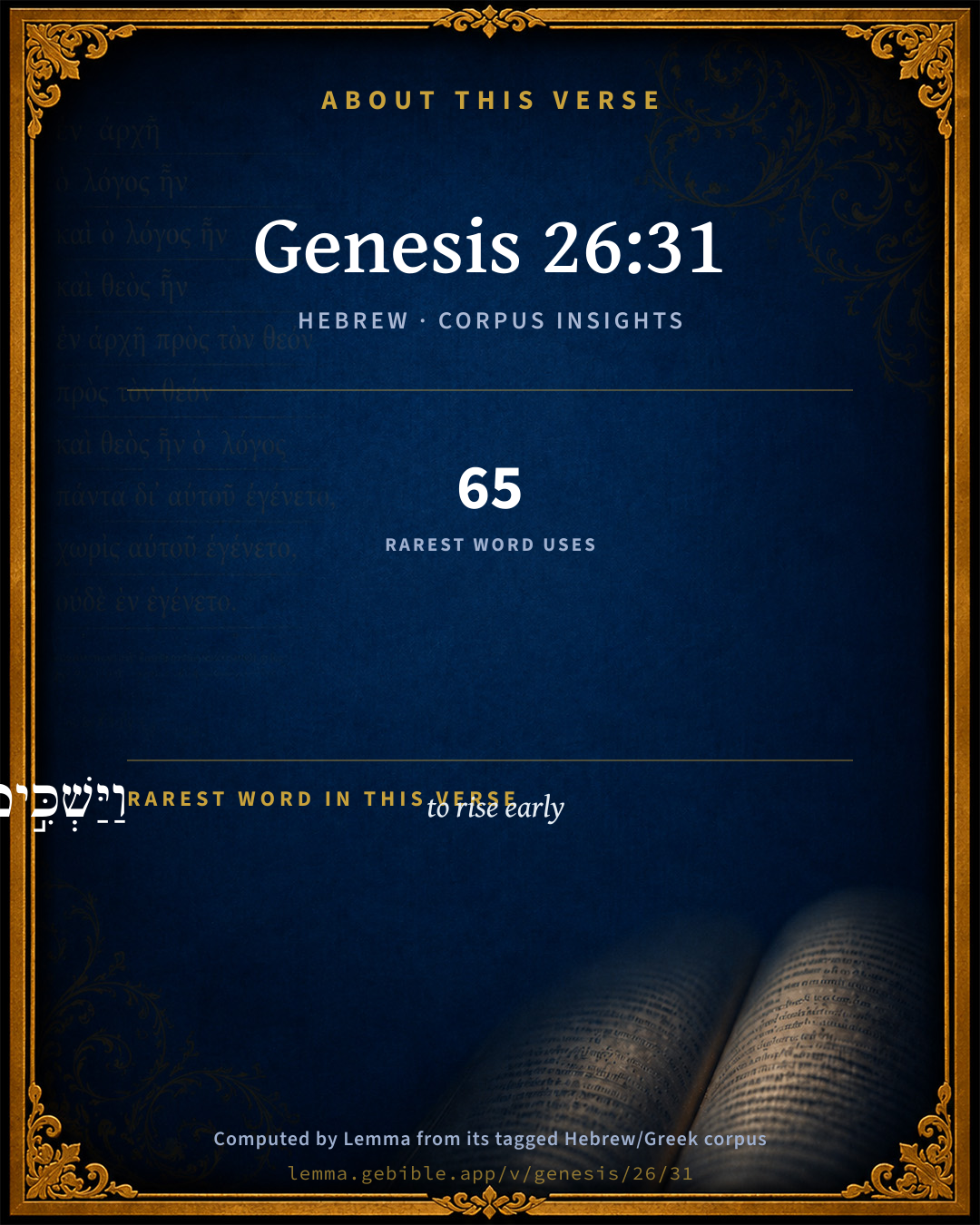
These counts appear in no published source. They are computed here, from the morphology-tagged text and Lemma’s own curated glosses. What Lemma adds →

10
words
10
distinct lemmas
Pentateuch
section

Grammatical profile

  • 4 verbs
  • 5 nouns
  • 1 preposition

Verb forms

  • וַיַּשְׁכִּ֣ימוּ Hiphil · Sequential Imperfect
  • וַיִּשָּׁבְע֖וּ Niphal · Sequential Imperfect
  • וַיְשַׁלְּחֵ֣ם Piel · Sequential Imperfect
  • וַיֵּלְכ֥וּ Qal · Sequential Imperfect

Hebrew & Septuagint length

In English translation the verse runs 24 words from the Hebrew and 24 from the Septuagint (LXX English) — the same length.

A rough comparison of the two English renderings, which tokenize alike — not a word-level alignment.

Word counts can differ between the Hebrew and the Greek without any difference in meaning — e.g. the Hebrew direct-object marker אֵת has no separate Greek word, and Greek often adds the article ὁ.

Cross-references

14

Topical passages linked to Genesis 26:31 in the Treasury of Scripture Knowledge — connected by theme and wording, ordered by reader-vote popularity; previews shown in the World English Bible.

  • Genesis 21:31–32 Therefore he called that place Beersheba, because they both swore there.
  • Genesis 25:33 Jacob said, "Swear to me first." He swore to him. He sold his birthright to Jacob.
  • Genesis 31:44 Now come, let us make a covenant, you and I; and let it be for a witness between me and you."
  • 1 Samuel 20:16–17 So Jonathan made a covenant with the house of David, [saying], Yahweh will require it at the hand of David's enemies.
  • 1 Samuel 30:15 David said to him, Will you bring me down to this troop? He said, Swear to me by God, that you will neither kill me, nor deliver me up into the hands of my master, and I will bring you down to this troop.
  • Hebrews 6:16 For men indeed swear by a greater one, and in every dispute of theirs the oath is final for confirmation.
  • Genesis 14:22 Abram said to the king of Sodom, "I have lifted up my hand to Yahweh, God Most High, possessor of heaven and earth,
  • Genesis 19:2 and he said, "See now, my lords, please turn aside into your servant's house, stay all night, wash your feet, and you will rise up early, and go on your way." They said, "No, but we will stay in the street all night."
  • Genesis 21:14 Abraham rose up early in the morning, and took bread and a bottle of water, and gave it to Hagar, putting it on her shoulder, and gave her the child, and sent her away. She departed, and wandered in the wilderness of Beersheba.
  • Genesis 21:23 Now therefore swear to me here by God that you will not deal falsely with me, nor with my son, nor with my son's son. But according to the kindness that I have done to you, you shall do to me, and to the land in which you have lived as a foreigner."
  • Genesis 22:3 Abraham rose early in the morning, and saddled his donkey, and took two of his young men with him, and Isaac his son. He split the wood for the burnt offering, and rose up, and went to the place of which God had told him.
  • Genesis 31:55 Early in the morning, Laban rose up, and kissed his sons and his daughters, and blessed them. Laban departed and returned to his place.
  • 1 Samuel 14:24 The men of Israel were distressed that day; for Saul had adjured the people, saying, Cursed be the man who eats any food until it be evening, and I be avenged on my enemies. So none of the people tasted food.
  • 1 Samuel 20:3 David swore moreover, and said, Your father knows well that I have found favor in your eyes; and he says, Don't let Jonathan know this, lest he be grieved: but truly as Yahweh lives, and as your soul lives, there is but a step between me and death.

Cross-references courtesy of OpenBible.info (CC BY 4.0).

Hebrew and Greek witnesses Masoretic Hebrew ↔ Greek Septuagint

The same verse in the two great witnesses to the Old Testament, shown verse-for-verse.

These are two independent witnesses, not word-aligned to each other, and the Septuagint is shown in lemma (dictionary) form.

Hebrew Genesis 26:31 Masoretic · Westminster Leningrad Codex

וַיַּשְׁכִּ֣ימוּ בַבֹּ֔קֶר וַיִּשָּׁבְע֖וּ אִ֣ישׁ לְאָחִ֑יו וַיְשַׁלְּחֵ֣ם יִצְחָ֔ק וַיֵּלְכ֥וּ מֵאִתּ֖וֹ בְּשָׁלֽוֹם

They rose up some time in the morning, and swore one to another. Isaac sent them away, and they departed from him in peace.

World English Bible · Public Domain

Greek LXX Genesis 26:31 Septuagint · lemma form

καί ἀναἵστημι ὁ πρωΐ ὄμνυμι ἄνθρωπος ὁ πλησίον αὐτός καί ἐκ ἀποστέλλω αὐτός ισαακ καί ἀποοἴχομαι ἀπό αὐτός μετά σωτηρία

And they arose in the morning, and swore each to his neighbor; and Isaac sent them forth, and they departed from him in safety.

LXX2012 (modern English Septuagint) · Public Domain

Hebrew: Westminster Leningrad Codex (CC BY 4.0). Greek: Septuagint (public domain); English from LXX2012 (modern English Septuagint) (Public Domain). How the Septuagint differs from the Hebrew →

Targum (Aramaic paraphrase)

2

The Targum is the ancient Jewish Aramaic paraphrase of the Hebrew Scriptures — an interpretive translation, not the Hebrew text itself. Onkelos (literal) and Pseudo-Jonathan (expansive) render the Torah, and Jonathan the Prophets. Coverage is partial: where no permissively-licensed English translation exists for a verse, only the Aramaic is shown. This is verse-level text, not a word-by-word alignment to the Hebrew.

  1. Targum Onkelos Torah (Genesis–Deuteronomy)
    וְאַקְדִימוּ בְצַפְרָא וְקַיִּימוּ גְּבַר לְאָחוּהִי וְשַׁלָּחִנוּן יִצְחָק וַאֲזָלוּ מִלְוָתֵהּ בִּשְׁלָם

    (no public-domain English translation for this verse)

    Targum Onkelos — Aramaic: “Onkelos Genesis” (public domain); “Onkelos Exodus” (public domain); “Onkelos Leviticus” (public domain); “Onkelos Numbers” (public domain); “Onkelos Deuteronomy” (public domain). English: “Sefaria Community Translation” (CC0 1.0 (public-domain dedication)); “J.W. Etheridge. The Targums of Onkelos and Jonathan Ben Uzziel on the Pentateuch. London: Longmans, Green, 1862” (public domain). Text via Sefaria.

  2. Targum Pseudo-Jonathan Torah (Genesis–Deuteronomy)
    וְאַקְדִימוּ בְּצַפְרָא וְקַיְמוּ גְבַר לְאָחוֹי וּפְסַג מַתְגָא דְחַמְרֵיהּ וִיהַב פִּסְגָא חָדָא לְהוֹם לְסַהֲדוּ וְצַלֵי עֲלֵיהֶם יִצְחָק וְאִתְרַוָוחוּ וְאַלְוִנוּן יִצְחָק וַאֲזָלוּ מִלְוָותֵיהּ בִּשְׁלָם

    And they arose in the morning, each man with his brother; and he broke off from the bridle of his ass, and gave one part to them for a testimony. And Izhak prayed for them, and they were enlarged. And Izhak accompanied them, and they went from him in peace.

    Targum Pseudo-Jonathan — Aramaic: “Targum Jonathan on Genesis” (public domain); “Targum Jonathan on Exodus” (public domain); “Targum Jonathan on Leviticus” (public domain); “Targum Jonathan on Numbers” (public domain); “Targum Jonathan on Deuteronomy” (public domain). English: “The Targum of Jonathan ben Uzziel, trans. J. W. Etheridge, London, 1862” (public domain). Text via Sefaria.

Commentary

Notes on Genesis 26:31 from classic Christian and Jewish commentators (each source and its license shown beneath its notes). The classic Christian expositions comment on the surrounding passage and are grouped to its opening verse, so a note may address several verses; the Jewish commentaries on the Tanakh (Rashi and others) are per-verse, so they appear only where the commentator wrote on this verse.

Lemma curates 59 commentaries, every one of them public domain or Creative Commons licensed, each selected and text-cleaned for this edition rather than reprinted as found. About our sources →

Trapp's Complete Commentary

John Trapp

Gen 26:31 And they rose up betimes in the morning, and sware one to another: and Isaac sent them away, and they departed from him in peace.

Ver. 31. And they rose up betimes, &c,] The proverb is, De sero convivium, de mane consilium. It was the Persians’ barbarous manner, in the midst of their cups, to advise of their weightiest affairs, as Pererius here noteth: Ardua negotia, praesertim in quibus iuramentum intervenit, ieiuno stomacho suscipi peragique debent, saith Piscator. Weighty businesses are best despatched fasting.

John Trapp, A Commentary or Exposition upon All the Books of the Old and New Testament (1647–1656) — public domain. Text from a community e-Sword module.

Adam Clarke's Commentary

Verse 31. They rose up betimes] Early rising was general among the primitive inhabitants of the world, and this was one cause which contributed greatly to their health and longevity.

Adam Clarke's Commentary on the Bible (1810–1826) — public domain. Text from a community e-Sword/MySword module.

John Calvin's Commentaries

31. And sware one to another. Isaac does not hesitate to swear; partly, that the Philistines may be the more easily appeased; partly, that he may not be suspected by them. And this is the legitimate method of swearing, when men mutually bind themselves to the cultivation of peace. A simple promise, indeed, ought to have sufficed; but since dissimulations or inconstancy causes men to be distrustful of each other, the Lord grants them the use of his name, that this more holy confirmation may be added to our covenants; and he does not only permit, he even commands us to swear as often as necessity requires it. (Deuteronomy 6:13.) Meanwhile we must beware, lest his name be profaned by rashly swearing.

John Calvin's Commentaries (1540-1563) — public domain. Text from the Calvin Translation Society English edition (1840s-50s) via the Christian Classics Ethereal Library (ccel.org). Calvin's coverage is partial (roughly two-thirds of the Bible); uncommented books and verses are honest gaps, never fabricated. The 19th-century editor's footnotes and remarks are omitted so the notes are faithfully Calvin's own voice.

The Cambridge Bible for Schools and Colleges

gen. ed. J. J. S. Perowne

31. betimes] More often rendered “early”; cf. 2Ch_36:15. The etymology of the Old English word is “by time,” i.e. “in good time.” See Psa_5:3 (P.B.V.).

sware] Cf. on Gen_21:31.

The Cambridge Bible for Schools and Colleges (gen. ed. J. J. S. Perowne; Cambridge University Press, 1878–1918) — public domain. Text from a community e-Sword module.

John Gill's Exposition

And he called it Sheba,.... Which, according to Jerom, signifies "fulness", as if it had its name from the abundance of water in it; but rather it signifies an "oath", and was so called from the oath, which he and Abimelech had just took to one another; and these circumstances meeting together, the taking of the oath, and the account of the well:

therefore the name of the city is Beersheba unto this day; that is, the well of the oath: it had been so called by Abraham an hundred years ago or more; but now upon this occasion it was renewed and confirmed, and so continued until the times of Moses, and many ages after.

John Gill's Exposition of the Whole Bible (1746–1763) — public domain (CC PDM 1.0). Text via the HelloAO Bible API.

Matthew Poole's English Annotations

They rose up betimes; partly for the despatch of their journey and business, and partly because then their minds were most vigorous, and sober, and fit to perform so sacred an action as an oath was.

Matthew Poole's English Annotations on the Holy Bible (1683–1685) — public domain. Text from a community e-Sword/MySword module.

The Pulpit Commentary

And they rose up betimes in the morning, and sware one to another literally, a man to his brother. On the derivation of the verb to swear from the word for seven, see Gen_21:23and Isaac sent them away, and they departed from him in peace.

The Pulpit Commentary (1880–1919), ed. H.D.M. Spence-Jones & Joseph S. Exell — public domain. Text from a community e-Sword module.

Radak

Rabbi David Kimhi (Radak)

וישכימו..וישלחם, they rose early and he sent them off after accompanying them for the appropriate distance.

Radak on the Tanakh — English translations: “Sefaria Community Translation” (CC0 1.0 (public-domain dedication)); “Eliyahu Munk, HaChut Hameshulash” (CC BY 4.0); “Rabbi Mike Feuer, Jerusalem Anthology” (CC BY 4.0); and “R. David Kimhi on the first book of Psalms, Translated by R.G. Finch, London, 1919” (public domain). Text via Sefaria.

Lesson kit

Teaching starters — assembled from the data on this page, not authored interpretation. Every prompt links to the verse data it draws on. Edit before teaching.

Genesis, in the Pentateuch, opens this verse with 10 words (10 distinct Hebrew lemmas). Its most distinctive word is shâkam (“to rise early”). A historical commentator’s framing appears above. Read the whole chapter for the surrounding context.

Discussion questions

  1. The word shâkam carries the sense “to rise early.” How does it shape the verse?
  2. Genesis 21:31–32 shares this passage’s theme. How do the two illuminate each other?
  3. These translations render this verse differently; the difference is in the English rendering, not the original. What questions does that raise?
  4. The verb «וַיַּשְׁכִּ֣ימוּ» is Hiphil Sequential Imperfect. How does its form color the action?
  5. Reading how Trapp's Complete Commentary and Adam Clarke's Commentary read this verse, where do the two commentators agree and where do they part?

Things to notice

Reading settings

Reading text

Shown beneath each verse's original-language words.

Old Testament
Old Testament edition

Read the OT as the Masoretic Hebrew (MT) or the Greek Septuagint (LXX).

English shown for the Greek Septuagint (in the Hebrew ↔ Greek comparison).

Comparing translations? Open the Compare panel on any verse page to stack up to four side by side.