
Genesis 38:25

Hebrew (Westminster Leningrad Codex) Genesis 38:25 appears in the Hebrew Old Testament. The text above is from the Westminster Leningrad Codex. Each word links to its Strong’s number, a concise gloss, and parsing drawn from the Open Scriptures Hebrew Bible morphology. Click any word for its full Brown-Driver-Briggs (BDB) entry.
Download image
Cite this verse

Genesis 38:25 (World English Bible). Public Domain. Lemma interlinear Bible study tool, https://lemma.gebible.app/v/genesis/38/25.

Show BibTeX & RIS
BibTeX
RIS
English Translation
When she was brought forth, she sent to her father-in-law, saying, "By the man, whose these are, I am with child." She also said, "Please discern whose are these-- the signet, and the cords, and the staff."
World English Bible · Public Domain
Highlights
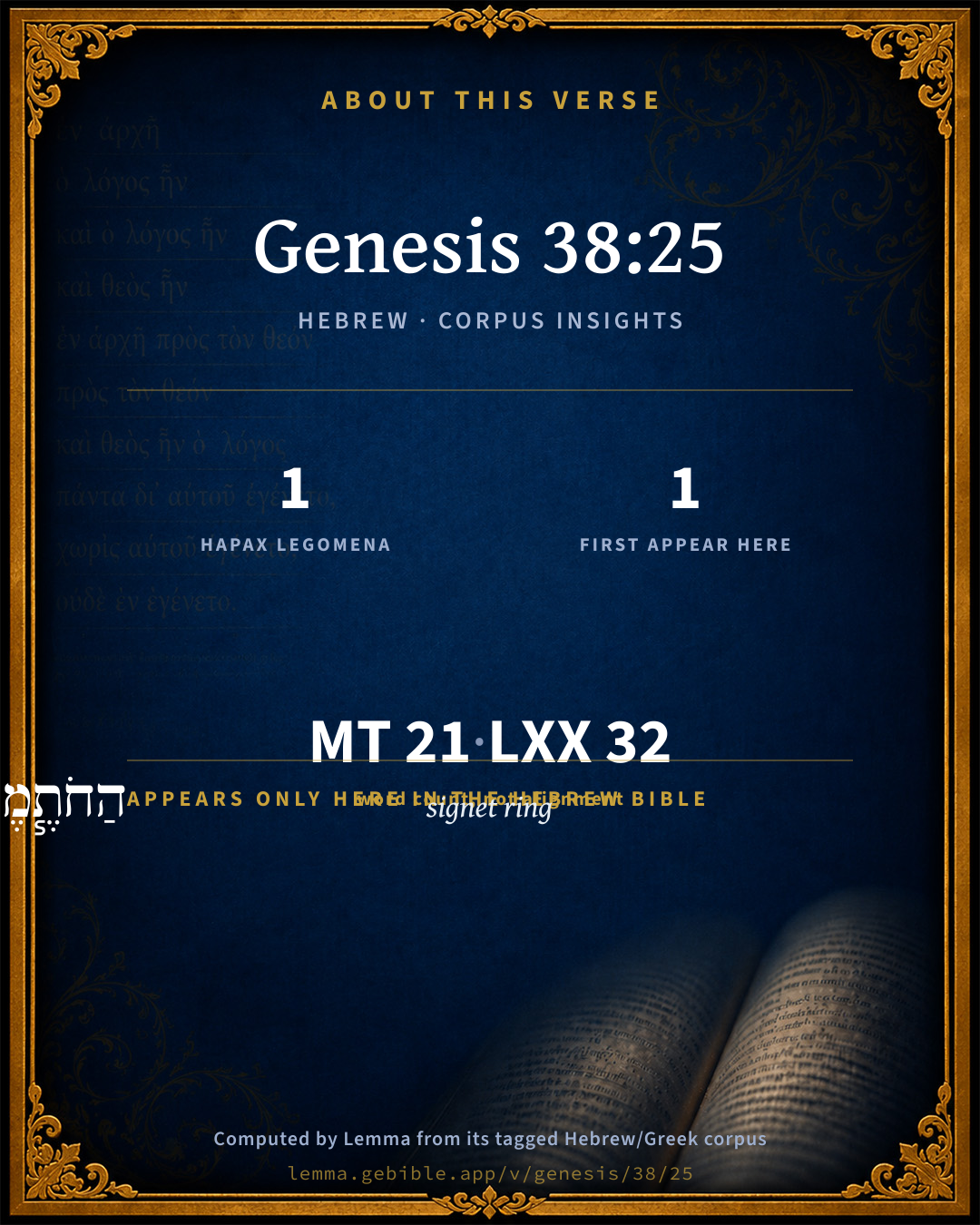
  • 1 hapax legomenon — only here in the Hebrew Bible
  • 1 first appearance in the Hebrew Bible
Full analysis ↓
Download a study sheet

One document with this verse’s original text, its word-by-word gloss line, the meaning frame, cross-references with their text, attributed commentary, and full source and license credits — printable, and it pastes into notes with its structure intact.

This verse Autodidact and up

Study sheet (.html) Plain text (.txt)

A passage Seminary Student

Up to 50 verses in one chapter. A passage sheet keeps up to 6 commentary sources and 12 cross-references per verse, in the order this page ranks them, and says so on the sheet whenever that leaves anything out. Ask for a single verse and you get the Autodidact verse sheet above.

Everything on this page stays free to read, with no account — the sheet is a download of what is already on screen, not access to it.

Want to remove ads? Support Godless Engineer
Compare translations 3

The same verse in 3 English versions, stacked beneath the original-language interlinear above. Click any original word for its lexicon entry.

Each is an independent rendering of the whole verse — the interlinear is not word-aligned to these translations.

Highlighted words mark where these versions differ — a whole-verse word diff, not a word-by-word alignment.

  • World English Bible Public Domain
    When she was brought forth, she sent to her father-in-law, saying, "By the man, whose these are, I am with child." She also said, "Please discern whose are these-- the signet, and the cords, and the staff."
  • King James Version Public Domain
    When she was brought forth, she sent to her father in law, saying, By the man, whose these are, am I with child: and she said, Discern, I pray thee, whose are these, the signet, and bracelets, and staff.
  • unfoldingWord Literal Text CC BY-SA 4.0
    She was being brought out, and she sent to her father-in-law, saying, “By the man whom these things belong to, I pregnant.” Then she said, “Please identify whose signet and cords and staff these.”

unfoldingWord Literal Text — © unfoldingWord, licensed CC BY-SA 4.0. Word-aligned USFM3 via Door43 (git.door43.org/unfoldingWord/en_ult).

Versions to compare (up to 4)

3 of 4 selected

Show all 18 translations

Every available English version of this verse, each an independent rendering of the whole verse.

  • World English Bible Public Domain
    When she was brought forth, she sent to her father-in-law, saying, "By the man, whose these are, I am with child." She also said, "Please discern whose are these-- the signet, and the cords, and the staff."
  • Berean Standard Bible Public Domain
    As she was being brought out, Tamar sent a message to her father-in-law: “I am pregnant by the man to whom these items belong.” And she added, “Please examine them. Whose seal and cord and staff are these?”
  • Majority Standard Bible Public Domain
    As she was being brought out, Tamar sent a message to her father-in-law: “I am pregnant by the man to whom these items belong.” And she added, “Please examine them. Whose seal and cord and staff are these?”
  • King James Version Public Domain
    When she was brought forth, she sent to her father in law, saying, By the man, whose these are, am I with child: and she said, Discern, I pray thee, whose are these, the signet, and bracelets, and staff.
  • American Standard Version (1901) Public Domain
    When she was brought forth, she sent to her father-in-law, saying, By the man, whose these are, am I with child: and she said, Discern, I pray thee, whose are these, the signet, and the cords, and the staff.
  • Revised Version (1885) Public Domain
    When she was brought forth, she sent to her father in law, saying, By the man, whose these are, am I with child: and she said, Discern, I pray thee, whose are these, the signet, and the cords, and the staff.
  • Geneva Bible (1599) Public Domain
    When she was brought foorth, she sent to her father in law, saying, By the man, vnto whom these things pertaine, am I with childe: and saide also, Looke, I pray thee, whose these are, the seale, and the cloke, and the staffe.
  • Douay-Rheims (1899) Public Domain
    And behold after three months they told a lie, saying: Thamar, thy daughter in law hath played the harlot, and she appeareth to have a big belly. And Juda said: Bring her out that she may be burnt.
  • Young's Literal Translation Public Domain
    She is brought out, and she hath sent unto her husband's father, saying, `To a man whose these `are', I `am' pregnant;' and she saith, `Discern, I pray thee, whose `are' these -- the seal, and the ribbons, and the staff.'
  • Literal Standard Version CC BY-SA 4.0
    She is brought out, and she has sent to her husband’s father, saying, “To a man whose these [are], I [am] pregnant”; and she says, “Please discern whose these [are]—the seal, and the ribbons, and the staff.”
  • Unlocked Literal Bible CC BY-SA 4.0
    When she was brought out, she sent to her father-in-law a message, “By the man who owns these I am pregnant.” She said, “Determine please whose these are, the seal and cords and staff.”
  • unfoldingWord Literal Text CC BY-SA 4.0
    She was being brought out, and she sent to her father-in-law, saying, “By the man whom these things belong to, I pregnant.” Then she said, “Please identify whose signet and cords and staff these.”
  • Darby Bible Public Domain
    When she was brought forth, she sent to her father-in-law, saying, By the man to whom these [belong] am I with child; and she said, Acknowledge, I pray thee, whose are this signet, and this lace, and this staff.
  • World Messianic Bible Public Domain
    When she was brought out, she sent to her father-in-law, saying, “I am with child by the man who owns these.” She also said, “Please discern whose these are—the signet, and the cords, and the staff.”
  • Webster's Bible Public Domain
    When she was brought forth, she sent to her father-in-law, saying, By the man whose these are, am I with child: and she said, Discern, I pray thee, whose are these, the signet, and bracelets, and staff.
  • Free Bible Version CC BY-SA 4.0
    As she was brought out, she sent a message to her father-in-law, saying, “I'm pregnant by the man who owns these things.” Then she added, “Please look carefully at this signet seal and its cord and walking stick. Who do they belong to?”
  • Bible in Basic English Public Domain
    And while she was being taken out, she sent word to her father-in-law, saying, The man whose property these things are, is the father of my child: say then, whose are this ring and this cord and this stick?
  • JPS Tanakh (1917) Public Domain
    When she was brought forth, she sent to her father-in-law, saying: 'By the man, whose these are, am I with child'; and she said: 'Discern, I pray thee, whose are these, the signet, and the cords, and the staff.'

Literal Standard Version (2020), Covenant Press — licensed CC BY-SA 4.0. Text via the HelloAO Bible API (eBible.org). Unlocked Literal Bible (unfoldingWord) — licensed CC BY-SA 4.0. Text via the HelloAO Bible API (eBible.org). unfoldingWord Literal Text — © unfoldingWord, licensed CC BY-SA 4.0. Word-aligned USFM3 via Door43 (git.door43.org/unfoldingWord/en_ult). Free Bible Version, Dr. Jonathan Gallagher — licensed CC BY-SA 4.0. Text via the HelloAO Bible API (eBible.org).

Word by word

More ways to search: Search by grammar → Find every occurrence → Compare this word →

Practice this passage: Drill this verse → Learn its vocabulary →

הַחֹתֶ֧מֶת
chôthemeth
H2858
“the · signet ring”
Particle, Definite Article + Noun, Common, Feminine, Singular, Absolute
Part of Speech
Particle + Noun
Type
Common
Gender
Feminine
Number
Singular
State
Absolute
Full BDB Definition

Origin: act. participle of H2856

TWOT: 780b

signet ring, signet seal
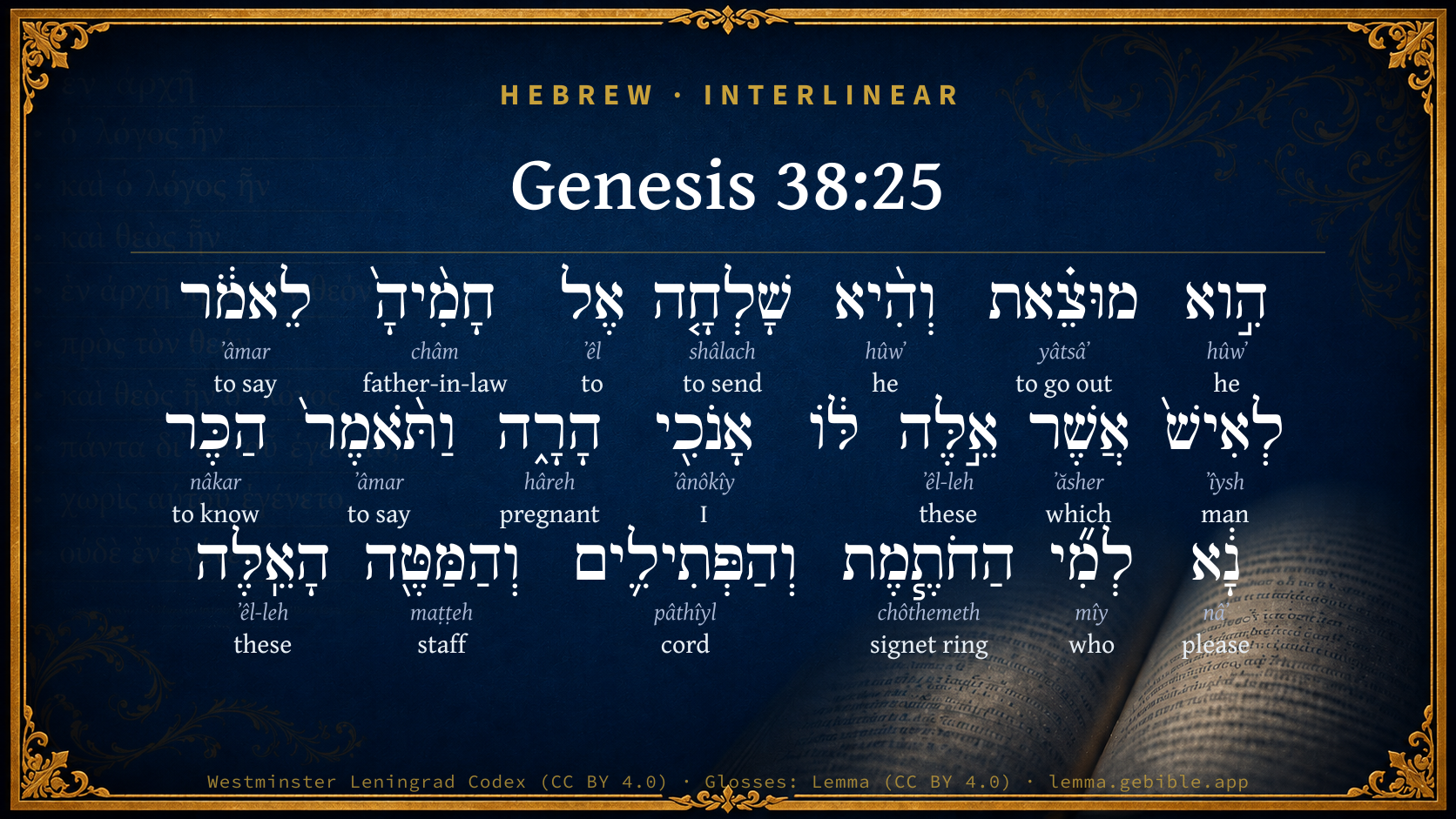
  1. הִ֣וא hûwʼ H1931 “he” Pronoun, Personal, 3rd Person, Feminine, Singular
  2. מוּצֵ֗את yâtsâʼ H3318 “gone out” Verb, Hophal, Participle Passive, Feminine, Singular, Absolute
  3. וְהִ֨יא hûwʼ H1931 “and · he” Conjunction + Pronoun, Personal, 3rd Person, Feminine, Singular
  4. שָׁלְחָ֤ה shâlach H7971 “to send” Verb, Qal, Perfect, 3rd Person, Feminine, Singular
  5. אֶל ʼêl H413 “to” Preposition
  6. חָמִ֨יהָ֙ châm H2524 “father-in-law · her” Noun, Common, Masculine, Singular, Construct + Suffix, Personal, 3rd Person, Feminine, Singular
  7. לֵאמֹ֔ר ʼâmar H559 “to say” Preposition + Verb, Qal, Infinitive Construct
  8. לְאִישׁ֙ ʼîysh H376 “to/for · man” Preposition + Noun, Common, Masculine, Singular, Absolute
  9. אֲשֶׁר ʼăsher H834 “which” Particle, Relative
  10. אֵ֣לֶּה ʼêl-leh H428 “these” Pronoun, Demonstrative, Common, Plural
  11. אָנֹכִ֖י ʼânôkîy H595 “I” Pronoun, Personal, 1st Person, Common, Singular
  12. הָרָ֑ה hâreh H2030 “pregnant” Adjective, Adjective, Feminine, Singular, Absolute
  13. וַתֹּ֨אמֶר֙ ʼâmar H559 “and · to say” Conjunction + Verb, Qal, Sequential Imperfect, 3rd Person, Feminine, Singular
  14. הַכֶּר nâkar H5234 “know” Verb, Hiphil, Imperative, 2nd Person, Masculine, Singular
  15. נָ֔א nâʼ H4994 “please” Particle, Exhortation
  16. לְמִ֞י mîy H4310 “to/for · who” Preposition + Particle, Interrogative
  17. וְהַפְּתִילִ֛ים pâthîyl H6616 “and · the · cords” Conjunction + Particle, Definite Article + Noun, Common, Masculine, Plural, Absolute
  18. וְהַמַּטֶּ֖ה maṭṭeh H4294 “and · the · staff” Conjunction + Particle, Definite Article + Noun, Common, Masculine, Singular, Absolute
  19. הָאֵֽלֶּה ʼêl-leh H428 “the · these” Particle, Definite Article + Pronoun, Demonstrative, Common, Plural

About this verse

These counts appear in no published source. They are computed here, from the morphology-tagged text and Lemma’s own curated glosses. What Lemma adds →

21
words
17
distinct lemmas
Pentateuch
section

Notable vocabulary

1 hapax legomenon — a word that appears only here in the entire Hebrew Bible:

  • הַחֹתֶ֧מֶת signet ring H2858

First appearance in Scripture

This word makes its first canonical appearance in the Hebrew Bible here:

  • הַחֹתֶ֧מֶת signet ring H2858

Shared distinctive vocabulary

חָמִ֨יהָ֙ father-in-law H2524 occurs in 4 verses of the Hebrew Bible. Also found in:

Grammatical profile

  • 5 verbs
  • 5 nouns
  • 1 adjective
  • 5 pronouns
  • 2 prepositions
  • 3 particles

Verb forms

  • מוּצֵ֗את Hophal · Participle Passive
  • שָׁלְחָ֤ה Qal · Perfect
  • לֵאמֹ֔ר Qal · Infinitive Construct
  • וַתֹּ֨אמֶר֙ Qal · Sequential Imperfect
  • הַכֶּר Hiphil · Imperative

Repetition

Words recur within this verse — often emphatic in Hebrew:

  • לֵאמֹ֔ר to say H559 ×2
  • הִ֣וא he H1931 ×2
  • אֵ֣לֶּה these H428 ×2

Hebrew & Septuagint length

In English translation the verse runs 37 words from the Hebrew and 35 from the Septuagint (LXX English) — closely comparable.

A rough comparison of the two English renderings, which tokenize alike — not a word-level alignment.

Word counts can differ between the Hebrew and the Greek without any difference in meaning — e.g. the Hebrew direct-object marker אֵת has no separate Greek word, and Greek often adds the article ὁ.

In the original languages it is 21 Hebrew tokens and 32 Greek tokens — but the two are counted differently (Hebrew bundles its prefixes and suffixes into one token; the Greek is in lemma form), so that isn’t a like-for-like length.

Cross-references

7

Topical passages linked to Genesis 38:25 in the Treasury of Scripture Knowledge — connected by theme and wording, ordered by reader-vote popularity; previews shown in the World English Bible.

  • Genesis 37:32 They took the coat of many colors, and they brought it to their father, and said, "We have found this. Examine it, now, whether it is your son's coat or not."
  • Genesis 38:18 He said, "What pledge will I give you?" She said, "Your signet and your cord, and your staff that is in your hand." He gave them to her, and came in to her, and she conceived by him.
  • Psalms 50:21 You have done these things, and I kept silent. You thought that the "I AM" was just like you. I will rebuke you, and accuse you in front of your eyes.
  • Jeremiah 2:26 As the thief is ashamed when he is found, so is the house of Israel ashamed; they, their kings, their princes, and their priests, and their prophets;
  • 1 Corinthians 4:5 Therefore judge nothing before the time, until the Lord comes, who will both bring to light the hidden things of darkness, and reveal the counsels of the hearts. Then each man will get his praise from God.
  • Revelation 20:12 I saw the dead, the great and the small, standing before the throne, and they opened books. Another book was opened, which is the book of life. The dead were judged out of the things which were written in the books, according to their works.
  • Romans 2:16 in the day when God will judge the secrets of men, according to my Gospel, by Jesus Christ.

Cross-references courtesy of OpenBible.info (CC BY 4.0).

Hebrew and Greek witnesses Masoretic Hebrew ↔ Greek Septuagint

The same verse in the two great witnesses to the Old Testament, shown verse-for-verse.

These are two independent witnesses, not word-aligned to each other, and the Septuagint is shown in lemma (dictionary) form.

Hebrew Genesis 38:25 Masoretic · Westminster Leningrad Codex

הִ֣וא מוּצֵ֗את וְהִ֨יא שָׁלְחָ֤ה אֶל חָמִ֨יהָ֙ לֵאמֹ֔ר לְאִישׁ֙ אֲשֶׁר אֵ֣לֶּה לּ֔וֹ אָנֹכִ֖י הָרָ֑ה וַתֹּ֨אמֶר֙ הַכֶּר נָ֔א לְמִ֞י הַחֹתֶ֧מֶת וְהַפְּתִילִ֛ים וְהַמַּטֶּ֖ה הָאֵֽלֶּה

When she was brought forth, she sent to her father-in-law, saying, "By the man, whose these are, I am with child." She also said, "Please discern whose are these-- the signet, and the cords, and the staff."

World English Bible · Public Domain

Greek LXX Genesis 38:25 Septuagint · lemma form

αὐτός δέ ἄγω ἀποστέλλω πρός ὁ πενθερός αὐτός λέγω ἐκ ὁ ἄνθρωπος τίς οὗτος εἰμί ἐγώ ἐν γαστήρ ἔχω καί εἶπον ἐπιγιγνώσκω τίς ὁ δακτύλιος καί ὁ ὁρμίσκος καί ὁ ῥάβδος οὗτος

And as they were bringing her, she sent to her father-in-law, saying, I am with child by the man whose these things are; and she said, See whose is this ring and bracelet and staff.

LXX2012 (modern English Septuagint) · Public Domain

Hebrew: Westminster Leningrad Codex (CC BY 4.0). Greek: Septuagint (public domain); English from LXX2012 (modern English Septuagint) (Public Domain). How the Septuagint differs from the Hebrew →

Targum (Aramaic paraphrase)

2

The Targum is the ancient Jewish Aramaic paraphrase of the Hebrew Scriptures — an interpretive translation, not the Hebrew text itself. Onkelos (literal) and Pseudo-Jonathan (expansive) render the Torah, and Jonathan the Prophets. Coverage is partial: where no permissively-licensed English translation exists for a verse, only the Aramaic is shown. This is verse-level text, not a word-by-word alignment to the Hebrew.

  1. Targum Onkelos Torah (Genesis–Deuteronomy)
    הִיא מִתַּפְּקָא וְהִיא שְׁלָחַת לַחֲמוּהָא לְמֵימַר לִגְבַר דִּי אִלֵּין דִּילֵהּ מִנֵּהּ אֲנָא מְעַדְּיָא וַאֲמֶרֶת אִשְׁתְּמוֹדַע כְּעַן לְמָן עִזְקְתָא וְשׁוֹשִׁפָּא וְחוּטְרָא הָאִלֵּין

    (no public-domain English translation for this verse)

    Targum Onkelos — Aramaic: “Onkelos Genesis” (public domain); “Onkelos Exodus” (public domain); “Onkelos Leviticus” (public domain); “Onkelos Numbers” (public domain); “Onkelos Deuteronomy” (public domain). English: “Sefaria Community Translation” (CC0 1.0 (public-domain dedication)); “J.W. Etheridge. The Targums of Onkelos and Jonathan Ben Uzziel on the Pentateuch. London: Longmans, Green, 1862” (public domain). Text via Sefaria.

  2. Targum Pseudo-Jonathan Torah (Genesis–Deuteronomy)
    תָּמָר מִתְאַפְקָא לְאִיתּוֹקְדָא וּבְעַת תְּלַת מַשְׁכּוֹנְיָא וְלָא אַשְׁכַּחְתְּנוּן תָּלַת עֵינָהָא לִשְׁמֵי מְרוֹמָא וְכֵן אָמְרַת בְּבָעוּ בְּרַחֲמִין מִן קֳדָמָךְ יְיָ עֲנֵי יָתִי בַּהֲדָא שַׁעְתָּא אַנַנְקִי וְאַנְהָר עַיְינִי וְאַשְׁכַּח תְּלַת סַהֲדֵי וַאֲנָא מְקַיְימָא לָךְ מִן חַרְצְיַי תְּלָתָא קַדִישַׁיָיא דְמִקַדְשִׁין שְׁמָךְ וְנַחְתִין לְאַתּוּן נוּרָא בְּבִקְעַת דוּרָא בֵּיהּ שַׁעְתָּא רָמַז קוּדְשָׁא בְּרִיךְ הוּא לְמִיכָאֵל וְאַנְהַר עַיְינָהּ וְאַשְׁכַּחְתּוּן וּנְסִיבַת יַתְהוֹן וְטַלְקַת יַתְהוֹן קָמֵי רִיגְלֵי דַיָינַיָא וַאֲמַרַת גַבְרָא דְאִלֵין מַשְׁכּוֹנְיָא דִידֵיהּ מִינֵיהּ אֲנָא מְעַבְּרָא וְאַף עַל גַב דַאֲנָא יָקְדָא לֵית אֲנָא מְפַרְסְמָא לֵיהּ בְּרָם מָרֵי עַלְמָא יִתֵּן בִּלְבָבֵיהּ דְיַכִּיר יַתְהוֹם וִישֵׁיזִיב יָתִי מִן דִינָא רַבָּא הָדֵין וְכֵיוַן דְחָמָא יַתְהוֹם יְהוּדָה אַכֵּר יַתְהוֹם בְּכֵן אָמַר בְּלִבֵּיהּ טַב לִי בָּהִית בְּעַלְמָא הָדֵין דְהוּא עָלַם עֲבִיר וְלָא נַבְהִית בְּאַנְפֵּי אַבְהָתִי צַדִיקַיָא בְּעַלְמָא דְאָתֵי טַב לִי יַקִיד בְּעַלְמָא הָדֵין בְּאֵישָׁא טַפְיָא וְלָא נֵיקַד בְּעַלְמָא דְאָתֵי בְּאֵישָׁא אָכְלָא אֵשָׁא דְמֵיכְלָא קָבֵיל מֵיכְלָא הוּא לְפוּם דְאַמָרִית לְיַעֲקב אַבָּא אַכַּר כְּדוֹן פַּרְגוֹדָא דִבְרָךְ לְפוּם כֵּן צְרָכִית לְמִשְׁמַע בְּבֵי דִינָא לְמַן אִינוּן סִיטוּמְתָּא וְחוֹטְיָא וְחוֹטְרַיָא הָאִלֵין

    Tamar was brought forth to be burned, and she searched for the three pledges, but found them not. Uplifiting her eyes to the heavens above, she thus said, Mercy I implore from Thee, O Lord: answer Thou me in this hour of need, and enlighten mine eyes to find the three witnesses; and I will dedicate unto Thee from my loins three saints who shall sanctify Thy name, and descend to the furnace of fire in the plain of Dura. In that hour the Holy One, blessed be He, signed to Michael, who enlightened her eyes, that she found (the witnesses) and took and cast them before the, feet of the judges, and said, The man to whom these pledges belong is he by whom I am with child. Yet though I may be burned I do not make him manifest: nevertheless the Lord of the world will cause him in his heart to acknowledged them, and will deliver me from this great judgment. Now when Jehuda saw them, he recognised them, and said in his heart, It is better for me to be ashamed in this world that passeth away, than be ashamed in the faces of my righteous fathers in the world to come. It is better that I burn in this world by a fire that is extinguished, than burn in the world to come with fire devouring fire. For measure is set against measure. This is according to that which I said to Jakob my father, Know now the robe of thy son; so am I now constrained to hear at the place of judgment, Whose are this seal and mantle and staff?

    Targum Pseudo-Jonathan — Aramaic: “Targum Jonathan on Genesis” (public domain); “Targum Jonathan on Exodus” (public domain); “Targum Jonathan on Leviticus” (public domain); “Targum Jonathan on Numbers” (public domain); “Targum Jonathan on Deuteronomy” (public domain). English: “The Targum of Jonathan ben Uzziel, trans. J. W. Etheridge, London, 1862” (public domain). Text via Sefaria.

Commentary

Notes on Genesis 38:25 from classic Christian and Jewish commentators (each source and its license shown beneath its notes). The classic Christian expositions comment on the surrounding passage and are grouped to its opening verse, so a note may address several verses; the Jewish commentaries on the Tanakh (Rashi and others) are per-verse, so they appear only where the commentator wrote on this verse.

Lemma curates 59 commentaries, every one of them public domain or Creative Commons licensed, each selected and text-cleaned for this edition rather than reprinted as found. About our sources →

Trapp's Complete Commentary

John Trapp

Gen 38:25 When she [was] brought forth, she sent to her father in law, saying, By the man, whose these [are, am] I with child: and she said, Discern, I pray thee, whose [are] these, the signet, and bracelets, and staff.

Ver. 25. By the man, whose these are, &c.] So his secret sin comes to light. All will out at length, though never so studiously concealed. {Mat 10:26} "That which hath wings shall tell the matter." {Ecc 10:20} It was a quill, a piece of a wing, that discovered the Gun Powder Plot. {a}

Discern, I pray thee, whose are these.] So, when we come to God, though he seem never so angry and ill set against us, can we but present unto him ourselves his own; our prayer, Mediator, arguments, all his; and then say, as she here to Judah, "Whose are these?" he cannot deny himself.

{a} Ut taceant homines iumenta loquentur. - Juven.

John Trapp, A Commentary or Exposition upon All the Books of the Old and New Testament (1647–1656) — public domain. Text from a community e-Sword module.

Adam Clarke's Commentary

Verse 25. The signet] חתמת chothemeth, properly a seal, or instrument with which impressions were made to ascertain property, c. These exist in all countries.

Bracelets] פתילים pethilim, from פתל pathal, to twist, wreathe, twine, may signify a girdle or a collar by which precedency, &c., might be indicated not the muslin, silk, or linen wreath of his turban, as Mr. Harmer has conjectured.

Staff.] מטה matteh, either what we would call a common walking stick, or the staff which was the ensign of his tribe.

Adam Clarke's Commentary on the Bible (1810–1826) — public domain. Text from a community e-Sword/MySword module.

Ellicott's Commentary for English Readers

(25, 26) She sent . . . —The Talmud praises Tamar for so acting, as to bring no public disgrace upon Judah; and he acknowledges that he was most to blame, because the cause of her crime was his own failure to act justly by her.

A Bible Commentary for English Readers, edited by Charles John Ellicott (1878–1897) — public domain. Text from a community e-Sword module.

John Gill's Exposition

And Judah acknowledged them,.... He knew them, and owned them to be his:

and said, she hath been more righteous than I; he means, not with respect to the sin of uncleanness committed by them, in which she was the greatest criminal; she sat not only in the way to tempt him to it, but she knew who he was, and wilfully committed incest with him; whereas he thought and knew of nothing else but simple fornication; but with respect to the affairs in connection between them: she had on her part, according to his direction, kept herself a widow, in expectation of being given to his son Shelah for a wife; but he had not made good his part, he had not fulfilled his promise, he had neglected to give her to his son, which he ought to have done, according to the usage of those times, and as he had suggested to her he would; and his neglect of this had been the cause and occasion of this criminal conversation between them; and this is the reason he himself gives of her being more righteous than he:

because I gave her not to Shelah my son; as he ought to have done, and as he promised he would:

and he knew her again no more; in a carnal way; he did not repeat the sin, but abstained from it having, no doubt, true repentance for it; though Jarchi observes, that some interpret the words, and Ben Melech says some copies read, "he did not cease to know her"; but took her for his wife and married her, which is supposed to be as justifiable as other things done before the law of Moses; but this is not likely, and it looks as if he never married any wife after, or, if he did, had no more children, since we read of no other but Shelah, and the twins he had by Tamar; and it seems as if Shelah also did not marry Tamar upon this, such an incest being committed with her, since he appears to have had children by another woman, Num 26:20.

John Gill's Exposition of the Whole Bible (1746–1763) — public domain (CC PDM 1.0). Text via the HelloAO Bible API.

Haydock's Catholic Bible Commentary

Execution. The Rabbin say she was to be marked with a hot iron. If she was to die, before she was delivered, God prevented the cruel sentence from taking effect. (Haydock) --- Many nations have punished adultery with fire. Macrinus, the Roman emperor, ordered the culprits to be tied together and thrown into the flames. (Capitolin.) --- Moses commanded the daughters of priests, who should be detected in this crime, to be given to the flames, (Leviticus xxi. 9,) and others to be stoned; (Leviticus xx. 10,) whence the Rabbin have concluded, that Thamar was a priest’s daughter. (Calmet)

George Leo Haydock (1774–1849), Haydock's Catholic Family Bible and Commentary, 1859 edition — public domain. Excludes Psalms (Douay-Rheims chapter numbering differs from Protestant) and Deuterocanonical books (Catholic canon only).

The Pulpit Commentary

When she was brought forth (literally, she was brought forth, and), she sent to her father-in-law (who apparently had not the heart to witness the execution of his own sentence), saying, By the man, whose these are, am I with child: and she said, Discern, I pray thee, whose are these, the signet, and bracelets (or chain), and staff.

The Pulpit Commentary (1880–1919), ed. H.D.M. Spence-Jones & Joseph S. Exell — public domain. Text from a community e-Sword module.

Rashi

Rabbi Shlomo Yitzchaki (Rashi)

הוא מוצאת WHEN SHE WAS BROUGHT FORTH to be burnt.

והיא שלחה אל חמיה SHE SENT TO HER FATHER-IN-LAW — she did not wish to put him to shame in public by saying “It is by thee that I am with child”, but she said only “By the man whose these are”. She thought: “if he is to acknowledge it, let him acknowledge it voluntarily, and if not, let them burn me and let me not put him to shame in public”. From this passage our Rabbis derived the teaching: Far better that a man should let himself be cast into a fiery furnace (even as Tamar was ready to be burnt to death) and let him not publicly put his fellow to shame (Sotah 10b).

הכר נא RECOGNISE, I PRAY THEE — The word נא is used as an expression of entreaty: Acknowledge (הכר) I beg of you, your Creator and do not destroy three lives (Genesis Rabbah 85:11).

Rashi on the Tanakh — English translations: “The Judaica Press complete Tanach with Rashi, translated by A. J. Rosenberg” (CC BY 4.0); “Pentateuch with Rashi's commentary by M. Rosenbaum and A.M. Silbermann, 1929-1934” (public domain); “The Metsudah Tanach series, Lakewood, N.J” (CC BY 4.0); and “The Book of Joshua, Metsudah Publications, 1997” (CC BY 4.0). Text via Sefaria.

Radak

Rabbi David Kimhi (Radak)

היא מוצאת, she did not make the matter public even when she was on the point of being executed. Therefore she only hinted at the owner of the trinkets she wanted Yehudah to recognise without accusing him outright as having given them to her after he had slept with her. לאיש אשר אלה לו, this prompted our ages in Sotah 10 to say that it is better for a person to throw himself into a burning furnace than to cause public embarrassment to a fellow human being. Tamar demonstrated this by the conduct the Torah attributes to her in our verse. The word לו, a reference to an unnamed third party left Yehudah the option to ignore her accusation, and for any future embarrassment on that score to be wiped out with her death.

ותאמר, this she said to the messenger she sent to Yehudah with the pledges that he had given her. הכר נא, Bereshit Rabbah 85,11 notes how the Torah “plays” with people. She hinted to Yehudah that he had used the same words to deceive his father into believing that Joseph had been devoured by a wild animal. Now it was his turn to be deceived. The punishment matches the crime. (37,32) The Torah, knowing what was to happen in the future, smiled to itself thinking: “wait until you will be deceived by these same words.”

Radak on the Tanakh — English translations: “Sefaria Community Translation” (CC0 1.0 (public-domain dedication)); “Eliyahu Munk, HaChut Hameshulash” (CC BY 4.0); “Rabbi Mike Feuer, Jerusalem Anthology” (CC BY 4.0); and “R. David Kimhi on the first book of Psalms, Translated by R.G. Finch, London, 1919” (public domain). Text via Sefaria.

Lesson kit

Teaching starters — assembled from the data on this page, not authored interpretation. Every prompt links to the verse data it draws on. Edit before teaching.

Genesis, in the Pentateuch, opens this verse with 21 words (17 distinct Hebrew lemmas). Its most distinctive word is chôthemeth (“signet ring”). A historical commentator’s framing appears above. Read the whole chapter for the surrounding context.

Discussion questions

  1. What does “signet ring” (chôthemeth) contribute to the verse as a whole?
  2. This verse holds 1 word here found nowhere else in the Hebrew Bible. What might the rare word draw attention to?
  3. The word “signet ring” first appears here in Scripture. What is being introduced at this debut?
  4. Genesis 38:13 shares the word «father-in-law» with this verse. How do the two illuminate each other?
  5. “to say” occurs 2× in this one verse. What is the effect of the repetition?
  6. The translations on this page render this verse differently — a whole-verse word diff, not a word-by-word alignment. What might account for the different wordings?
  7. The verb «מוּצֵ֗את» is Hophal Participle Passive. How does its form color the action?
  8. Reading how Trapp's Complete Commentary and Adam Clarke's Commentary read this verse, where do the two commentators agree and where do they part?

Things to notice

  • 1 word in this verse appears nowhere else in the Hebrew Bible.
  • 1 word makes its first canonical appearance in Scripture here.
  • This verse counts 21 Hebrew ↔ 32 Greek words.
  • These translations choose different wording for 20 words in this verse.
  • “to say” occurs 2× in this single verse.

Reading settings

Reading text

Shown beneath each verse's original-language words.

Old Testament
Old Testament edition

Read the OT as the Masoretic Hebrew (MT) or the Greek Septuagint (LXX).

English shown for the Greek Septuagint (in the Hebrew ↔ Greek comparison).

Comparing translations? Open the Compare panel on any verse page to stack up to four side by side.