Exodus 11:2

Hebrew (Westminster Leningrad Codex) Exodus 11:2 appears in the Hebrew Old Testament. The text above is from the Westminster Leningrad Codex. Each word links to its Strong’s number, a concise gloss, and parsing drawn from the Open Scriptures Hebrew Bible morphology. Click any word for its full Brown-Driver-Briggs (BDB) entry.
Download image
Cite this verse

Exodus 11:2 (World English Bible). Public Domain. Lemma interlinear Bible study tool, https://lemma.gebible.app/v/exodus/11/2.

Show BibTeX & RIS
BibTeX
RIS
English Translation
Speak now in the ears of the people, and let them ask every man of his neighbor, and every woman of her neighbor, jewels of silver, and jewels of gold."
World English Bible · Public Domain
Highlights
  • 1 first appearance in the Hebrew Bible
Full analysis ↓
Download a study sheet

One document with this verse’s original text, its word-by-word gloss line, the meaning frame, cross-references with their text, attributed commentary, and full source and license credits — printable, and it pastes into notes with its structure intact.

This verse Autodidact and up

Study sheet (.html) Plain text (.txt)

A passage Seminary Student

Up to 50 verses in one chapter. A passage sheet keeps up to 6 commentary sources and 12 cross-references per verse, in the order this page ranks them, and says so on the sheet whenever that leaves anything out. Ask for a single verse and you get the Autodidact verse sheet above.

Everything on this page stays free to read, with no account — the sheet is a download of what is already on screen, not access to it.

Want to remove ads? Support Godless Engineer
Compare translations 3

The same verse in 3 English versions, stacked beneath the original-language interlinear above. Click any original word for its lexicon entry.

Each is an independent rendering of the whole verse — the interlinear is not word-aligned to these translations.

Highlighted words mark where these versions differ — a whole-verse word diff, not a word-by-word alignment.

  • World English Bible Public Domain
    Speak now in the ears of the people, and let them ask every man of his neighbor, and every woman of her neighbor, jewels of silver, and jewels of gold."
  • King James Version Public Domain
    Speak now in the ears of the people, and let every man borrow of his neighbor, and every woman of her neighbor, jewels of silver and jewels of gold.
  • unfoldingWord Literal Text CC BY-SA 4.0
    Speak now in the ears of the people, and let them ask, a man from his neighbor and a woman from her neighbor, items of silver and items of gold.”

unfoldingWord Literal Text — © unfoldingWord, licensed CC BY-SA 4.0. Word-aligned USFM3 via Door43 (git.door43.org/unfoldingWord/en_ult).

Versions to compare (up to 4)

3 of 4 selected

Show all 18 translations

Every available English version of this verse, each an independent rendering of the whole verse.

  • World English Bible Public Domain
    Speak now in the ears of the people, and let them ask every man of his neighbor, and every woman of her neighbor, jewels of silver, and jewels of gold."
  • Berean Standard Bible Public Domain
    Now announce to the people that men and women alike should ask their neighbors for articles of silver and gold.”
  • Majority Standard Bible Public Domain
    Now announce to the people that men and women alike should ask their neighbors for articles of silver and gold.”
  • King James Version Public Domain
    Speak now in the ears of the people, and let every man borrow of his neighbor, and every woman of her neighbor, jewels of silver and jewels of gold.
  • American Standard Version (1901) Public Domain
    Speak now in the ears of the people, and let them ask every man of his neighbor, and every woman of her neighbor, jewels of silver, and jewels of gold.
  • Revised Version (1885) Public Domain
    Speak now in the ears of the people, and let them ask every man of his neighbour, and every woman of her neighbour, jewels of silver, and jewels of gold.
  • Geneva Bible (1599) Public Domain
    Speake thou nowe to the people, that euery man require of his neighbour, and euery woman of her neighbour iewels of siluer and iewels of gold.
  • Douay-Rheims (1899) Public Domain
    Therefore thou shalt tell all the people that every man ask of his friend, and every woman of her neighbour, vessels of silver, and of gold.
  • Young's Literal Translation Public Domain
    speak, I pray thee, in the ears of the people, and they ask -- each man from his neighbour, and each woman from her neighbour, vessels of silver, and vessels of gold.'
  • Literal Standard Version CC BY-SA 4.0
    now speak in the ears of the people, and they ask—each man from his neighbor, and each woman from her neighbor—[for] vessels of silver and vessels of gold.”
  • Unlocked Literal Bible CC BY-SA 4.0
    Instruct the people that every man and woman is to ask of his or her neighbor for articles of silver and articles of gold.”
  • unfoldingWord Literal Text CC BY-SA 4.0
    Speak now in the ears of the people, and let them ask, a man from his neighbor and a woman from her neighbor, items of silver and items of gold.”
  • Darby Bible Public Domain
    Speak now in the ears of the people, that they ask every man of his neighbour, and every woman of her neighbour, utensils of silver and utensils of gold.
  • World Messianic Bible Public Domain
    Speak now in the ears of the people, and let every man ask of his neighbor, and every woman of her neighbor, jewels of silver, and jewels of gold.”
  • Webster's Bible Public Domain
    Speak now in the ears of the people, and let every man borrow of his neighbor, and every woman of her neighbor, jewels of silver, and jewels of gold.
  • Free Bible Version CC BY-SA 4.0
    Now go and tell the Israelites, both men and women, to ask their Egyptian neighbors for silver and gold objects.”
  • Bible in Basic English Public Domain
    So go now and give orders to the people that every man and every woman is to get from his or her neighbour ornaments of silver and of gold.
  • JPS Tanakh (1917) Public Domain
    Speak now in the ears of the people, and let them ask every man of his neighbour, and every woman of her neighbour, jewels of silver, and jewels of gold.'

Literal Standard Version (2020), Covenant Press — licensed CC BY-SA 4.0. Text via the HelloAO Bible API (eBible.org). Unlocked Literal Bible (unfoldingWord) — licensed CC BY-SA 4.0. Text via the HelloAO Bible API (eBible.org). unfoldingWord Literal Text — © unfoldingWord, licensed CC BY-SA 4.0. Word-aligned USFM3 via Door43 (git.door43.org/unfoldingWord/en_ult). Free Bible Version, Dr. Jonathan Gallagher — licensed CC BY-SA 4.0. Text via the HelloAO Bible API (eBible.org).

Word by word

More ways to search: Search by grammar → Find every occurrence → Compare this word →

Practice this passage: Drill this verse → Learn its vocabulary →

רְעוּתָ֔הּ
rᵉʻûwth
H7468
“companion · her”
Noun, Common, Feminine, Singular, Construct + Suffix, Personal, 3rd Person, Feminine, Singular
Part of Speech
Noun
Type
Common
Gender
Feminine
Number
Singular
State
Construct
Full BDB Definition

Origin: from H7462 in the sense of H7453

TWOT: 2186e

female companion, mate, neighbour woman
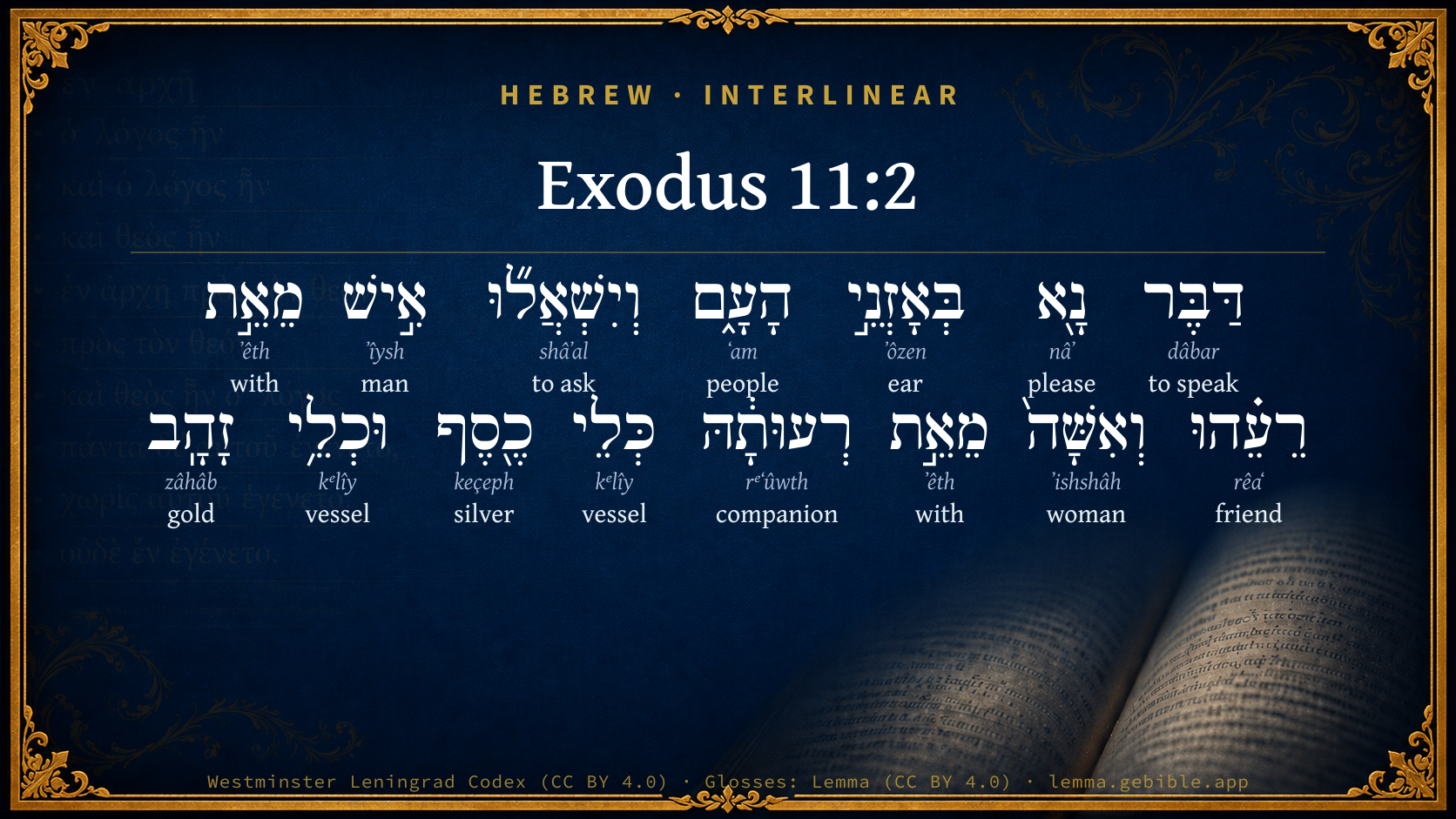
  1. דַּבֶּר dâbar H1696 “speak” Verb, Piel, Imperative, 2nd Person, Masculine, Singular
  2. נָ֖א nâʼ H4994 “please” Particle, Exhortation
  3. בְּאָזְנֵ֣י ʼôzen H241 “in/at · ears of” Preposition + Noun, Common, Feminine, Dual, Construct
  4. הָעָ֑ם ʻam H5971 “the · people” Particle, Definite Article + Noun, Common, Masculine, Singular, Absolute
  5. וְיִשְׁאֲל֞וּ shâʼal H7592 “and · to ask” Conjunction + Verb, Qal, Jussive, 3rd Person, Masculine, Plural
  6. אִ֣ישׁ ʼîysh H376 “man” Noun, Common, Masculine, Singular, Absolute
  7. מֵאֵ֣ת ʼêth H854 “from · with” Preposition + Preposition
  8. רֵעֵ֗הוּ rêaʻ H7453 “friend · his” Noun, Common, Masculine, Singular, Construct + Suffix, Personal, 3rd Person, Masculine, Singular
  9. וְאִשָּׁה֙ ʼishshâh H802 “and · woman” Conjunction + Noun, Common, Feminine, Singular, Absolute
  10. מֵאֵ֣ת ʼêth H854 “from · with” Preposition + Preposition
  11. כְּלֵי kᵉlîy H3627 “vessels of” Noun, Common, Masculine, Plural, Construct
  12. כֶ֖סֶף keçeph H3701 “silver” Noun, Common, Masculine, Singular, Absolute
  13. וּכְלֵ֥י kᵉlîy H3627 “and · vessels of” Conjunction + Noun, Common, Masculine, Plural, Construct
  14. זָהָֽב zâhâb H2091 “gold” Noun, Common, Masculine, Singular, Absolute

About this verse

These counts appear in no published source. They are computed here, from the morphology-tagged text and Lemma’s own curated glosses. What Lemma adds →

15
words
13
distinct lemmas
Pentateuch
section

Notable vocabulary

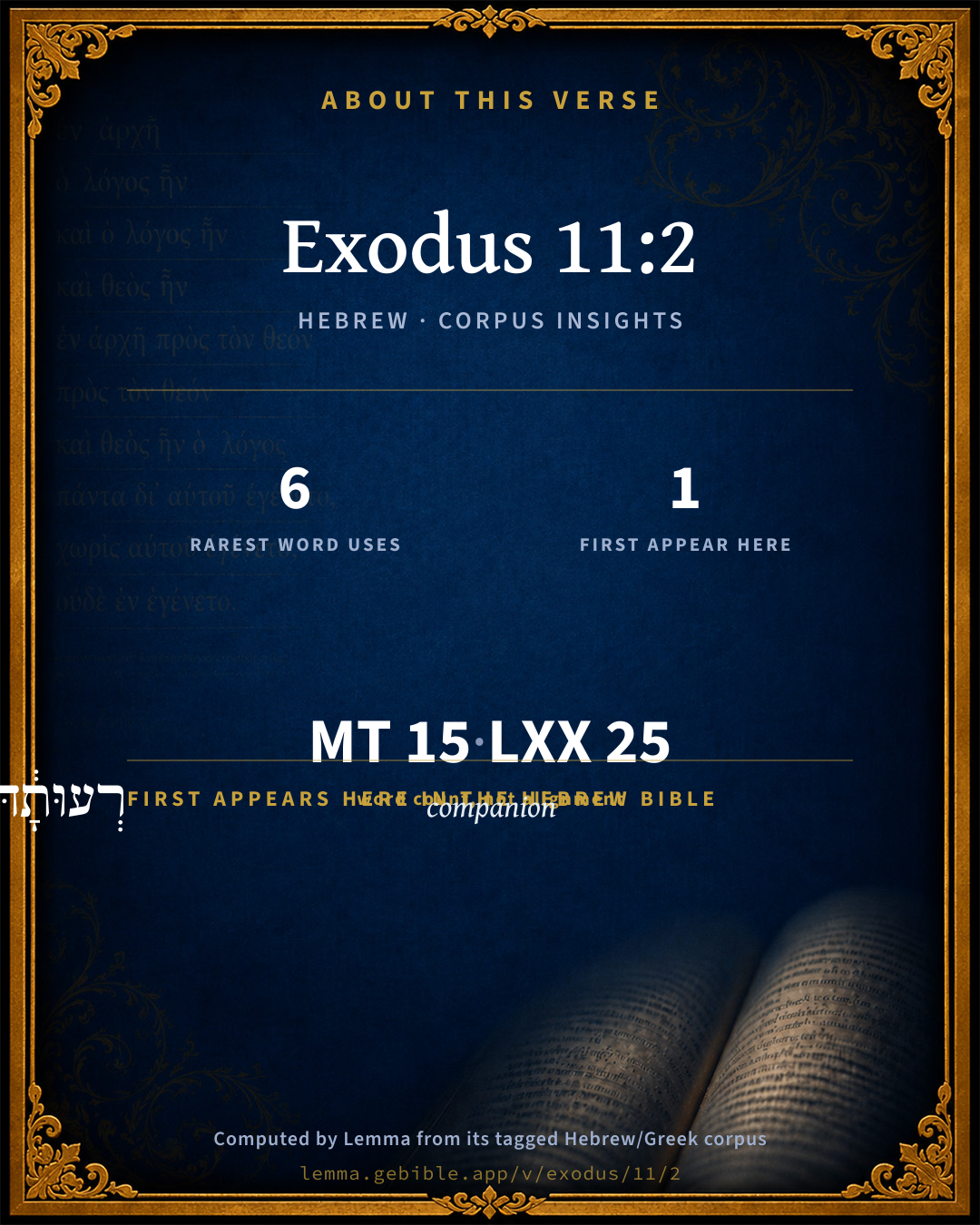
The rarest word here is רְעוּתָ֔הּ companion H7468 — appearing just 6 times in the whole Hebrew Bible.

First appearance in Scripture

This word makes its first canonical appearance in the Hebrew Bible here:

  • רְעוּתָ֔הּ companion H7468

Shared distinctive vocabulary

רְעוּתָ֔הּ companion H7468 occurs in 6 verses of the Hebrew Bible. Also found in:

Grammatical profile

  • 2 verbs
  • 10 nouns
  • 2 prepositions
  • 1 particle

Verb forms

  • דַּבֶּר Piel · Imperative
  • וְיִשְׁאֲל֞וּ Qal · Jussive

Repetition

Words recur within this verse — often emphatic in Hebrew:

  • כְּלֵי vessel H3627 ×2
  • מֵאֵ֣ת with H854 ×2

Hebrew & Septuagint length

In English translation the verse runs 30 words from the Hebrew and 24 from the Septuagint (LXX English) — closely comparable.

A rough comparison of the two English renderings, which tokenize alike — not a word-level alignment.

Word counts can differ between the Hebrew and the Greek without any difference in meaning — e.g. the Hebrew direct-object marker אֵת has no separate Greek word, and Greek often adds the article ὁ.

In the original languages it is 15 Hebrew tokens and 25 Greek tokens — but the two are counted differently (Hebrew bundles its prefixes and suffixes into one token; the Greek is in lemma form), so that isn’t a like-for-like length.

Cross-references

14

Topical passages linked to Exodus 11:2 in the Treasury of Scripture Knowledge — connected by theme and wording, ordered by reader-vote popularity; previews shown in the World English Bible.

  • Exodus 3:22 But every woman shall ask of her neighbor, and of her who visits her house, jewels of silver, jewels of gold, and clothing; and you shall put them on your sons, and on your daughters. You shall despoil the Egyptians.
  • Exodus 12:35–36 The children of Israel did according to the word of Moses; and they asked of the Egyptians jewels of silver, and jewels of gold, and clothing.
  • Psalms 24:1 The earth is Yahweh's, with its fullness; The world, and those who dwell therein.
  • Psalms 105:37 He brought them forth with silver and gold. There was not one feeble person among his tribes.
  • Proverbs 13:22 A good man leaves an inheritance to his children's children, But the wealth of the sinner is stored for the righteous.
  • Haggai 2:8 The silver is mine, and the gold is mine,' says Yahweh of Hosts.
  • Matthew 20:15 Isn't it lawful for me to do what I want to with what I own? Or is your eye evil, because I am good?'
  • Genesis 31:9 Thus God has taken away the cattle of your father, and given them to me.
  • Exodus 12:1–2 Yahweh spoke to Moses and Aaron in the land of Egypt, saying,
  • Exodus 32:2–4 Aaron said to them, "Take off the golden rings, which are in the ears of your wives, of your sons, and of your daughters, and bring them to me."
  • Exodus 32:24 I said to them, 'Whoever has any gold, let them take it off:' so they gave it me; and I threw it into the fire, and out came this calf."
  • Exodus 35:22 They came, both men and women, as many as were willing-hearted, and brought brooches, ear-rings, signet-rings, and armlets, all jewels of gold; even every man who offered an offering of gold to Yahweh.
  • Job 27:16–17 Though he heap up silver as the dust, And prepare clothing as the clay;
  • Ezekiel 16:10–13 I clothed you also with embroidered work, and shod you with sealskin, and I girded you about with fine linen, and covered you with silk.

Cross-references courtesy of OpenBible.info (CC BY 4.0).

Hebrew and Greek witnesses Masoretic Hebrew ↔ Greek Septuagint

The same verse in the two great witnesses to the Old Testament, shown verse-for-verse.

These are two independent witnesses, not word-aligned to each other, and the Septuagint is shown in lemma (dictionary) form.

Hebrew Exodus 11:2 Masoretic · Westminster Leningrad Codex

דַּבֶּר נָ֖א בְּאָזְנֵ֣י הָעָ֑ם וְיִשְׁאֲל֞וּ אִ֣ישׁ מֵאֵ֣ת רֵעֵ֗הוּ וְאִשָּׁה֙ מֵאֵ֣ת רְעוּתָ֔הּ כְּלֵי כֶ֖סֶף וּכְלֵ֥י זָהָֽב

Speak now in the ears of the people, and let them ask every man of his neighbor, and every woman of her neighbor, jewels of silver, and jewels of gold."

World English Bible · Public Domain

Greek LXX Exodus 11:2 Septuagint · lemma form

λαλέω οὖν κρυφῇ εἰς ὁ οὖς ὁ λαός καί αἰτέω ἕκαστος παρά ὁ πλησίον καί γυνή παρά ὁ πλησίον σκεῦος ἀργυροῦς καί χρυσοῦς καί ἱματισμός

Speak therefore secretly in the ears of the people, and let every one ask of his neighbor jewels of silver and gold, and raiment.

LXX2012 (modern English Septuagint) · Public Domain

On this verse, John Gill's Exposition discusses the Septuagint’s reading. Read the note in Commentary ↓

Hebrew: Westminster Leningrad Codex (CC BY 4.0). Greek: Septuagint (public domain); English from LXX2012 (modern English Septuagint) (Public Domain). How the Septuagint differs from the Hebrew →

Targum (Aramaic paraphrase)

2

The Targum is the ancient Jewish Aramaic paraphrase of the Hebrew Scriptures — an interpretive translation, not the Hebrew text itself. Onkelos (literal) and Pseudo-Jonathan (expansive) render the Torah, and Jonathan the Prophets. Coverage is partial: where no permissively-licensed English translation exists for a verse, only the Aramaic is shown. This is verse-level text, not a word-by-word alignment to the Hebrew.

  1. Targum Onkelos Torah (Genesis–Deuteronomy)
    מַלֵיל כְּעַן קֳדָם עַמָא וּשְׁאִילוּ גְבַר מִן חַבְרֵהּ וְאִתְּתָא מִן חַבְרָתַהּ מָנִין דִכְסַף וּמָנִין דִדְהָב:

    (no public-domain English translation for this verse)

    Targum Onkelos — Aramaic: “Onkelos Genesis” (public domain); “Onkelos Exodus” (public domain); “Onkelos Leviticus” (public domain); “Onkelos Numbers” (public domain); “Onkelos Deuteronomy” (public domain). English: “Sefaria Community Translation” (CC0 1.0 (public-domain dedication)); “J.W. Etheridge. The Targums of Onkelos and Jonathan Ben Uzziel on the Pentateuch. London: Longmans, Green, 1862” (public domain). Text via Sefaria.

  2. Targum Pseudo-Jonathan Torah (Genesis–Deuteronomy)
    מַלֵּיל כְּדוֹן בְּמִשְׁמָעֵיהוֹן דְּעַמָּא וִישַׁיְילוּן גְּבַר מִן רַחֲמֵיהּ מִצְרָאֵי וְאִתְּתָא מִן רְחִימָא מִצְרֵיתָא מָאנִין דִּכְסַף וּמָאנִין דִּדְהַב

    Speak now in the hearing of the people, That every man shall demand from his Mizraite friend, and every woman of her Mizraite friend, vessels of silver and vessels of gold.

    Targum Pseudo-Jonathan — Aramaic: “Targum Jonathan on Genesis” (public domain); “Targum Jonathan on Exodus” (public domain); “Targum Jonathan on Leviticus” (public domain); “Targum Jonathan on Numbers” (public domain); “Targum Jonathan on Deuteronomy” (public domain). English: “The Targum of Jonathan ben Uzziel, trans. J. W. Etheridge, London, 1862” (public domain). Text via Sefaria.

Commentary

Notes on Exodus 11:2 from classic Christian and Jewish commentators (each source and its license shown beneath its notes). The classic Christian expositions comment on the surrounding passage and are grouped to its opening verse, so a note may address several verses; the Jewish commentaries on the Tanakh (Rashi and others) are per-verse, so they appear only where the commentator wrote on this verse.

Lemma curates 59 commentaries, every one of them public domain or Creative Commons licensed, each selected and text-cleaned for this edition rather than reprinted as found. About our sources →

Trapp's Complete Commentary

John Trapp

Exo 11:2 Speak now in the ears of the people, and let every man borrow of his neighbour, and every woman of her neighbour, jewels of silver, and jewels of gold.

Ver. 2. Borrow of his neighbour.] This was an extraordinary command, and may not be made a precedent but in the same case, and upon the same warrant. The Lawgiver only can dispense with his own law. Ordinarily it is "the wicked" that "borroweth, and payeth not again." {Psa 37:21}

John Trapp, A Commentary or Exposition upon All the Books of the Old and New Testament (1647–1656) — public domain. Text from a community e-Sword module.

Joseph Benson's Commentary

Exo 11:2. Let every man ask — (not borrow!) of his neighbour — The Israelites, who at first lived distinctly by themselves, when they were greatly multiplied, and Pharaoh began to cast a jealous eye upon them, and to take cruel counsels against them, were more mixed with the Egyptians, as appears from Exo 12:12-13, and many other passages; and this either by their own choice, that they might receive protection and sustenance from them; or rather by Pharaoh’s design, who placed many of his own people among them to watch and chastise them, (Exo 1:12,) and perhaps removed some of them from Goshen to the parts adjoining, which were inhabited by his people. Jewels of silver, or vessels, as the Hebrew word כלי, chelee, properly signifies. For they might plausibly ask, and the Egyptians would more readily give them vessels, which might be both proper and useful for their sacrifices and feasts, than jewels, for which they had neither present need nor use. This was the last day of their servitude, when they were to go away, and their masters, who had abused them in their work, would now have defrauded them of their wages, and have sent them away empty; and the poor Israelites were so fond of liberty that they themselves would have been satisfied with that without pay: but he that executeth righteousness and judgment for the oppressed, provided that the labourers should not lose their hire. God ordered them to demand it now at their departure, in vessels of silver and vessels of gold; to prepare for which, God had now made the Egyptians as willing to part with them upon any terms, as before the Egyptians had made them willing to go upon any terms.

Joseph Benson's Commentary on the Old and New Testaments (1811–1818) — public domain. Text from a community e-Sword module.

Geneva Bible (1599)

Geneva Bible translators

Or, borrow.

Geneva Bible (1599) marginal notes — public domain. Text via Bolls.life.

Jamieson, Fausset & Brown

Robert Jamieson, A. R. Fausset & David Brown

Speak now in the ears of the people--These verses, describing the communication which had been made in private to Moses, are inserted here as a parenthesis, and will be considered (Exo 12:35).

Jamieson, Fausset & Brown — Commentary Critical and Explanatory on the Whole Bible (1871) — public domain (CC PDM 1.0). Text via the HelloAO Bible API.

Adam Clarke's Commentary

Verse 2. Let every man borrow] For a proper correction of the strange mistranslation of the word שאל shaal in this verse, See Clarke on Ex 3:22.

Adam Clarke's Commentary on the Bible (1810–1826) — public domain. Text from a community e-Sword/MySword module.

Ellicott's Commentary for English Readers

(2) Let every man borrow.—See the comment on Exo_3:22. The directions to “ask” the Egyptians for presents is extended here from the women alone to both women and men. Egyptian obduracy and Israelitish loss through some of the plagues may have caused the enlargement of the original instruction.

A Bible Commentary for English Readers, edited by Charles John Ellicott (1878–1897) — public domain. Text from a community e-Sword module.

John Gill's Exposition

Speak now in the ears of the people,.... This cannot be understood of the whole body of the people being gathered together, but of some of the principal ones, who should communicate it to others, and so from one to another, until all the heads and masters of families became acquainted with it:

and let every man borrow of his neighbour, and every woman of her neighbour, jewels of silver, and jewels of gold; to ornament themselves with at the feast they were going to keep: the Samaritan and Septuagint versions add, and clothing or raiment, and such it is certain they did borrow, Exo 12:35 or vessels (p) of different forms, made of gold and silver, such as were fit and proper to be used at sacrifices and feasts, and which will account for the vessels given by princes, Num 7:1 for the doing of which the divine authority was sufficient; though there seems to be a reason for it in justice, that they might be paid for their hard service they had been made to serve for so many years, without having a proper reward for it: the word may be rendered, "let every man ask", &c.

(p) Sept. "vasa", V. L. Pagninus, Montanus, Tigurine version, Piscator, Drusius; "instrumenta", Junius & Tremellius.

John Gill's Exposition of the Whole Bible (1746–1763) — public domain (CC PDM 1.0). Text via the HelloAO Bible API.

Albert Barnes' Notes on the Bible

Every man - In Exo 3:22 only women were named; the command is more explicit when the time has come for its execution.

Borrow - “ask.” See Exo 3:22 note.

Albert Barnes' Notes on the Bible (1834–1885) — public domain. Text from a community e-Sword/MySword module.

Haydock's Catholic Bible Commentary

Ask; "not borrow," as the Protestants translate; nor "jewels of silver," but vessels, such as the princes offered at the dedication of the tabernacle, Numbers vii. The Samaritan and Septuagint add "and raiment," which they also asked for, (chap. xii. 35,) according to God’s command, chap. iii. 22. (Kennicott, 1. Dis. p. 391.)

George Leo Haydock (1774–1849), Haydock's Catholic Family Bible and Commentary, 1859 edition — public domain. Excludes Psalms (Douay-Rheims chapter numbering differs from Protestant) and Deuterocanonical books (Catholic canon only).

Matthew Poole's English Annotations

The Israelites, who at first lived distinctly by when they themselves, were greatly multiplied, and Pharaoh began to cast a jealous eye upon them, and to take cruel counsels against them, were more mixed with the Egyptians, as appears from Exo 12:12,13, and many other places, either by their own choice, that they might receive protection and sustenance from them; or rather by Pharaoh’s design, who planted many of his own people among them to watch and chastise them, Exo 1:11; and, it may be, removed some of them from Goshen to the parts adjoining to it, which were inhabited by his people. Jewels, or vessels, as the Hebrew word properly signifies; for they might more plausibly ask, and the Egyptians would with less suspicion lend them vessels, which might be proper and useful, both for their sacrifices and feasts, than jewels, for which they had no present need or use.

Matthew Poole's English Annotations on the Holy Bible (1683–1685) — public domain. Text from a community e-Sword/MySword module.

Whedon's Commentary on the Bible

Daniel D. Whedon

2. Let every man borrow — שׁאלask, demand, (Septuagint, Vulgate, Luther, De Wette, Ewald, Knobel.) See on chap. 52:22. Of course the Egyptians could have expected no return of the gold and silver, when they urged them to go wholly out of the land. This was no “borrowing” or purloining, but these “spoils” were gifts obtained by moral constraint. The terror-stricken Egyptians were glad to give them any thing so they would but go in peace. If this despoiling the Egyptians were not so particularly described we should find much difficulty in accounting for the quantity of gold and jewelry which we find in the possession of the Hebrews when they went out of servitude. A large amount of gold was used in the manufacture of the calf in Horeb; and, after this idol had been destroyed, we find the men and women bringing freewill offerings of “bracelets, and earrings, and (signet) rings, and tablets, (necklaces,) all jewels of gold,” (Exo_35:22,) for the ornamentation and furnishing of the tabernacle, whose beams were all plated with gold, and all whose vessels were gold. It would be hard to account for such an extraordinary amount of the precious metal in the possession of a nation just emerged from bondage were not this unusual means of supply set before us. It was fit that the oppressor who had so long luxuriated on their unrequited toil should repay; it was proper that they should go in festal attire to Jehovah’s feast; and it was the crown of their triumph that the Egyptians willingly loaded them with their costly garments and jewels, freely bidding them go, and praying, Bless us also.

Daniel D. Whedon (gen. ed.), Commentary on the Old and New Testaments (1874–1909) — public domain. Text from a community e-Sword module.

The Pulpit Commentary

Every man every woman. In Exo_3:22 only women had been mentioned. Now the terms of the direction were enlarged. It is worthy of notice that gold and silver ornaments ear-rings, collars, armlets, bracelets, and anklets, were worn almost as much by the Egyptian men of the Rameside period as by the women. Borrow. On this faulty translation, see the comment on Exo_3:22. Jewels. Literally, "articles." The word is one of a very wide meaning, and might include drinking-cups and other vessels; but from the statement in Exo_3:22, that they were to "put them on their sons and on their daughters" it is clear that personal ornaments are especially meant.

The Pulpit Commentary (1880–1919), ed. H.D.M. Spence-Jones & Joseph S. Exell — public domain. Text from a community e-Sword module.

John Wesley's Explanatory Notes

Let every man ask (not borrow!) of his neighbour jewels - This was the last day of their servitude, when they were to go away, and their masters, who had abused them in their work, would now have defrauded them of their wages, and have sent them away empty, and the poor Israelites were so fond of liberty that they themselves would be satisfied with that, without pay: but he that executeth righteousness and judgment for the oppressed, provided that the labourers should not lose their hire. God ordered them to demand it now at their departure, in jewels of silver, and jewels of gold; to prepare for which, God had now made the Egyptians as willing to part with them upon any terms, as before the Egyptians had made them willing to go upon any terms.

John Wesley, Explanatory Notes Upon the Whole Bible (1754–1765) — public domain. Text via the GEBible commentary corpus.

Keil & Delitzsch

C. F. Keil & F. Delitzsch

In this way Jehovah would overcome the resistance of Pharaoh; and even more than that, for Moses was to tell the people to ask the Egyptians for articles of silver and gold, for Jehovah would make them willing to give. The renown acquired by Moses through his miracles in Egypt would also contribute to this. (For the discussion of this subject, see Exo 3:21-22.) The communication of these instructions to the people is not expressly mentioned; but it is referred to in Exo 12:35-36, as having taken place.

Keil & Delitzsch — Biblical Commentary on the Old Testament (1861–1891) — public domain (CC PDM 1.0). Text via the HelloAO Bible API. (Old Testament only.)

Rashi

Rabbi Shlomo Yitzchaki (Rashi)

דבר נא SPEAK נא — The word נא is always an expression of entreaty. Here it means: I entreat you, admonish them about this which follows (impress this injunction upon them), so that righteous man, Abraham, may not say: the prophecy (Genesis 15:13) “they shall serve them, and they shall afflict them” He permitted to be fulfilled in them, but the promise (Genesis 15:14) “and afterwards they shall go forth with great substance” He did not bring to fulfilment for them (Berakhot 9a-b).

Rashi on the Tanakh — English translations: “The Judaica Press complete Tanach with Rashi, translated by A. J. Rosenberg” (CC BY 4.0); “Pentateuch with Rashi's commentary by M. Rosenbaum and A.M. Silbermann, 1929-1934” (public domain); “The Metsudah Tanach series, Lakewood, N.J” (CC BY 4.0); and “The Book of Joshua, Metsudah Publications, 1997” (CC BY 4.0). Text via Sefaria.

Ramban (Nachmanides)

Rabbi Moshe ben Nachman (Ramban / Nachmanides)

SPEAK NOW IN THE EARS OF THE PEOPLE. I.e., after you depart from Pharaoh.

Ramban (Nachmanides) on the Tanakh — English translation: “Commentary on the Torah by Ramban (Nachmanides). Translated and annotated by Charles B. Chavel. New York, Shilo Pub. House, 1971-1976” (CC BY 4.0). Text via Sefaria.

Lesson kit

Teaching starters — assembled from the data on this page, not authored interpretation. Every prompt links to the verse data it draws on. Edit before teaching.

Exodus, in the Pentateuch, opens this verse with 15 words (13 distinct Hebrew lemmas). Its most distinctive word is rᵉʻûwth (“companion”). A historical commentator’s framing appears above. Read the whole chapter for the surrounding context.

Discussion questions

  1. What does “companion” (rᵉʻûwth) contribute to the verse as a whole?
  2. The word “companion” first appears here in Scripture. What is being introduced at this debut?
  3. Esther 1:19 shares the word «companion» with this verse. How do the two illuminate each other?
  4. “vessel” occurs 2× in this one verse. What is the effect of the repetition?
  5. These translations render this verse differently. What is at stake in choosing one wording over another?
  6. The verb «דַּבֶּר» is Piel Imperative. How does its form color the action?
  7. Reading how Trapp's Complete Commentary and Joseph Benson's Commentary read this verse, where do the two commentators agree and where do they part?

Things to notice

Reading settings

Reading text

Shown beneath each verse's original-language words.

Old Testament
Old Testament edition

Read the OT as the Masoretic Hebrew (MT) or the Greek Septuagint (LXX).

English shown for the Greek Septuagint (in the Hebrew ↔ Greek comparison).

Comparing translations? Open the Compare panel on any verse page to stack up to four side by side.