Genesis 24:61

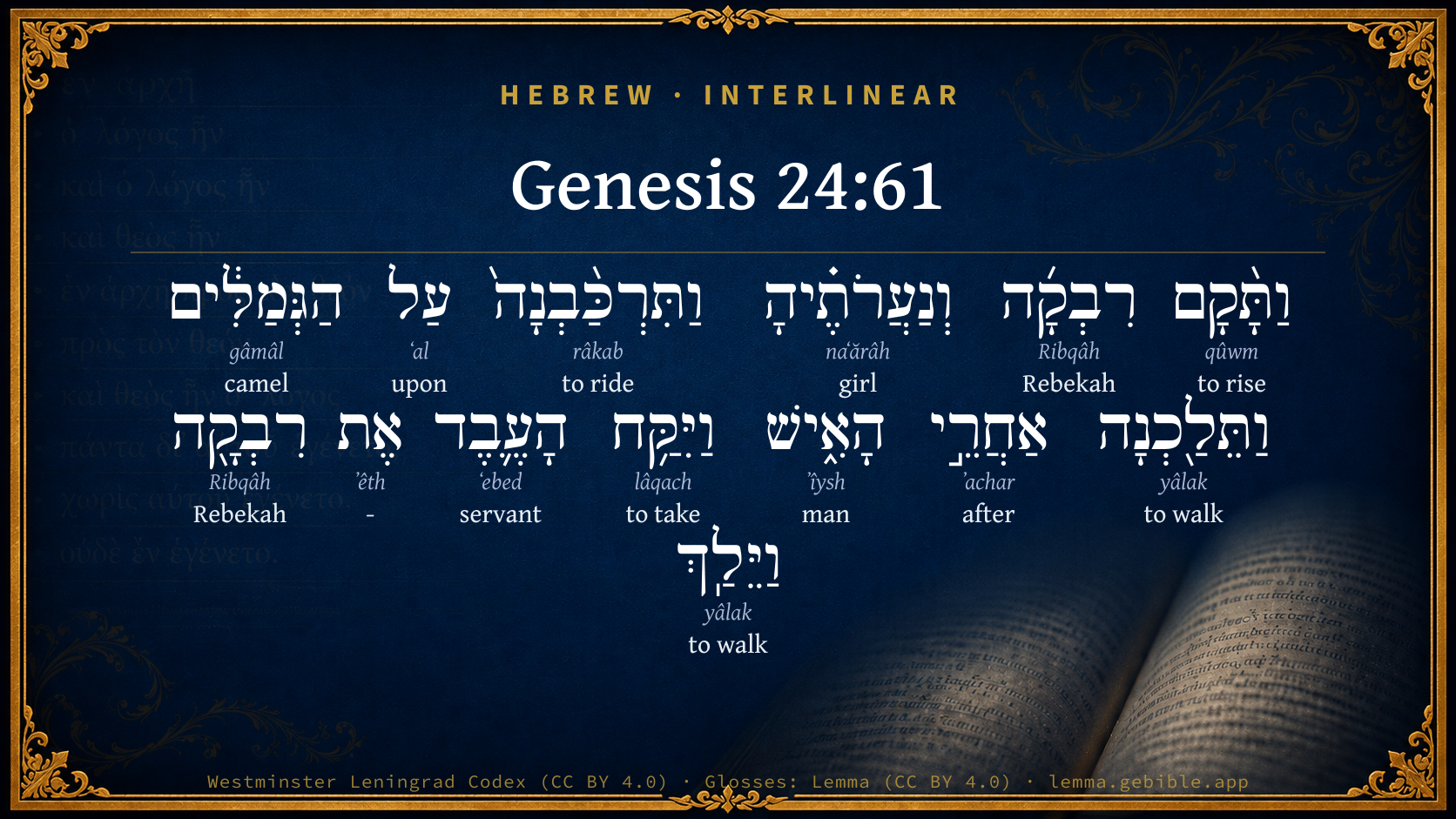
Hebrew (Westminster Leningrad Codex) Genesis 24:61 appears in the Hebrew Old Testament. The text above is from the Westminster Leningrad Codex. Each word links to its Strong’s number, a concise gloss, and parsing drawn from the Open Scriptures Hebrew Bible morphology. Click any word for its full Brown-Driver-Briggs (BDB) entry.
Download image
Cite this verse

Genesis 24:61 (World English Bible). Public Domain. Lemma interlinear Bible study tool, https://lemma.gebible.app/v/genesis/24/61.

Show BibTeX & RIS
BibTeX
RIS
English Translation
Rebekah arose with her ladies. They rode on the camels, and followed the man. The servant took Rebekah, and went his way.
World English Bible · Public Domain
Highlights
  • 1 first appearance in the Hebrew Bible
Full analysis ↓
Download a study sheet

One document with this verse’s original text, its word-by-word gloss line, the meaning frame, cross-references with their text, attributed commentary, and full source and license credits — printable, and it pastes into notes with its structure intact.

This verse Autodidact and up

Study sheet (.html) Plain text (.txt)

A passage Seminary Student

Up to 50 verses in one chapter. A passage sheet keeps up to 6 commentary sources and 12 cross-references per verse, in the order this page ranks them, and says so on the sheet whenever that leaves anything out. Ask for a single verse and you get the Autodidact verse sheet above.

Everything on this page stays free to read, with no account — the sheet is a download of what is already on screen, not access to it.

Want to remove ads? Support Godless Engineer
Compare translations 3

The same verse in 3 English versions, stacked beneath the original-language interlinear above. Click any original word for its lexicon entry.

Each is an independent rendering of the whole verse — the interlinear is not word-aligned to these translations.

Highlighted words mark where these versions differ — a whole-verse word diff, not a word-by-word alignment.

  • World English Bible Public Domain
    Rebekah arose with her ladies. They rode on the camels, and followed the man. The servant took Rebekah, and went his way.
  • King James Version Public Domain
    And Rebekah arose, and her damsels, and they rode upon the camels, and followed the man: and the servant took Rebekah, and went his way.
  • unfoldingWord Literal Text CC BY-SA 4.0
    Then Rebekah got up and her maids, and they mounted the camels and went with the man. So the servant took Rebekah and left.

unfoldingWord Literal Text — © unfoldingWord, licensed CC BY-SA 4.0. Word-aligned USFM3 via Door43 (git.door43.org/unfoldingWord/en_ult).

Versions to compare (up to 4)

3 of 4 selected

Show all 18 translations

Every available English version of this verse, each an independent rendering of the whole verse.

  • World English Bible Public Domain
    Rebekah arose with her ladies. They rode on the camels, and followed the man. The servant took Rebekah, and went his way.
  • Berean Standard Bible Public Domain
    Then Rebekah and her servant girls got ready, mounted the camels, and followed the man. So the servant took Rebekah and left.
  • Majority Standard Bible Public Domain
    Then Rebekah and her servant girls got ready, mounted the camels, and followed the man. So the servant took Rebekah and left.
  • King James Version Public Domain
    And Rebekah arose, and her damsels, and they rode upon the camels, and followed the man: and the servant took Rebekah, and went his way.
  • American Standard Version (1901) Public Domain
    And Rebekah arose, and her damsels, and they rode upon the camels, and followed the man. And the servant took Rebekah, and went his way.
  • Revised Version (1885) Public Domain
    And Rebekah arose, and her damsels, and they rode upon the camels, and followed the man: and the servant took Rebekah, and went his way.
  • Geneva Bible (1599) Public Domain
    Then Rebekah arose, and her maydes, and rode vpon the camels, and followed the man. and the seruant tooke Rebekah, and departed.
  • Douay-Rheims (1899) Public Domain
    So Rebecca and her maids, being set upon camels, followed the man: who with speed returned to his master.
  • Young's Literal Translation Public Domain
    And Rebekah and her young women arise, and ride on the camels, and go after the man; and the servant taketh Rebekah and goeth.
  • Literal Standard Version CC BY-SA 4.0
    And Rebekah and her young women arise, and ride on the camels, and go after the man; and the servant takes Rebekah and goes.
  • Unlocked Literal Bible CC BY-SA 4.0
    Then Rebekah arose, and she and her servant girls mounted the camels, and followed the man. Thus the servant took Rebekah, and went his way.
  • unfoldingWord Literal Text CC BY-SA 4.0
    Then Rebekah got up and her maids, and they mounted the camels and went with the man. So the servant took Rebekah and left.
  • Darby Bible Public Domain
    And Rebecca arose, and her maids, and they rode upon the camels, and followed the man. And the servant took Rebecca, and went away.
  • World Messianic Bible Public Domain
    Rebekah arose with her ladies. They rode on the camels, and followed the man. The servant took Rebekah, and went his way.
  • Webster's Bible Public Domain
    And Rebekah arose, and her damsels, and they rode upon the camels, and followed the man: and the servant took Rebekah, and went his way.
  • Free Bible Version CC BY-SA 4.0
    Then Rebekah and her servant girls got on the camels. They followed Abraham's servant and left.
  • Bible in Basic English Public Domain
    So Rebekah and her servant-women went with the man, seated on the camels; and so the servant took Rebekah and went on his way.
  • JPS Tanakh (1917) Public Domain
    And Rebekah arose, and her damsels, and they rode upon the camels, and followed the man. And the servant took Rebekah, and went his way.

Literal Standard Version (2020), Covenant Press — licensed CC BY-SA 4.0. Text via the HelloAO Bible API (eBible.org). Unlocked Literal Bible (unfoldingWord) — licensed CC BY-SA 4.0. Text via the HelloAO Bible API (eBible.org). unfoldingWord Literal Text — © unfoldingWord, licensed CC BY-SA 4.0. Word-aligned USFM3 via Door43 (git.door43.org/unfoldingWord/en_ult). Free Bible Version, Dr. Jonathan Gallagher — licensed CC BY-SA 4.0. Text via the HelloAO Bible API (eBible.org).

Word by word

More ways to search: Search by grammar → Find every occurrence → Compare this word →

Practice this passage: Drill this verse → Learn its vocabulary →

רִבְקָ֜ה
Ribqâh
H7259
“Rebekah”
Noun, Proper
Part of Speech
Noun
Type
Proper
Full BDB Definition

Origin: from an unused root probably meaning to clog by tying up the fetlock

TWOT: None

Rebekah = "ensnarer" - daughter of Bethuel, sister of Laban, wife of Isaac, and mother of Esau and Jacob
  1. וַתָּ֨קָם qûwm H6965 “and · to rise” Conjunction + Verb, Qal, Sequential Imperfect, 3rd Person, Feminine, Singular
  2. וְנַעֲרֹתֶ֗יהָ naʻărâh H5291 “and · girls · her” Conjunction + Noun, Common, Feminine, Plural, Construct + Suffix, Personal, 3rd Person, Feminine, Singular
  3. וַתִּרְכַּ֨בְנָה֙ râkab H7392 “and · to ride” Conjunction + Verb, Qal, Sequential Imperfect, 3rd Person, Feminine, Plural
  4. עַל ʻal H5921 “upon” Preposition
  5. הַגְּמַלִּ֔ים gâmâl H1581 “the · camels” Particle, Definite Article + Noun, Common, Masculine, Plural, Absolute
  6. וַתֵּלַ֖כְנָה yâlak H3212 “and · to walk” Conjunction + Verb, Qal, Sequential Imperfect, 3rd Person, Feminine, Plural
  7. אַחֲרֵ֣י ʼachar H310 “after” Preposition
  8. הָאִ֑ישׁ ʼîysh H376 “the · man” Particle, Definite Article + Noun, Common, Masculine, Singular, Absolute
  9. וַיִּקַּ֥ח lâqach H3947 “and · to take” Conjunction + Verb, Qal, Sequential Imperfect, 3rd Person, Masculine, Singular
  10. הָעֶ֛בֶד ʻebed H5650 “the · servant” Particle, Definite Article + Noun, Common, Masculine, Singular, Absolute
  11. אֶת ʼêth H853 “-” Particle, Direct Object
  12. רִבְקָ֖ה Ribqâh H7259 “Rebekah” Noun, Proper
  13. וַיֵּלַֽךְ yâlak H3212 “and · to walk” Conjunction + Verb, Qal, Sequential Imperfect, 3rd Person, Masculine, Singular

About this verse

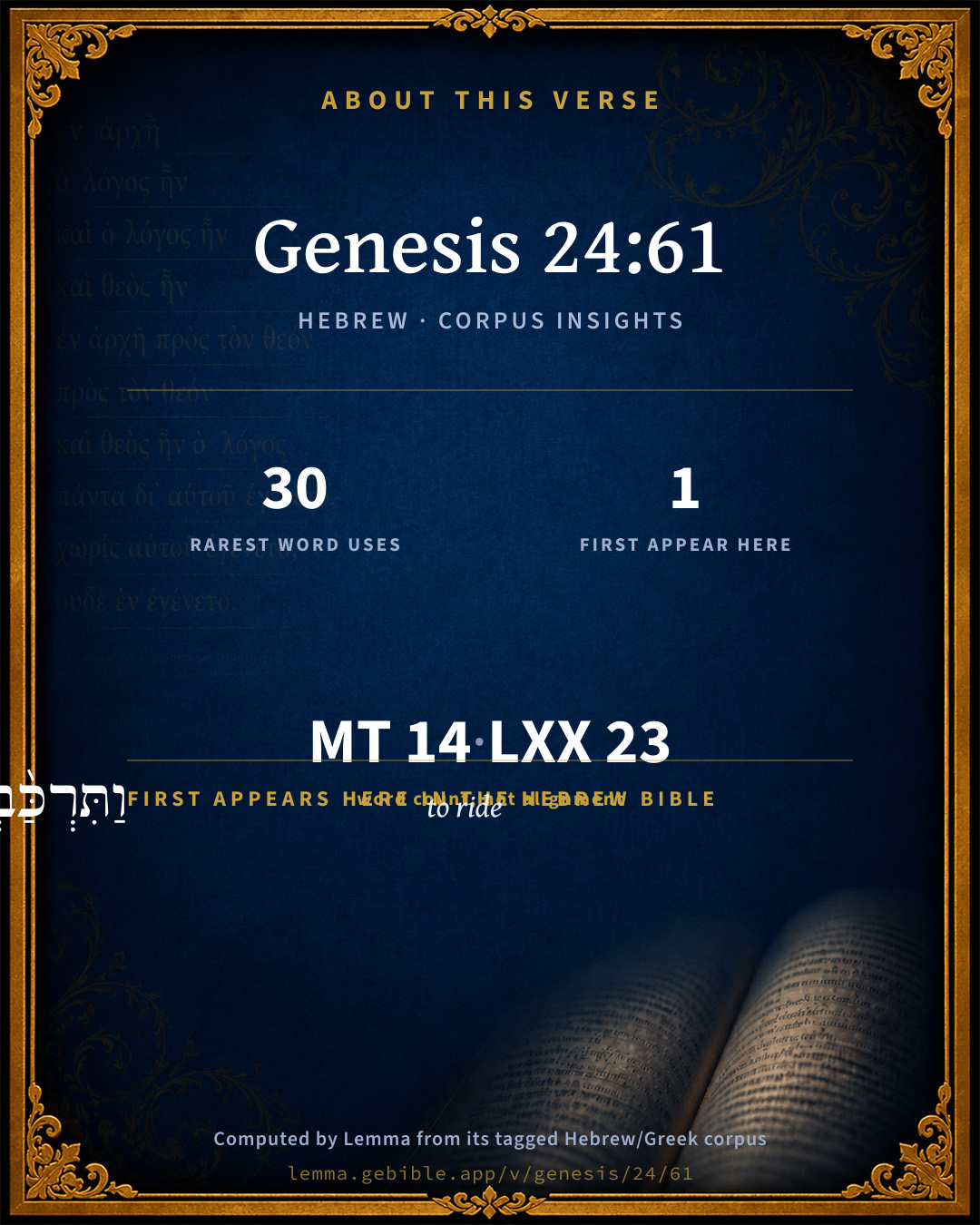
These counts appear in no published source. They are computed here, from the morphology-tagged text and Lemma’s own curated glosses. What Lemma adds →

14
words
12
distinct lemmas
Pentateuch
section

First appearance in Scripture

This word makes its first canonical appearance in the Hebrew Bible here:

  • וַתִּרְכַּ֨בְנָה֙ to ride H7392

Shared distinctive vocabulary

רִבְקָ֜ה Rebekah H7259 occurs in 29 verses of the Hebrew Bible. Also found in:

Grammatical profile

  • 5 verbs
  • 6 nouns
  • 2 prepositions
  • 1 particle

Verb forms

  • וַתָּ֨קָם Qal · Sequential Imperfect
  • וַתִּרְכַּ֨בְנָה֙ Qal · Sequential Imperfect
  • וַתֵּלַ֖כְנָה Qal · Sequential Imperfect
  • וַיִּקַּ֥ח Qal · Sequential Imperfect
  • וַיֵּלַֽךְ Qal · Sequential Imperfect

Repetition

Words recur within this verse — often emphatic in Hebrew:

  • רִבְקָ֜ה Rebekah H7259 ×2
  • וַתֵּלַ֖כְנָה to walk H3212 ×2

Hebrew & Septuagint length

In English translation the verse runs 22 words from the Hebrew and 25 from the Septuagint (LXX English) — closely comparable.

A rough comparison of the two English renderings, which tokenize alike — not a word-level alignment.

Word counts can differ between the Hebrew and the Greek without any difference in meaning — e.g. the Hebrew direct-object marker אֵת has no separate Greek word, and Greek often adds the article ὁ.

In the original languages it is 14 Hebrew tokens and 23 Greek tokens — but the two are counted differently (Hebrew bundles its prefixes and suffixes into one token; the Greek is in lemma form), so that isn’t a like-for-like length.

Cross-references

6

Topical passages linked to Genesis 24:61 in the Treasury of Scripture Knowledge — connected by theme and wording, ordered by reader-vote popularity; previews shown in the World English Bible.

  • Genesis 2:24 Therefore a man will leave his father and his mother, and will join with his wife, and they will be one flesh.
  • Psalms 45:10 Listen, daughter, consider, and turn your ear. Forget your own people, and also your father's house.
  • Genesis 31:34 Now Rachel had taken the teraphim, put them in the camel's saddle, and sat on them. Laban felt about all the tent, but didn't find them.
  • 1 Samuel 30:17 David struck them from the twilight even to the evening of the next day: and there not a man of them escaped, except four hundred young men, who rode on camels and fled.
  • Esther 8:10 He wrote the name of king Ahasuerus, and sealed it with the king's ring, and sent letters by post on horseback, riding on swift steeds that were used in the king's service, bred of the stud:
  • Esther 8:14 So the posts who rode on swift steeds that were used in the king's service went out, being hurried and pressed on by the king's commandment; and the decree was given out in Shushan the palace.

Cross-references courtesy of OpenBible.info (CC BY 4.0).

Hebrew and Greek witnesses Masoretic Hebrew ↔ Greek Septuagint

The same verse in the two great witnesses to the Old Testament, shown verse-for-verse.

These are two independent witnesses, not word-aligned to each other, and the Septuagint is shown in lemma (dictionary) form.

Hebrew Genesis 24:61 Masoretic · Westminster Leningrad Codex

וַתָּ֨קָם רִבְקָ֜ה וְנַעֲרֹתֶ֗יהָ וַתִּרְכַּ֨בְנָה֙ עַל הַגְּמַלִּ֔ים וַתֵּלַ֖כְנָה אַחֲרֵ֣י הָאִ֑ישׁ וַיִּקַּ֥ח הָעֶ֛בֶד אֶת רִבְקָ֖ה וַיֵּלַֽךְ

Rebekah arose with her ladies. They rode on the camels, and followed the man. The servant took Rebekah, and went his way.

World English Bible · Public Domain

Greek LXX Genesis 24:61 Septuagint · lemma form

ἀναἵστημι δέ ρεβεκκα καί ὁ ἅβρα αὐτός ἐπιβαίνω ἐπί ὁ κάμηλος καί πορεύομαι μετά ὁ ἄνθρωπος καί ἀναλαμβάνω ὁ παῖς ὁ ρεβεκκα ἀποἔρχομαι

And Rebecca rose up and her maidens, and they mounted the camels and went with the man; and the servant having taken up Rebecca, departed.

LXX2012 (modern English Septuagint) · Public Domain

On this verse, The Preacher's Complete Homiletical Commentary discusses the Septuagint’s reading. Read the note in Commentary ↓

Hebrew: Westminster Leningrad Codex (CC BY 4.0). Greek: Septuagint (public domain); English from LXX2012 (modern English Septuagint) (Public Domain). How the Septuagint differs from the Hebrew →

Targum (Aramaic paraphrase)

2

The Targum is the ancient Jewish Aramaic paraphrase of the Hebrew Scriptures — an interpretive translation, not the Hebrew text itself. Onkelos (literal) and Pseudo-Jonathan (expansive) render the Torah, and Jonathan the Prophets. Coverage is partial: where no permissively-licensed English translation exists for a verse, only the Aramaic is shown. This is verse-level text, not a word-by-word alignment to the Hebrew.

  1. Targum Onkelos Torah (Genesis–Deuteronomy)
    וְקָמַת רִבְקָה וְעוּלֶמְתָּהָא וּרְכִיבָא עַל גַּמְלַיָּא וְאָזְלָּא בָּתַר גַּבְרָא וּדְבַר עַבְדָּא יָת רִבְקָה וַאֲזָל

    (no public-domain English translation for this verse)

    Targum Onkelos — Aramaic: “Onkelos Genesis” (public domain); “Onkelos Exodus” (public domain); “Onkelos Leviticus” (public domain); “Onkelos Numbers” (public domain); “Onkelos Deuteronomy” (public domain). English: “Sefaria Community Translation” (CC0 1.0 (public-domain dedication)); “J.W. Etheridge. The Targums of Onkelos and Jonathan Ben Uzziel on the Pentateuch. London: Longmans, Green, 1862” (public domain). Text via Sefaria.

  2. Targum Pseudo-Jonathan Torah (Genesis–Deuteronomy)
    וְקָמַת רִבְקָה וְרִבְתָהָא וּרְכָבָן עַל גַמְלַיָא וְאָזְלַן בָּתַר גַבְרָא וּדְבַר עַבְדָא יַת רִבְקָה בַּהֲדֵיהּ וְטַיֵיל וְהֵיכְמָא דְאִתְקְטָעָא לֵיהּ אָרְחָא בְּמֵיזְלֵיהּ לְפַדָן אֲרָם הֵיכְדֵין אִתְקְטָעָא לֵיהּ בְּמִיתְבֵיהּ דִבְיוֹמָא חַד אָזֵיל וּבְיוֹמָא חַד תַּב

    And Rivekah arose, and her damsel, and they rode upon camels, and went after the man. And the servant took Rivekah with him and journeyed. And as the way was shortened to him in his journey to Padan Aram, so was it shortened to him in his return, that in one day he went, and in one day he returned.

    Targum Pseudo-Jonathan — Aramaic: “Targum Jonathan on Genesis” (public domain); “Targum Jonathan on Exodus” (public domain); “Targum Jonathan on Leviticus” (public domain); “Targum Jonathan on Numbers” (public domain); “Targum Jonathan on Deuteronomy” (public domain). English: “The Targum of Jonathan ben Uzziel, trans. J. W. Etheridge, London, 1862” (public domain). Text via Sefaria.

Commentary

Notes on Genesis 24:61 from classic Christian and Jewish commentators (each source and its license shown beneath its notes). The classic Christian expositions comment on the surrounding passage and are grouped to its opening verse, so a note may address several verses; the Jewish commentaries on the Tanakh (Rashi and others) are per-verse, so they appear only where the commentator wrote on this verse.

Lemma curates 59 commentaries, every one of them public domain or Creative Commons licensed, each selected and text-cleaned for this edition rather than reprinted as found. About our sources →

Trapp's Complete Commentary

John Trapp

Gen 24:61 And Rebekah arose, and her damsels, and they rode upon the camels, and followed the man: and the servant took Rebekah, and went his way.

Ver. 61. They rode upon the camels.] A tiresome and tedious journey it was, but for a good husband. Suffer we with, and for Christ, "that we may be glorified together," {Rom 8:17} when the marriage shall be consummated. Heaven will pay for all. What though thou ride on a trotting camel it is to be married. He that rides to be crowned, will not think much of a rainy day.

John Trapp, A Commentary or Exposition upon All the Books of the Old and New Testament (1647–1656) — public domain. Text from a community e-Sword module.

Joseph Benson's Commentary

Gen 24:61. And her damsels — It seems then, when she went to the well for water, it was not because she had no servants at command, but because she took pleasure in these instances of humanity and industry.

Joseph Benson's Commentary on the Old and New Testaments (1811–1818) — public domain. Text from a community e-Sword module.

The Pulpit Commentary

CHAPTER 24:61-67

And Rebekah arose (expressive of the promptitude, celerity, and decision of her departure), and her damsels, probably a company, at least two, though Laban afterwards only gave each of his daughters one (Gen_29:24, Gen_29:29) and they rode upon camels (most likely those which Abraham"s servant had brought), and followed the man (not in fear, but in hope): and the servant took (in the sense of undertook the charge of) Rebekah (who, in his eyes, would now he invested with additional charms, as his young master"s intended bride), and went his way returning by the road he came.

Vers. 61-67.

A bride for the heir. 4. Rebekah and Isaac, or the wedding of the bride.

I THE PENSIVE BRIDEGROOM.

1. Mourning for his mother. Isaac s meditation clearly includes this. Good mothers, when they die, should be deeply and affectionately sorrowed for by grateful and loving sons. A son who loves his mother living forgets not to lament her dead. The best testimonial of filial piety is to know that a son tenderly regards his mother while she lives, and cherishes her memory when she is gone.

2. Musing on his bride. This too the language will admit. Scarcely could the thought of Eliezer"s mission be excluded from Isaac"s mind. Doubtless he would often, during the interval of his absence, have his silent wonderings about its return with the God-pro vide d spouse. Almost certainly too his prayers would ascend to heaven on her behalf. He who asks a wife from God is most likely to receive one, and he who frequently prays for the wife of his youth is most likely to love her when she comes. Note that Isaac"s mournings and musings were in the field at eventide. While any place and time will suffice for heart exercises, some places and times are more suitable than others, and none more so than the solitude of nature and the darkening of eve.

II THE VEILED BRIDE. Springing from her camel at the sight of her intended husband, "she took a veil and covered herself." The actions indicated

1. Rebekah"s politeness. Etiquette required both. It was satisfactory at least that Isaac was about to receive as his wife a lady, one acquainted with the gentle manners of the day. Refinement, while desirable in all, is specially beautiful in woman. Elegance of manners are only second to beauty of form in a bride.

2. Rebekahs modesty. Nothing can palliate immodesty in any, least of all in the gentler sex. Hence, not only should maidens be educated with the greatest possible attention to the cultivation of pure and delicate emotions, but nothing should ever tempt them to east aside that shield of maidenly reserve which is one of their surest protections in the midst of life"s dangers and seductions.

III THE PRIMITIVE WEDDING.

1. The giving of the bride. This we can suppose was performed by Eliezer, who, by his recital of "all things that he had done," practically certified that Rebekah was the maiden whom Jehovah had pro vide d, and now in formal act handed over to him to be his wife.

2. The taking of the bride. "Isaac took Rebekah, i.e. publicly and solemnly accepted her in the presence of witnesses as his bride. Thus, without elaborate or expensive Ceremonial, Rebekah "became his wife.

3. The home-coming of the bride. "Isaac brought her into his mother Sarah"s tent," and thus installed her in the honors as well as invested her with the privileges of matron of his house.

IV THE HAPPY HOME.

1. Isaac loved Rebekah. "So ought husbands to love their wives as their own bodies". (Eph_5:28) It is their duty; it ought to be their happiness; it certainly will prove their interest.

2. Rebekah comforted Isaac. So ought wives not merely "to reverence their husbands", (Eph_5:33) but to soothe their sorrows, cure their cares, and dispel their despondencies.

Learn

1. That the son who sorrows for a mother will likely prove a husband that can love a wife.

2. That maidens" charms are most attractive when seen through a veil of modesty.

3. That those marriages are most auspicious which are made by God.

4. That those homes are happiest where husband and wife love and comfort one another.

The Pulpit Commentary (1880–1919), ed. H.D.M. Spence-Jones & Joseph S. Exell — public domain. Text from a community e-Sword module.

The Preacher's Complete Homiletical Commentary

Joseph S. Exell (gen. ed.)

CRITICAL NOTES.—

Gen_24:63. To meditate.] Onkelos has to pray, and the LXX. to exercise himself, i.e., religiously, to employ his mind and heart in devout contemplation. The Heb. word occurs only in this place, and is variously interpreted. The rendering in the A.V. is generally adopted.

Gen_24:64. She lighted off the camel.] “It is an Eastern custom, prevalent in many parts to this day, that women, when riding on the road and meeting strange men, descend from their animals as a mark of respect offered to the stronger sex.” (Kalisch.)

Gen_24:67. And Isaac was comforted after his mother’s death. The interval between her death and his marriage was about three years.

MAIN HOMILETICS OF THE PARAGRAPH.—Gen_24:61-67

A PRIMEVAL MARRIAGE

Here we have a beautiful and touching picture of a primeval marriage, in which the following characteristics are remarkable:—

I. Its simplicity. The servant had returned from his journey, and now “told Isaac all things that he had done.” (Gen_24:66.) To him he introduces Rebekah. Isaac takes her in the presence of all witnesses, and she becomes his wife. There was no elaborate form or ceremony. The whole transaction was reduced to the utmost simplicity.

II. Its purity. The motives of all concerned were honest and sincere. As for Rebekah, she was modest and retiring, though simple and trustful. As for Isaac, “he loved her.” (Gen_24:67.) Love is essential to a real marriage, and where this is wanting that pure and holy institution is dishonoured. Everything belonging to this marriage was real and true. It had a pure motive and a pure end in view.

III. Its godliness. This was truly a marriage in the Lord. It was pervaded by a spirit of reverence towards God and a desire for His blessing. Isaac prepares himself for this favour of Providence by prayer and meditation. (Gen_24:63.) This quiet and retiring duty became him, for he was rather a man of thoughtful and reflective habits than of action. Probably he now meditated upon the time when he was bound upon the altar, and when God wrought for him a wonderful deliverance. He would naturally hope that great things were still in store for him. The spirit of meditation was a suitable attitude of mind in which to await the events that were impending.

IV. It is illustration of the principle of unity in diversity. In this principle we have the true idea of marriage—the conjunction of things that are unlike. The characters of Isaac and Rebekah were most diverse. They were truly complements of each other, and when brought together made a complete whole. Isaac was passive, obedient, submissive; and on the other hand Rebekah was modest, trustful, and impulsive. The deficiencies of one were supplied by the other, and both together made a strong and full-orbed character.

SUGGESTIVE COMMENTS ON THE VERSES

Gen_24:61. Rebekah, like Abraham, was one of the children of faith. Like him she obeyed what she believed to be the voice of God, and went out not knowing whither she went. It is true that God spoke directly to Abraham, and that Rebekah followed the guidance of a man who was charged to carry out the Divine purpose. And herein we are represented, for in the Bible we listen to holy men who have received a message from God.

Her damsels. These were her attendants besides her nurse. These were probably given to her as part of her patrimony. Rebekah went in company with Eliezer, and the damsels (attendants, and nurse, and retinue) followed in a train or caravan.—(Jacobus.)

A tiresome and a tedious journey it was, but for a good husband. Suffer we with and for Christ, “that we may be glorified together” (Rom_8:17), when the marriage shall be consummated. Heaven will pay for all. What though thou ride on a trotting camel? it is to be married. He that rides to be crowned will not think much of a rainy day.—(Trapp.)

Gen_24:62. Isaac was just come from the entering in of that place. This may mean that here he resided at this time. It was the well where the Covenant Angel had met Hagar (Gen_16:14). He was living in the south country. And in ch. Gen_25:11, it is said that he dwelt by this well, and he was just now coming (or come) from that direction towards Beersheba, his father’s house, to learn the result. Some suppose that he had been thither on account of its association with the family history and the omnipresence of the Covenant Angel, and had there laid this important matter before God. This would be a reason for noting this incidental fact. This view would be sustained by the connection—he went out into the field to meditate.—(Jacobus.)

This place was well calculated to awaken thoughts of an overruling Providence. To every religious mind there are such sacred spots upon earth.

Gen_24:63. This is a characteristic of Isaac’s retiring contemplative word. Abraham was the active, authoritative father; Isaac was the passive, submissive son. To meditate was to hold converse with his own thoughts, to ponder on the import of that never-to-be-forgotten scene, when he was laid on the altar by a father’s hand, and a ram caught in the thicket became his substitute, and to pour out his soul unto the God of his salvation. In this hour of his grave reflection comes his destined bride with her faithful escort upon his view.—(Murphy).

She found Isaac engaged in prayer and meditation; two things from which we have sadly fallen. We are not the giants in prayer that our fathers were.—(Robertson).

Important interests were pending upon the results of this servant’s mission. Isaac therefore, awaited them with prayer and meditation.

The closing hour of the day, the still time of evening, is most welcome to meditation. The labour of the day is over, but its mercies and cares and anxieties are still fresh in our mind. We can gather these up by meditation, until they find expression in trustful and thankful prayer.

Much power and fervour in the Church of God are wasted for the want of that guidance and direction which only meditation can give.

By meditation alone can we make Divine truth the real possession of our souls.

As meditation and prayer are the right improvement of mercies past, so they are the best preparative for mercies yet expected. Isaac could not have put himself in a more suitable posture for welcoming the anticipated blessings than that in which he is here represented, nor in one which would have been more apt to ensure its being made more substantial and durable. As a general fact, it may safely be affirmed that those husbands and wives, are likely to prove the greatest blessings to each other whose union is brought about in answer to prayer. “A prudent wife is from the Lord.”—(Bush.)

A garment that is double dyed, dipped again and again will retain the colour a great while; so a truth which is the subject of meditation.—(Philip Henry.)

It will do us good to be often left alone, and sitting alone, and if we have the art of improving solitude, we shall find that we are never less alone than when alone. Meditation and prayer ought to be both our business and our delight when we are alone, while we have a God, a Christ, and a heaven, to acquaint ourselves with, and to secure an interest in, we need not want matter either for meditation or prayer, which, if they go together, will mutually befriend each other. Our walks in the field are then truely pleasant, when in them we apply ourselves to meditation and prayer. We there have a free and open prospect of the heavens above us, and the earth around us, and the hosts and riches of both by the view of which we should be led to the contemplation of the maker and owner of all.—(Matthew Henry).

Gerson calls meditation the nurse of prayer; Jerome calls it his paradise; Basil calls it the treasury where all the graces are locked up; Theophylact calls it the very gate and portal by which we enter into glory; and Aristotle, though a heathen, placeth felicity in the contemplation of the mind. You may read much, and hear much, yet without meditation you will never be excellent, you will never be eminent Christians.—(Brooks).

Gen_24:64-65. Rebekah, too, is alive to the scene, and as she sees this man walking towards them alone in the field, she inquires of Eliezer as to his name. And having learned that it was none other than Isaac, she lighted off the camel, to receive him, and according to the custom, she put on a veil, which covers the face, and hangs down over her breast and shoulders. It is still customary in Syria and Palestine for the bride to be introduced to the groom covered with her veil, denoting modesty and subjection to her husband.—(Jacobus).

We read here that as soon as Rebekah knew that her husband was coming, she alighted from her camel, and took a veil, and covered herself. And this, brethren, is what we so much want; I know it to be the bane of domestic life, the want of modesty and delicacy; without Rebekah’s veil affection becomes alienated, and often turns to hatred; love, to be constant; must be kept pure.—(Robertson).

Isaac had now another experience of the promise, “the Lord will provide.”

What a meeting on that calm summer’s night! It is faith meeting faith;—faith venturous and bold, meeting faith meditative and meek! On the one hand, there is a faith that not all the perils of a long journey and an unknown issue can daunt; on the other hand there is a faith that seeks quiet rest in communing with the God of nature, as the God also of covenanted grace. Rebekah, dropping thy modest veil, as if half afraid, or half ashamed, of thine own adventurous spirit; and thou, Isaac, lifting thine eyes, as if awakened out of a trance,—ye two are now one in the Lord!—(Candlish).

Gen_24:66. Isaac addresses himself, at first, not to Rebekah, but to the servant, and learns from him what is the result of his embassy. Like the quiet meditative man that he was, he does not rush to conclusions, but calmly waits for the unfolding of events. The true believer in the Divine direction and help does not make haste. While he has confidence, he is rational and collected, and he observes the proprieties of circumstances.

Ministers also must give account of their stewardship. Happy he that can present his people “as a chaste virgin to Christ,” with Paul (2Co_11:2), that can say, with the prophet, “here am I, and the children that thou hast given me” (Isa_8:18).—(Trapp).

Gen_24:67. This is the first mention of the social affections. It comes in probably because Isaac had not before seen his bride, and now felt his heart drawn towards her, when she was presented to his view. All things were evidently done in the fear of God, as became those who were to be the progenitors of the seed of promise. We have here a description of the primeval marriage. It is a simple taking of a woman for a wife before all witnesses, and with suitable feelings and expression of reverence towards God, and of desire for His blessing. It is a pure and holy relation, reaching back into the realms of innocence, and fit to be the emblem of the humble, confiding, affectionate union between the Lord and his people.—(Murphy).

Thus the comfort of a wife was made to compensate for the loss of a mother. God, in infinite wisdom, saw fit to set a day of prosperity over against a day of adversity. Now He wounds our spirits by dissolving one tender union, and now binds up our wounds by cementing another. But while these vicissitudes occur, let us remember that the transition from the character of a dutiful son to that of a kind and affectionate husband is natural and easy, and that he that fills up one station in life with credit and honour is thereby prepared for all those that follow.—(Bush).

Isaac was a lovely and contemplative man, and needed marriage to draw him from his habits as a recluse and to prepare him for the place he was to take in the history of the Church.

As Isaac was introduced to Rebekah by his faithful servant, so was Jesus introduced to the Church, as His bride, by John the Baptist,—the friend of the Bridegroom.

The Preacher's Complete Homiletical Commentary (gen. ed. Joseph S. Exell; Funk & Wagnalls, c. 1892) — public domain (pre-1929). A full-Bible homiletical/sermon-outline anthology covering 65 of 66 books (2 John is absent from the source module). Text from a community e-Sword module.

The Cambridge Bible for Schools and Colleges

gen. ed. J. J. S. Perowne

61. her damsels] Rebekah took attendants with her besides the nurse mentioned in Gen_24:59. See note on Gen_24:10.

The Cambridge Bible for Schools and Colleges (gen. ed. J. J. S. Perowne; Cambridge University Press, 1878–1918) — public domain. Text from a community e-Sword module.

John Gill's Exposition

And the servant told Isaac all things that he had done. By what means he found out the person designed for his wife, and got knowledge of her father's house, to which he was introduced, and where he was made welcome; and what agreement he had made with the parents and relations of Rebekah to be his wife, whom he had brought with him.

Genesis 24:67

John Gill's Exposition of the Whole Bible (1746–1763) — public domain (CC PDM 1.0). Text via the HelloAO Bible API.

Whedon's Commentary on the Bible

Daniel D. Whedon

61. Her damsels — Besides her especial nurse, (Gen_24:59,) she was accompanied by other maidservants, as became one of her state and dignity.

Daniel D. Whedon (gen. ed.), Commentary on the Old and New Testaments (1874–1909) — public domain. Text from a community e-Sword module.

John Wesley's Explanatory Notes

And her damsels - It seems then, when she went to the well for water, it was not because she had no servants at command, but because she took pleasure in the instances of humanity and industry.

John Wesley, Explanatory Notes Upon the Whole Bible (1754–1765) — public domain. Text via the GEBible commentary corpus.

Keil & Delitzsch

C. F. Keil & F. Delitzsch

When the caravan arrived in Canaan with Rebekah and her maidens, Isaac had just come from going to the well Lahai-Roi (Gen 16:14), as he was then living in the south country; and he went towards evening (ערב לפנות, at the turning, coming on, of the evening, Deu 23:12) to the field "to meditate." It is impossible to determine whether Isaac had been to the well of Hagar which called to mind the omnipresence of God, and there, in accordance with his contemplative character, had laid the question of his marriage before the Lord (Delitzsch), or whether he had merely travelled thither to look after his flocks and herds (Knobel). But the object of his going to the field to meditate, was undoubtedly to lay the question of his marriage before God in solitude. שׂוּח, meditari, is rendered "to pray" in the Chaldee, and by Luther and others, with substantial correctness. The caravan arrived at the time; and Rebekah, as soon as she saw the man in the field coming to meet them, sprang (נפל signifying a hasty descent, Kg2 5:21) from the camel to receive him, according to Oriental custom, in the most respectful manner. She then inquired the name of the man; and as soon as she heard that it was Isaac, she enveloped herself in her veil, as became a bride when meeting the bridegroom. צעיף, θέπιστρον, the cloak-like veil of Arabia (see my Archologie, 103, 5). The servant then related to Isaac the result of his journey; and Isaac conducted the maiden, who had been brought to him by God, into the tent of Sarah his mother, and she became his wife, and he loved her, and was consoled after his mother, i.e., for his mother's death. האהלה, with ה local, in the construct state, as in Gen 20:1; Gen 28:2, etc.; and in addition to that, with the article prefixed (cf. Ges. Gram. 110, 2bc).

Keil & Delitzsch — Biblical Commentary on the Old Testament (1861–1891) — public domain (CC PDM 1.0). Text via the HelloAO Bible API. (Old Testament only.)

Kretzmann's Popular Commentary

Paul E. Kretzmann

The Marriage of Isaac and Rebekah

v. 61. And Rebekah arose, and her damsels, and they rode upon the camels, and followed the man; and the servant took Rebekah, and went his way. Thus the departure of Eliezer with Rebekah took place, Rebekah taking along not only her old nurse, Deborah, Gen 35:8, but also a number of other slave-girls, her attendants.

v. 62. And Isaac came from the way of the well Lahairoi; for he dwelt in the south country. It appears from this note that Isaac, at least, if not his father as well, had journeyed down into the southern part of Canaan, near the well of Hagar, Gen 16:14, probably to inspect the flocks in this part of the country.

v. 63. And Isaac went out to meditate in the field at the eventide, for meditation, deliberation, and prayer, very likely also with regard to the very important step, his approaching marriage. And he lifted up his eyes, and saw, and, behold, the camels were coming, which he probably recognized at once as those belonging to his establishment.

v. 64. And Rebekah lifted up her eyes, and when she saw Isaac, she lighted off the camel. She dropped or sprang down from the camel which she was riding; this action was characteristic of her energy and quick decision. It was customary for a rider to descend from the animal he was riding in meeting some distinguished person.

v. 65. For she had said unto the servant, What man is this that walketh in the field to meet us? These words were addressed to Eliezer after she had alighted from the camel. And the servant had said, It is my master; therefore she took a veil, and covered herself. She drew down the mantle-like veil which covered her head, for it was customary for the bride to appear before the bridegroom veiled.

v. 66. And the servant told Isaac all things that he had done; he rendered a brief report of his journey and its success.

v. 67. And Isaac brought her in to his mother Sarah’s tent, and took Rebekah, and she became his wife; and he loved her; and Isaac was comforted after his mother’s death. The Lord Himself worked in the heart of Isaac the true bridal love for the woman so evidently destined to be his wife. So he took her to Hebron, to Sarah’s tent, where Abraham’s chief station was located. In this way the grief which had taken hold upon Isaac after the death of his mother was gradually assuaged. Thus the marriage which had begun with God was carried forward under His blessing.

Paul E. Kretzmann, Popular Commentary of the Bible (1921–1924) — public domain. Text from a community e-Sword module.

unfoldingWord translationNotes

Door43 World Missions Community

Then Rebekah arose, and she and her servant girls mounted the camels

"Then Rebekah and her servant girls went and got on the camels"

Thus the servant took Rebekah, and went his way

"In this way Abraham's servant took Rebekah with him and returned to where he had come from"

Now

This word marks a change in the story. It was telling about the servant finding a wife, and now it will tell about Isaac.

Beer Lahai Roi

This is the name of a water well in the Negev. See how you translated it in Genesis 16:14.

translationWords

Rebekah

servant

camel

Isaac

Negev

unfoldingWord translationNotes — © Distant Shores Media and the Door43 World Missions Community, licensed CC BY-SA 4.0. Source: git.door43.org/Door43/en_tn.

Ramban (Nachmanides)

Rabbi Moshe ben Nachman (Ramban / Nachmanides)

AND REBEKAH AROSE, AND HER MAIDS. Scripture relates that after they gave permission for Rebekah and her nurse to go, as well as for Abraham’s servant and his men, Rebekah rose and called her maids. And they rode upon the camels, and followed the man because he led them on the way.

AND THE SERVANT TOOK REBEKAH, AND WENT HIS WAY. The purpose of this is to tell of his zealousness for after having left the city with all the women following him, the servant took Rebekah to him and did not part from her in order to guard her against any mishap along the way. And Rabbi Abraham ibn Ezra said that it means that he walked with Rebekah and never felt the weariness of the journey until Isaac came and met him.

Ramban (Nachmanides) on the Tanakh — English translation: “Commentary on the Torah by Ramban (Nachmanides). Translated and annotated by Charles B. Chavel. New York, Shilo Pub. House, 1971-1976” (CC BY 4.0). Text via Sefaria.

Radak

Rabbi David Kimhi (Radak)

ותקם, after they had departed from accompanying her on foot, Rivkah mounted the camel and rode. It is not good manners for the departing person to ride while those accompanying her are walking on foot. This part of the story teaches us this basic point of good manners, something that Rivkah was aware of.

אחרי האיש, for he knew the way so that he had to be in the lead and Rivkah and her entourage behind him.

ויקח העבד את רבקה, he took her to be by his side so that she would not be apart from him, a sign of his high regard for her.

Radak on the Tanakh — English translations: “Sefaria Community Translation” (CC0 1.0 (public-domain dedication)); “Eliyahu Munk, HaChut Hameshulash” (CC BY 4.0); “Rabbi Mike Feuer, Jerusalem Anthology” (CC BY 4.0); and “R. David Kimhi on the first book of Psalms, Translated by R.G. Finch, London, 1919” (public domain). Text via Sefaria.

Lesson kit

Teaching starters — assembled from the data on this page, not authored interpretation. Every prompt links to the verse data it draws on. Edit before teaching.

Genesis, in the Pentateuch, opens this verse with 14 words (12 distinct Hebrew lemmas). Its most distinctive word is Ribqâh (“Rebekah”). A historical commentator’s framing appears above. Read the whole chapter for the surrounding context.

Discussion questions

  1. How does “Rebekah” (Ribqâh) shape what this verse is saying?
  2. This is the first place “to ride” appears in Scripture (first appears here). What does its debut here establish?
  3. How does Genesis 22:23, which shares the word «Rebekah», read alongside this verse?
  4. What does the repetition of “Rebekah” (2× in this one verse) do in this verse?
  5. These translations render this verse differently; the difference is in the English rendering, not the original. What questions does that raise?
  6. «וַתָּ֨קָם» is a Qal Sequential Imperfect verb. How does that grammatical form shape the action described?
  7. Compare how Trapp's Complete Commentary and Joseph Benson's Commentary read this verse. Where do they agree or differ?

Things to notice

Reading settings

Reading text

Shown beneath each verse's original-language words.

Old Testament
Old Testament edition

Read the OT as the Masoretic Hebrew (MT) or the Greek Septuagint (LXX).

English shown for the Greek Septuagint (in the Hebrew ↔ Greek comparison).

Comparing translations? Open the Compare panel on any verse page to stack up to four side by side.