
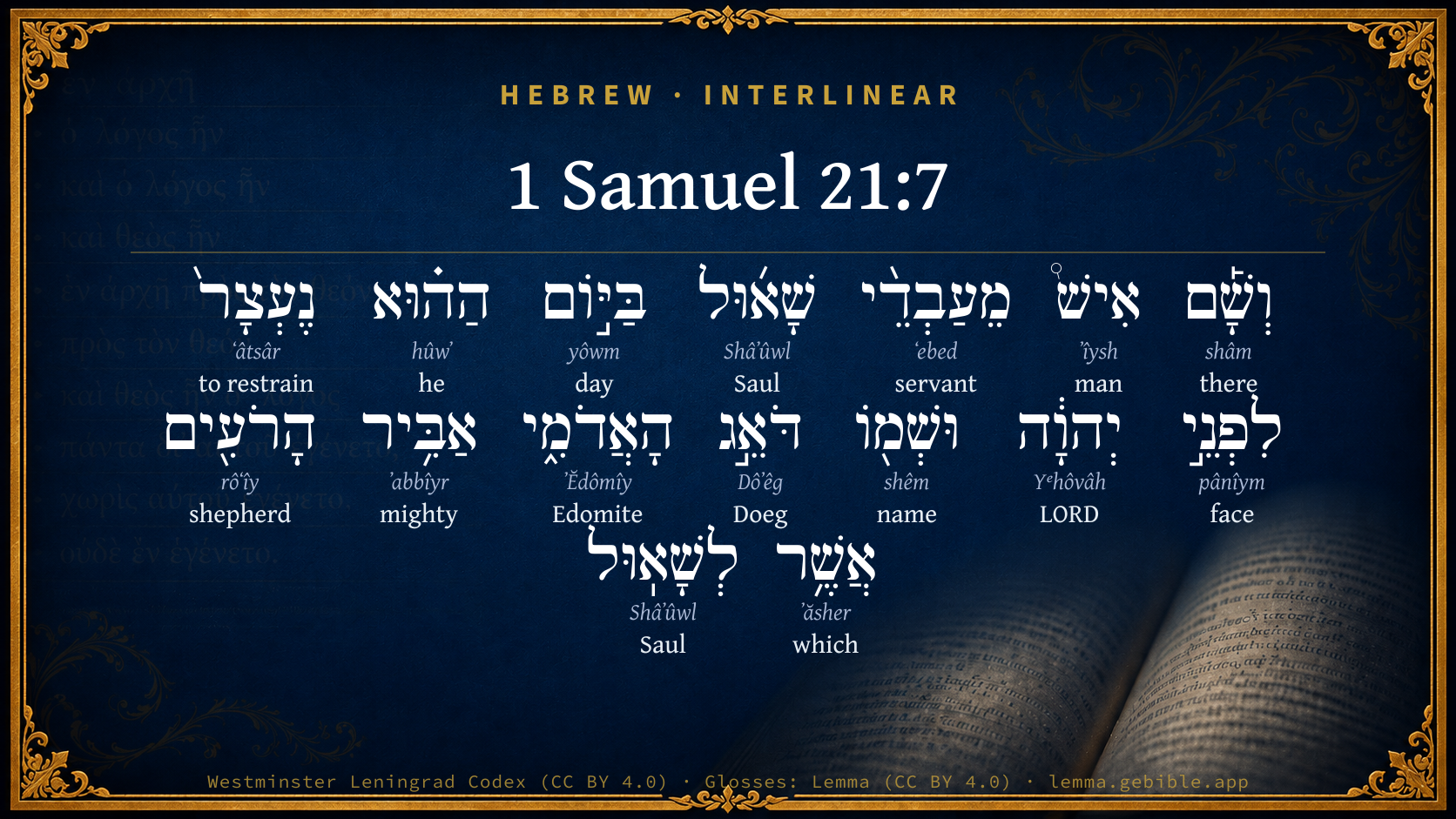
1 Samuel 21:7

Hebrew (Westminster Leningrad Codex) 1 Samuel 21:7 appears in the Hebrew Old Testament. The text above is from the Westminster Leningrad Codex. Each word links to its Strong’s number, a concise gloss, and parsing drawn from the Open Scriptures Hebrew Bible morphology. Click any word for its full Brown-Driver-Briggs (BDB) entry.
Download image
Cite this verse

1 Samuel 21:7 (World English Bible). Public Domain. Lemma interlinear Bible study tool, https://lemma.gebible.app/v/1-samuel/21/7.

Show BibTeX & RIS
BibTeX
RIS
English Translation
Now a certain man of the servants of Saul was there that day, detained before Yahweh; and his name was Doeg the Edomite, the best of the herdsmen who belonged to Saul.
World English Bible · Public Domain
Highlights
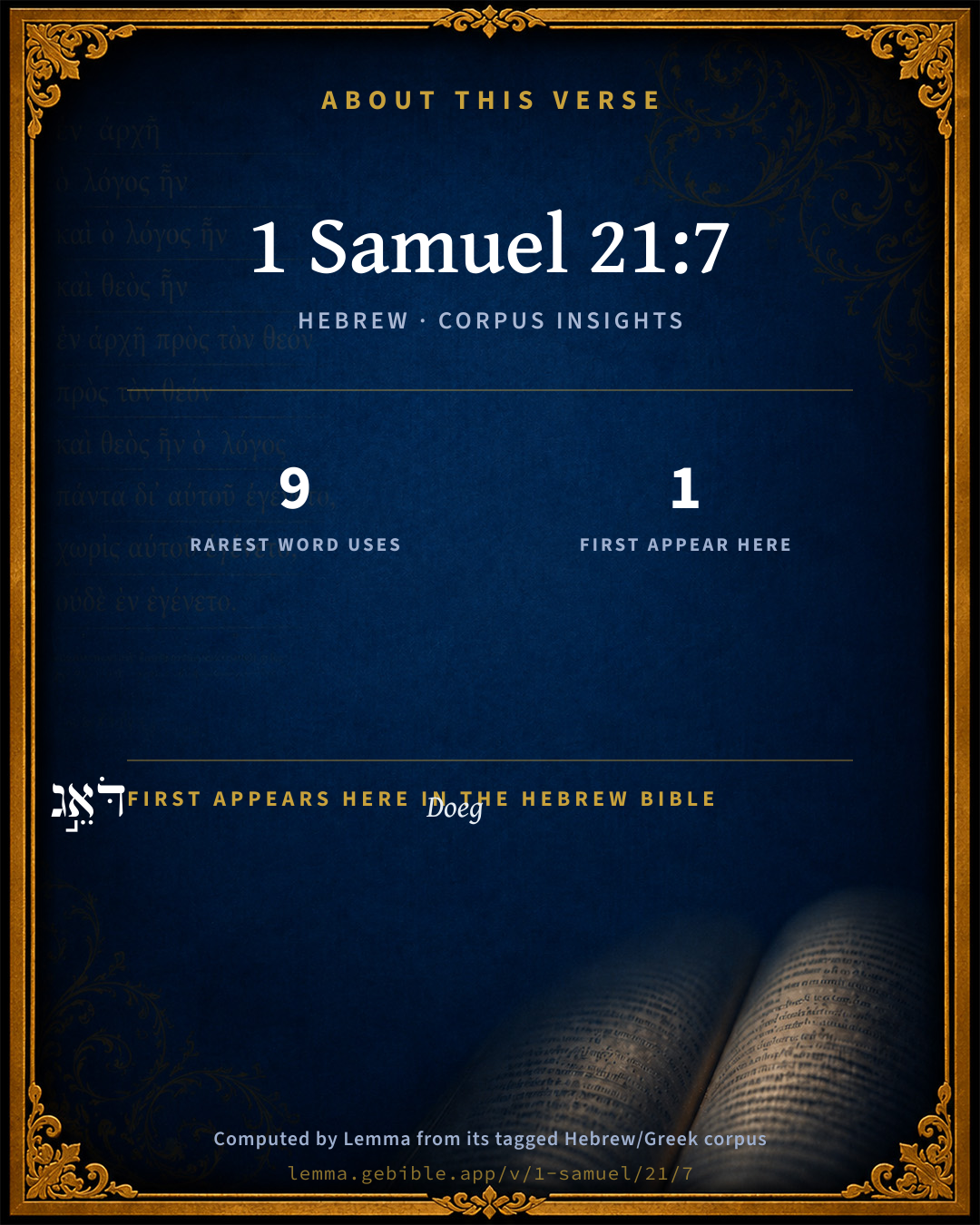
  • 1 first appearance in the Hebrew Bible
Full analysis ↓
Download a study sheet

One document with this verse’s original text, its word-by-word gloss line, the meaning frame, cross-references with their text, attributed commentary, and full source and license credits — printable, and it pastes into notes with its structure intact.

This verse Autodidact and up

Study sheet (.html) Plain text (.txt)

A passage Seminary Student

Up to 50 verses in one chapter. A passage sheet keeps up to 6 commentary sources and 12 cross-references per verse, in the order this page ranks them, and says so on the sheet whenever that leaves anything out. Ask for a single verse and you get the Autodidact verse sheet above.

Everything on this page stays free to read, with no account — the sheet is a download of what is already on screen, not access to it.

Want to remove ads? Support Godless Engineer
Compare translations 3

The same verse in 3 English versions, stacked beneath the original-language interlinear above. Click any original word for its lexicon entry.

Each is an independent rendering of the whole verse — the interlinear is not word-aligned to these translations.

Highlighted words mark where these versions differ — a whole-verse word diff, not a word-by-word alignment.

  • World English Bible Public Domain
    Now a certain man of the servants of Saul was there that day, detained before Yahweh; and his name was Doeg the Edomite, the best of the herdsmen who belonged to Saul.
  • King James Version Public Domain
    Now a certain man of the servants of Saul was there that day, detained before the LORD; and his name was Doeg, an Edomite, the chiefest of the herdmen that belonged to Saul.
  • unfoldingWord Literal Text CC BY-SA 4.0
    Now a man there from the servants of Saul on that day. He was detained to the face of Yahweh. And his name Doeg the Edomite, the chief of the herders who to Saul.

unfoldingWord Literal Text — © unfoldingWord, licensed CC BY-SA 4.0. Word-aligned USFM3 via Door43 (git.door43.org/unfoldingWord/en_ult).

Versions to compare (up to 4)

3 of 4 selected

Show all 18 translations

Every available English version of this verse, each an independent rendering of the whole verse.

  • World English Bible Public Domain
    Now a certain man of the servants of Saul was there that day, detained before Yahweh; and his name was Doeg the Edomite, the best of the herdsmen who belonged to Saul.
  • Berean Standard Bible Public Domain
    Now one of Saul’s servants was there that day, detained before the LORD. And his name was Doeg the Edomite, the chief shepherd for Saul.
  • Majority Standard Bible Public Domain
    Now one of Saul’s servants was there that day, detained before the LORD. And his name was Doeg the Edomite, the chief shepherd for Saul.
  • King James Version Public Domain
    Now a certain man of the servants of Saul was there that day, detained before the LORD; and his name was Doeg, an Edomite, the chiefest of the herdmen that belonged to Saul.
  • American Standard Version (1901) Public Domain
    Now a certain man of the servants of Saul was there that day, detained before Jehovah; and his name was Doeg the Edomite, the chiefest of the herdsmen that belonged to Saul.
  • Revised Version (1885) Public Domain
    Now a certain man of the servants of Saul was there that day, detained before the LORD; and his name was Doeg the Edomite, the chiefest of the herdmen that belonged to Saul.
  • Geneva Bible (1599) Public Domain
    (And there was the same day one of the seruants of Saul abiding before the Lord, named Doeg the Edomite, the chiefest of Sauls heardmen)
  • Douay-Rheims (1899) Public Domain
    Now a certain man of the servants of Saul was there that day, within the tabernacle of the Lord: and his name was Doeg, an Edomite, the chiefest of Saul's herdsmen.
  • Young's Literal Translation Public Domain
    And there `is' a man of the servants of Saul on that day detained before Jehovah, and his name `is' Doeg the Edomite, chief of the shepherds whom Saul hath.
  • Literal Standard Version CC BY-SA 4.0
    And there [is] a man of the servants of Saul detained before YHWH on that day, and his name [is] Doeg the Edomite, chief of the shepherds whom Saul has.
  • Unlocked Literal Bible CC BY-SA 4.0
    Now one of the servants of Saul was there that day, detained before Yahweh. His name was Doeg the Edomite, the chief of Saul's herdsmen.
  • unfoldingWord Literal Text CC BY-SA 4.0
    Now a man there from the servants of Saul on that day. He was detained to the face of Yahweh. And his name Doeg the Edomite, the chief of the herders who to Saul.
  • Darby Bible Public Domain
    (Now a certain man of the servants of Saul was there that day, detained before Jehovah; and his name was Doeg, the Edomite, chief of the shepherds that [belonged] to Saul.)
  • World Messianic Bible Public Domain
    Now a certain man of the servants of Saul was there that day, detained before the LORD; and his name was Doeg the Edomite, the best of the herdsmen who belonged to Saul.
  • Webster's Bible Public Domain
    Now a certain man of the servants of Saul was there that day, detained before the LORD; and his name was Doeg, an Edomite, the chief of the herdmen that belonged to Saul.
  • Free Bible Version CC BY-SA 4.0
    One of Saul's servants happened to be there that day, trying to make himself right with the Lord. He was Doeg the Edomite, Saul's chief shepherd.
  • Bible in Basic English Public Domain
    Now a certain man of the servants of Saul was there that day, kept back before the Lord; his name was Doeg, an Edomite, the strongest of Saul's runners.
  • JPS Tanakh (1917) Public Domain
    (21-8) Now a certain man of the servants of Saul was there that day, detained before the LORD; and his name was Doeg the Edomite, the chiefest of the herdmen that belonged to Saul. —

Literal Standard Version (2020), Covenant Press — licensed CC BY-SA 4.0. Text via the HelloAO Bible API (eBible.org). Unlocked Literal Bible (unfoldingWord) — licensed CC BY-SA 4.0. Text via the HelloAO Bible API (eBible.org). unfoldingWord Literal Text — © unfoldingWord, licensed CC BY-SA 4.0. Word-aligned USFM3 via Door43 (git.door43.org/unfoldingWord/en_ult). Free Bible Version, Dr. Jonathan Gallagher — licensed CC BY-SA 4.0. Text via the HelloAO Bible API (eBible.org).

Word by word

More ways to search: Search by grammar → Find every occurrence → Compare this word →

Practice this passage: Drill this verse → Learn its vocabulary →

דֹּאֵ֣ג
Dôʼêg
H1673
“Doeg”
Noun, Proper
Part of Speech
Noun
Type
Proper
Full BDB Definition

Origin: act. participle of H1672

TWOT: None

Doeg = "fearing" - an Edomite, chief of Saul's herdsmen, who slew all the priests
  1. וְשָׁ֡ם shâm H8033 “and · there” Conjunction + Adverb
  2. אִישׁ֩ ʼîysh H376 “man” Noun, Common, Masculine, Singular, Absolute
  3. מֵעַבְדֵ֨י ʻebed H5650 “from · servants of” Preposition + Noun, Common, Masculine, Plural, Construct
  4. שָׁא֜וּל Shâʼûwl H7586 “Saul” Noun, Proper
  5. בַּיּ֣וֹם yôwm H3117 “in/at the · day” Preposition, Determined + Noun, Common, Masculine, Singular, Absolute
  6. הַה֗וּא hûwʼ H1931 “the · he” Particle, Definite Article + Pronoun, Personal, 3rd Person, Masculine, Singular
  7. נֶעְצָר֙ ʻâtsâr H6113 “restraining” Verb, Niphal, Participle Active, Masculine, Singular, Absolute
  8. לִפְנֵ֣י pânîym H6440 “to/for · face(s) of” Preposition + Noun, Common, Both, Plural, Construct
  9. יְהוָ֔ה Yᵉhôvâh H3068 “LORD” Noun, Proper
  10. וּשְׁמ֖וֹ shêm H8034 “and · name · his” Conjunction + Noun, Common, Masculine, Singular, Construct + Suffix, Personal, 3rd Person, Masculine, Singular
  11. הָאֲדֹמִ֑י ʼĔdômîy H130 “the · Edomite” Particle, Definite Article + Noun, Gentilic, Masculine, Singular, Absolute
  12. אַבִּ֥יר ʼabbîyr H47 “mighty of” Adjective, Adjective, Masculine, Singular, Construct
  13. הָרֹעִ֖ים rôʻîy H7473 “the · shepherd” Particle, Definite Article + Verb, Qal, Participle Active, Masculine, Plural, Absolute
  14. אֲשֶׁ֥ר ʼăsher H834 “which” Particle, Relative
  15. לְשָׁאֽוּל Shâʼûwl H7586 “to/for · Saul” Preposition + Noun, Proper

About this verse

These counts appear in no published source. They are computed here, from the morphology-tagged text and Lemma’s own curated glosses. What Lemma adds →

16
words
15
distinct lemmas
Historical
section

Notable vocabulary

The rarest word here is דֹּאֵ֣ג Doeg H1673 — appearing just 9 times in the whole Hebrew Bible.

First appearance in Scripture

This word makes its first canonical appearance in the Hebrew Bible here:

  • דֹּאֵ֣ג Doeg H1673

Shared distinctive vocabulary

דֹּאֵ֣ג Doeg H1673 occurs in 5 verses of the Hebrew Bible. Also found in:

Grammatical profile

  • 2 verbs
  • 10 nouns
  • 1 adjective
  • 1 pronoun
  • 1 adverb
  • 1 particle

Verb forms

  • נֶעְצָר֙ Niphal · Participle Active
  • הָרֹעִ֖ים Qal · Participle Active

Repetition

A word recurs within this verse — often emphatic in Hebrew:

  • שָׁא֜וּל Saul H7586 ×2

Hebrew & Septuagint length

In English translation the verse runs 32 words from the Hebrew and 27 from the Septuagint (LXX English) — closely comparable.

A rough comparison of the two English renderings, which tokenize alike — not a word-level alignment.

Word counts can differ between the Hebrew and the Greek without any difference in meaning — e.g. the Hebrew direct-object marker אֵת has no separate Greek word, and Greek often adds the article ὁ.

Cross-references

13

Topical passages linked to 1 Samuel 21:7 in the Treasury of Scripture Knowledge — connected by theme and wording, ordered by reader-vote popularity; previews shown in the World English Bible.

  • 1 Samuel 22:9 Then answered Doeg the Edomite, who stood by the servants of Saul, and said, I saw the son of Jesse coming to Nob, to Ahimelech the son of Ahitub.
  • Psalms 52:1–9 Why do you boast of mischief, mighty man? God's loving kindness endures continually.
  • 1 Chronicles 27:29 and over the herds that fed in Sharon was Shitrai the Sharonite: and over the herds that were in the valleys was Shaphat the son of Adlai:
  • Genesis 13:7–8 There was a strife between the herdsmen of Abram's cattle and the herdsmen of Lot's cattle: and the Canaanite and the Perizzite lived then in the land.
  • Genesis 26:20 The herdsmen of Gerar argued with Isaac's herdsmen, saying, "The water is ours." He called the name of the well Esek, because they contended with him.
  • 1 Samuel 11:5 Behold, Saul came following the oxen out of the field; and Saul said, What ails the people that they weep? They told him the words of the men of Jabesh.
  • 1 Samuel 14:47 Now when Saul had taken the kingdom over Israel, he fought against all his enemies on every side, against Moab, and against the children of Ammon, and against Edom, and against the kings of Zobah, and against the Philistines: and wherever he turned himself, he put [them] to the worse.
  • 2 Chronicles 26:10 He built towers in the wilderness, and hewed out many cisterns, for he had much cattle; in the lowland also, and in the plain: [and he had] farmers and vineyard keepers in the mountains and in the fruitful fields; for he loved farming.
  • Jeremiah 7:9–11 Will you steal, murder, and commit adultery, and swear falsely, and burn incense to Baal, and walk after other gods that you have not known,
  • Ezekiel 33:31 They come to you as the people comes, and they sit before you as my people, and they hear your words, but don't do them; for with their mouth they show much love, but their heart goes after their gain.
  • Amos 8:5 Saying, 'When will the new moon be gone, that we may sell grain? And the Sabbath, that we may market wheat, Making the ephah small, and the shekel large, And dealing falsely with balances of deceit;
  • Matthew 15:8 'These people draw near to me with their mouth, And honor me with their lips; But their heart is far from me.
  • Acts 21:26–27 Then Paul took the men, and the next day, purified himself and went with them into the temple, declaring the fulfillment of the days of purification, until the offering was offered for every one of them.

Cross-references courtesy of OpenBible.info (CC BY 4.0).

Hebrew and Greek witnesses Masoretic Hebrew ↔ Greek Septuagint

The same verse in the two great witnesses to the Old Testament, shown verse-for-verse.

These are two independent witnesses, not word-aligned to each other, and the Septuagint is shown in lemma (dictionary) form.

Hebrew 1 Samuel 21:7 Masoretic · Westminster Leningrad Codex

וְשָׁ֡ם אִישׁ֩ מֵעַבְדֵ֨י שָׁא֜וּל בַּיּ֣וֹם הַה֗וּא נֶעְצָר֙ לִפְנֵ֣י יְהוָ֔ה וּשְׁמ֖וֹ דֹּאֵ֣ג הָאֲדֹמִ֑י אַבִּ֥יר הָרֹעִ֖ים אֲשֶׁ֥ר לְשָׁאֽוּל

Now a certain man of the servants of Saul was there that day, detained before Yahweh; and his name was Doeg the Edomite, the best of the herdsmen who belonged to Saul.

World English Bible · Public Domain

Greek LXX 1 Samuel 21:7 Septuagint · lemma form

καί δίδωμι αὐτός αβιμελεχ ὁ ἱερεύς ὁ ἄρτος ὁ πρόθεσις ὅτι οὐ εἰμί ἐκεῖ ἄρτος ὅτι ἀλλά ἤ ἄρτος ὁ πρόσωπον ὁ ἀποαἱρέω ἐκ πρόσωπον κύριος παρατίθημι ἄρτος θερμός ὅς ἡμέρα λαμβάνω αὐτός

And there was there on that day one of Saul's servants detained before the Lord, and his name was Doec the Syrian, tending the mules of Saul.

LXX2012 (modern English Septuagint) · Public Domain

On this verse, Trapp's Complete Commentary discusses the Septuagint’s reading. Read the note in Commentary ↓

Hebrew: Westminster Leningrad Codex (CC BY 4.0). Greek: Septuagint (public domain); English from LXX2012 (modern English Septuagint) (Public Domain). How the Septuagint differs from the Hebrew →

Targum (Aramaic paraphrase)

1

The Targum is the ancient Jewish Aramaic paraphrase of the Hebrew Scriptures — an interpretive translation, not the Hebrew text itself. Onkelos (literal) and Pseudo-Jonathan (expansive) render the Torah, and Jonathan the Prophets. Coverage is partial: where no permissively-licensed English translation exists for a verse, only the Aramaic is shown. This is verse-level text, not a word-by-word alignment to the Hebrew.

  1. Targum Jonathan Prophets (Joshua–Malachi)
    וִיהַב לֵיהּ כַּהֲנָא קֻדְשָׁא אֲרֵי לָא הֲוָה תַמָן לְחֵם חוֹלִין אֱלָהֵין לְחַם אַפַּיָא דְמַעְדָן מִן קֳדָם יְיָ לְשַׁוְיוּתֵיהּ לְחֵם חַמִים בְּיוֹם אִתְנְסִיבוּתֵיהּ:

    (no public-domain English translation for this verse)

    Targum Jonathan — Aramaic: “Mikraot Gedolot” (public domain). English: “Sefaria Community Translation” (CC0 1.0 (public-domain dedication)); “London "Chaldee Paraphrase," 1871” (public domain). Text via Sefaria.

Commentary

Notes on 1 Samuel 21:7 from classic Christian and Jewish commentators (each source and its license shown beneath its notes). The classic Christian expositions comment on the surrounding passage and are grouped to its opening verse, so a note may address several verses; the Jewish commentaries on the Tanakh (Rashi and others) are per-verse, so they appear only where the commentator wrote on this verse.

Lemma curates 59 commentaries, every one of them public domain or Creative Commons licensed, each selected and text-cleaned for this edition rather than reprinted as found. About our sources →

Trapp's Complete Commentary

John Trapp

1Sa 21:7 Now a certain man of the servants of Saul [was] there that day, detained before the LORD; and his name [was] Doeg, an Edomite, the chiefest of the herdmen that [belonged] to Saul.

Ver. 7. Now a certain man of the servants of Saul was there that day.] Doeg may set his foot as far within the tabernacle as David, and seem to be as devout: "but God knoweth your hearts," saith our Saviour to the Pharisees, {Luk 16:15} and will wash off your paint with rivers of brimstone.

Detained before the Lord.] Either because it was the Sabbath, or by reason of some vow, or for some other religious respect. Some render it Incluserat se ante tabernaculum, he had shut up himself - as a recluse - before the tabernacle; viz., that he might give himself wholly to reading and prayer. A wicked wretch he was, and of ill fame amongst the better sort; and therefore David was very sorry to see him there, {1Sa 22:22} as fearing that he would "carry tales to shed blood." {Eze 22:9} A very Judas he was, and a type of Judas Iscariot.

Doeg, an Edomite.] By nation, but an Israelite by profession, as was also Ahimelech the Hittite, {1Sa 26:6} and Jether the Ismaelite. {1Ch 2:17 2Sa 17:25, marg.}

The chiefest of the herdmen that belonged to Saul.] The Septuagint makes him his mule keeper: the Rabbis say that he was that armourbearer of his that slew him, and himself also with him, {1Sa 31:5} but that is uncertain.

John Trapp, A Commentary or Exposition upon All the Books of the Old and New Testament (1647–1656) — public domain. Text from a community e-Sword module.

The Biblical Illustrator

Joseph S. Exell

1Sa_21:7

A certain man of the servants of Saul was there that day, detained before the Lord.

Doeg the Edomite

Doeg was detained there before the Lord. How or why he was detained before the Lord, we are not informed. Doeg the Edomite was detained there that day before the Lord, and with his eyes upturned and his arms across his breast, very probably groaning as if moved to the heart by the aspect of poor David and his few straggling companions, dusty, and dirty and hungry. Doeg witnessed all and hurrying off to the royal palace told King Saul all he saw and all he heard during his stay at Nob, as passing between David and Ahimelech. This malicious spy was glad to violate all confidence.

I. Doeg was detained there that day before the Lord as a spy. Now of all the characters in the world the spy is the meanest and the most despicable. It was allowed at the time, and historians confirm it, that the espionage system of the Duke of Wellington, during his Peninsular campaign, was the most perfect ever known in any European army, and yet his scouts were selected without regard to character. No man respects a spy. Is Doeg dead? It is to be feared that in every age there have been those who come to the house of God only to hear and report, and misrepresent the services of the sanctuary. The spy has neither character nor conscience.

II. Doeg is there that day as a malicious tale bearer and wicked slanderer. The tale bearer and murderer are regarded by God as one and the same. A heathen once said, The slanderer is the most terrible of wild beasts.

III. It is possible that Doeg may have been detained there that day before the Lord, for the very reason that he knew he was not wanted. It is clear that Ahimelech did not want him, and equally clear that the eighty-five priests whom he afterwards murdered so wantonly did not want him, and still more obvious that David did not want him. Not a single worshipper in the priestly City of Nob. Some men are woefully gifted with a perverse spirit, and their happiness consist in trying to make other men miserable. Their aim is annoy; evil is their good.

IV. It may be that Doeg was detained there that day before the Lord, from the force of habit. He had been a churchgoing man.

V. It may be that Doeg was detained there that day before the Lord, from the love of the service. The old Rabbis have a tradition that Doeg was a skilful performer on the psaltery, and wherever music was the prevailing part of the worship, he was present to take part in the service of song. If there is no higher motive than the mere gratification of a refined ear or a cultivated taste, or even a delicate sentimentalism, the ordinances cannot profit.

VI. It may be that Doeg was detained there that day before the Lord, from the hope of patronage or preferment. He was only chief of the herdsmen of King Saul; probably, by acting as a spy and a tale bearer, be hoped to be advanced to some situation of honour and emolument. Doeg is ready for any work, from that of the highest seraph in heaven down to the lowest fiend in hell, if it will only pay!

VII. It may be that Doeg was detained there that day before the Lord, because the service at Nob was a branch of the national worship. This was a priestly city, and the Divine arrangement provided that the house of Levi should have the sacerdotal cities and their suburbs. Doeg, therefore, as a Hebrew, had a right to attend upon any altar that represented the religion of the Hebrew commonwealth. Oh! that is Gods meeting place with the inquiring saint who is there that day detained before the Lord. because he wants to meet and hold communion with God. (R. Irvine, D. D.)

The Biblical Illustrator, edited by Joseph S. Exell (c. 1880s–1900s) — public domain. Text from a community e-Sword module.

Joseph Benson's Commentary

1Sa 21:7. Detained before the Lord — That is, at the tabernacle. It is not to be imagined that he was detained here by force, but by his own choice he stayed there that day, either because it was the sabbath day, on which he might not proceed on his journey, or for the performance of some vow, or other religious duty, to which he had obliged himself. His name was Doeg, an Edomite — His native country was Edom; but he was proselyted to the Jewish religion.

Joseph Benson's Commentary on the Old and New Testaments (1811–1818) — public domain. Text from a community e-Sword module.

Tyndale Open Study Notes

Tyndale Open Resources

21:7 having been detained before the Lord: Ahimelech sought guidance from God on others’ behalf (22:15), so it is possible that Doeg was awaiting a response to an inquiry.

Tyndale Open Study Notes — © Tyndale Open Resources, licensed CC BY-SA 4.0. Text via the HelloAO Bible API.

Geneva Bible (1599)

Geneva Bible translators

Tarrying to worship before the Ark.

Or, master of them that kept Saul’s castle.

Geneva Bible (1599) marginal notes — public domain. Text via Bolls.life.

Jamieson, Fausset & Brown

Robert Jamieson, A. R. Fausset & David Brown

Doeg, an Edomite--who had embraced the Hebrew religion.

detained before the Lord--at the tabernacle, perhaps, in the performance of a vow, or from its being the Sabbath, which rendered it unlawful for him to prosecute his journey.

the chiefest of the herdmen that belonged to Saul--Eastern monarchs anciently had large possessions in flocks and herds; and the office of the chief shepherd was an important one.

Jamieson, Fausset & Brown — Commentary Critical and Explanatory on the Whole Bible (1871) — public domain (CC PDM 1.0). Text via the HelloAO Bible API.

Adam Clarke's Commentary

Verse 7. Detained before the Lord] Probably fulfilling some vow to the Lord, and therefore for a time resident at the tabernacle.

And his name was Doeg] From 1Sa 22:9 we learn that this man betrayed David's secret to Saul, which caused him to destroy the city, and slay eighty-five priests. We learn from its title that the fifty-second Psalm was made on this occasion; but titles are not to be implicitly trusted.

Adam Clarke's Commentary on the Bible (1810–1826) — public domain. Text from a community e-Sword/MySword module.

Ellicott's Commentary for English Readers

(7) A certain man.—Among the personages who surround Saul in the Bible story appears incidentally the keeper of the royal mules, and chief of the household slaves, the “Comes stabuli,” “the constable of the king,” as appears in the later monarchy. “He is the first instance of a foreigner employed in a high function in Israel, being an Edomite, or Syrian, of the name of Doeg—according to Jewish tradition, the steward who accompanied Saul in his pursuit after the asses, who counselled him to send for David, and who ultimately slew him, according to the sacred narrative—a person of vast and sinister influence in his master’s counsels.” (Stanley, Lectures on the Jewish Church, Lect. 21) Some traditions affirm that the armour-bearer who slew Saul on Mount Gilboa was not Doeg, but Doeg’s son.

The Hebrew words rendered in the English Version, “the chiefest of the herdmen that belonged to Saul,” are translated in the LXX. by “feeding the mules of Saul;” and in accordance with this reading, in 1Sa_22:9 also, they have changed “Saul’s servants” into “Saul’s mules.” The Vulg. and the other versions, however, translate as the English Version, “potentissimus pastorum,” although in some of the Vulg. MSS. there is an explanatory gloss, evidently derived from the singular interpretation of the LXX., “This (man) used to feed Saul’s mules.” There can be no foundation in tradition or otherwise for such a reading, as we never read until the days of King David of mules being used by royal princes. (See 2Sa_13:29; 2Sa_18:9.) Before David’s time, the sons of princes used to ride on asses. (See Jdg_10:4; Jdg_12:14.) Ewald, disregarding the current Jewish tradition respecting the ancient connection of Doeg with the house of Kish, considers that this influential chieftain of the king probably came over to Saul in his war with Edom.

Detained before the Lord.—Several interpretations have been suggested for these words. (a) He was at the sanctuary of the Tabernacle as a proselyte—one who wished to be received into the religious communion of Israel. (b) He was detained there for his purification on account of supposed leprosy, or simply in fulfilment of a temporary Nazarite vow. (c) According to Ephrem Syrus (who probably referred to some lost tradition), he had committed some trespass, and was detained there till he had offered the appointed sacrifice. Any one of these reasons—all sufficiently probable in themselves—would have occasioned a residence long or short at the sanctuary at Nob. At all events, when the fugitive David recognised the presence of one of Saul’s most unscrupulous servants, whom he must have known well, his mind must have misgiven him, and he, probably on this account, hasted to get away, and at once begs the old high priest to furnish him with any arms he might have laid up in the priestly homes.

A Bible Commentary for English Readers, edited by Charles John Ellicott (1878–1897) — public domain. Text from a community e-Sword module.

The Cambridge Bible for Schools and Colleges

gen. ed. J. J. S. Perowne

7. detained before the Lord] In charge of the priest for some religious purpose such as the fulfilment of a vow, or purification, or on account of suspected leprosy (Lev_13:4; Lev_13:11; Lev_13:31). His presence in the Tabernacle implies that he was a proselyte.

Doeg, an Edomite] He may have come over to Saul in his wars with Edom (1Sa_14:47).

the chiefest of the herdmen, &c.] An important post in a pastoral country. Cp. 1Ch_27:29; 1Ch_27:31. The Sept. reads, “Doeg the Syrian, the keeper of Saul’s mules.” Cp. 1Ch_27:30. “Syrian” is certainly a mistake for “Edomite,” the consonants of the Heb. words “Aramite” and “Edomite” being almost exactly alike.

The Cambridge Bible for Schools and Colleges (gen. ed. J. J. S. Perowne; Cambridge University Press, 1878–1918) — public domain. Text from a community e-Sword module.

John Gill's Exposition

Now a certain man of the servants of Saul was there that day,.... When David came to Nob, and asked bread of the priest, and had it, which this man was an eyewitness of, Sa1 22:9,

detained before the Lord; either because it was sabbath day, and so he might not travel, at least no more than two thousand cubits; or by some vow of his, which he was obliged to stay and perform; or on account of some impurity he had contracted, which he came to be cleansed from; or this detention was voluntary, in order to offer sacrifice to the Lord, or pray unto him, or to study the law of God in the tabernacle, pretending to be a very religious man:

and his name was Doeg, an Edomite, being by birth an Idumean, but a proselyte to the Jewish religion; or he was of the seed of Israel, but because he had dwelt in Edom, he was called an Edomite, as Kimchi thinks; just as Uriah is called for a like reason the Hittite:

the chiefest of the herdmen that belonged to Saul; Saul had his herds and men to look after them, and this man was set over them all, to see that they faithfully discharged their trust. The same officer the Romans called the praefect, or master of the cattle (k); See Gill on Ch1 27:29, and See Gill on Ch1 27:31; though this man was not only over the king's cattle, but over those that kept them; and was in the same office as Phorbas was, under Laius king of Thebes (l), and Melanthius in Homer (m), and Faustulus to Amulius (n): but Abarbinel is of opinion that this is to be understood not of the keepers of herds and flocks, but of the shepherds or rulers of the people; and that this man was set over all the other magistrates and rulers of the people, hence said to be "set over the servants of Saul", Sa1 22:9; and so Jarchi calls him "Ab Beth Din", or father of the sanhedrim, or great court of judicature; who was detained in the tabernacle to learn the law there, that he might be the better qualified for his office; but Kimchi interprets it as we do, the chief of the keepers of the herd, and both the Septuagint and Josephus (o) say that he fed the king's mules.

(k) Vid. Pignorium de servis, p. 539. (l) Senecae Oedipus, Act. 4. v. 815, 816, 839. (m) Odyss. 20. ver. 21. (n) Aurel. Victor. orig. Gent. Roman. (o) Antiqu. l. 6. c. 12. sect. 1.

John Gill's Exposition of the Whole Bible (1746–1763) — public domain (CC PDM 1.0). Text via the HelloAO Bible API.

Albert Barnes' Notes on the Bible

Detained before the Lord - Either to fulfill a vow Act 21:23-27, or on account of uncleanness, or under the law of lepers Lev 13:4, Lev 13:11, Lev 13:21, or as a proselyte. It is not impossible that Doeg may have been in custody or in sanctuary for some crime.

Albert Barnes' Notes on the Bible (1834–1885) — public domain. Text from a community e-Sword/MySword module.

Haydock's Catholic Bible Commentary

Within. Hebrew mehtsar, "detained, or assembles before the Lord." Theodoret thinks he was possessed; others believe he had made a vow, &c. --- Edomite. Some Greek copies read, a Syrian, as also chap. xxii. 9. (Calmet) --- He had embraced the Jewish religion. (Menochius)

George Leo Haydock (1774–1849), Haydock's Catholic Family Bible and Commentary, 1859 edition — public domain. Excludes Psalms (Douay-Rheims chapter numbering differs from Protestant) and Deuterocanonical books (Catholic canon only).

Matthew Poole's English Annotations

Detained; not by force from others, but by his own choice; he fixed his abode there for that day; either because it was the sabbath day, on which he might not proceed in his journey, or other business; or for the discharge of some vow; or to beg direction and help from God in some great business.

Before the Lord, i.e. at the tabernacle.

An Edomite; either,

1. By his habitation and conversation among those people for some considerable time, as for the same reason Uriah is called the Hittite, and Obed-edom the Gittite: or rather,

2. By his birth and nation; but he was proselyted to the Jewish religion, or took it up for sinister ends, being advanced, as here we read, to a place of trust and preferment, possibly upon this occasion.

Matthew Poole's English Annotations on the Holy Bible (1683–1685) — public domain. Text from a community e-Sword/MySword module.

Whedon's Commentary on the Bible

Daniel D. Whedon

7. Detained before the Lord — But what detained him? Various answers have been given, as that he was fulfiling some vow at the tabernacle, or offering some special sacrifice. But if the supposition of the above note be correct, that David’s interview with the priest occurred on the sabbath day, then we may naturally understand that Doeg was detained there by the sabbath, since it would be unlawful to be abroad at his work on that holy day.

The chiefest of the herdmen — Overseer and chief manager of this department of the king’s affairs. Doeg is introduced here in anticipation of what is related in 1Sa_22:9-22, and also, perhaps, to account for David’s words and action. David had often inquired of the Lord through Ahimelech, (1Sa_22:15,) and had probably come to Nob to do so now, but, finding Doeg there, he seems to have been confused and embarrassed, so framed a fictitious pretext as to his coming alone, and then took his departure as soon as possible. His strange action may have led Doeg to suspect conspiracy between him and Ahimelech against the government of Saul. Compare 1Sa_22:9-13.

Daniel D. Whedon (gen. ed.), Commentary on the Old and New Testaments (1874–1909) — public domain. Text from a community e-Sword module.

The Pulpit Commentary

David"s visit to Nob had probably been dictated simply by a desire to get food while a few attendants were being collected for him, and under ordinary circumstances would have remained unknown to Saul. Unfortunately there chanced to be a person present there who informed the king of it, and brought a second terrible catastrophe upon the house of Eli; (see on 1Sa_2:33) by working too upon his jealousy he caused Saul to commit a crime which sets him before us as a hateful and remorseless tyrant. This man was Doeg, an Edomite, who had, it seems, long been in Saul"s service, as he was his chief herdsman. According to the Septuagint he had charge of the king"s mules, but the other versions agree with the Hebrew. As herds would form the main part of Saul"s wealth, his chief herdsman would be a person of importance. He was detained before Jehovah. Ie. shut up in close seclusion within the precincts of the tabernacle, either for some vow, or for purification, or perhaps as suspected of leprosy, (Lev_13:4) or, as some think, as a proselyte. Ephrem Syrus thinks he had committed some trespass, and was detained till he had offered the appointed sacrifice. David at once felt that Doeg"s presence boded much ill, (1Sa_22:22) and it probably was the cause of his taking the rash resolution to flee for refuge to Gath.

The Pulpit Commentary (1880–1919), ed. H.D.M. Spence-Jones & Joseph S. Exell — public domain. Text from a community e-Sword module.

John Wesley's Explanatory Notes

Detained - Not by force but by his choice; he fixed his abode there for that day; either because it was the sabbath-day; on which he might not proceed in his journey, or for the discharge of some vow. Before the Lord - That is, at the tabernacle. An Edomite - By birth, but he was proselyted to the Jewish religion.

John Wesley, Explanatory Notes Upon the Whole Bible (1754–1765) — public domain. Text via the GEBible commentary corpus.

unfoldingWord translationNotes

Door43 World Missions Community

detained before Yahweh

Possible meanings are that 1) Doeg had some religious work regarding Yahweh to do there. AT: "for some work before Yahweh" or 2) Yahweh detained Doeg there. AT: "because Yahweh had detained him there" (See: Active or Passive)

Doeg ... herdsmen

You may need to say clearly that Doeg saw what David did. AT: "Doeg ... herdsmen, and he saw what Ahimelech did" (See: Assumed Knowledge and Implicit Information)

Doeg

man's name (See: How to Translate Names)

herdsmen

the keepers and protectors of a herd, especially of cattle or sheep

translationWords

servant

Saul (OT)

Yahweh

Edom

chief

unfoldingWord translationNotes — © Distant Shores Media and the Door43 World Missions Community, licensed CC BY-SA 4.0. Source: git.door43.org/Door43/en_tn.

Rashi

Rabbi Shlomo Yitzchaki (Rashi)

In order to put hot bread. Other warm bread on the day this was removed. Our Rabbis said, that it was warm on the day it was taken, i.e., it was as warm on the day it was removed as it was on the day it was arranged.

Rashi on the Tanakh — English translations: “The Judaica Press complete Tanach with Rashi, translated by A. J. Rosenberg” (CC BY 4.0); “Pentateuch with Rashi's commentary by M. Rosenbaum and A.M. Silbermann, 1929-1934” (public domain); “The Metsudah Tanach series, Lakewood, N.J” (CC BY 4.0); and “The Book of Joshua, Metsudah Publications, 1997” (CC BY 4.0). Text via Sefaria.

Lesson kit

Teaching starters — assembled from the data on this page, not authored interpretation. Every prompt links to the verse data it draws on. Edit before teaching.

1 Samuel, in the Historical, opens this verse with 16 words (15 distinct Hebrew lemmas). Its most distinctive word is Dôʼêg (“Doeg”). A historical commentator’s framing appears above. Read the whole chapter for the surrounding context.

Discussion questions

  1. What does “Doeg” (Dôʼêg) contribute to the verse as a whole?
  2. The word “Doeg” first appears here in Scripture. What is being introduced at this debut?
  3. 1 Samuel 22:9 shares the word «Doeg» with this verse. How do the two illuminate each other?
  4. “Saul” occurs 2× in this one verse. What is the effect of the repetition?
  5. These translations render this verse differently; the difference is in the English rendering, not the original. What questions does that raise?
  6. The verb «נֶעְצָר֙» is Niphal Participle Active. How does its form color the action?
  7. Reading how Trapp's Complete Commentary and The Biblical Illustrator read this verse, where do the two commentators agree and where do they part?

Things to notice

  • 1 word makes its first canonical appearance in Scripture here.
  • These translations choose different wording for 13 words in this verse.
  • “Saul” occurs 2× in this single verse.
  • 15 distinct Hebrew lemmas span 16 words in this verse.

Reading settings

Reading text

Shown beneath each verse's original-language words.

Old Testament
Old Testament edition

Read the OT as the Masoretic Hebrew (MT) or the Greek Septuagint (LXX).

English shown for the Greek Septuagint (in the Hebrew ↔ Greek comparison).

Comparing translations? Open the Compare panel on any verse page to stack up to four side by side.