
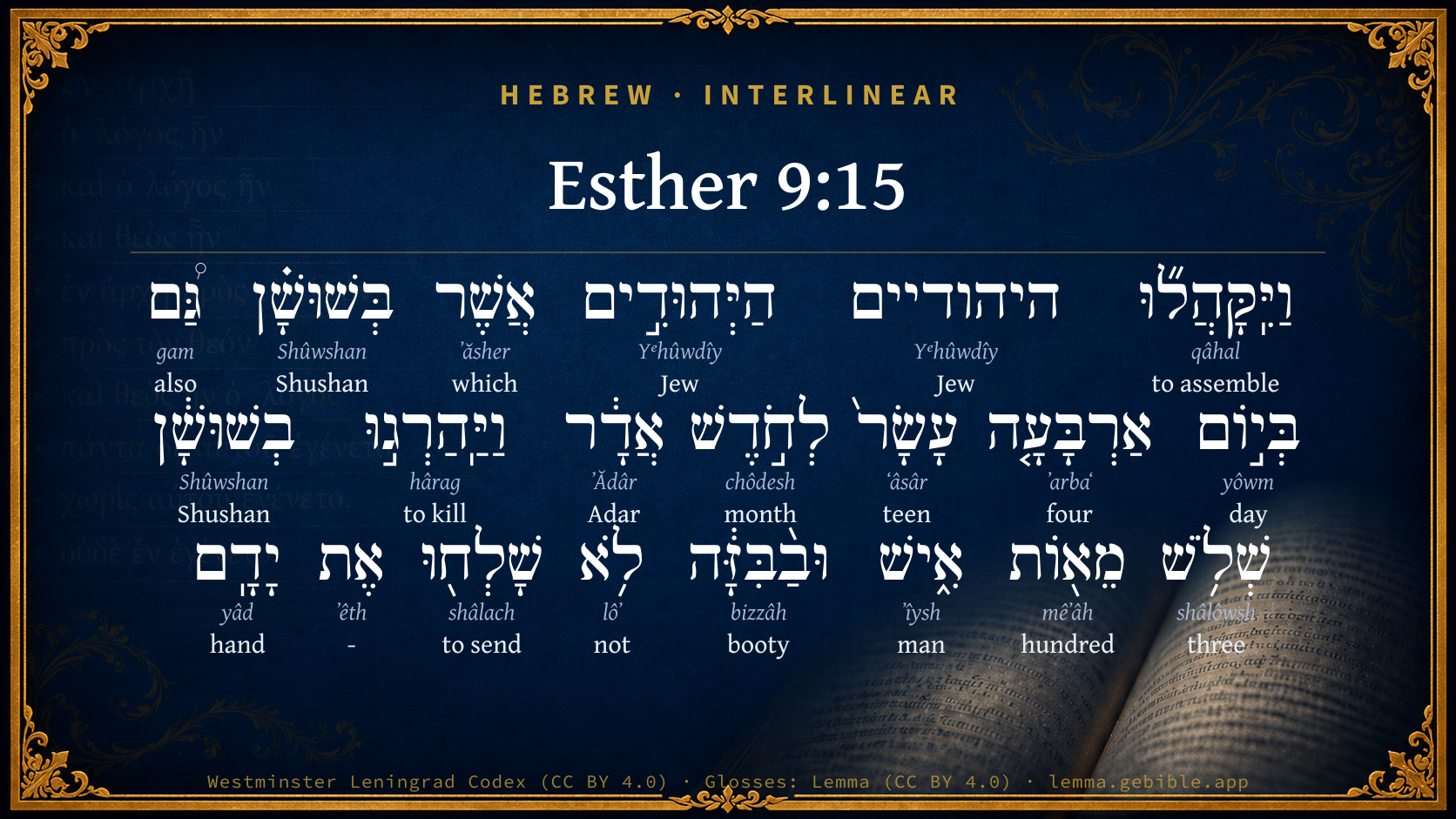
Esther 9:15

Hebrew (Westminster Leningrad Codex) Esther 9:15 appears in the Hebrew Old Testament. The text above is from the Westminster Leningrad Codex. Each word links to its Strong’s number, a concise gloss, and parsing drawn from the Open Scriptures Hebrew Bible morphology. Click any word for its full Brown-Driver-Briggs (BDB) entry.
Download image
Cite this verse

Esther 9:15 (World English Bible). Public Domain. Lemma interlinear Bible study tool, https://lemma.gebible.app/v/esther/9/15.

Show BibTeX & RIS
BibTeX
RIS
English Translation
The Jews who were in Shushan gathered themselves together on the fourteenth day also of the month Adar, and killed three hundred men in Shushan; but they didn't lay their hand on the spoil.
World English Bible · Public Domain
Download a study sheet

One document with this verse’s original text, its word-by-word gloss line, the meaning frame, cross-references with their text, attributed commentary, and full source and license credits — printable, and it pastes into notes with its structure intact.

This verse Autodidact and up

Study sheet (.html) Plain text (.txt)

A passage Seminary Student

Up to 50 verses in one chapter. A passage sheet keeps up to 6 commentary sources and 12 cross-references per verse, in the order this page ranks them, and says so on the sheet whenever that leaves anything out. Ask for a single verse and you get the Autodidact verse sheet above.

Everything on this page stays free to read, with no account — the sheet is a download of what is already on screen, not access to it.

Want to remove ads? Support Godless Engineer
Compare translations 3

The same verse in 3 English versions, stacked beneath the original-language interlinear above. Click any original word for its lexicon entry.

Each is an independent rendering of the whole verse — the interlinear is not word-aligned to these translations.

Highlighted words mark where these versions differ — a whole-verse word diff, not a word-by-word alignment.

  • World English Bible Public Domain
    The Jews who were in Shushan gathered themselves together on the fourteenth day also of the month Adar, and killed three hundred men in Shushan; but they didn't lay their hand on the spoil.
  • King James Version Public Domain
    For the Jews that were in Shushan gathered themselves together on the fourteenth day also of the month Adar, and slew three hundred men at Shushan; but on the prey they laid not their hand.
  • unfoldingWord Literal Text CC BY-SA 4.0
    And the Jews who were in Susa assembled themselves also on day 14 of the month of Adar, and they killed 300 men in Susa. But they did not stretch out their hand to the plunder.

unfoldingWord Literal Text — © unfoldingWord, licensed CC BY-SA 4.0. Word-aligned USFM3 via Door43 (git.door43.org/unfoldingWord/en_ult).

Versions to compare (up to 4)

3 of 4 selected

Show all 18 translations

Every available English version of this verse, each an independent rendering of the whole verse.

  • World English Bible Public Domain
    The Jews who were in Shushan gathered themselves together on the fourteenth day also of the month Adar, and killed three hundred men in Shushan; but they didn't lay their hand on the spoil.
  • Berean Standard Bible Public Domain
    On the fourteenth day of the month of Adar, the Jews in Susa came together again and put to death three hundred men there, but they did not lay a hand on the plunder.
  • Majority Standard Bible Public Domain
    On the fourteenth day of the month of Adar, the Jews in Susa came together again and put to death three hundred men there, but they did not lay a hand on the plunder.
  • King James Version Public Domain
    For the Jews that were in Shushan gathered themselves together on the fourteenth day also of the month Adar, and slew three hundred men at Shushan; but on the prey they laid not their hand.
  • American Standard Version (1901) Public Domain
    And the Jews that were in Shushan gathered themselves together on the fourteenth day also of the month Adar, and slew three hundred men in Shushan; but on the spoil they laid not their hand.
  • Revised Version (1885) Public Domain
    And the Jews that were in Shushan gathered themselves together on the fourteenth day also of the month Adar, and slew three hundred men in Shushan; but on the spoil they laid not their hand.
  • Geneva Bible (1599) Public Domain
    So the Iewes that were in Shushan, assembled themselues vpon the fourteenth day of the moneth Adar, and slew three hundreth men in Shushan, but on the spoyle they layd not their hand.
  • Douay-Rheims (1899) Public Domain
    ,15And on the fourteenth day of the month Adar the Jews gathered themselves together, and they killed in Susan three hundred men: but they took not their substance.
  • Young's Literal Translation Public Domain
    And the Jews who `are' in Shushan are assembled also on the fourteenth day of the month of Adar, and they slay in Shushan three hundred men, and on the prey they have not put forth their hand.
  • Literal Standard Version CC BY-SA 4.0
    And the Jews who [are] in Shushan are also assembled on the fourteenth day of the month of Adar, and they slay three hundred men in Shushan, and they have not put forth their hand on the prey.
  • Unlocked Literal Bible CC BY-SA 4.0
    The Jews who were in Susa came together on the fourteenth day of the month of Adar, and killed three hundred more men in Susa, but laid no hands on the plunder.
  • unfoldingWord Literal Text CC BY-SA 4.0
    And the Jews who were in Susa assembled themselves also on day 14 of the month of Adar, and they killed 300 men in Susa. But they did not stretch out their hand to the plunder.
  • Darby Bible Public Domain
    And the Jews that were in Shushan gathered themselves together on the fourteenth day also of the month Adar, and slew three hundred men at Shushan; but they laid not their hand on the prey.
  • World Messianic Bible Public Domain
    The Jews who were in Susa gathered themselves together on the fourteenth day also of the month Adar, and killed three hundred men in Susa; but they didn’t lay their hand on the plunder.
  • Webster's Bible Public Domain
    For the Jews that were in Shushan assembled on the fourteenth day also of the month Adar, and slew three hundred men at Shushan; but on the prey they laid not their hand.
  • Free Bible Version CC BY-SA 4.0
    On the fourteenth day of the month of Adar, the Jews in Susa gathered together again and killed three hundred men there, but again they did not take their possessions.
  • Bible in Basic English Public Domain
    For the Jews who were in Shushan came together again on the fourteenth day of the month Adar and put to death three hundred men in Shushan; but they put not a hand on their goods.
  • JPS Tanakh (1917) Public Domain
    And the Jews that were in Shushan gathered themselves together on the fourteenth day also of the month Adar, and slew three hundred men in Shushan; but on the spoil they laid not their hand.

Literal Standard Version (2020), Covenant Press — licensed CC BY-SA 4.0. Text via the HelloAO Bible API (eBible.org). Unlocked Literal Bible (unfoldingWord) — licensed CC BY-SA 4.0. Text via the HelloAO Bible API (eBible.org). unfoldingWord Literal Text — © unfoldingWord, licensed CC BY-SA 4.0. Word-aligned USFM3 via Door43 (git.door43.org/unfoldingWord/en_ult). Free Bible Version, Dr. Jonathan Gallagher — licensed CC BY-SA 4.0. Text via the HelloAO Bible API (eBible.org).

Word by word

More ways to search: Search by grammar → Find every occurrence → Compare this word →

Practice this passage: Drill this verse → Learn its vocabulary →

אֲדָ֔ר
ʼĂdâr
H143
“Adar”
Noun, Proper
Part of Speech
Noun
Type
Proper
Full BDB Definition

Origin: probably of foreign derivation

TWOT: None

Adar = "glorious" - twelfth month, corresponding to modern March-April
  1. וַיִּֽקָּהֲל֞וּ qâhal H6950 “and · to assemble” Conjunction + Verb, Niphal, Sequential Imperfect, 3rd Person, Masculine, Plural
  2. היהודיים Yᵉhûwdîy H3064 “the · Jews” Particle, Definite Article + Noun, Gentilic, Masculine, Plural, Absolute
  3. הַיְּהוּדִ֣ים Yᵉhûwdîy H3064 “the · Jews” Particle, Definite Article + Noun, Gentilic, Masculine, Plural, Absolute
  4. אֲשֶׁר ʼăsher H834 “which” Particle, Relative
  5. בְּשׁוּשָׁ֗ן Shûwshan H7800 “in/at · Shushan” Preposition + Noun, Proper
  6. גַּ֠ם gam H1571 “also” Particle, Accusative
  7. בְּי֣וֹם yôwm H3117 “in/at · day of” Preposition + Noun, Common, Masculine, Singular, Construct
  8. אַרְבָּעָ֤ה ʼarbaʻ H702 “four” Adjective, Cardinal number, Masculine, Singular, Absolute
  9. עָשָׂר֙ ʻâsâr H6240 “teen” Adjective, Cardinal number, Masculine, Singular, Absolute
  10. לְחֹ֣דֶשׁ chôdesh H2320 “to/for · month of” Preposition + Noun, Common, Masculine, Singular, Construct
  11. וַיַּֽהַרְג֣וּ hârag H2026 “and · to kill” Conjunction + Verb, Qal, Sequential Imperfect, 3rd Person, Masculine, Plural
  12. בְשׁוּשָׁ֔ן Shûwshan H7800 “in/at · Shushan” Preposition + Noun, Proper
  13. שְׁלֹ֥שׁ shâlôwsh H7969 “three” Adjective, Cardinal number, Feminine, Singular, Absolute
  14. מֵא֖וֹת mêʼâh H3967 “hundred” Adjective, Cardinal number, Both, Plural, Absolute
  15. אִ֑ישׁ ʼîysh H376 “man” Noun, Common, Masculine, Singular, Absolute
  16. וּבַ֨בִּזָּ֔ה bizzâh H961 “and · in/at the · booty” Conjunction + Preposition, Determined + Noun, Common, Feminine, Singular, Absolute
  17. לֹ֥א lôʼ H3808 “not” Particle, Negative
  18. שָׁלְח֖וּ shâlach H7971 “to send” Verb, Qal, Perfect, 3rd Person, Common, Plural
  19. אֶת ʼêth H853 “-” Particle, Direct Object
  20. יָדָֽם yâd H3027 “hand · their” Noun, Common, Both, Singular, Construct + Suffix, Personal, 3rd Person, Masculine, Plural

About this verse

These counts appear in no published source. They are computed here, from the morphology-tagged text and Lemma’s own curated glosses. What Lemma adds →

21
words
19
distinct lemmas
Historical
section

Notable vocabulary

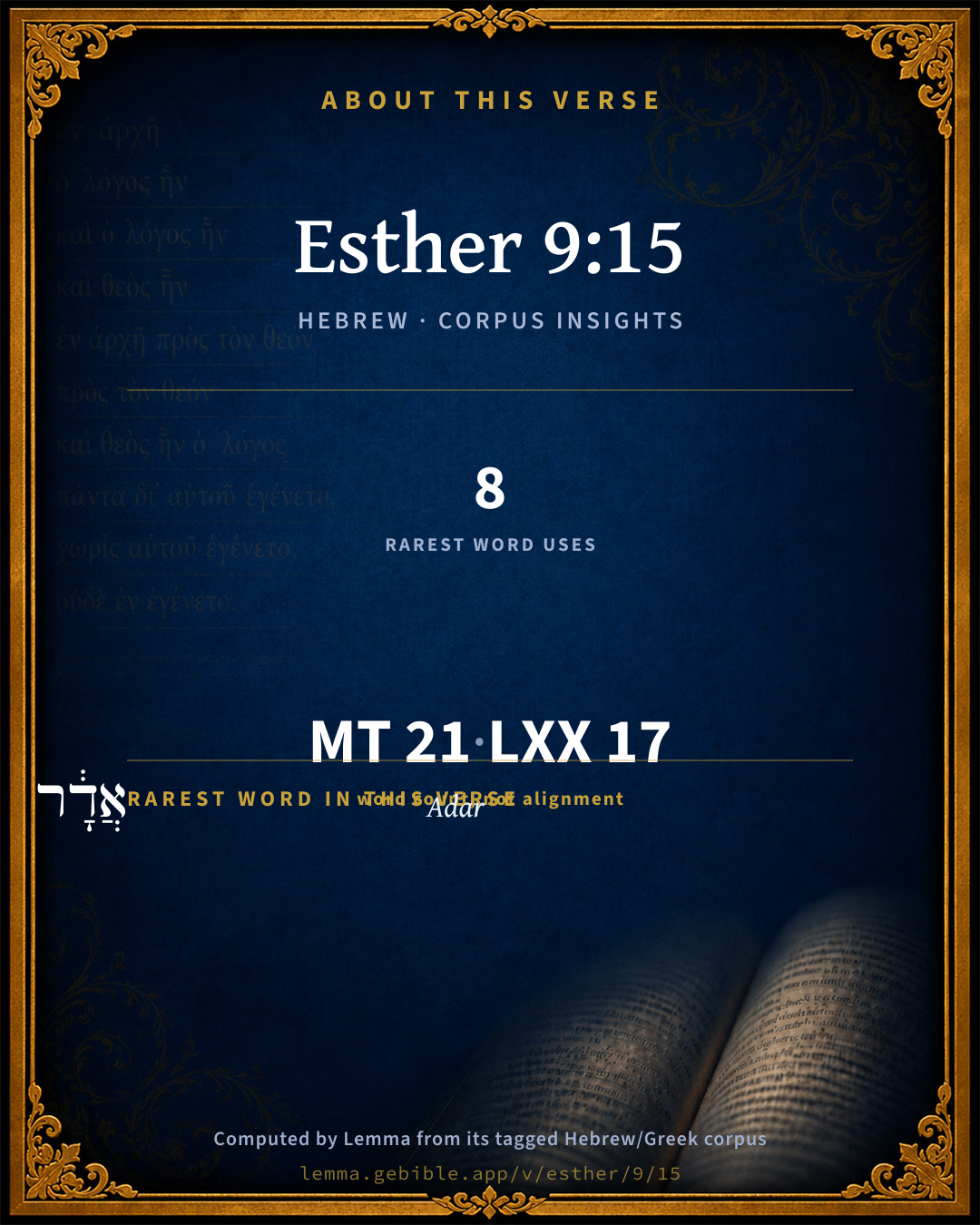
The rarest word here is אֲדָ֔ר Adar H143 — appearing just 8 times in the whole Hebrew Bible.

Shared distinctive vocabulary

אֲדָ֔ר Adar H143 occurs in 8 verses of the Hebrew Bible. Also found in:

Grammatical profile

  • 3 verbs
  • 10 nouns
  • 4 adjectives
  • 4 particles

Verb forms

  • וַיִּֽקָּהֲל֞וּ Niphal · Sequential Imperfect
  • וַיַּֽהַרְג֣וּ Qal · Sequential Imperfect
  • שָׁלְח֖וּ Qal · Perfect

Repetition

Words recur within this verse — often emphatic in Hebrew:

  • היהודיים Jew H3064 ×2
  • בְּשׁוּשָׁ֗ן Shushan H7800 ×2

Hebrew & Septuagint length

In English translation the verse runs 34 words from the Hebrew and 21 from the Septuagint (LXX English) — the Septuagint runs noticeably shorter here. See the side-by-side →

A rough comparison of the two English renderings, which tokenize alike — not a word-level alignment.

Word counts can differ between the Hebrew and the Greek without any difference in meaning — e.g. the Hebrew direct-object marker אֵת has no separate Greek word, and Greek often adds the article ὁ.

In the original languages it is 21 Hebrew tokens and 17 Greek tokens — but the two are counted differently (Hebrew bundles its prefixes and suffixes into one token; the Greek is in lemma form), so that isn’t a like-for-like length.

Cross-references

8

Topical passages linked to Esther 9:15 in the Treasury of Scripture Knowledge — connected by theme and wording, ordered by reader-vote popularity; previews shown in the World English Bible.

  • Esther 8:11 in which the king granted the Jews who were in every city to gather themselves together, and to stand for their life, to destroy, to kill, and to cause to perish, all the power of the people and province that would assault them, [their] little ones and women, and to take the spoil of them for a prey,
  • Esther 9:10 the ten sons of Haman the son of Hammedatha, the Jew's enemy, killed they; but they didn't lay their hand on the spoil.
  • Esther 9:2 the Jews gathered themselves together in their cities throughout all the provinces of the king Ahasuerus, to lay hand on such as sought their hurt: and no man could withstand them; for the fear of them was fallen on all the peoples.
  • Esther 9:13 Then said Esther, If it please the king, let it be granted to the Jews who are in Shushan to do tomorrow also according to this day's decree, and let Haman's ten sons be hanged on the gallows.
  • Esther 9:16 The other Jews who were in the king's provinces gathered themselves together, and stood for their lives, and had rest from their enemies, and killed of those who hated them seventy-five thousand; but they didn't lay their hand on the spoil.
  • Psalms 118:7–12 Yahweh is on my side among those who help me. Therefore I will look in triumph at those who hate me.
  • 1 Thessalonians 5:22 Abstain from every form of evil.
  • Hebrews 13:5 Be free from the love of money, content with such things as you have, for he has said, "I will in no way leave you, neither will I in any way forsake you."

Cross-references courtesy of OpenBible.info (CC BY 4.0).

Hebrew and Greek witnesses Masoretic Hebrew ↔ Greek Septuagint

The same verse in the two great witnesses to the Old Testament, shown verse-for-verse.

Here the Septuagint runs noticeably shorter than the Hebrew — LXX2012 (modern English Septuagint) 21 words vs World English Bible 34. A rough length comparison of the two English translations, not a word-level alignment — read both below.

These are two independent witnesses, not word-aligned to each other, and the Septuagint is shown in lemma (dictionary) form.

Hebrew Esther 9:15 Masoretic · Westminster Leningrad Codex

וַיִּֽקָּהֲל֞וּ היהודיים הַיְּהוּדִ֣ים אֲשֶׁר בְּשׁוּשָׁ֗ן גַּ֠ם בְּי֣וֹם אַרְבָּעָ֤ה עָשָׂר֙ לְחֹ֣דֶשׁ אֲדָ֔ר וַיַּֽהַרְג֣וּ בְשׁוּשָׁ֔ן שְׁלֹ֥שׁ מֵא֖וֹת אִ֑ישׁ וּבַ֨בִּזָּ֔ה לֹ֥א שָׁלְח֖וּ אֶת יָדָֽם

The Jews who were in Shushan gathered themselves together on the fourteenth day also of the month Adar, and killed three hundred men in Shushan; but they didn't lay their hand on the spoil.

World English Bible · Public Domain

Greek LXX Esther 9:15 Septuagint · lemma form

καί συνἄγω ὁ ἰουδαῖος ἐν σουσά ὁ οςτεσσαρεσκαιδέκατ ὁ αδαρ καί ἀποκτείνω ἀνήρ τριακόσιοι καί οὐδείς διαἁρπάζω

And the Jews assembled in Susa on the fourteenth day of Adar, and killed three hundred men, but plundered no property.

LXX2012 (modern English Septuagint) · Public Domain

Hebrew: Westminster Leningrad Codex (CC BY 4.0). Greek: Septuagint (public domain); English from LXX2012 (modern English Septuagint) (Public Domain). How the Septuagint differs from the Hebrew →

Commentary

Notes on Esther 9:15 from classic Christian and Jewish commentators (each source and its license shown beneath its notes). The classic Christian expositions comment on the surrounding passage and are grouped to its opening verse, so a note may address several verses; the Jewish commentaries on the Tanakh (Rashi and others) are per-verse, so they appear only where the commentator wrote on this verse.

Lemma curates 59 commentaries, every one of them public domain or Creative Commons licensed, each selected and text-cleaned for this edition rather than reprinted as found. About our sources →

Trapp's Complete Commentary

John Trapp

Est 9:15 For the Jews that [were] in Shushan gathered themselves together on the fourteenth day also of the month Adar, and slew three hundred men at Shushan; but on the prey they laid not their hand.

Ver. 15. For the Jews that were in Shushan] They did not stand to cast perils or frame excuses, but with singular courage and constancy went an end with the work, whereunto they saw themselves to be rightly called by God and man, keeping themselves still within the compass of the king’s edict, and so carrying the matter, that those that were slain were judged by their own fellow citizens to have deservedly perished.

And slew three hundred men at Shushan] Besides the former five hundred. All these, with Haman, their chieftain, might have lived long in honour and safety could they have kept them quiet. But, by the just and secret judgment of God, they kindled a fire with great force, that consumed themselves, according to that in the prophet Isaiah, Isa 33:10-12, "Now will I rise, saith the Lord of recompenses; now will I be exalted; now will I lift up myself Ye shall conceive chaff, ye shall bring forth stubble: your breath, as fire, shall devour you. And the people shall be as the burnings of lime: as thorns cut up shall they be burnt in the fire."

But on the prey they laid not, &c.] See Est 9:10.

John Trapp, A Commentary or Exposition upon All the Books of the Old and New Testament (1647–1656) — public domain. Text from a community e-Sword module.

Tyndale Open Study Notes

Tyndale Open Resources

9:15 Once again, the Jews took the high moral ground and took no plunder from their enemies, though it was legally permitted (8:11; 9:10).

Tyndale Open Study Notes — © Tyndale Open Resources, licensed CC BY-SA 4.0. Text via the HelloAO Bible API.

Adam Clarke's Commentary

Verse 15. And slew three hundred men] Esther had probably been informed by Mordecai that there were still many enemies of the Jews who sought their destruction, who had escaped the preceding day; and, therefore, begs that this second day be added to the former permission. This being accordingly granted, they found three hundred more, in all eight hundred. And thus Susa was purged of all their enemies.

Adam Clarke's Commentary on the Bible (1810–1826) — public domain. Text from a community e-Sword/MySword module.

Ellicott's Commentary for English Readers

(15) For the Jews . . .—Translate, And the Jews.

A Bible Commentary for English Readers, edited by Charles John Ellicott (1878–1897) — public domain. Text from a community e-Sword module.

John Gill's Exposition

On the thirteenth day of the month Adar,.... This belongs to the preceding verse; and the meaning is, that on this day the Jews gathered together and slew so many thousand of their enemies as before related:

and on the fourteenth day of the same rested they, and made it a feast of gladness: rejoicing that they were delivered out of the hand of their enemies, who hoped and expected on that day to have made an utter end of them; according to the Jewish canons (l), mourning and fasting on this day were forbidden, but feasting and gladness were to be multiplied.

(l) Lebush, c. 697. Schulchan Aruch, par. 1. c. 697.

John Gill's Exposition of the Whole Bible (1746–1763) — public domain (CC PDM 1.0). Text via the HelloAO Bible API.

Albert Barnes' Notes on the Bible

Shushan - Here probably the lower town, which lay east of the upper one, and was of about the same size (compare the Est 9:6 note).

Albert Barnes' Notes on the Bible (1834–1885) — public domain. Text from a community e-Sword/MySword module.

Whedon's Commentary on the Bible

Daniel D. Whedon

15. Slew three hundred men at Shushan — Making, with the five hundred of the previous day, eight hundred slain at this capital city. We understand that, as Esther suspected, there were in Shushan many desperate persons who had resolved not to let the matter stop with the thirteenth of Adar, and so recommenced the fight on the next day. The result was the death of these three hundred men.

Daniel D. Whedon (gen. ed.), Commentary on the Old and New Testaments (1874–1909) — public domain. Text from a community e-Sword module.

The Pulpit Commentary

For the Jews. Rather, and the Jews," or so the Jews." The Hebrew has the vau conjunctive, which is here certainly expressive of a sequence, or consequence.

The Pulpit Commentary (1880–1919), ed. H.D.M. Spence-Jones & Joseph S. Exell — public domain. Text from a community e-Sword module.

Keil & Delitzsch

C. F. Keil & F. Delitzsch

On this second day the Jews slew 300 more; comp. Est 9:10. - Est 9:16. The rest of the Jews in the provinces, i.e., the Jews in the other parts of the kingdom, assembled themselves and stood for their lives, and had rest from their enemies, and slew of their foes 75,000, but upon the spoil they laid not their hand. על עמד like Est 8:11. The מאיביהם ונוח inserted between על נ ועמד and והרוג is striking; we should rather have expected the resting or having rest from their enemies after the death of the latter, as in Est 9:17 and Est 9:18, where this is plainly stated to have taken place on the day after the slaughter. The position of these words is only explained by the consideration, that the narrator desired at once to point out how the matter ended. The narrative continues in the infin. abs. instead of expressing this clause by the infin. constr., and so causing it to be governed by what precedes. Thus - as Ew. 351, c, remarks - all the possible hues of the sentence fade into this grey and formless termination (viz., the use of the infin. absol. instead of the verb. fin.). This inaccuracy of diction does not justify us, however, in assuming that we have here an interpolation or an alteration in the text. The statement of the day is given in Est 9:17, and then the clause following is again added in the inf. absol.: "and they rested on the 14th day of the same (of Adar), and made it a day of feasting and gladness."

Keil & Delitzsch — Biblical Commentary on the Old Testament (1861–1891) — public domain (CC PDM 1.0). Text via the HelloAO Bible API. (Old Testament only.)

unfoldingWord translationNotes

Door43 World Missions Community

the fourteenth day of the month of Adar

See how you translated a similar phrase in Esther 3:13.

laid no hands on the plunder

Laying their hands on things represents taking them. AT: "took none of the plunder" or "did not take any of the plunder" (See: Metonymy)

seventy-five thousand

"75,000" (See: Numbers)

they did not lay their hands on the valuables of those they killed

Laying their hands on things represents taking them. AT: "they did not take any of the valuables of the people they killed" (See: Metonymy)

valuables

"valuable things" or "possessions"

translationWords

day

unfoldingWord translationNotes — © Distant Shores Media and the Door43 World Missions Community, licensed CC BY-SA 4.0. Source: git.door43.org/Door43/en_tn.

Lesson kit

Teaching starters — assembled from the data on this page, not authored interpretation. Every prompt links to the verse data it draws on. Edit before teaching.

Esther, in the Historical, opens this verse with 21 words (19 distinct Hebrew lemmas). Its most distinctive word is ʼĂdâr (“Adar”). The Greek Septuagint runs shorter here. A historical commentator’s framing appears above. Read the whole chapter for the surrounding context.

Discussion questions

  1. How does “Adar” (ʼĂdâr) shape what this verse is saying?
  2. Esther 3:7 shares the word «Adar» with this verse. How do the two illuminate each other?
  3. “Jew” occurs 2× in this one verse. What is the effect of the repetition?
  4. Compared with the Hebrew, the Septuagint runs shorter here. What questions does that raise?
  5. The translations on this page render this verse differently — a whole-verse word diff, not a word-by-word alignment. What might account for the different wordings?
  6. The verb «וַיִּֽקָּהֲל֞וּ» is Niphal Sequential Imperfect. How does its form color the action?
  7. Reading how Trapp's Complete Commentary and Tyndale Open Study Notes read this verse, where do the two commentators agree and where do they part?

Things to notice

Reading settings

Reading text

Shown beneath each verse's original-language words.

Old Testament
Old Testament edition

Read the OT as the Masoretic Hebrew (MT) or the Greek Septuagint (LXX).

English shown for the Greek Septuagint (in the Hebrew ↔ Greek comparison).

Comparing translations? Open the Compare panel on any verse page to stack up to four side by side.