
Genesis 9:5

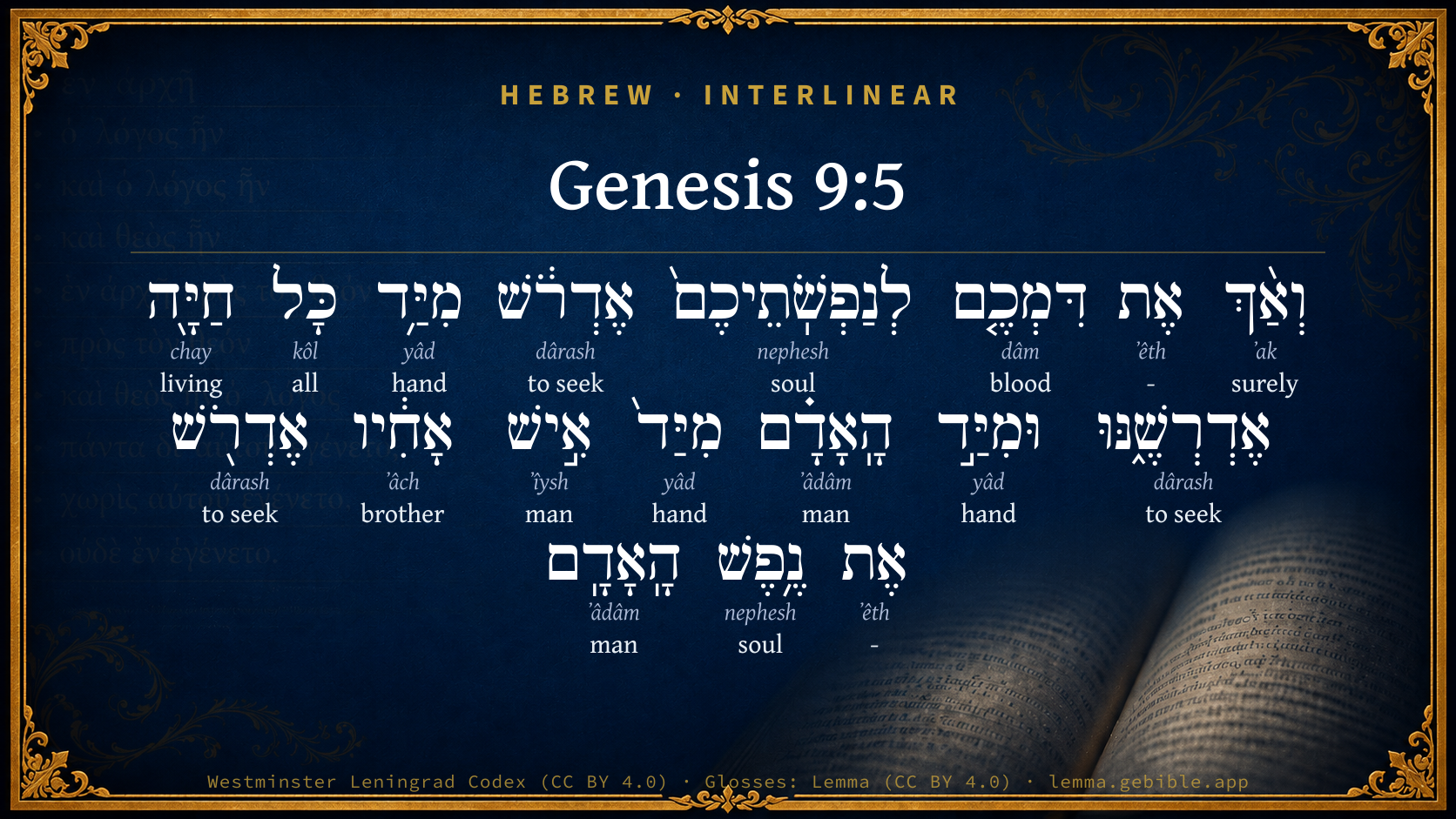
Hebrew (Westminster Leningrad Codex) Genesis 9:5 appears in the Hebrew Old Testament. The text above is from the Westminster Leningrad Codex. Each word links to its Strong’s number, a concise gloss, and parsing drawn from the Open Scriptures Hebrew Bible morphology. Click any word for its full Brown-Driver-Briggs (BDB) entry.
Download image
Cite this verse

Genesis 9:5 (World English Bible). Public Domain. Lemma interlinear Bible study tool, https://lemma.gebible.app/v/genesis/9/5.

Show BibTeX & RIS
BibTeX
RIS
English Translation
I will surely require your blood of your lives. At the hand of every animal I will require it. At the hand of man, even at the hand of every man's brother, I will require the life of man.
World English Bible · Public Domain
Highlights
  • 1 first appearance in the Hebrew Bible
Full analysis ↓
Download a study sheet

One document with this verse’s original text, its word-by-word gloss line, the meaning frame, cross-references with their text, attributed commentary, and full source and license credits — printable, and it pastes into notes with its structure intact.

This verse Autodidact and up

Study sheet (.html) Plain text (.txt)

A passage Seminary Student

Up to 50 verses in one chapter. A passage sheet keeps up to 6 commentary sources and 12 cross-references per verse, in the order this page ranks them, and says so on the sheet whenever that leaves anything out. Ask for a single verse and you get the Autodidact verse sheet above.

Everything on this page stays free to read, with no account — the sheet is a download of what is already on screen, not access to it.

Want to remove ads? Support Godless Engineer
Compare translations 3

The same verse in 3 English versions, stacked beneath the original-language interlinear above. Click any original word for its lexicon entry.

Each is an independent rendering of the whole verse — the interlinear is not word-aligned to these translations.

Highlighted words mark where these versions differ — a whole-verse word diff, not a word-by-word alignment.

  • World English Bible Public Domain
    I will surely require your blood of your lives. At the hand of every animal I will require it. At the hand of man, even at the hand of every man's brother, I will require the life of man.
  • King James Version Public Domain
    And surely your blood of your lives will I require; at the hand of every beast will I require it, and at the hand of man; at the hand of every man's brother will I require the life of man.
  • unfoldingWord Literal Text CC BY-SA 4.0
    And surely I will demand your blood for your lives. From the hand of every living thing I will demand it, and from the hand of mankind; from the hand of a man his brother, I will demand the life of the man.

unfoldingWord Literal Text — © unfoldingWord, licensed CC BY-SA 4.0. Word-aligned USFM3 via Door43 (git.door43.org/unfoldingWord/en_ult).

Versions to compare (up to 4)

3 of 4 selected

Show all 18 translations

Every available English version of this verse, each an independent rendering of the whole verse.

  • World English Bible Public Domain
    I will surely require your blood of your lives. At the hand of every animal I will require it. At the hand of man, even at the hand of every man's brother, I will require the life of man.
  • Berean Standard Bible Public Domain
    And surely I will require the life of any man or beast by whose hand your lifeblood is shed. I will demand an accounting from anyone who takes the life of his fellow man:
  • Majority Standard Bible Public Domain
    And surely I will require the life of any man or beast by whose hand your lifeblood is shed. I will demand an accounting from anyone who takes the life of his fellow man:
  • King James Version Public Domain
    And surely your blood of your lives will I require; at the hand of every beast will I require it, and at the hand of man; at the hand of every man's brother will I require the life of man.
  • American Standard Version (1901) Public Domain
    And surely your blood, `the blood' of your lives, will I require; At the hand of every beast will I require it. And at the hand of man, even at the hand of every man's brother, will I require the life of man.
  • Revised Version (1885) Public Domain
    And surely your blood, the blood of your lives, will I require; at the hand of every beast will I require it: and at the hand of man, even at the hand of every man’s brother, will I require the life of man.
  • Geneva Bible (1599) Public Domain
    For surely I will require your blood, wherein your liues are: at the hand of euery beast will I require it: and at the hand of man, euen at the hand of a mans brother will I require the life of man.
  • Douay-Rheims (1899) Public Domain
    For I will require the blood of your lives at the hand of every beast, and at the hand of man, at the hand of every man, and of his brother, will I require the life of man.
  • Young's Literal Translation Public Domain
    `And only your blood for your lives do I require; from the hand of every living thing I require it, and from the hand of man, from the hand of every man's brother I require the life of man;
  • Literal Standard Version CC BY-SA 4.0
    And only your blood for your lives do I require; from the hand of every living thing I require it, and from the hand of man, from the hand of every man’s brother I require the life of man;
  • Unlocked Literal Bible CC BY-SA 4.0
    But for your blood, the life that is in your blood, I will require payment. From the hand of every animal I will require it. From the hand of any man, that is, from the hand of one who has murdered his brother, I will require an accounting for the life of that man.
  • unfoldingWord Literal Text CC BY-SA 4.0
    And surely I will demand your blood for your lives. From the hand of every living thing I will demand it, and from the hand of mankind; from the hand of a man his brother, I will demand the life of the man.
  • Darby Bible Public Domain
    And indeed your blood, [the blood] of your lives, will I require: at the hand of every animal will I require it, and at the hand of Man, at the hand of each [the blood] of his brother, will I require the life of Man.
  • World Messianic Bible Public Domain
    I will surely require accounting for your life’s blood. At the hand of every animal I will require it. At the hand of man, even at the hand of every man’s brother, I will require the life of man.
  • Webster's Bible Public Domain
    And surely your blood of your lives will I require: at the hand of every beast will I require it: and at the hand of man, at the hand of every man's brother will I require the life of man.
  • Free Bible Version CC BY-SA 4.0
    If your blood is shed by any animal, I will call it to account; and if your blood is shed by any person, I will call that person to account.
  • Bible in Basic English Public Domain
    And for your blood, which is your life, will I take payment; from every beast I will take it, and from every man will I take payment for the blood of his brother-man.
  • JPS Tanakh (1917) Public Domain
    And surely your blood of your lives will I require; at the hand of every beast will I require it; and at the hand of man, even at the hand of every man's brother, will I require the life of man.

Literal Standard Version (2020), Covenant Press — licensed CC BY-SA 4.0. Text via the HelloAO Bible API (eBible.org). Unlocked Literal Bible (unfoldingWord) — licensed CC BY-SA 4.0. Text via the HelloAO Bible API (eBible.org). unfoldingWord Literal Text — © unfoldingWord, licensed CC BY-SA 4.0. Word-aligned USFM3 via Door43 (git.door43.org/unfoldingWord/en_ult). Free Bible Version, Dr. Jonathan Gallagher — licensed CC BY-SA 4.0. Text via the HelloAO Bible API (eBible.org).

Word by word

More ways to search: Search by grammar → Find every occurrence → Compare this word →

Practice this passage: Drill this verse → Learn its vocabulary →

וְאַ֨ךְ
ʼak
H389
“and · surely”
Conjunction + Adverb
Part of Speech
Conjunction + Adverb
Full BDB Definition

Origin: akin to H403

TWOT: 84

indeed, surely (emphatic) - howbeit, only, but, yet (restrictive)
  1. אֶת ʼêth H853 “-” Particle, Direct Object
  2. דִּמְכֶ֤ם dâm H1818 “blood · your” Noun, Common, Masculine, Singular, Construct + Suffix, Personal, 2nd Person, Masculine, Plural
  3. לְנַפְשֹֽׁתֵיכֶם֙ nephesh H5315 “to/for · souls · your” Preposition + Noun, Common, Both, Plural, Construct + Suffix, Personal, 2nd Person, Masculine, Plural
  4. אֶדְרֹ֔שׁ dârash H1875 “to seek” Verb, Qal, Imperfect, 1st Person, Common, Singular
  5. מִיַּ֥ד yâd H3027 “from · hand of” Preposition + Noun, Common, Both, Singular, Construct
  6. כָּל kôl H3605 “all of” Noun, Common, Masculine, Singular, Construct
  7. חַיָּ֖ה chay H2416 “living” Noun, Common, Feminine, Singular, Absolute
  8. אֶדְרְשֶׁ֑נּוּ dârash H1875 “to seek · him” Verb, Qal, Imperfect, 1st Person, Common, Singular + Suffix, Personal, 3rd Person, Masculine, Singular
  9. וּמִיַּ֣ד yâd H3027 “and · from · hand of” Conjunction + Preposition + Noun, Common, Both, Singular, Construct
  10. הָֽאָדָ֗ם ʼâdâm H120 “the · man” Particle, Definite Article + Noun, Common, Masculine, Singular, Absolute
  11. מִיַּד֙ yâd H3027 “from · hand of” Preposition + Noun, Common, Both, Singular, Construct
  12. אִ֣ישׁ ʼîysh H376 “man of” Noun, Common, Masculine, Singular, Construct
  13. אָחִ֔יו ʼâch H251 “brother · his” Noun, Common, Masculine, Singular, Construct + Suffix, Personal, 3rd Person, Masculine, Singular
  14. אֶדְרֹ֖שׁ dârash H1875 “to seek” Verb, Qal, Imperfect, 1st Person, Common, Singular
  15. אֶת ʼêth H853 “-” Particle, Direct Object
  16. נֶ֥פֶשׁ nephesh H5315 “soul of” Noun, Common, Both, Singular, Construct
  17. הָֽאָדָֽם ʼâdâm H120 “the · man” Particle, Definite Article + Noun, Common, Masculine, Singular, Absolute

About this verse

These counts appear in no published source. They are computed here, from the morphology-tagged text and Lemma’s own curated glosses. What Lemma adds →

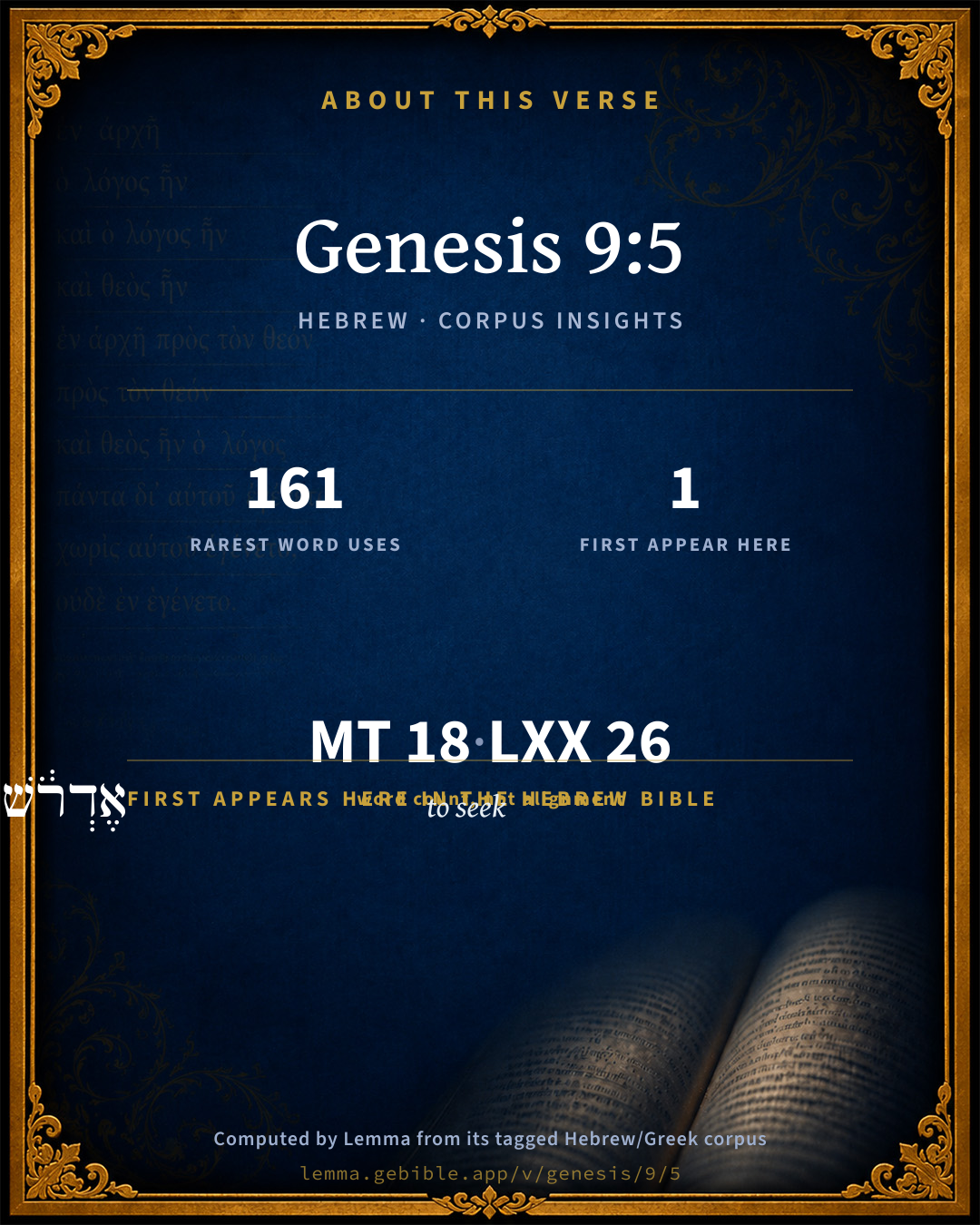
18
words
11
distinct lemmas
Pentateuch
section

First appearance in Scripture

This word makes its first canonical appearance in the Hebrew Bible here:

  • אֶדְרֹ֔שׁ to seek H1875

Grammatical profile

  • 3 verbs
  • 12 nouns
  • 1 adverb
  • 2 particles

Verb forms

  • אֶדְרֹ֔שׁ Qal · Imperfect
  • אֶדְרְשֶׁ֑נּוּ Qal · Imperfect
  • אֶדְרֹ֖שׁ Qal · Imperfect

Repetition

Words recur within this verse — often emphatic in Hebrew:

  • אֶדְרֹ֔שׁ to seek H1875 ×3
  • מִיַּ֥ד hand H3027 ×3
  • לְנַפְשֹֽׁתֵיכֶם֙ soul H5315 ×2
  • הָֽאָדָ֗ם man H120 ×2

Hebrew & Septuagint length

In English translation the verse runs 39 words from the Hebrew and 31 from the Septuagint (LXX English) — closely comparable.

A rough comparison of the two English renderings, which tokenize alike — not a word-level alignment.

Word counts can differ between the Hebrew and the Greek without any difference in meaning — e.g. the Hebrew direct-object marker אֵת has no separate Greek word, and Greek often adds the article ὁ.

In the original languages it is 18 Hebrew tokens and 26 Greek tokens — but the two are counted differently (Hebrew bundles its prefixes and suffixes into one token; the Greek is in lemma form), so that isn’t a like-for-like length.

Cross-references

9

Topical passages linked to Genesis 9:5 in the Treasury of Scripture Knowledge — connected by theme and wording, ordered by reader-vote popularity; previews shown in the World English Bible.

  • Exodus 21:28–29 "If a bull gores a man or a woman to death, the bull shall surely be stoned, and its flesh shall not be eaten; but the owner of the bull shall not be held responsible.
  • Exodus 21:12 "One who strikes a man so that he dies shall surely be put to death,
  • Genesis 4:9–10 Yahweh said to Cain, "Where is Abel, your brother?" He said, "I don't know. Am I my brother's keeper?"
  • Numbers 35:31–33 Moreover you shall take no ransom for the life of a murderer who is guilty of death; but he shall surely be put to death.
  • Psalms 9:12 For he who avenges blood remembers them. He doesn't forget the cry of the afflicted.
  • Exodus 20:13 "You shall not murder.
  • Leviticus 19:16 "'You shall not go up and down as a slanderer among your people; neither shall you stand against the life of your neighbor. I am Yahweh.
  • Deuteronomy 21:1–9 If one be found slain in the land which Yahweh your God gives you to possess it, lying in the field, and it isn't known who has struck him;
  • Matthew 23:35 that on you may come all the righteous blood shed on the earth, from the blood of righteous Abel to the blood of Zachariah son of Barachiah, whom you killed between the sanctuary and the altar.

Cross-references courtesy of OpenBible.info (CC BY 4.0).

Hebrew and Greek witnesses Masoretic Hebrew ↔ Greek Septuagint

The same verse in the two great witnesses to the Old Testament, shown verse-for-verse.

These are two independent witnesses, not word-aligned to each other, and the Septuagint is shown in lemma (dictionary) form.

Hebrew Genesis 9:5 Masoretic · Westminster Leningrad Codex

וְאַ֨ךְ אֶת דִּמְכֶ֤ם לְנַפְשֹֽׁתֵיכֶם֙ אֶדְרֹ֔שׁ מִיַּ֥ד כָּל חַיָּ֖ה אֶדְרְשֶׁ֑נּוּ וּמִיַּ֣ד הָֽאָדָ֗ם מִיַּד֙ אִ֣ישׁ אָחִ֔יו אֶדְרֹ֖שׁ אֶת נֶ֥פֶשׁ הָֽאָדָֽם

I will surely require your blood of your lives. At the hand of every animal I will require it. At the hand of man, even at the hand of every man's brother, I will require the life of man.

World English Bible · Public Domain

Greek LXX Genesis 9:5 Septuagint · lemma form

καί γάρ ὁ ὑμέτερος αἷμα ὁ ψυχή σύ ἐκζητέω ἐκ χείρ πᾶς ὁ θηρίον ἐκζητέω αὐτός καί ἐκ χείρ ἄνθρωπος ἀδελφός ἐκζητέω ὁ ψυχή ὁ ἄνθρωπος

For your blood of your lives will I require at the hand of all wild beasts, and I will require the life of man at the hand of his brother man.

LXX2012 (modern English Septuagint) · Public Domain

On this verse, The Pulpit Commentary discusses the Septuagint’s reading. Read the note in Commentary ↓

Hebrew: Westminster Leningrad Codex (CC BY 4.0). Greek: Septuagint (public domain); English from LXX2012 (modern English Septuagint) (Public Domain). How the Septuagint differs from the Hebrew →

Targum (Aramaic paraphrase)

2

The Targum is the ancient Jewish Aramaic paraphrase of the Hebrew Scriptures — an interpretive translation, not the Hebrew text itself. Onkelos (literal) and Pseudo-Jonathan (expansive) render the Torah, and Jonathan the Prophets. Coverage is partial: where no permissively-licensed English translation exists for a verse, only the Aramaic is shown. This is verse-level text, not a word-by-word alignment to the Hebrew.

  1. Targum Onkelos Torah (Genesis–Deuteronomy)
    וּבְרַם יָת דִּמְכוֹן לְנַפְשָׁתֵיכוֹן אֶתְבַּע מִיַּד כָּל חַיְתָא אֶתְבְּעִנֵהּ וּמִיַד אֱנָשָׁא מִיַד גְבַר דְיֵשׁוֹד יָת דְמָא דַאֲחוֹהִי אֶתְבַּע יָת נַפְשָׁא דֶאֱנָשָׁא

    And also your blood of your lives will I require, from every beast will I require it, and from the hand of man. From the hand of the man who sheddeth the blood of his brother will I require the life of man.

    Targum Onkelos — Aramaic: “Onkelos Genesis” (public domain); “Onkelos Exodus” (public domain); “Onkelos Leviticus” (public domain); “Onkelos Numbers” (public domain); “Onkelos Deuteronomy” (public domain). English: “Sefaria Community Translation” (CC0 1.0 (public-domain dedication)); “J.W. Etheridge. The Targums of Onkelos and Jonathan Ben Uzziel on the Pentateuch. London: Longmans, Green, 1862” (public domain). Text via Sefaria.

  2. Targum Pseudo-Jonathan Torah (Genesis–Deuteronomy)
    וּבְרַם יַת דִמְכוֹן לְנַפְשָׁתֵיכוֹן אֵתְבּוֹעַ מִן יְדָא דְכָל חַיְתָא דְקַטְלָא לְבַר נְשָׁא אִיתְבּוֹעִינֵיהּ לְאִיתְקַטְלָא עֲלֵיהּ וּמִידָא דְאֵינָשָׁא מִיַד גְבַר דְיֵישׁוֹד יַת דְמָא דְאָחוֹי אִתְבַּע יַת נַפְשָׁא דְאֵינָשָׁא

    But the blood of your lives I will I require of every animal which hath killed a man, I will require that it be put to death on his account. And from the hand of the human being, from the hand of the man who hath shed the blood of his brother, will I require the life of man.

    Targum Pseudo-Jonathan — Aramaic: “Targum Jonathan on Genesis” (public domain); “Targum Jonathan on Exodus” (public domain); “Targum Jonathan on Leviticus” (public domain); “Targum Jonathan on Numbers” (public domain); “Targum Jonathan on Deuteronomy” (public domain). English: “The Targum of Jonathan ben Uzziel, trans. J. W. Etheridge, London, 1862” (public domain). Text via Sefaria.

Commentary

Notes on Genesis 9:5 from classic Christian and Jewish commentators (each source and its license shown beneath its notes). The classic Christian expositions comment on the surrounding passage and are grouped to its opening verse, so a note may address several verses; the Jewish commentaries on the Tanakh (Rashi and others) are per-verse, so they appear only where the commentator wrote on this verse.

Lemma curates 59 commentaries, every one of them public domain or Creative Commons licensed, each selected and text-cleaned for this edition rather than reprinted as found. About our sources →

Trapp's Complete Commentary

John Trapp

Gen 9:5 And surely your blood of your lives will I require; at the hand of every beast will I require it, and at the hand of man; at the hand of every man’s brother will I require the life of man.

Ver. 5. Your blood of your lives will I require,] i.e., I will punish it either by the magistrate, or if he fail to do his office, by mine own immediate hand; as he did in David, Charles the Ninth of France, Richard the Third of England, Felix Count of Waterburg, and others, that either were above law, or escaped the lash of it. See for this, "The Thunderbolt of God’s Judgments," lib. ii. cap. iv. 5,16. Richard the Third used the instruments of his bloody plots, as men do their candles; burn the first out to a snuff, and then having lighted another, tread that under foot. {a}

{a} Daniel’s Chron. continued by Trussel.

John Trapp, A Commentary or Exposition upon All the Books of the Old and New Testament (1647–1656) — public domain. Text from a community e-Sword module.

Joseph Benson's Commentary

Gen 9:5. And surely your blood of your lives will I require — The sense is, If I am thus careful of the blood of beasts, be assured I will be much more solicitous for the blood of men, when it shall be shed by unjust and violent hands. Our own lives are not so our own that we may quit them at our own pleasure; but they are God’s, and we must resign them at his pleasure. If we any way hasten our own deaths, we are accountable to God for it. Yea, At the hand of every beast will I require it — To show how tender God was of the life of man, he will have the beast put to death that kills a man. This was confirmed by the law of Moses, Exo 21:28, and it would not be improper to observe it still. And at the hand of every man’s brother will I require the life of man — I will avenge the blood of the murdered upon the murderer. When God requires the life of a man at the hand of him that took it away unjustly, as he cannot render that, therefore he must render his own in lieu of it, which is the only way he hath of making restitution.

Joseph Benson's Commentary on the Old and New Testaments (1811–1818) — public domain. Text from a community e-Sword module.

Tyndale Open Study Notes

Tyndale Open Resources

9:5-6 Violence, including murder, was a major factor in bringing about God’s judgment of the flood (4:8; 6:11, 13). At this new beginning for humans, God affirmed the sanctity of human life and established a system of retributive justice for the taking of human life (see also Ps 9:12; “Retribution” Theme Note). The function of law is to restrain human wickedness and preserve moral order. This law was further developed in the law of Moses (Exod 21:12-14; Lev 24:17-22; Num 35:16-34; Deut 17:6-7; 19:15).

Tyndale Open Study Notes — © Tyndale Open Resources, licensed CC BY-SA 4.0. Text via the HelloAO Bible API.

Geneva Bible (1599)

Geneva Bible translators

That is, I will take vengeance for your blood.

Or, neighbor.

Geneva Bible (1599) marginal notes — public domain. Text via Bolls.life.

Jamieson, Fausset & Brown

Robert Jamieson, A. R. Fausset & David Brown

surely your blood of your lives will I require--The fourth part establishes a new power for protecting life--the institution of the civil magistrate (Rom 13:4), armed with public and official authority to repress the commission of violence and crime. Such a power had not previously existed in patriarchal society.

Jamieson, Fausset & Brown — Commentary Critical and Explanatory on the Whole Bible (1871) — public domain (CC PDM 1.0). Text via the HelloAO Bible API.

Adam Clarke's Commentary

Verse 5. Surely your blood - will I require; at the hand of every beast] This is very obscure, but if taken literally it seems to be an awful warning against cruelty to the brute creation; and from it we may conclude that horse-racers, hare-hunters, bull-baiters, and cock-fighters shall be obliged to give an account to God for every creature they have wantonly destroyed. Instead of חיה chaiyah, "beast," the Samaritan reads [Sam. Yod Kaph] chai, "living," any "living creature or person;" this makes a very good sense, and equally forbids cruelty either to men or brutes.

Adam Clarke's Commentary on the Bible (1810–1826) — public domain. Text from a community e-Sword/MySword module.

John Calvin's Commentaries

5. And surely your blood of your lives will I require. In these words the Lord more explicitly declares that he does not forbid the use of blood out of regard to animals themselves, but because he accounts the life of men precious: and because the sole end of his law is, to promote the exercise of common humanity between them. I therefore think that Jerome, in rendering the particle אך (ach,) for, has done better than they who read it as an adversative disjunctive; ‘otherwise your blood will I require;’ yet literally it may best be thus translated, ‘And truly your blood.’ The whole context is (in my opinion) to be thus read, ‘And truly your blood, which is in your lives, or which is as your lives, that is which vivifies and quickens you, as it respects your body, will I require: from the hand of all animals will require it; from the hand of man, from the hand, I say, of man, his brother, will I require the life of man.’ The distinction by which the Jews constitute four kinds of homicide is frivolous; for I have explained the simple and genuine sense, namely, that God so highly estimates our life, that he will not suffer murder to go unavenged. And he inculcates this in so many words, in order that he may render the cruelty of those the more detestable, who lay violent hands upon their neighbors. And it is no common proof of God’s love towards us, that he undertakes the defense of our lives, and declares that he will be the avenger of our death. In saying that he will exact punishment from animals for the violated life of men, he gives us this as an example. For if, on behalf of man, he is angry with brute creatures who are hurried by a blind impulse to feed upon him; what, do we suppose, will become of the man who, unjustly, cruelly, and contrary to the sense of nature, falls upon his brother?

John Calvin's Commentaries (1540-1563) — public domain. Text from the Calvin Translation Society English edition (1840s-50s) via the Christian Classics Ethereal Library (ccel.org). Calvin's coverage is partial (roughly two-thirds of the Bible); uncommented books and verses are honest gaps, never fabricated. The 19th-century editor's footnotes and remarks are omitted so the notes are faithfully Calvin's own voice.

Ellicott's Commentary for English Readers

(5) Your blood of your lives. . . . —This verse should be translated: “And surely your blood, which is for your souls, will I require (i.e., avenge); from every beast will I require it, and from man: even from a man’s brother will I require the soul of man,” as from Cain. “Your blood, which is for your souls,” means that it is the means for the maintenance of the animal life within them. As it is, then, the support of man’s life, au animal which sheds it becomes guilty, and must be slain; and still more must those animals be destroyed which prey upon man. Thus there is a command given for the extirpation of the carnivora at the time when the more peaceful animals had just been saved. The last clause literally is . . . at the hand of man, at the hand of one that is his brother, will I require the soul of man. This has nothing to do with the avenger of blood. The near kinsman is here the murderer, and the commandment requires that even such an one should not be spared.

A Bible Commentary for English Readers, edited by Charles John Ellicott (1878–1897) — public domain. Text from a community e-Sword module.

The Cambridge Bible for Schools and Colleges

gen. ed. J. J. S. Perowne

5. your blood] The second prohibition is that of manslaughter. The thought of human bloodshed is naturally suggested by the subject of the slaying of animals. Man’s life is sacred. Neither man nor beast is to take it.

the blood of your lives] A difficult expression. Literally, “for,” or “according to, your souls,” i.e. the blood of a person for the life of each person, “blood for blood,” “life for life,” will God require (as Gen_9:6). That “the blood of your souls” means “the blood of your own selves,” as distinguished from “the blood of the animals,” is another explanation, but not so probable.

But either of these renderings is to be preferred to that of Tuch, “for the protection of your lives.”

will I require] This thought that God Himself “will require it,” in the case of human bloodshed, appears in Psa_9:12, “he that maketh inquisition for blood remembereth them,” and Psa_10:13, “wherefore doth the wicked contemn God, and say in his heart, Thou wilt not require it.” See also Gen_42:22, “behold, his blood is required.”

of every beast] e.g. in Exo_21:28-29, the ox that gores a person to death is to be stoned.

at the hand of every man’s brother] “Brother” here denotes the brotherhood of humanity, not of a particular family. He who slays a man slays his own “brother,” although technically there is no relationship.

the life of man] i.e. “the nephesh, or vital principle, of man.” In the first clause God had said He would “require” the blood: here He says He will “require” the life. In Gen_9:4 “the life” is “the blood.”

The Cambridge Bible for Schools and Colleges (gen. ed. J. J. S. Perowne; Cambridge University Press, 1878–1918) — public domain. Text from a community e-Sword module.

John Gill's Exposition

And surely your blood of your lives will I require,.... Or "for surely your blood", &c. (o); and so is a reason of the preceding law, to teach men not to shed human blood; or though, "surely your blood", as Jarchi and Aben Ezra; though God had given them liberty to slay the creatures, and shed their blood, and eat them, yet he did not allow them to shed their own blood, or the blood of their fellow creatures; should they do this, he would surely make inquisition, and punish them for it:

at the hand of every beast will I require it; should a beast kill a man, or be the instrument of shedding his blood, it should be slain for it; not by means of another beast, God so ordering it, as Aben Ezra suggests, but by the hands or order of the civil magistrate; which was to be done partly to show the great regard God has to the life of man, and partly to punish men for not taking more care of their beasts, as well as to be an example to others to be more careful, and to lessen, the number of mischievous creatures:

and at the hand of man, at the hand of every man's brother will I require the life of man; which may be reasonably supposed; for if it is required of a beast, and that is punished for the slaughter of a man, then much more a man himself, that is wilfully guilty of murder; and the rather, since he is by general relation a brother to the person he has murdered, which is an aggravation of his crime: or it may signify, that though he is a brother in the nearest relation, as his crime is the greater, he shall not go unpunished.

(o) , Sept. "enim", V. L.

John Gill's Exposition of the Whole Bible (1746–1763) — public domain (CC PDM 1.0). Text via the HelloAO Bible API.

Haydock's Catholic Bible Commentary

At the hand; a Hebrew idiom. God orders an ox to be stoned, which had slain a man, Exodus xxi. 28. --- Man, (hominis) every man, (viri) brother. By these three terms, God inculcates a horror of bloodshed; because we are all of the same nature, ought to act like generous men, and to consider every individual as a brother, since we spring from the same stock. (Menochius)

George Leo Haydock (1774–1849), Haydock's Catholic Family Bible and Commentary, 1859 edition — public domain. Excludes Psalms (Douay-Rheims chapter numbering differs from Protestant) and Deuterocanonical books (Catholic canon only).

Matthew Poole's English Annotations

And; or, for, as the particle is oft taken; this being the reason of the foregoing prohibition.

Of your lives; or, of your souls, i.e. of your persons; the word soul being oft put for person. Or, your blood, which is for your lives, i.e. which by the spirits it generates is the great preserver and instrument of your lives, and of all your vital actions, and the great bond which ties your souls and bodies together. The sense of the place is: If I am thus careful for the blood of beasts, be assured I will be much more solicitous for the blood of men, when it shall be shed by unjust and violent hands. I will make inquisition for the author of such bloodshed, as I did after Cain, and consequently punish him; for this phrase of requiring implies punishment. See Gen 42:22; Deu 18:19, compared with Act 3:23; Psa 9:13. If magistrates neglect this duty, I myself will avenge it by my own hand.

At the hand of every beast will I require it; not for the punishment of the beast, which being under no law is not capable of sin nor punishment; but for caution to men, for whose use seeing they were made, it is no abuse of them if they be destroyed for man’s benefit. Compare Exo 21:28; Lev 20:15.

At the hand of every man’s brother. This is added, either,

1. As an aggravation of the crime, because the man slain was the brother of the murderer; all men being made of one blood, Act 17:26. And having one Father, even God, Mal 2:10, and Adam too. Upon which account all men are frequently called one another’s brethren, as is manifest from Gen 26:31; 29:4; Lev 19:17; 25:14; 26:37, and from many other places of Scripture. Or.

2. As an assurance of the punishment of the murderer, without any exception of the nearest relation; which, though it makes the sin greater, yet many times is a security against punishment, the murderer easily finding favour and pardon from his parents and dear friends. But the former sense seems the better.

Matthew Poole's English Annotations on the Holy Bible (1683–1685) — public domain. Text from a community e-Sword/MySword module.

Whedon's Commentary on the Bible

Daniel D. Whedon

5. And surely — In the original, Gen_9:4-5 both commence with the particle, אךְ, except, or but, which introduces two stringent prohibitions supplementary to the liberty granted in Gen_9:2; Gen_3:1) The life, or blood of the animal, is never to be used as food. 2) The life of man is to be held sacred,

Blood of your lives — Rather Your blood, for your lives, (in requital for them,) will I require, (seek for, demand.) A command sternly guarding the life of man.

At the hand of every beast — Beasts should be killed that endanger the life of man, (Exo_21:28,) for the animal creation exists for man. By this precept the sacredness of human life is impressively declared.

At the hand of every man’s brother — The brotherhood of man is the foundation of this precept. The beast is man’s servant — made for him — but man, wherever met, of whatever race or condition, is his brother. How completely this strikes at the root of national pride, at the aristocracy of family or race! Man’s life is to be sacred simply because he is a man, a brother, God’s image. The Noachian precept is the germ of the Pauline declaration uttered in the ears of the proud Athenians, amid the very glories of Greek civilization, God “hath made of one blood all nations of men.” Act_17:26.

Daniel D. Whedon (gen. ed.), Commentary on the Old and New Testaments (1874–1909) — public domain. Text from a community e-Sword module.

The Pulpit Commentary

And surely. Again the conjunction introduces a restriction.

The blood of beasts might without fear be shed for necessary uses, but the blood of man was holy and inviolable. Following the LXX (kai gar), Jerome, Pererius, Mercerus, Calvin, Peele, Willet give a causal sense to the conjunction, as if it supplied the reason of" the foregoing restriction a sense which, according to Furst ("Hebrews Lex.," sub nom.) it sometimes, though rarely, has; as in 2Ki_24:3; Psa_39:12 Psa_68:22; but in each case is better rendered "surely." Your blood of your lives.

(1) For your souls, i.e. in requital for themlex talionis, blood for blood, life for life (Kalisch, Wordsworth, Bush);

(2) for your souls, i.e. for their protection (Gesenins, Miehaelis, Schumann, Tuch);

(3) from your souls a prohibition against suicide (Suma-tan);

(4) with reference to your souls, l = quoad (Ewald, "Hebrews Syn.," 310 a), as if specifying the particular blood for which exaction would be made (Keil);

(5) of your souls, belonging to them, or residing in them (LXX, Syriac, Vulgate, A.V, Calvin, Rosenm (qui ad animas vestras perti net), Murphy, "Speaker"s Commentary") although, according to Kalisch, l cannot have the force of a genitive after sk,mD, a substantive with a suffix; but vide Lev_18:20, Lev_18:23; cf. Ewald, "Hebrews Syn.," p. 113. Perhaps the force of l may be brought out by rendering, "your blood to the extent of your lives; i.e. not all blood-letting, but that which proceeds to the extent of taking life (cf. ver. 15: "There shall no more be waters to the extent of a flood"). Will I require. Literally, search after, with a view to punishment; hence avenge (cf. Gen_42:22; Eze_33:6; Psa_9:13) At (literally, from) the hand of every beast will I require it. Not "an awful warning against cruelty to the brute creation!" (Clarke), but a solemn proclamation of the sanctity of human life, since it enacted that that beast should be destroyed which slew a man a statute afterwards incorporated in the Mosaic legislation, (Exo_21:28-32) and practiced even in Christian times; "not for any punishment to the beast, which, being under no law, is capable of neither sin nor punishment, but for caution to men" (Peele). If this practice appears absurd to some moderns (Dr. H. Oort, "The Bible for Young People," p. 103), it was not so to Solon and Draco, in whose enactments there was a similar provision (Delitzsch, Lunge). And at (from) the hand of man; at (or from) the hand of every man"s brother. Either

(1) two per sons are here described

(a) the individual man himself, and

(b) his brother, i.e. the suicide and the murderer (Maimonides, Wordsworth, Murphy), or the murderer and his brother man, i.e. kinsman, or goel (Michaelis, Bohlen, Baumgarten, Kalisch, Bush), or the ordinary civil authorities (Kalisch, Candlish, Jamieson) or

(2) one, viz., the murderer, who is first generically distinguished from the beast, and then characterized as his victim"s brother; as thus at" or from "the hand of man," as well as beast; "from the hand of the individual man, or every man (cf. Gen_42:25; Num_17:1-6 for this distributive use of vyai) his brother," supplying a new argument against homicide (Calvin, Knobel, Delitzsch, Keil, Lunge). The principal objection to discovering Goelism in the phraseology is that it requires dYmi to be understood in two different senses, and the circumstance, that the institution of the magistracy appears to be hinted at in the next verse, renders it unnecessary to detect it in this. Will I require the life (or soul) of man. The specific manner in which this inquisition after Blood should be carried out is indicated in the words that follow.

The Pulpit Commentary (1880–1919), ed. H.D.M. Spence-Jones & Joseph S. Exell — public domain. Text from a community e-Sword module.

John Wesley's Explanatory Notes

And surely your blood of your lives will I require - Our own lives are not so our own, that we may quit them at our own pleasure; but they are God's, and we must resign them at his pleasure. If we any way hasten our own deaths, we are accountable to God for it. Yea, At the hand of every beast will I require it - To shew how tender God was of the life of man, he will have the beast put to death that kills a man. This was confirmed by the law of Moses, Exod. xxi, 28, and it would not be unsafe to observe it still. And at the hand of every man's brother will I require the life of a man - I will avenge the blood of the murdered upon the murderer. When God requires the life of a man at the hand of him that took it away unjustly, he cannot render that, and therefore must render his own in lieu of it, which is the only way left of making restitution.

John Wesley, Explanatory Notes Upon the Whole Bible (1754–1765) — public domain. Text via the GEBible commentary corpus.

unfoldingWord translationNotes

Door43 World Missions Community

General Information:

God continues speaking to Noah and his sons.

But for your blood

This contrasts man's blood with the blood of animals (Genesis 9:4).

for your blood, the life that is in your blood

It is implied that the blood is shed, or poured out, or spilled out. AT: "if anyone causes your blood to pour out" or "if anyone spills your blood" or "if anyone kills you" (See: Assumed Knowledge and Implicit Information and Metaphor)

life

This refers to physical life.

I will require payment

This payment refers to the death of the murderer, not to money. AT: "I will require anyone who kills you to pay"

from the hand

Here the word "hand" refers to the one who is responsible for something happening. (See: Synecdoche)

From the hand of every animal I will require it

"I will require any animal that takes your life to pay"

From the hand of any man, that is, from the hand of one who has murdered his brother, I will require an accounting for the life of that man

"I will require anyone who takes the life of another person to pay"

From the hand of

This phrase refers to the person in a very personal way. AT: "From that very man" (See: Synecdoche)

brother

Here "brother" is used as a general reference to relatives, such as members of the same tribe, clan, or people group.

Whoever sheds man's blood, by man will his blood be shed

The shedding of blood is a metaphor for killing someone. This means that if a person murders someone, someone else must kill the murderer. However, "blood" is very significant in this passage and should be used in the translation if possible. Translate "sheds blood" with words that indicate a major loss of blood that causes death. (See: Metaphor)

for it was in the image of God that he made man

"because God made people to be like him" or "because I made people in my own image"

be fruitful and multiply

This is God's blessing. He told Noah and his family to produce more humans like themselves, so that there would be many of them. The word "multiply" explains how they are to be "fruitful." See how you translated this in Genesis 1:28. (See: Doublet and Idiom)

translationWords

blood

life

hand

brother

bloodshed

image of God

multiply

unfoldingWord translationNotes — © Distant Shores Media and the Door43 World Missions Community, licensed CC BY-SA 4.0. Source: git.door43.org/Door43/en_tn.

Rashi

Rabbi Shlomo Yitzchaki (Rashi)

ואך את דמכם HOWEVER YOUR BLOOD — Although I have permitted you to take the life of cattle yet your blood I will surely require from him amongst you who sheds his own blood (see Bava Kamma 91b).

לנפשותיכם YOUR LIFE — Even though one strangles himself (Genesis Rabbah 34:13) so that no blood flows from him yet I will require it from him.

מיד כל חיה AT THE HAND OF EVERY BEAST — Because the generation of the Flood sinned and they were therefore freely exposed to become food for wild beasts which would have power over them — as it is said (Psalms 49:21), “He is ruled over by wild beasts like the beasts that perish” (these being the prey of other animals) (Shabbat 151b) — it was therefore necessary to proclaim a punishment against wild animals on their account.

ומיד האדם AT THE HAND OF MAN — At the hand of one who kills with premeditation, when there are no witnesses to the murder, will “I” require it.

מיד איש אחיו AT THE HAND OF EVERY MAN’S BROTHER — At the hand of a man who loves him like a brother and slays him accidentally will “I” require it, unless he go into banishment (in one of the Cities of Refuge) and pray for forgiveness for his iniquity. For even one who kills another by accident needs atonement: therefore if there are no witnesses to the deed to make him liable to banishment and he does not humble himself, the Holy One, blessed be He, will require it of him, just as our Rabbis explain the text, (Exodus 21:13) ‘‘But God causes it to come to hand”, in Treatise Makkot (Makkot 10b): The Holy One, blessed be He, causes them (the man who killed by accident and had not expiated the murder and the man who killed with premeditation) to meet at the same inn. The former in ascending a ladder falls upon the latter and kills him and has therefore — the accident having been seen by men — to go to banishment.

Rashi on the Tanakh — English translations: “The Judaica Press complete Tanach with Rashi, translated by A. J. Rosenberg” (CC BY 4.0); “Pentateuch with Rashi's commentary by M. Rosenbaum and A.M. Silbermann, 1929-1934” (public domain); “The Metsudah Tanach series, Lakewood, N.J” (CC BY 4.0); and “The Book of Joshua, Metsudah Publications, 1997” (CC BY 4.0). Text via Sefaria.

Ramban (Nachmanides)

Rabbi Moshe ben Nachman (Ramban / Nachmanides)

AND SURELY YOUR BLOOD ‘LENAPHSHOTHEICHEM’ (OF YOUR LIVES) WILL I REQUIRE. This is as if it were written, your blood ‘naphshotheichem,’ [without the letter lamed], and meaning “your blood which is your lives.” This is similar to the verse, ‘Lechol’ (To all) the instruments of the tabernacle, [which means all the instruments needed for the tabernacle, the letter lamed in the word lechol being redundant]. So also, the third ‘l’Avshalom’ (to Absalom), [which means, “the third, Absolom,” the lamed in the word l’Avshalom is redundant].It is possible to explain your blood ‘lenaphshotheichem’ as meaning benaphshotheichem (in your souls), for the life of all flesh, the blood thereof is all one with the life thereof. Likewise, And ye shall eat no manner of blood in all your dwelling places, ‘la’oph velabeheimah’ (to fowl and to cattle), 7:26. which is to be explained as “in fowl or in beast.”The correct interpretation is that Scripture is saying, “the blood which is the life in you I will require.” He is thus declaring that the blood is one with the life, and He intimates that one incurs the death penalty for spilling the blood upon which life depends, but not for spilling the blood of those limbs on which life is not dependent. Our Rabbis have expounded this verse as an injunction against suicide, the verse stating, “I will require your blood from your own souls.”

AT THE HAND OF EVERY BEAST WILL I REQUIRE IT. I wonder: if “the requiring” is here meant in its usual sense, i.e., from the hand of the beast as well as from the hand of man, in both cases there will be punishment in the matter, but the beast has no reason [with which to discern between good and evil] so that it should be punished or rewarded! Perhaps this principle applies only to spilling man’s blood; every beast that will devour him will itself be devoured, for such is the decree of the King. And this is the reason [why Scripture says of an ox that killed a human being], the ox shall surely be stoned, and its flesh shall not be eaten. This is not a form of monetary punishment for the owner since even an ownerless ox is subject to the death penalty, and the command applies alike to the sons of Noah, Note 222. and to the Israelites. The meaning of Who so sheddeth man’s blood would thus be, “all shedders” whether beast or man, their blood will be required by the Court on earth and by the hand of Heaven.It is possible that the meaning of the expression, at the hand of every beast, is that the vengeance upon the shedder of blood will be at the hand of every beast, just as it is said, That she hath received of the Eternal’s hand double of all her sins. Thus He says, “Surely your blood will I require and avenge at the hand of every beast for I will send against the murderer all beasts of the earth, and I will also send against him the hand of man, and he will not escape them.” Similarly, Because of all mine adversaries I am become a reproach, meaning “because of the hand of all mine adversaries;” This is the portion of a wicked man from G-d, and the heritage appointed unto him by G-d, [meaning this is the portion of a wicked man by the hand of G-d].Perhaps the requiring at the hand of the beast means that she should not devour man for so He established their nature. The secret of the matter is that at the time of creation He gave man every herb bearing seed… and every tree in which is the fruit of a tree… for food, and to the beast He gave every green herb for food, Verse 30. and Scripture says, and it was so, Verse 30. meaning that such was their nature and habit. But now when He said of man that he may slaughter the lower living creatures for food and it was so placed in nature or habit that living creatures should eat each other, it became necessary to command that the other living creatures be unto men a prey to their teeth while they are to fear men and not devour them. And He said, And surely, your blood of your lives will I require, in order to hint that He will not require the blood of one beast from the hand of another. This being so, it was thus left to them to devour one another. And this is the reason why He mentioned here the prohibition of spilling the blood of man; it is on account of the permission given here for slaughtering, which became the customary way of spilling blood since in the opinion of our Rabbis, Adam had already been admonished against spilling blood. But on account of the permission for slaughtering, it became necessary for Him to say, “I have permitted you to spill the blood of every living thing except your own blood. This is forbidden to you as well as to all living things for it will not be their nature to spill it.”

Ramban (Nachmanides) on the Tanakh — English translation: “Commentary on the Torah by Ramban (Nachmanides). Translated and annotated by Charles B. Chavel. New York, Shilo Pub. House, 1971-1976” (CC BY 4.0). Text via Sefaria.

Radak

Rabbi David Kimhi (Radak)

אך את דמכם לנפשותיכם, even though I have permitted the blood of animals, i.e. you may kill animals, I have not permitted the animals to kill you, seeing that I have given them into your control, and not vice versa.

לנפשותיכם, the meaning of this word is that if an animal kills a human being it becomes guilty of death itself, unless I use the animal to exact retribution form wicked people, as in the case of the bears who killed the youngsters who had mocked the prophet Elisha (Kings II 20,23, or Kings I 13, entire chapter). [the fact that the lion had not touched the corpse of the man he had killed, showed that the lion had acted as G’d’s messenger, had not acted from impulse in order to still its hunger. Ed] Also in the תוכחה in Leviticus 26,22 G’d specifically announces that He would use the free roaming beasts as His agents to wreak vengeance of the Jewish people who had sinned deliberately and for a long period of time. Our sages (Bereshit Rabbah 34,13) explain the words דמכם לנפשותיכם, as a warning not to commit suicide (especially to people who thereby expect to escape G’d’s retribution) The message is that the person who killed himself will be held accountable in the hereafter. They said further that the word אך at the beginning of the verse excludes such apparent suicides as Chananyah, Mishael, and Azaryah, being prepared to become martyrs to demonstrate their faith in the G’d in heaven

מיד כל חיה אדרשנו, the offending animal which killed a human being will itself be killed by another animal. Even though the principle of reward and punishment is not generally applicable to any species other than the human species, seeing that only man possesses intelligence so that he can be held responsible for his sins, when animals attack human beings G’d did restrict their instincts, and holds them responsible for not respecting the צלם אלוקים, the divine image in which man has been created. Chabakuk 2,17 phrases this principle as ושד בהמות יחיתן, “the destruction of beasts will overwhelm you.” Moreover, when speaking of retribution, we read in Kings I 13,28 ולא שבר את החמור, “nor had it mauled the ass.” [this proved that when the lion had killed the man of G’d, it had acted as an instrument of G’d’s justice. Ed]

ומיד האדם, if man kills man, G’d reserves the right to exact retribution from him either in this life or in the hereafter.

Radak on the Tanakh — English translations: “Sefaria Community Translation” (CC0 1.0 (public-domain dedication)); “Eliyahu Munk, HaChut Hameshulash” (CC BY 4.0); “Rabbi Mike Feuer, Jerusalem Anthology” (CC BY 4.0); and “R. David Kimhi on the first book of Psalms, Translated by R.G. Finch, London, 1919” (public domain). Text via Sefaria.

Lesson kit

Teaching starters — assembled from the data on this page, not authored interpretation. Every prompt links to the verse data it draws on. Edit before teaching.

Genesis, in the Pentateuch, opens this verse with 18 words (11 distinct Hebrew lemmas). Its most distinctive word is ʼak (“surely”). A historical commentator’s framing appears above. Read the whole chapter for the surrounding context.

Discussion questions

  1. What does “surely” (ʼak) contribute to the verse as a whole?
  2. The word “to seek” first appears here in Scripture. What is being introduced at this debut?
  3. Exodus 21:28–29 shares this passage’s theme. How do the two illuminate each other?
  4. “to seek” occurs 3× in this one verse. What is the effect of the repetition?
  5. These translations render this verse differently. What is at stake in choosing one wording over another?
  6. The verb «אֶדְרֹ֔שׁ» is Qal Imperfect. How does its form color the action?
  7. Reading how Trapp's Complete Commentary and Joseph Benson's Commentary read this verse, where do the two commentators agree and where do they part?

Things to notice

Reading settings

Reading text

Shown beneath each verse's original-language words.

Old Testament
Old Testament edition

Read the OT as the Masoretic Hebrew (MT) or the Greek Septuagint (LXX).

English shown for the Greek Septuagint (in the Hebrew ↔ Greek comparison).

Comparing translations? Open the Compare panel on any verse page to stack up to four side by side.