Judges 1:4

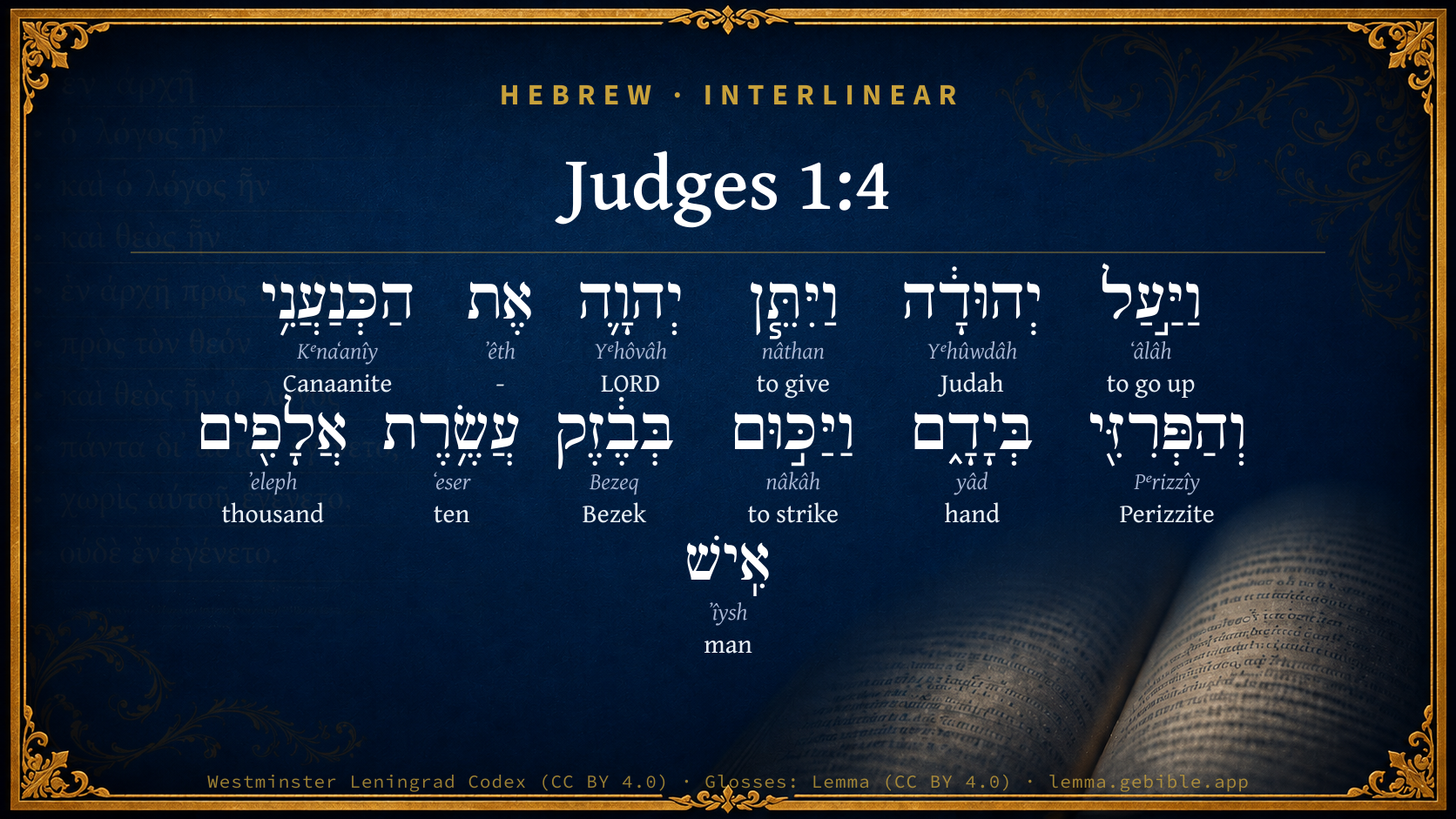
Hebrew (Westminster Leningrad Codex) Judges 1:4 appears in the Hebrew Old Testament. The text above is from the Westminster Leningrad Codex. Each word links to its Strong’s number, a concise gloss, and parsing drawn from the Open Scriptures Hebrew Bible morphology. Click any word for its full Brown-Driver-Briggs (BDB) entry.
Download image
Cite this verse

Judges 1:4 (World English Bible). Public Domain. Lemma interlinear Bible study tool, https://lemma.gebible.app/v/judges/1/4.

Show BibTeX & RIS
BibTeX
RIS
English Translation
Judah went up; and Yahweh delivered the Canaanites and the Perizzites into their hand: and they struck of them in Bezek ten thousand men.
World English Bible · Public Domain
Highlights
  • 1 first appearance in the Hebrew Bible
Full analysis ↓
Download a study sheet

One document with this verse’s original text, its word-by-word gloss line, the meaning frame, cross-references with their text, attributed commentary, and full source and license credits — printable, and it pastes into notes with its structure intact.

This verse Autodidact and up

Study sheet (.html) Plain text (.txt)

A passage Seminary Student

Up to 50 verses in one chapter. A passage sheet keeps up to 6 commentary sources and 12 cross-references per verse, in the order this page ranks them, and says so on the sheet whenever that leaves anything out. Ask for a single verse and you get the Autodidact verse sheet above.

Everything on this page stays free to read, with no account — the sheet is a download of what is already on screen, not access to it.

Want to remove ads? Support Godless Engineer
Compare translations 3

The same verse in 3 English versions, stacked beneath the original-language interlinear above. Click any original word for its lexicon entry.

Each is an independent rendering of the whole verse — the interlinear is not word-aligned to these translations.

Highlighted words mark where these versions differ — a whole-verse word diff, not a word-by-word alignment.

  • World English Bible Public Domain
    Judah went up; and Yahweh delivered the Canaanites and the Perizzites into their hand: and they struck of them in Bezek ten thousand men.
  • King James Version Public Domain
    And Judah went up; and the LORD delivered the Canaanites and the Perizzites into their hand: and they slew of them in Bezek ten thousand men.
  • unfoldingWord Literal Text CC BY-SA 4.0
    And Judah went up, and Yahweh gave the Canaanite and the Perizzite into their hand. And at Bezek they struck 10,000 men.

unfoldingWord Literal Text — © unfoldingWord, licensed CC BY-SA 4.0. Word-aligned USFM3 via Door43 (git.door43.org/unfoldingWord/en_ult).

Versions to compare (up to 4)

3 of 4 selected

Show all 18 translations

Every available English version of this verse, each an independent rendering of the whole verse.

  • World English Bible Public Domain
    Judah went up; and Yahweh delivered the Canaanites and the Perizzites into their hand: and they struck of them in Bezek ten thousand men.
  • Berean Standard Bible Public Domain
    When Judah attacked, the LORD delivered the Canaanites and Perizzites into their hands, and they struck down ten thousand men at Bezek.
  • Majority Standard Bible Public Domain
    When Judah attacked, the LORD delivered the Canaanites and Perizzites into their hands, and they struck down ten thousand men at Bezek.
  • King James Version Public Domain
    And Judah went up; and the LORD delivered the Canaanites and the Perizzites into their hand: and they slew of them in Bezek ten thousand men.
  • American Standard Version (1901) Public Domain
    And Judah went up; and Jehovah delivered the Canaanites and the Perizzites into their hand: and they smote of them in Bezek ten thousand men.
  • Revised Version (1885) Public Domain
    And Judah went up; and the LORD delivered the Canaanites and the Perizzites into their hand: and they smote of them in Bezek ten thousand men.
  • Geneva Bible (1599) Public Domain
    Then Iudah went vp, and the Lord deliuered the Canaanites and the Perizzites into their hands, and they slew of them in Bezek ten thousand men.
  • Douay-Rheims (1899) Public Domain
    And Juda went up, and the Lord delivered the Chanaanite, and the Pherezite into their hands: and they slew of them in Bezec ten thousand men.
  • Young's Literal Translation Public Domain
    And Judah goeth up, and Jehovah giveth the Canaanite and the Perizzite into their hand, and they smite them in Bezek -- ten thousand men;
  • Literal Standard Version CC BY-SA 4.0
    And Judah goes up, and YHWH gives the Canaanite and the Perizzite into their hand, and they strike them in Bezek—ten thousand men;
  • Unlocked Literal Bible CC BY-SA 4.0
    The men of Judah attacked, and Yahweh gave them victory over the Canaanites and the Perizzites. They killed ten thousand of them at Bezek.
  • unfoldingWord Literal Text CC BY-SA 4.0
    And Judah went up, and Yahweh gave the Canaanite and the Perizzite into their hand. And at Bezek they struck 10,000 men.
  • Darby Bible Public Domain
    Then Judah went up and the LORD gave the Canaanites and the Per'izzites into their hand; and they defeated ten thousand of them at Bezek.
  • World Messianic Bible Public Domain
    Judah went up, and the LORD delivered the Canaanites and the Perizzites into their hand. They struck ten thousand men in Bezek.
  • Webster's Bible Public Domain
    And Judah went up, and the LORD delivered the Canaanites and the Perizzites into their hand: and they slew of them in Bezek ten thousand men.
  • Free Bible Version CC BY-SA 4.0
    The men of Judah attacked the Canaanites and Perizzites, and the Lord handed them over in defeat. They killed ten thousand of the enemy at the town of Bezek.
  • Bible in Basic English Public Domain
    And Judah went up; and the Lord gave the Canaanites and the Perizzites into their hands; and they overcame ten thousand of them in Bezek.
  • JPS Tanakh (1917) Public Domain
    And Judah went up; and the LORD delivered the Canaanites and the Perizzites into their hand; and they smote of them in Bezek ten thousand men.

Literal Standard Version (2020), Covenant Press — licensed CC BY-SA 4.0. Text via the HelloAO Bible API (eBible.org). Unlocked Literal Bible (unfoldingWord) — licensed CC BY-SA 4.0. Text via the HelloAO Bible API (eBible.org). unfoldingWord Literal Text — © unfoldingWord, licensed CC BY-SA 4.0. Word-aligned USFM3 via Door43 (git.door43.org/unfoldingWord/en_ult). Free Bible Version, Dr. Jonathan Gallagher — licensed CC BY-SA 4.0. Text via the HelloAO Bible API (eBible.org).

Word by word

More ways to search: Search by grammar → Find every occurrence → Compare this word →

Practice this passage: Drill this verse → Learn its vocabulary →

בְּבֶ֔זֶק
Bezeq
H966
“in/at · Bezek”
Preposition + Noun, Proper
Part of Speech
Preposition + Noun
Type
Proper
Full BDB Definition

Origin: from H965

TWOT: None

Bezek = "lightning" - the home of Adonibezek, the place where Israel rallied under Saul
  1. וַיַּ֣עַל ʻâlâh H5927 “and · to go up” Conjunction + Verb, Qal, Sequential Imperfect, 3rd Person, Masculine, Singular
  2. יְהוּדָ֔ה Yᵉhûwdâh H3063 “Judah” Noun, Proper
  3. וַיִּתֵּ֧ן nâthan H5414 “and · to give” Conjunction + Verb, Qal, Sequential Imperfect, 3rd Person, Masculine, Singular
  4. יְהוָ֛ה Yᵉhôvâh H3068 “LORD” Noun, Proper
  5. אֶת ʼêth H853 “-” Particle, Direct Object
  6. הַכְּנַעֲנִ֥י Kᵉnaʻanîy H3669 “the · Canaanite” Particle, Definite Article + Noun, Gentilic, Masculine, Singular, Absolute
  7. וְהַפְּרִזִּ֖י Pᵉrizzîy H6522 “and · the · Perizzite” Conjunction + Particle, Definite Article + Noun, Gentilic, Masculine, Singular, Absolute
  8. בְּיָדָ֑ם yâd H3027 “in/at · hand · their” Preposition + Noun, Common, Both, Singular, Construct + Suffix, Personal, 3rd Person, Masculine, Plural
  9. וַיַּכּ֣וּם nâkâh H5221 “and · to strike · them” Conjunction + Verb, Hiphil, Sequential Imperfect, 3rd Person, Masculine, Plural + Suffix, Personal, 3rd Person, Masculine, Plural
  10. עֲשֶׂ֥רֶת ʻeser H6235 “ten” Adjective, Cardinal number, Masculine, Singular, Construct
  11. אֲלָפִ֖ים ʼeleph H505 “thousand” Adjective, Cardinal number, Both, Plural, Absolute
  12. אִֽישׁ ʼîysh H376 “man” Noun, Common, Masculine, Singular, Absolute

About this verse

These counts appear in no published source. They are computed here, from the morphology-tagged text and Lemma’s own curated glosses. What Lemma adds →

13
words
13
distinct lemmas
Historical
section

Notable vocabulary

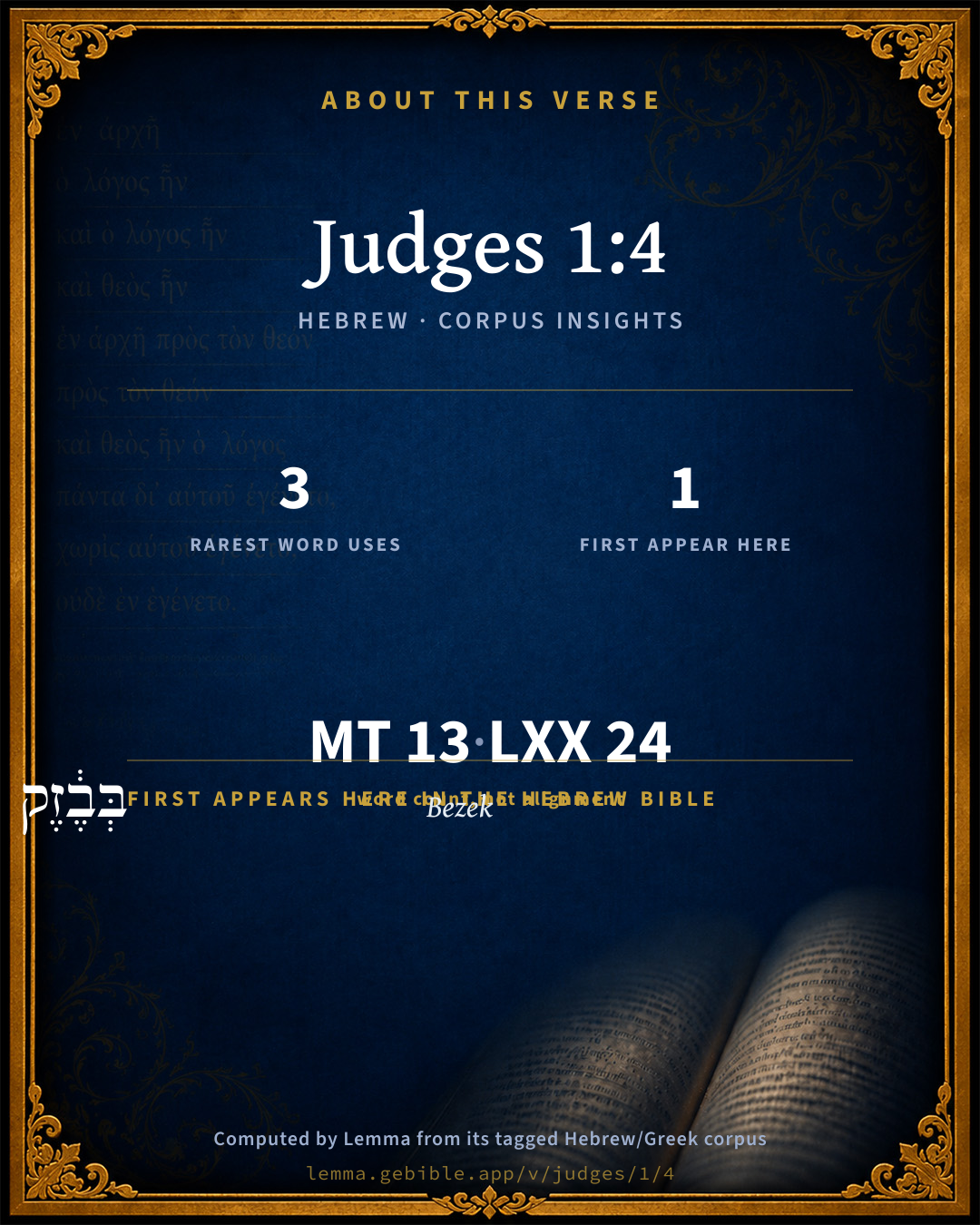
The rarest word here is בְּבֶ֔זֶק Bezek H966 — appearing just 3 times in the whole Hebrew Bible.

First appearance in Scripture

This word makes its first canonical appearance in the Hebrew Bible here:

  • בְּבֶ֔זֶק Bezek H966

Shared distinctive vocabulary

בְּבֶ֔זֶק Bezek H966 occurs in 3 verses of the Hebrew Bible. Also found in:

Grammatical profile

  • 3 verbs
  • 7 nouns
  • 2 adjectives
  • 1 particle

Verb forms

  • וַיַּ֣עַל Qal · Sequential Imperfect
  • וַיִּתֵּ֧ן Qal · Sequential Imperfect
  • וַיַּכּ֣וּם Hiphil · Sequential Imperfect

Hebrew & Septuagint length

In English translation the verse runs 24 words from the Hebrew and 29 from the Septuagint (LXX English) — closely comparable.

A rough comparison of the two English renderings, which tokenize alike — not a word-level alignment.

Word counts can differ between the Hebrew and the Greek without any difference in meaning — e.g. the Hebrew direct-object marker אֵת has no separate Greek word, and Greek often adds the article ὁ.

In the original languages it is 13 Hebrew tokens and 24 Greek tokens — but the two are counted differently (Hebrew bundles its prefixes and suffixes into one token; the Greek is in lemma form), so that isn’t a like-for-like length.

Cross-references

11

Topical passages linked to Judges 1:4 in the Treasury of Scripture Knowledge — connected by theme and wording, ordered by reader-vote popularity; previews shown in the World English Bible.

  • Joshua 11:6–8 Yahweh said to Joshua, Don't be afraid because of them; for tomorrow at this time will I deliver them up all slain before Israel: you shall hamstring their horses, and burn their chariots with fire.
  • 1 Samuel 11:8 He numbered them in Bezek; and the children of Israel were three hundred thousand, and the men of Judah thirty thousand.
  • Exodus 23:28–29 I will send the hornet before you, which will drive out the Hivite, the Canaanite, and the Hittite, from before you.
  • Deuteronomy 7:2 and when Yahweh your God shall deliver them up before you, and you shall strike them; then you shall utterly destroy them: you shall make no covenant with them, nor show mercy to them;
  • Deuteronomy 9:3 Know therefore this day, that Yahweh your God is he who goes over before you as a devouring fire; he will destroy them, and he will bring them down before you: so shall you drive them out, and make them to perish quickly, as Yahweh has spoken to you.
  • Joshua 10:8–10 Yahweh said to Joshua, Don't fear them: for I have delivered them into your hands; there shall not a man of them stand before you.
  • 1 Samuel 14:6 Jonathan said to the young man who bore his armor, Come, and let us go over to the garrison of these uncircumcised: it may be that Yahweh will work for us; for there is no restraint to Yahweh to save by many or by few.
  • 1 Samuel 14:10 But if they say thus, Come up to us; then we will go up; for Yahweh has delivered them into our hand: and this shall be the sign to us.
  • 1 Samuel 17:46–47 This day will Yahweh deliver you into my hand; and I will strike you, and take your head from off you; and I will give the dead bodies of the host of the Philistines this day to the birds of the sky, and to the wild animals of the earth; that all the earth may know that there is a God in Israel,
  • 1 Kings 22:6 Then the king of Israel gathered the prophets together, about four hundred men, and said to them, Shall I go against Ramoth-gilead to battle, or shall I forbear? They said, Go up; for the Lord will deliver it into the hand of the king.
  • 1 Kings 22:15 When he was come to the king, the king said to him, Micaiah, shall we go to Ramoth-gilead to battle, or shall we forbear? He answered him, Go up and prosper; and Yahweh will deliver it into the hand of the king.

Cross-references courtesy of OpenBible.info (CC BY 4.0).

Hebrew and Greek witnesses Masoretic Hebrew ↔ Greek Septuagint

The same verse in the two great witnesses to the Old Testament, shown verse-for-verse.

These are two independent witnesses, not word-aligned to each other, and the Septuagint is shown in lemma (dictionary) form.

Hebrew Judges 1:4 Masoretic · Westminster Leningrad Codex

וַיַּ֣עַל יְהוּדָ֔ה וַיִּתֵּ֧ן יְהוָ֛ה אֶת הַכְּנַעֲנִ֥י וְהַפְּרִזִּ֖י בְּיָדָ֑ם וַיַּכּ֣וּם בְּבֶ֔זֶק עֲשֶׂ֥רֶת אֲלָפִ֖ים אִֽישׁ

Judah went up; and Yahweh delivered the Canaanites and the Perizzites into their hand: and they struck of them in Bezek ten thousand men.

World English Bible · Public Domain

Greek LXX Judges 1:4 Septuagint · lemma form

καί ἀναβαίνω ἰούδας καί παραδίδωμι κύριος ὁ χαναναῖος καί ὁ φερεζαῖος εἰς ὁ χείρ αὐτός καί κόπτω αὐτός ἐν βεζεκ εἰς δέκα χιλιάς ἀνήρ

And Judas went up; and the Lord delivered the Chananite and the Pherezite into their hands, and they struck them in Bezek to the number of ten thousand men.

LXX2012 (modern English Septuagint) · Public Domain

Hebrew: Westminster Leningrad Codex (CC BY 4.0). Greek: Septuagint (public domain); English from LXX2012 (modern English Septuagint) (Public Domain). How the Septuagint differs from the Hebrew →

Targum (Aramaic paraphrase)

1

The Targum is the ancient Jewish Aramaic paraphrase of the Hebrew Scriptures — an interpretive translation, not the Hebrew text itself. Onkelos (literal) and Pseudo-Jonathan (expansive) render the Torah, and Jonathan the Prophets. Coverage is partial: where no permissively-licensed English translation exists for a verse, only the Aramaic is shown. This is verse-level text, not a word-by-word alignment to the Hebrew.

  1. Targum Jonathan Prophets (Joshua–Malachi)
    וּסְלִיקוּ דְבֵית יְהוּדָה וּמְסַר יְיָ יַת כְּנַעֲנָאָה וּפְרִיזָאָה בִּידֵיהוֹן וּמְחָנוּן בְּבֶזֶק עַסְרָא אַלְפִין גַבְרָא:

    (no public-domain English translation for this verse)

    Targum Jonathan — Aramaic: “Mikraot Gedolot” (public domain). English: “Sefaria Community Translation” (CC0 1.0 (public-domain dedication)); “London "Chaldee Paraphrase," 1871” (public domain). Text via Sefaria.

Commentary

Notes on Judges 1:4 from classic Christian and Jewish commentators (each source and its license shown beneath its notes). The classic Christian expositions comment on the surrounding passage and are grouped to its opening verse, so a note may address several verses; the Jewish commentaries on the Tanakh (Rashi and others) are per-verse, so they appear only where the commentator wrote on this verse.

Lemma curates 59 commentaries, every one of them public domain or Creative Commons licensed, each selected and text-cleaned for this edition rather than reprinted as found. About our sources →

Trapp's Complete Commentary

John Trapp

Jdg 1:4 And Judah went up; and the LORD delivered the Canaanites and the Perizzites into their hand: and they slew of them in Bezek ten thousand men.

Ver. 4. And they slew of them in Bezek.] Saul’s rendezvous. {1Sa 11:8}

4 For there are certain men crept in unawares, who were before of old ordained to this condemnation, ungodly men, turning the grace of our God into lasciviousness, and denying the only Lord God, and our Lord Jesus Christ.

Ver. 4. For there are certain men] Not worthy to be named, as that rich glutton, Luk 16:19.

Crept in unawares] παρεισεδυσαν, stealing their passage, and making as if they minded nothing less. Thus Socrates (the writer of the Ecclesiastical History) was a close Novatian, as the learned Jacobus Billius observeth; he favoureth that heresy all along his history, sed ita oblique, ut minus perspicaci Lectori non tam dolori suo atque irae obsequi quam veritatis rationem habere videatur, but he doth it so cunningly, that a man would think he did it out of pure regard to the truth. (Observat. Sacrar. i. 26.) So Spondanus, the epitomizer of Baronius, drinks to his readers the pernicious poison of Hildebrand’s heresies, quasi aliud agens, as if he intended no such matter.

Ordained to this] Gr. προγεγραμμενοι, written down, enrolled, set down in the black bill.

Turning the grace of our God] Gr. μετατιθεμενοι, translating it from its proper end, perverting it, by arguing from mercy to liberty, which is the devil’s logic. Corruptio optimi est pessima. The corruption of the best is the worst. Learned men have conceived, saith Plutarch, that as of oxen, being dead and rotten, there breed bees, of horses wasps, of asses beetles; so men’s bodies, when the marrow melteth and gathereth together, do bring forth serpents. The grace of God, if turned into wantonness, becometh the "savour of death unto death."

John Trapp, A Commentary or Exposition upon All the Books of the Old and New Testament (1647–1656) — public domain. Text from a community e-Sword module.

Joseph Benson's Commentary

Jdg 1:4. Judah went up — The people of that tribe were principally concerned in this expedition, and therefore are only mentioned, though those of the tribe of Simeon went up with them. And the Lord delivered, &c. — We meet with no such pious expression (which occurs often here) in any heathen writer. In them every success is attributed to the conduct and valour of the generals, or the strength and courage of the forces; but in the Scriptures every success is attributed to God only. They slew them in Bezek — Not in the city, for that was not yet taken, (Jdg 1:5,) but in the territory of it.

Joseph Benson's Commentary on the Old and New Testaments (1811–1818) — public domain. Text from a community e-Sword module.

Whedon's Commentary on the Bible

Daniel D. Whedon

DEFEAT OF ADONI-BEZEK, Jdg_1:4-7.

4. Judah went up — That is, in the military sense, as in Jdg_1:1. Judah proceeded to the war.

The Lord delivered — The devout Hebrew was remarkable for acknowledging the Divine hand in all his victories. The civilisation which laughs at all faith in the supernatural, and makes the strongest battalions the arbiters of battles, is very defective.

The Canaanites and the Perizzites — On these nations see note on Jos_3:10. There seems to have been a gathering of these foes under Adoni-bezek for the purpose of conquering and oppressing Israel, and to crush the rising rebellion Judah led an army promptly against the gathering host, and fought the decisive battle in Bezek. This place is mentioned only once again, at 1Sa_11:8, where the context shows it to have been near the Jordan valley, and within a day’s journey of Jabesh-gilead. Its site has not been identified, but there is no good reason for maintaining that this Bezek must have been within the tribe of Judah. It may have been expedient for Judah to march beyond his borders, and attack the enemy on their own grounds.

Ten thousand men — Ancient battles were more destructive of human life, because there were generally no prisoners taken, or, if taken, their sufferings in slavery were worse than death on the field.

Daniel D. Whedon (gen. ed.), Commentary on the Old and New Testaments (1874–1909) — public domain. Text from a community e-Sword module.

Ellicott's Commentary for English Readers

(4) And Judah went up.—Under the leadership of Caleb (Jos_14:6).

The Canaanites and the Perizzites.—See Gen_13:7; Gen_34:30. The former seem to have been lowlanders—“by the sea and by the coast of Jordan” (Num_13:29), “on the east and on the west” (Jos_11:3; Jos_17:16). The Perizzites were the mountain and forest tribes (Jos_11:3; Jos_17:15). Their antiquity and importance appear from the allusions to them in Gen_13:7; Gen_34:30; 1Ki_9:20; 2Es_1:21. The name itself seems to imply “open villages” (1Sa_6:18; Deu_3:5), and may imply that they were agriculturists. The name does not occur in the genealogy of nations in Genesis 10

In Bezek.—The name means “lightning.” There seems to be no adequate reason to distinguish this town from the one mentioned in 1Sa_11:8. Saul numbered the people there before his expedition to deliver Jabesh Gilead. At first sight the mention of this town is surprising, for we have no information of any Bezek except the two villages of that name referred to by Eusebius and Jerome, which were seventeen miles from Shechem, and therefore in the lot of Ephraim. It is, however, needless to conjecture that there was another Bezek in the lot of Judah. We must suppose that the two warlike tribes began their conquest by marching into the centre of Palestine to strike a blow at the main stronghold of Canaanitish power. Ewald conjectures that in this expedition they took Shiloh, and refers Gen_49:8-12 to this fact, rendering “till he come to Shiloh” (Hist. Isr. i. 284, E. Tr.). If this chapter does not refer retrospectively to events which occurred before the death of Joshua, it might well be considered strange that this powerful king is not mentioned among those attacked by the Israelites in Joshua’s lifetime. It is, however, possible, as Ewald suggests, that a new power may have sprung up.

A Bible Commentary for English Readers, edited by Charles John Ellicott (1878–1897) — public domain. Text from a community e-Sword module.

The Cambridge Bible for Schools and Colleges

gen. ed. J. J. S. Perowne

4. This verse is made up of general phrases borrowed from Jdg_1:5-7, with the addition of the 10,000—a common round number, Jdg_3:29, Jdg_4:6, Jdg_7:3. The story of Adoni-bezek which follows has evidently been abridged; the editor has substituted a verse of his own for the omitted clauses. Note that the verb went up is singular; Judah alone is mentioned, as in the other editorial Jdg_1:8-10; Jdg_1:18.

The Cambridge Bible for Schools and Colleges (gen. ed. J. J. S. Perowne; Cambridge University Press, 1878–1918) — public domain. Text from a community e-Sword module.

John Gill's Exposition

And Judah went up,.... Simeon being along with him, from the southern parts of the land, where they dwelt, and went more northward towards Jerusalem, and which therefore is called a going up:

and the Lord delivered the Canaanites and Perizzites into their hands: into the hands of Judah and Simeon: the Canaanites here is not the common name of the seven nations, but the name of one of those nations, distinguished from the rest, as here from the Perizzites, who otherwise were also Canaanites; and both these, at least many of them, dwelt in those parts, and were subdued by the united forces of Judah and Simeon, whereby the Lord's promise was fulfilled, Jdg 1:2,

and they slew of them in Bezek ten thousand men: that is, in and about Bezek, first and last, in the course of this war, as after related. Jerom says (d) there were two villages of this name in his time near one another, seven miles from Neapolis, as you go to Scythopolis; and our countryman Mr. Sandys (e) says, that when they departed from Bethlehem, bending their course from the mountains of Judea lying west from it, near to which, on the side of the opposite hill, they passed a little village called Bezek, as he took it, two miles from Bethsur, see Sa1 11:8.

(d) De loc. Heb. fol. 89. H. (e) Travels, p. 142. Ed. 5th.

John Gill's Exposition of the Whole Bible (1746–1763) — public domain (CC PDM 1.0). Text via the HelloAO Bible API.

Albert Barnes' Notes on the Bible

The Canaanites and the Perizzites - See Gen 12:6, note; Gen 13:7, note. Bezek may be the name of a district. It has not yet been identified.

Albert Barnes' Notes on the Bible (1834–1885) — public domain. Text from a community e-Sword/MySword module.

Haydock's Catholic Bible Commentary

Pherezite. This name denotes "a countryman," as the former does "a merchant." None of the children of Chanaan were of this appellation, Genesis x. 15. The people of the country assembled therefore at Bezec, where Saul called a rendezvous when he was going to attack Jabes, and which seems to have been near the Jordan, 17 miles from Sichem. (Eusebius; St. Jerome) --- It signifies "lightning." A place of this name lies to the west of Bethlehem. (Menochius)

George Leo Haydock (1774–1849), Haydock's Catholic Family Bible and Commentary, 1859 edition — public domain. Excludes Psalms (Douay-Rheims chapter numbering differs from Protestant) and Deuterocanonical books (Catholic canon only).

Matthew Poole's English Annotations

Not in the city, for that was not yet taken, Jdg 1:5, but in the territory of it, or near to it; as in Hor is taken, Num 33:37; and in Jericho, Jos 5:13.

Matthew Poole's English Annotations on the Holy Bible (1683–1685) — public domain. Text from a community e-Sword/MySword module.

John Wesley's Explanatory Notes

In Bezek - Not in the city, for that was not yet taken, ver. 5, but in the territory of it.

John Wesley, Explanatory Notes Upon the Whole Bible (1754–1765) — public domain. Text via the GEBible commentary corpus.

Keil & Delitzsch

C. F. Keil & F. Delitzsch

"And Judah went up," sc., against the Canaanites, to make war upon them.

The completion of the sentence is supplied by the context, more especially by Jdg 1:2. So far as the sense is concerned, Rosenmller has given the correct explanation of ויּעל, "Judah entered upon the expedition along with Simeon." "And they smote the Canaanites and the Perizzites in Bezek, 10,000 men." The result of the war is summed up briefly in these words; and then in Jdg 1:5-7 the capture and punishment of the hostile king Adoni-bezek is specially mentioned as being the most important event in the war. The foe is described as consisting of Canaanites and Perizzites, two tribes which have been already named in Gen 13:7 and Gen 34:30 as representing the entire population of Canaan, "the Canaanites" comprising principally those in the lowlands by the Jordan and the Mediterranean (vid., Num 13:29; Jos 11:3), and "the Perizzites" the tribes who dwelt in the mountains (Jos 17:15). On the Perizzites, see Gen 13:7. The place mentioned, Bezek, is only mentioned once more, namely in Sa1 11:8, where it is described as being situated between Gibeah of Saul (see at Jos 18:28) and Jabesh in Gilead. According to the Onom. (s. v. Bezek), there were at that time two places very near together both named Bezek, seventeen Roman miles from Neapolis on the road to Scythopolis, i.e., about seven hours to the north of Nabulus on the road to Beisan. This description is perfectly reconcilable with Sa1 11:8. On the other hand, Clericus (ad h. l.), Rosenmller, and v. Raumer suppose the Bezek mentioned here to have been situated in the territory of Judah; though this cannot be proved, since it is merely based upon an inference drawn from Jdg 1:3, viz., that Judah and Simeon simply attacked the Canaanites in their own allotted territories-an assumption which is very uncertain. There is no necessity, however, to adopt the opposite and erroneous opinion of Bertheau, that the tribes of Judah and Simeon commenced their expedition to the south from the gathering-place of the united tribes at Shechem, and fought the battle with the Canaanitish forces in that region upon this expedition; since Shechem is not described in Josha as the gathering-place of the united tribes, i.e., of the whole of the military force of Israel, and the battle fought with Adoni-bezek did not take place at the time when the tribes prepared to leave Shiloh and march to their own possessions after the casting of the lots was over. The simplest explanation is, that when the tribes of Judah and Simeon prepared to make war upon the Canaanites in the possessions allotted to them, they were threatened or attacked by the forces of the Canaanites collected together by Adoni-bezek, so that they had first of all to turn their arms against this king before they could attack the Canaanites in their own tribe-land. As the precise circumstances connected with the occasion and course of this war have not been recorded, there is nothing to hinder the supposition that Adoni-bezek may have marched from the north against the possession of Benjamin and Judah, possibly with the intention of joining the Canaanites in Jebus, and the Anakim in Hebron and upon the mountains in the south, and then making a combined attack upon the Israelites. This might induce or even compel Judah and Simeon to attack this enemy first of all, and even to pursue him till they overtook him at his capital Bezek, and smote him with all his army. Adoni-bezek, i.e., lord of Bezek, is the official title of this king, whose proper name is unknown.

In the principal engagement, in which 10,000 Canaanites fell, Adoni-bezek escaped; but he was overtaken in his flight (Jdg 1:6, Jdg 1:7), and so mutilated, by the cutting off of his thumbs and great toes, that he could neither carry arms nor flee. With this cruel treatment, which the Athenians are said to have practised upon the capture Aegynetes (Aelian, var. hist. ii. 9), the Israelites simply executed the just judgment of retribution, as Adoni-bezek was compelled to acknowledge, for the cruelties which he had inflicted upon captives taken by himself. "Seventy kings," he says in Jdg 1:7, "with the thumbs of their hands and feet cut off, were gathering under my table. As I have done, so God hath requited me." מקצּצים ... בּהנות, lit. "cut in the thumbs of their hands and feet" (see Ewald, Lehrb. 284 c.). The object to מלקּטים, "gathering up" (viz., crumbs), is easily supplied from the idea of the verb itself. Gathering up crumbs under the table, like the dogs in Mat 15:27, is a figurative representation of the most shameful treatment and humiliation. "Seventy" is a round number, and is certainly an exaggerated hyperbole here. For even if every town of importance in Canaan had its own king, the fact that, when Joshua conquered the land, he only smote thirty-one kings, is sufficient evidence that there can hardly have been seventy kings to be found in all Canaan. It appears strange, too, that the king of Bezek is not mentioned in connection with the conquest of Canaan under Joshua. Bezek was probably situated more on the side towards the valley of the Jordan, where the Israelites under Joshua did not go. Possibly, too, the culminating point of Adoni-bezek's power, when he conquered so many kings, was before the arrival of the Israelites in Canaan, and it may at that time have begun to decline; so that he did not venture to undertake anything against the combined forces of Israel under Joshua, and it was not till the Israelitish tribes separated to go to their own possessions, that he once more tried the fortunes of war and was defeated. The children of Judah took him with them to Jerusalem, where he died.

Keil & Delitzsch — Biblical Commentary on the Old Testament (1861–1891) — public domain (CC PDM 1.0). Text via the HelloAO Bible API. (Old Testament only.)

unfoldingWord translationNotes

Door43 World Missions Community

The men of Judah attacked

It is implied that the men of Simeon attacked with the men of Judah. (See: Assumed Knowledge and Implicit Information)

They killed ten thousand

"They killed about 10,000" or "They killed a large number" (See: Numbers)

of them

"soldiers of the Canaanites and Perizzites" or "enemies"

Bezek

This is an area in the mountains of Canaan. (See: How to Translate Names)

Adoni-Bezek

This man was the leader of the army of the Canaanites and the Perizzites. (See: How to Translate Names)

they fought against him

Here "him" actually refers to Adoni-Bezek and his army. AT: "they fought against him and his army" (See: Synecdoche)

translationWords

Judah

Yahweh

Canaan

Perizzite

unfoldingWord translationNotes — © Distant Shores Media and the Door43 World Missions Community, licensed CC BY-SA 4.0. Source: git.door43.org/Door43/en_tn.

Rashi

Rabbi Shlomo Yitzchaki (Rashi)

At Bezek. The name of a place.

Rashi on the Tanakh — English translations: “The Judaica Press complete Tanach with Rashi, translated by A. J. Rosenberg” (CC BY 4.0); “Pentateuch with Rashi's commentary by M. Rosenbaum and A.M. Silbermann, 1929-1934” (public domain); “The Metsudah Tanach series, Lakewood, N.J” (CC BY 4.0); and “The Book of Joshua, Metsudah Publications, 1997” (CC BY 4.0). Text via Sefaria.

Lesson kit

Teaching starters — assembled from the data on this page, not authored interpretation. Every prompt links to the verse data it draws on. Edit before teaching.

Judges, in the Historical, opens this verse with 13 words (13 distinct Hebrew lemmas). Its most distinctive word is Bezeq (“Bezek”). A historical commentator’s framing appears above. Read the whole chapter for the surrounding context.

Discussion questions

  1. What does “Bezek” (Bezeq) contribute to the verse as a whole?
  2. This is the first place “Bezek” appears in Scripture (first appears here). What does its debut here establish?
  3. How does Judges 1:5, which shares the word «Bezek», read alongside this verse?
  4. These translations render this verse differently. What is at stake in choosing one wording over another?
  5. «וַיַּ֣עַל» is a Qal Sequential Imperfect verb. How does that grammatical form shape the action described?
  6. Compare how Trapp's Complete Commentary and Joseph Benson's Commentary read this verse. Where do they agree or differ?

Things to notice

Reading settings

Reading text

Shown beneath each verse's original-language words.

Old Testament
Old Testament edition

Read the OT as the Masoretic Hebrew (MT) or the Greek Septuagint (LXX).

English shown for the Greek Septuagint (in the Hebrew ↔ Greek comparison).

Comparing translations? Open the Compare panel on any verse page to stack up to four side by side.