Exodus 30:33

Hebrew (Westminster Leningrad Codex) Exodus 30:33 appears in the Hebrew Old Testament. The text above is from the Westminster Leningrad Codex. Each word links to its Strong’s number, a concise gloss, and parsing drawn from the Open Scriptures Hebrew Bible morphology. Click any word for its full Brown-Driver-Briggs (BDB) entry.
Download image
Cite this verse

Exodus 30:33 (World English Bible). Public Domain. Lemma interlinear Bible study tool, https://lemma.gebible.app/v/exodus/30/33.

Show BibTeX & RIS
BibTeX
RIS
English Translation
Whoever compounds any like it, or whoever puts any of it on a stranger, he shall be cut off from his people.'"
World English Bible · Public Domain
Download a study sheet

One document with this verse’s original text, its word-by-word gloss line, the meaning frame, cross-references with their text, attributed commentary, and full source and license credits — printable, and it pastes into notes with its structure intact.

This verse Autodidact and up

Study sheet (.html) Plain text (.txt)

A passage Seminary Student

Up to 50 verses in one chapter. A passage sheet keeps up to 6 commentary sources and 12 cross-references per verse, in the order this page ranks them, and says so on the sheet whenever that leaves anything out. Ask for a single verse and you get the Autodidact verse sheet above.

Everything on this page stays free to read, with no account — the sheet is a download of what is already on screen, not access to it.

Want to remove ads? Support Godless Engineer
Compare translations 3

The same verse in 3 English versions, stacked beneath the original-language interlinear above. Click any original word for its lexicon entry.

Each is an independent rendering of the whole verse — the interlinear is not word-aligned to these translations.

Highlighted words mark where these versions differ — a whole-verse word diff, not a word-by-word alignment.

  • World English Bible Public Domain
    Whoever compounds any like it, or whoever puts any of it on a stranger, he shall be cut off from his people.'"
  • King James Version Public Domain
    Whosoever compoundeth any like it, or whosoever putteth any of it upon a stranger, shall even be cut off from his people.
  • unfoldingWord Literal Text CC BY-SA 4.0
    A man that mixes its like or that puts any of it on a stranger shall be cut off from his people.’”

unfoldingWord Literal Text — © unfoldingWord, licensed CC BY-SA 4.0. Word-aligned USFM3 via Door43 (git.door43.org/unfoldingWord/en_ult).

Versions to compare (up to 4)

3 of 4 selected

Show all 18 translations

Every available English version of this verse, each an independent rendering of the whole verse.

  • World English Bible Public Domain
    Whoever compounds any like it, or whoever puts any of it on a stranger, he shall be cut off from his people.'"
  • Berean Standard Bible Public Domain
    Anyone who mixes perfume like it or puts it on an outsider shall be cut off from his people.’”
  • Majority Standard Bible Public Domain
    Anyone who mixes perfume like it or puts it on an outsider shall be cut off from his people.’”
  • King James Version Public Domain
    Whosoever compoundeth any like it, or whosoever putteth any of it upon a stranger, shall even be cut off from his people.
  • American Standard Version (1901) Public Domain
    Whosoever compoundeth any like it, or whosoever putteth any of it upon a stranger, he shall be cut off from his people.
  • Revised Version (1885) Public Domain
    Whosoever compoundeth any like it, or whosoever putteth any of it upon a stranger, he shall be cut off from his people.
  • Geneva Bible (1599) Public Domain
    Whosoeuer shall make the like oyntment, or whosoeuer shall put any of it vpon a stranger, euen he shalbe cut off from his people.
  • Douay-Rheims (1899) Public Domain
    What man soever shall compound such, and shall give thereof to a stranger, he shall be cut off from his people.
  • Young's Literal Translation Public Domain
    a man who compoundeth `any' like it, or who putteth of it on a stranger -- hath even been cut off from his people.'
  • Literal Standard Version CC BY-SA 4.0
    a man who compounds [any] like it, or who puts of it on a stranger, has even been cut off from his people.”
  • Unlocked Literal Bible CC BY-SA 4.0
    Whoever makes perfume like it, or whoever puts any of it on someone, that person must be cut off from his people.'”
  • unfoldingWord Literal Text CC BY-SA 4.0
    A man that mixes its like or that puts any of it on a stranger shall be cut off from his people.’”
  • Darby Bible Public Domain
    Whoever compoundeth [any] like it, or whoever putteth [any] of it upon any strange thing, shall be cut off from his peoples.
  • World Messianic Bible Public Domain
    Whoever compounds any like it, or whoever puts any of it on a stranger, he shall be cut off from his people.’”
  • Webster's Bible Public Domain
    Whoever compoundeth any like it, or whoever putteth any of it upon a stranger, shall even be cut off from his people.
  • Free Bible Version CC BY-SA 4.0
    Anyone who mixes anointing oil like it, or puts it on someone other than a priest, will be expelled from their people.’”
  • Bible in Basic English Public Domain
    Whoever makes any like it, or puts it on one who is not a priest, will be cut off from his people.
  • JPS Tanakh (1917) Public Domain
    Whosoever compoundeth any like it, or whosoever putteth any of it upon a stranger, he shall be cut off from his people.'

Literal Standard Version (2020), Covenant Press — licensed CC BY-SA 4.0. Text via the HelloAO Bible API (eBible.org). Unlocked Literal Bible (unfoldingWord) — licensed CC BY-SA 4.0. Text via the HelloAO Bible API (eBible.org). unfoldingWord Literal Text — © unfoldingWord, licensed CC BY-SA 4.0. Word-aligned USFM3 via Door43 (git.door43.org/unfoldingWord/en_ult). Free Bible Version, Dr. Jonathan Gallagher — licensed CC BY-SA 4.0. Text via the HelloAO Bible API (eBible.org).

Word by word

More ways to search: Search by grammar → Find every occurrence → Compare this word →

Practice this passage: Drill this verse → Learn its vocabulary →

יִרְקַ֣ח
râqach
H7543
“to mix”
Verb, Qal, Imperfect, 3rd Person, Masculine, Singular
Part of Speech
Verb
Stem
Qal
Form
Imperfect
Person
3rd Person
Gender
Masculine
Number
Singular
Full BDB Definition

Origin: a primitive root

TWOT: 2215

to mix, compound - (Qal) - to mix, compound - compounder, mixer, perfumer (participle) (substantive) - (Pual) mixed (participle) - (Hiphil) to mix
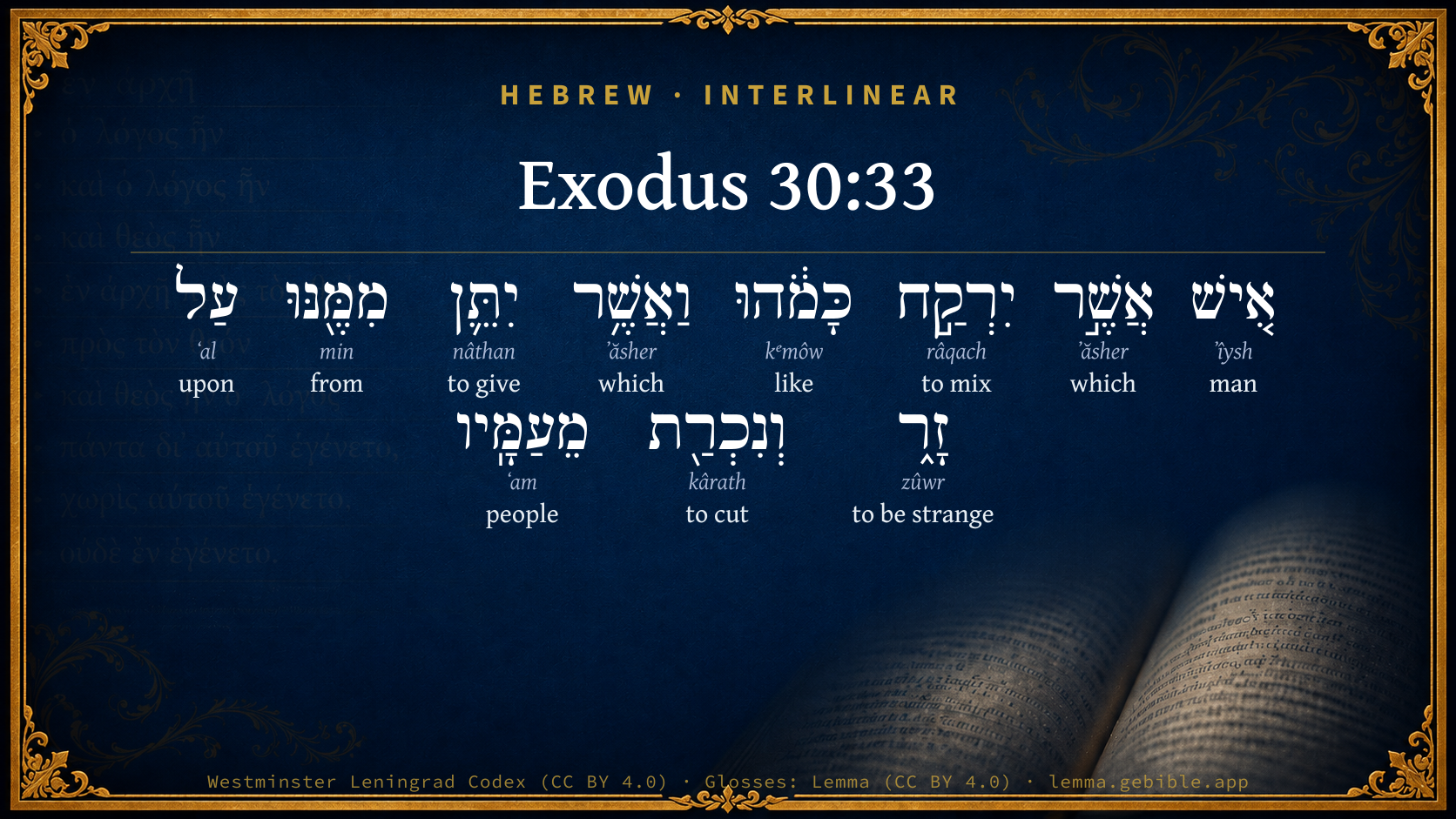
  1. אִ֚ישׁ ʼîysh H376 “man” Noun, Common, Masculine, Singular, Absolute
  2. אֲשֶׁ֣ר ʼăsher H834 “which” Particle, Relative
  3. כָּמֹ֔הוּ kᵉmôw H3644 “like · him” Preposition + Suffix, Personal, 3rd Person, Masculine, Singular
  4. וַאֲשֶׁ֥ר ʼăsher H834 “and · which” Conjunction + Particle, Relative
  5. יִתֵּ֛ן nâthan H5414 “to give” Verb, Qal, Imperfect, 3rd Person, Masculine, Singular
  6. מִמֶּ֖נּוּ min H4480 “from · us” Preposition + Suffix, Personal, 1st Person, Common, Plural
  7. עַל ʻal H5921 “upon” Preposition
  8. זָ֑ר zûwr H2114 “strange” Adjective, Adjective, Masculine, Singular, Absolute
  9. וְנִכְרַ֖ת kârath H3772 “and · to cut” Conjunction + Verb, Niphal, Sequential Perfect, 3rd Person, Masculine, Singular
  10. מֵעַמָּֽיו ʻam H5971 “from · peoples · his” Preposition + Noun, Common, Masculine, Plural, Construct + Suffix, Personal, 3rd Person, Masculine, Singular

About this verse

These counts appear in no published source. They are computed here, from the morphology-tagged text and Lemma’s own curated glosses. What Lemma adds →

11
words
10
distinct lemmas
Pentateuch
section

Notable vocabulary

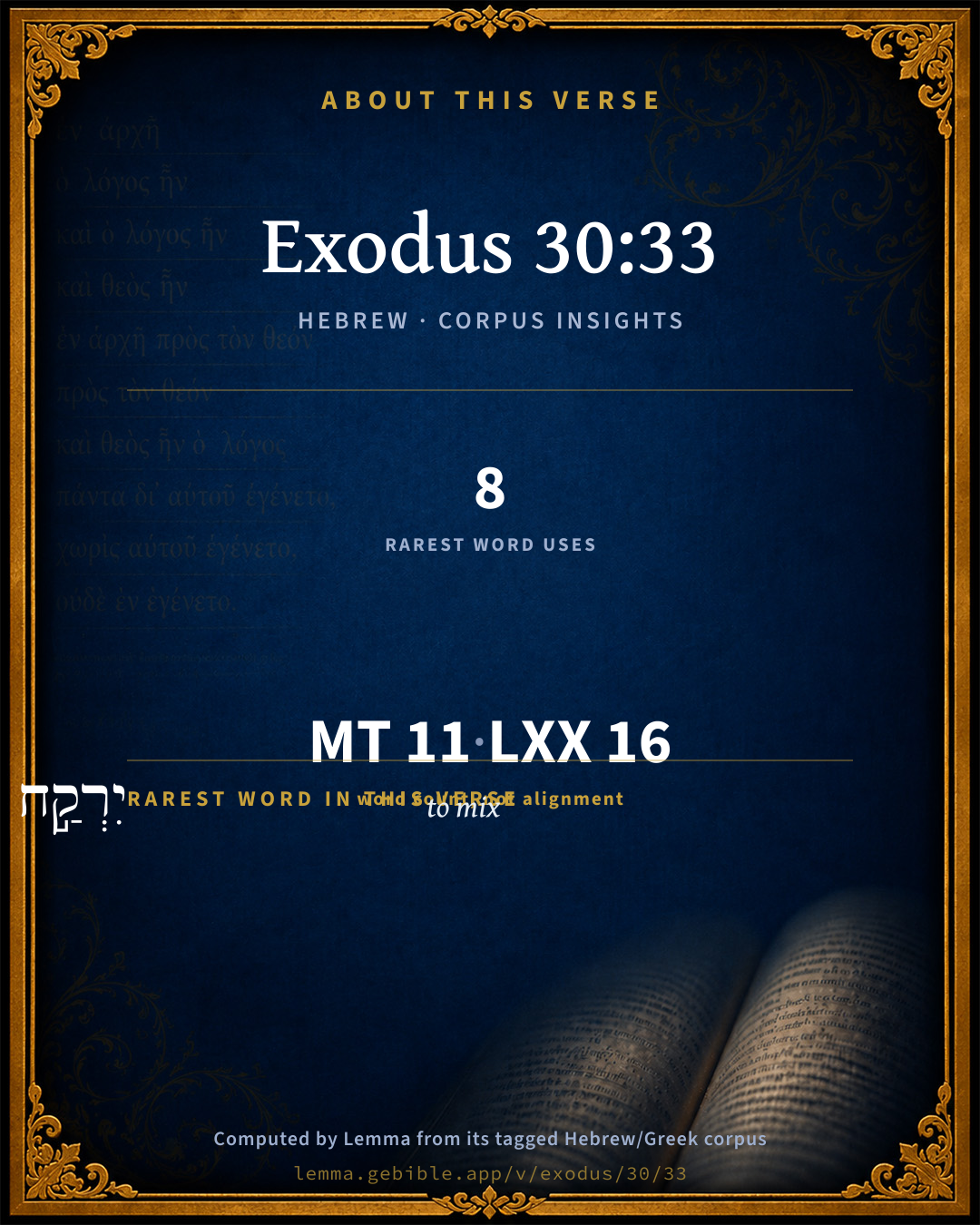
The rarest word here is יִרְקַ֣ח to mix H7543 — appearing just 8 times in the whole Hebrew Bible.

Shared distinctive vocabulary

יִרְקַ֣ח to mix H7543 occurs in 8 verses of the Hebrew Bible. Also found in:

Grammatical profile

  • 3 verbs
  • 2 nouns
  • 1 adjective
  • 3 prepositions
  • 2 particles

Verb forms

  • יִרְקַ֣ח Qal · Imperfect
  • יִתֵּ֛ן Qal · Imperfect
  • וְנִכְרַ֖ת Niphal · Sequential Perfect

Repetition

A word recurs within this verse — often emphatic in Hebrew:

  • אֲשֶׁ֣ר which H834 ×2

Hebrew & Septuagint length

In English translation the verse runs 22 words from the Hebrew and 23 from the Septuagint (LXX English) — closely comparable.

A rough comparison of the two English renderings, which tokenize alike — not a word-level alignment.

Word counts can differ between the Hebrew and the Greek without any difference in meaning — e.g. the Hebrew direct-object marker אֵת has no separate Greek word, and Greek often adds the article ὁ.

In the original languages it is 11 Hebrew tokens and 16 Greek tokens — but the two are counted differently (Hebrew bundles its prefixes and suffixes into one token; the Greek is in lemma form), so that isn’t a like-for-like length.

Cross-references

13

Topical passages linked to Exodus 30:33 in the Treasury of Scripture Knowledge — connected by theme and wording, ordered by reader-vote popularity; previews shown in the World English Bible.

  • Exodus 30:38 Whoever shall make any like that, to smell of it, he shall be cut off from his people."
  • Genesis 17:14 The uncircumcised male who is not circumcised in the flesh of his foreskin, that soul shall be cut off from his people. He has broken my covenant."
  • Exodus 12:15 Seven days shall you eat unleavened bread; even the first day you shall put away yeast out of your houses, for whoever eats leavened bread from the first day until the seventh day, that soul shall be cut off from Israel.
  • Exodus 12:19 Seven days shall there be no yeast found in your houses, for whoever eats that which is leavened, that soul shall be cut off from the congregation of Israel, whether he be a foreigner, or one who is born in the land.
  • Exodus 29:33 They shall eat those things with which atonement was made, to consecrate and sanctify them: but a stranger shall not eat of it, because they are holy.
  • Leviticus 7:20–21 but the soul who eats of the flesh of the sacrifice of peace offerings, that belongs to Yahweh, having his uncleanness on him, that soul shall be cut off from his people.
  • Leviticus 17:4 and hasn't brought it to the door of the Tent of Meeting, to offer it as an offering to Yahweh before the tabernacle of Yahweh: blood shall be imputed to that man. He has shed blood; and that man shall be cut off from among his people.
  • Leviticus 17:9 and doesn't bring it to the door of the Tent of Meeting, to sacrifice it to Yahweh; that man shall be cut off from his people.
  • Leviticus 19:8 but everyone who eats it shall bear his iniquity, because he has profaned the holy thing of Yahweh, and that soul shall be cut off from his people.
  • Leviticus 23:29 For whoever it is who shall not deny himself in that same day; shall be cut off from his people.
  • Numbers 9:13 But the man who is clean, and is not on a journey, and fails to keep the Passover, that soul shall be cut off from his people. Because he didn't offer the offering of Yahweh in its appointed season, that man shall bear his sin.
  • Luke 12:1–2 Meanwhile, when a multitude of many thousands had gathered together, so much so that they trampled on each other, he began to tell his disciples first of all, "Beware of the yeast of the Pharisees, which is hypocrisy.
  • Hebrews 10:26–29 For if we sin willfully after we have received the knowledge of the truth, there remains no more a sacrifice for sins,

Cross-references courtesy of OpenBible.info (CC BY 4.0).

Hebrew and Greek witnesses Masoretic Hebrew ↔ Greek Septuagint

The same verse in the two great witnesses to the Old Testament, shown verse-for-verse.

These are two independent witnesses, not word-aligned to each other, and the Septuagint is shown in lemma (dictionary) form.

Hebrew Exodus 30:33 Masoretic · Westminster Leningrad Codex

אִ֚ישׁ אֲשֶׁ֣ר יִרְקַ֣ח כָּמֹ֔הוּ וַאֲשֶׁ֥ר יִתֵּ֛ן מִמֶּ֖נּוּ עַל זָ֑ר וְנִכְרַ֖ת מֵעַמָּֽיו

Whoever compounds any like it, or whoever puts any of it on a stranger, he shall be cut off from his people.'"

World English Bible · Public Domain

Greek LXX Exodus 30:33 Septuagint · lemma form

ὅς ἄν ποιέω ὡσαύτως καί ὅς ἄν δίδωμι ἀπό αὐτός ἀλλογενής ἐκὀλεθρεύω ἐκ ὁ λαός αὐτός

Whosoever shall make it in like manner, and whoever shall give of it to a stranger, shall be destroyed from among his people.

LXX2012 (modern English Septuagint) · Public Domain

Hebrew: Westminster Leningrad Codex (CC BY 4.0). Greek: Septuagint (public domain); English from LXX2012 (modern English Septuagint) (Public Domain). How the Septuagint differs from the Hebrew →

Targum (Aramaic paraphrase)

2

The Targum is the ancient Jewish Aramaic paraphrase of the Hebrew Scriptures — an interpretive translation, not the Hebrew text itself. Onkelos (literal) and Pseudo-Jonathan (expansive) render the Torah, and Jonathan the Prophets. Coverage is partial: where no permissively-licensed English translation exists for a verse, only the Aramaic is shown. This is verse-level text, not a word-by-word alignment to the Hebrew.

  1. Targum Onkelos Torah (Genesis–Deuteronomy)
    גְבַר דִי יְבַסֵם דִכְוָתֵהּ וְדִי יִתֵּן מִנֵהּ עַל חִלוֹנָי וְיִשְׁתֵּצֵי מֵעַמֵהּ:

    (no public-domain English translation for this verse)

    Targum Onkelos — Aramaic: “Onkelos Genesis” (public domain); “Onkelos Exodus” (public domain); “Onkelos Leviticus” (public domain); “Onkelos Numbers” (public domain); “Onkelos Deuteronomy” (public domain). English: “Sefaria Community Translation” (CC0 1.0 (public-domain dedication)); “J.W. Etheridge. The Targums of Onkelos and Jonathan Ben Uzziel on the Pentateuch. London: Longmans, Green, 1862” (public domain). Text via Sefaria.

  2. Targum Pseudo-Jonathan Torah (Genesis–Deuteronomy)
    גְבַר דִּי יִמְזָג כְּוָותֵיהּ וּדְיִתֵּן מִינָהּ עַל חִילוֹנֵי דְלָא מִבְּנוֹי דְאַהֲרן וְיִשְׁתֵּיצֵי מֵעַמֵּיהּ

    The man who compoundeth the like of it, or putteth it upon the unconsecrated who are not of the sons of Aharon, shall be destroyed from his people.

    Targum Pseudo-Jonathan — Aramaic: “Targum Jonathan on Genesis” (public domain); “Targum Jonathan on Exodus” (public domain); “Targum Jonathan on Leviticus” (public domain); “Targum Jonathan on Numbers” (public domain); “Targum Jonathan on Deuteronomy” (public domain). English: “The Targum of Jonathan ben Uzziel, trans. J. W. Etheridge, London, 1862” (public domain). Text via Sefaria.

Commentary

Notes on Exodus 30:33 from classic Christian and Jewish commentators (each source and its license shown beneath its notes). The classic Christian expositions comment on the surrounding passage and are grouped to its opening verse, so a note may address several verses; the Jewish commentaries on the Tanakh (Rashi and others) are per-verse, so they appear only where the commentator wrote on this verse.

Lemma curates 59 commentaries, every one of them public domain or Creative Commons licensed, each selected and text-cleaned for this edition rather than reprinted as found. About our sources →

Trapp's Complete Commentary

John Trapp

Exo 30:33 Whosoever compoundeth [any] like it, or whosoever putteth [any] of it upon a stranger, shall even be cut off from his people.

Ver. 33. Whosoever compoundeth any like it.] Holy things must not be profaned, on pain of death. No people so abuse Scripture to common and ordinary use as the Jews do.

John Trapp, A Commentary or Exposition upon All the Books of the Old and New Testament (1647–1656) — public domain. Text from a community e-Sword module.

Tyndale Open Study Notes

Tyndale Open Resources

30:33 cut off from the community: Either by death or by expulsion.

Tyndale Open Study Notes — © Tyndale Open Resources, licensed CC BY-SA 4.0. Text via the HelloAO Bible API.

Geneva Bible (1599)

Geneva Bible translators

Either a stranger or an Israelite, save only the Priests.

Geneva Bible (1599) marginal notes — public domain. Text via Bolls.life.

The Cambridge Bible for Schools and Colleges

gen. ed. J. J. S. Perowne

33. a stranger] i.e. one not authorized to be anointed with it = one not of the seed of Aaron: cf. on Exo_29:33.

shall be cut off, &c.] a formula signifying emphatically the Divine disapproval: see on Exo_12:15.

from his father’s kin] The word, though it is externally the same as the ordinary Heb. word for ‘a people,’ is plural: as it is impossible to speak of a man’s ‘peoples,’ the word, when it is so used, must have some different meaning; and this is shewn by Arabic (where ‘am means both patruus and patruelis) to be father’s kin (cf. EB. iii. 3289). The word, in this sense, is almost entirely confined to P: with to be cut off from it occurs in it 12 times, and with to be gathered to (Gen_25:8 al.) 9 times.

The Cambridge Bible for Schools and Colleges (gen. ed. J. J. S. Perowne; Cambridge University Press, 1878–1918) — public domain. Text from a community e-Sword module.

John Gill's Exposition

Whosoever compoundeth any like it,.... For his own use, or for any other than what God appointed it for: or

whosoever putteth any of it upon a stranger; meaning not a Gentile, an alien from the commonwealth of israel; though Japhet interprets it of such a stranger who was not of the children of Israel; this Aben Ezra says is not right, but he says it means one that is not of the seed of Aaron; and so the Targum of Jonathan,"upon a profane person (or a common person, a laic) that is not of the sons of Aaron:''though the kings of Israel seem to be an exception to this, which might be by a special order from the Lord; yet it is a question whether it was with this, or with common oil, that they were anointed: indeed, the oil with which Solomon was anointed was taken out of the tabernacle, Kg1 1:39.

shall even be cut off from his people; either by death, by the immediate hand of God inflicting some disease upon him, or by excommunication from the congregation of Israel, or by not favouring him with any posterity, to keep up his name in the nation.

John Gill's Exposition of the Whole Bible (1746–1763) — public domain (CC PDM 1.0). Text via the HelloAO Bible API.

Haydock's Catholic Bible Commentary

Cut off. Excommunicated, and deprived of all the privileges of the Israelites; (Calmet) or even put to death for his presumption. (Menochius)

George Leo Haydock (1774–1849), Haydock's Catholic Family Bible and Commentary, 1859 edition — public domain. Excludes Psalms (Douay-Rheims chapter numbering differs from Protestant) and Deuterocanonical books (Catholic canon only).

Matthew Poole's English Annotations

The word stranger is commonly used to note the Gentiles, or such as were not of Israel’s race; but sometimes it notes those that are not of the priestly race, as Exo 29:33; Lev 22:12,13; and so it seems to be here. And if any of the kings were anointed with this oil, it was done by God’s special appointment, who may dispense with his own laws.

Matthew Poole's English Annotations on the Holy Bible (1683–1685) — public domain. Text from a community e-Sword/MySword module.

The Pulpit Commentary

Upon a stranger. A "stranger" here means any one not of the family of Aaron. Compare Exo_29:33.

The Pulpit Commentary (1880–1919), ed. H.D.M. Spence-Jones & Joseph S. Exell — public domain. Text from a community e-Sword module.

Rashi

Rabbi Shlomo Yitzchaki (Rashi)

ואשר יתן ממנו WHOSOEVER PUTTETH ANY OF IT — of that made by Moses (Keritot 5a)

על זר UPON A STRANGER — when it is not required for installing a person into the high-priesthood or kingdom (Keritot 5b).

Rashi on the Tanakh — English translations: “The Judaica Press complete Tanach with Rashi, translated by A. J. Rosenberg” (CC BY 4.0); “Pentateuch with Rashi's commentary by M. Rosenbaum and A.M. Silbermann, 1929-1934” (public domain); “The Metsudah Tanach series, Lakewood, N.J” (CC BY 4.0); and “The Book of Joshua, Metsudah Publications, 1997” (CC BY 4.0). Text via Sefaria.

Ramban (Nachmanides)

Rabbi Moshe ben Nachman (Ramban / Nachmanides)

OR WHOSOEVER PUTTETH ANY OF IT UPON A ZAR'… — “When it is not required [for anointing a person] into the [high-] priesthood or kingship.” This is Rashi’s language. But Rabbi Abraham ibn Ezra retorted that zar in this connection means anyone who is not of the seed of Aaron and his sons mentioned, it follows that the expression, or whosoever putteth any of it upon a ‘zar’ means that anyone who is not of the seed of Aaron is a zar (a stranger). So why did Rashi say that the oil may also be used for the anointing of a king? just like the verse, and the ‘zar’ that draweth nigh shall be put to death, — by the hand of Heaven” (Rashi). which means any stranger not included in those mentioned. Similarly: There shall no ‘zar’ eat of the holy thing, [which means anyone not of the seed of Aaron]; to the end that no ‘zar’ that is not of the seed of Aaron, draw near… It is for this reason that [Ibn Ezra] thought that the anointing of Solomon which was done by Zadok [the priest] taking the horn of oil out of the Tent, — which refers to the Oil of Anointment [which Moses prepared] — was a special, temporary decree by authority of prophecy [permitting the oil to be used upon one who was not of the seed of Aaron]. But this is not the opinion of our Rabbis. And I say that [the opinion of our Rabbis is borne out by the language of the verse]. For Scripture states, This shall be a holy anointing oil unto Me throughout your generations, and it would have been correct if it were to say instead, “This shall be a holy anointing oil for Aaron and his sons throughout their generations,” just as He said in the case of the garments, And the holy garments of Aaron shall be for his sons after him; or that He say, “And thou shalt anoint Aaron and his sons, and sanctify them, that they may minister unto Me, and it shall be a statute forever to them throughout their generations.” But now that He mentioned only them, [And Aaron and his sons thou shalt anoint] and then continued by saying that it should not be put upon any zar, it could mean that [the prohibition extends] to all people [even High Priests after Aaron] except those mentioned specifically [i.e., Aaron and his sons]! Similarly He said, Upon the flesh of man shall it not be poured, [which might be taken to mean upon anyone’s flesh — even that of the High Priests after Aaron], and yet Scripture explicitly states, And the anointed priest that shall be in his [Aaron’s] stead, from among his sons! But such is the explanation: He commanded that at the moment Aaron and his sons should be anointed with this oil, and then He continued, This shall be a holy anointing oil unto Me, — to anoint with it My holy anointed ones whom I will choose — throughout your generations, and it shall not be put upon a zar (stranger) whom I have not designated unto Me. It is for this reason that kings and High Priests were anointed with this oil, for both of them are “the anointed ones of G-d.” Thus it is written, I have found David My servant; with My holy oil have I anointed him — meaning, with the oil which is the holy anointing oil unto Me. And the meaning of the verse, Upon the flesh of man shall it not be poured, is as an admonition to all men [even to Aaron and his sons after they have been anointed with it], since He did not say, “upon the flesh of a zar shall it not be poured.” Thus the purport thereof is that he [Moses] is to pour of the oil upon Aaron’s head in order to anoint him, and then he is to anoint also his sons, but he is not to pour this oil upon any man, even upon the anointed priests, merely as people apply good oils to their bodies in order to scent themselves with hands soaked in oil, after bathing, something like it is said, Wash thyself and anoint thee; Then I washed thee with water… and I anointed thee with oil. This is the plain meaning of the verse and its intention. And so did our Rabbis say: “How do we know that if the High Priest took some of the oil of anointment which was upon his head and put it upon his stomach, that he is liable [to punishment]? Scripture therefore says, Upon the flesh of man shall it not be poured.”

Ramban (Nachmanides) on the Tanakh — English translation: “Commentary on the Torah by Ramban (Nachmanides). Translated and annotated by Charles B. Chavel. New York, Shilo Pub. House, 1971-1976” (CC BY 4.0). Text via Sefaria.

Ibn Ezra

Rabbi Abraham ibn Ezra

Upon an unauthorized person. That is, anyone not descended from Aharon. Rav Sadyah Gaon cites oral tradition according to which kings of the House of David could also be anointed with it, but not others. This explains how Tzadok, the kohein gadol, was able to anoint King Shelomo with oil taken from the Tent of Meeting as described in Melachim I:1:39.

Ibn Ezra on the Tanakh — English translations: “Sefaria Community Translation” (CC0 1.0 (public-domain dedication)); “Yalkut, Sifsei Chachomim Chumash, Metsudah Publications, 2009” (CC BY 4.0); and “Commentary of Ibn Ezra on Isaiah - trans. by M. Friedlander, 1873” (public domain). Text via Sefaria.

Lesson kit

Teaching starters — assembled from the data on this page, not authored interpretation. Every prompt links to the verse data it draws on. Edit before teaching.

Exodus, in the Pentateuch, opens this verse with 11 words (10 distinct Hebrew lemmas). Its most distinctive word is râqach (“to mix”). A historical commentator’s framing appears above. Read the whole chapter for the surrounding context.

Discussion questions

  1. How does “to mix” (râqach) shape what this verse is saying?
  2. How does Exodus 30:25, which shares the word «to mix», read alongside this verse?
  3. What does the repetition of “which” (2× in this one verse) do in this verse?
  4. The translations on this page render this verse differently — a whole-verse word diff, not a word-by-word alignment. What might account for the different wordings?
  5. «יִרְקַ֣ח» is a Qal Imperfect verb. How does that grammatical form shape the action described?
  6. Compare how Trapp's Complete Commentary and Tyndale Open Study Notes read this verse. Where do they agree or differ?

Things to notice

Reading settings

Reading text

Shown beneath each verse's original-language words.

Old Testament
Old Testament edition

Read the OT as the Masoretic Hebrew (MT) or the Greek Septuagint (LXX).

English shown for the Greek Septuagint (in the Hebrew ↔ Greek comparison).

Comparing translations? Open the Compare panel on any verse page to stack up to four side by side.