
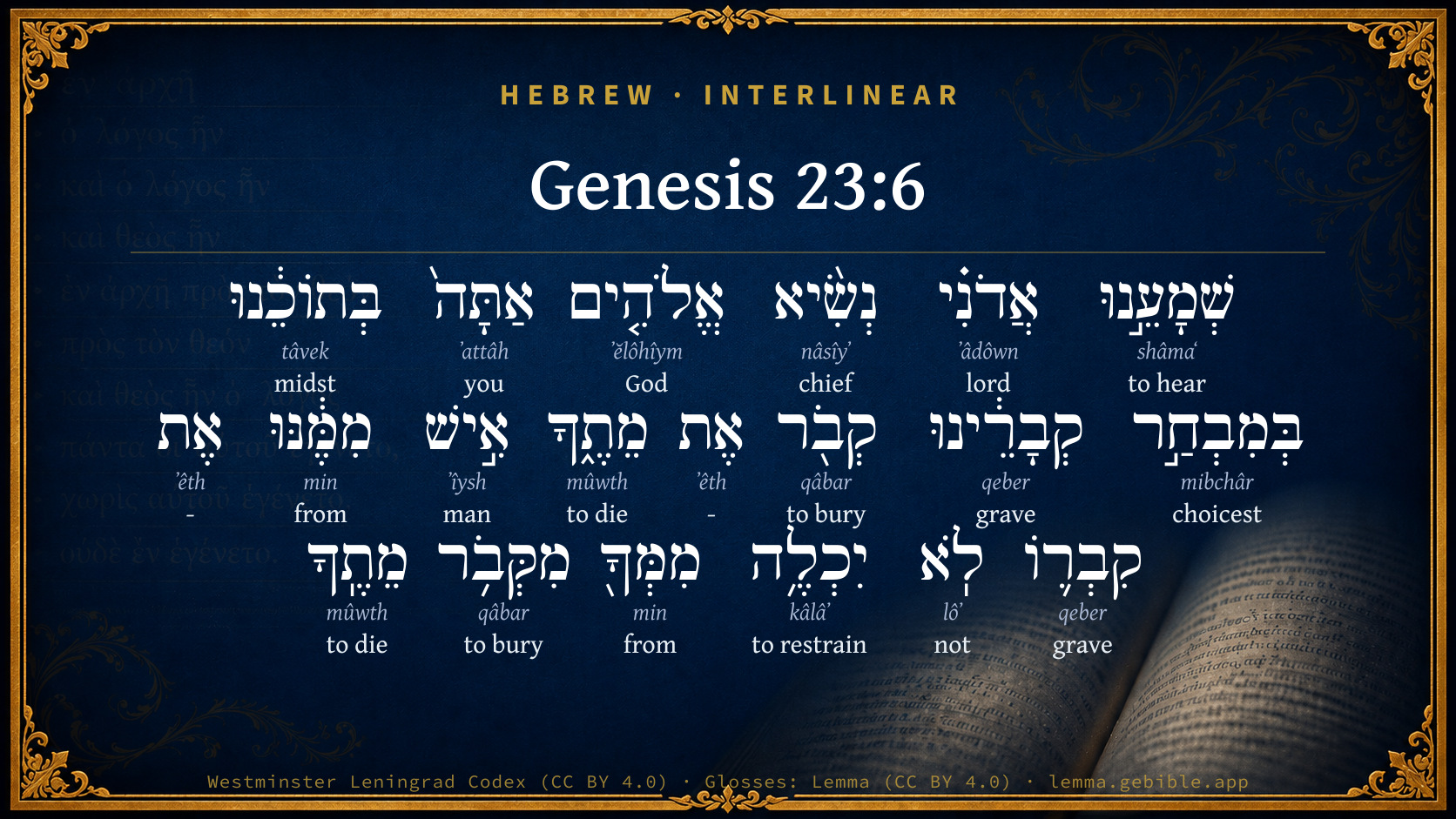
Genesis 23:6

Hebrew (Westminster Leningrad Codex) Genesis 23:6 appears in the Hebrew Old Testament. The text above is from the Westminster Leningrad Codex. Each word links to its Strong’s number, a concise gloss, and parsing drawn from the Open Scriptures Hebrew Bible morphology. Click any word for its full Brown-Driver-Briggs (BDB) entry.
Download image
Cite this verse

Genesis 23:6 (World English Bible). Public Domain. Lemma interlinear Bible study tool, https://lemma.gebible.app/v/genesis/23/6.

Show BibTeX & RIS
BibTeX
RIS
English Translation
"Hear us, my lord. You are a prince of God among us. In the choice of our tombs bury your dead. None of us will withhold from you his tomb, but that you may bury your dead."
World English Bible · Public Domain
Highlights
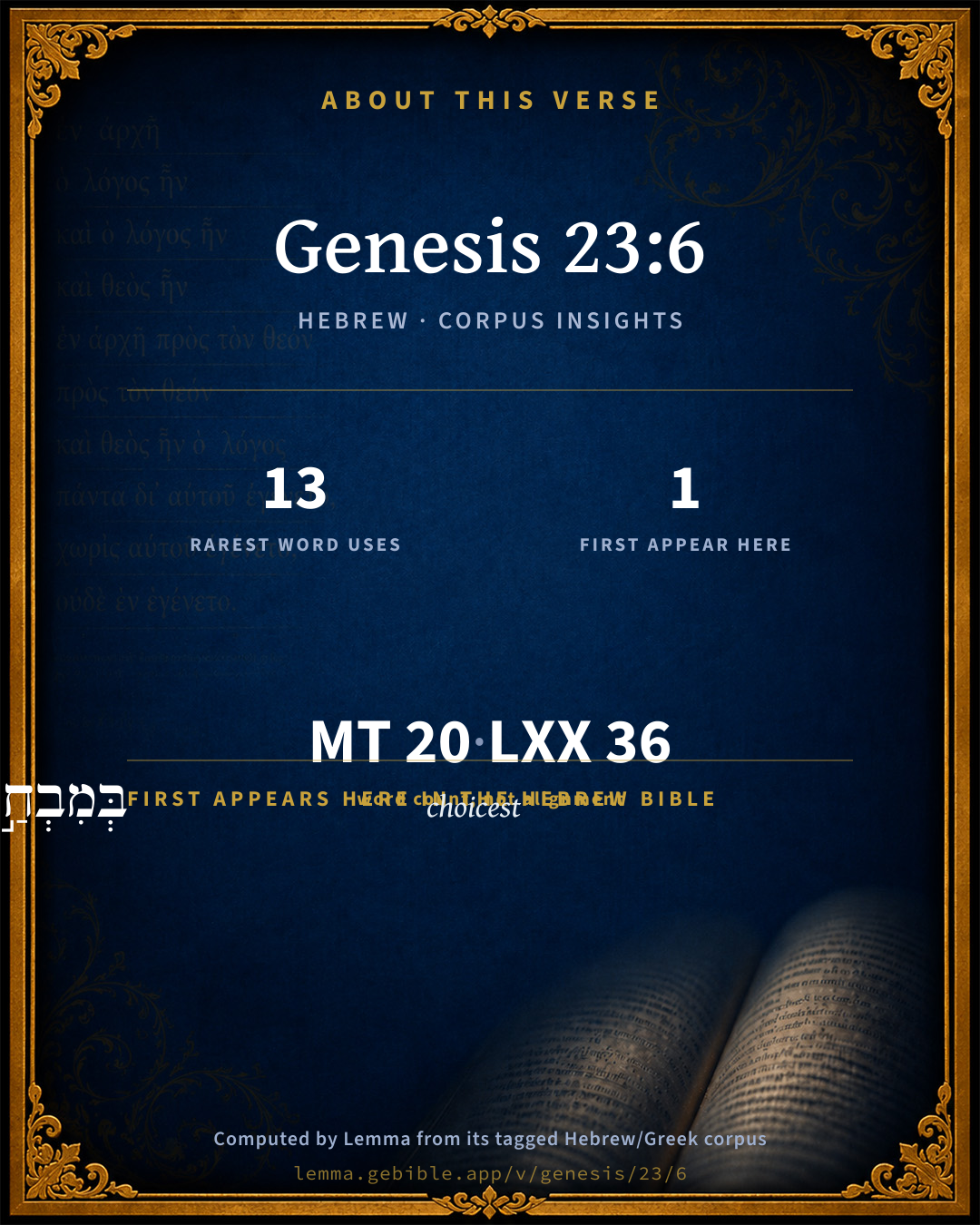
  • 1 first appearance in the Hebrew Bible
Full analysis ↓
Download a study sheet

One document with this verse’s original text, its word-by-word gloss line, the meaning frame, cross-references with their text, attributed commentary, and full source and license credits — printable, and it pastes into notes with its structure intact.

This verse Autodidact and up

Study sheet (.html) Plain text (.txt)

A passage Seminary Student

Up to 50 verses in one chapter. A passage sheet keeps up to 6 commentary sources and 12 cross-references per verse, in the order this page ranks them, and says so on the sheet whenever that leaves anything out. Ask for a single verse and you get the Autodidact verse sheet above.

Everything on this page stays free to read, with no account — the sheet is a download of what is already on screen, not access to it.

Want to remove ads? Support Godless Engineer
Compare translations 3

The same verse in 3 English versions, stacked beneath the original-language interlinear above. Click any original word for its lexicon entry.

Each is an independent rendering of the whole verse — the interlinear is not word-aligned to these translations.

Highlighted words mark where these versions differ — a whole-verse word diff, not a word-by-word alignment.

  • World English Bible Public Domain
    "Hear us, my lord. You are a prince of God among us. In the choice of our tombs bury your dead. None of us will withhold from you his tomb, but that you may bury your dead."
  • King James Version Public Domain
    Hear us, my lord: thou art a mighty prince among us: in the choice of our sepulchres bury thy dead; none of us shall withhold from thee his sepulchre, but that thou mayest bury thy dead.
  • unfoldingWord Literal Text CC BY-SA 4.0
    “Listen to us, my lord. You a mighty prince among us. Bury your dead in the choicest of our burial places. Each of us will not withhold from you his burial place to bury your dead.”

unfoldingWord Literal Text — © unfoldingWord, licensed CC BY-SA 4.0. Word-aligned USFM3 via Door43 (git.door43.org/unfoldingWord/en_ult).

Versions to compare (up to 4)

3 of 4 selected

Show all 18 translations

Every available English version of this verse, each an independent rendering of the whole verse.

  • World English Bible Public Domain
    "Hear us, my lord. You are a prince of God among us. In the choice of our tombs bury your dead. None of us will withhold from you his tomb, but that you may bury your dead."
  • Berean Standard Bible Public Domain
    “Listen to us, sir. You are God’s chosen one among us. Bury your dead in the finest of our tombs. None of us will withhold his tomb for burying your dead.”
  • Majority Standard Bible Public Domain
    “Listen to us, sir. You are God’s chosen one among us. Bury your dead in the finest of our tombs. None of us will withhold his tomb for burying your dead.”
  • King James Version Public Domain
    Hear us, my lord: thou art a mighty prince among us: in the choice of our sepulchres bury thy dead; none of us shall withhold from thee his sepulchre, but that thou mayest bury thy dead.
  • American Standard Version (1901) Public Domain
    Hear us, my lord. Thou art a prince of God among us. In the choice of our sepulchres bury thy dead. None of us shall withhold from thee his sepulchre, but that thou mayest bury thy dead.
  • Revised Version (1885) Public Domain
    Hear us, my lord: thou art a mighty prince among us: in the choice of our sepulchres bury thy dead; none of us shall withhold from thee his sepulchre, but that thou mayest bury thy dead.
  • Geneva Bible (1599) Public Domain
    Heare vs, my lorde: thou art a prince of God among vs: in the chiefest of our sepulchres bury thy dead: none of vs shall forbid thee his sepulchre, but thou mayest bury thy dead therein.
  • Douay-Rheims (1899) Public Domain
    My Lord, hear us, thou art a prince of God among us: bury thy dead in our principle sepulchers: and no man shall have power to hinder thee from burying thy dead in his sepulcher.
  • Young's Literal Translation Public Domain
    `Hear us, my lord; a prince of God `art' thou in our midst; in the choice of our burying-places bury thy dead: none of us his burying-place doth withhold from thee, from burying thy dead.'
  • Literal Standard Version CC BY-SA 4.0
    “Hear us, my lord; a prince of God [are] you in our midst; in the choice of our burying-places bury your dead: none of our burying-places do we withhold from you, from burying your dead.”
  • Unlocked Literal Bible CC BY-SA 4.0
    “Listen to us, my master. You are a prince of God among us. Bury your dead in the choicest of our tombs. None of us will refuse you his tomb, so that you may bury your dead.”
  • unfoldingWord Literal Text CC BY-SA 4.0
    “Listen to us, my lord. You a mighty prince among us. Bury your dead in the choicest of our burial places. Each of us will not withhold from you his burial place to bury your dead.”
  • Darby Bible Public Domain
    Hear us, my lord: thou art a prince of God among us: in the choicest of our sepulchres bury thy dead: none of us shall withhold from thee his sepulchre for burying thy dead.
  • World Messianic Bible Public Domain
    “Hear us, my lord. You are a prince of God among us. Bury your dead in the best of our tombs. None of us will withhold from you his tomb. Bury your dead.”
  • Webster's Bible Public Domain
    Hear us, my lord; thou art a mighty prince among us: in the choice of our sepulchers bury thy dead: none of us will withhold from thee his sepulcher, but that thou mayest bury thy dead.
  • Free Bible Version CC BY-SA 4.0
    “Listen, my lord, you are a highly-respected prince among us. Choose the very best of our burial sites to bury your dead. None of us will say no to you.”
  • Bible in Basic English Public Domain
    My lord, truly you are a great chief among us; take the best of our resting-places for your dead; not one of us will keep back from you a place where you may put your dead to rest.
  • JPS Tanakh (1917) Public Domain
    'Hear us, my lord: thou art a mighty prince among us; in the choice of our sepulchres bury thy dead; none of us shall withhold from thee his sepulchre, but that thou mayest bury thy dead.'

Literal Standard Version (2020), Covenant Press — licensed CC BY-SA 4.0. Text via the HelloAO Bible API (eBible.org). Unlocked Literal Bible (unfoldingWord) — licensed CC BY-SA 4.0. Text via the HelloAO Bible API (eBible.org). unfoldingWord Literal Text — © unfoldingWord, licensed CC BY-SA 4.0. Word-aligned USFM3 via Door43 (git.door43.org/unfoldingWord/en_ult). Free Bible Version, Dr. Jonathan Gallagher — licensed CC BY-SA 4.0. Text via the HelloAO Bible API (eBible.org).

Word by word

More ways to search: Search by grammar → Find every occurrence → Compare this word →

Practice this passage: Drill this verse → Learn its vocabulary →

בְּמִבְחַ֣ר
mibchâr
H4005
“in/at · choicest of”
Preposition + Noun, Common, Masculine, Singular, Construct
Part of Speech
Preposition + Noun
Type
Common
Gender
Masculine
Number
Singular
State
Construct
Full BDB Definition

Origin: from H977

TWOT: 231d

choicest, best
  1. שְׁמָעֵ֣נוּ shâmaʻ H8085 “hear · us” Verb, Qal, Imperative, 2nd Person, Masculine, Singular + Suffix, Personal, 1st Person, Common, Plural
  2. אֲדֹנִ֗י ʼâdôwn H113 “lord · my” Noun, Common, Masculine, Singular, Construct + Suffix, Personal, 1st Person, Common, Singular
  3. נְשִׂ֨יא nâsîyʼ H5387 “chief of” Noun, Common, Masculine, Singular, Construct
  4. אֱלֹהִ֤ים ʼĕlôhîym H430 “God(s)” Noun, Common, Masculine, Plural, Absolute
  5. אַתָּה֙ ʼattâh H859 “you” Pronoun, Personal, 2nd Person, Masculine, Singular
  6. בְּתוֹכֵ֔נוּ tâvek H8432 “in/at · midst · our” Preposition + Noun, Common, Masculine, Singular, Construct + Suffix, Personal, 1st Person, Common, Plural
  7. קְבָרֵ֔ינוּ qeber H6913 “graves · our” Noun, Common, Masculine, Plural, Construct + Suffix, Personal, 1st Person, Common, Plural
  8. קְבֹ֖ר qâbar H6912 “bury” Verb, Qal, Imperative, 2nd Person, Masculine, Singular
  9. אֶת ʼêth H853 “-” Particle, Direct Object
  10. מֵתֶ֑ךָ mûwth H4191 “dying · you” Verb, Qal, Participle Active, Masculine, Singular, Construct + Suffix, Personal, 2nd Person, Masculine, Singular
  11. אִ֣ישׁ ʼîysh H376 “man” Noun, Common, Masculine, Singular, Absolute
  12. מִמֶּ֔נּוּ min H4480 “from · us” Preposition + Suffix, Personal, 1st Person, Common, Plural
  13. אֶת ʼêth H853 “-” Particle, Direct Object
  14. קִבְר֛וֹ qeber H6913 “grave · his” Noun, Common, Masculine, Singular, Construct + Suffix, Personal, 3rd Person, Masculine, Singular
  15. לֹֽא lôʼ H3808 “not” Particle, Negative
  16. יִכְלֶ֥ה kâlâʼ H3607 “to restrain” Verb, Qal, Imperfect, 3rd Person, Masculine, Singular
  17. מִמְּךָ֖ min H4480 “from · you” Preposition + Suffix, Personal, 2nd Person, Masculine, Singular
  18. מִקְּבֹ֥ר qâbar H6912 “from · to bury” Preposition + Verb, Qal, Infinitive Construct
  19. מֵתֶֽךָ mûwth H4191 “dying · you” Verb, Qal, Participle Active, Masculine, Singular, Construct + Suffix, Personal, 2nd Person, Masculine, Singular

About this verse

These counts appear in no published source. They are computed here, from the morphology-tagged text and Lemma’s own curated glosses. What Lemma adds →

20
words
15
distinct lemmas
Pentateuch
section

Notable vocabulary

The rarest word here is בְּמִבְחַ֣ר choicest H4005 — appearing just 13 times in the whole Hebrew Bible.

First appearance in Scripture

This word makes its first canonical appearance in the Hebrew Bible here:

  • בְּמִבְחַ֣ר choicest H4005

Shared distinctive vocabulary

בְּמִבְחַ֣ר choicest H4005 occurs in 13 verses of the Hebrew Bible. Also found in:

Grammatical profile

  • 6 verbs
  • 8 nouns
  • 1 pronoun
  • 2 prepositions
  • 3 particles

Verb forms

  • שְׁמָעֵ֣נוּ Qal · Imperative
  • קְבֹ֖ר Qal · Imperative
  • מֵתֶ֑ךָ Qal · Participle Active
  • יִכְלֶ֥ה Qal · Imperfect
  • מִקְּבֹ֥ר Qal · Infinitive Construct
  • מֵתֶֽךָ Qal · Participle Active

Repetition

Words recur within this verse — often emphatic in Hebrew:

  • קְבָרֵ֔ינוּ grave H6913 ×2
  • קְבֹ֖ר to bury H6912 ×2
  • מֵתֶ֑ךָ to die H4191 ×2
  • מִמֶּ֔נּוּ from H4480 ×2

Hebrew & Septuagint length

In English translation the verse runs 37 words from the Hebrew and 44 from the Septuagint (LXX English) — closely comparable.

A rough comparison of the two English renderings, which tokenize alike — not a word-level alignment.

Word counts can differ between the Hebrew and the Greek without any difference in meaning — e.g. the Hebrew direct-object marker אֵת has no separate Greek word, and Greek often adds the article ὁ.

In the original languages it is 20 Hebrew tokens and 36 Greek tokens — but the two are counted differently (Hebrew bundles its prefixes and suffixes into one token; the Greek is in lemma form), so that isn’t a like-for-like length.

Cross-references

16

Topical passages linked to Genesis 23:6 in the Treasury of Scripture Knowledge — connected by theme and wording, ordered by reader-vote popularity; previews shown in the World English Bible.

  • Genesis 24:35 Yahweh has blessed my master greatly. He has become great. He has given him flocks and herds, silver and gold, men-servants and maid-servants, and camels and donkeys.
  • Genesis 14:14 When Abram heard that his relative was taken captive, he led forth his trained men, born in his house, three hundred and eighteen, and pursued as far as Dan.
  • Genesis 13:2 Abram was very rich in cattle, in silver, and in gold.
  • Genesis 18:12 Sarah laughed within herself, saying, "After I have grown old will I have pleasure, my lord being old also?"
  • Genesis 21:22 It happened at that time, that Abimelech and Phicol the captain of his host spoke to Abraham, saying, "God is with you in all that you do.
  • Genesis 24:18 She said, "Drink, my lord." She hurried, and let down her pitcher on her hand, and gave him drink.
  • Genesis 31:35 She said to her father, "Don't let my lord be angry that I can't rise up before you; for the manner of women is on me." He searched, but didn't find the teraphim.
  • Genesis 32:4–5 He commanded them, saying, "This is what you shall tell my lord, Esau: 'This is what your servant, Jacob, says. I have lived as a foreigner with Laban, and stayed until now.
  • Genesis 32:18 Then you shall say, 'They are your servant, Jacob's. It is a present sent to my lord, Esau. Behold, he also is behind us.'"
  • Genesis 42:10 They said to him, "No, my lord, but your servants have come to buy food.
  • Genesis 44:5 Isn't this that from which my lord drinks, and by which he indeed divines? You have done evil in so doing.'"
  • Genesis 44:8 Behold, the money, which we found in our sacks' mouths, we brought again to you out of the land of Canaan. How then should we steal silver or gold out of your lord's house?
  • Exodus 32:22 Aaron said, "Don't let the anger of my lord grow hot. You know the people, that they are set on evil.
  • Isaiah 45:14 Thus says Yahweh: "The labor of Egypt, and the merchandise of Ethiopia, and the Sabeans, men of stature, shall come over to you, and they shall be yours. They shall go after you. In chains they shall come over; and they shall fall down to you. They shall make supplication to you: 'Surely God is in you; and there is none else, there is no other god.
  • 1 John 3:1–2 Behold, how great a love the Father has bestowed on us, that we should be called children of God! For this cause the world doesn't know us, because it didn't know him.
  • Ruth 2:13 Then she said, Let me find favor in your sight, my lord, because you have comforted me, and because you have spoken kindly to your handmaid, though I am not as one of your handmaidens.

Cross-references courtesy of OpenBible.info (CC BY 4.0).

Hebrew and Greek witnesses Masoretic Hebrew ↔ Greek Septuagint

The same verse in the two great witnesses to the Old Testament, shown verse-for-verse.

These are two independent witnesses, not word-aligned to each other, and the Septuagint is shown in lemma (dictionary) form.

Hebrew Genesis 23:6 Masoretic · Westminster Leningrad Codex

שְׁמָעֵ֣נוּ אֲדֹנִ֗י נְשִׂ֨יא אֱלֹהִ֤ים אַתָּה֙ בְּתוֹכֵ֔נוּ בְּמִבְחַ֣ר קְבָרֵ֔ינוּ קְבֹ֖ר אֶת מֵתֶ֑ךָ אִ֣ישׁ מִמֶּ֔נּוּ אֶת קִבְר֛וֹ לֹֽא יִכְלֶ֥ה מִמְּךָ֖ מִקְּבֹ֥ר מֵתֶֽךָ

"Hear us, my lord. You are a prince of God among us. In the choice of our tombs bury your dead. None of us will withhold from you his tomb, but that you may bury your dead."

World English Bible · Public Domain

Greek LXX Genesis 23:6 Septuagint · lemma form

μή κύριος ἀκούω δέ ἐγώ βασιλεύς παρά θεός εἰμί σύ ἐν ἐγώ ἐν ὁ ἐκλεκτός μνημεῖον ἐγώ θάπτω ὁ νεκρός σύ οὐδείς γάρ ἐγώ ὁ μνημεῖον αὐτός κωλύω ἀπό σύ ὁ θάπτω ὁ νεκρός σύ ἐκεῖ

but hear us; you are in the midst of us a king from God; bury your dead in our choice sepulchres, for not one of us will by any means withhold his sepulchre from you, so that you should not bury your dead there.

LXX2012 (modern English Septuagint) · Public Domain

On this verse, The Cambridge Bible for Schools and Colleges discusses the Septuagint’s reading. Read the note in Commentary ↓

Hebrew: Westminster Leningrad Codex (CC BY 4.0). Greek: Septuagint (public domain); English from LXX2012 (modern English Septuagint) (Public Domain). How the Septuagint differs from the Hebrew →

Targum (Aramaic paraphrase)

2

The Targum is the ancient Jewish Aramaic paraphrase of the Hebrew Scriptures — an interpretive translation, not the Hebrew text itself. Onkelos (literal) and Pseudo-Jonathan (expansive) render the Torah, and Jonathan the Prophets. Coverage is partial: where no permissively-licensed English translation exists for a verse, only the Aramaic is shown. This is verse-level text, not a word-by-word alignment to the Hebrew.

  1. Targum Onkelos Torah (Genesis–Deuteronomy)
    קַבֵּל מִנָּנָא רִבּוֹנָנָא רַב קֳדָם יְיָ אַתְּ בֵּינָנָא בִּשְׁפַר קִבְרָנָא קְבַר יָת מִיתָךְ אֱנַשׁ מִנָּנָא יָת קִבְרֵהּ לָא יִמְנַע מִנָּךְ מִלְמִקְבַּר מִיתָךְ

    (no public-domain English translation for this verse)

    Targum Onkelos — Aramaic: “Onkelos Genesis” (public domain); “Onkelos Exodus” (public domain); “Onkelos Leviticus” (public domain); “Onkelos Numbers” (public domain); “Onkelos Deuteronomy” (public domain). English: “Sefaria Community Translation” (CC0 1.0 (public-domain dedication)); “J.W. Etheridge. The Targums of Onkelos and Jonathan Ben Uzziel on the Pentateuch. London: Longmans, Green, 1862” (public domain). Text via Sefaria.

  2. Targum Pseudo-Jonathan Torah (Genesis–Deuteronomy)
    קַבֵּל מִנָנָא רוֹבָּנָנָא רַב קֳדָם יְיָ אַתְּ בֵּינָנָא בִּשְׁפַר קִיבְרָנָא קְבַר יַת מִיתָךְ אִינַשׁ מִינָנָא יַת קְבוּרְתֵּיהּ לָא יִמְנַע מִינָךְ בְּגִין דְלָא לְמִיקְבַּר מִיתָךְ

    Attend to us, our lord. Great before the Lord art thou among us, in the best of our sepulchres bury thy dead: there is not a man of us who will refuse thee his sepulchre, that thou mayest bury thy dead.

    Targum Pseudo-Jonathan — Aramaic: “Targum Jonathan on Genesis” (public domain); “Targum Jonathan on Exodus” (public domain); “Targum Jonathan on Leviticus” (public domain); “Targum Jonathan on Numbers” (public domain); “Targum Jonathan on Deuteronomy” (public domain). English: “The Targum of Jonathan ben Uzziel, trans. J. W. Etheridge, London, 1862” (public domain). Text via Sefaria.

Commentary

Notes on Genesis 23:6 from classic Christian and Jewish commentators (each source and its license shown beneath its notes). The classic Christian expositions comment on the surrounding passage and are grouped to its opening verse, so a note may address several verses; the Jewish commentaries on the Tanakh (Rashi and others) are per-verse, so they appear only where the commentator wrote on this verse.

Lemma curates 59 commentaries, every one of them public domain or Creative Commons licensed, each selected and text-cleaned for this edition rather than reprinted as found. About our sources →

Trapp's Complete Commentary

John Trapp

Gen 23:6 Hear us, my lord: thou [art] a mighty prince among us: in the choice of our sepulchres bury thy dead; none of us shall withhold from thee his sepulchre, but that thou mayest bury thy dead.

Ver. 6. Thou art a prince of God amongst us.] That is, excellent or prosperous, as Gen 21:22; and it was their ingenuity and candour to acknowledge it. God’s people are "princes in all lands" {Psa 45:16} Kings they are in righteousness and peace; but somewhat obscure ones, as was Melehizedek, and therefore little set by. {1Jn 3:1-2} Unkent, unkist, as the northern proverb is. So was Christ the heir of all. But "we know that when he shall appear, we shall be like him"; that is enough for us. In the meantime, "the righteous is more excellent than his neighbour" (let him dwell by whomsoever), and shall be more prosperous, if it may be for his good.

John Trapp, A Commentary or Exposition upon All the Books of the Old and New Testament (1647–1656) — public domain. Text from a community e-Sword module.

Joseph Benson's Commentary

Gen 23:6. Thou art a prince of God — So it is in the original, not only great, but good. He called himself a stranger and a sojourner, they call him a great prince; and well they might, considering his wealth, prosperity, and retinue, and the simple manners of those times.

Joseph Benson's Commentary on the Old and New Testaments (1811–1818) — public domain. Text from a community e-Sword module.

Geneva Bible (1599)

Geneva Bible translators

That is, godly or excellent: for the Hebrews so speak of all things that are notable, because all excellency cometh of God.

Geneva Bible (1599) marginal notes — public domain. Text via Bolls.life.

Adam Clarke's Commentary

Verse 6. Thou art a mighty prince] נשיא אלהים nesi Elohim, a prince of God - a person whom we know to be Divinely favoured, and whom, in consequence, we deeply respect and reverence.

Adam Clarke's Commentary on the Bible (1810–1826) — public domain. Text from a community e-Sword/MySword module.

John Calvin's Commentaries

6. Thou art a mighty prince among us The Hittites gratuitously offer a burying-place to Abraham wherever he might please to choose one. They testify that they do this, as a tribute to his virtues. We have before seen, that the Hebrews give a divine title to anything which excels. Therefore we are to understand by the expression, ‘a prince of God,’ a person of great and singular excellency. And they properly signalize him whom they reverence for his virtues, with this eulogium; thereby testifying, that they ascribe to God alone, whatever virtues in men are deserving of praise and reverence. Now some seed of piety manifests itself in the Hittites, by thus doing honor to Abraham, whom they acknowledge to be adorned with rare gifts of the Spirit of God. For profane and brutal men tread under foot, with barbarous contempt, every excellent gift of God, as swine do pearls. And yet we know with how many vices those nations were defiled; how much greater then, and more disgraceful is our ingratitude, if we give no honor to the image of God, when it shines before our eyes? Abraham’s sanctity of manners procures him such favor with the Hittites, that they do not envy his preeminence among them; what excuse then is there for us, if we hold in less esteem those virtues in which the majesty of God is conspicuous? Truly their madness is diabolical, who not only despise the favors of God, but even ferociously oppose them.

John Calvin's Commentaries (1540-1563) — public domain. Text from the Calvin Translation Society English edition (1840s-50s) via the Christian Classics Ethereal Library (ccel.org). Calvin's coverage is partial (roughly two-thirds of the Bible); uncommented books and verses are honest gaps, never fabricated. The 19th-century editor's footnotes and remarks are omitted so the notes are faithfully Calvin's own voice.

Ellicott's Commentary for English Readers

(6) A mighty prince.—Heb., a prince of God. Comp. “wind of God” (Gen_1:2); “wrestlings of God” (Gen_30:8); “mountains of God” (Psa_36:6); “cedars of God” (Psa_80:10). So also “a sleep of Jehovah” for a deep sleep (1Sa_26:12).

In the choice of our sepulchres.—The interview between Abraham and the Hittites is marked by the utmost courtesy on both sides, but it is a mistake to suppose that this acceptance of the patriarch’s proposal contained the idea that he might select a sepulchre without paying for it. The payment, in true Oriental fashion, is kept in the background, but is pre-supposed on both sides. After the acceptance of his proposal, it was Abraham’s turn to name the burying-place he wished, and the owner next consents, but while treating the purchase-money as a matter of small importance, he nevertheless asks a very high price, to which Abraham at once consents.

A Bible Commentary for English Readers, edited by Charles John Ellicott (1878–1897) — public domain. Text from a community e-Sword module.

The Cambridge Bible for Schools and Colleges

gen. ed. J. J. S. Perowne

6. my lord] A title of respect, Adoni (see note on Gen_18:3). LXX Κύριε, Lat. domine.

a mighty prince] Heb. a prince of God. The Hebrew idiom for the superlative, “a prince worthy to rank with the sons of God”: cf. Deu_33:1. For other instances, cf. Psa_36:6, “the mountains of God” = A.V. “the great mountains,” Psa_80:10, “cedars of God” = A.V. “the goodly cedars.” See note on Gen_10:9, “Like Nimrod, a mighty hunter before the Lord.” For “prince,” nâsî, cf. Eze_12:10; Eze_27:21; Eze_30:13; Eze_32:29; Eze_38:2.

in the choice of, &c.] In the complimentary style of Orientals the preliminaries to a business transaction are characterized by the greatest deliberateness and the greatest generosity. The opening proposal is that Abraham should make use of one of the “choicest” Hittite sepulchres, for the burial of Sarah. Even if the offer was meant seriously, Abraham will not accept it; he wishes to possess a burial-place of his own. For the phrase “the choice,” cf. Isa_22:7; Isa_37:24. It means what we should express familiarly as “the pick of.”

Probably their complimentary phrase is intended to conceal their dislike of selling a grave.

The Cambridge Bible for Schools and Colleges (gen. ed. J. J. S. Perowne; Cambridge University Press, 1878–1918) — public domain. Text from a community e-Sword module.

John Gill's Exposition

Hear us, my lord,.... One of them spake in the name of the rest, who calls Abraham not "our lord", but "my lord"; addressing him very honourably, and desires he would hear what he had to say on the behalf of others with himself; "hear us", representing not the body of the common people, but the princes among them, the heads of their families:

thou art a mighty prince amongst us; though he was pleased to call himself a stranger and a sojourner, yet they had an high opinion of him, as a person of great wealth and substance, and of great power and authority; and who lived like a prince, and was a potent one, having a large train of servants under him: or, "a prince of God" (x), as it may be rendered; one raised up to grandeur and dignity by him; with whom he was, find in whose sight he had favour, and was very grateful and acceptable; and by whom he was highly honoured, and had in great esteem as a friend of his:

in the choice of our sepulchres bury thy dead; as they had many, every family a distinct sepulchre for itself, they made offer of them to him, to bury his dead in the choicest of them, the most grand and magnificent, or in which of them soever he pleased; which was very kind, generous, and respectful:

none of us shall withhold from thee his sepulchre, but that thou mayest bury thy dead; there is not a man among us but what has such a regard for thee, that he will not deny thee the use of his sepulchre to bury thy dead in; and therefore need not scruple to make use of any that may be judged most proper and convenient: no doubt the speaker full well knew the mind of those in whose name he addressed Abraham.

(x) "princeps Dei", Pagninus, Montanus, Junius & Tremellius, Piscator, Vatablus, Drusius, Schmidt, &c.

John Gill's Exposition of the Whole Bible (1746–1763) — public domain (CC PDM 1.0). Text via the HelloAO Bible API.

Haydock's Catholic Bible Commentary

Prince of God, powerful and holy, and worthy of respect. (Haydock) --- A great prince. See Acts vii. 5, where St. Stephen says, that God did not give Abraham a foot of land, meaning as an inheritance; and that Abraham bought this double cave, for a sepulchre, of the sons of Hemor, the son of Sichem; (Calmet) from which latter he seems to derive the name of the place, which is here called Hebron. (Haydock) --- Nothing is more common, than for men and places to have two names; though some think, the name of Abraham has been inserted in the Acts by a mistake of the copyists, when Jacob was meant. See chap. xxxiii. 19. (Calmet)

George Leo Haydock (1774–1849), Haydock's Catholic Family Bible and Commentary, 1859 edition — public domain. Excludes Psalms (Douay-Rheims chapter numbering differs from Protestant) and Deuterocanonical books (Catholic canon only).

Matthew Poole's English Annotations

Hear us, my lord: here is a conjunction of the plural and singular number, because though but one person spake, yet he spake in the name of the whole community.

A mighty prince; Heb. a prince of God. Great and excellent persons or things are oft expressed by adding the name of God. See Gen 13:10. Or, by prince of God, they understand a prince favoured and beloved of God.

In the choice of our sepulchres; for each family had a distinct sepulchre.

Matthew Poole's English Annotations on the Holy Bible (1683–1685) — public domain. Text from a community e-Sword/MySword module.

Whedon's Commentary on the Bible

Daniel D. Whedon

6. Thou art a mighty prince — Hebrews, a prince of God. These Hitties had observed that Abraham was one on whom God had put honour. Compare Abimelech’s words in Gen_21:22.

In the choice — In the one thou may choose for thyself. Abraham had a choice, and in most respectful form he shows (Gen_23:8-9) that he has already made a choice in the possession of one of the Hittite chiefs. But to obtain it requires diplomacy and tact. If the ancient habits of making a bargain were like the modern in the East, all this generous liberality on the part of the sons of Heth was but a courteous formality, and was so understood by Abraham.

Daniel D. Whedon (gen. ed.), Commentary on the Old and New Testaments (1874–1909) — public domain. Text from a community e-Sword module.

John Wesley's Explanatory Notes

Thou art a prince of God among us - So the word is; not only great, but good. He called himself a stranger and a sojourner, they call him a great prince.

John Wesley, Explanatory Notes Upon the Whole Bible (1754–1765) — public domain. Text via the GEBible commentary corpus.

Rashi

Rabbi Shlomo Yitzchaki (Rashi)

לא יכלה means will not withhold, just as (Psalms 40:12) “Thou wilt not withhold (תכלא) Thy mercies”, and (Genesis 8:2) “And the rain was restrained (ויכלא).

Rashi on the Tanakh — English translations: “The Judaica Press complete Tanach with Rashi, translated by A. J. Rosenberg” (CC BY 4.0); “Pentateuch with Rashi's commentary by M. Rosenbaum and A.M. Silbermann, 1929-1934” (public domain); “The Metsudah Tanach series, Lakewood, N.J” (CC BY 4.0); and “The Book of Joshua, Metsudah Publications, 1997” (CC BY 4.0). Text via Sefaria.

Radak

Rabbi David Kimhi (Radak)

שמענו אדני, this was said by their spokesman speaking on behalf of all of them. This is why he addressed Avraham as adoni in the singular mode, whereas the words following are all in the plural mode.

נשיא אלוהים, G’d has given you an elevated position, and we consider your status as such among us.

במבחר קברנו, they possessed many caves within which to bury the dead, and each family had such a cave reserved for interring its dead. Every corpse was buried in an individual coffin, the overall description of such a place being the word קבר, tomb. This is why the spokesman spoke of איש ממנו את קברו, he considered not the individual grave but the family’s burial grounds. They intended that Avraham should ask one of them to share their family plots with him.

The words לא יכלה in verse 6 mean that no one would withhold his burial plots from Avraham if the latter chose to use it. We come across this verb in a similar usage in Samuel I 25,33 אשר כליתני היום הזה מבא בדמים, ”for preventing me from seeking redress in blood.”

Radak on the Tanakh — English translations: “Sefaria Community Translation” (CC0 1.0 (public-domain dedication)); “Eliyahu Munk, HaChut Hameshulash” (CC BY 4.0); “Rabbi Mike Feuer, Jerusalem Anthology” (CC BY 4.0); and “R. David Kimhi on the first book of Psalms, Translated by R.G. Finch, London, 1919” (public domain). Text via Sefaria.

Lesson kit

Teaching starters — assembled from the data on this page, not authored interpretation. Every prompt links to the verse data it draws on. Edit before teaching.

Genesis, in the Pentateuch, opens this verse with 20 words (15 distinct Hebrew lemmas). Its most distinctive word is mibchâr (“choicest”). A historical commentator’s framing appears above. Read the whole chapter for the surrounding context.

Discussion questions

  1. What does “choicest” (mibchâr) contribute to the verse as a whole?
  2. This is the first place “choicest” appears in Scripture (first appears here). What does its debut here establish?
  3. How does Exodus 15:4, which shares the word «choicest», read alongside this verse?
  4. What does the repetition of “grave” (2× in this one verse) do in this verse?
  5. These translations render this verse differently; the difference is in the English rendering, not the original. What questions does that raise?
  6. «שְׁמָעֵ֣נוּ» is a Qal Imperative verb. How does that grammatical form shape the action described?
  7. Compare how Trapp's Complete Commentary and Joseph Benson's Commentary read this verse. Where do they agree or differ?

Things to notice

Reading settings

Reading text

Shown beneath each verse's original-language words.

Old Testament
Old Testament edition

Read the OT as the Masoretic Hebrew (MT) or the Greek Septuagint (LXX).

English shown for the Greek Septuagint (in the Hebrew ↔ Greek comparison).

Comparing translations? Open the Compare panel on any verse page to stack up to four side by side.