Exodus 2:19

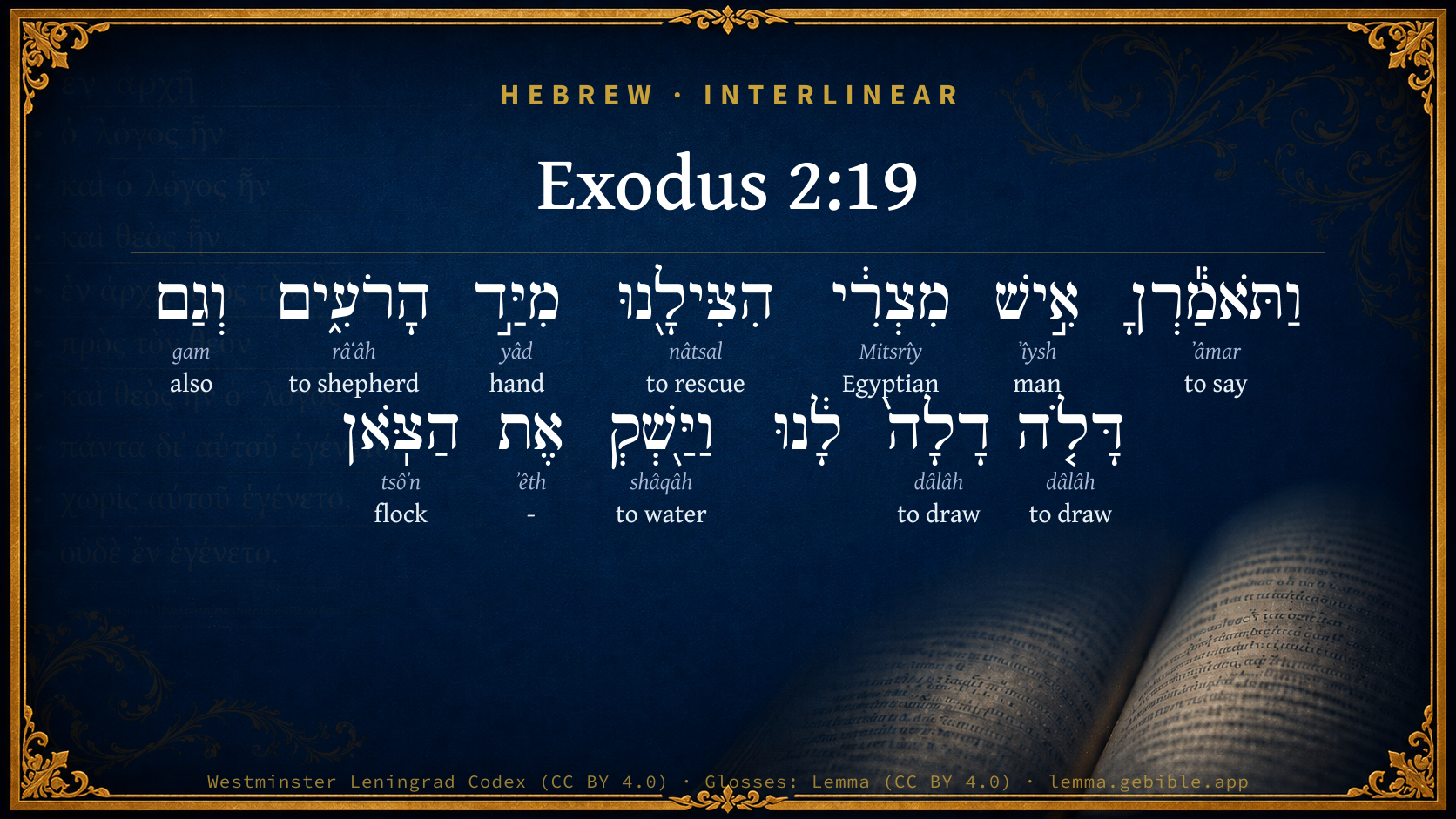
Hebrew (Westminster Leningrad Codex) Exodus 2:19 appears in the Hebrew Old Testament. The text above is from the Westminster Leningrad Codex. Each word links to its Strong’s number, a concise gloss, and parsing drawn from the Open Scriptures Hebrew Bible morphology. Click any word for its full Brown-Driver-Briggs (BDB) entry.
Download image
Cite this verse

Exodus 2:19 (World English Bible). Public Domain. Lemma interlinear Bible study tool, https://lemma.gebible.app/v/exodus/2/19.

Show BibTeX & RIS
BibTeX
RIS
English Translation
They said, "An Egyptian delivered us out of the hand of the shepherds, and moreover he drew water for us, and watered the flock."
World English Bible · Public Domain
Download a study sheet

One document with this verse’s original text, its word-by-word gloss line, the meaning frame, cross-references with their text, attributed commentary, and full source and license credits — printable, and it pastes into notes with its structure intact.

This verse Autodidact and up

Study sheet (.html) Plain text (.txt)

A passage Seminary Student

Up to 50 verses in one chapter. A passage sheet keeps up to 6 commentary sources and 12 cross-references per verse, in the order this page ranks them, and says so on the sheet whenever that leaves anything out. Ask for a single verse and you get the Autodidact verse sheet above.

Everything on this page stays free to read, with no account — the sheet is a download of what is already on screen, not access to it.

Want to remove ads? Support Godless Engineer
Compare translations 3

The same verse in 3 English versions, stacked beneath the original-language interlinear above. Click any original word for its lexicon entry.

Each is an independent rendering of the whole verse — the interlinear is not word-aligned to these translations.

Highlighted words mark where these versions differ — a whole-verse word diff, not a word-by-word alignment.

  • World English Bible Public Domain
    They said, "An Egyptian delivered us out of the hand of the shepherds, and moreover he drew water for us, and watered the flock."
  • King James Version Public Domain
    And they said, An Egyptian delivered us out of the hand of the shepherds, and also drew water enough for us, and watered the flock.
  • unfoldingWord Literal Text CC BY-SA 4.0
    And they said, “An Egyptian man rescued us from the hand of the men who were shepherding. And he even drew especially for us and caused the flock to drink water.”

unfoldingWord Literal Text — © unfoldingWord, licensed CC BY-SA 4.0. Word-aligned USFM3 via Door43 (git.door43.org/unfoldingWord/en_ult).

Versions to compare (up to 4)

3 of 4 selected

Show all 18 translations

Every available English version of this verse, each an independent rendering of the whole verse.

  • World English Bible Public Domain
    They said, "An Egyptian delivered us out of the hand of the shepherds, and moreover he drew water for us, and watered the flock."
  • Berean Standard Bible Public Domain
    “An Egyptian rescued us from the shepherds,” they replied. “He even drew water for us and watered the flock.”
  • Majority Standard Bible Public Domain
    “An Egyptian rescued us from the shepherds,” they replied. “He even drew water for us and watered the flock.”
  • King James Version Public Domain
    And they said, An Egyptian delivered us out of the hand of the shepherds, and also drew water enough for us, and watered the flock.
  • American Standard Version (1901) Public Domain
    And they said, An Egyptian delivered us out of the hand of the shepherds, and moreover he drew water for us, and watered the flock.
  • Revised Version (1885) Public Domain
    And they said, An Egyptian delivered us out of the hand of the shepherds, and moreover he drew water for us, and watered the flock.
  • Geneva Bible (1599) Public Domain
    And they saide, A man of Egypt deliuered vs from the hand of the shepherdes, and also drew vs water ynough, and watered the sheepe.
  • Douay-Rheims (1899) Public Domain
    They answered: A man of Egypt delivered us from the hands of the shepherds: and he drew water also with us, and gave the sheep to drink.
  • Young's Literal Translation Public Domain
    and they say, `A man, an Egyptian, hath delivered us out of the hand of the shepherds, and also hath diligently drawn for us, and watereth the flock;'
  • Literal Standard Version CC BY-SA 4.0
    And they say, “A man, an Egyptian, has delivered us out of the hand of the shepherds, and has also diligently drawn for us, and waters the flock”;
  • Unlocked Literal Bible CC BY-SA 4.0
    They said, “An Egyptian rescued us from the shepherds. He even drew water for us and watered the flock.”
  • unfoldingWord Literal Text CC BY-SA 4.0
    And they said, “An Egyptian man rescued us from the hand of the men who were shepherding. And he even drew especially for us and caused the flock to drink water.”
  • Darby Bible Public Domain
    And they said, An Egyptian delivered us out of the hand of the shepherds, and also drew [water] abundantly for us, and watered the flock.
  • World Messianic Bible Public Domain
    They said, “An Egyptian delivered us out of the hand of the shepherds, and moreover he drew water for us, and watered the flock.”
  • Webster's Bible Public Domain
    And they said, An Egyptian delivered us from the hand of the shepherds, and also drew water enough for us, and watered the flock.
  • Free Bible Version CC BY-SA 4.0
    “An Egyptian rescued us from some shepherds who attacked us,” they replied. “Then he even fetched water for us so the flock could drink.”
  • Bible in Basic English Public Domain
    And they said, An Egyptian came to our help against the keepers of sheep and got water for us and gave it to the flock.
  • JPS Tanakh (1917) Public Domain
    And they said: 'An Egyptian delivered us out of the hand of the shepherds, and moreover he drew water for us, and watered the flock.'

Literal Standard Version (2020), Covenant Press — licensed CC BY-SA 4.0. Text via the HelloAO Bible API (eBible.org). Unlocked Literal Bible (unfoldingWord) — licensed CC BY-SA 4.0. Text via the HelloAO Bible API (eBible.org). unfoldingWord Literal Text — © unfoldingWord, licensed CC BY-SA 4.0. Word-aligned USFM3 via Door43 (git.door43.org/unfoldingWord/en_ult). Free Bible Version, Dr. Jonathan Gallagher — licensed CC BY-SA 4.0. Text via the HelloAO Bible API (eBible.org).

Word by word

More ways to search: Search by grammar → Find every occurrence → Compare this word →

Practice this passage: Drill this verse → Learn its vocabulary →

דָּלֹ֤ה
dâlâh
H1802
“to draw”
Verb, Qal, Infinitive Absolute
Part of Speech
Verb
Stem
Qal
Form
Infinitive Absolute
Full BDB Definition

Origin: a primitive root (compare H1809 )

TWOT: 431

to draw, dangle - (Qal) - to draw - drawing advice (figuratively) - (Piel) to draw up
  1. וַתֹּאמַ֕רְןָ ʼâmar H559 “and · to say” Conjunction + Verb, Qal, Sequential Imperfect, 3rd Person, Feminine, Plural
  2. אִ֣ישׁ ʼîysh H376 “man” Noun, Common, Masculine, Singular, Absolute
  3. מִצְרִ֔י Mitsrîy H4713 “Egyptian” Noun, Gentilic, Masculine, Singular, Absolute
  4. הִצִּילָ֖נוּ nâtsal H5337 “to rescue · us” Verb, Hiphil, Perfect, 3rd Person, Masculine, Singular + Suffix, Personal, 1st Person, Common, Plural
  5. מִיַּ֣ד yâd H3027 “from · hand of” Preposition + Noun, Common, Both, Singular, Construct
  6. הָרֹעִ֑ים râʻâh H7462 “the · shepherding” Particle, Definite Article + Verb, Qal, Participle Active, Masculine, Plural, Absolute
  7. וְגַם gam H1571 “and · also” Conjunction + Particle, Accusative
  8. דָלָה֙ dâlâh H1802 “to draw” Verb, Qal, Perfect, 3rd Person, Masculine, Singular
  9. וַיַּ֖שְׁקְ shâqâh H8248 “and · to water” Conjunction + Verb, Hiphil, Sequential Imperfect, 3rd Person, Masculine, Singular
  10. אֶת ʼêth H853 “-” Particle, Direct Object
  11. הַצֹּֽאן tsôʼn H6629 “the · flock” Particle, Definite Article + Noun, Common, Both, Singular, Absolute

About this verse

These counts appear in no published source. They are computed here, from the morphology-tagged text and Lemma’s own curated glosses. What Lemma adds →

13
words
11
distinct lemmas
Pentateuch
section

Notable vocabulary

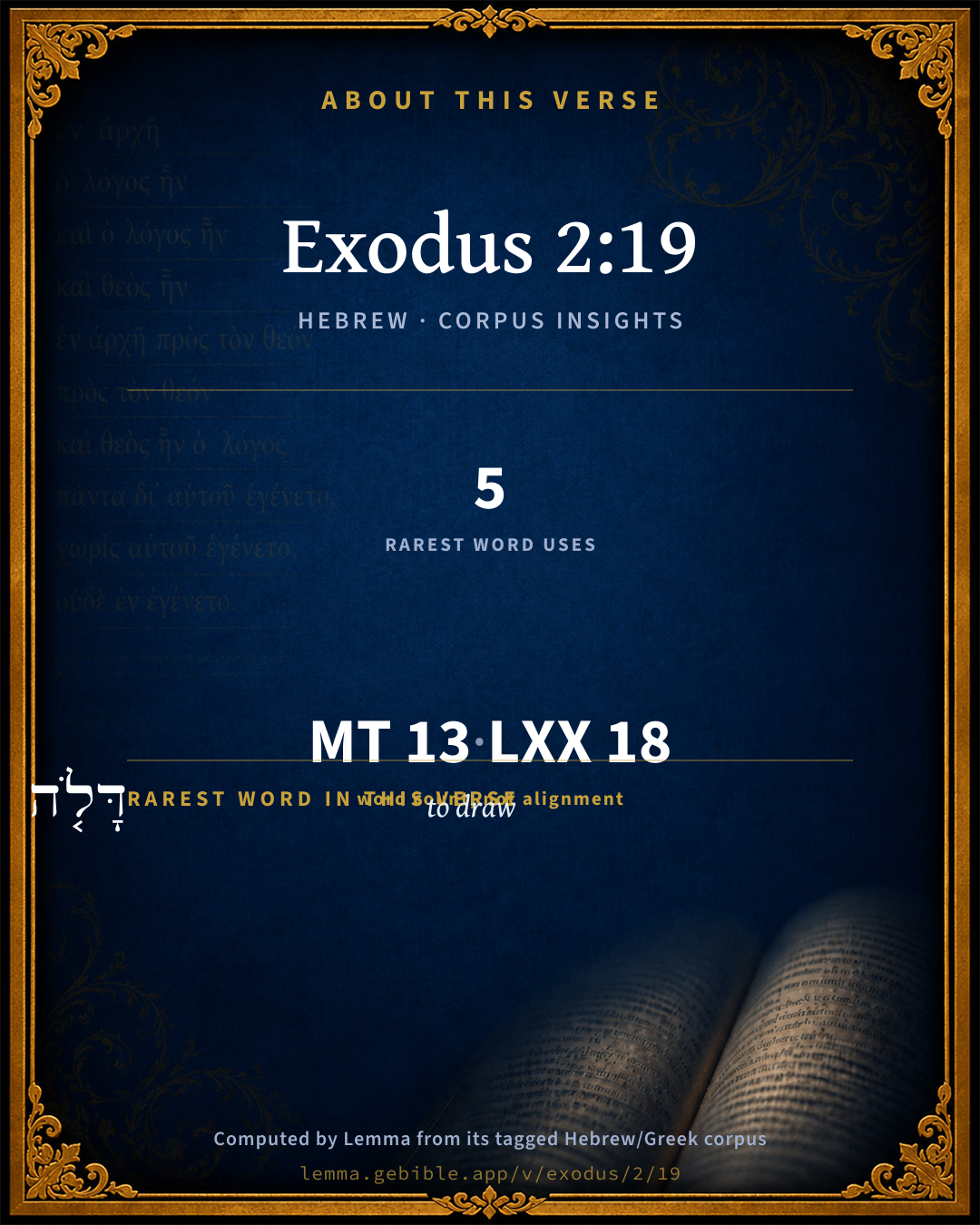
The rarest word here is דָּלֹ֤ה to draw H1802 — appearing just 5 times in the whole Hebrew Bible.

Shared distinctive vocabulary

דָּלֹ֤ה to draw H1802 occurs in 4 verses of the Hebrew Bible. Also found in:

Grammatical profile

  • 6 verbs
  • 4 nouns
  • 1 preposition
  • 2 particles

Verb forms

  • וַתֹּאמַ֕רְןָ Qal · Sequential Imperfect
  • הִצִּילָ֖נוּ Hiphil · Perfect
  • הָרֹעִ֑ים Qal · Participle Active
  • דָּלֹ֤ה Qal · Infinitive Absolute
  • דָלָה֙ Qal · Perfect
  • וַיַּ֖שְׁקְ Hiphil · Sequential Imperfect

Repetition

A word recurs within this verse — often emphatic in Hebrew:

  • דָּלֹ֤ה to draw H1802 ×2

Hebrew & Septuagint length

In English translation the verse runs 24 words from the Hebrew and 19 from the Septuagint (LXX English) — closely comparable.

A rough comparison of the two English renderings, which tokenize alike — not a word-level alignment.

Word counts can differ between the Hebrew and the Greek without any difference in meaning — e.g. the Hebrew direct-object marker אֵת has no separate Greek word, and Greek often adds the article ὁ.

In the original languages it is 13 Hebrew tokens and 18 Greek tokens — but the two are counted differently (Hebrew bundles its prefixes and suffixes into one token; the Greek is in lemma form), so that isn’t a like-for-like length.

Cross-references

2

Topical passages linked to Exodus 2:19 in the Treasury of Scripture Knowledge — connected by theme and wording, ordered by reader-vote popularity; previews shown in the World English Bible.

  • Genesis 29:10 It happened, when Jacob saw Rachel the daughter of Laban, his mother's brother, and the sheep of Laban, his mother's brother, that Jacob went near, and rolled the stone from the well's mouth, and watered the flock of Laban his mother's brother.
  • Genesis 50:11 When the inhabitants of the land, the Canaanites, saw the mourning in the floor of Atad, they said, "This is a grievous mourning by the Egyptians." Therefore, the name of it was called Abel Mizraim, which is beyond the Jordan.

Cross-references courtesy of OpenBible.info (CC BY 4.0).

Hebrew and Greek witnesses Masoretic Hebrew ↔ Greek Septuagint

The same verse in the two great witnesses to the Old Testament, shown verse-for-verse.

These are two independent witnesses, not word-aligned to each other, and the Septuagint is shown in lemma (dictionary) form.

Hebrew Exodus 2:19 Masoretic · Westminster Leningrad Codex

וַתֹּאמַ֕רְןָ אִ֣ישׁ מִצְרִ֔י הִצִּילָ֖נוּ מִיַּ֣ד הָרֹעִ֑ים וְגַם דָּלֹ֤ה דָלָה֙ לָ֔נוּ וַיַּ֖שְׁקְ אֶת הַצֹּֽאן

They said, "An Egyptian delivered us out of the hand of the shepherds, and moreover he drew water for us, and watered the flock."

World English Bible · Public Domain

Greek LXX Exodus 2:19 Septuagint · lemma form

ὁ δέ εἶπον ἄνθρωπος αἰγύπτιος ῥύομαι ἐγώ ἀπό ὁ ποιμήν καί ἀντλέω ἐγώ καί ποτίζω ὁ πρόβατον ἐγώ

And they said, An Egyptian delivered us from the shepherds, and drew water for us and watered our sheep.

LXX2012 (modern English Septuagint) · Public Domain

Hebrew: Westminster Leningrad Codex (CC BY 4.0). Greek: Septuagint (public domain); English from LXX2012 (modern English Septuagint) (Public Domain). How the Septuagint differs from the Hebrew →

Targum (Aramaic paraphrase)

2

The Targum is the ancient Jewish Aramaic paraphrase of the Hebrew Scriptures — an interpretive translation, not the Hebrew text itself. Onkelos (literal) and Pseudo-Jonathan (expansive) render the Torah, and Jonathan the Prophets. Coverage is partial: where no permissively-licensed English translation exists for a verse, only the Aramaic is shown. This is verse-level text, not a word-by-word alignment to the Hebrew.

  1. Targum Onkelos Torah (Genesis–Deuteronomy)
    וַאֲמָרָא גַבְרָא מִצְרָאָה שֵׁזְבָנָא מִיַד רָעַיָא וְאַף מִדְלָא דְלָא לָנָא וְאַשְׁקֵי יָת עָנָא:

    (no public-domain English translation for this verse)

    Targum Onkelos — Aramaic: “Onkelos Genesis” (public domain); “Onkelos Exodus” (public domain); “Onkelos Leviticus” (public domain); “Onkelos Numbers” (public domain); “Onkelos Deuteronomy” (public domain). English: “Sefaria Community Translation” (CC0 1.0 (public-domain dedication)); “J.W. Etheridge. The Targums of Onkelos and Jonathan Ben Uzziel on the Pentateuch. London: Longmans, Green, 1862” (public domain). Text via Sefaria.

  2. Targum Pseudo-Jonathan Torah (Genesis–Deuteronomy)
    וְאָמָרָא גַבְרָא שֵׁיזְבָנָא מִן יְדָא דְרַעֲיָא לְחוֹד מִדוֹל חַד דָלָה לָן וְאַשְׁקֵי יַת עָנָא

    And they replied, A Mizraite man not only delivered us from the hand of the shepherds, but also himself drawing drew and watered the flock.

    Targum Pseudo-Jonathan — Aramaic: “Targum Jonathan on Genesis” (public domain); “Targum Jonathan on Exodus” (public domain); “Targum Jonathan on Leviticus” (public domain); “Targum Jonathan on Numbers” (public domain); “Targum Jonathan on Deuteronomy” (public domain). English: “The Targum of Jonathan ben Uzziel, trans. J. W. Etheridge, London, 1862” (public domain). Text via Sefaria.

Commentary

Notes on Exodus 2:19 from classic Christian and Jewish commentators (each source and its license shown beneath its notes). The classic Christian expositions comment on the surrounding passage and are grouped to its opening verse, so a note may address several verses; the Jewish commentaries on the Tanakh (Rashi and others) are per-verse, so they appear only where the commentator wrote on this verse.

Lemma curates 59 commentaries, every one of them public domain or Creative Commons licensed, each selected and text-cleaned for this edition rather than reprinted as found. About our sources →

Trapp's Complete Commentary

John Trapp

Exo 2:19 And they said, An Egyptian delivered us out of the hand of the shepherds, and also drew [water] enough for us, and watered the flock.

Ver. 19. Delivered us out of the hand,] Moses, if he may not in Egypt, will be doing justice in Midian. Christ went about doing good. The place is the better wherever a good man cometh: his trade, saith one, is a compound of charity and justice.

John Trapp, A Commentary or Exposition upon All the Books of the Old and New Testament (1647–1656) — public domain. Text from a community e-Sword module.

Joseph Benson's Commentary

Exo 2:19. An Egyptian delivered us — Such they supposed him to be by his habit and speech; or perhaps he told them that he came from Egypt. Drew water enough — Hebrew, In drawing he drew, which phrase means that he drew it readily and diligently, which caused their quick return.

Joseph Benson's Commentary on the Old and New Testaments (1811–1818) — public domain. Text from a community e-Sword module.

Ellicott's Commentary for English Readers

(19) An Egyptian.—So they concluded from his dress and appearance, perhaps even from his speech. It would be natural for them to make the mistake, and for Moses to remember it. Any other author would probably have said, “a man,” or “a stranger.”

And also drew water enough.—The shepherds had consumed some of the maidens’ water before Moses’s interference, so that he had to draw more for them —another “little trait,” which speaks for the Mosaic authorship.

A Bible Commentary for English Readers, edited by Charles John Ellicott (1878–1897) — public domain. Text from a community e-Sword module.

John Gill's Exposition

And they said, an Egyptian delivered us out of the hand of the shepherds,.... A man, who by his habit and by his speech appeared to them to be an Egyptian, and upon their inquiry he might tell them so, being born in Egypt, though of Hebrew parents:

and also drew water enough for us; or "in drawing drew" (t); drew it readily, quickly and in abundance:

and watered the flock; by which means their business was done, and they returned home earlier than usual.

(t) "hauriendo bausit", Pagninus, Montanus, Piscator.

John Gill's Exposition of the Whole Bible (1746–1763) — public domain (CC PDM 1.0). Text via the HelloAO Bible API.

Albert Barnes' Notes on the Bible

An Egyptian - They judged from his costume, or language.

Albert Barnes' Notes on the Bible (1834–1885) — public domain. Text from a community e-Sword/MySword module.

Matthew Poole's English Annotations

They guessed him to be

an Egyptian by his habit and speech, or he told them that he came from thence.

Drew water; Heb. in drawing drew, which notes that he drew it very diligently and readily, which caused their quick return.

Matthew Poole's English Annotations on the Holy Bible (1683–1685) — public domain. Text from a community e-Sword/MySword module.

Whedon's Commentary on the Bible

Daniel D. Whedon

19. An Egyptian — For such Moses seemed to the Midianitish maidens, from his costume and language.

Daniel D. Whedon (gen. ed.), Commentary on the Old and New Testaments (1874–1909) — public domain. Text from a community e-Sword module.

The Pulpit Commentary

An Egyptian. Reuel"s daughters judged by the outward appearance. Moses wore the garb and probably spoke the language of Egypt. He had had no occasion to reveal to them his real nationality. Drew water enough for us. The shepherds had consumed some of the water drawn by the maidens, before Moses could drive them off. He supplied the deficiency by drawing more for them an act of polite attention.

The Pulpit Commentary (1880–1919), ed. H.D.M. Spence-Jones & Joseph S. Exell — public domain. Text from a community e-Sword module.

Lesson kit

Teaching starters — assembled from the data on this page, not authored interpretation. Every prompt links to the verse data it draws on. Edit before teaching.

Exodus, in the Pentateuch, opens this verse with 13 words (11 distinct Hebrew lemmas). Its most distinctive word is dâlâh (“to draw”). A historical commentator’s framing appears above. Read the whole chapter for the surrounding context.

Discussion questions

  1. How does “to draw” (dâlâh) shape what this verse is saying?
  2. Exodus 2:16 shares the word «to draw» with this verse. How do the two illuminate each other?
  3. “to draw” occurs 2× in this one verse. What is the effect of the repetition?
  4. The translations on this page render this verse differently — a whole-verse word diff, not a word-by-word alignment. What might account for the different wordings?
  5. The verb «וַתֹּאמַ֕רְןָ» is Qal Sequential Imperfect. How does its form color the action?
  6. Reading how Trapp's Complete Commentary and Joseph Benson's Commentary read this verse, where do the two commentators agree and where do they part?

Things to notice

Reading settings

Reading text

Shown beneath each verse's original-language words.

Old Testament
Old Testament edition

Read the OT as the Masoretic Hebrew (MT) or the Greek Septuagint (LXX).

English shown for the Greek Septuagint (in the Hebrew ↔ Greek comparison).

Comparing translations? Open the Compare panel on any verse page to stack up to four side by side.