Genesis 24:13

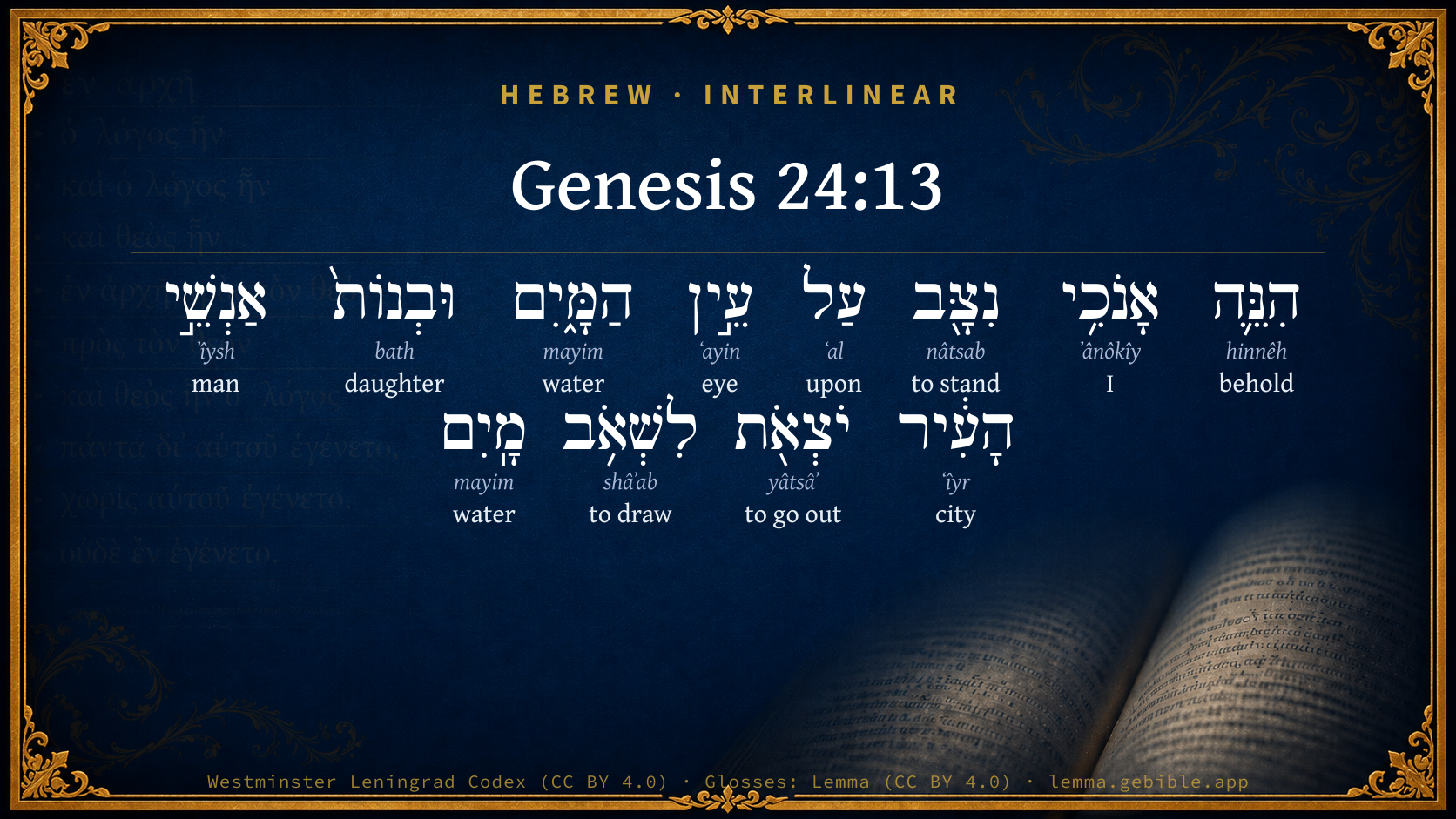
Hebrew (Westminster Leningrad Codex) Genesis 24:13 appears in the Hebrew Old Testament. The text above is from the Westminster Leningrad Codex. Each word links to its Strong’s number, a concise gloss, and parsing drawn from the Open Scriptures Hebrew Bible morphology. Click any word for its full Brown-Driver-Briggs (BDB) entry.
Download image
Cite this verse

Genesis 24:13 (World English Bible). Public Domain. Lemma interlinear Bible study tool, https://lemma.gebible.app/v/genesis/24/13.

Show BibTeX & RIS
BibTeX
RIS
English Translation
Behold, I am standing by the spring of water. The daughters of the men of the city are coming out to draw water.
World English Bible · Public Domain
Download a study sheet

One document with this verse’s original text, its word-by-word gloss line, the meaning frame, cross-references with their text, attributed commentary, and full source and license credits — printable, and it pastes into notes with its structure intact.

This verse Autodidact and up

Study sheet (.html) Plain text (.txt)

A passage Seminary Student

Up to 50 verses in one chapter. A passage sheet keeps up to 6 commentary sources and 12 cross-references per verse, in the order this page ranks them, and says so on the sheet whenever that leaves anything out. Ask for a single verse and you get the Autodidact verse sheet above.

Everything on this page stays free to read, with no account — the sheet is a download of what is already on screen, not access to it.

Want to remove ads? Support Godless Engineer
Compare translations 3

The same verse in 3 English versions, stacked beneath the original-language interlinear above. Click any original word for its lexicon entry.

Each is an independent rendering of the whole verse — the interlinear is not word-aligned to these translations.

Highlighted words mark where these versions differ — a whole-verse word diff, not a word-by-word alignment.

  • World English Bible Public Domain
    Behold, I am standing by the spring of water. The daughters of the men of the city are coming out to draw water.
  • King James Version Public Domain
    Behold, I stand here by the well of water; and the daughters of the men of the city come out to draw water:
  • unfoldingWord Literal Text CC BY-SA 4.0
    Behold, I am standing by this spring of water, and the daughters of the people of the city are coming out to draw water.

unfoldingWord Literal Text — © unfoldingWord, licensed CC BY-SA 4.0. Word-aligned USFM3 via Door43 (git.door43.org/unfoldingWord/en_ult).

Versions to compare (up to 4)

3 of 4 selected

Show all 18 translations

Every available English version of this verse, each an independent rendering of the whole verse.

  • World English Bible Public Domain
    Behold, I am standing by the spring of water. The daughters of the men of the city are coming out to draw water.
  • Berean Standard Bible Public Domain
    Here I am, standing beside the spring, and the daughters of the townspeople are coming out to draw water.
  • Majority Standard Bible Public Domain
    Here I am, standing beside the spring, and the daughters of the townspeople are coming out to draw water.
  • King James Version Public Domain
    Behold, I stand here by the well of water; and the daughters of the men of the city come out to draw water:
  • American Standard Version (1901) Public Domain
    Behold, I am standing by the fountain of water. And the daughters of the men of the city are coming out to draw water.
  • Revised Version (1885) Public Domain
    Behold, I stand by the fountain of water; and the daughters of the men of the city come out to draw water:
  • Geneva Bible (1599) Public Domain
    Lo, I stand by the well of water, whiles the mens daughters of this citie come out to drawe water.
  • Douay-Rheims (1899) Public Domain
    Behold I stand nigh the spring of water, and the daughters of the inhabitants of this city will come out to draw water.
  • Young's Literal Translation Public Domain
    lo, I am standing by the fountain of water, and daughters of the men of the city are coming out to draw water;
  • Literal Standard Version CC BY-SA 4.0
    behold, I am standing by the fountain of water, and daughters of the men of the city are coming out to draw water;
  • Unlocked Literal Bible CC BY-SA 4.0
    Look, here I am standing by the spring of water, and the daughters of the men of the city are coming out to draw water.
  • unfoldingWord Literal Text CC BY-SA 4.0
    Behold, I am standing by this spring of water, and the daughters of the people of the city are coming out to draw water.
  • Darby Bible Public Domain
    Behold, I stand [here] by the well of water, and the daughters of the men of the city come out to draw water.
  • World Messianic Bible Public Domain
    Behold, I am standing by the spring of water. The daughters of the men of the city are coming out to draw water.
  • Webster's Bible Public Domain
    Behold, I stand here by the well of water; and the daughters of the men of the city come out to draw water:
  • Free Bible Version CC BY-SA 4.0
    Look, I'm standing here beside this spring, and the young women of the town are coming to get water.
  • Bible in Basic English Public Domain
    See, I am waiting here by the water-spring; and the daughters of the town are coming out to get water:
  • JPS Tanakh (1917) Public Domain
    Behold, I stand by the fountain of water; and the daughters of the men of the city come out to draw water.

Literal Standard Version (2020), Covenant Press — licensed CC BY-SA 4.0. Text via the HelloAO Bible API (eBible.org). Unlocked Literal Bible (unfoldingWord) — licensed CC BY-SA 4.0. Text via the HelloAO Bible API (eBible.org). unfoldingWord Literal Text — © unfoldingWord, licensed CC BY-SA 4.0. Word-aligned USFM3 via Door43 (git.door43.org/unfoldingWord/en_ult). Free Bible Version, Dr. Jonathan Gallagher — licensed CC BY-SA 4.0. Text via the HelloAO Bible API (eBible.org).

Word by word

More ways to search: Search by grammar → Find every occurrence → Compare this word →

Practice this passage: Drill this verse → Learn its vocabulary →

לִשְׁאֹ֥ב
shâʼab
H7579
“to draw”
Preposition + Verb, Qal, Infinitive Construct
Part of Speech
Preposition + Verb
Stem
Qal
Form
Infinitive Construct
Full BDB Definition

Origin: a primitive root

TWOT: 2299 . 1

to draw (water) - (Qal) - to draw (water) - water-drawing women (participle)
  1. הִנֵּ֛ה hinnêh H2009 “behold” Particle, Demonstrative
  2. אָנֹכִ֥י ʼânôkîy H595 “I” Pronoun, Personal, 1st Person, Common, Singular
  3. נִצָּ֖ב nâtsab H5324 “standing” Verb, Niphal, Participle Active, Masculine, Singular, Absolute
  4. עַל ʻal H5921 “upon” Preposition
  5. עֵ֣ין ʻayin H5869 “eye of” Noun, Common, Both, Singular, Construct
  6. הַמָּ֑יִם mayim H4325 “the · water(s)” Particle, Definite Article + Noun, Common, Masculine, Plural, Absolute
  7. וּבְנוֹת֙ bath H1323 “and · daughters of” Conjunction + Noun, Common, Feminine, Plural, Construct
  8. אַנְשֵׁ֣י ʼîysh H376 “men of” Noun, Common, Masculine, Plural, Construct
  9. הָעִ֔יר ʻîyr H5892 “the · city” Particle, Definite Article + Noun, Common, Feminine, Singular, Absolute
  10. יֹצְאֹ֖ת yâtsâʼ H3318 “going out” Verb, Qal, Participle Active, Feminine, Plural, Absolute
  11. מָֽיִם mayim H4325 “water(s)” Noun, Common, Masculine, Plural, Absolute

About this verse

These counts appear in no published source. They are computed here, from the morphology-tagged text and Lemma’s own curated glosses. What Lemma adds →

12
words
11
distinct lemmas
Pentateuch
section

Notable vocabulary

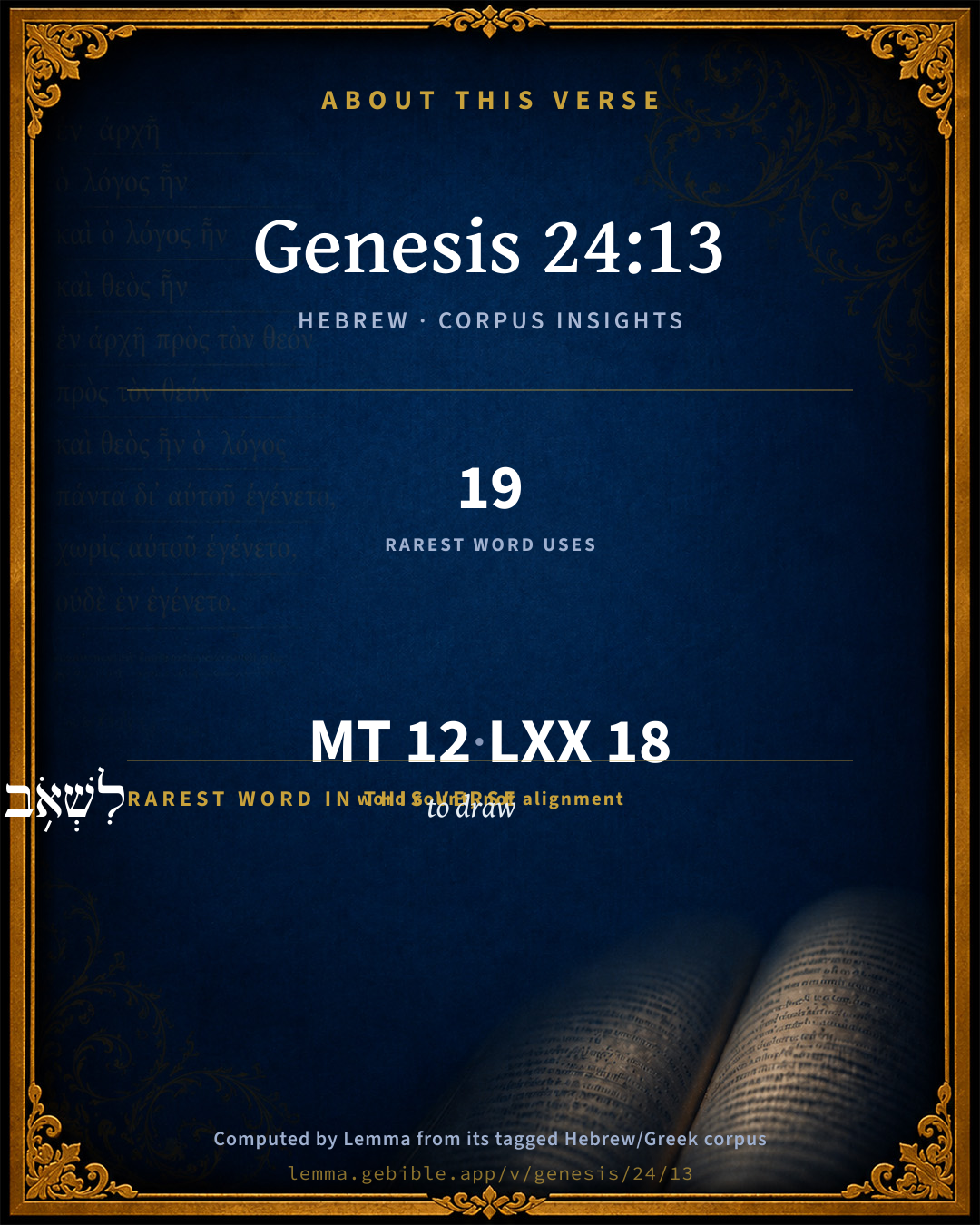
The rarest word here is לִשְׁאֹ֥ב to draw H7579 — appearing just 19 times in the whole Hebrew Bible.

Shared distinctive vocabulary

לִשְׁאֹ֥ב to draw H7579 occurs in 18 verses of the Hebrew Bible. Also found in:

Grammatical profile

  • 3 verbs
  • 6 nouns
  • 1 pronoun
  • 1 preposition
  • 1 particle

Verb forms

  • נִצָּ֖ב Niphal · Participle Active
  • יֹצְאֹ֖ת Qal · Participle Active
  • לִשְׁאֹ֥ב Qal · Infinitive Construct

Repetition

A word recurs within this verse — often emphatic in Hebrew:

  • הַמָּ֑יִם water H4325 ×2

Hebrew & Septuagint length

In English translation the verse runs 23 words from the Hebrew and 22 from the Septuagint (LXX English) — closely comparable.

A rough comparison of the two English renderings, which tokenize alike — not a word-level alignment.

Word counts can differ between the Hebrew and the Greek without any difference in meaning — e.g. the Hebrew direct-object marker אֵת has no separate Greek word, and Greek often adds the article ὁ.

In the original languages it is 12 Hebrew tokens and 18 Greek tokens — but the two are counted differently (Hebrew bundles its prefixes and suffixes into one token; the Greek is in lemma form), so that isn’t a like-for-like length.

Cross-references

9

Topical passages linked to Genesis 24:13 in the Treasury of Scripture Knowledge — connected by theme and wording, ordered by reader-vote popularity; previews shown in the World English Bible.

  • Genesis 24:43 Behold, I am standing by the spring of water. Let it happen, that the maiden who comes forth to draw, to whom I will say, Give me, I pray you, a little water from your pitcher to drink.
  • Psalms 37:5 Commit your way to Yahweh. Trust also in him, and he will do this:
  • Genesis 24:11 He made the camels kneel down outside the city by the well of water at the time of evening, the time that women go out to draw water.
  • Genesis 29:9–10 While he was yet speaking with them, Rachel came with her father's sheep, for she kept them.
  • Exodus 2:16 Now the priest of Midian had seven daughters. They came and drew water, and filled the troughs to water their father's flock.
  • Judges 5:11 Far from the noise of archers, in the places of drawing water, There shall they rehearse the righteous acts of Yahweh, [Even] the righteous acts of his rule in Israel. Then the people of Yahweh went down to the gates.
  • 1 Samuel 9:11 As they went up the ascent to the city, they found young maidens going out to draw water, and said to them, Is the seer here?
  • Proverbs 3:6 In all your ways acknowledge him, And he will direct your paths.
  • John 4:7 A woman of Samaria came to draw water. Jesus said to her, "Give me a drink."

Cross-references courtesy of OpenBible.info (CC BY 4.0).

Hebrew and Greek witnesses Masoretic Hebrew ↔ Greek Septuagint

The same verse in the two great witnesses to the Old Testament, shown verse-for-verse.

These are two independent witnesses, not word-aligned to each other, and the Septuagint is shown in lemma (dictionary) form.

Hebrew Genesis 24:13 Masoretic · Westminster Leningrad Codex

הִנֵּ֛ה אָנֹכִ֥י נִצָּ֖ב עַל עֵ֣ין הַמָּ֑יִם וּבְנוֹת֙ אַנְשֵׁ֣י הָעִ֔יר יֹצְאֹ֖ת לִשְׁאֹ֥ב מָֽיִם

Behold, I am standing by the spring of water. The daughters of the men of the city are coming out to draw water.

World English Bible · Public Domain

Greek LXX Genesis 24:13 Septuagint · lemma form

ἰδού ἐγώ ἵστημι ἐπί ὁ πηγή ὁ ὕδωρ ὁ δέ θυγάτηρ ὁ οἰκέω ὁ πόλις ἐκπορεύομαι ἀντλέω ὕδωρ

Behold! I stand by the well of water, and the daughters of them that inhabit the city come forth to draw water.

LXX2012 (modern English Septuagint) · Public Domain

On this verse, The Cambridge Bible for Schools and Colleges discusses the Septuagint’s reading. Read the note in Commentary ↓

Hebrew: Westminster Leningrad Codex (CC BY 4.0). Greek: Septuagint (public domain); English from LXX2012 (modern English Septuagint) (Public Domain). How the Septuagint differs from the Hebrew →

Targum (Aramaic paraphrase)

2

The Targum is the ancient Jewish Aramaic paraphrase of the Hebrew Scriptures — an interpretive translation, not the Hebrew text itself. Onkelos (literal) and Pseudo-Jonathan (expansive) render the Torah, and Jonathan the Prophets. Coverage is partial: where no permissively-licensed English translation exists for a verse, only the Aramaic is shown. This is verse-level text, not a word-by-word alignment to the Hebrew.

  1. Targum Onkelos Torah (Genesis–Deuteronomy)
    הָא אֲנָא קָאֵם עַל עֵינָא דְמַיָּא וּבְנַת אֱנָשֵׁי קַרְתָּא נַפְקַן לְמִמְלֵי מַיָּא

    (no public-domain English translation for this verse)

    Targum Onkelos — Aramaic: “Onkelos Genesis” (public domain); “Onkelos Exodus” (public domain); “Onkelos Leviticus” (public domain); “Onkelos Numbers” (public domain); “Onkelos Deuteronomy” (public domain). English: “Sefaria Community Translation” (CC0 1.0 (public-domain dedication)); “J.W. Etheridge. The Targums of Onkelos and Jonathan Ben Uzziel on the Pentateuch. London: Longmans, Green, 1862” (public domain). Text via Sefaria.

  2. Targum Pseudo-Jonathan Torah (Genesis–Deuteronomy)
    הָא אֲנָא קָאִי עַל עֵינָא דְמַיָא וּבְנַתְהוֹן דְאַנְשֵׁי קַרְתָּא נַפְקַן לְמִמְלֵי מוֹי

    Behold I stand at the well of waters, and the daughters of the men of the city are coming forth to fill waters.

    Targum Pseudo-Jonathan — Aramaic: “Targum Jonathan on Genesis” (public domain); “Targum Jonathan on Exodus” (public domain); “Targum Jonathan on Leviticus” (public domain); “Targum Jonathan on Numbers” (public domain); “Targum Jonathan on Deuteronomy” (public domain). English: “The Targum of Jonathan ben Uzziel, trans. J. W. Etheridge, London, 1862” (public domain). Text via Sefaria.

Commentary

Notes on Genesis 24:13 from classic Christian and Jewish commentators (each source and its license shown beneath its notes). The classic Christian expositions comment on the surrounding passage and are grouped to its opening verse, so a note may address several verses; the Jewish commentaries on the Tanakh (Rashi and others) are per-verse, so they appear only where the commentator wrote on this verse.

Lemma curates 59 commentaries, every one of them public domain or Creative Commons licensed, each selected and text-cleaned for this edition rather than reprinted as found. About our sources →

Trapp's Complete Commentary

John Trapp

Gen 24:13 Behold, I stand [here] by the well of water; and the daughters of the men of the city come out to draw water:

Ver. 13. And the daughters, &c.] So did Rachel, and those in Deborah’s song, that rehearsed the acts of the Lord at the places of drawing water; {Jdg 5:11} and Jethro’s daughters, though he were prince of Median. Oh, the simplicity and plainness of those times! They that plead Rebekah’s ornaments for their garish attire, would be loath to take her office - to be at the pains that she was.

John Trapp, A Commentary or Exposition upon All the Books of the Old and New Testament (1647–1656) — public domain. Text from a community e-Sword module.

The Cambridge Bible for Schools and Colleges

gen. ed. J. J. S. Perowne

13. the fountain of water] Two words are used in this passage which require to be distinguished: (1) “the fountain,” or “spring” (‘ayin), the water of which rises from the ground, or out of the rock; and (2) “the well” (be’êr), as in Gen_24:11; Gen_24:20, the tank or cistern, protected with stones, and provided with steps leading down to the actual “fountain” or “spring”; cf. 16. The “well” is the LXX φρέαρ, Lat. puteus: the “fountain” is the LXX πηγή, Lat. fons, cf. Gen_16:7.

The Cambridge Bible for Schools and Colleges (gen. ed. J. J. S. Perowne; Cambridge University Press, 1878–1918) — public domain. Text from a community e-Sword module.

John Gill's Exposition

Behold, I stand here by the well of water,.... Wishing, hoping, and expecting that something would turn out that would direct and instruct what further to do, and that would lead on to the business he came about:

and the daughters of the men of the city came out to draw water; which was the usual custom in those parts about that time. So Homer speaks (w) of meeting a girl before the city drawing or fetching water. And this was a principal reason why Abraham's servant stopped at the well, not only to refresh himself, his men, and his cattle, but in hopes he should meet with the damsel there he was come for; or at least should hear of her, or meet with some one or another that would direct him to her; or something would fall out there that would be a means in Providence of bringing about what he was sent to do.

(w) Odyss. 10. ver. 109.

John Gill's Exposition of the Whole Bible (1746–1763) — public domain (CC PDM 1.0). Text via the HelloAO Bible API.

Lesson kit

Teaching starters — assembled from the data on this page, not authored interpretation. Every prompt links to the verse data it draws on. Edit before teaching.

Genesis, in the Pentateuch, opens this verse with 12 words (11 distinct Hebrew lemmas). Its most distinctive word is shâʼab (“to draw”). A historical commentator’s framing appears above. Read the whole chapter for the surrounding context.

Discussion questions

  1. What does “to draw” (shâʼab) contribute to the verse as a whole?
  2. Genesis 24:11 shares the word «to draw» with this verse. How do the two illuminate each other?
  3. “water” occurs 2× in this one verse. What is the effect of the repetition?
  4. These translations render this verse differently. What is at stake in choosing one wording over another?
  5. The verb «נִצָּ֖ב» is Niphal Participle Active. How does its form color the action?
  6. Reading how Trapp's Complete Commentary and The Cambridge Bible for Schools and Colleges read this verse, where do the two commentators agree and where do they part?

Things to notice

Reading settings

Reading text

Shown beneath each verse's original-language words.

Old Testament
Old Testament edition

Read the OT as the Masoretic Hebrew (MT) or the Greek Septuagint (LXX).

English shown for the Greek Septuagint (in the Hebrew ↔ Greek comparison).

Comparing translations? Open the Compare panel on any verse page to stack up to four side by side.