Exodus 10:23

Hebrew (Westminster Leningrad Codex) Exodus 10:23 appears in the Hebrew Old Testament. The text above is from the Westminster Leningrad Codex. Each word links to its Strong’s number, a concise gloss, and parsing drawn from the Open Scriptures Hebrew Bible morphology. Click any word for its full Brown-Driver-Briggs (BDB) entry.
Download image
Cite this verse

Exodus 10:23 (World English Bible). Public Domain. Lemma interlinear Bible study tool, https://lemma.gebible.app/v/exodus/10/23.

Show BibTeX & RIS
BibTeX
RIS
English Translation
They didn't see one another, neither did anyone rise from his place for three days; but all the children of Israel had light in their dwellings.
World English Bible · Public Domain
Download a study sheet

One document with this verse’s original text, its word-by-word gloss line, the meaning frame, cross-references with their text, attributed commentary, and full source and license credits — printable, and it pastes into notes with its structure intact.

This verse Autodidact and up

Study sheet (.html) Plain text (.txt)

A passage Seminary Student

Up to 50 verses in one chapter. A passage sheet keeps up to 6 commentary sources and 12 cross-references per verse, in the order this page ranks them, and says so on the sheet whenever that leaves anything out. Ask for a single verse and you get the Autodidact verse sheet above.

Everything on this page stays free to read, with no account — the sheet is a download of what is already on screen, not access to it.

Want to remove ads? Support Godless Engineer
Compare translations 3

The same verse in 3 English versions, stacked beneath the original-language interlinear above. Click any original word for its lexicon entry.

Each is an independent rendering of the whole verse — the interlinear is not word-aligned to these translations.

Highlighted words mark where these versions differ — a whole-verse word diff, not a word-by-word alignment.

  • World English Bible Public Domain
    They didn't see one another, neither did anyone rise from his place for three days; but all the children of Israel had light in their dwellings.
  • King James Version Public Domain
    They saw not one another, neither rose any from his place for three days: but all the children of Israel had light in their dwellings.
  • unfoldingWord Literal Text CC BY-SA 4.0
    No man could see his brother, and no man rose from his place for three days. But for all the sons of Israel, there was light in their dwelling-places.

unfoldingWord Literal Text — © unfoldingWord, licensed CC BY-SA 4.0. Word-aligned USFM3 via Door43 (git.door43.org/unfoldingWord/en_ult).

Versions to compare (up to 4)

3 of 4 selected

Show all 18 translations

Every available English version of this verse, each an independent rendering of the whole verse.

  • World English Bible Public Domain
    They didn't see one another, neither did anyone rise from his place for three days; but all the children of Israel had light in their dwellings.
  • Berean Standard Bible Public Domain
    No one could see anyone else, and for three days no one left his place. Yet all the Israelites had light in their dwellings.
  • Majority Standard Bible Public Domain
    No one could see anyone else, and for three days no one left his place. Yet all the Israelites had light in their dwellings.
  • King James Version Public Domain
    They saw not one another, neither rose any from his place for three days: but all the children of Israel had light in their dwellings.
  • American Standard Version (1901) Public Domain
    they saw not one another, neither rose any one from his place for three days: but all the children of Israel had light in their dwellings.
  • Revised Version (1885) Public Domain
    they saw not one another, neither rose any from his place for three days: but all the children of Israel had light in their dwellings.
  • Geneva Bible (1599) Public Domain
    No man saw an other, neither rose vp from ye place where he was for three dayes: but all the children of Israel had light where they dwelt.
  • Douay-Rheims (1899) Public Domain
    No man saw his brother, nor moved himself out of the place where he was: but wheresoever the children of Israel dwelt there was light.
  • Young's Literal Translation Public Domain
    they have not seen one another, and none hath risen from his place three days; and to all the sons of Israel there hath been light in their dwellings.'
  • Literal Standard Version CC BY-SA 4.0
    they have not seen one another, and none has risen from his place [for] three days; but there has been light for all the sons of Israel in their dwellings.
  • Unlocked Literal Bible CC BY-SA 4.0
    No one could see anyone else; no one left his home for three days. However, all the Israelites had light in the place where they lived.
  • unfoldingWord Literal Text CC BY-SA 4.0
    No man could see his brother, and no man rose from his place for three days. But for all the sons of Israel, there was light in their dwelling-places.
  • Darby Bible Public Domain
    they saw not one another, neither rose any from his place, for three days. But all the children of Israel had light in their dwellings.
  • World Messianic Bible Public Domain
    They didn’t see one another, and nobody rose from his place for three days; but all the children of Israel had light in their dwellings.
  • Webster's Bible Public Domain
    They saw not one another, neither rose any from his place for three days: but all the children of Israel had light in their dwellings.
  • Free Bible Version CC BY-SA 4.0
    No one could see anyone else, and no one moved from where they were for three days. But there was still light where all the Israelites lived.
  • Bible in Basic English Public Domain
    They were not able to see one another, and no one got up from his place for three days: but where the children of Israel were living it was light.
  • JPS Tanakh (1917) Public Domain
    they saw not one another, neither rose any from his place for three days; but all the children of Israel had light in their dwellings.

Literal Standard Version (2020), Covenant Press — licensed CC BY-SA 4.0. Text via the HelloAO Bible API (eBible.org). Unlocked Literal Bible (unfoldingWord) — licensed CC BY-SA 4.0. Text via the HelloAO Bible API (eBible.org). unfoldingWord Literal Text — © unfoldingWord, licensed CC BY-SA 4.0. Word-aligned USFM3 via Door43 (git.door43.org/unfoldingWord/en_ult). Free Bible Version, Dr. Jonathan Gallagher — licensed CC BY-SA 4.0. Text via the HelloAO Bible API (eBible.org).

Word by word

More ways to search: Search by grammar → Find every occurrence → Compare this word →

Practice this passage: Drill this verse → Learn its vocabulary →

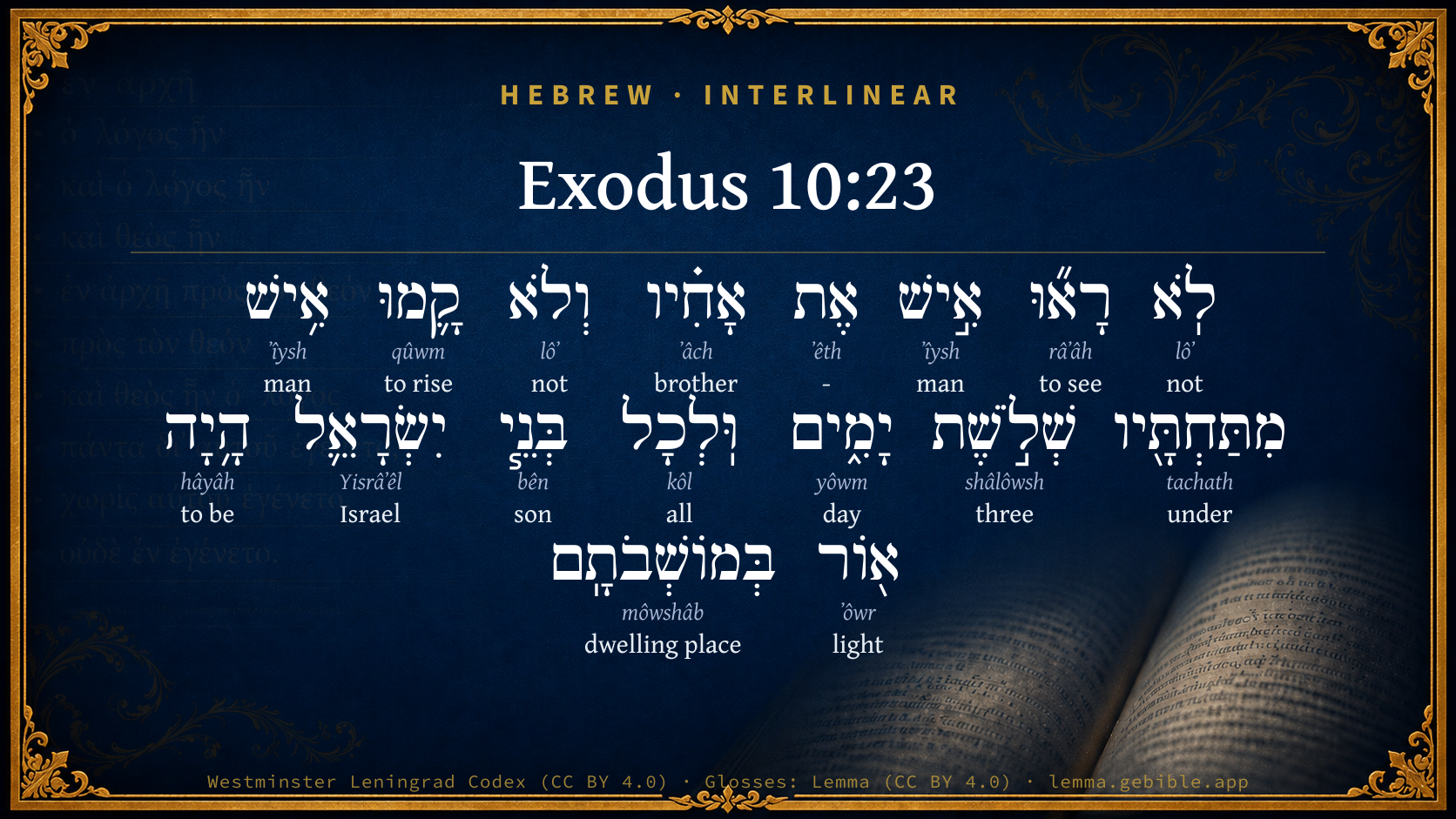
בְּמוֹשְׁבֹתָֽם
môwshâb
H4186
“in/at · dwelling places · their”
Preposition + Noun, Common, Masculine, Plural, Construct + Suffix, Personal, 3rd Person, Masculine, Plural
Part of Speech
Preposition + Noun
Type
Common
Gender
Masculine
Number
Plural
State
Construct
Full BDB Definition

Origin: from H3427 ; a seat

TWOT: 922c

seat, assembly, dwelling-place, dwelling, dwellers - seat, sitting, those sitting, sitting company or assembly - dwelling place, dwelling - situation, location - time of dwelling - those dwelling, dweller
  1. לֹֽא lôʼ H3808 “not” Particle, Negative
  2. רָא֞וּ râʼâh H7200 “to see” Verb, Qal, Perfect, 3rd Person, Common, Plural
  3. אִ֣ישׁ ʼîysh H376 “man” Noun, Common, Masculine, Singular, Absolute
  4. אֶת ʼêth H853 “-” Particle, Direct Object
  5. אָחִ֗יו ʼâch H251 “brother · his” Noun, Common, Masculine, Singular, Construct + Suffix, Personal, 3rd Person, Masculine, Singular
  6. וְלֹא lôʼ H3808 “and · not” Conjunction + Particle, Negative
  7. קָ֛מוּ qûwm H6965 “to rise” Verb, Qal, Perfect, 3rd Person, Common, Plural
  8. אִ֥ישׁ ʼîysh H376 “man” Noun, Common, Masculine, Singular, Absolute
  9. מִתַּחְתָּ֖יו tachath H8478 “from · under · him” Preposition + Preposition + Suffix, Personal, 3rd Person, Masculine, Singular
  10. שְׁלֹ֣שֶׁת shâlôwsh H7969 “three” Adjective, Cardinal number, Masculine, Singular, Construct
  11. יָמִ֑ים yôwm H3117 “days” Noun, Common, Masculine, Plural, Absolute
  12. וּֽלְכָל kôl H3605 “and · to/for · all of” Conjunction + Preposition + Noun, Common, Masculine, Singular, Construct
  13. בְּנֵ֧י bên H1121 “sons of” Noun, Common, Masculine, Plural, Construct
  14. יִשְׂרָאֵ֛ל Yisrâʼêl H3478 “Israel” Noun, Proper
  15. הָ֥יָה hâyâh H1961 “to be” Verb, Qal, Perfect, 3rd Person, Masculine, Singular
  16. א֖וֹר ʼôwr H216 “light” Noun, Common, Both, Singular, Absolute

About this verse

These counts appear in no published source. They are computed here, from the morphology-tagged text and Lemma’s own curated glosses. What Lemma adds →

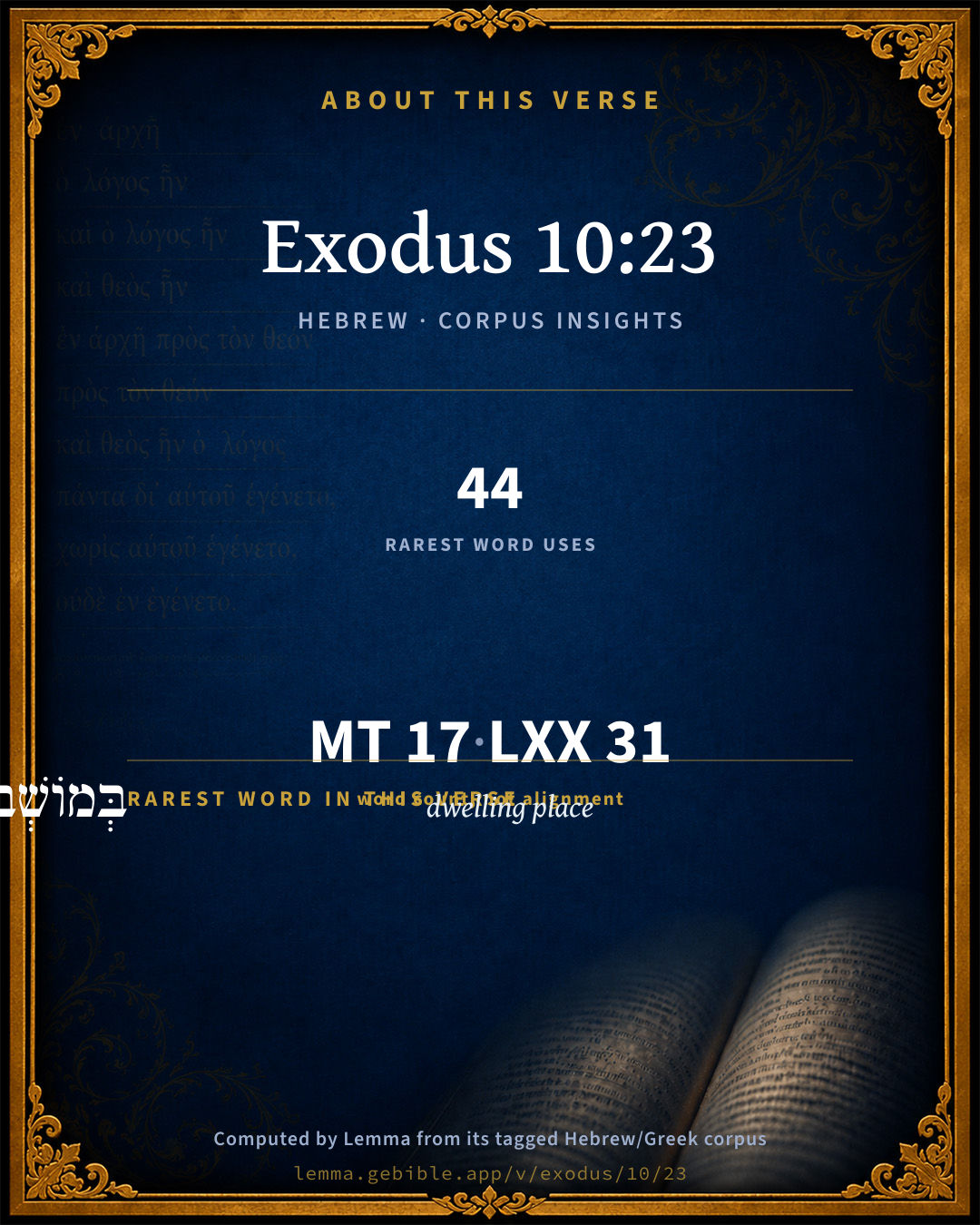
17
words
15
distinct lemmas
Pentateuch
section

Shared distinctive vocabulary

בְּמוֹשְׁבֹתָֽם dwelling place H4186 occurs in 43 verses of the Hebrew Bible. Also found in:

Grammatical profile

  • 3 verbs
  • 9 nouns
  • 1 adjective
  • 1 preposition
  • 3 particles

Verb forms

  • רָא֞וּ Qal · Perfect
  • קָ֛מוּ Qal · Perfect
  • הָ֥יָה Qal · Perfect

Repetition

Words recur within this verse — often emphatic in Hebrew:

  • אִ֣ישׁ man H376 ×2
  • לֹֽא not H3808 ×2

Hebrew & Septuagint length

In English translation the verse runs 26 words from the Hebrew and 35 from the Septuagint (LXX English) — closely comparable.

A rough comparison of the two English renderings, which tokenize alike — not a word-level alignment.

Word counts can differ between the Hebrew and the Greek without any difference in meaning — e.g. the Hebrew direct-object marker אֵת has no separate Greek word, and Greek often adds the article ὁ.

In the original languages it is 17 Hebrew tokens and 31 Greek tokens — but the two are counted differently (Hebrew bundles its prefixes and suffixes into one token; the Greek is in lemma form), so that isn’t a like-for-like length.

Cross-references

11

Topical passages linked to Exodus 10:23 in the Treasury of Scripture Knowledge — connected by theme and wording, ordered by reader-vote popularity; previews shown in the World English Bible.

  • Exodus 8:22 I will set apart in that day the land of Goshen, in which my people dwell, that no swarms of flies shall be there; to the end you may know that I am Yahweh in the midst of the earth.
  • Exodus 9:4 Yahweh will make a distinction between the cattle of Israel and the cattle of Egypt; and there shall nothing die of all that belongs to the children of Israel."'"
  • Isaiah 42:16 I will bring the blind by a way that they don't know; in paths that they don't know will I lead them; I will make darkness light before them, and crooked places straight. These things will I do, and I will not forsake them.
  • 1 Peter 2:9 But you are a chosen race, a royal priesthood, a holy nation, a people for God's own possession, that you may show forth the excellencies of him who called you out of darkness into his marvelous light:
  • Exodus 9:26 Only in the land of Goshen, where the children of Israel were, there was no hail.
  • Exodus 14:20 It came between the camp of Egypt and the camp of Israel; and there was the cloud and the darkness, yet gave it light by night: and the one didn't come near the other all the night.
  • Joshua 24:7 When they cried out to Yahweh, he put darkness between you and the Egyptians, and brought the sea on them, and covered them; and your eyes saw what I did in Egypt: and you lived in the wilderness many days.
  • Isaiah 60:1–3 Arise, shine; for your light is come, and the glory of Yahweh is risen on you.
  • Isaiah 65:13–14 Therefore thus says the Lord Yahweh, Behold, my servants shall eat, but you shall be hungry; behold, my servants shall drink, but you shall be thirsty; behold, my servants shall rejoice, but you shall be disappointed;
  • Malachi 3:18 Then you shall return and discern between the righteous and the wicked, between him who serves God and him who doesn't serve him.
  • Colossians 1:13 who delivered us out of the power of darkness, and translated us into the Kingdom of the Son of his love;

Cross-references courtesy of OpenBible.info (CC BY 4.0).

Hebrew and Greek witnesses Masoretic Hebrew ↔ Greek Septuagint

The same verse in the two great witnesses to the Old Testament, shown verse-for-verse.

These are two independent witnesses, not word-aligned to each other, and the Septuagint is shown in lemma (dictionary) form.

Hebrew Exodus 10:23 Masoretic · Westminster Leningrad Codex

לֹֽא רָא֞וּ אִ֣ישׁ אֶת אָחִ֗יו וְלֹא קָ֛מוּ אִ֥ישׁ מִתַּחְתָּ֖יו שְׁלֹ֣שֶׁת יָמִ֑ים וּֽלְכָל בְּנֵ֧י יִשְׂרָאֵ֛ל הָ֥יָה א֖וֹר בְּמוֹשְׁבֹתָֽם

They didn't see one another, neither did anyone rise from his place for three days; but all the children of Israel had light in their dwellings.

World English Bible · Public Domain

Greek LXX Exodus 10:23 Septuagint · lemma form

καί οὐ ὁράω οὐδείς ὁ ἀδελφός αὐτός τρεῖς ἡμέρα καί οὐ ἐκ ἀναἵστημι οὐδείς ἐκ ὁ κοίτη αὐτός τρεῖς ἡμέρα πᾶς δέ ὁ υἱός ἰσραήλ εἰμί φῶς ἐν πᾶς ὅς καταγίγνομαι

And for three days no man saw his brother, and no man rose up from his bed for three days: but all the children of Israel had light in all the places where they were.

LXX2012 (modern English Septuagint) · Public Domain

Hebrew: Westminster Leningrad Codex (CC BY 4.0). Greek: Septuagint (public domain); English from LXX2012 (modern English Septuagint) (Public Domain). How the Septuagint differs from the Hebrew →

Targum (Aramaic paraphrase)

2

The Targum is the ancient Jewish Aramaic paraphrase of the Hebrew Scriptures — an interpretive translation, not the Hebrew text itself. Onkelos (literal) and Pseudo-Jonathan (expansive) render the Torah, and Jonathan the Prophets. Coverage is partial: where no permissively-licensed English translation exists for a verse, only the Aramaic is shown. This is verse-level text, not a word-by-word alignment to the Hebrew.

  1. Targum Onkelos Torah (Genesis–Deuteronomy)
    לָא חֲזוֹ אֱנָשׁ יָת אֲחוֹהִי וְלָא קָמוּ אֱנָשׁ מִתְּחוֹתוֹהִי תְּלָתָא יוֹמִין וּלְכָל בְּנֵי יִשְׂרָאֵל הֲוָה נְהוֹרָא בְּמוֹתְבָנְהוֹן:

    (no public-domain English translation for this verse)

    Targum Onkelos — Aramaic: “Onkelos Genesis” (public domain); “Onkelos Exodus” (public domain); “Onkelos Leviticus” (public domain); “Onkelos Numbers” (public domain); “Onkelos Deuteronomy” (public domain). English: “Sefaria Community Translation” (CC0 1.0 (public-domain dedication)); “J.W. Etheridge. The Targums of Onkelos and Jonathan Ben Uzziel on the Pentateuch. London: Longmans, Green, 1862” (public domain). Text via Sefaria.

  2. Targum Pseudo-Jonathan Torah (Genesis–Deuteronomy)
    לָא חָמוּן גְּבַר יַת אָחוֹי וְלָא קָמוּן אֱנַשׁ מֵאַתְרֵיהּ תְּלָתָא יוֹמִין וּלְכָל בְּנֵי יִשְרָאֵל הֲוָה נְהוֹרָא לְמִקְבּוֹר רַשִׁיעַיָא דִי בֵינֵיהוֹן דְּמִיתַן וְזַכָּאַיָא לְמֶעֱסוֹק בְּמִצְוָתָא בְּמוֹתְבָנֵיהוֹן

    No man saw his brother, and none arose from his place three days. But among all the sons of Israel there was light, that the wicked among them who died might be buried, and that the righteous might be occupied with the precepts of the law in their dwellings.

    Targum Pseudo-Jonathan — Aramaic: “Targum Jonathan on Genesis” (public domain); “Targum Jonathan on Exodus” (public domain); “Targum Jonathan on Leviticus” (public domain); “Targum Jonathan on Numbers” (public domain); “Targum Jonathan on Deuteronomy” (public domain). English: “The Targum of Jonathan ben Uzziel, trans. J. W. Etheridge, London, 1862” (public domain). Text via Sefaria.

Commentary

Notes on Exodus 10:23 from classic Christian and Jewish commentators (each source and its license shown beneath its notes). The classic Christian expositions comment on the surrounding passage and are grouped to its opening verse, so a note may address several verses; the Jewish commentaries on the Tanakh (Rashi and others) are per-verse, so they appear only where the commentator wrote on this verse.

Lemma curates 59 commentaries, every one of them public domain or Creative Commons licensed, each selected and text-cleaned for this edition rather than reprinted as found. About our sources →

Trapp's Complete Commentary

John Trapp

Exo 10:23 They saw not one another, neither rose any from his place for three days: but all the children of Israel had light in their dwellings.

Ver. 23. They saw not one another.] That they might know the worth of light, by the want of it. One being asked whether light was pleasant, answered, τυφλου το ερωτμηα, That is a blind man’s question. Little do we prize this excellent creature.

John Trapp, A Commentary or Exposition upon All the Books of the Old and New Testament (1647–1656) — public domain. Text from a community e-Sword module.

Joseph Benson's Commentary

Exo 10:23. Neither rose any from his place — This circumstance is one of the lively strokes in description which critics call picturesque: it strongly paints the horror and dismay which this palpable darkness cast upon their minds. Le Clerc, however, justly remarks, that we are not to understand the expression so strictly, as if not one of the Egyptians rose from his place; for the servants, at least, must have moved about the best way they could to find victuals for themselves and their masters. The expression denotes that there was a total inaction and cessation from ordinary business, that they were all confined to their houses, and that such a terror seized them, that few of them had courage to go even from their chairs to their beds, or from their beds to their chairs. Thus were they silent in darkness, 1Sa 2:9. Now Pharaoh had time to consider, if he would have improved it. But the children of Israel had light in their dwellings — Not only in the land of Goshen, where most of them inhabited, but in the particular dwellings which in other places the Israelites had dispersed among the Egyptians, as it appears they had, by the distinction afterward appointed to be put on their door-posts. And during these three days of darkness to the Egyptians, if God had so pleased, the Israelites, by the light which they had, might have made their escape, and have asked Pharaoh no leave; but God would bring them out with a high hand, and not by stealth, or in haste.

Joseph Benson's Commentary on the Old and New Testaments (1811–1818) — public domain. Text from a community e-Sword module.

Adam Clarke's Commentary

Verse 23. They saw not one another] So deep was the obscurity, and probably such was its nature, that no artificial light could be procured; as the thick clammy vapours would prevent lamps, c., from burning, or if they even could be ignited, the light through the palpable obscurity, could diffuse itself to no distance from the burning body. The author of the book of Wisdom, chap. xvii. 2-19, gives a fearful description of this plague. He says, "The Egyptians were shut up in their houses, the prisoners of darkness: and were fettered with the bonds of a long night. They were scattered under a dark veil of forgetfulness, being horribly astonished and troubled with strange apparitions for neither might the corner that held them keep them from fear; but noises as of waters falling down sounded about them; and sad visions appeared unto them with heavy countenances. No power of the fire could give them light-only there appeared unto them a fire kindled of itself very dreadful; for being much terrified, they thought the things which they saw to be worse than the sight they saw not. For though no terrible thing did scare them, yet being scared with beasts that passed by, and hissing of serpents, they died for fear: for whether he were husbandman, or shepherd, or a labourer in the field, he was overtaken; for they were all bound with one chain of darkness. Whether it were a whistling wind, or a terrible sound of stones cast down, or a running that could not be seen of tripping beasts, or a roaring voice of most savage wild beasts, or a rebounding echo from the hollow mountains, these things made them to swoon for fear." See Ps 78:49.

To this description nothing need be added except this circumstance, that the darkness, with its attendant horrors, lasted for three days.

All the children of Israel had light] By thus distinguishing the Israelites, God showed the Egyptians that the darkness was produced by his power; that he sent it in judgment against them for their cruelty to his people; that because they trusted in him they were exempted from these plagues; that in the displeasure of such a Being his enemies had every thing to fear, and in his approbation his followers had every thing to hope.

Adam Clarke's Commentary on the Bible (1810–1826) — public domain. Text from a community e-Sword/MySword module.

Ellicott's Commentary for English Readers

(23) They saw not one another.—Heb., man did not see his brother. The darkness was absolute, equal to that of the darkest night.

Neither rose any from his place.—Comp. Exo_16:29. No one quitted his house. Mr. Millington imagines that they all sat “glued to their seats” (Plagues of Egypt, p. 159), but this savours of over-literalism. It is not necessary to suppose that they had no artificial light, or that they ceased to move from chamber to chamber. What the writer intends to note is that all business and all intercourse with neighbours was suspended. No one quitted the house in which he was when the darkness began.

All the children of Israel had light in their dwellings.—The visitation, whatever it was, did not extend to the land of Goshen. (Comp. Exo_8:22-24; Exo_9:4-7; Exo_9:26.)

A Bible Commentary for English Readers, edited by Charles John Ellicott (1878–1897) — public domain. Text from a community e-Sword module.

The Cambridge Bible for Schools and Colleges

gen. ed. J. J. S. Perowne

23. but, &c.] What is here described is evidently miraculous: but it is said that the sand-clouds of the Ḥamsîn (see below) sometimes travel in streaks, so that parts of the country may escape them.

The darkness was no doubt occasioned really by a sand-storm, produced by the hot electrical wind called the Ḥamsîn, which in Egypt blows in most years intermittently,—usually for two or three days at a time,—from the S., SE., or SW. during some 50 days in spring (hence its name, ḥamsîn = fifty). These winds spring up for the most part suddenly: they are violent, and often as hot as ‘the air of an oven’; and they frequently raise such an amount of sand and dust as to darken the sun, and even to conceal objects a few yards off. Men and animals like are greatly distressed by the sand and heat: the sand penetrates everywhere; and while the storm lasts, people are obliged to remain secluded in their houses. On account of the sand and dust, the darkness is really such as ‘can be felt.’ See R. Pococke, Description of the East (1743), i. 195; Volney, Voyage en Syrie et en Égypte (1787), i. 55–7; DB. iii. 892a; A. B. Edwards, A thousand miles up the Nile2 (1889), ch. 5, p. 76 f.; Rosenm. Schol. ad loc. (a sandstorm, c. 1100, producing darkness so intense that it was thought the end of the world had come); Denon [above, p. 79], i. 285 f.; and a photograph in the Ill. London News, Feb. 17, 1906.

The Cambridge Bible for Schools and Colleges (gen. ed. J. J. S. Perowne; Cambridge University Press, 1878–1918) — public domain. Text from a community e-Sword module.

John Gill's Exposition

And Moses said, thou must give us also sacrifices and burnt offerings,.... Sheep, rams, and goats for sacrifices, and oxen for burnt offerings; and that of his own, as Jarchi interprets it; but rather the meaning is, that besides having their little ones with them, they must be allowed also to take their cattle for sacrifices and burnt offerings:

that we may sacrifice unto the Lord our God; might have wherewith to offer up in sacrifice to him as he shall require.

John Gill's Exposition of the Whole Bible (1746–1763) — public domain (CC PDM 1.0). Text via the HelloAO Bible API.

Albert Barnes' Notes on the Bible

Had light in their dwellings - The sandstorm, if such were the cause, may not have extended to the district of Goshen; but the expression clearly denotes a miraculous intervention, whether accomplished or not by natural agencies.

Albert Barnes' Notes on the Bible (1834–1885) — public domain. Text from a community e-Sword/MySword module.

Matthew Poole's English Annotations

They saw not one another, because these gross and moist fogs and vapours did not only quite shut out the light of the heavenly bodies, but also put out their candles, or other artificial lights, or at least so darken them that men could have no benefit by them.

From his place. Place here may be taken, either,

1. More strictly and particularly; so the sense is, The horror of that darkness was so great that they durst not remove at all, but stood or sat where the darkness found them, like men astonished or affrighted, and therefore unmovable, having their minds disturbed, being terrified with their guilty consciences, which most affect men in the dark, and with the dreadful noises which they heard, Wis 17:5, and with the apparitions of evil angels, as may seem from Psa 78:49 where the plague of evil angels is put instead of this plague of darkness, which therefore is omitted in that place where all the rest are reckoned up. Or rather,

2. More largely, for their own houses or dwellings, for so the Hebrew word is certainly used, Exo 16:29. So the sense is, They did not stir abroad out of their houses upon their most necessary occasions.

Object. He saith not that they could not go, but that they could not rise from their place, which may seem to limit this expression to their particular places.

Answ. The word to rise is commonly put for going about any business; and here it is a pregnant word, as they call it, and implies going in it, none arose, viz. to go or remove

from his place. And rising cannot be properly taken here for that particular posture, unless we will suppose that this darkness found all men sitting, which is absurd to imagine.

The children of Israel had light in their dwellings, whereby they might have conveyed themselves, and families, and goods away, as afterwards they did in haste; but they waited for Moses’s orders, and he for God’s command; and God intended to bring them forth, not by stealth, but in a more honourable and public manner, in spite of all opposition.

Matthew Poole's English Annotations on the Holy Bible (1683–1685) — public domain. Text from a community e-Sword/MySword module.

The Pulpit Commentary

They saw not one another. Or, "Man did not see his brother." The descriptive phrases previously used are poetic, and might imply many different degrees of obscurity. This seems distinctly to shew that pitch darkness is meant. Such absolute obscurity is far beyond anything which the khamsin produces, even when it is most severe, and indicates the miraculous character of the visitation. Neither rose any from his place for three days. It is not meant that no one moved about his house, but that no one quitted it. (Compare Exo_16:29, where the phrase used is similar.) No one went out into the unnatural darkness out of doors, which he dreaded. All stayed at home, and did what they had to do by the artificial light of lamps or torches. All the children of Israel had light in their dwellings. It is not explained how this was effected. Some suppose that the sand-storm did not extend to the land of Goshen. But in that case, such Egyptians as lived among the Israelites their neighbours. (Exo_11:2) would have shared the benefit, which seems not to have been the case. I should rather suppose that the storm was general, and that the Israelites were supplied with a light, not that of the sun, by miracle.

The Pulpit Commentary (1880–1919), ed. H.D.M. Spence-Jones & Joseph S. Exell — public domain. Text from a community e-Sword module.

John Wesley's Explanatory Notes

But the children of Israel had light in their dwellings - Not only in the land of Goshen, where most of them inhabited, but in the particular dwellings which in other places the Israelites had dispersed among the Egyptians, as it appears they had by the distinction afterwards appointed to be put on their door-posts. And during these three days of darkness to the Egyptians, if God had so pleased, the Israelites by the light which they had, might have made their escape, and have asked Pharaoh no leave; but God would bring them out with a high hand, and not by stealth or in haste.

John Wesley, Explanatory Notes Upon the Whole Bible (1754–1765) — public domain. Text via the GEBible commentary corpus.

Ramban (Nachmanides)

Rabbi Moshe ben Nachman (Ramban / Nachmanides)

THEY SAW NOT ONE ANOTHER, NEITHER ROSE ANY FROM HIS PLACE. The meaning thereof is that this darkness was not a mere absence of sunlight where the sun set and it was like night. Rather, it was a thick darkness. That is to say, it was a very thick cloud that came down from heaven. It is for this reason that He said, “Stretch out thy hand toward heaven to bring down from there a great darkness which would descend upon them and which would extinguish every light, just as in all deep caverns and in all extremely dark places where light cannot last [as it is swallowed up in the density of the thick darkness].” Similarly, people who pass through the Mountains of Darkness find that no candle or fire can continue to burn at all. It is for this reason that they saw not one another, neither rose any from his place, for otherwise they would have used the light of fire. This is the intent of the verse, He sent darkness, and it became dark. It was not the usual absence of daylight above but an extraordinary darkness as well. It is possible that it was such a very thick cloud that there was something tangible in it, as our Rabbis have said, and as indeed it happens on the Atlantic Ocean, as Rabbi Abraham ibn Ezra testified.

Ramban (Nachmanides) on the Tanakh — English translation: “Commentary on the Torah by Ramban (Nachmanides). Translated and annotated by Charles B. Chavel. New York, Shilo Pub. House, 1971-1976” (CC BY 4.0). Text via Sefaria.

Lesson kit

Teaching starters — assembled from the data on this page, not authored interpretation. Every prompt links to the verse data it draws on. Edit before teaching.

Exodus, in the Pentateuch, opens this verse with 17 words (15 distinct Hebrew lemmas). Its most distinctive word is môwshâb (“dwelling place”). A historical commentator’s framing appears above. Read the whole chapter for the surrounding context.

Discussion questions

  1. How does “dwelling place” (môwshâb) shape what this verse is saying?
  2. Genesis 10:30 shares the word «dwelling place» with this verse. How do the two illuminate each other?
  3. “man” occurs 2× in this one verse. What is the effect of the repetition?
  4. The translations on this page render this verse differently — a whole-verse word diff, not a word-by-word alignment. What might account for the different wordings?
  5. The verb «רָא֞וּ» is Qal Perfect. How does its form color the action?
  6. Reading how Trapp's Complete Commentary and Joseph Benson's Commentary read this verse, where do the two commentators agree and where do they part?

Things to notice

Reading settings

Reading text

Shown beneath each verse's original-language words.

Old Testament
Old Testament edition

Read the OT as the Masoretic Hebrew (MT) or the Greek Septuagint (LXX).

English shown for the Greek Septuagint (in the Hebrew ↔ Greek comparison).

Comparing translations? Open the Compare panel on any verse page to stack up to four side by side.