Exodus 5:9

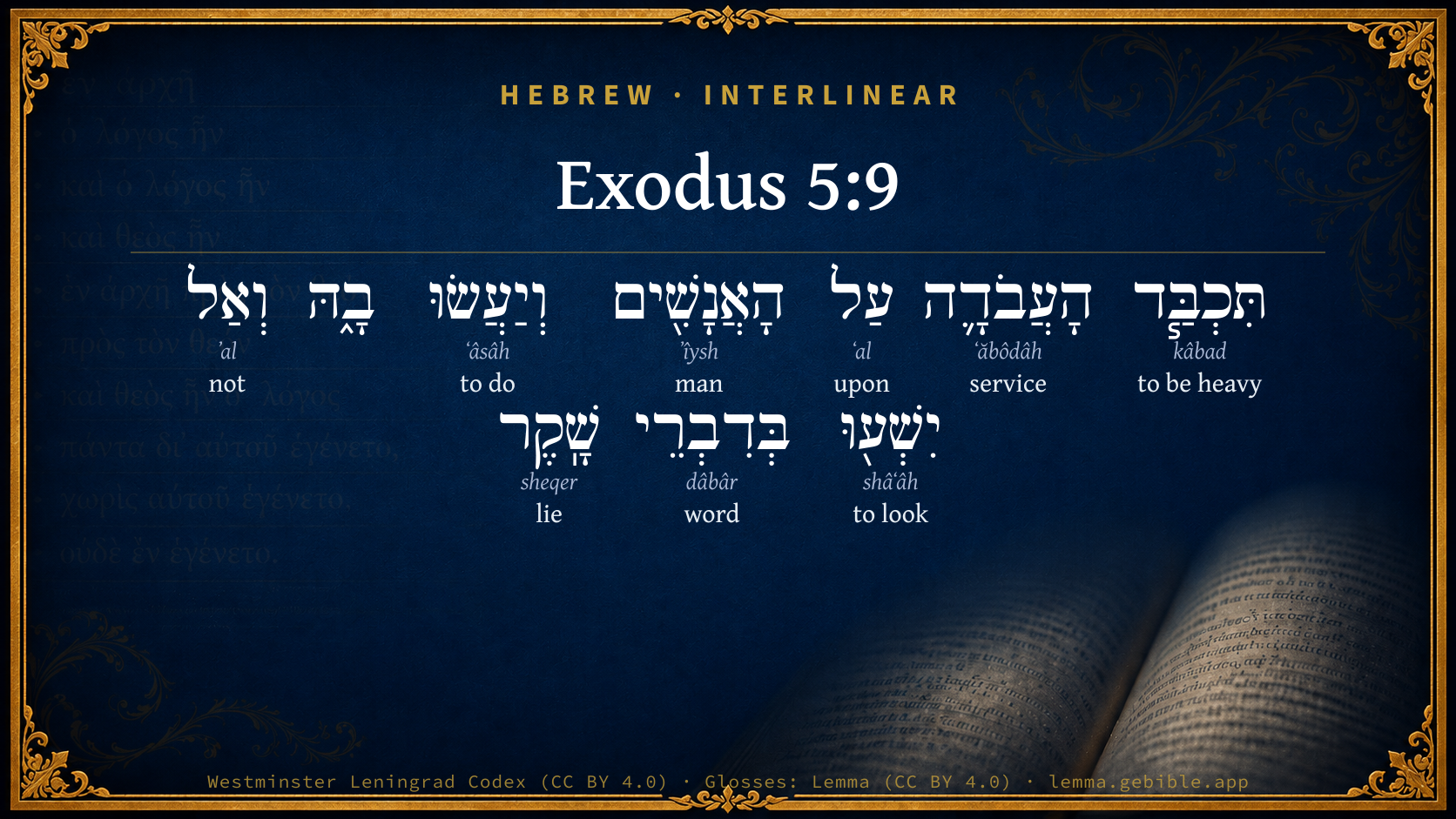
Hebrew (Westminster Leningrad Codex) Exodus 5:9 appears in the Hebrew Old Testament. The text above is from the Westminster Leningrad Codex. Each word links to its Strong’s number, a concise gloss, and parsing drawn from the Open Scriptures Hebrew Bible morphology. Click any word for its full Brown-Driver-Briggs (BDB) entry.
Download image
Cite this verse

Exodus 5:9 (World English Bible). Public Domain. Lemma interlinear Bible study tool, https://lemma.gebible.app/v/exodus/5/9.

Show BibTeX & RIS
BibTeX
RIS
English Translation
Let heavier work be laid on the men, that they may labor therein; and don't let them pay any attention to lying words."
World English Bible · Public Domain
Highlights
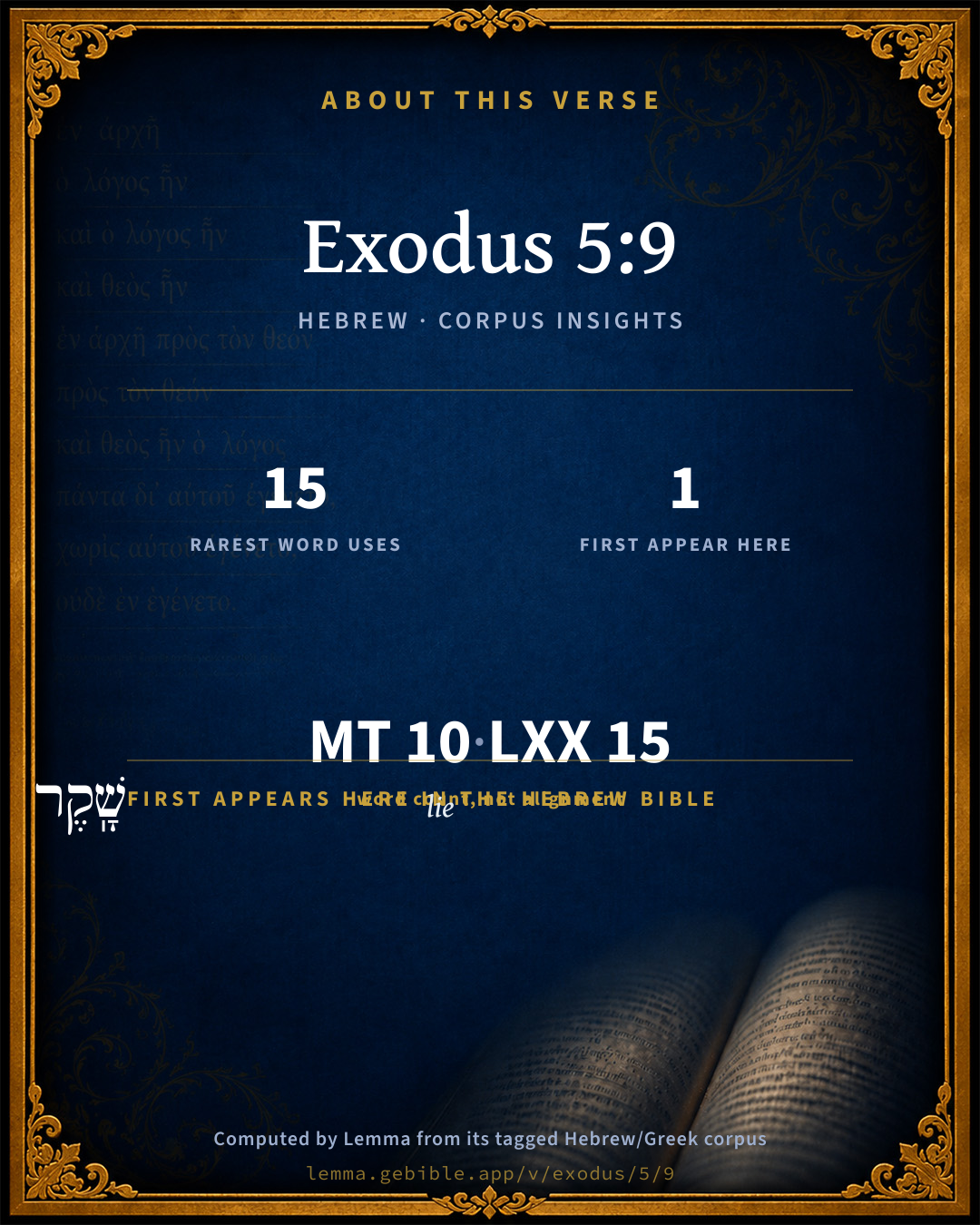
  • 1 first appearance in the Hebrew Bible
Full analysis ↓
Download a study sheet

One document with this verse’s original text, its word-by-word gloss line, the meaning frame, cross-references with their text, attributed commentary, and full source and license credits — printable, and it pastes into notes with its structure intact.

This verse Autodidact and up

Study sheet (.html) Plain text (.txt)

A passage Seminary Student

Up to 50 verses in one chapter. A passage sheet keeps up to 6 commentary sources and 12 cross-references per verse, in the order this page ranks them, and says so on the sheet whenever that leaves anything out. Ask for a single verse and you get the Autodidact verse sheet above.

Everything on this page stays free to read, with no account — the sheet is a download of what is already on screen, not access to it.

Want to remove ads? Support Godless Engineer
Compare translations 3

The same verse in 3 English versions, stacked beneath the original-language interlinear above. Click any original word for its lexicon entry.

Each is an independent rendering of the whole verse — the interlinear is not word-aligned to these translations.

Highlighted words mark where these versions differ — a whole-verse word diff, not a word-by-word alignment.

  • World English Bible Public Domain
    Let heavier work be laid on the men, that they may labor therein; and don't let them pay any attention to lying words."
  • King James Version Public Domain
    Let there more work be laid upon the men, that they may labor therein; and let them not regard vain words.
  • unfoldingWord Literal Text CC BY-SA 4.0
    Let the slavery be heavy on the men so they shall do it and shall not gaze at words of lies.”

unfoldingWord Literal Text — © unfoldingWord, licensed CC BY-SA 4.0. Word-aligned USFM3 via Door43 (git.door43.org/unfoldingWord/en_ult).

Versions to compare (up to 4)

3 of 4 selected

Show all 18 translations

Every available English version of this verse, each an independent rendering of the whole verse.

  • World English Bible Public Domain
    Let heavier work be laid on the men, that they may labor therein; and don't let them pay any attention to lying words."
  • Berean Standard Bible Public Domain
    Make the work harder on the men so they will be occupied and pay no attention to these lies.”
  • Majority Standard Bible Public Domain
    Make the work harder on the men so they will be occupied and pay no attention to these lies.”
  • King James Version Public Domain
    Let there more work be laid upon the men, that they may labor therein; and let them not regard vain words.
  • American Standard Version (1901) Public Domain
    Let heavier work be laid upon the men, that they may labor therein; and let them not regard lying words.
  • Revised Version (1885) Public Domain
    Let heavier work be laid upon the men, that they may labour therein; and let them not regard lying words.
  • Geneva Bible (1599) Public Domain
    Lay more worke vpon the men, and cause them to do it, and let the not regard vaine words.
  • Douay-Rheims (1899) Public Domain
    Let them be oppressed, with works, and let them fulfill them: that they may not regard lying words.
  • Young's Literal Translation Public Domain
    let the service be heavy on the men, and let them work at it, and not be dazzled by lying words.'
  • Literal Standard Version CC BY-SA 4.0
    let the service be heavy on the men, and let them work at it, and not be dazzled by lying words.”
  • Unlocked Literal Bible CC BY-SA 4.0
    Increase the workload for the men so that they keep at it and pay no more attention to deceptive words.”
  • unfoldingWord Literal Text CC BY-SA 4.0
    Let the slavery be heavy on the men so they shall do it and shall not gaze at words of lies.”
  • Darby Bible Public Domain
    Let them put heavier labour on the men, that they may be taken up with it, and not regard vain words.
  • World Messianic Bible Public Domain
    Let heavier work be laid on the men, that they may labor in it. Don’t let them pay any attention to lying words.”
  • Webster's Bible Public Domain
    Let more work be laid upon the men, that they may labor therein: and let them not regard vain words.
  • Free Bible Version CC BY-SA 4.0
    Make their work harder so they can get on with it and not pay any attention to all these lies!”
  • Bible in Basic English Public Domain
    Give the men harder work, and see that they do it; let them not give attention to false words.
  • JPS Tanakh (1917) Public Domain
    Let heavier work be laid upon the men, that they may labour therein; and let them not regard lying words.'

Literal Standard Version (2020), Covenant Press — licensed CC BY-SA 4.0. Text via the HelloAO Bible API (eBible.org). Unlocked Literal Bible (unfoldingWord) — licensed CC BY-SA 4.0. Text via the HelloAO Bible API (eBible.org). unfoldingWord Literal Text — © unfoldingWord, licensed CC BY-SA 4.0. Word-aligned USFM3 via Door43 (git.door43.org/unfoldingWord/en_ult). Free Bible Version, Dr. Jonathan Gallagher — licensed CC BY-SA 4.0. Text via the HelloAO Bible API (eBible.org).

Word by word

More ways to search: Search by grammar → Find every occurrence → Compare this word →

Practice this passage: Drill this verse → Learn its vocabulary →

יִשְׁע֖וּ
shâʻâh
H8159
“to look”
Verb, Qal, Jussive, 3rd Person, Masculine, Plural
Part of Speech
Verb
Stem
Qal
Form
Jussive
Person
3rd Person
Gender
Masculine
Number
Plural
Full BDB Definition

Origin: a primitive root

TWOT: 2429

to look at or to, regard, gaze at or about - (Qal) to gaze at, regard, behold, look about - (Hiphil) to look away, cause gaze to turn away - (Hithpael) to look in dismay, gaze about (in anxiety)
  1. תִּכְבַּ֧ד kâbad H3513 “to be heavy” Verb, Qal, Imperfect, 3rd Person, Feminine, Singular
  2. הָעֲבֹדָ֛ה ʻăbôdâh H5656 “the · service” Particle, Definite Article + Noun, Common, Feminine, Singular, Absolute
  3. עַל ʻal H5921 “upon” Preposition
  4. הָאֲנָשִׁ֖ים ʼîysh H376 “the · men” Particle, Definite Article + Noun, Common, Masculine, Plural, Absolute
  5. וְיַעֲשׂוּ ʻâsâh H6213 “and · to do” Conjunction + Verb, Qal, Imperfect, 3rd Person, Masculine, Plural
  6. וְאַל ʼal H408 “and · not” Conjunction + Particle, Negative
  7. בְּדִבְרֵי dâbâr H1697 “in/at · words of” Preposition + Noun, Common, Masculine, Plural, Construct
  8. שָֽׁקֶר sheqer H8267 “lie” Noun, Common, Masculine, Singular, Absolute

About this verse

These counts appear in no published source. They are computed here, from the morphology-tagged text and Lemma’s own curated glosses. What Lemma adds →

10
words
9
distinct lemmas
Pentateuch
section

Notable vocabulary

The rarest word here is יִשְׁע֖וּ to look H8159 — appearing just 15 times in the whole Hebrew Bible.

First appearance in Scripture

This word makes its first canonical appearance in the Hebrew Bible here:

  • שָֽׁקֶר lie H8267

Shared distinctive vocabulary

יִשְׁע֖וּ to look H8159 occurs in 15 verses of the Hebrew Bible. Also found in:

Grammatical profile

  • 3 verbs
  • 4 nouns
  • 2 prepositions
  • 1 particle

Verb forms

  • תִּכְבַּ֧ד Qal · Imperfect
  • וְיַעֲשׂוּ Qal · Imperfect
  • יִשְׁע֖וּ Qal · Jussive

Hebrew & Septuagint length

In English translation the verse runs 23 words from the Hebrew and 22 from the Septuagint (LXX English) — closely comparable.

A rough comparison of the two English renderings, which tokenize alike — not a word-level alignment.

Word counts can differ between the Hebrew and the Greek without any difference in meaning — e.g. the Hebrew direct-object marker אֵת has no separate Greek word, and Greek often adds the article ὁ.

In the original languages it is 10 Hebrew tokens and 15 Greek tokens — but the two are counted differently (Hebrew bundles its prefixes and suffixes into one token; the Greek is in lemma form), so that isn’t a like-for-like length.

Cross-references

6

Topical passages linked to Exodus 5:9 in the Treasury of Scripture Knowledge — connected by theme and wording, ordered by reader-vote popularity; previews shown in the World English Bible.

  • 2 Kings 18:20 You say (but they are but vain words), [There is] counsel and strength for the war. Now on whom do you trust, that you have rebelled against me?
  • Job 16:3 Shall vain words have an end? Or what provokes you that you answer?
  • Jeremiah 43:2 then spoke Azariah the son of Hoshaiah, and Johanan the son of Kareah, and all the proud men, saying to Jeremiah, You speak falsely: Yahweh our God has not sent you to say, You shall not go into Egypt to sojourn there;
  • Zechariah 1:6 But my words and my decrees, which I commanded my servants the prophets, didn't they overtake your fathers? "Then they repented and said, 'Just as Yahweh of Hosts determined to do to us, according to our ways, and according to our practices, so he has dealt with us.'"
  • Malachi 3:14 You have said, 'It is vain to serve God;' and 'What profit is it that we have kept his charge, and that we have walked mournfully before Yahweh of Hosts?
  • Ephesians 5:6 Let no one deceive you with empty words. For because of these things, the wrath of God comes on the children of disobedience.

Cross-references courtesy of OpenBible.info (CC BY 4.0).

Hebrew and Greek witnesses Masoretic Hebrew ↔ Greek Septuagint

The same verse in the two great witnesses to the Old Testament, shown verse-for-verse.

These are two independent witnesses, not word-aligned to each other, and the Septuagint is shown in lemma (dictionary) form.

Hebrew Exodus 5:9 Masoretic · Westminster Leningrad Codex

תִּכְבַּ֧ד הָעֲבֹדָ֛ה עַל הָאֲנָשִׁ֖ים וְיַעֲשׂוּ בָ֑הּ וְאַל יִשְׁע֖וּ בְּדִבְרֵי שָֽׁקֶר

Let heavier work be laid on the men, that they may labor therein; and don't let them pay any attention to lying words."

World English Bible · Public Domain

Greek LXX Exodus 5:9 Septuagint · lemma form

βαρύνω ὁ ἔργον ὁ ἄνθρωπος οὗτος καί μεριμνάω οὗτος καί μή μεριμνάω ἐν λόγος κενός

Let the works of these men be made grievous, and let them care for these things, and not care for vain words.

LXX2012 (modern English Septuagint) · Public Domain

Hebrew: Westminster Leningrad Codex (CC BY 4.0). Greek: Septuagint (public domain); English from LXX2012 (modern English Septuagint) (Public Domain). How the Septuagint differs from the Hebrew →

Targum (Aramaic paraphrase)

2

The Targum is the ancient Jewish Aramaic paraphrase of the Hebrew Scriptures — an interpretive translation, not the Hebrew text itself. Onkelos (literal) and Pseudo-Jonathan (expansive) render the Torah, and Jonathan the Prophets. Coverage is partial: where no permissively-licensed English translation exists for a verse, only the Aramaic is shown. This is verse-level text, not a word-by-word alignment to the Hebrew.

  1. Targum Onkelos Torah (Genesis–Deuteronomy)
    תִּתָּקַף פָּלְחָנָא עַל גֻבְרַיָא וְיִתְעַסְקוּן בַּהּ וְלָא יִתְעַסְקוּן בְּפִתְגָמִ ין בְּטֵלִין:

    (no public-domain English translation for this verse)

    Targum Onkelos — Aramaic: “Onkelos Genesis” (public domain); “Onkelos Exodus” (public domain); “Onkelos Leviticus” (public domain); “Onkelos Numbers” (public domain); “Onkelos Deuteronomy” (public domain). English: “Sefaria Community Translation” (CC0 1.0 (public-domain dedication)); “J.W. Etheridge. The Targums of Onkelos and Jonathan Ben Uzziel on the Pentateuch. London: Longmans, Green, 1862” (public domain). Text via Sefaria.

  2. Targum Pseudo-Jonathan Torah (Genesis–Deuteronomy)
    תִּתְקַף פּוּלְחָנָא עִלוֹי גוּבְרַיָא וְיִתְעַסְקוּן בָּה וְלָא יִתְרַחֲצוּן עַל מִילֵי שִׁקְרָא

    Make their work strenuous upon the men, that they may be occupied with it, and not be setting their hopes upon lying words.

    Targum Pseudo-Jonathan — Aramaic: “Targum Jonathan on Genesis” (public domain); “Targum Jonathan on Exodus” (public domain); “Targum Jonathan on Leviticus” (public domain); “Targum Jonathan on Numbers” (public domain); “Targum Jonathan on Deuteronomy” (public domain). English: “The Targum of Jonathan ben Uzziel, trans. J. W. Etheridge, London, 1862” (public domain). Text via Sefaria.

Commentary

Notes on Exodus 5:9 from classic Christian and Jewish commentators (each source and its license shown beneath its notes). The classic Christian expositions comment on the surrounding passage and are grouped to its opening verse, so a note may address several verses; the Jewish commentaries on the Tanakh (Rashi and others) are per-verse, so they appear only where the commentator wrote on this verse.

Lemma curates 59 commentaries, every one of them public domain or Creative Commons licensed, each selected and text-cleaned for this edition rather than reprinted as found. About our sources →

Trapp's Complete Commentary

John Trapp

Exo 5:9 Let there more work be laid upon the men, that they may labour therein; and let them not regard vain words.

Ver. 9. And not regard vain words.] Vain lying words. So this profane prince calleth and counteth the word of God. "What is truth?" saith Pilate, scoffingly.

John Trapp, A Commentary or Exposition upon All the Books of the Old and New Testament (1647–1656) — public domain. Text from a community e-Sword module.

Joseph Benson's Commentary

Exo 5:9. Vain words — Those of Moses and Aaron, which he said were vain, or false; that is, that they falsely pretended that their God had commanded them to go and worship, when it was only a crafty design of their own to advance themselves by raising sedition.

Joseph Benson's Commentary on the Old and New Testaments (1811–1818) — public domain. Text from a community e-Sword module.

Geneva Bible (1599)

Geneva Bible translators

The more cruelly that tyrants rage, the nearer is God’s help.

Of Moses and Aaron.

Geneva Bible (1599) marginal notes — public domain. Text via Bolls.life.

Ellicott's Commentary for English Readers

(9) Let them not regard vain words.—Or, false words. The reference is to the promises of deliverance wherewith Moses and Aaron had raised the people’s hopes (Exo_4:30). Pharaoh supposed these to be “vain words,” as Sennacherib did those spoken by Hezekiah (2Ki_18:20).

A Bible Commentary for English Readers, edited by Charles John Ellicott (1878–1897) — public domain. Text from a community e-Sword module.

The Cambridge Bible for Schools and Colleges

gen. ed. J. J. S. Perowne

9. Let them be fully occupied with their work, and have no time to regard ‘lying words,’ as if God had really demanded a pilgrimage of them.

The Cambridge Bible for Schools and Colleges (gen. ed. J. J. S. Perowne; Cambridge University Press, 1878–1918) — public domain. Text from a community e-Sword module.

John Gill's Exposition

Let there more work be laid upon the men,.... Instead of lessening it, let it be increased, or "be heavy" (k) upon them, that it may oppress and afflict them and keep them down, and weaken their strength and their spirits, and diminish them:

that they may labour therein; and have no leisure time to spend in idleness and sloth:

and let them not regard vain words; or "words of falsehood" (l) and lies, such as were spoken by Moses and Aaron, promising them liberty and deliverance from their bondage, which he was determined never to grant, and so eventually make such words to appear to be vain and empty, falsehood and lies.

(k) "aggravetur", Pagninus, Montanus, &c. (l) "in verbis mendacii", Pagninus, Montanus, Vatablus. "Verbis falsis", Junius & Tremellius, Piscator.

John Gill's Exposition of the Whole Bible (1746–1763) — public domain (CC PDM 1.0). Text via the HelloAO Bible API.

Haydock's Catholic Bible Commentary

Lying words, alluding to the proposals of Moses. (Haydock) -- Let them not spend their time in idle conversation. (Calmet)

George Leo Haydock (1774–1849), Haydock's Catholic Family Bible and Commentary, 1859 edition — public domain. Excludes Psalms (Douay-Rheims chapter numbering differs from Protestant) and Deuterocanonical books (Catholic canon only).

Matthew Poole's English Annotations

The words of Moses and Aaron, which are vain or false, i.e. which they falsely pretend to come from God, when it is only an ill design of their own to advance themselves by raising sedition.

Matthew Poole's English Annotations on the Holy Bible (1683–1685) — public domain. Text from a community e-Sword/MySword module.

The Pulpit Commentary

Ver. 9. Let there more work be laid upon the men. Rather, as in the margin, "Let the work be heavy upon the men." Let the tasks set them be such as to occupy all their time, and not leave them any spare moments in which they may be tempted to listen to mischievous talkers, like Moses and Aaron) who flatter them with vain (literally, lying, words). Pharaoh, no doubt, imagined that the hopes raised by the two brothers were vain and illusive. He was utterly blind as to the course which events were about to take.

Vain words.

There can be no doubt that "vain words" are unworthy of attention, deserve contempt, are foolish, unjustifiable. But what are "vain words"? What is the test whereby we are to know whether words are vain or not? Simply, the issue of them. Pharaoh thought that the promises of deliverance wherewith Moses and Aaron had excited the people were "vain words." Sennacherib described similarly the words of trust and confidence in God uttered by Hezekiah. (2Ki_18:20) The Athenians thought the same of St Paul"s words concerning the resurrection. (Act_17:32) But we know that, in none of these cases, were the words uttered "vain." The event justified or will justify them. When words then are uttered by any grave authority, especially if they are uttered in the name of God, we should hesitate to call them "vain." We should await the end. Full often, what the scoffer has called "vain words" turn out "words of truth and soberness words which tell with terrible force against those who have despised and rejected them words which to have heard and despised is condemnation in the sight of the Almighty.

The Pulpit Commentary (1880–1919), ed. H.D.M. Spence-Jones & Joseph S. Exell — public domain. Text from a community e-Sword module.

John Wesley's Explanatory Notes

Vain words - Those of Moses and Aaron.

John Wesley, Explanatory Notes Upon the Whole Bible (1754–1765) — public domain. Text via the GEBible commentary corpus.

Keil & Delitzsch

C. F. Keil & F. Delitzsch

"Let the work be heavy (press heavily) upon the people, and they shall make with it (i.e., stick to their work), and not look at lying words." By "lying words" the king meant the words of Moses, that the God of Israel had appeared to him, and demanded a sacrificial festival from His people. In Exo 5:11 special emphasis is laid upon אתּם "ye:" "Go, ye yourselves, fetch your straw," not others for you as heretofore; "for nothing is taken (diminished) from your work." The word כּי for has been correctly explained by Kimchi as supposing a parenthetical thought, et quidem alacriter vobis eundum est.

Keil & Delitzsch — Biblical Commentary on the Old Testament (1861–1891) — public domain (CC PDM 1.0). Text via the HelloAO Bible API. (Old Testament only.)

Rashi

Rabbi Shlomo Yitzchaki (Rashi)

ואל ישעו בדברי שקר AND LET THEM NOT REGARD VAIN WORDS — let them not think and speak always about “words of wind” saying, “Let us go and sacrifice”. Of similar meaning is, (Psalm 119:117) “And I will speak of (ואשעה ב־) thy statutes continually”. The phrase (Deuteronomy 28:37) למשל ולשנינה “[thou shalt become] a proverb and a byword” we translate in the Targum by “a topic of conversation (שועי)”, and the word ויספר (Genesis 24:66) “and he related” by ואשתעי “and he spoke about”. One cannot possibly say that the word ישעו has the same meaning as the verbs in (Genesis 4:4) “And the Lord turned (וישע) to Abel” and in (Genesis 4:4) “but to Cain and his offering he did not turn (שעה)”, and that we must translate אל ישעו by “Let them not turn”, for if this were so Scripture should have written אל דברי שקר or לדברי שקר (instead of בדברי) for so is the construction in all such cases. Examples are: (Isaiah 17:7) “A man shall turn to (ישעה אל) his Maker”; (Isaiah 17:8) “and he shall not turn to (ישעה על) the altars”; (Isaiah 31:1) “they turn not unto (שעו על) the Holy One of Israel”. I do not find the construction of a ב following these verbs in the sense of “turning to”, but after an expression of דבר “speaking” — as when one intently directs his conversation upon a matter — the construction with כ is quite an appropriate one. For instance: (Ezekiel 33:30) “those who intently direct their conversation (הנדברים) upon thee (בך)”; (Numbers 12:1) “And Miriam and Aaron directed their speech (ותדבר) upon Moses (במשה)”; (Zechariah 4:1) “And the angel who directed his conversaion (הדובר) upon me (בי)”; (Deuteronomy 11:9) “To turn your conversation (לדבר) intently upon them (בם)”; (Psalm 119:46) “And I will direct my speech (אדברה) upon thy testimonies (בעדותיך)”. So, too, here: ואל ישעו בדברי שקר means “let them not always be conversing about vain and idle matters”.

Rashi on the Tanakh — English translations: “The Judaica Press complete Tanach with Rashi, translated by A. J. Rosenberg” (CC BY 4.0); “Pentateuch with Rashi's commentary by M. Rosenbaum and A.M. Silbermann, 1929-1934” (public domain); “The Metsudah Tanach series, Lakewood, N.J” (CC BY 4.0); and “The Book of Joshua, Metsudah Publications, 1997” (CC BY 4.0). Text via Sefaria.

Lesson kit

Teaching starters — assembled from the data on this page, not authored interpretation. Every prompt links to the verse data it draws on. Edit before teaching.

Exodus, in the Pentateuch, opens this verse with 10 words (9 distinct Hebrew lemmas). Its most distinctive word is shâʻâh (“to look”). A historical commentator’s framing appears above. Read the whole chapter for the surrounding context.

Discussion questions

  1. The word shâʻâh carries the sense “to look.” How does it shape the verse?
  2. The word “lie” first appears here in Scripture. What is being introduced at this debut?
  3. Genesis 4:4 shares the word «to look» with this verse. How do the two illuminate each other?
  4. The translations on this page render this verse differently — a whole-verse word diff, not a word-by-word alignment. What might account for the different wordings?
  5. The verb «תִּכְבַּ֧ד» is Qal Imperfect. How does its form color the action?
  6. Reading how Trapp's Complete Commentary and Joseph Benson's Commentary read this verse, where do the two commentators agree and where do they part?

Things to notice

Reading settings

Reading text

Shown beneath each verse's original-language words.

Old Testament
Old Testament edition

Read the OT as the Masoretic Hebrew (MT) or the Greek Septuagint (LXX).

English shown for the Greek Septuagint (in the Hebrew ↔ Greek comparison).

Comparing translations? Open the Compare panel on any verse page to stack up to four side by side.