
Exodus 21:29

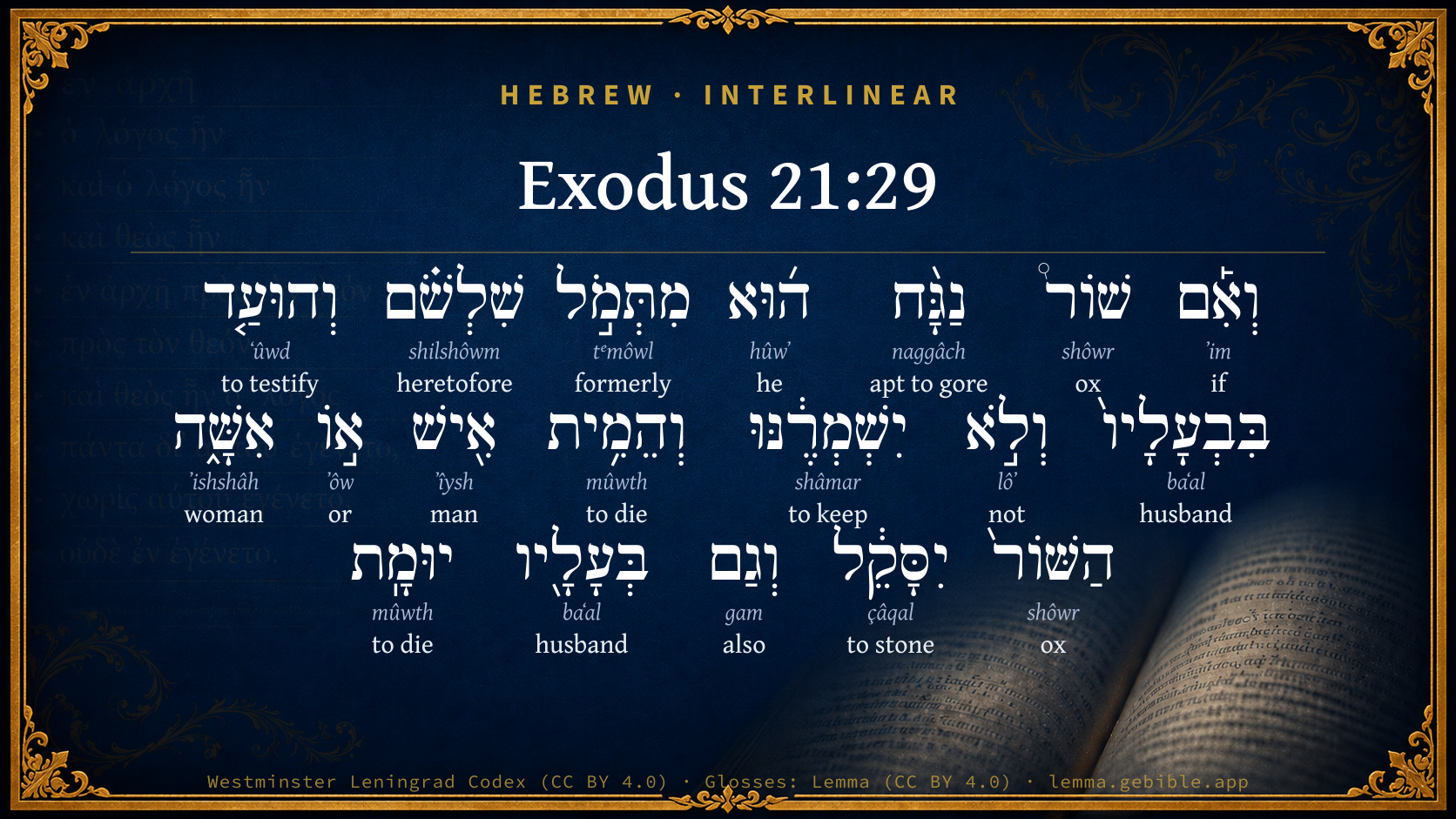
Hebrew (Westminster Leningrad Codex) Exodus 21:29 appears in the Hebrew Old Testament. The text above is from the Westminster Leningrad Codex. Each word links to its Strong’s number, a concise gloss, and parsing drawn from the Open Scriptures Hebrew Bible morphology. Click any word for its full Brown-Driver-Briggs (BDB) entry.
Download image
Cite this verse

Exodus 21:29 (World English Bible). Public Domain. Lemma interlinear Bible study tool, https://lemma.gebible.app/v/exodus/21/29.

Show BibTeX & RIS
BibTeX
RIS
English Translation
But if the bull had a habit of goring in the past, and it has been testified to its owner, and he has not kept it in, but it has killed a man or a woman, the bull shall be stoned, and its owner shall also be put to death.
World English Bible · Public Domain
Highlights
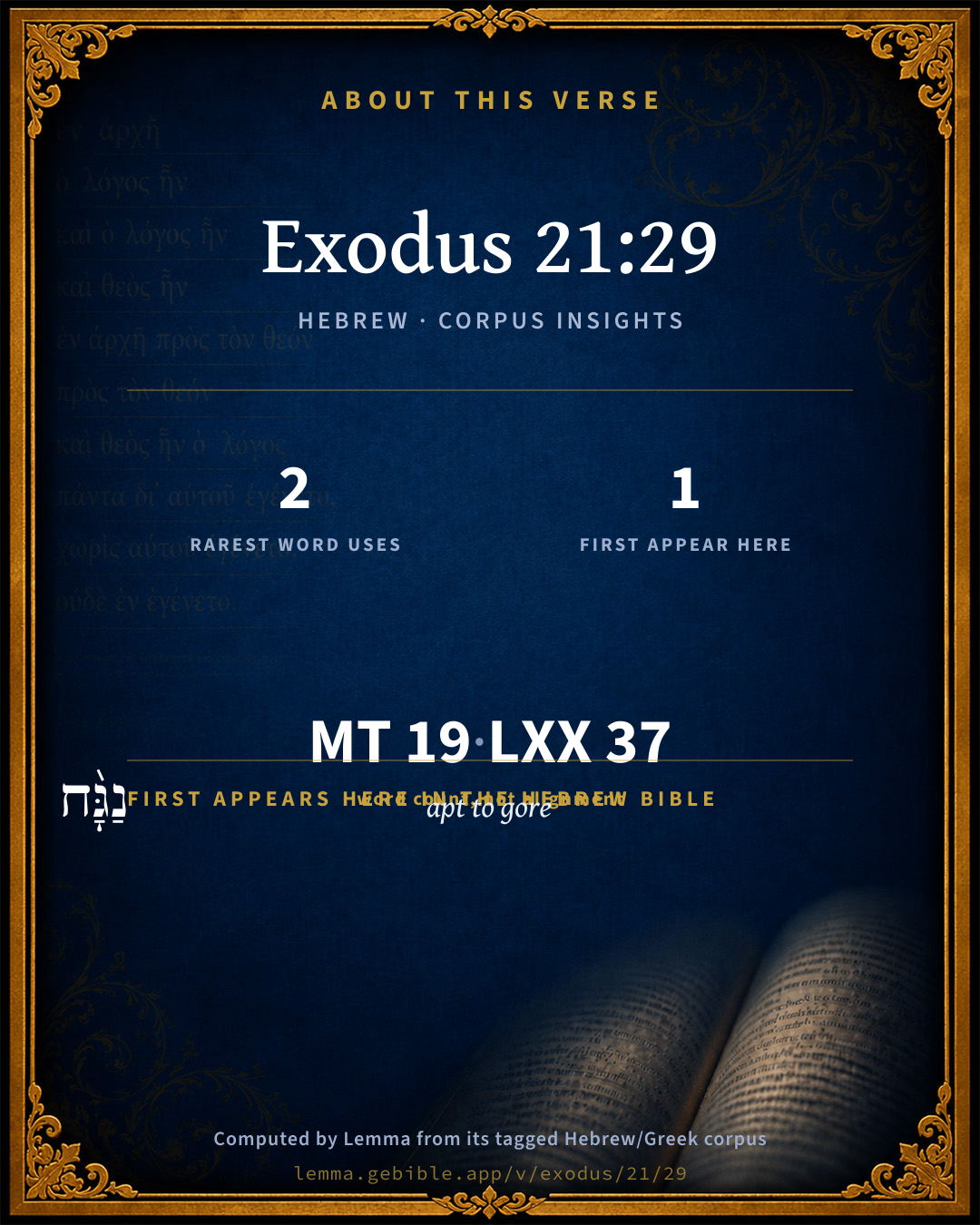
  • 1 first appearance in the Hebrew Bible
Full analysis ↓
Download a study sheet

One document with this verse’s original text, its word-by-word gloss line, the meaning frame, cross-references with their text, attributed commentary, and full source and license credits — printable, and it pastes into notes with its structure intact.

This verse Autodidact and up

Study sheet (.html) Plain text (.txt)

A passage Seminary Student

Up to 50 verses in one chapter. A passage sheet keeps up to 6 commentary sources and 12 cross-references per verse, in the order this page ranks them, and says so on the sheet whenever that leaves anything out. Ask for a single verse and you get the Autodidact verse sheet above.

Everything on this page stays free to read, with no account — the sheet is a download of what is already on screen, not access to it.

Want to remove ads? Support Godless Engineer
Compare translations 3

The same verse in 3 English versions, stacked beneath the original-language interlinear above. Click any original word for its lexicon entry.

Each is an independent rendering of the whole verse — the interlinear is not word-aligned to these translations.

Highlighted words mark where these versions differ — a whole-verse word diff, not a word-by-word alignment.

  • World English Bible Public Domain
    But if the bull had a habit of goring in the past, and it has been testified to its owner, and he has not kept it in, but it has killed a man or a woman, the bull shall be stoned, and its owner shall also be put to death.
  • King James Version Public Domain
    But if the ox were wont to push with his horn in time past, and it hath been testified to his owner, and he hath not kept him in, but that he hath killed a man or a woman; the ox shall be stoned, and his owner also shall be put to death.
  • unfoldingWord Literal Text CC BY-SA 4.0
    But if the ox had a habit of goring in the past, and its owner was warned but did not keep it in, and it kills a man or a woman, the ox shall be stoned and its owner also shall be put to death.

unfoldingWord Literal Text — © unfoldingWord, licensed CC BY-SA 4.0. Word-aligned USFM3 via Door43 (git.door43.org/unfoldingWord/en_ult).

Versions to compare (up to 4)

3 of 4 selected

Show all 18 translations

Every available English version of this verse, each an independent rendering of the whole verse.

  • World English Bible Public Domain
    But if the bull had a habit of goring in the past, and it has been testified to its owner, and he has not kept it in, but it has killed a man or a woman, the bull shall be stoned, and its owner shall also be put to death.
  • Berean Standard Bible Public Domain
    But if the ox has a habit of goring, and its owner has been warned yet does not restrain it, and it kills a man or woman, then the ox must be stoned and its owner must also be put to death.
  • Majority Standard Bible Public Domain
    But if the ox has a habit of goring, and its owner has been warned yet does not restrain it, and it kills a man or woman, then the ox must be stoned and its owner must also be put to death.
  • King James Version Public Domain
    But if the ox were wont to push with his horn in time past, and it hath been testified to his owner, and he hath not kept him in, but that he hath killed a man or a woman; the ox shall be stoned, and his owner also shall be put to death.
  • American Standard Version (1901) Public Domain
    But if the ox was wont to gore in time past, and it hath been testified to its owner, and he hath not kept it in, but it hath killed a man or a woman, the ox shall be stoned, and its owner also shall be put to death.
  • Revised Version (1885) Public Domain
    But if the ox were wont to gore in time past, and it hath been testified to his owner, and he hath not kept him in, but that he hath killed a man or a woman; the ox shall be stoned, and his owner also shall be put to death.
  • Geneva Bible (1599) Public Domain
    If the oxe were wont to push in times past, and it hath bene tolde his master, and hee hath not kept him, and after he killeth a man or a woman, the oxe shall be stoned, and his owner shall die also.
  • Douay-Rheims (1899) Public Domain
    But if the ox was wont to push with his horn yesterday and the day before, and they warned his master, and he did not shut him up, and he shall kill a man or a woman: then the ox shall be stoned, an his owner also shall be put to death.
  • Young's Literal Translation Public Domain
    and if the ox is `one' accustomed to gore heretofore, and it hath been testified to its owner, and he doth not watch it, and it hath put to death a man or woman, the ox is stoned, and its owner also is put to death.
  • Literal Standard Version CC BY-SA 4.0
    and if the ox is [one] accustomed to gore before, and it has been testified to its owner, and he does not watch it, and it has put to death a man or woman, the ox is stoned, and its owner is also put to death.
  • Unlocked Literal Bible CC BY-SA 4.0
    But if the ox had a habit of goring in the past, and its owner was warned but did not keep it in, and the ox has killed a man or a woman, that ox must be stoned, and its owner also must be put to death.
  • unfoldingWord Literal Text CC BY-SA 4.0
    But if the ox had a habit of goring in the past, and its owner was warned but did not keep it in, and it kills a man or a woman, the ox shall be stoned and its owner also shall be put to death.
  • Darby Bible Public Domain
    But if the ox have gored heretofore, and it have been testified to its owner, and he have not kept it in, and it kill a man or a woman, -- the ox shall be stoned, and its owner also shall be put to death.
  • World Messianic Bible Public Domain
    But if the bull had a habit of goring in the past, and this has been testified to its owner, and he has not kept it in, but it has killed a man or a woman, the bull shall be stoned, and its owner shall also be put to death.
  • Webster's Bible Public Domain
    But if the ox was accustomed to push with his horn in time past, and it hath been testified to his owner, and he hath not restrained him, but that he hath killed a man or a woman; the ox shall be stoned, and his owner also shall be put to death.
  • Free Bible Version CC BY-SA 4.0
    But if the ox has repeatedly hurt people with its horns, and its owner has been warned but still doesn't keep it under control, and it kills a man or woman, then the ox must be stoned to death and its owner must also be executed.
  • Bible in Basic English Public Domain
    But if the ox has frequently done such damage in the past, and the owner has had word of it and has not kept it under control, so that it has been the cause of the death of a man or woman, not only is the ox to be stoned, but its owner is to be put to death.
  • JPS Tanakh (1917) Public Domain
    But if the ox was wont to gore in time past, and warning hath been given to its owner, and he hath not kept it in, but it hath killed a man or a woman; the ox shall be stoned, and its owner also shall be put to death.

Literal Standard Version (2020), Covenant Press — licensed CC BY-SA 4.0. Text via the HelloAO Bible API (eBible.org). Unlocked Literal Bible (unfoldingWord) — licensed CC BY-SA 4.0. Text via the HelloAO Bible API (eBible.org). unfoldingWord Literal Text — © unfoldingWord, licensed CC BY-SA 4.0. Word-aligned USFM3 via Door43 (git.door43.org/unfoldingWord/en_ult). Free Bible Version, Dr. Jonathan Gallagher — licensed CC BY-SA 4.0. Text via the HelloAO Bible API (eBible.org).

Word by word

More ways to search: Search by grammar → Find every occurrence → Compare this word →

Practice this passage: Drill this verse → Learn its vocabulary →

נַגָּ֨ח
naggâch
H5056
“apt to gore”
Adjective, Adjective, Masculine, Singular, Absolute
Part of Speech
Adjective
Type
Adjective
Gender
Masculine
Number
Singular
State
Absolute
Full BDB Definition

Origin: from H5055

TWOT: 1291a

addicted to goring, apt to gore
  1. וְאִ֡ם ʼim H518 “and · if” Conjunction + Conjunction
  2. שׁוֹר֩ shôwr H7794 “ox” Noun, Common, Masculine, Singular, Absolute
  3. ה֜וּא hûwʼ H1931 “he” Pronoun, Personal, 3rd Person, Masculine, Singular
  4. מִתְּמֹ֣ל tᵉmôwl H8543 “from · formerly” Preposition + Adverb
  5. שִׁלְשֹׁ֗ם shilshôwm H8032 “heretofore” Adverb
  6. וְהוּעַ֤ד ʻûwd H5749 “and · to testify” Conjunction + Verb, Hophal, Sequential Perfect, 3rd Person, Masculine, Singular
  7. בִּבְעָלָיו֙ baʻal H1167 “in/at · husbands · his” Preposition + Noun, Common, Masculine, Plural, Construct + Suffix, Personal, 3rd Person, Masculine, Singular
  8. וְלֹ֣א lôʼ H3808 “and · not” Conjunction + Particle, Negative
  9. יִשְׁמְרֶ֔נּוּ shâmar H8104 “to keep · him” Verb, Qal, Imperfect, 3rd Person, Masculine, Singular + Suffix, Personal, 3rd Person, Masculine, Singular
  10. וְהֵמִ֥ית mûwth H4191 “and · to die” Conjunction + Verb, Hiphil, Sequential Perfect, 3rd Person, Masculine, Singular
  11. אִ֖ישׁ ʼîysh H376 “man” Noun, Common, Masculine, Singular, Absolute
  12. א֣וֹ ʼôw H176 “or” Conjunction
  13. אִשָּׁ֑ה ʼishshâh H802 “woman” Noun, Common, Feminine, Singular, Absolute
  14. הַשּׁוֹר֙ shôwr H7794 “the · ox” Particle, Definite Article + Noun, Common, Masculine, Singular, Absolute
  15. יִסָּקֵ֔ל çâqal H5619 “to stone” Verb, Niphal, Imperfect, 3rd Person, Masculine, Singular
  16. וְגַם gam H1571 “and · also” Conjunction + Particle, Accusative
  17. בְּעָלָ֖יו baʻal H1167 “husbands · his” Noun, Common, Masculine, Plural, Construct + Suffix, Personal, 3rd Person, Masculine, Singular
  18. יוּמָֽת mûwth H4191 “to die” Verb, Hophal, Imperfect, 3rd Person, Masculine, Singular

About this verse

These counts appear in no published source. They are computed here, from the morphology-tagged text and Lemma’s own curated glosses. What Lemma adds →

19
words
16
distinct lemmas
Pentateuch
section

Notable vocabulary

The rarest word here is נַגָּ֨ח apt to gore H5056 — appearing just 2 times in the whole Hebrew Bible.

First appearance in Scripture

This word makes its first canonical appearance in the Hebrew Bible here:

  • נַגָּ֨ח apt to gore H5056

Shared distinctive vocabulary

נַגָּ֨ח apt to gore H5056 occurs in 2 verses of the Hebrew Bible. Also found in:

Grammatical profile

  • 5 verbs
  • 6 nouns
  • 1 adjective
  • 1 pronoun
  • 2 conjunctions
  • 2 adverbs
  • 2 particles

Verb forms

  • וְהוּעַ֤ד Hophal · Sequential Perfect
  • יִשְׁמְרֶ֔נּוּ Qal · Imperfect
  • וְהֵמִ֥ית Hiphil · Sequential Perfect
  • יִסָּקֵ֔ל Niphal · Imperfect
  • יוּמָֽת Hophal · Imperfect

Repetition

Words recur within this verse — often emphatic in Hebrew:

  • שׁוֹר֩ ox H7794 ×2
  • בִּבְעָלָיו֙ husband H1167 ×2
  • וְהֵמִ֥ית to die H4191 ×2

Hebrew & Septuagint length

In English translation the verse runs 50 words from the Hebrew and 46 from the Septuagint (LXX English) — closely comparable.

A rough comparison of the two English renderings, which tokenize alike — not a word-level alignment.

Word counts can differ between the Hebrew and the Greek without any difference in meaning — e.g. the Hebrew direct-object marker אֵת has no separate Greek word, and Greek often adds the article ὁ.

In the original languages it is 19 Hebrew tokens and 37 Greek tokens — but the two are counted differently (Hebrew bundles its prefixes and suffixes into one token; the Greek is in lemma form), so that isn’t a like-for-like length.

Cross-references

1

Topical passages linked to Exodus 21:29 in the Treasury of Scripture Knowledge — connected by theme and wording, ordered by reader-vote popularity; previews shown in the World English Bible.

  • Deuteronomy 21:1–9 If one be found slain in the land which Yahweh your God gives you to possess it, lying in the field, and it isn't known who has struck him;

Cross-references courtesy of OpenBible.info (CC BY 4.0).

Hebrew and Greek witnesses Masoretic Hebrew ↔ Greek Septuagint

The same verse in the two great witnesses to the Old Testament, shown verse-for-verse.

These are two independent witnesses, not word-aligned to each other, and the Septuagint is shown in lemma (dictionary) form.

Hebrew Exodus 21:29 Masoretic · Westminster Leningrad Codex

וְאִ֡ם שׁוֹר֩ נַגָּ֨ח ה֜וּא מִתְּמֹ֣ל שִׁלְשֹׁ֗ם וְהוּעַ֤ד בִּבְעָלָיו֙ וְלֹ֣א יִשְׁמְרֶ֔נּוּ וְהֵמִ֥ית אִ֖ישׁ א֣וֹ אִשָּׁ֑ה הַשּׁוֹר֙ יִסָּקֵ֔ל וְגַם בְּעָלָ֖יו יוּמָֽת

But if the bull had a habit of goring in the past, and it has been testified to its owner, and he has not kept it in, but it has killed a man or a woman, the bull shall be stoned, and its owner shall also be put to death.

World English Bible · Public Domain

Greek LXX Exodus 21:29 Septuagint · lemma form

ἐάν δέ ὁ ταῦρος κερατιστής εἰμί πρό ὁ χθές καί πρό ὁ τρίτος καί διαμαρτύρομαι ὁ κύριος αὐτός καί μή ἀπο ἀναἵζω αὐτός ἀναἔρχομαι δέ ἀνήρ ἤ γυνή ὁ ταῦρος λιθοβολέω καί ὁ κύριος αὐτός προσ ἀποθνήσκω

But if the bull should have been given to goring in former time, and men should have told his owner, and he have not removed him, but he should have slain a man or woman, the bull shall be stoned, and his owner shall die also.

LXX2012 (modern English Septuagint) · Public Domain

Hebrew: Westminster Leningrad Codex (CC BY 4.0). Greek: Septuagint (public domain); English from LXX2012 (modern English Septuagint) (Public Domain). How the Septuagint differs from the Hebrew →

Targum (Aramaic paraphrase)

2

The Targum is the ancient Jewish Aramaic paraphrase of the Hebrew Scriptures — an interpretive translation, not the Hebrew text itself. Onkelos (literal) and Pseudo-Jonathan (expansive) render the Torah, and Jonathan the Prophets. Coverage is partial: where no permissively-licensed English translation exists for a verse, only the Aramaic is shown. This is verse-level text, not a word-by-word alignment to the Hebrew.

  1. Targum Onkelos Torah (Genesis–Deuteronomy)
    וְאִם תּוֹר נַגַח הוּא מֵאִתְּמַלֵי וּמִדְקַמוֹהִי וְיִתַּסְהֵד בְּמָרֵהּ וְלָא נַטְרֵהּ וְיִקְטוֹל גַבְרָא אוֹ אִתְּתָא תּוֹרָא יִתְרְגֵם וְאַף מָרֵהּ יִתְקְטֵל:

    (no public-domain English translation for this verse)

    Targum Onkelos — Aramaic: “Onkelos Genesis” (public domain); “Onkelos Exodus” (public domain); “Onkelos Leviticus” (public domain); “Onkelos Numbers” (public domain); “Onkelos Deuteronomy” (public domain). English: “Sefaria Community Translation” (CC0 1.0 (public-domain dedication)); “J.W. Etheridge. The Targums of Onkelos and Jonathan Ben Uzziel on the Pentateuch. London: Longmans, Green, 1862” (public domain). Text via Sefaria.

  2. Targum Pseudo-Jonathan Torah (Genesis–Deuteronomy)
    וְאִין תּוֹר נַגְשָׁן הוּא מֵאִתְמְלֵי וּמִדְקֳדָמוֹי וְאִתַּסְהַד עַל אַנְפֵּי מָרֵיהּ תְּלָתֵי זִמְנֵי וְלָא נַטְרֵיהּ וּמִבָּתַר כֵּן קָטֵל גַּבְרָא אוֹ אִיתָא תּוֹרָא יִתְרְגֵם וְאוּף מָרֵיהּ יִתְקְטֵיל בְּמִיתוּתָא דְמִשְׁתַּלְחָא עֲלוֹי מִן שְׁמַיָא

    But if the ox (had been wont) to gore yesterday and before, and it had been attested before his owner three times, and he (had neglected) to restrain him, the ox, when he killeth man or woman, shall be stoned, and his master also shall die with a death sent upon him from heaven.

    Targum Pseudo-Jonathan — Aramaic: “Targum Jonathan on Genesis” (public domain); “Targum Jonathan on Exodus” (public domain); “Targum Jonathan on Leviticus” (public domain); “Targum Jonathan on Numbers” (public domain); “Targum Jonathan on Deuteronomy” (public domain). English: “The Targum of Jonathan ben Uzziel, trans. J. W. Etheridge, London, 1862” (public domain). Text via Sefaria.

Commentary

Notes on Exodus 21:29 from classic Christian and Jewish commentators (each source and its license shown beneath its notes). The classic Christian expositions comment on the surrounding passage and are grouped to its opening verse, so a note may address several verses; the Jewish commentaries on the Tanakh (Rashi and others) are per-verse, so they appear only where the commentator wrote on this verse.

Lemma curates 59 commentaries, every one of them public domain or Creative Commons licensed, each selected and text-cleaned for this edition rather than reprinted as found. About our sources →

Trapp's Complete Commentary

John Trapp

Exo 21:29 But if the ox were wont to push with his horn in time past, and it hath been testified to his owner, and he hath not kept him in, but that he hath killed a man or a woman; the ox shall be stoned, and his owner also shall be put to death.

Ver. 29. That he hath killed a man, &c.] Since the fall, all creatures are armed against us; as that sword which Hector gave Ajax: which so long as he used against men, his enemies, served for help and defence: but after he began to abuse it to the hurt of hurtless beasts, it turned into his own bowels.

John Trapp, A Commentary or Exposition upon All the Books of the Old and New Testament (1647–1656) — public domain. Text from a community e-Sword module.

Geneva Bible (1599)

Geneva Bible translators

Or, testified to his.

Geneva Bible (1599) marginal notes — public domain. Text via Bolls.life.

Ellicott's Commentary for English Readers

(29) His owner also shall be put to death.—It seems clear that under this law the representatives of the slain person might have exacted life for life; but probably they would in almost all cases have been ready to accept a compensation.

A Bible Commentary for English Readers, edited by Charles John Ellicott (1878–1897) — public domain. Text from a community e-Sword module.

The Cambridge Bible for Schools and Colleges

gen. ed. J. J. S. Perowne

29. If, however, the owner of the animal had been warned that it was vicious, and had taken no precautions to keep it in, he is held responsible, if it kills any one, and must suffer the penalty of death himself.

The Cambridge Bible for Schools and Colleges (gen. ed. J. J. S. Perowne; Cambridge University Press, 1878–1918) — public domain. Text from a community e-Sword module.

John Gill's Exposition

But if the ox were wont to push with his horns in time past,.... Or "from or before yesterday, to the third" (m) that is, three days before, and had made three pushes, as Jarchi explains it:

and it hath been testified to his owner; by sufficient witnesses, who saw him push at people for three days past: the Targum of Jonathan is,"and it hath been testified to the face of his owner three days.''Concerning this testimony Maimonides (n) thus writes,"this is a testification, all that testify of it three days; but if he pushes, or bites, or kicks, or strikes even an hundred times on one day, this is no testification (not a sufficient one): three companies of witnesses testify of it in one day, lo, this is a doubt, whether it is a (proper) testimony or not; there is no testification but before the owner, and before the sanhedrim:"

and he hath not kept him in; in some enclosed place, house or field, not frequented by people, and where there was no danger of doing any hurt, if this care was not taken, after a proper testimony had been given of his vicious disposition. By the Roman laws (o) oxen that pushed with their horns were to have hay bound about them, that those that met them might beware of them; hence that of Horace (p): but that he hath killed a man or a woman; by pushing and goring them with his horns, or any other way, as biting or kicking:

the ox shall be stoned; as is provided for the preceding law:

and his owner shall be put to death; since he was accessory to the death of the person killed, not keeping in his beast, when he had sufficient notice of his vicious temper: the Targum of Jonathan, and so other Jewish writers, interpret this of death sent upon him from heaven, or death by the immediate hand of God, as sudden death, or death by some disease inflicted, or before a man is fifty years of age; but there is no doubt to be made but this intends death by the civil magistrate, according to the original law, Gen 9:6.

(m) "ab heri et nudiustertius", Pagninus, Montanus, Vatablus, Piscator, Drusius. (n) Hilchot Niske Mammon, c. 6. sect. 1, 2. (o) Plutarch. in Crasso. (p) "Foenum habet in cornu, longe fuge". Horat. Sermon. l. 1. Satyr. 4.

John Gill's Exposition of the Whole Bible (1746–1763) — public domain (CC PDM 1.0). Text via the HelloAO Bible API.

Matthew Poole's English Annotations

It hath been testified, which the Jews say was to be done thrice, and before the magistrate.

A man or a woman, to wit, an Israelite, or a stranger who is free, by comparing this with Exo 21:32.

Matthew Poole's English Annotations on the Holy Bible (1683–1685) — public domain. Text from a community e-Sword/MySword module.

The Pulpit Commentary

If the ox were wont to push with his horns. If he were notoriously, and to his owner"s knowledge, a dangerous animal, which required watching, and no watch was kept on him, then the owner became blame-able, and having by his neglect contributed to a homicide, was "guilty of death."

The Pulpit Commentary (1880–1919), ed. H.D.M. Spence-Jones & Joseph S. Exell — public domain. Text from a community e-Sword module.

Rashi

Rabbi Shlomo Yitzchaki (Rashi)

מתמל שלשם [BUT IF THE OX HAS BEEN WONT TO THRUST] YESTERDAY AND BEFORE YESTERDAY — Here you have including the present occasion the three times an ox must gore before it can be declared a מועד (Bava Kamma 23b).‎

והועד בבעליו AND IT HATH BEEN TESTIFIED TO HIS OWNER — הועד (from the root עוד) is an expression for warning through witnesses (Bava Kamma 24a), as in, (Genesis 43:3) “the man hath solemnly forewarned (הָעֵד הַעִד) us”.

והמית איש וגו׳ BUT HE HATH PUT TO DEATH A MAN [OR WOMAN] — Since it states, (v. 28) “If an ox gore (יגח) [a man or a woman, that he die]” I might say that I have only the law dealing with the case that it kills by pushing him with the horn (the root נגח being mainly used of thrusting with the horn, cf. e.g., Deuteronomy 33:17) but whence can the law be derived that it applies also to the case where it kills by biting, thrusting, or kicking? Scripture therefore states “he hath put to death [a man or a woman]” thus intimating that so long as death is caused by the animal it is liable to stoning.

וגם בעליו יומת AND HIS OWNER ALSO SHALL BE PUT TO DEATH by a visitation of God. You might perhaps think he shall be punished by human agency (the judges)! Scripture, however, states, (Numbers 35:21) “he that smote him (a human being) shall surely be put to death; for he is a murderer” — the force of these last words is to intimate that for a murder committed by himself you shall put him to death (i. e. he suffers death by human agency as is the law regarding a murderer), but you shall not put him to death on account of a murder committed by his ox; this must be left to God (Sanhedrin 15b; cf. also Mekhilta).

Rashi on the Tanakh — English translations: “The Judaica Press complete Tanach with Rashi, translated by A. J. Rosenberg” (CC BY 4.0); “Pentateuch with Rashi's commentary by M. Rosenbaum and A.M. Silbermann, 1929-1934” (public domain); “The Metsudah Tanach series, Lakewood, N.J” (CC BY 4.0); and “The Book of Joshua, Metsudah Publications, 1997” (CC BY 4.0). Text via Sefaria.

Ramban (Nachmanides)

Rabbi Moshe ben Nachman (Ramban / Nachmanides)

AND ITS OWNER SHALL BE PUT TO DEATH. Our Rabbis have received by Tradition that this death means by the hand of Heaven. Similar cases are these verses: and the common man that draweth nigh shall be put to death; and they die therein, if they profane it. I have noticed that where the Torah speaks of those liable to be put to death by the court, it does not mention just yumoth (he shall be put to death), but always says, moth yumoth (he shall surely be put to death). Do not object to this rule from the verse, and he that killeth a man ‘yumoth’ (shall be put to death),! or from the verse about the Sabbath, (further 35:2), and his punishment is death by the court! or a prophet who misleads, (Deuteronomy 13:6), and there too his punishment is by the court (Sanhedrin 84 a). for in each of these cases He has already clearly explained elsewhere about them [that they are liable to death by the court, by using the phrase: moth yumoth]..Now I do not know the reason for Onkelos’ rendering yumoth as yithk’teil [“he shall be killed”, which indicates that his death is to be by the court, instead of by the hand of Heaven]. Perhaps his intention is to state that the owner, [who had been previously warned that his ox had gored three times, but still did not guard it, so that it went out and killed a man or woman], deserves to be put to death, but is instead made liable to the payment of a ransom. Or perhaps Onkelos means to explain that that which Scripture states, and its owner also shall be put to death means that the owner will perish in a similar manner to that by which the gored person was killed, for his day shall come to die, or he shall go down into battle, and be swept away; the Eternal will not hold him guiltless. Thus Onkelos wanted to teach us that the owner of the ox is liable, according to the view of Heaven, to die by the hand of a killer, and not by a natural death, something like it is said, and I will kill you with the sword. In the verse, and the common man that draweth nigh shall be put to death, Onkelos also translated yumoth as yithk’teil [“he shall be killed,” indicating that his death is to be by the court], because he agrees with the opinion of Rabbi Akiba who said that a non-priest who performed the Divine service in the Sanctuary is put to death by strangulation.

Ramban (Nachmanides) on the Tanakh — English translation: “Commentary on the Torah by Ramban (Nachmanides). Translated and annotated by Charles B. Chavel. New York, Shilo Pub. House, 1971-1976” (CC BY 4.0). Text via Sefaria.

Sforno

Rabbi Ovadia Sforno

And the owner shall also die. He incurs death at the hands of heaven when there are no witnesses to impose upon him the atonement fine.

Sforno on the Tanakh — English translation: “Yalkut, Sifsei Chachomim Chumash, Metsudah Publications, 2009” (CC BY 4.0). Text via Sefaria.

Lesson kit

Teaching starters — assembled from the data on this page, not authored interpretation. Every prompt links to the verse data it draws on. Edit before teaching.

Exodus, in the Pentateuch, opens this verse with 19 words (16 distinct Hebrew lemmas). Its most distinctive word is naggâch (“apt to gore”). A historical commentator’s framing appears above. Read the whole chapter for the surrounding context.

Discussion questions

  1. What does “apt to gore” (naggâch) contribute to the verse as a whole?
  2. The word “apt to gore” first appears here in Scripture. What is being introduced at this debut?
  3. Exodus 21:36 shares the word «apt to gore» with this verse. How do the two illuminate each other?
  4. “ox” occurs 2× in this one verse. What is the effect of the repetition?
  5. These translations render this verse differently; the difference is in the English rendering, not the original. What questions does that raise?
  6. The verb «וְהוּעַ֤ד» is Hophal Sequential Perfect. How does its form color the action?
  7. Reading how Trapp's Complete Commentary and Geneva Bible (1599) read this verse, where do the two commentators agree and where do they part?

Things to notice

Reading settings

Reading text

Shown beneath each verse's original-language words.

Old Testament
Old Testament edition

Read the OT as the Masoretic Hebrew (MT) or the Greek Septuagint (LXX).

English shown for the Greek Septuagint (in the Hebrew ↔ Greek comparison).

Comparing translations? Open the Compare panel on any verse page to stack up to four side by side.