Genesis 13:16

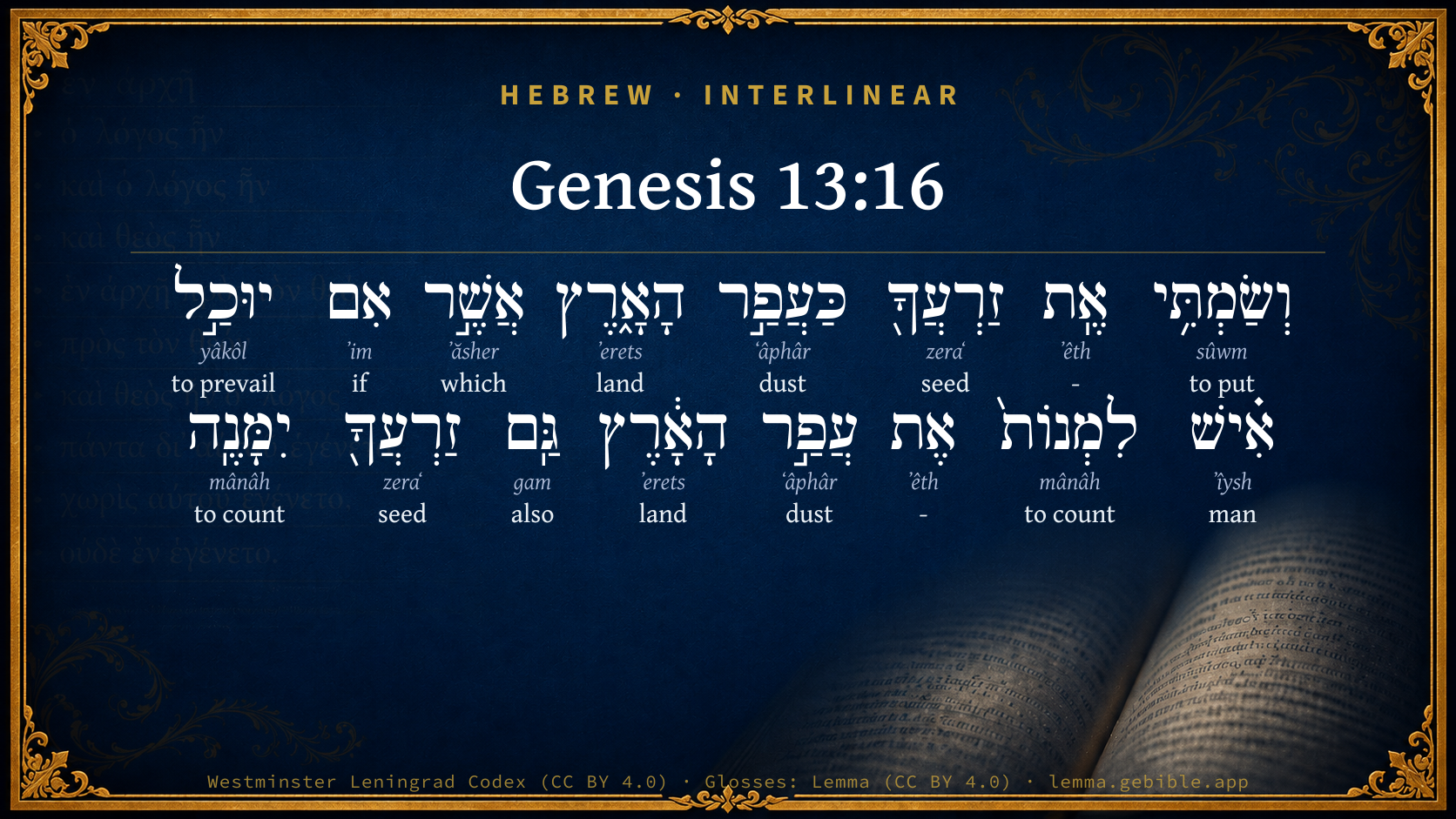
Hebrew (Westminster Leningrad Codex) Genesis 13:16 appears in the Hebrew Old Testament. The text above is from the Westminster Leningrad Codex. Each word links to its Strong’s number, a concise gloss, and parsing drawn from the Open Scriptures Hebrew Bible morphology. Click any word for its full Brown-Driver-Briggs (BDB) entry.
Download image
Cite this verse

Genesis 13:16 (World English Bible). Public Domain. Lemma interlinear Bible study tool, https://lemma.gebible.app/v/genesis/13/16.

Show BibTeX & RIS
BibTeX
RIS
English Translation
I will make your offspring as the dust of the earth, so that if a man can number the dust of the earth, then your seed may also be numbered.
World English Bible · Public Domain
Highlights
  • 1 first appearance in the Hebrew Bible
Full analysis ↓
Download a study sheet

One document with this verse’s original text, its word-by-word gloss line, the meaning frame, cross-references with their text, attributed commentary, and full source and license credits — printable, and it pastes into notes with its structure intact.

This verse Autodidact and up

Study sheet (.html) Plain text (.txt)

A passage Seminary Student

Up to 50 verses in one chapter. A passage sheet keeps up to 6 commentary sources and 12 cross-references per verse, in the order this page ranks them, and says so on the sheet whenever that leaves anything out. Ask for a single verse and you get the Autodidact verse sheet above.

Everything on this page stays free to read, with no account — the sheet is a download of what is already on screen, not access to it.

Want to remove ads? Support Godless Engineer
Compare translations 3

The same verse in 3 English versions, stacked beneath the original-language interlinear above. Click any original word for its lexicon entry.

Each is an independent rendering of the whole verse — the interlinear is not word-aligned to these translations.

Highlighted words mark where these versions differ — a whole-verse word diff, not a word-by-word alignment.

  • World English Bible Public Domain
    I will make your offspring as the dust of the earth, so that if a man can number the dust of the earth, then your seed may also be numbered.
  • King James Version Public Domain
    And I will make thy seed as the dust of the earth: so that if a man can number the dust of the earth, then shall thy seed also be numbered.
  • unfoldingWord Literal Text CC BY-SA 4.0
    And I will make your offspring like the dust of the earth, which if anyone were able to count the dust of the earth, your offspring could also be counted.

unfoldingWord Literal Text — © unfoldingWord, licensed CC BY-SA 4.0. Word-aligned USFM3 via Door43 (git.door43.org/unfoldingWord/en_ult).

Versions to compare (up to 4)

3 of 4 selected

Show all 18 translations

Every available English version of this verse, each an independent rendering of the whole verse.

  • World English Bible Public Domain
    I will make your offspring as the dust of the earth, so that if a man can number the dust of the earth, then your seed may also be numbered.
  • Berean Standard Bible Public Domain
    I will make your offspring like the dust of the earth, so that if one could count the dust of the earth, then your offspring could be counted.
  • Majority Standard Bible Public Domain
    I will make your offspring like the dust of the earth, so that if one could count the dust of the earth, then your offspring could be counted.
  • King James Version Public Domain
    And I will make thy seed as the dust of the earth: so that if a man can number the dust of the earth, then shall thy seed also be numbered.
  • American Standard Version (1901) Public Domain
    And I will make thy seed as the dust of the earth: So that if a man can number the dust of the earth, then may thy seed also be numbered.
  • Revised Version (1885) Public Domain
    And I will make thy seed as the dust of the earth: so that if a man can number the dust of the earth, then shall thy seed also be numbered.
  • Geneva Bible (1599) Public Domain
    And I will make thy seede, as the dust of the earth: so that if a man can number the dust of the earth, then shall thy seede be numbred.
  • Douay-Rheims (1899) Public Domain
    And I will make thy seed as the dust of the earth: if any man be able to number the dust of the earth, he shall be able to number thy seed also.
  • Young's Literal Translation Public Domain
    And I have set thy seed as dust of the earth, so that, if one is able to number the dust of the earth, even thy seed is numbered;
  • Literal Standard Version CC BY-SA 4.0
    And I have set your seed as dust of the earth, so that, if one is able to number the dust of the earth, even your seed is numbered;
  • Unlocked Literal Bible CC BY-SA 4.0
    I will make your descendants as abundant as the dust of the earth, so that if a man could count the dust of the earth, then your descendants could also be counted.
  • unfoldingWord Literal Text CC BY-SA 4.0
    And I will make your offspring like the dust of the earth, which if anyone were able to count the dust of the earth, your offspring could also be counted.
  • Darby Bible Public Domain
    And I will make thy seed as the dust of the earth, so that if any one can number the dust of the earth, thy seed also will be numbered.
  • World Messianic Bible Public Domain
    I will make your offspring as the dust of the earth, so that if a man can count the dust of the earth, then your offspring may also be counted.
  • Webster's Bible Public Domain
    And I will make thy seed as the dust of the earth: so that if a man can number the dust of the earth, then shall thy seed also be numbered.
  • Free Bible Version CC BY-SA 4.0
    You will have so many descendants that they'll be like the dust of the earth. If anyone could count dust then they could count the number of your descendants!
  • Bible in Basic English Public Domain
    And I will make your children like the dust of the earth, so that if the dust of the earth may be numbered, then will your children be numbered.
  • JPS Tanakh (1917) Public Domain
    And I will make thy seed as the dust of the earth; so that if a man can number the dust of the earth, then shall thy seed also be numbered.

Literal Standard Version (2020), Covenant Press — licensed CC BY-SA 4.0. Text via the HelloAO Bible API (eBible.org). Unlocked Literal Bible (unfoldingWord) — licensed CC BY-SA 4.0. Text via the HelloAO Bible API (eBible.org). unfoldingWord Literal Text — © unfoldingWord, licensed CC BY-SA 4.0. Word-aligned USFM3 via Door43 (git.door43.org/unfoldingWord/en_ult). Free Bible Version, Dr. Jonathan Gallagher — licensed CC BY-SA 4.0. Text via the HelloAO Bible API (eBible.org).

Word by word

More ways to search: Search by grammar → Find every occurrence → Compare this word →

Practice this passage: Drill this verse → Learn its vocabulary →

לִמְנוֹת֙
mânâh
H4487
“to count”
Preposition + Verb, Qal, Infinitive Construct
Part of Speech
Preposition + Verb
Stem
Qal
Form
Infinitive Construct
Full BDB Definition

Origin: a primitive root

TWOT: 1213

to count, reckon, number, assign, tell, appoint, prepare - (Qal) - to count, number - reckon, assign, appoint - (Niphal) - to be counted, be numbered - to be reckoned, be assigned - (Piel) to appoint, ordain - (Pual) appointed (participle)
  1. וְשַׂמְתִּ֥י sûwm H7760 “and · to put” Conjunction + Verb, Qal, Sequential Perfect, 1st Person, Common, Singular
  2. אֶֽת ʼêth H853 “-” Particle, Direct Object
  3. זַרְעֲךָ֖ zeraʻ H2233 “seed · your” Noun, Common, Masculine, Singular, Construct + Suffix, Personal, 2nd Person, Masculine, Singular
  4. כַּעֲפַ֣ר ʻâphâr H6083 “like/as · dust of” Preposition + Noun, Common, Masculine, Singular, Construct
  5. הָאָ֑רֶץ ʼerets H776 “the · land” Particle, Definite Article + Noun, Common, Both, Singular, Absolute
  6. אֲשֶׁ֣ר ʼăsher H834 “which” Particle, Relative
  7. אִם ʼim H518 “if” Conjunction
  8. יוּכַ֣ל yâkôl H3201 “to prevail” Verb, Qal, Imperfect, 3rd Person, Masculine, Singular
  9. אִ֗ישׁ ʼîysh H376 “man” Noun, Common, Masculine, Singular, Absolute
  10. אֶת ʼêth H853 “-” Particle, Direct Object
  11. עֲפַ֣ר ʻâphâr H6083 “dust of” Noun, Common, Masculine, Singular, Construct
  12. הָאָ֔רֶץ ʼerets H776 “the · land” Particle, Definite Article + Noun, Common, Both, Singular, Absolute
  13. גַּֽם gam H1571 “also” Particle, Accusative
  14. זַרְעֲךָ֖ zeraʻ H2233 “seed · your” Noun, Common, Masculine, Singular, Construct + Suffix, Personal, 2nd Person, Masculine, Singular
  15. יִמָּנֶֽה mânâh H4487 “to count” Verb, Niphal, Imperfect, 3rd Person, Masculine, Singular

About this verse

These counts appear in no published source. They are computed here, from the morphology-tagged text and Lemma’s own curated glosses. What Lemma adds →

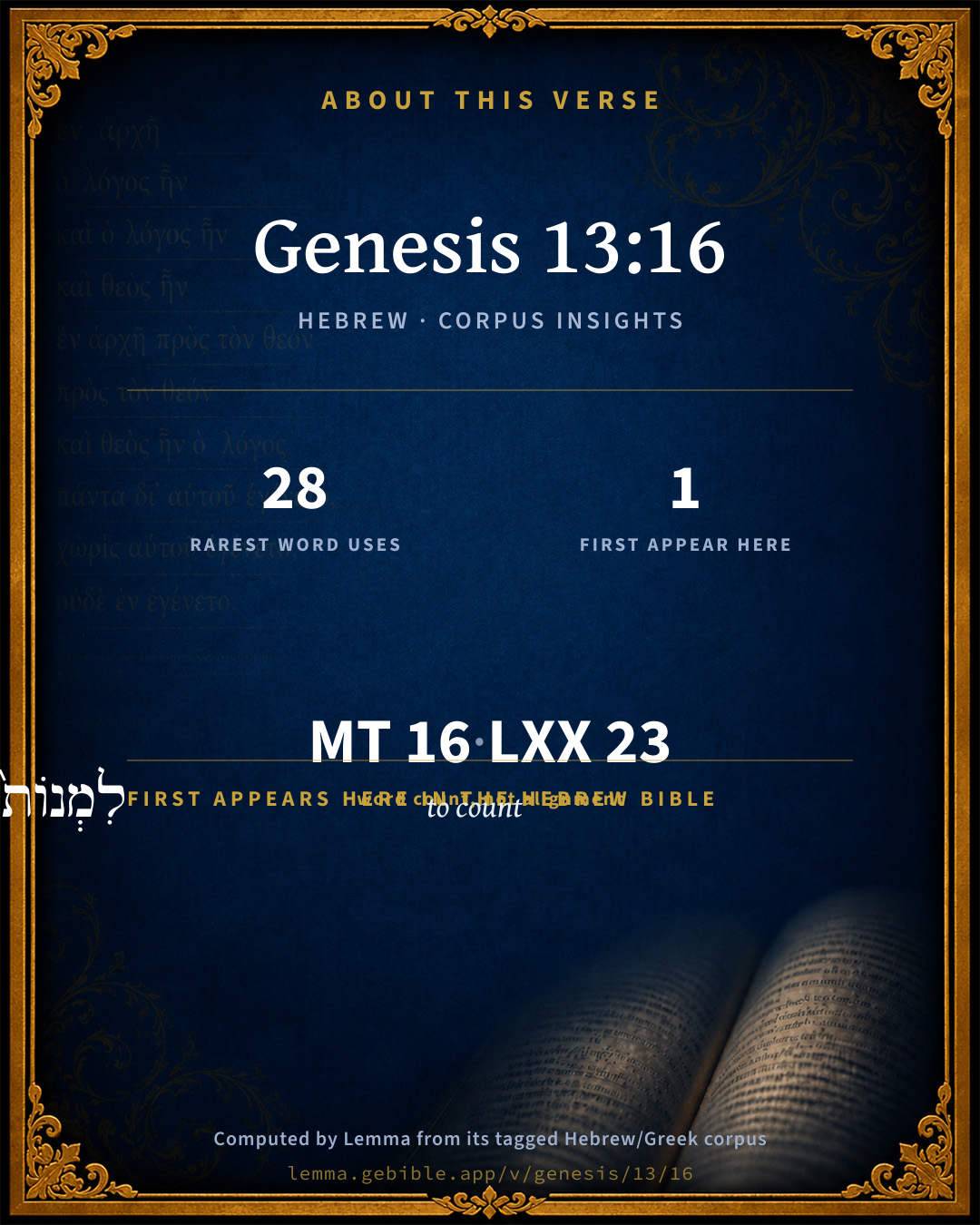
16
words
11
distinct lemmas
Pentateuch
section

First appearance in Scripture

This word makes its first canonical appearance in the Hebrew Bible here:

  • לִמְנוֹת֙ to count H4487

Shared distinctive vocabulary

לִמְנוֹת֙ to count H4487 occurs in 27 verses of the Hebrew Bible. Also found in:

Grammatical profile

  • 4 verbs
  • 7 nouns
  • 1 conjunction
  • 4 particles

Verb forms

  • וְשַׂמְתִּ֥י Qal · Sequential Perfect
  • יוּכַ֣ל Qal · Imperfect
  • לִמְנוֹת֙ Qal · Infinitive Construct
  • יִמָּנֶֽה Niphal · Imperfect

Repetition

Words recur within this verse — often emphatic in Hebrew:

  • זַרְעֲךָ֖ seed H2233 ×2
  • כַּעֲפַ֣ר dust H6083 ×2
  • הָאָ֑רֶץ land H776 ×2
  • לִמְנוֹת֙ to count H4487 ×2

Hebrew & Septuagint length

In English translation the verse runs 30 words from the Hebrew and 30 from the Septuagint (LXX English) — the same length.

A rough comparison of the two English renderings, which tokenize alike — not a word-level alignment.

Word counts can differ between the Hebrew and the Greek without any difference in meaning — e.g. the Hebrew direct-object marker אֵת has no separate Greek word, and Greek often adds the article ὁ.

In the original languages it is 16 Hebrew tokens and 23 Greek tokens — but the two are counted differently (Hebrew bundles its prefixes and suffixes into one token; the Greek is in lemma form), so that isn’t a like-for-like length.

Cross-references

32

Topical passages linked to Genesis 13:16 in the Treasury of Scripture Knowledge — connected by theme and wording, ordered by reader-vote popularity; previews shown in the World English Bible.

  • Genesis 28:14 Your seed will be as the dust of the earth, and you will spread abroad to the west, and to the east, and to the north, and to the south. In you and in your seed will all the families of the earth be blessed.
  • Numbers 23:10 Who can count the dust of Jacob, Or number the fourth part of Israel? Let me die the death of the righteous, Let my last end be like his!
  • Genesis 22:17 that in blessing I will bless you, and in multiplying I will multiply your seed as the stars of the heavens, and as the sand which is on the seashore. Your seed will possess the gate of his enemies.
  • Genesis 32:12 You said, 'I will surely do you good, and make your seed as the sand of the sea, which can't be numbered because there are so many.'"
  • Exodus 32:13 Remember Abraham, Isaac, and Israel, your servants, to whom you swore by your own self, and said to them, 'I will multiply your seed as the stars of the sky, and all this land that I have spoken of I will give to your seed, and they shall inherit it forever.'"
  • 1 Kings 3:8 Your servant is in the midst of your people which you have chosen, a great people, that can't be numbered nor counted for multitude.
  • Romans 4:16–18 For this cause it is of faith, that it may be according to grace, to the end that the promise may be sure to all the seed, not to that only which is of the law, but to that also which is of the faith of Abraham, who is the father of us all.
  • Genesis 15:5 Yahweh brought him outside, and said, "Look now toward the sky, and count the stars, if you are able to count them." He said to Abram, "So shall your seed be."
  • Genesis 12:2–3 I will make of you a great nation. I will bless you, and make your name great. You will be a blessing.
  • Genesis 17:6 I will make you exceeding fruitful, and I will make nations of you. Kings will come out of you.
  • Genesis 17:16 I will bless her, and moreover I will give you a son by her. Yes, I will bless her, and she will be a mother of nations. Kings of peoples will come from her."
  • Genesis 17:20 As for Ishmael, I have heard you. Behold, I have blessed him, and will make him fruitful, and will multiply him exceedingly. He will become the father of twelve princes, and I will make him a great nation.
  • Genesis 18:18 seeing that Abraham has surely become a great and mighty nation, and all the nations of the earth will be blessed in him?
  • Genesis 21:13 Also of the son of the handmaid will I make a nation, because he is your seed."
  • Genesis 25:1–34 Abraham took another wife, and her name was Keturah.
  • Genesis 26:4 I will multiply your seed as the stars of the sky, and will give to your seed all these lands. In your seed will all the nations of the earth be blessed,
  • Genesis 28:3 May God Almighty bless you, and make you fruitful, and multiply you, that you may be a company of peoples,
  • Genesis 35:11 God said to him, "I am God Almighty. Be fruitful and multiply. A nation and a company of nations will be from you, and kings will come out of your loins.
  • Genesis 36:1–43 Now this is the history of the generations of Esau (the same is Edom).
  • Genesis 46:3 He said, "I am God, the God of your father. Don't be afraid to go down into Egypt; for there I will make of you a great nation.
  • Exodus 1:7 The children of Israel were fruitful, and increased abundantly, and multiplied, and grew exceedingly mighty; and the land was filled with them.
  • Deuteronomy 1:10 Yahweh your God has multiplied you, and, behold, you are this day as the stars of the sky for multitude.
  • Judges 6:3 So it was, when Israel had sown, that the Midianites came up, and the Amalekites, and the children of the east; they came up against them;
  • Judges 6:5 For they came up with their cattle and their tents; they came in as locusts for multitude; both they and their camels were without number: and they came into the land to destroy it.
  • 1 Kings 4:20 Judah and Israel were many as the sand which is by the sea in multitude, eating and drinking and making merry.
  • 1 Chronicles 21:5 Joab gave up the sum of the numbering of the people to David. All those of Israel were one million one hundred thousand men who drew sword: and in Judah were four hundred seventy thousand men who drew sword.
  • 1 Chronicles 27:23 But David didn't take the number of them from twenty years old and under, because Yahweh had said he would increase Israel like the stars of the sky.
  • 2 Chronicles 17:14–18 This was the numbering of them according to their fathers' houses: Of Judah, the captains of thousands: Adnah the captain, and with him mighty men of valor three hundred thousand;
  • Isaiah 48:18–19 Oh that you had listened to my commandments! then had your peace been as a river, and your righteousness as the waves of the sea:
  • Jeremiah 33:22 As the host of the sky can't be numbered, neither the sand of the sea measured; so will I multiply the seed of David my servant, and the Levites who minister to me.
  • Revelation 7:9 After these things I looked, and behold, a great multitude, which no man could number, out of every nation and of all tribes, peoples, and languages, standing before the throne and before the Lamb, dressed in white robes, with palm branches in their hands.
  • Hebrews 11:12 Therefore as many as the stars of the sky in multitude, and as innumerable as the sand which is by the sea shore, were fathered by one man, and him as good as dead.

Cross-references courtesy of OpenBible.info (CC BY 4.0).

Hebrew and Greek witnesses Masoretic Hebrew ↔ Greek Septuagint

The same verse in the two great witnesses to the Old Testament, shown verse-for-verse.

These are two independent witnesses, not word-aligned to each other, and the Septuagint is shown in lemma (dictionary) form.

Hebrew Genesis 13:16 Masoretic · Westminster Leningrad Codex

וְשַׂמְתִּ֥י אֶֽת זַרְעֲךָ֖ כַּעֲפַ֣ר הָאָ֑רֶץ אֲשֶׁ֣ר אִם יוּכַ֣ל אִ֗ישׁ לִמְנוֹת֙ אֶת עֲפַ֣ר הָאָ֔רֶץ גַּֽם זַרְעֲךָ֖ יִמָּנֶֽה

I will make your offspring as the dust of the earth, so that if a man can number the dust of the earth, then your seed may also be numbered.

World English Bible · Public Domain

Greek LXX Genesis 13:16 Septuagint · lemma form

καί ποιέω ὁ σπέρμα σύ ὡς ὁ ἄμμος ὁ γῆ εἰ δύναμαι τις ἐκἀριθμέω ὁ ἄμμος ὁ γῆ καί ὁ σπέρμα σύ ἐκἀριθμέω

And I will make your seed like the dust of the earth; if any one is able to number the dust of the earth, then shall your seed be numbered.

LXX2012 (modern English Septuagint) · Public Domain

Hebrew: Westminster Leningrad Codex (CC BY 4.0). Greek: Septuagint (public domain); English from LXX2012 (modern English Septuagint) (Public Domain). How the Septuagint differs from the Hebrew →

Targum (Aramaic paraphrase)

2

The Targum is the ancient Jewish Aramaic paraphrase of the Hebrew Scriptures — an interpretive translation, not the Hebrew text itself. Onkelos (literal) and Pseudo-Jonathan (expansive) render the Torah, and Jonathan the Prophets. Coverage is partial: where no permissively-licensed English translation exists for a verse, only the Aramaic is shown. This is verse-level text, not a word-by-word alignment to the Hebrew.

  1. Targum Onkelos Torah (Genesis–Deuteronomy)
    וֶאֱשַׁוֵּי יָת בְּנָיךְ סַגִיאִין כְּעַפְרָא דְאַרְעָא כְּמָא דִי לָא אֶפְשַׁר לִגְבַר לְּמִמְנֵי יָת עַפְרָא דְאַרְעָא אַף בְּנָיךְ לָא יִתִּמְנוּן

    And I will place thy children numerous as the dust of the earth; so that as it is not possible for a man to number the dust of the earth, so also thy sons shall not be numbered.

    Targum Onkelos — Aramaic: “Onkelos Genesis” (public domain); “Onkelos Exodus” (public domain); “Onkelos Leviticus” (public domain); “Onkelos Numbers” (public domain); “Onkelos Deuteronomy” (public domain). English: “Sefaria Community Translation” (CC0 1.0 (public-domain dedication)); “J.W. Etheridge. The Targums of Onkelos and Jonathan Ben Uzziel on the Pentateuch. London: Longmans, Green, 1862” (public domain). Text via Sefaria.

  2. Targum Pseudo-Jonathan Torah (Genesis–Deuteronomy)
    וְאֵשַׁוֵי יַת בְּנָךְ סַגִיאִין כְּעַפְרָא דְאַרְעָא דְהֵיכְמָא דְאִית אֶפְשַר לִגְבַר לְמִימְנֵי יַת עַפְרָא דְאַרְעָא אַף כֵּן בְּנָךְ אֶפְשַׁר דְיִתְמְנוּן

    And I will make thy sons manifold as the dust of the earth, as that, as it is impossible for a man to number the dust of the earth, so also it shall be impossible to number thy sons.

    Targum Pseudo-Jonathan — Aramaic: “Targum Jonathan on Genesis” (public domain); “Targum Jonathan on Exodus” (public domain); “Targum Jonathan on Leviticus” (public domain); “Targum Jonathan on Numbers” (public domain); “Targum Jonathan on Deuteronomy” (public domain). English: “The Targum of Jonathan ben Uzziel, trans. J. W. Etheridge, London, 1862” (public domain). Text via Sefaria.

Commentary

Notes on Genesis 13:16 from classic Christian and Jewish commentators (each source and its license shown beneath its notes). The classic Christian expositions comment on the surrounding passage and are grouped to its opening verse, so a note may address several verses; the Jewish commentaries on the Tanakh (Rashi and others) are per-verse, so they appear only where the commentator wrote on this verse.

Lemma curates 59 commentaries, every one of them public domain or Creative Commons licensed, each selected and text-cleaned for this edition rather than reprinted as found. About our sources →

Trapp's Complete Commentary

John Trapp

Gen 13:16 And I will make thy seed as the dust of the earth: so that if a man can number the dust of the earth, [then] shall thy seed also be numbered.

Ver. 16. And I will make thy seed as the dust of the earth.] Afterwards, {Gen 15:5} God promiseth that his seed shall be as the stars of heaven. Abram’s seed, saith one, {a} are of two sorts: some are visible members of a church, yet have earthly hearts: others are as the stars of heaven, for spiritual light, motion, and influence.

{a} Moses’s Choice, by Mr Burr.

John Trapp, A Commentary or Exposition upon All the Books of the Old and New Testament (1647–1656) — public domain. Text from a community e-Sword module.

Joseph Benson's Commentary

Gen 13:16. I will make thy seed as the dust of the earth — That is, they shall increase incredibly, and, take them all together, shall be such a multitude as no man can number. When Moses wrote this history, these predictions had been in some measure fulfilled. But the increase of Abram’s seed at that time bore no proportion to what it was in the days of Solomon, when Israel and Judah, without taking his descendants by Ishmael, Esau, and the children he had by his second wife Keturah, into the account at all, were as many as the sand which is by the sea in multitude. Now what human foresight could have perceived that this would be the case? And who that was prudent, and professed to be a messenger of God to man, and to be intrusted with the revelation of his counsel, would have ventured to predict such a thing, and thereby to risk his character as a true prophet of the Lord on the accomplishment of the prediction, if he had not known, on the most solid grounds, that God had actually made such a promise? How thankful we ought to be for the demonstration this affords us, that Moses spake by inspiration of God, and that our faith in the divine revelation made by him is built on a firm foundation!

Joseph Benson's Commentary on the Old and New Testaments (1811–1818) — public domain. Text from a community e-Sword module.

John Calvin's Commentaries

16. And I will make thy seed as the dust. Omitting those subtleties, by means of which others argue about nothing, I simply explain the words to signify, that the seed of Abram is compared to the dust, because of its immense multitude; and truly the sense of the term is to be sought for only in Moses’ own words. It was, however, necessary to be here added, that God would raise up for him a seed, of which he was hitherto destitute. And we see that God always keeps him under the restraint of his own word; and will have him dependent upon his own lips. Abram is commanded to look at the dust; but when he turns his eyes upon his own family, what similitude is there between his solitariness and the countless particles of dust? This authority the Lord therefore requires us to attribute to his own word, that it alone should be sufficient for us. It may also give occasion to ridicule, that God commands Abram to travel till he should have examined the whole land. To what purpose shall he do this, except that he may more clearly perceive himself to be a stranger; and that, being exhausted by continual and fruitless disquietude, he may despair of any stable and permanent possession? For how shall he persuade himself that he is lord of that land in which he is scarcely permitted to drink water, although he has with great labor dug the wells? But these are the exercises of faith, in order that it may perceive, in the word, those things which are far off, and which are hidden from carnal sense. For faith is the beholding of absent things, (Hebrews 11:1,) and it has the word as a mirror, in which it may discover the hidden grace of God. And the condition of the pious, at this days is not dissimilar: for since they are hated by all, are exposed to contempt and reproach, wander without a home, are sometimes driven hither and thither, and suffer from nakedness and poverty, it is nevertheless their duty to lay hold on the inheritance which is promised. Let us therefore walk through the world, as persons debarred from all repose, who have no other resource than the mirror of the word.

John Calvin's Commentaries (1540-1563) — public domain. Text from the Calvin Translation Society English edition (1840s-50s) via the Christian Classics Ethereal Library (ccel.org). Calvin's coverage is partial (roughly two-thirds of the Bible); uncommented books and verses are honest gaps, never fabricated. The 19th-century editor's footnotes and remarks are omitted so the notes are faithfully Calvin's own voice.

The Cambridge Bible for Schools and Colleges

gen. ed. J. J. S. Perowne

16. as the dust of the earth] For this simile cf. Gen_28:14, which is also from J. Abram’s descendants are elsewhere compared in number to the stars, Gen_15:5, Gen_22:17, Gen_26:4; and to the sand which is upon the seashore, Gen_22:17, Gen_32:12.

The Cambridge Bible for Schools and Colleges (gen. ed. J. J. S. Perowne; Cambridge University Press, 1878–1918) — public domain. Text from a community e-Sword module.

John Gill's Exposition

And I will make thy seed as the dust of the earth,.... An hyperbolical expression denoting the great multitude of Abram's posterity, as they were in the days of Solomon, and as they will be in the latter day; and especially as this may respect all the spiritual seed of Abram, Jews and Gentiles, and as they will be in the spiritual reign of Christ, see Hos 1:10,

so that if a man can number the dust of the earth, then shall thy seed be numbered; but as it is impossible to do the one, so the other is not practicable, see Num 23:10.

John Gill's Exposition of the Whole Bible (1746–1763) — public domain (CC PDM 1.0). Text via the HelloAO Bible API.

Haydock's Catholic Bible Commentary

As the dust, an hyperbole, to express a very numerous offspring, which is more exact, if we take in the spiritual children of Abram. (Menochius)

George Leo Haydock (1774–1849), Haydock's Catholic Family Bible and Commentary, 1859 edition — public domain. Excludes Psalms (Douay-Rheims chapter numbering differs from Protestant) and Deuterocanonical books (Catholic canon only).

The Pulpit Commentary

And I will make thy seed as the dust of the earth. "As the land shall be great for thy people, thy posterity, so thy people shall be great or innumerable for the land" (Lunge). Afterwards the seed of Abram is likened to the stars of heaven for multitude. (Gen_15:5) So that if a man can number the dust of the earth, then shall thy seed also be numbered.

The Pulpit Commentary (1880–1919), ed. H.D.M. Spence-Jones & Joseph S. Exell — public domain. Text from a community e-Sword module.

John Wesley's Explanatory Notes

I will make thy seed as the dust of the earth - That is, they shall increase incredibly, and take them altogether; they shall be such a great multitude as no man can number. They were so in Solomon's time, 1 Kings iv, 20. Judah and Israel were many as the land which is by the sea in multitude. This God here gives him the promise of.

John Wesley, Explanatory Notes Upon the Whole Bible (1754–1765) — public domain. Text via the GEBible commentary corpus.

unfoldingWord translationNotes

Door43 World Missions Community

walk through the length and breadth of the land

"walk around all over the whole land"

Mamre

This was the name of the man who owned the oak trees. (See: How to Translate Names)

Hebron

place name (See: How to Translate Names)

an altar to Yahweh

"an altar for worshiping Yahweh"

translationWords

descend

oak

Hebron

altar

Yahweh

unfoldingWord translationNotes — © Distant Shores Media and the Door43 World Missions Community, licensed CC BY-SA 4.0. Source: git.door43.org/Door43/en_tn.

Rashi

Rabbi Shlomo Yitzchaki (Rashi)

אשר אם יוכל איש SO THAT IF A MAN IS ABLE [TO COUNT] —just as it is impossible for the dust to be counted, so, too, your seed shall not be counted.

Rashi on the Tanakh — English translations: “The Judaica Press complete Tanach with Rashi, translated by A. J. Rosenberg” (CC BY 4.0); “Pentateuch with Rashi's commentary by M. Rosenbaum and A.M. Silbermann, 1929-1934” (public domain); “The Metsudah Tanach series, Lakewood, N.J” (CC BY 4.0); and “The Book of Joshua, Metsudah Publications, 1997” (CC BY 4.0). Text via Sefaria.

Radak

Rabbi David Kimhi (Radak)

ושמתי את זרעך כעפר הארץ, a figure of speech, poetic license, exaggeration. We find more such metaphors, such as in Genesis 22,17 ככוכבי השמים, “as numerous as the stars in heaven.” According to the Midrash Aggadah, Vayetze 25,13 the reason why on occasion the Jewish people and their numbers are compared to dust and on other occasions to the stars, is that when they deserve it they are comparable to the stars in heaven, whereas at times when they do not deserve it, they are compared to the dust of the earth which everyone steps on.

גם זרעך ימנה, if one part of the metaphor comes true so does the other. Just as it is inconceivable to have a world without stars or dust, so it is inconceivable to have a world without Jews. (compare Jeremiah 13,23)

Radak on the Tanakh — English translations: “Sefaria Community Translation” (CC0 1.0 (public-domain dedication)); “Eliyahu Munk, HaChut Hameshulash” (CC BY 4.0); “Rabbi Mike Feuer, Jerusalem Anthology” (CC BY 4.0); and “R. David Kimhi on the first book of Psalms, Translated by R.G. Finch, London, 1919” (public domain). Text via Sefaria.

Lesson kit

Teaching starters — assembled from the data on this page, not authored interpretation. Every prompt links to the verse data it draws on. Edit before teaching.

Genesis, in the Pentateuch, opens this verse with 16 words (11 distinct Hebrew lemmas). Its most distinctive word is mânâh (“to count”). A historical commentator’s framing appears above. Read the whole chapter for the surrounding context.

Discussion questions

  1. What does “to count” (mânâh) contribute to the verse as a whole?
  2. This is the first place “to count” appears in Scripture (first appears here). What does its debut here establish?
  3. How does Numbers 23:10, which shares the word «to count», read alongside this verse?
  4. What does the repetition of “seed” (2× in this one verse) do in this verse?
  5. These translations render this verse differently. What is at stake in choosing one wording over another?
  6. «וְשַׂמְתִּ֥י» is a Qal Sequential Perfect verb. How does that grammatical form shape the action described?
  7. Compare how Trapp's Complete Commentary and Joseph Benson's Commentary read this verse. Where do they agree or differ?

Things to notice

Reading settings

Reading text

Shown beneath each verse's original-language words.

Old Testament
Old Testament edition

Read the OT as the Masoretic Hebrew (MT) or the Greek Septuagint (LXX).

English shown for the Greek Septuagint (in the Hebrew ↔ Greek comparison).

Comparing translations? Open the Compare panel on any verse page to stack up to four side by side.