
Genesis 2:23

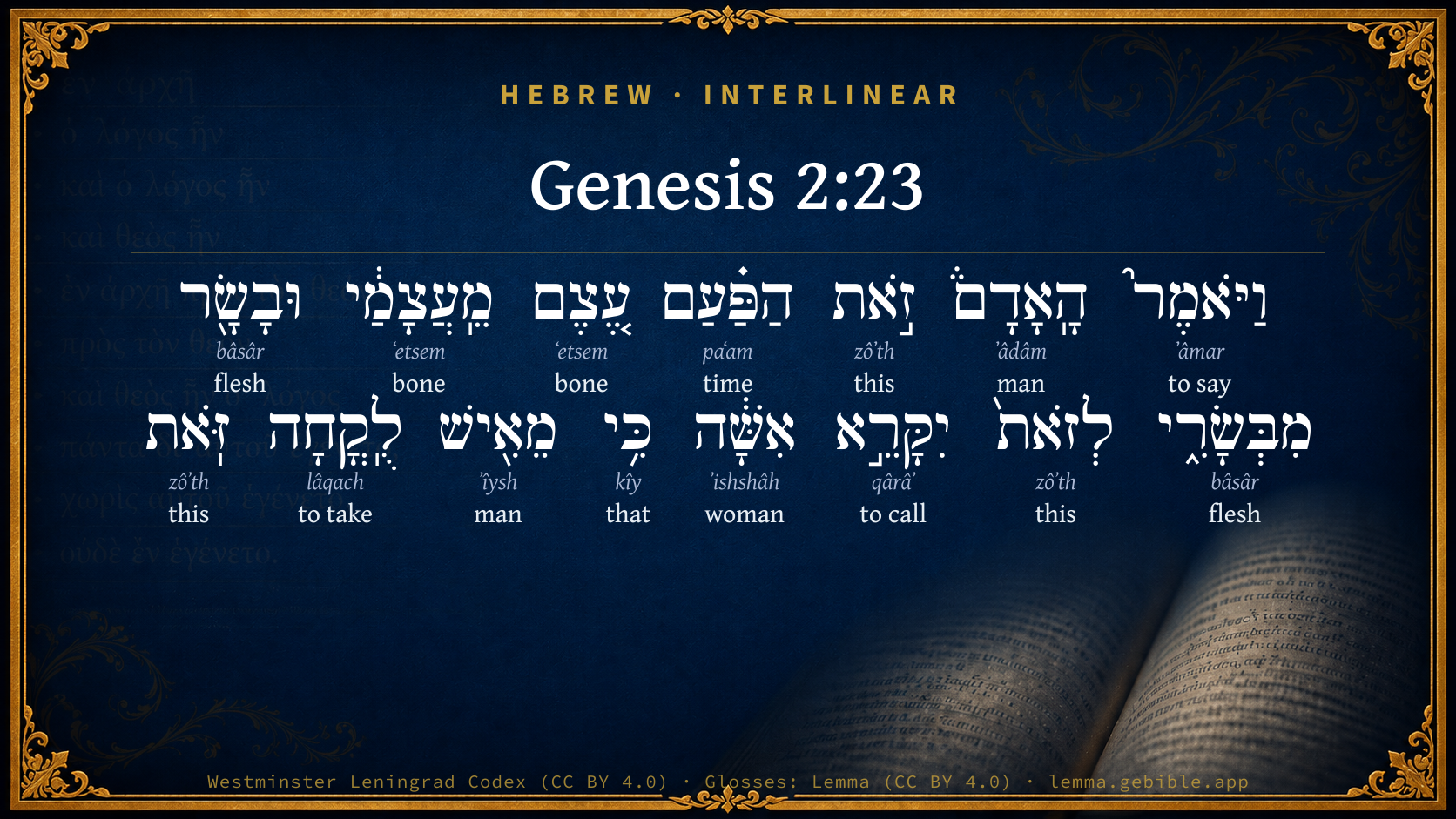
Hebrew (Westminster Leningrad Codex) Genesis 2:23 appears in the Hebrew Old Testament. The text above is from the Westminster Leningrad Codex. Each word links to its Strong’s number, a concise gloss, and parsing drawn from the Open Scriptures Hebrew Bible morphology. Click any word for its full Brown-Driver-Briggs (BDB) entry.
Download image
Cite this verse

Genesis 2:23 (World English Bible). Public Domain. Lemma interlinear Bible study tool, https://lemma.gebible.app/v/genesis/2/23.

Show BibTeX & RIS
BibTeX
RIS
English Translation
The man said, "This is now bone of my bones, and flesh of my flesh. She will be called Woman, because she was taken out of Man."
World English Bible · Public Domain
Highlights
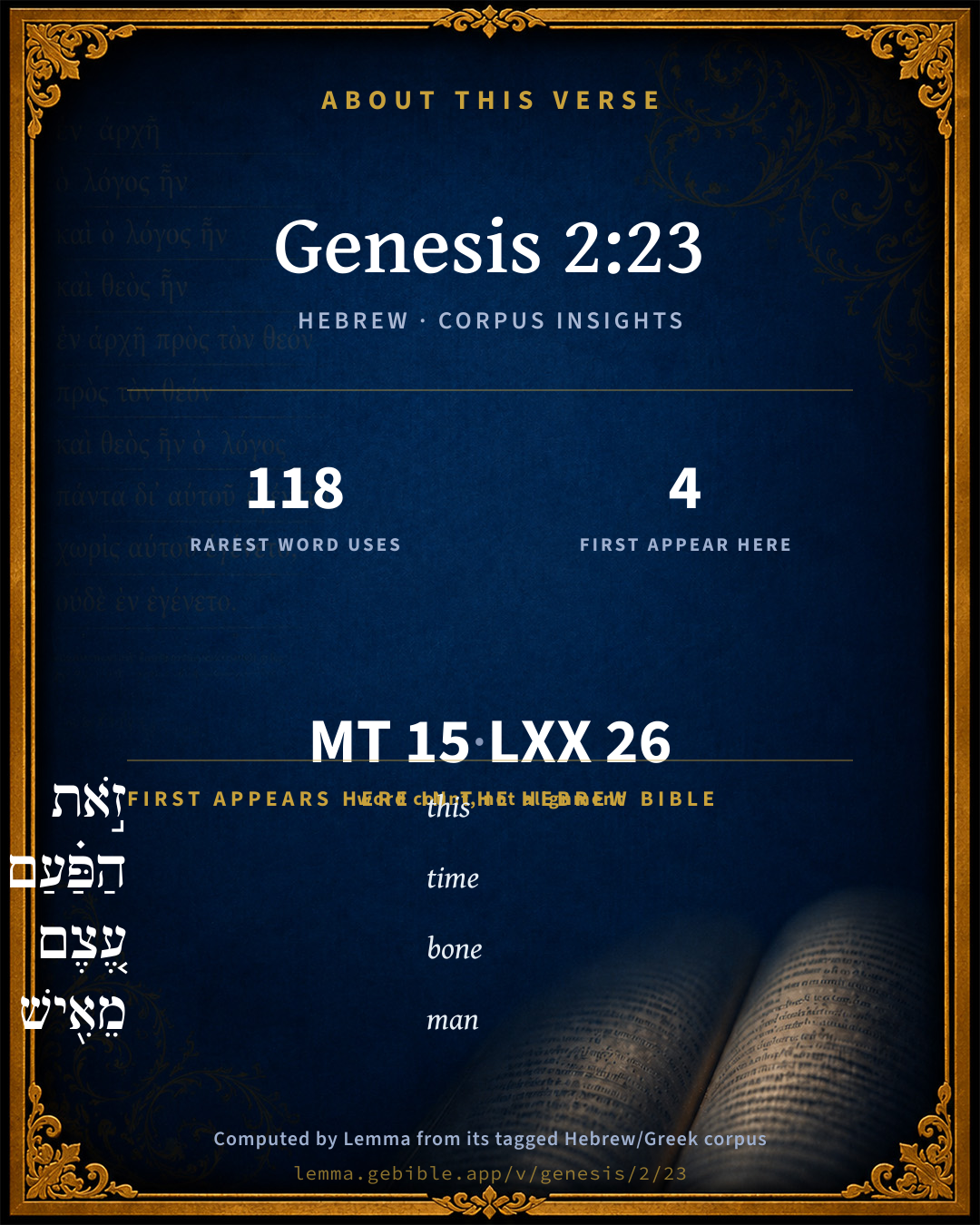
  • 4 first appearances in the Hebrew Bible
Full analysis ↓
Download a study sheet

One document with this verse’s original text, its word-by-word gloss line, the meaning frame, cross-references with their text, attributed commentary, and full source and license credits — printable, and it pastes into notes with its structure intact.

This verse Autodidact and up

Study sheet (.html) Plain text (.txt)

A passage Seminary Student

Up to 50 verses in one chapter. A passage sheet keeps up to 6 commentary sources and 12 cross-references per verse, in the order this page ranks them, and says so on the sheet whenever that leaves anything out. Ask for a single verse and you get the Autodidact verse sheet above.

Everything on this page stays free to read, with no account — the sheet is a download of what is already on screen, not access to it.

Want to remove ads? Support Godless Engineer
Compare translations 3

The same verse in 3 English versions, stacked beneath the original-language interlinear above. Click any original word for its lexicon entry.

Each is an independent rendering of the whole verse — the interlinear is not word-aligned to these translations.

Highlighted words mark where these versions differ — a whole-verse word diff, not a word-by-word alignment.

  • World English Bible Public Domain
    The man said, "This is now bone of my bones, and flesh of my flesh. She will be called Woman, because she was taken out of Man."
  • King James Version Public Domain
    And Adam said, This is now bone of my bones, and flesh of my flesh: she shall be called Woman, because she was taken out of Man.
  • unfoldingWord Literal Text CC BY-SA 4.0
    And the man said, “This now bone from my bones and flesh from my flesh! She will be called ‘woman,’ because from a man she was taken.”

unfoldingWord Literal Text — © unfoldingWord, licensed CC BY-SA 4.0. Word-aligned USFM3 via Door43 (git.door43.org/unfoldingWord/en_ult).

Versions to compare (up to 4)

3 of 4 selected

Show all 18 translations

Every available English version of this verse, each an independent rendering of the whole verse.

  • World English Bible Public Domain
    The man said, "This is now bone of my bones, and flesh of my flesh. She will be called Woman, because she was taken out of Man."
  • Berean Standard Bible Public Domain
    And the man said: “This is now bone of my bones and flesh of my flesh; she shall be called ‘woman,’ for out of man she was taken.”
  • Majority Standard Bible Public Domain
    And the man said: “This is now bone of my bones and flesh of my flesh; she shall be called ‘woman,’ for out of man she was taken.”
  • King James Version Public Domain
    And Adam said, This is now bone of my bones, and flesh of my flesh: she shall be called Woman, because she was taken out of Man.
  • American Standard Version (1901) Public Domain
    And the man said, This is now bone of my bones, and flesh of my flesh: she shall be called Woman, because she was taken out of Man.
  • Revised Version (1885) Public Domain
    And the man said, This is now bone of my bones, and flesh of my flesh: she shall be called Woman, because she was taken out of Man.
  • Geneva Bible (1599) Public Domain
    Then the man said, This now is bone of my bones, and flesh of my flesh. She shalbe called woman, because she was taken out of man.
  • Douay-Rheims (1899) Public Domain
    And Adam said: This now is bone of my bones, and flesh of my flesh; she shall be called woman, because she was taken out of man.
  • Young's Literal Translation Public Domain
    and the man saith, `This `is' the `proper' step! bone of my bone, and flesh of my flesh!' for this it is called Woman, for from a man hath this been taken;
  • Literal Standard Version CC BY-SA 4.0
    and the man says, “This at last! Bone of my bone, and flesh of my flesh!” For this is called Woman, for this has been taken from Man;
  • Unlocked Literal Bible CC BY-SA 4.0
    The man said, “This time, this one is bone of my bones, and flesh of my flesh. She will be called 'woman,' because she was taken out of man.”
  • unfoldingWord Literal Text CC BY-SA 4.0
    And the man said, “This now bone from my bones and flesh from my flesh! She will be called ‘woman,’ because from a man she was taken.”
  • Darby Bible Public Domain
    And Man said, This time it is bone of my bones and flesh of my flesh: this shall be called Woman, because this was taken out of a man.
  • World Messianic Bible Public Domain
    The man said, “This is now bone of my bones, and flesh of my flesh. She will be called ‘woman,’ because she was taken out of Man.”
  • Webster's Bible Public Domain
    And Adam said, This is now bone of my bones, and flesh of my flesh: she shall be called Woman, because she was taken out of man.
  • Free Bible Version CC BY-SA 4.0
    “Finally!” said Adam. “Here is bone from my bone and flesh from my flesh. She shall be called woman, because she was taken out of man.”
  • Bible in Basic English Public Domain
    And the man said, This is now bone of my bone and flesh of my flesh: let her name be Woman because she was taken out of Man.
  • JPS Tanakh (1917) Public Domain
    And the man said: 'This is now bone of my bones, and flesh of my flesh; she shall be called Woman, because she was taken out of Man.'

Literal Standard Version (2020), Covenant Press — licensed CC BY-SA 4.0. Text via the HelloAO Bible API (eBible.org). Unlocked Literal Bible (unfoldingWord) — licensed CC BY-SA 4.0. Text via the HelloAO Bible API (eBible.org). unfoldingWord Literal Text — © unfoldingWord, licensed CC BY-SA 4.0. Word-aligned USFM3 via Door43 (git.door43.org/unfoldingWord/en_ult). Free Bible Version, Dr. Jonathan Gallagher — licensed CC BY-SA 4.0. Text via the HelloAO Bible API (eBible.org).

Word by word

More ways to search: Search by grammar → Find every occurrence → Compare this word →

Practice this passage: Drill this verse → Learn its vocabulary →

הַפַּ֗עַם
paʻam
H6471
“the · time”
Particle, Definite Article + Noun, Common, Feminine, Singular, Absolute
Part of Speech
Particle + Noun
Type
Common
Gender
Feminine
Number
Singular
State
Absolute
Full BDB Definition

Origin: from H6470

TWOT: 1793a

stroke, beat, foot, step, anvil, occurrence - foot, hoof-beat, footfall, footstep - anvil - occurrence, time, stroke, beat - one time, once, twice, thrice, as time on time, at this repetition, this once, now at length, now...now, at one time...at another
  1. וַיֹּאמֶר֮ ʼâmar H559 “and · to say” Conjunction + Verb, Qal, Sequential Imperfect, 3rd Person, Masculine, Singular
  2. הָֽאָדָם֒ ʼâdâm H120 “the · man” Particle, Definite Article + Noun, Common, Masculine, Singular, Absolute
  3. זֹ֣את zôʼth H2063 “this” Pronoun, Demonstrative, Feminine, Singular
  4. עֶ֚צֶם ʻetsem H6106 “bone” Noun, Common, Feminine, Singular, Absolute
  5. מֵֽעֲצָמַ֔י ʻetsem H6106 “from · bones · my” Preposition + Noun, Common, Feminine, Plural, Construct + Suffix, Personal, 1st Person, Common, Singular
  6. וּבָשָׂ֖ר bâsâr H1320 “and · flesh” Conjunction + Noun, Common, Masculine, Singular, Absolute
  7. מִבְּשָׂרִ֑י bâsâr H1320 “from · flesh · my” Preposition + Noun, Common, Masculine, Singular, Construct + Suffix, Personal, 1st Person, Common, Singular
  8. לְזֹאת֙ zôʼth H2063 “to/for · this” Preposition + Pronoun, Demonstrative, Feminine, Singular
  9. יִקָּרֵ֣א qârâʼ H7121 “to call” Verb, Niphal, Imperfect, 3rd Person, Masculine, Singular
  10. אִשָּׁ֔ה ʼishshâh H802 “woman” Noun, Common, Feminine, Singular, Absolute
  11. כִּ֥י kîy H3588 “that” Conjunction
  12. מֵאִ֖ישׁ ʼîysh H376 “from · man” Preposition + Noun, Common, Masculine, Singular, Absolute
  13. לֻֽקֳחָה lâqach H3947 “to take” Verb, Pual, Perfect, 3rd Person, Feminine, Singular
  14. זֹּֽאת zôʼth H2063 “this” Pronoun, Demonstrative, Feminine, Singular

About this verse

These counts appear in no published source. They are computed here, from the morphology-tagged text and Lemma’s own curated glosses. What Lemma adds →

15
words
11
distinct lemmas
Pentateuch
section

First appearance in Scripture

These words make their first canonical appearance in the Hebrew Bible here:

  • זֹ֣את this H2063
  • הַפַּ֗עַם time H6471
  • עֶ֚צֶם bone H6106
  • מֵאִ֖ישׁ man H376

Grammatical profile

  • 3 verbs
  • 8 nouns
  • 3 pronouns
  • 1 conjunction

Verb forms

  • וַיֹּאמֶר֮ Qal · Sequential Imperfect
  • יִקָּרֵ֣א Niphal · Imperfect
  • לֻֽקֳחָה Pual · Perfect

Repetition

Words recur within this verse — often emphatic in Hebrew:

  • עֶ֚צֶם bone H6106 ×2
  • וּבָשָׂ֖ר flesh H1320 ×2
  • זֹ֣את this H2063 ×3

Hebrew & Septuagint length

In English translation the verse runs 27 words from the Hebrew and 28 from the Septuagint (LXX English) — closely comparable.

A rough comparison of the two English renderings, which tokenize alike — not a word-level alignment.

Word counts can differ between the Hebrew and the Greek without any difference in meaning — e.g. the Hebrew direct-object marker אֵת has no separate Greek word, and Greek often adds the article ὁ.

In the original languages it is 15 Hebrew tokens and 26 Greek tokens — but the two are counted differently (Hebrew bundles its prefixes and suffixes into one token; the Greek is in lemma form), so that isn’t a like-for-like length.

Cross-references

6

Topical passages linked to Genesis 2:23 in the Treasury of Scripture Knowledge — connected by theme and wording, ordered by reader-vote popularity; previews shown in the World English Bible.

  • Ephesians 5:28–30 Even so ought husbands also to love their own wives as their own bodies. He who loves his own wife loves himself.
  • 1 Corinthians 11:8–9 For man is not from woman, but woman from man;
  • 2 Samuel 5:1 Then came all the tribes of Israel to David to Hebron, and spoke, saying, Behold, we are your bone and your flesh.
  • Genesis 29:14 Laban said to him, Surely you are my bone and my flesh. He lived with him for a month.
  • Judges 9:2 Please speak in the ears of all the men of Shechem, Whether is better for you, that all the sons of Jerubbaal, who are seventy persons, rule over you, or that one rule over you? Remember also that I am your bone and your flesh.
  • 2 Samuel 19:13 Say you to Amasa, Aren't you my bone and my flesh? God do so to me, and more also, if you aren't captain of the host before me continually in the room of Joab.

Cross-references courtesy of OpenBible.info (CC BY 4.0).

Hebrew and Greek witnesses Masoretic Hebrew ↔ Greek Septuagint

The same verse in the two great witnesses to the Old Testament, shown verse-for-verse.

These are two independent witnesses, not word-aligned to each other, and the Septuagint is shown in lemma (dictionary) form.

Hebrew Genesis 2:23 Masoretic · Westminster Leningrad Codex

וַיֹּאמֶר֮ הָֽאָדָם֒ זֹ֣את הַפַּ֗עַם עֶ֚צֶם מֵֽעֲצָמַ֔י וּבָשָׂ֖ר מִבְּשָׂרִ֑י לְזֹאת֙ יִקָּרֵ֣א אִשָּׁ֔ה כִּ֥י מֵאִ֖ישׁ לֻֽקֳחָה זֹּֽאת

The man said, "This is now bone of my bones, and flesh of my flesh. She will be called Woman, because she was taken out of Man."

World English Bible · Public Domain

Greek LXX Genesis 2:23 Septuagint · lemma form

καί εἶπον αδαμ οὗτος νῦν ὀστέον ἐκ ὁ ὀστέον ἐγώ καί σάρξ ἐκ ὁ σάρξ ἐγώ οὗτος καλέω γυνή ὅτι ἐκ ὁ ἀνήρ αὐτός λαμβάνω οὗτος

And Adam said, This now is bone of my bones, and flesh of my flesh; she shall be called woman, because she was taken out of her husband.

LXX2012 (modern English Septuagint) · Public Domain

On this verse, The Cambridge Bible for Schools and Colleges discusses the Septuagint’s reading. Read the note in Commentary ↓

Hebrew: Westminster Leningrad Codex (CC BY 4.0). Greek: Septuagint (public domain); English from LXX2012 (modern English Septuagint) (Public Domain). How the Septuagint differs from the Hebrew →

Targum (Aramaic paraphrase)

2

The Targum is the ancient Jewish Aramaic paraphrase of the Hebrew Scriptures — an interpretive translation, not the Hebrew text itself. Onkelos (literal) and Pseudo-Jonathan (expansive) render the Torah, and Jonathan the Prophets. Coverage is partial: where no permissively-licensed English translation exists for a verse, only the Aramaic is shown. This is verse-level text, not a word-by-word alignment to the Hebrew.

  1. Targum Onkelos Torah (Genesis–Deuteronomy)
    וַאֲמַר הָאָדָם הֲדָא זִמְנָא גַּרְמָא מִגַּרְמַי וּבִסְרָא מִבִּסְרִי לְדָא יִתְקְרֵי אִתְּתָא אֲרֵי מִבַּעְלָא נְסִיבָא דָא

    (no public-domain English translation for this verse)

    Targum Onkelos — Aramaic: “Onkelos Genesis” (public domain); “Onkelos Exodus” (public domain); “Onkelos Leviticus” (public domain); “Onkelos Numbers” (public domain); “Onkelos Deuteronomy” (public domain). English: “Sefaria Community Translation” (CC0 1.0 (public-domain dedication)); “J.W. Etheridge. The Targums of Onkelos and Jonathan Ben Uzziel on the Pentateuch. London: Longmans, Green, 1862” (public domain). Text via Sefaria.

  2. Targum Pseudo-Jonathan Torah (Genesis–Deuteronomy)
    וַאֲמַר אָדָם הֲדָא זִמְנָא וְלָא תּוּב תִּתְבְּרִי אִתְּתָא מִן גְבַר הֵיכְמָא דְאִתְבְרִיאַת דָא מִנִי גַרְמָא מִגְרָמַיי וּבִשְרָא מִבִּשְרִי לְדָא חָמֵי לְמִיקְרָא אִתָּא אֲרוּם מִגְבַר אִיתְנְסִיבַת דָא

    And Adam said, This time, and not again, is woman created from man. Thus, because she is created from me, (she is) bone of my bone, and flesh of my flesh. This it is fit to call Woman, because from man she was taken.

    Targum Pseudo-Jonathan — Aramaic: “Targum Jonathan on Genesis” (public domain); “Targum Jonathan on Exodus” (public domain); “Targum Jonathan on Leviticus” (public domain); “Targum Jonathan on Numbers” (public domain); “Targum Jonathan on Deuteronomy” (public domain). English: “The Targum of Jonathan ben Uzziel, trans. J. W. Etheridge, London, 1862” (public domain). Text via Sefaria.

Commentary

Notes on Genesis 2:23 from classic Christian and Jewish commentators (each source and its license shown beneath its notes). The classic Christian expositions comment on the surrounding passage and are grouped to its opening verse, so a note may address several verses; the Jewish commentaries on the Tanakh (Rashi and others) are per-verse, so they appear only where the commentator wrote on this verse.

Lemma curates 59 commentaries, every one of them public domain or Creative Commons licensed, each selected and text-cleaned for this edition rather than reprinted as found. About our sources →

Trapp's Complete Commentary

John Trapp

Gen 2:23 And Adam said, This [is] now bone of my bones, and flesh of my flesh: she shall be called Woman, because she was taken out of Man.

Ver. 23. This is now bone of my bone.] This sentence, saith Tertullian, and, after him, Beda, is the first prophecy that was ever uttered in the world. And it is uttered in a way of admiration, which they that are taken with, do commonly use a concise kind of speech; especially if overjoyed, as Adam here was upon the first sight of the woman; whom he no sooner saw but knew, and thereupon cried out as wondering at God’s goodness to himself, "This now is bone of my bone and flesh of my flesh." Luther, the night before he died, was reasonably well, and sat with his friends at table. The matter of their discourse was, whether they should know one another in heaven, or not. Luther held it affirmatively, and this was one reason he gave: Adam as soon as he saw Eve, knew what she was, not by discourse, but by divine revelation; so shall we in the life to come. All the saints shall sit down with Abraham, Isaac, and Jacob, having communion with them, not only as godly men, but as Abraham, Isaac, and Jacob. And if with them, why not with others? {a} Chrysostom {b} saith, we shall point them out, and say, Lo, yonder is Peter, and that’s Paul, and there are the prophets, apostles, &c.

She shall be called woman.] Or maness, of man; as Ishah of Ish. He gave her her name from his own, by taking away one numeral letter that stands for ten, and adding another that stands for five; to note her infirmity, and duty of submitting to her husband, whose very naming of her notes her subjection.

{a} Melch. Adam.

{b} Iδου, ο Pετρος, και ο Pαυλος

John Trapp, A Commentary or Exposition upon All the Books of the Old and New Testament (1647–1656) — public domain. Text from a community e-Sword module.

Joseph Benson's Commentary

Gen 2:23. This is now bone of my bone — Probably it was revealed to Adam in a vision, when he was asleep that this lovely creature, now presented to him, was a piece of himself, and was to be his companion, and the wife of his covenant. In token of his acceptance of her, he gave her a name, not peculiar to her, but common to her sex: she shall be called woman, isha, a she-man, differing from man in sex only, not in nature; made of man, and joined to man.

Joseph Benson's Commentary on the Old and New Testaments (1811–1818) — public domain. Text from a community e-Sword module.

Tyndale Open Study Notes

Tyndale Open Resources

2:23 Adam recognized the woman as a “helper just right for him” (2:20). His celebration of her in poetry and song observed his unity with her, not their distinctions (cp. 29:14). • Adam declares that “She will be called ‘woman’ (Hebrew ’ishah) because she was taken from ‘man’ (Hebrew ’ish).” He understood the nature of their connection (see Eph 5:28-29). Adam had earlier assessed the animals without finding the characteristics he needed in a partner. How different this evaluation is!

Tyndale Open Study Notes — © Tyndale Open Resources, licensed CC BY-SA 4.0. Text via the HelloAO Bible API.

Geneva Bible (1599)

Geneva Bible translators

Or, Manness, because she cometh of man: for in Hebrew Ish is man, and Ishah the woman.

Geneva Bible (1599) marginal notes — public domain. Text via Bolls.life.

Jamieson, Fausset & Brown

Robert Jamieson, A. R. Fausset & David Brown

Woman--in Hebrew, "man-ess."

Jamieson, Fausset & Brown — Commentary Critical and Explanatory on the Whole Bible (1871) — public domain (CC PDM 1.0). Text via the HelloAO Bible API.

Adam Clarke's Commentary

Verse 23. Adam said, This is now bone of my bones, c.] There is a very delicate and expressive meaning in the original which does not appear in our version. When the different genera of creatures were brought to Adam, that he might assign them their proper names, it is probable that they passed in pairs before him, and as they passed received their names. To this circumstance the words in this place seem to refer. Instead of this now is זאת הפאם zoth happaam, we should render more literally this turn, this creature, which now passes or appears before me, is flesh of my flesh, c. The creatures that had passed already before him were not suitable to him, and therefore it was said, For Adam there was not a help meet found, Ge 2:20 but when the woman came, formed out of himself, he felt all that attraction which consanguinity could produce, and at the same time saw that she was in her person and in her mind every way suitable to be his companion. See Parkhurst, sub voce.

She shall be called Woman] A literal version of the Hebrew would appear strange, and yet a literal version is the only proper one. איש ish signifies man, and the word used to express what we term woman is the same with a feminine termination, אשה ishshah, and literally means she-man. Most of the ancient versions have felt the force of the term, and have endeavoured to express it as literally as possible. The intelligent reader will not regret to see some of them here. The Vulgate Latin renders the Hebrew virago, which is a feminine form of vir, a man. Symmachus uses ανδρις, andris, a female form of ανηρ, aner, a man. Our own term is equally proper when understood. Woman has been defined by many as compounded of wo and man, as if called man's wo because she tempted him to eat the forbidden fruit but this is no meaning of the original word, nor could it be intended, as the transgression was not then committed. The truth is, our term is a proper and literal translation of the original, and we may thank the discernment of our Anglo-Saxon ancestors for giving it. [A.S.], of which woman is a contraction, means the man with the womb. A very appropriate version of the Hebrew אשה ishshah, rendered by terms which signify she-man, in the versions already specified. Hence we see the propriety of Adam's observation: This creature is flesh of my flesh, and bone of my bones; therefore shall she be called WOMB-MAN, or female man, because she was taken out of man. See Verstegan. Others derive it from [A.S.] or [A.S.], man's wife or she-man. Either may be proper, the first seems the most likely.

Adam Clarke's Commentary on the Bible (1810–1826) — public domain. Text from a community e-Sword/MySword module.

John Calvin's Commentaries

23. And Adam said, etc It is demanded whence Adam derived this knowledge since he was at that time buried in deep sleep. If we say that his quickness of perception was then such as to enable him by conjecture to form a judgment, the solution would be weak. But we ought not to doubt that God would make the whole course of the affair manifest to him, either by secret revelation or by his word; for it was not from any necessity on God’s part that He borrowed from man the rib out of which he might form the woman; but he designed that they should be more closely joined together by this bonds which could not have been effected unless he had informed them of the fact. Moses does not indeed explain by what means God gave them this information; yet unless we would make the work of God superfluous, we must conclude that its Author revealed both the fact itself and the method and design of its accomplishment. The deep sleep was sent upon Adam, not to hide from him the origin of his wife, but to exempt him from pain and trouble, until he should receive a compensation so excellent for the loss of his rib.

This is now bone of, etc In using the expression הפעם (hac vice,) Adam indicates that something had been wanting to him; as if he had said, Now at length I have obtained a suitable companion, who is part of the substance of my flesh, and in whom I behold, as it were, another self. And he gives to his wife a name taken from that of man, that by this testimony and this mark he might transmit a perpetual memorial of the wisdom of God. A deficiency in the Latin language has compelled the ancient interpreter to render אשה (ishah,) by the word virago. It is, however, to be remarked, that the Hebrew term means nothing else than the female of the man.

John Calvin's Commentaries (1540-1563) — public domain. Text from the Calvin Translation Society English edition (1840s-50s) via the Christian Classics Ethereal Library (ccel.org). Calvin's coverage is partial (roughly two-thirds of the Bible); uncommented books and verses are honest gaps, never fabricated. The 19th-century editor's footnotes and remarks are omitted so the notes are faithfully Calvin's own voice.

Ellicott's Commentary for English Readers

(23) This is now.—Literally, this stroke, or beat of the foot in keeping time. It means, therefore, this time, or colloquially, at last. Adam had long studied the natural world, and while, with their confidence as yet unmarred by human cruelty, they came to his call, grew tame, and joined his company, he found none that answered to his wants, and replied to him with articulate speech. At last, on waking from his trance, he found one standing by him in whom he recognised a second self, and he welcomed her joyfully, and exclaimed, “This at last is bone of my bones, and flesh of my flesh:” that is, she is man’s counterpart, not merely in feeling and sense—his flesh—but in his solid qualities. In several of the Semitic dialects bone is used for self. Thus, in the Jerusalem Lectionary (ed. Miniscalchi, Verona, 1861) we read: “I will manifest my bone unto him” (Joh_14:21), that is, myself; and again, “I have power to lay it down of my bone” (Joh_10:18), that is, of myself. So, too, in Hebrew, “In the selfsame day” is “in the bone of this day” (Gen_7:13). Thus bone of my bones means “my very own self,” while flesh of my flesh adds the more tender and gentle qualities.

She shall be called Woman (Ishah), because she was taken out of Man (Ish).—Adam, who knew that he was an Ish (see Excursus at end of this book), called the woman a “female Ish.” The words of our Version, man and woman (perhaps womb-man), represent with sufficient accuracy the relation of the words in the original.

A Bible Commentary for English Readers, edited by Charles John Ellicott (1878–1897) — public domain. Text from a community e-Sword module.

The Cambridge Bible for Schools and Colleges

gen. ed. J. J. S. Perowne

23. This is now, &c.] The exclamation of joy and wonder is expressed in the rhythmical language of poetry. It is as if the man, after passing in review the animals, recognizes instantaneously in woman the fulfilment of his hope. “This is now” is equivalent to “here at last”; the German “Diese endlich.”

bone of my bones] A strong metaphorical phrase to denote that the woman is different from all the animals, and is absolutely one with the man. For similar expressions used of near relationship, compare Gen_29:14, Gen_37:27; Jdg_9:2; 2Sa_5:1; 2Sa_19:12-13; 1Ch_11:1. This proverbial expression may have furnished the symbolism of the story.

she shall be called, &c.] The marg. by pointing out that the Hebrew for “woman” is Isshah, and for “man” Ish, shews the resemblance in the sound of the two words. This is fairly reproduced in the English words “Woman” and “Man”; and in Luther’s rendering “Männin” and “Mann.” The LXX is unable to reproduce it. The Latin attempts it with questionable success, haec vocabitur virago, quoniam de viro sumpta est.

Instead of “from man.” mê-ish. LXX and Targ. read “from her husband” = mê-ishâh, which adds to the resemblance in sound.

As a matter of philology the derivation is inaccurate. Probably Isshah is derived from a different root, anash. But nearly all these popular derivations of words prove to be inaccurate when judged by scientific etymology. They are based upon the assonance, or obvious resemblance in sound; and this, while it cannot fail to catch the ear and cling to the recollection of the people, is notoriously to be distrusted for supplying the real derivation.

The Cambridge Bible for Schools and Colleges (gen. ed. J. J. S. Perowne; Cambridge University Press, 1878–1918) — public domain. Text from a community e-Sword module.

John Gill's Exposition

And Adam said, this is now bone of my bones, and flesh of my flesh,.... Of "his bones", because made out of a pair of his ribs, as some think, one on each side, and therefore expressed in the plural number, "and of his flesh", a part of which was taken with the rib; this Adam knew, either being awake while she was made, though asleep when the rib was taken out; or by divine revelation, by an impress of it on his mind; or it might have been declared to him in a dream, while asleep, when, being in an ecstasy or trance, this whole affair was represented unto him: and this was "now" done, just done, and would be done no more in like manner; "this time" (o), this once, as many render it; so it was, but hereafter the woman was to be produced in the way of generation, as man:

she shall be called woman, because she was taken out of man: her name was "Ishah", because taken from "Ish", as "vira" in Latin from "vir", and "woman" in our language from "man".

(o) "hac vice", Pagninus, Montanus, Junius & Tremellius, Piscator, Vatablus, so the Targum; , Symmachus & Theodotion; "hoc semel", Fagius.

John Gill's Exposition of the Whole Bible (1746–1763) — public domain (CC PDM 1.0). Text via the HelloAO Bible API.

Albert Barnes' Notes on the Bible

Whether the primeval man was conscious of the change in himself, and of the work of the Supreme Being while it was going on, or received supernatural information of the event when he awoke, does not appear. But he is perfectly aware of the nature of her who now for the first time appears before his eyes. This is evinced in his speech on beholding her: “This, now” - in contrast with the whole animal creation just before presented to his view, in which he had failed to find a helpmeet for him - “is bone of my bone, and flesh of my flesh;” whence we perceive that the rib included both bone and flesh. “To this” counterpart of myself “shall be called woman;” the word in the original being a feminine form of “man,” to which we have no exact equivalent, though the word “woman” (womb-man, or wife-man), proves our word “man” to have been originally of the common gender. “Because out of a man was she taken;” being taken out of a man, she is human; and being a perfect individual, she is a female man.

Albert Barnes' Notes on the Bible (1834–1885) — public domain. Text from a community e-Sword/MySword module.

Haydock's Catholic Bible Commentary

Of my flesh. God did not, therefore, take a rib without flesh, nor perhaps did he replace flesh without a rib in Adam’s side, though St. Augustine thinks he did. These words of Adam are attributed to God, Matthew xix, because they were inspired by him. --- Woman. As this word is derived from man, so in Hebrew Isha (or Asse) comes from Iish or Aiss; Latin vira woman, and virago comes from vir. (Haydock) --- But we do not find this allusion so sensible in any of the Oriental languages, as in the Hebrew, whence another proof arises of this being the original language. (Calmet)

George Leo Haydock (1774–1849), Haydock's Catholic Family Bible and Commentary, 1859 edition — public domain. Excludes Psalms (Douay-Rheims chapter numbering differs from Protestant) and Deuterocanonical books (Catholic canon only).

Matthew Poole's English Annotations

And Adam said.

Quest. How knew he this?

Answ. Either,

1. By his own observation; for though it be said that he was asleep till the rib was taken out and restored, yet he might awake as soon as ever that was done, the reason of his sleep ceasing, and so might see the making of the woman. Or,

2. By the revelation of God, who put these words into Adam’s mouth, to whom therefore these words of Adam are ascribed, Mat 19:5.

This is now; or, for this time the woman is made of my bones, &c.; but for the time to come the woman as well as the man shall be produced another way, to wit, by generation. Made of my rib and flesh; i.e. God hath provided me a meet help and wife, not out of the brute creatures, but nearer hand, a part of my own body, and of the same nature with myself.

Matthew Poole's English Annotations on the Holy Bible (1683–1685) — public domain. Text from a community e-Sword/MySword module.

Whedon's Commentary on the Bible

Daniel D. Whedon

23. This is now bone — Hebrews, This — the time — bone of my bones, etc. הפעם, the time, is here equivalent to the adverb now. Comp. Gen_30:20. The words are an exclamation, and indicate the joyful surprise with which he recognises this time, after having looked hitherto repeatedly among the lower animals in vain, a suitable companion for himself.

Shall be called Woman — He gives her at once her proper name, and he does it by means of the same deep insight into her nature as that by which he named the living creatures of Paradise. Thus now has the sacred writer completed a fuller description of the creation of man, male and female, than it was his design to give in the previous section, Gen_1:27. That was creation, this formation. See above on Gen_2:7. On the proper name of the woman, see Gen_3:20.

Daniel D. Whedon (gen. ed.), Commentary on the Old and New Testaments (1874–1909) — public domain. Text from a community e-Sword module.

The Pulpit Commentary

And Adam said. Either as being possessed, while in a sinless state, of a power of intuitive perception which has been lost through the fall, or as speaking under Divine inspiration (vide. (Mat_19:4-6) This now. Literally, this tread, step, or stroke, meaning either this time, looking back to the previous review of the animal creation, as if he wished to say, At last one has come who is suitable to be my partner (Calvin); or, less probably, looking forward to the ordinary mode of woman"s production, this time she is supernaturally formed (Bush). "The thrice repeated this is characteristic. It vividly points to the woman on whom, in joyful astonishment, the man"s eye now rests with the full power of first love" (Delitzsch). Instinctively he recognizes her relation to himself. Bone of my bone, and flesh of my flesh. The language is expressive at once of woman"s derivation from man, (gunhv 1Co_11:8, 1Co_11:12) and likeness to man. The first of these implies her subordination or subjection to man, or man"s headship over woman, (1Co_11:3) which Adam immediately proceeds to assert by assigning to her a name; the second is embodied in the name which she receives. She (literally, to this) shall be called Woman (isha, i.e. maness, from ish, man. Cf. Greek, ajndriv (Symmachus), from ajnhr; Latin, virago, virae (old Latin), from vir; English, woman (womb-man, Anglo-Saxon), from man; German, manninn, from mann; Sanscrit, hart, from nara; Ethiopic, beesith, from beesi), because she (this) was taken from Man. Ish, the name given by Adam to himself in contradistinction to his spouse, is interpreted as significant of man"s authority (Gesenius), or of his social nature (Meier); but its exact etymology is involved in obscurity. Its relation to Adham is the same as that of vir to homo and ajnhr to anqrwpov.

The Pulpit Commentary (1880–1919), ed. H.D.M. Spence-Jones & Joseph S. Exell — public domain. Text from a community e-Sword module.

John Wesley's Explanatory Notes

And Adam said, this is now bone of my bones - Probably it was revealed to Adam in a vision, when he was asleep, that this lovely creature, now presented to him, was a piece of himself and was to be his companion, and the wife of his covenant - In token of his acceptance of her, he gave her a name, not peculiar to her, but common to her sex; she shall be called woman, Isha, a She- man, differing from man in sex only, not in nature; made of man, and joined to man.

John Wesley, Explanatory Notes Upon the Whole Bible (1754–1765) — public domain. Text via the GEBible commentary corpus.

Keil & Delitzsch

C. F. Keil & F. Delitzsch

The design of God in the creation of the woman is perceived by Adam, as soon as he awakes, when the woman is brought to him by God. Without a revelation from God, he discovers in the woman "bone of his bones and flesh of his flesh." The words, "this is now (הפּעם lit., this time) bone of my bones," etc., are expressive of joyous astonishment at the suitable helpmate, whose relation to himself he describes in the words, "she shall be called Woman, for she is taken out of man." אשּׁה is well rendered by Luther, "Mnnin" (a female man), like the old Latin vira from vir. The words which follow, "therefore shall a man leave his father and his mother, and shall cleave unto his wife, and they shall become one flesh," are not to be regarded as Adam's, first on account of the על־כּן, which is always used in Genesis, with the exception of Gen 20:6; Gen 42:21, to introduce remarks of the writer, either of an archaeological or of a historical character, and secondly, because, even if Adam on seeing the woman had given prophetic utterance to his perception of the mystery of marriage, he could not with propriety have spoken of father and mother. They are the words of Moses, written to bring out the truth embodied in the fact recorded as a divinely appointed result, to exhibit marriage as the deepest corporeal and spiritual unity of man and woman, and to hold up monogamy before the eyes of the people of Israel as the form of marriage ordained by God. But as the words of Moses, they are the utterance of divine revelation; and Christ could quote them, therefore, as the word of God (Mat 19:5). By the leaving of father and mother, which applies to the woman as well as to the man, the conjugal union is shown to be a spiritual oneness, a vital communion of heart as well as of body, in which it finds its consummation. This union is of a totally different nature from that of parents and children; hence marriage between parents and children is entirely opposed to the ordinance of God. Marriage itself, notwithstanding the fact that it demands the leaving of father and mother, is a holy appointment of God; hence celibacy is not a higher or holier state, and the relation of the sexes for a pure and holy man is a pure and holy relation. This is shown in Gen 2:25 : "They were both naked ערוּמּים, with dagesh in the מ, is an abbreviated form of עירמּים Gen 3:7, from עוּר to strip), the man and his wife, and were not ashamed." Their bodies were sanctified by the spirit, which animated them. Shame entered first with sin, which destroyed the normal relation of the spirit to the body, exciting tendencies and lusts which warred against the soul, and turning the sacred ordinance of God into sensual impulses and the lust of the flesh.

Keil & Delitzsch — Biblical Commentary on the Old Testament (1861–1891) — public domain (CC PDM 1.0). Text via the HelloAO Bible API. (Old Testament only.)

Scofield Reference Notes

C. I. Scofield

Eve

Eve, type of the Church as bride of Christ Joh 3:28; Joh 3:29; 2Co 11:2; Eph 5:25-32; Rev 19:7; Rev 19:8

Woman "Isha," "because she was taken out of man" (Ish) Hos 2:16

The Scofield Reference Bible (1917 edition), notes by C. I. Scofield — public domain. Text from a community e-Sword module.

Rashi

Rabbi Shlomo Yitzchaki (Rashi)

זאת הפעם THIS NOW — This teaches that Adam endeavoured to find a companion among all cattle and beasts, but found no satisfaction except in Eve (Yevamot 63a).

לזאת יקרא אשה כי מאיש וגו THIS SHALL BE CALLED WOMAN, BECAUSE THIS WAS TAKEN OUT OF MAN — Here we have a kind of play upon words (the words אשה and איש sounding similar): hence we may learn that the language used at the time of the Creation was the Holy Tongue (Hebrew) (Genesis Rabbah 18:4).

Rashi on the Tanakh — English translations: “The Judaica Press complete Tanach with Rashi, translated by A. J. Rosenberg” (CC BY 4.0); “Pentateuch with Rashi's commentary by M. Rosenbaum and A.M. Silbermann, 1929-1934” (public domain); “The Metsudah Tanach series, Lakewood, N.J” (CC BY 4.0); and “The Book of Joshua, Metsudah Publications, 1997” (CC BY 4.0). Text via Sefaria.

Radak

Rabbi David Kimhi (Radak)

ויאמר..זאת, for on the first occasion when G’d brought the domesticated animals, the free roaming beasts and the birds to be inspected by Adam, he had not seen among them one that would qualify as his mate. The reason was that none of them matched him in physical features even, not to speak of intellectual compatibility. However, this time, finally, when G’d brought Chavah to him, he recognised immediately that he had found a truly compatible mate. He did not only realise this by comparing her visible features, but he became aware that part of his body, or at least one of his ribs, had been removed, which confirmed his impression that Chavah must indeed be his other half.

לזאת יקרא אשה כי מאיש לוקחה זאת, note that he did not say לזאת יקרא אדמה, “this one must be called אדמה, (as the feminine form of אדם). The reason he did not call here this was that she, as opposed to him, had not been formed directly from earth, but from refined matter, i.e. his own rib. Even though subsequent human beings who are born by woman and from sperm supplied by the male, are still referred to as אדם, although they do not originate in the אדמה, the custom is justified just as is the fact that the Jewish people whose ancestor was Yisrael, are called בני ישראל, “Children of Yisrael” though their genetic connection to the original Yisrael is extremely tenuous.

The word איש is a general term for man, also sometimes used to refer to a specific human being. This is why sometimes the word is used as describing people in general, such as ואיש לא נעדר, and “no one was missing,” (Isaiah 40,26) or גדעון איש ישראל, “or איש ואשתו, “male and his mate” (Genesis 7,2). Seeing that the man is the predominant partner and the woman’s husband, seeing she is as if literally one of his organs, he is often referred to as אדון, “master.” In Judges 8,23 we read ויאמרו איש ישראל אל גדעון וגו'. The meaning is not that a particular Jewish man said something to Gideon, but that the Jewish people at that time suggested to Gideon that be become their ruler on an ongoing basis, even his children having a claim to succeed him. The reason why Adam did not refer to Chavah as אישה, as the feminine form of איש, was to avoid confusion with the word אישה when it means “her husband.”

לוקחה זאת, the letter ל is pronounced as a long syllable, whereas the vowel kametz is shortened into a chataf kametz. When Adam referred to Chavah merely as זאת, “this one,” as if she were merely some chattel, he did so because he did not refer to her alone but to her entire species, i.e. the female of the human species. `

Radak on the Tanakh — English translations: “Sefaria Community Translation” (CC0 1.0 (public-domain dedication)); “Eliyahu Munk, HaChut Hameshulash” (CC BY 4.0); “Rabbi Mike Feuer, Jerusalem Anthology” (CC BY 4.0); and “R. David Kimhi on the first book of Psalms, Translated by R.G. Finch, London, 1919” (public domain). Text via Sefaria.

Lesson kit

Teaching starters — assembled from the data on this page, not authored interpretation. Every prompt links to the verse data it draws on. Edit before teaching.

Genesis, in the Pentateuch, opens this verse with 15 words (11 distinct Hebrew lemmas). Its most distinctive word is paʻam (“time”). A historical commentator’s framing appears above. Read the whole chapter for the surrounding context.

Discussion questions

  1. The word paʻam carries the sense “time.” How does it shape the verse?
  2. 4 words make their first appearance in Scripture here. What does this debut establish?
  3. How does Ephesians 5:28–30, which shares this passage’s theme, read alongside this verse?
  4. What does the repetition of “bone” (2× in this one verse) do in this verse?
  5. These translations render this verse differently; the difference is in the English rendering, not the original. What questions does that raise?
  6. «וַיֹּאמֶר֮» is a Qal Sequential Imperfect verb. How does that grammatical form shape the action described?
  7. Compare how Trapp's Complete Commentary and Joseph Benson's Commentary read this verse. Where do they agree or differ?

Things to notice

Reading settings

Reading text

Shown beneath each verse's original-language words.

Old Testament
Old Testament edition

Read the OT as the Masoretic Hebrew (MT) or the Greek Septuagint (LXX).

English shown for the Greek Septuagint (in the Hebrew ↔ Greek comparison).

Comparing translations? Open the Compare panel on any verse page to stack up to four side by side.