
Genesis 24:65

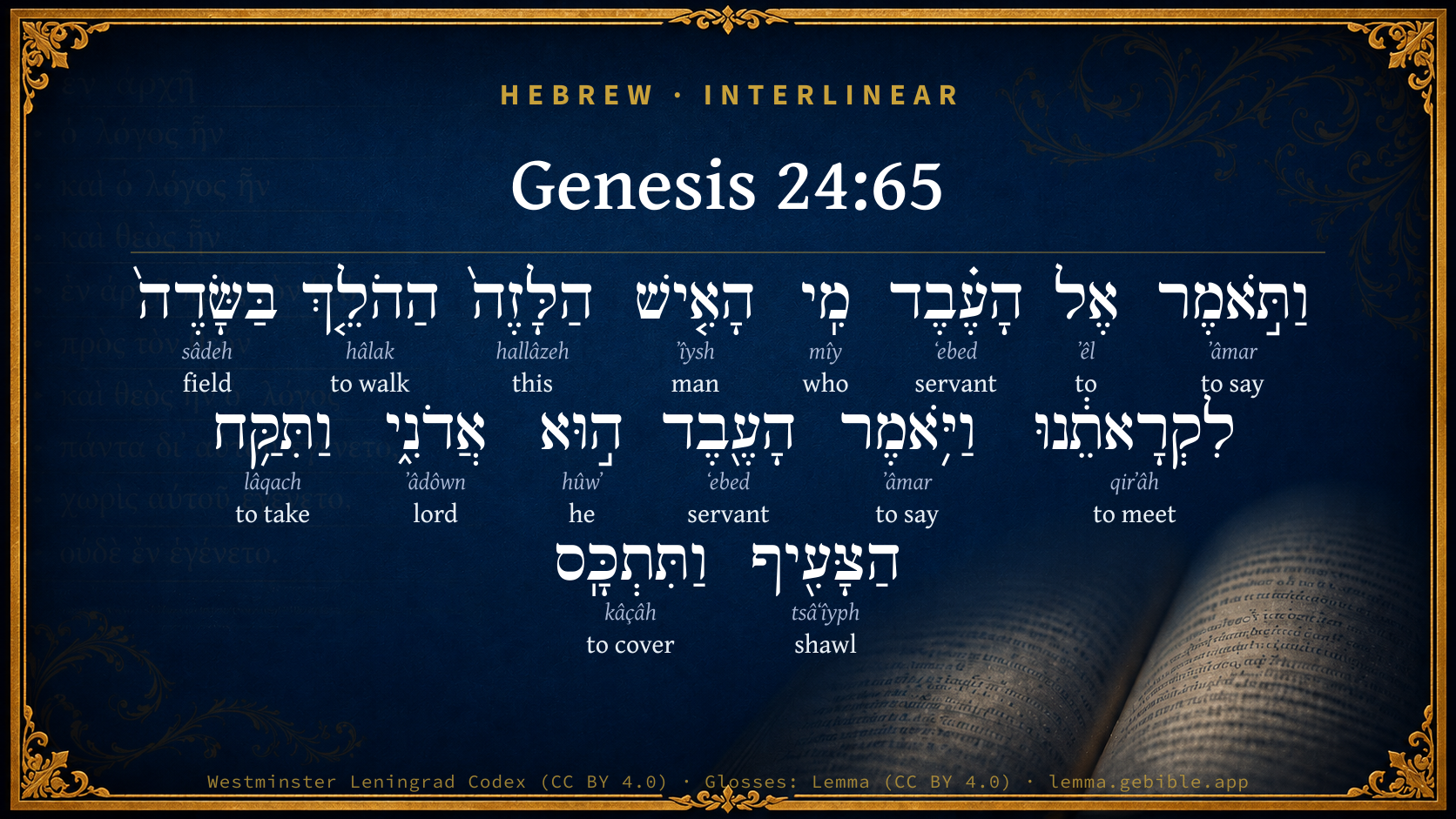
Hebrew (Westminster Leningrad Codex) Genesis 24:65 appears in the Hebrew Old Testament. The text above is from the Westminster Leningrad Codex. Each word links to its Strong’s number, a concise gloss, and parsing drawn from the Open Scriptures Hebrew Bible morphology. Click any word for its full Brown-Driver-Briggs (BDB) entry.
Download image
Cite this verse

Genesis 24:65 (World English Bible). Public Domain. Lemma interlinear Bible study tool, https://lemma.gebible.app/v/genesis/24/65.

Show BibTeX & RIS
BibTeX
RIS
English Translation
She said to the servant, "Who is the man who is walking in the field to meet us?" The servant said, "It is my master." She took her veil, and covered herself.
World English Bible · Public Domain
Highlights
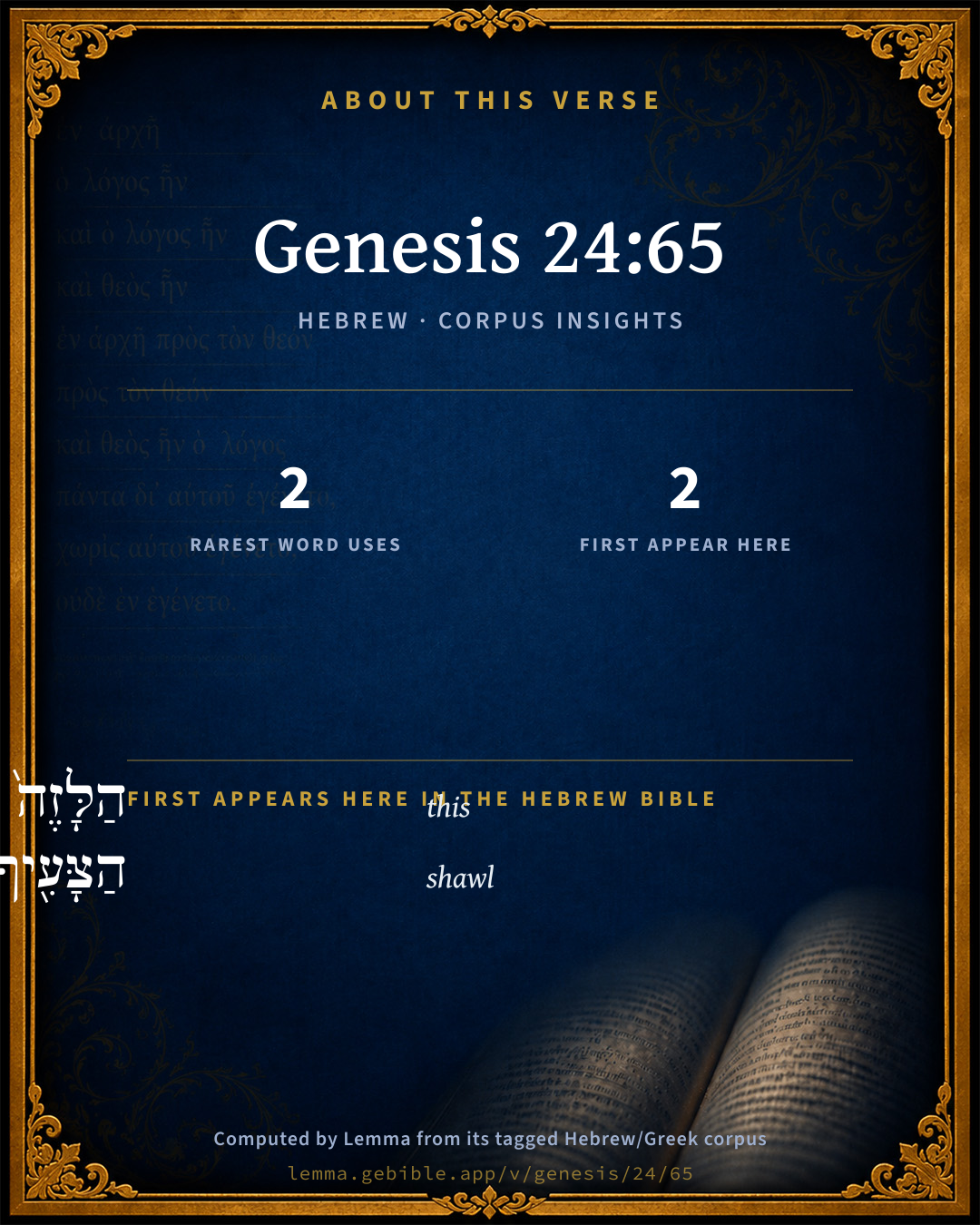
  • 2 first appearances in the Hebrew Bible
Full analysis ↓
Download a study sheet

One document with this verse’s original text, its word-by-word gloss line, the meaning frame, cross-references with their text, attributed commentary, and full source and license credits — printable, and it pastes into notes with its structure intact.

This verse Autodidact and up

Study sheet (.html) Plain text (.txt)

A passage Seminary Student

Up to 50 verses in one chapter. A passage sheet keeps up to 6 commentary sources and 12 cross-references per verse, in the order this page ranks them, and says so on the sheet whenever that leaves anything out. Ask for a single verse and you get the Autodidact verse sheet above.

Everything on this page stays free to read, with no account — the sheet is a download of what is already on screen, not access to it.

Want to remove ads? Support Godless Engineer
Compare translations 3

The same verse in 3 English versions, stacked beneath the original-language interlinear above. Click any original word for its lexicon entry.

Each is an independent rendering of the whole verse — the interlinear is not word-aligned to these translations.

Highlighted words mark where these versions differ — a whole-verse word diff, not a word-by-word alignment.

  • World English Bible Public Domain
    She said to the servant, "Who is the man who is walking in the field to meet us?" The servant said, "It is my master." She took her veil, and covered herself.
  • King James Version Public Domain
    For she had said unto the servant, What man is this that walketh in the field to meet us? And the servant had said, It is my master: therefore she took a vail, and covered herself.
  • unfoldingWord Literal Text CC BY-SA 4.0
    and she said to the servant, “Who that man in the field who is coming to meet us?” And the servant said, “He my master.” So she took the veil and covered herself.

unfoldingWord Literal Text — © unfoldingWord, licensed CC BY-SA 4.0. Word-aligned USFM3 via Door43 (git.door43.org/unfoldingWord/en_ult).

Versions to compare (up to 4)

3 of 4 selected

Show all 18 translations

Every available English version of this verse, each an independent rendering of the whole verse.

  • World English Bible Public Domain
    She said to the servant, "Who is the man who is walking in the field to meet us?" The servant said, "It is my master." She took her veil, and covered herself.
  • Berean Standard Bible Public Domain
    and asked the servant, “Who is that man in the field coming to meet us?” “It is my master,” the servant answered. So she took her veil and covered herself.
  • Majority Standard Bible Public Domain
    and asked the servant, “Who is that man in the field coming to meet us?” “It is my master,” the servant answered. So she took her veil and covered herself.
  • King James Version Public Domain
    For she had said unto the servant, What man is this that walketh in the field to meet us? And the servant had said, It is my master: therefore she took a vail, and covered herself.
  • American Standard Version (1901) Public Domain
    And she said unto the servant, What man is this that walketh in the field to meet us? And the servant said, It is my master. And she took her veil, and covered herself.
  • Revised Version (1885) Public Domain
    And she said unto the servant, What man is this that walketh in the field to meet us? And the servant said, It is my master: and she took her veil, and covered herself.
  • Geneva Bible (1599) Public Domain
    (For shee had sayde to the seruant, Who is yonder man, that commeth in the fielde to meete vs? and the seruant had said, It is my master) So she tooke a vaile, and couered her.
  • Douay-Rheims (1899) Public Domain
    And said to the servant: Who is that man who cometh towards us along the field? And he said to her: That man is my master. But she quickly took her cloak, and covered herself.
  • Young's Literal Translation Public Domain
    and she saith unto the servant, `Who `is' this man who is walking in the field to meet us?' and the servant saith, `It `is' my lord;' and she taketh the veil, and covereth herself.
  • Literal Standard Version CC BY-SA 4.0
    and she says to the servant, “Who [is] this man who is walking in the field to meet us?” And the servant says, “It [is] my lord”; and she takes the veil, and covers herself.
  • Unlocked Literal Bible CC BY-SA 4.0
    She said to the servant, “Who is that man who is walking in the field to meet us?” The servant said, “It is my master.” So she took her veil, and covered herself.
  • unfoldingWord Literal Text CC BY-SA 4.0
    and she said to the servant, “Who that man in the field who is coming to meet us?” And the servant said, “He my master.” So she took the veil and covered herself.
  • Darby Bible Public Domain
    And she had said to the servant, Who is the man that is walking in the fields to meet us? And the servant said, That is my master! Then she took the veil, and covered herself.
  • World Messianic Bible Public Domain
    She said to the servant, “Who is the man who is walking in the field to meet us?” The servant said, “It is my master.” She took her veil, and covered herself.
  • Webster's Bible Public Domain
    For she had said to the servant, What man is this that walketh in the field to meet us? And the servant had said, It is my master: therefore she took a vail and covered herself.
  • Free Bible Version CC BY-SA 4.0
    She asked the servant, “Who is this walking through the fields to meet us?” “He's my master, Isaac,” he replied. So she put on her veil to cover herself.
  • Bible in Basic English Public Domain
    And said to the servant, Who is that man coming to us through the field? And the servant said, It is my master: then she took her veil, covering her face with it.
  • JPS Tanakh (1917) Public Domain
    And she said unto the servant: 'What man is this that walketh in the field to meet us?' And the servant said: 'It is my master.' And she took her veil, and covered herself.

Literal Standard Version (2020), Covenant Press — licensed CC BY-SA 4.0. Text via the HelloAO Bible API (eBible.org). Unlocked Literal Bible (unfoldingWord) — licensed CC BY-SA 4.0. Text via the HelloAO Bible API (eBible.org). unfoldingWord Literal Text — © unfoldingWord, licensed CC BY-SA 4.0. Word-aligned USFM3 via Door43 (git.door43.org/unfoldingWord/en_ult). Free Bible Version, Dr. Jonathan Gallagher — licensed CC BY-SA 4.0. Text via the HelloAO Bible API (eBible.org).

Word by word

More ways to search: Search by grammar → Find every occurrence → Compare this word →

Practice this passage: Drill this verse → Learn its vocabulary →

הַלָּזֶה֙
hallâzeh
H1976
“this”
Pronoun, Demonstrative, Masculine, Singular
Part of Speech
Pronoun
Type
Demonstrative
Gender
Masculine
Number
Singular
Full BDB Definition

Origin: from the article [see H1973 ] and H2088

TWOT: 497

this, this one (without subst), yonder
  1. וַתֹּ֣אמֶר ʼâmar H559 “and · to say” Conjunction + Verb, Qal, Sequential Imperfect, 3rd Person, Feminine, Singular
  2. אֶל ʼêl H413 “to” Preposition
  3. הָעֶ֗בֶד ʻebed H5650 “the · servant” Particle, Definite Article + Noun, Common, Masculine, Singular, Absolute
  4. מִֽי mîy H4310 “who” Particle, Interrogative
  5. הָאִ֤ישׁ ʼîysh H376 “the · man” Particle, Definite Article + Noun, Common, Masculine, Singular, Absolute
  6. הַהֹלֵ֤ךְ hâlak H1980 “the · walking” Particle, Definite Article + Verb, Qal, Participle Active, Masculine, Singular, Absolute
  7. בַּשָּׂדֶה֙ sâdeh H7704 “in/at the · field” Preposition, Determined + Noun, Common, Masculine, Singular, Absolute
  8. לִקְרָאתֵ֔נוּ qirʼâh H7125 “to meet · us” Preposition + Verb, Qal, Infinitive Construct + Suffix, Personal, 1st Person, Common, Plural
  9. וַיֹּ֥אמֶר ʼâmar H559 “and · to say” Conjunction + Verb, Qal, Sequential Imperfect, 3rd Person, Masculine, Singular
  10. הָעֶ֖בֶד ʻebed H5650 “the · servant” Particle, Definite Article + Noun, Common, Masculine, Singular, Absolute
  11. ה֣וּא hûwʼ H1931 “he” Pronoun, Personal, 3rd Person, Masculine, Singular
  12. אֲדֹנִ֑י ʼâdôwn H113 “lord · my” Noun, Common, Masculine, Singular, Construct + Suffix, Personal, 1st Person, Common, Singular
  13. וַתִּקַּ֥ח lâqach H3947 “and · to take” Conjunction + Verb, Qal, Sequential Imperfect, 3rd Person, Feminine, Singular
  14. הַצָּעִ֖יף tsâʻîyph H6809 “the · shawl” Particle, Definite Article + Noun, Common, Masculine, Singular, Absolute
  15. וַתִּתְכָּֽס kâçâh H3680 “and · to cover” Conjunction + Verb, Hithpael, Sequential Imperfect, 3rd Person, Feminine, Singular

About this verse

These counts appear in no published source. They are computed here, from the morphology-tagged text and Lemma’s own curated glosses. What Lemma adds →

16
words
14
distinct lemmas
Pentateuch
section

Notable vocabulary

The rarest word here is הַלָּזֶה֙ this H1976 — appearing just 2 times in the whole Hebrew Bible.

First appearance in Scripture

These words make their first canonical appearance in the Hebrew Bible here:

  • הַלָּזֶה֙ this H1976
  • הַצָּעִ֖יף shawl H6809

Shared distinctive vocabulary

הַלָּזֶה֙ this H1976 occurs in 2 verses of the Hebrew Bible. Also found in:

Grammatical profile

  • 6 verbs
  • 6 nouns
  • 2 pronouns
  • 1 preposition
  • 1 particle

Verb forms

  • וַתֹּ֣אמֶר Qal · Sequential Imperfect
  • הַהֹלֵ֤ךְ Qal · Participle Active
  • לִקְרָאתֵ֔נוּ Qal · Infinitive Construct
  • וַיֹּ֥אמֶר Qal · Sequential Imperfect
  • וַתִּקַּ֥ח Qal · Sequential Imperfect
  • וַתִּתְכָּֽס Hithpael · Sequential Imperfect

Repetition

Words recur within this verse — often emphatic in Hebrew:

  • וַתֹּ֣אמֶר to say H559 ×2
  • הָעֶ֗בֶד servant H5650 ×2

Hebrew & Septuagint length

In English translation the verse runs 32 words from the Hebrew and 33 from the Septuagint (LXX English) — closely comparable.

A rough comparison of the two English renderings, which tokenize alike — not a word-level alignment.

Word counts can differ between the Hebrew and the Greek without any difference in meaning — e.g. the Hebrew direct-object marker אֵת has no separate Greek word, and Greek often adds the article ὁ.

Cross-references

4

Topical passages linked to Genesis 24:65 in the Treasury of Scripture Knowledge — connected by theme and wording, ordered by reader-vote popularity; previews shown in the World English Bible.

  • 1 Timothy 2:9 In the same way, that women also adorn themselves in decent clothing, with modesty and propriety; not just with braided hair, gold, pearls, or expensive clothing;
  • 1 Corinthians 11:5–6 But every woman praying or prophesying with her head unveiled dishonors her head. For it is one and the same thing as if she were shaved.
  • 1 Corinthians 11:10 For this cause the woman ought to have authority on her head, because of the angels.
  • Genesis 20:16 To Sarah he said, "Behold, I have given your brother a thousand pieces of silver. Behold, it is for you a covering of the eyes to all that are with you. In front of all you are vindicated."

Cross-references courtesy of OpenBible.info (CC BY 4.0).

Hebrew and Greek witnesses Masoretic Hebrew ↔ Greek Septuagint

The same verse in the two great witnesses to the Old Testament, shown verse-for-verse.

These are two independent witnesses, not word-aligned to each other, and the Septuagint is shown in lemma (dictionary) form.

Hebrew Genesis 24:65 Masoretic · Westminster Leningrad Codex

וַתֹּ֣אמֶר אֶל הָעֶ֗בֶד מִֽי הָאִ֤ישׁ הַלָּזֶה֙ הַהֹלֵ֤ךְ בַּשָּׂדֶה֙ לִקְרָאתֵ֔נוּ וַיֹּ֥אמֶר הָעֶ֖בֶד ה֣וּא אֲדֹנִ֑י וַתִּקַּ֥ח הַצָּעִ֖יף וַתִּתְכָּֽס

She said to the servant, "Who is the man who is walking in the field to meet us?" The servant said, "It is my master." She took her veil, and covered herself.

World English Bible · Public Domain

Greek LXX Genesis 24:65 Septuagint · lemma form

καί εἶπον ὁ παῖς τίς εἰμί ὁ ἄνθρωπος ἐκεῖνος ὁ πορεύομαι ἐν ὁ πεδίον εἰς συνάντησις ἐγώ εἶπον δέ ὁ παῖς οὗτος εἰμί ὁ κύριος ἐγώ ὁ δέ λαμβάνω ὁ θέριστρον περιβάλλω

and said to the servant, Who is that man that walks in the plain to meet us? And the servant said, This is my master; and she took her veil and covered herself.

LXX2012 (modern English Septuagint) · Public Domain

Hebrew: Westminster Leningrad Codex (CC BY 4.0). Greek: Septuagint (public domain); English from LXX2012 (modern English Septuagint) (Public Domain). How the Septuagint differs from the Hebrew →

Targum (Aramaic paraphrase)

2

The Targum is the ancient Jewish Aramaic paraphrase of the Hebrew Scriptures — an interpretive translation, not the Hebrew text itself. Onkelos (literal) and Pseudo-Jonathan (expansive) render the Torah, and Jonathan the Prophets. Coverage is partial: where no permissively-licensed English translation exists for a verse, only the Aramaic is shown. This is verse-level text, not a word-by-word alignment to the Hebrew.

  1. Targum Onkelos Torah (Genesis–Deuteronomy)
    וַאֲמֶרֶת לְעַבְדָּא מָן גַּבְרָא דֵיכִי דִּמְהַלֵּךְ בְּחַקְלָא לְקַדָּמוּתָנָא וַאֲמַר עַבְדָּא הוּא רִבּוֹנִי וּנְסֵיבַת עֵיפָא וְאִתְכַּסִּיאַת

    (no public-domain English translation for this verse)

    Targum Onkelos — Aramaic: “Onkelos Genesis” (public domain); “Onkelos Exodus” (public domain); “Onkelos Leviticus” (public domain); “Onkelos Numbers” (public domain); “Onkelos Deuteronomy” (public domain). English: “Sefaria Community Translation” (CC0 1.0 (public-domain dedication)); “J.W. Etheridge. The Targums of Onkelos and Jonathan Ben Uzziel on the Pentateuch. London: Longmans, Green, 1862” (public domain). Text via Sefaria.

  2. Targum Pseudo-Jonathan Torah (Genesis–Deuteronomy)
    וַאֲמָרַת לְעַבְדָא מַן גַבְרָא הֲדוֹר וְיָאִי דִמְטַיֵיל בְּחַקְלָא לִקְדָמוּתָנָא וַאֲמַר עַבְדָא הוּא רִבּוֹנִי וּנְסִיבַת רְדִידָא וְאִתְעֲטִיפַת בֵּיהּ

    And she said to the servant, Who is the man (so) majestic and graceful, who walks in the field before us? And the servant said, He is my master. And she took a veil and covered herself.

    Targum Pseudo-Jonathan — Aramaic: “Targum Jonathan on Genesis” (public domain); “Targum Jonathan on Exodus” (public domain); “Targum Jonathan on Leviticus” (public domain); “Targum Jonathan on Numbers” (public domain); “Targum Jonathan on Deuteronomy” (public domain). English: “The Targum of Jonathan ben Uzziel, trans. J. W. Etheridge, London, 1862” (public domain). Text via Sefaria.

Commentary

Notes on Genesis 24:65 from classic Christian and Jewish commentators (each source and its license shown beneath its notes). The classic Christian expositions comment on the surrounding passage and are grouped to its opening verse, so a note may address several verses; the Jewish commentaries on the Tanakh (Rashi and others) are per-verse, so they appear only where the commentator wrote on this verse.

Lemma curates 59 commentaries, every one of them public domain or Creative Commons licensed, each selected and text-cleaned for this edition rather than reprinted as found. About our sources →

Geneva Bible (1599)

Geneva Bible translators

The custom was that the spouse was brought to her husband, her head being covered, in token of shamefastness and chastity.

Geneva Bible (1599) marginal notes — public domain. Text via Bolls.life.

Jamieson, Fausset & Brown

Robert Jamieson, A. R. Fausset & David Brown

she took a veil, and covered herself--The veil is an essential part of female dress. In country places it is often thrown aside, but on the appearance of a stranger, it is drawn over the face, as to conceal all but the eyes. In a bride it was a token of her reverence and subjection to her husband.

Jamieson, Fausset & Brown — Commentary Critical and Explanatory on the Whole Bible (1871) — public domain (CC PDM 1.0). Text via the HelloAO Bible API.

Adam Clarke's Commentary

Verse 65. She took a veil] הצעיף hatstsaaif. This is the first time this word occurs, and it is of doubtful signification; but most agree to render it a veil or a cloak. The former is the most likely, as it was generally used by women in the east as a sign of chastity, modesty, and subjection.

Adam Clarke's Commentary on the Bible (1810–1826) — public domain. Text from a community e-Sword/MySword module.

Ellicott's Commentary for English Readers

(65) She took a vail, and covered herself.—Brides are usually taken to the bridegroom enveloped in a vail, which covers the whole body, and is far larger than that ordinarily worn. At the present time the bride-vail is usually red, the ordinary vail blue or white. By wrapping herself in this vail Rebekah notified that she was the bride. After marriage it was seldom worn at this early period, and so both the Egyptians and Abimelech saw Sarah’s beauty.

A Bible Commentary for English Readers, edited by Charles John Ellicott (1878–1897) — public domain. Text from a community e-Sword module.

The Cambridge Bible for Schools and Colleges

gen. ed. J. J. S. Perowne

65. It is my master] Referring to Isaac. The expression favours the suggestion that, according to the original version of the story, Abraham’s death had been mentioned after Gen_24:9 (see note); the servant’s master was no longer Abraham.

took her veil] According to Oriental custom the bride was brought veiled into the presence of the bridegroom: cf. Gen_29:23; Gen_29:25.

The Cambridge Bible for Schools and Colleges (gen. ed. J. J. S. Perowne; Cambridge University Press, 1878–1918) — public domain. Text from a community e-Sword module.

Haydock's Catholic Bible Commentary

Cloak, or summer veil, covering the whole body, and having an opening only for the eyes; such as the Eastern ladies use. St. Jerome in Isai. iii, Rebecca does this out of modesty. (Haydock) --- She prefigures the Gentiles, whom Jesus calls by his servants laden with his gifts, to become his spouse, or his Church, (Calmet) at the fountain of baptism. He adorns her with the ear-rings of obedience, and the bracelets of good works. (Du Hamel)

George Leo Haydock (1774–1849), Haydock's Catholic Family Bible and Commentary, 1859 edition — public domain. Excludes Psalms (Douay-Rheims chapter numbering differs from Protestant) and Deuterocanonical books (Catholic canon only).

Matthew Poole's English Annotations

In token of modesty, reverence, and subjection. See Gen 20:16; 1Co 11:10.

Matthew Poole's English Annotations on the Holy Bible (1683–1685) — public domain. Text from a community e-Sword/MySword module.

Whedon's Commentary on the Bible

Daniel D. Whedon

65. For she had said — Rather, and she said. There is no need of interpolating had in either of the two places in which it occurs in this verse.

Took a vail — Hebrews, took the vail; the vail proper to be used in such a case, “the long cloak-like vail, with which the Eastern women covered their faces.”

Daniel D. Whedon (gen. ed.), Commentary on the Old and New Testaments (1874–1909) — public domain. Text from a community e-Sword module.

The Pulpit Commentary

For she had said (literally, and she said; not before, but after alighting) unto the servant (of Abraham), What man is this that walketh in the field to meet us? Isaac having obviously hastened forward to give a welcome to his bride. On learning who it was she took a veil cloak-like veil of Arabia" (Keil), which covers not merely the face, but, "like a kind of large wrapper, nearly the whole form, rendering it impossible to recognize the person" (Kalisch)and covered herself. That married ladies did not always use the yell when traveling appears from the case of Sarah; (Gen_20:16) but that brides did not discover their faces to their intended husbands until after marriage may be inferred from the case of Leah. (Gen_29:23, Gen_29:25) Thus modestly attired, she meekly yields herself to one whom she had never before seen, in the confident persuasion that so Jehovah willed.

The Pulpit Commentary (1880–1919), ed. H.D.M. Spence-Jones & Joseph S. Exell — public domain. Text from a community e-Sword module.

Rashi

Rabbi Shlomo Yitzchaki (Rashi)

ותתכס AND [SHE] COVERED HERSELF — This has a passive meaning (she was covered); it is like (35:8) ותקבר “and she was buried”, and (1 Samuel 4:18) ותשבר “and [his neck] was broken”.

Rashi on the Tanakh — English translations: “The Judaica Press complete Tanach with Rashi, translated by A. J. Rosenberg” (CC BY 4.0); “Pentateuch with Rashi's commentary by M. Rosenbaum and A.M. Silbermann, 1929-1934” (public domain); “The Metsudah Tanach series, Lakewood, N.J” (CC BY 4.0); and “The Book of Joshua, Metsudah Publications, 1997” (CC BY 4.0). Text via Sefaria.

Radak

Rabbi David Kimhi (Radak)

ותאמר, she had asked Eliezer who the man was before she alighted from the camel. She did so only after having been informed that the man was her husband to be, Yitzchok. She had not enquired about every person that they met on the journey, but in the case of Yitzchok, the fact that he approached sideways had made her wonder if, by chance, this was Yitzchok or someone from his household. This is why she added the words: ההולך בשדה לקראתנו, she had observed that this man was busy in the field and only after he had seen them did he come walking in their direction.

Radak on the Tanakh — English translations: “Sefaria Community Translation” (CC0 1.0 (public-domain dedication)); “Eliyahu Munk, HaChut Hameshulash” (CC BY 4.0); “Rabbi Mike Feuer, Jerusalem Anthology” (CC BY 4.0); and “R. David Kimhi on the first book of Psalms, Translated by R.G. Finch, London, 1919” (public domain). Text via Sefaria.

Lesson kit

Teaching starters — assembled from the data on this page, not authored interpretation. Every prompt links to the verse data it draws on. Edit before teaching.

Genesis, in the Pentateuch, opens this verse with 16 words (14 distinct Hebrew lemmas). Its most distinctive word is hallâzeh (“this”). A historical commentator’s framing appears above. Read the whole chapter for the surrounding context.

Discussion questions

  1. The word hallâzeh carries the sense “this.” How does it shape the verse?
  2. 2 words make their first appearance in Scripture here. What does this debut establish?
  3. How does Genesis 37:19, which shares the word «this», read alongside this verse?
  4. What does the repetition of “to say” (2× in this one verse) do in this verse?
  5. These translations render this verse differently; the difference is in the English rendering, not the original. What questions does that raise?
  6. «וַתֹּ֣אמֶר» is a Qal Sequential Imperfect verb. How does that grammatical form shape the action described?
  7. Compare how Geneva Bible (1599) and Jamieson, Fausset & Brown read this verse. Where do they agree or differ?

Things to notice

  • 2 words make their first canonical appearance in Scripture here.
  • These translations choose different wording for 9 words in this verse.
  • “to say” occurs 2× in this single verse.
  • 14 distinct Hebrew lemmas span 16 words in this verse.

Reading settings

Reading text

Shown beneath each verse's original-language words.

Old Testament
Old Testament edition

Read the OT as the Masoretic Hebrew (MT) or the Greek Septuagint (LXX).

English shown for the Greek Septuagint (in the Hebrew ↔ Greek comparison).

Comparing translations? Open the Compare panel on any verse page to stack up to four side by side.