
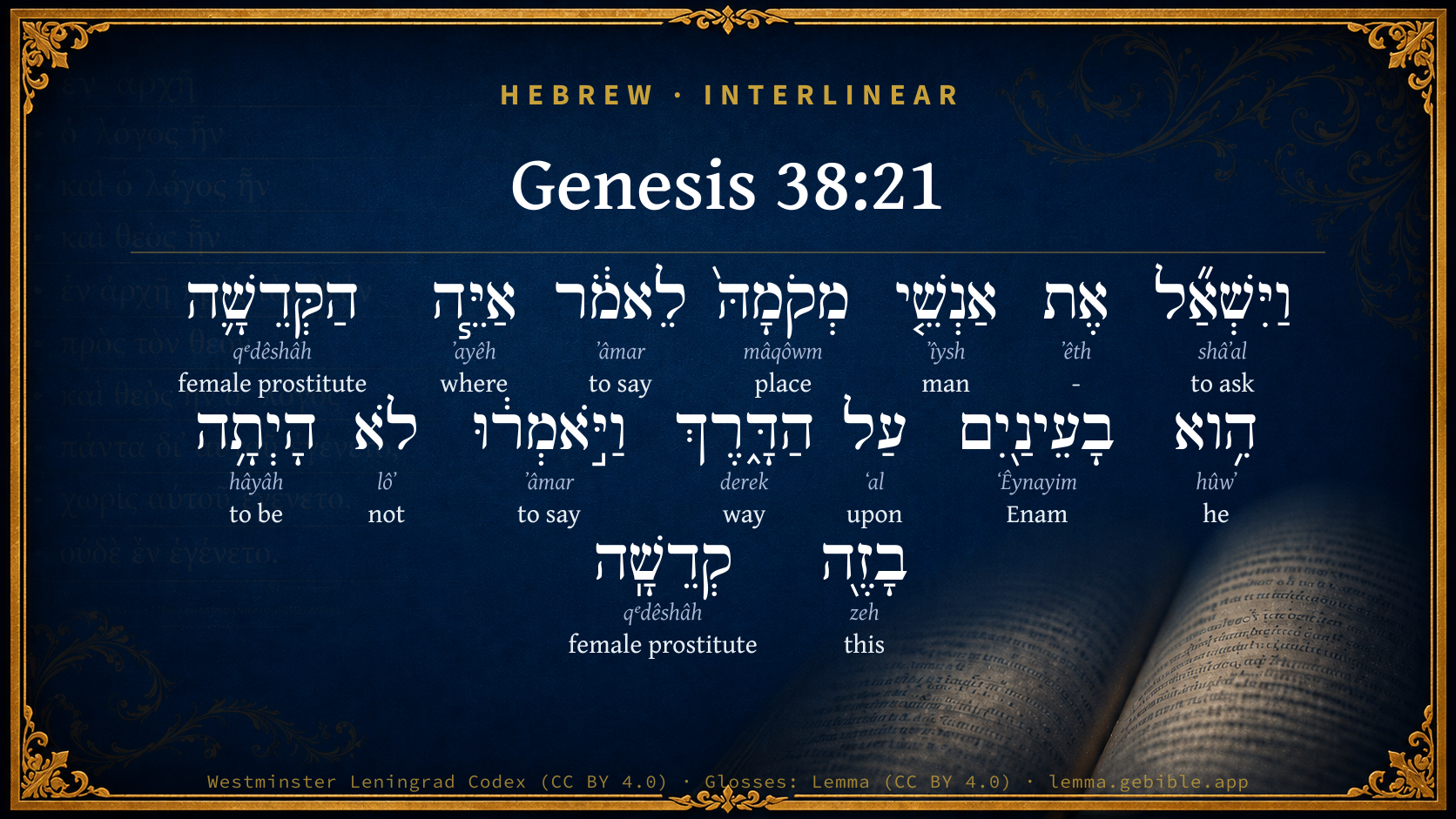
Genesis 38:21

Hebrew (Westminster Leningrad Codex) Genesis 38:21 appears in the Hebrew Old Testament. The text above is from the Westminster Leningrad Codex. Each word links to its Strong’s number, a concise gloss, and parsing drawn from the Open Scriptures Hebrew Bible morphology. Click any word for its full Brown-Driver-Briggs (BDB) entry.
Download image
Cite this verse

Genesis 38:21 (World English Bible). Public Domain. Lemma interlinear Bible study tool, https://lemma.gebible.app/v/genesis/38/21.

Show BibTeX & RIS
BibTeX
RIS
English Translation
Then he asked the men of her place, saying, "Where is the prostitute, that was at Enaim by the road?" They said, "There has been no prostitute here."
World English Bible · Public Domain
Highlights
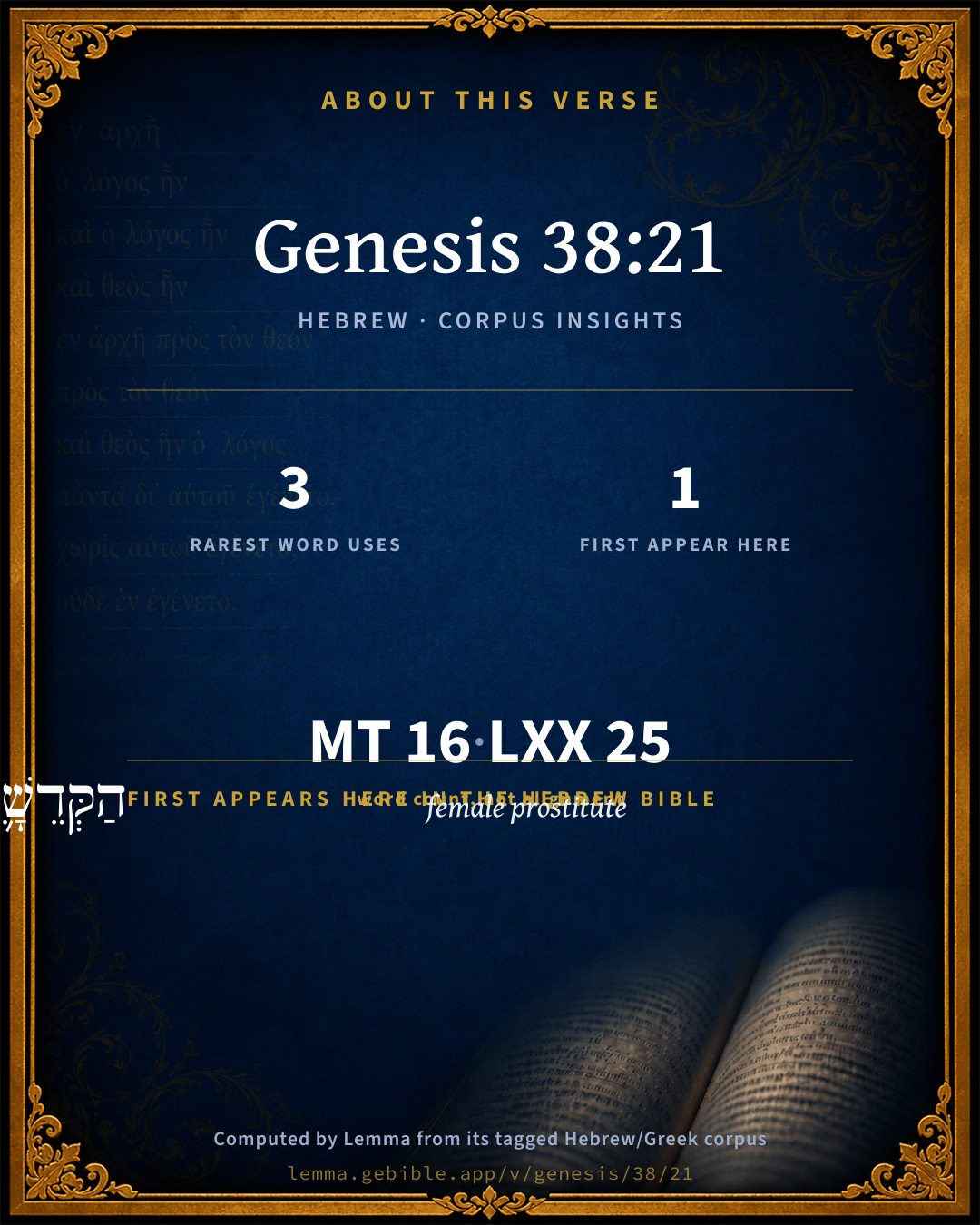
  • 1 first appearance in the Hebrew Bible
Full analysis ↓
Download a study sheet

One document with this verse’s original text, its word-by-word gloss line, the meaning frame, cross-references with their text, attributed commentary, and full source and license credits — printable, and it pastes into notes with its structure intact.

This verse Autodidact and up

Study sheet (.html) Plain text (.txt)

A passage Seminary Student

Up to 50 verses in one chapter. A passage sheet keeps up to 6 commentary sources and 12 cross-references per verse, in the order this page ranks them, and says so on the sheet whenever that leaves anything out. Ask for a single verse and you get the Autodidact verse sheet above.

Everything on this page stays free to read, with no account — the sheet is a download of what is already on screen, not access to it.

Want to remove ads? Support Godless Engineer
Compare translations 3

The same verse in 3 English versions, stacked beneath the original-language interlinear above. Click any original word for its lexicon entry.

Each is an independent rendering of the whole verse — the interlinear is not word-aligned to these translations.

Highlighted words mark where these versions differ — a whole-verse word diff, not a word-by-word alignment.

  • World English Bible Public Domain
    Then he asked the men of her place, saying, "Where is the prostitute, that was at Enaim by the road?" They said, "There has been no prostitute here."
  • King James Version Public Domain
    Then he asked the men of that place, saying, Where is the harlot, that was openly by the way side? And they said, There was no harlot in this place.
  • unfoldingWord Literal Text CC BY-SA 4.0
    So he asked the men of her place, saying, “Where the temple prostitute who at Enaim beside the road?” But they said, “There has not been a temple prostitute in this place.”

unfoldingWord Literal Text — © unfoldingWord, licensed CC BY-SA 4.0. Word-aligned USFM3 via Door43 (git.door43.org/unfoldingWord/en_ult).

Versions to compare (up to 4)

3 of 4 selected

Show all 18 translations

Every available English version of this verse, each an independent rendering of the whole verse.

  • World English Bible Public Domain
    Then he asked the men of her place, saying, "Where is the prostitute, that was at Enaim by the road?" They said, "There has been no prostitute here."
  • Berean Standard Bible Public Domain
    He asked the men of that place, “Where is the shrine prostitute who was beside the road at Enaim?” “No shrine prostitute has been here,” they answered.
  • Majority Standard Bible Public Domain
    He asked the men of that place, “Where is the shrine prostitute who was beside the road at Enaim?” “No shrine prostitute has been here,” they answered.
  • King James Version Public Domain
    Then he asked the men of that place, saying, Where is the harlot, that was openly by the way side? And they said, There was no harlot in this place.
  • American Standard Version (1901) Public Domain
    Then he asked the men of her place, saying, Where is the prostitute, that was at Enaim by the wayside? And they said, There hath been no prostitute here.
  • Revised Version (1885) Public Domain
    Then he asked the men of her place, saying, Where is the harlot, that was at Enaim by the way side? And they said, There hath been no harlot here.
  • Geneva Bible (1599) Public Domain
    Then asked he the men of that place, saying, Where is ye whore, that sate in Enaim by the way side? And they answered, There was no whore here.
  • Douay-Rheims (1899) Public Domain
    And Juda sent a kid by his shepherd, the Odollamite, that he might receive the pledge again, which he had given to the woman: but he, not finding her,
  • Young's Literal Translation Public Domain
    And he asketh the men of her place, saying, `Where `is' the separated one -- she in Enayim, by the way?' and they say, `There hath not been in this `place' a separated one.'
  • Literal Standard Version CC BY-SA 4.0
    And he asks the men of her place, saying, “Where [is] the separated one—she in Enayim, by the way?” And they say, “There has not been in this [place] a separated one.”
  • Unlocked Literal Bible CC BY-SA 4.0
    Then the Adullamite asked the men of the place, “Where is the cultic prostitute who was at Enaim by the road?” They said, “There has not been a cultic prostitute here.”
  • unfoldingWord Literal Text CC BY-SA 4.0
    So he asked the men of her place, saying, “Where the temple prostitute who at Enaim beside the road?” But they said, “There has not been a temple prostitute in this place.”
  • Darby Bible Public Domain
    And he asked the men of her place, saying, Where is the prostitute that was at Enaim, by the way-side? And they said, There was no prostitute here.
  • World Messianic Bible Public Domain
    Then he asked the men of her place, saying, “Where is the prostitute, that was at Enaim by the road?” They said, “There has been no prostitute here.”
  • Webster's Bible Public Domain
    Then he asked the men of that place, saying, where is the harlot that was openly by the way-side? and they said, There was no harlot in this place.
  • Free Bible Version CC BY-SA 4.0
    Hirah asked the men there, “Where's the cult prostitute that sits by the entrance road to Enaim?” “There's no cult prostitute here,” they answered.
  • Bible in Basic English Public Domain
    And he put questions to the men of the place, saying, Where is the loose woman who was in Enaim by the wayside? And they said, There was no such woman there.
  • JPS Tanakh (1917) Public Domain
    Then he asked the men of her place, saying: 'Where is the harlot, that was at Enaim by the wayside?' And they said: 'There hath been no harlot here.'

Literal Standard Version (2020), Covenant Press — licensed CC BY-SA 4.0. Text via the HelloAO Bible API (eBible.org). Unlocked Literal Bible (unfoldingWord) — licensed CC BY-SA 4.0. Text via the HelloAO Bible API (eBible.org). unfoldingWord Literal Text — © unfoldingWord, licensed CC BY-SA 4.0. Word-aligned USFM3 via Door43 (git.door43.org/unfoldingWord/en_ult). Free Bible Version, Dr. Jonathan Gallagher — licensed CC BY-SA 4.0. Text via the HelloAO Bible API (eBible.org).

Word by word

More ways to search: Search by grammar → Find every occurrence → Compare this word →

Practice this passage: Drill this verse → Learn its vocabulary →

בָעֵינַ֖יִם
ʻÊynayim
H5879
“in/at the · Enam”
Preposition, Determined + Noun, Proper
Part of Speech
Preposition + Noun
Type
Proper
Full BDB Definition

Origin: dual of H5869

TWOT: None

Enam = "double spring" - a city in the lowlands of Judah
  1. וַיִּשְׁאַ֞ל shâʼal H7592 “and · to ask” Conjunction + Verb, Qal, Sequential Imperfect, 3rd Person, Masculine, Singular
  2. אֶת ʼêth H853 “-” Particle, Direct Object
  3. אַנְשֵׁ֤י ʼîysh H376 “men of” Noun, Common, Masculine, Plural, Construct
  4. מְקֹמָהּ֙ mâqôwm H4725 “place · her” Noun, Common, Masculine, Singular, Construct + Suffix, Personal, 3rd Person, Feminine, Singular
  5. לֵאמֹ֔ר ʼâmar H559 “to say” Preposition + Verb, Qal, Infinitive Construct
  6. אַיֵּ֧ה ʼayêh H346 “where” Particle, Interrogative
  7. הַקְּדֵשָׁ֛ה qᵉdêshâh H6948 “the · female prostitute” Particle, Definite Article + Noun, Common, Feminine, Singular, Absolute
  8. הִ֥וא hûwʼ H1931 “he” Pronoun, Personal, 3rd Person, Feminine, Singular
  9. עַל ʻal H5921 “upon” Preposition
  10. הַדָּ֑רֶךְ derek H1870 “the · way” Particle, Definite Article + Noun, Common, Both, Singular, Absolute
  11. וַיֹּ֣אמְר֔וּ ʼâmar H559 “and · to say” Conjunction + Verb, Qal, Sequential Imperfect, 3rd Person, Masculine, Plural
  12. לֹא lôʼ H3808 “not” Particle, Negative
  13. הָיְתָ֥ה hâyâh H1961 “to be” Verb, Qal, Perfect, 3rd Person, Feminine, Singular
  14. בָזֶ֖ה zeh H2088 “in/at · this” Preposition + Pronoun, Demonstrative, Masculine, Singular
  15. קְדֵשָֽׁה qᵉdêshâh H6948 “female prostitute” Adjective, Adjective, Feminine, Singular, Absolute

About this verse

These counts appear in no published source. They are computed here, from the morphology-tagged text and Lemma’s own curated glosses. What Lemma adds →

16
words
14
distinct lemmas
Pentateuch
section

Notable vocabulary

The rarest word here is בָעֵינַ֖יִם Enam H5879 — appearing just 3 times in the whole Hebrew Bible.

First appearance in Scripture

This word makes its first canonical appearance in the Hebrew Bible here:

  • הַקְּדֵשָׁ֛ה female prostitute H6948

Shared distinctive vocabulary

בָעֵינַ֖יִם Enam H5879 occurs in 3 verses of the Hebrew Bible. Also found in:

Grammatical profile

  • 4 verbs
  • 5 nouns
  • 1 adjective
  • 2 pronouns
  • 1 preposition
  • 3 particles

Verb forms

  • וַיִּשְׁאַ֞ל Qal · Sequential Imperfect
  • לֵאמֹ֔ר Qal · Infinitive Construct
  • וַיֹּ֣אמְר֔וּ Qal · Sequential Imperfect
  • הָיְתָ֥ה Qal · Perfect

Repetition

Words recur within this verse — often emphatic in Hebrew:

  • לֵאמֹ֔ר to say H559 ×2
  • הַקְּדֵשָׁ֛ה female prostitute H6948 ×2

Hebrew & Septuagint length

In English translation the verse runs 28 words from the Hebrew and 27 from the Septuagint (LXX English) — closely comparable.

A rough comparison of the two English renderings, which tokenize alike — not a word-level alignment.

Word counts can differ between the Hebrew and the Greek without any difference in meaning — e.g. the Hebrew direct-object marker אֵת has no separate Greek word, and Greek often adds the article ὁ.

In the original languages it is 16 Hebrew tokens and 25 Greek tokens — but the two are counted differently (Hebrew bundles its prefixes and suffixes into one token; the Greek is in lemma form), so that isn’t a like-for-like length.

Hebrew and Greek witnesses Masoretic Hebrew ↔ Greek Septuagint

The same verse in the two great witnesses to the Old Testament, shown verse-for-verse.

These are two independent witnesses, not word-aligned to each other, and the Septuagint is shown in lemma (dictionary) form.

Hebrew Genesis 38:21 Masoretic · Westminster Leningrad Codex

וַיִּשְׁאַ֞ל אֶת אַנְשֵׁ֤י מְקֹמָהּ֙ לֵאמֹ֔ר אַיֵּ֧ה הַקְּדֵשָׁ֛ה הִ֥וא בָעֵינַ֖יִם עַל הַדָּ֑רֶךְ וַיֹּ֣אמְר֔וּ לֹא הָיְתָ֥ה בָזֶ֖ה קְדֵשָֽׁה

Then he asked the men of her place, saying, "Where is the prostitute, that was at Enaim by the road?" They said, "There has been no prostitute here."

World English Bible · Public Domain

Greek LXX Genesis 38:21 Septuagint · lemma form

ἐπιἐρωτάω δέ ὁ ἀνήρ ὁ ἐκ ὁ τόπος ποῦ εἰμί ὁ πόρνη ὁ γίγνομαι ἐν αιναν ἐπί ὁ ὁδός καί εἶπον οὐ εἰμί ἐνταῦθα πόρνη

And he asked the men of the place, Where is the harlot who was in Aenan by the wayside? and they said, There was no harlot here.

LXX2012 (modern English Septuagint) · Public Domain

Hebrew: Westminster Leningrad Codex (CC BY 4.0). Greek: Septuagint (public domain); English from LXX2012 (modern English Septuagint) (Public Domain). How the Septuagint differs from the Hebrew →

Targum (Aramaic paraphrase)

2

The Targum is the ancient Jewish Aramaic paraphrase of the Hebrew Scriptures — an interpretive translation, not the Hebrew text itself. Onkelos (literal) and Pseudo-Jonathan (expansive) render the Torah, and Jonathan the Prophets. Coverage is partial: where no permissively-licensed English translation exists for a verse, only the Aramaic is shown. This is verse-level text, not a word-by-word alignment to the Hebrew.

  1. Targum Onkelos Torah (Genesis–Deuteronomy)
    וּשְׁאִיל יָת אֲנָשֵׁי אַתְרַהּ לְמֵימַר אָן מְקַדִּשְׁתָּא הִיא בְעַיְנִין עַל אָרְחָא וַאֲמָרוּ לֵית הָכָא מְקַדִּשְׁתָּא

    (no public-domain English translation for this verse)

    Targum Onkelos — Aramaic: “Onkelos Genesis” (public domain); “Onkelos Exodus” (public domain); “Onkelos Leviticus” (public domain); “Onkelos Numbers” (public domain); “Onkelos Deuteronomy” (public domain). English: “Sefaria Community Translation” (CC0 1.0 (public-domain dedication)); “J.W. Etheridge. The Targums of Onkelos and Jonathan Ben Uzziel on the Pentateuch. London: Longmans, Green, 1862” (public domain). Text via Sefaria.

  2. Targum Pseudo-Jonathan Torah (Genesis–Deuteronomy)
    וּשְׁאַל יַת אִינְשֵׁי אַתְרָהּ לְמֵימַר הָאַן מַטְעִיתָא דְהִיא בִּסְכוֹת עַיְינִין עַל אוֹרְחָא וַאֲמָרוּ לָא הֲוָת הָכָא מַטְעִיתָא

    And he asked the men of the place, saying, Where is the harlot who was in the sight of the eyes by the way? And they said, There is no harlot here.

    Targum Pseudo-Jonathan — Aramaic: “Targum Jonathan on Genesis” (public domain); “Targum Jonathan on Exodus” (public domain); “Targum Jonathan on Leviticus” (public domain); “Targum Jonathan on Numbers” (public domain); “Targum Jonathan on Deuteronomy” (public domain). English: “The Targum of Jonathan ben Uzziel, trans. J. W. Etheridge, London, 1862” (public domain). Text via Sefaria.

Commentary

Notes on Genesis 38:21 from classic Christian and Jewish commentators (each source and its license shown beneath its notes). The classic Christian expositions comment on the surrounding passage and are grouped to its opening verse, so a note may address several verses; the Jewish commentaries on the Tanakh (Rashi and others) are per-verse, so they appear only where the commentator wrote on this verse.

Lemma curates 59 commentaries, every one of them public domain or Creative Commons licensed, each selected and text-cleaned for this edition rather than reprinted as found. About our sources →

Trapp's Complete Commentary

John Trapp

Gen 38:21 Then he asked the men of that place, saying, Where [is] the harlot, that [was] openly by the way side? And they said, There was no harlot in this [place].

Ver. 21. Where is the harlot?] The holy whore, as the Hebrew word importeth; such as committed that filthiness, under a pretence of holiness. Such, among the heathens, were the lewd worshippers of Priapus (this is thought to be Baalpeor); and Venus at Cyprus; where the maids, in honour of their goddess, prostituted their chastity to all that would, once a year. So in their Lupercals and Bacchanals at Rome, in quibus discurrebatur ad publicos concubitus, for like reason. Of such unclean persons, even by God’s house, we read in 2Ki 23:7, and of such as "sacrificed with harlots" in Hos 4:14, who brought their hire for a vow; called therefore, the price of a salt bitch (dog). {Deu 23:17-18} Vah propudium!

John Trapp, A Commentary or Exposition upon All the Books of the Old and New Testament (1647–1656) — public domain. Text from a community e-Sword module.

Adam Clarke's Commentary

Verse 21. Where is the harlot that was openly by the wayside?] Our translators often render different Hebrew words by the same term in English, and thus many important shades of meaning, which involve traits of character, are lost. In Ge 38:15, Tamar is called a harlot, זונה zonah, which, as we have already seen, signifies a person who prostitutes herself for money. In this verse she is called a harlot in our version; but the original is not זונה but קדשה kedeshah, a holy or consecrated person, from קדש kadash, to make holy, or to consecrate to religious purposes. And the word here must necessarily signify a person consecrated by prostitution to the worship of some impure goddess.

The public prostitutes in the temple of Venus are called ιεροδουλοι γυναικες, holy or consecrated female servants, by Strabo; and it appears from the words zonah and kedeshah above, that impure rites and public prostitution prevailed in the worship of the Canaanites in the time of Judah. And among these people we have much reason to believe that Astarte and Asteroth occupied the same place in their theology as Venus did among the Greeks and Romans, and were worshipped with the same impure rites.

Adam Clarke's Commentary on the Bible (1810–1826) — public domain. Text from a community e-Sword/MySword module.

Ellicott's Commentary for English Readers

(21) Where is the harlot . . .?—Heb.,Whercisthe kedeshah (see Gen_38:15) that was at Enajim by the wayside? “Enajim (the two founts) by-the-wayside,” seems to have been the full name of the village. (See Gen_38:14.)

A Bible Commentary for English Readers, edited by Charles John Ellicott (1878–1897) — public domain. Text from a community e-Sword module.

The Cambridge Bible for Schools and Colleges

gen. ed. J. J. S. Perowne

21. harlot] Heb. ḳedêshah, that is, a woman dedicated to impure heathen worship: see Deu_23:17; Hos_4:14. The Heb. word denotes “a woman dedicated to the service of some god, or goddess.” Her dedication consisted in the sacrifice of her chastity. This repulsive and strangely degrading custom prevailed generally among Semitic races, and was associated with the impure and immoral rites of the Phoenician, Syrian, and Babylonian worship.

The Cambridge Bible for Schools and Colleges (gen. ed. J. J. S. Perowne; Cambridge University Press, 1878–1918) — public domain. Text from a community e-Sword module.

John Gill's Exposition

And he returned to Judah, and said, I cannot find her,.... That is, the Adullamite returned to him, and informed him that he could not find the harlot to whom he was sent to deliver the kid and receive the pledge, after he had made the strictest inquiry for her he could:

and also the men of the place said, that there was no harlot in this place; by which it appears, that near the place where Tamar was, there was a town or city, and which was so free from such infamous persons, that there was not one in it that was known to be of such a character, at least, that in such a public manner exposed herself: it would be well if the same could be said of many other places.

John Gill's Exposition of the Whole Bible (1746–1763) — public domain (CC PDM 1.0). Text via the HelloAO Bible API.

Haydock's Catholic Bible Commentary

Harlot. Hebrew Kedesha a person consecrated to good or evil. Many nations esteemed prostitution, in honour of Venus, as a laudable action, 2 Kings xvii. 30. (Calmet)

George Leo Haydock (1774–1849), Haydock's Catholic Family Bible and Commentary, 1859 edition — public domain. Excludes Psalms (Douay-Rheims chapter numbering differs from Protestant) and Deuterocanonical books (Catholic canon only).

Whedon's Commentary on the Bible

Daniel D. Whedon

21. Openly by the wayside — Rather, at Enajim on the way. See on Gen_38:14.

Daniel D. Whedon (gen. ed.), Commentary on the Old and New Testaments (1874–1909) — public domain. Text from a community e-Sword module.

The Pulpit Commentary

Then he asked the men of that place, saying, Where is the harlot, literally, the consecrated, the prostitute being regarded as "one devoted to the worship of Astarte, a goddess of the Canaanites, the deification of the generative and productive principle of nature," corresponding to the Babylonian Ashtarte, whose worship was of a grossly libidinous character (Herod., 1:199). Cf. Deu_23:19; Num_25:1; Hos_4:14; and vide Keil on Deu_23:19 that was openly by the way side? or, that was in Enajim on the way, (ut supra, ver. 14). And they said, There was no harlot (or kedeshah) in this place.

The Pulpit Commentary (1880–1919), ed. H.D.M. Spence-Jones & Joseph S. Exell — public domain. Text from a community e-Sword module.

unfoldingWord translationNotes

Door43 World Missions Community

Adullamite

a person who lives in the village of Adullam. See how you translated this in Genesis 38:1. (See: How to Translate Names)

the men of the place

"some of the men who lived there"

cultic prostitute

"prostitute who serves in the temple"

Enaim

This is the name of a place. See how you translated this in Genesis 38:14. (See: How to Translate Names)

that we not be put to shame

When people found out what had happened they would ridicule Judah and laugh at him. This can be made clear and stated in active form. AT: "or else people will laugh at us when they find out what happened" (See: Assumed Knowledge and Implicit Information and Active or Passive)

translationWords

prostitute

shame

unfoldingWord translationNotes — © Distant Shores Media and the Door43 World Missions Community, licensed CC BY-SA 4.0. Source: git.door43.org/Door43/en_tn.

Rashi

Rabbi Shlomo Yitzchaki (Rashi)

הקדשה— means a woman who is devoted to, (מקדשת) and who is ever ready for illicit intercourse.

Rashi on the Tanakh — English translations: “The Judaica Press complete Tanach with Rashi, translated by A. J. Rosenberg” (CC BY 4.0); “Pentateuch with Rashi's commentary by M. Rosenbaum and A.M. Silbermann, 1929-1934” (public domain); “The Metsudah Tanach series, Lakewood, N.J” (CC BY 4.0); and “The Book of Joshua, Metsudah Publications, 1997” (CC BY 4.0). Text via Sefaria.

Radak

Rabbi David Kimhi (Radak)

וישאל..אנשי מקומה, in the alley where she lived. Yehudah must have asked her for her address; how else could he expect to redeem the items he had left with her? She had therefore named a certain alley as her address. When Chirom came there to seek her out at the address she had given Yehudah, and he did not see a harlot in that alley, he asked people of the alley if they knew where the harlot was who had been plying her trade at the road junction. The local residents told him: לא היתה בזה קדשה, that in that location there had not been any prostitute. Both the words בזה and מזה occur in the Torah as references to locations, as we know already from 37,17.

Radak on the Tanakh — English translations: “Sefaria Community Translation” (CC0 1.0 (public-domain dedication)); “Eliyahu Munk, HaChut Hameshulash” (CC BY 4.0); “Rabbi Mike Feuer, Jerusalem Anthology” (CC BY 4.0); and “R. David Kimhi on the first book of Psalms, Translated by R.G. Finch, London, 1919” (public domain). Text via Sefaria.

Lesson kit

Teaching starters — assembled from the data on this page, not authored interpretation. Every prompt links to the verse data it draws on. Edit before teaching.

Genesis, in the Pentateuch, opens this verse with 16 words (14 distinct Hebrew lemmas). Its most distinctive word is ʻÊynayim (“Enam”). A historical commentator’s framing appears above. Read the whole chapter for the surrounding context.

Discussion questions

  1. How does “Enam” (ʻÊynayim) shape what this verse is saying?
  2. The word “female prostitute” first appears here in Scripture. What is being introduced at this debut?
  3. Genesis 38:14 shares the word «Enam» with this verse. How do the two illuminate each other?
  4. “to say” occurs 2× in this one verse. What is the effect of the repetition?
  5. These translations render this verse differently. What is at stake in choosing one wording over another?
  6. The verb «וַיִּשְׁאַ֞ל» is Qal Sequential Imperfect. How does its form color the action?
  7. Reading how Trapp's Complete Commentary and Adam Clarke's Commentary read this verse, where do the two commentators agree and where do they part?

Things to notice

Reading settings

Reading text

Shown beneath each verse's original-language words.

Old Testament
Old Testament edition

Read the OT as the Masoretic Hebrew (MT) or the Greek Septuagint (LXX).

English shown for the Greek Septuagint (in the Hebrew ↔ Greek comparison).

Comparing translations? Open the Compare panel on any verse page to stack up to four side by side.