
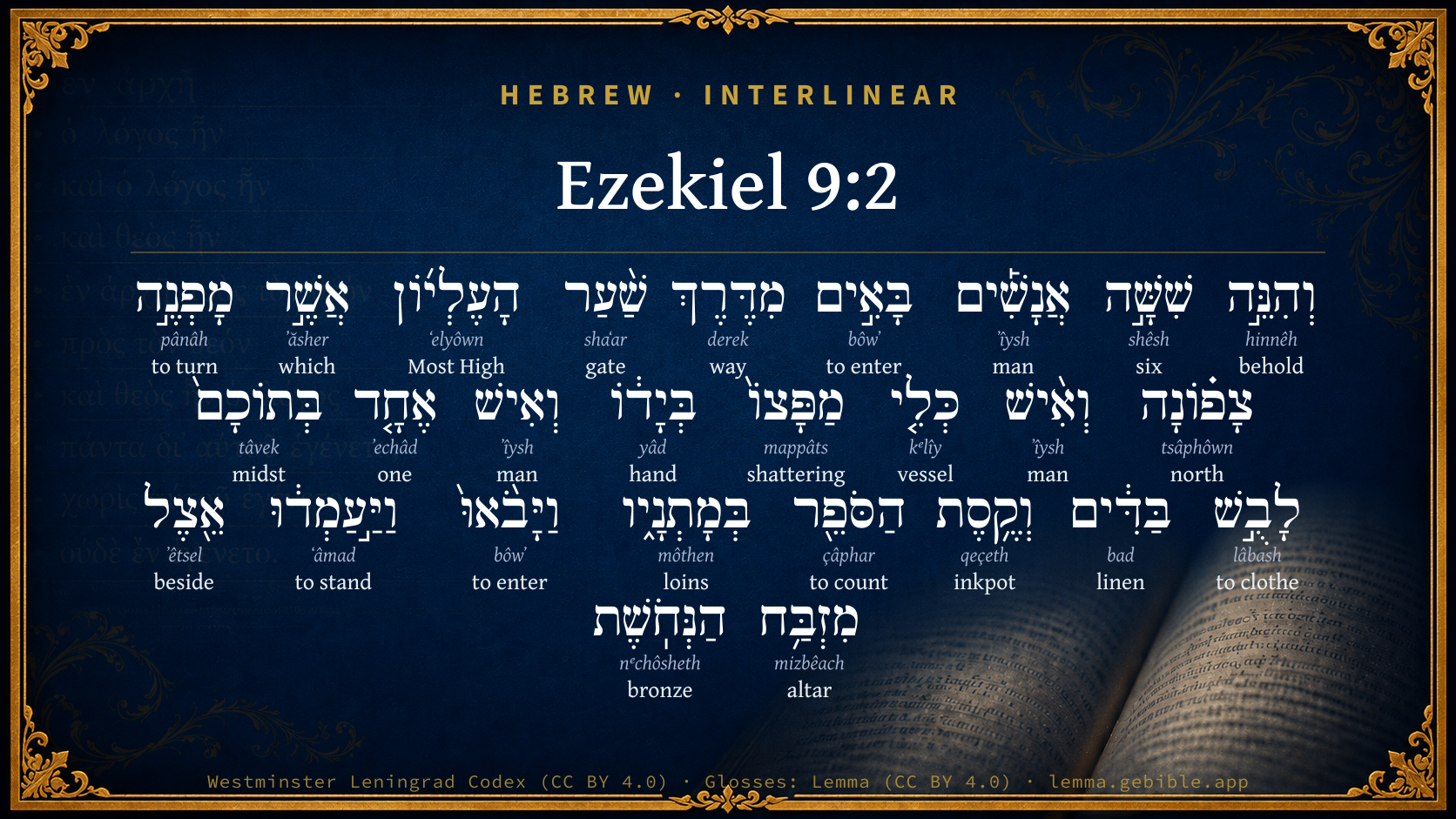
Ezekiel 9:2

Hebrew (Westminster Leningrad Codex) Ezekiel 9:2 appears in the Hebrew Old Testament. The text above is from the Westminster Leningrad Codex. Each word links to its Strong’s number, a concise gloss, and parsing drawn from the Open Scriptures Hebrew Bible morphology. Click any word for its full Brown-Driver-Briggs (BDB) entry.
Download image
Cite this verse

Ezekiel 9:2 (World English Bible). Public Domain. Lemma interlinear Bible study tool, https://lemma.gebible.app/v/ezekiel/9/2.

Show BibTeX & RIS
BibTeX
RIS
English Translation
Behold, six men came from the way of the upper gate, which lies toward the north, every man with his slaughter weapon in his hand; and one man in the midst of them clothed in linen, with a writer's inkhorn by his side. They went in, and stood beside the brazen altar.
World English Bible · Public Domain
Highlights
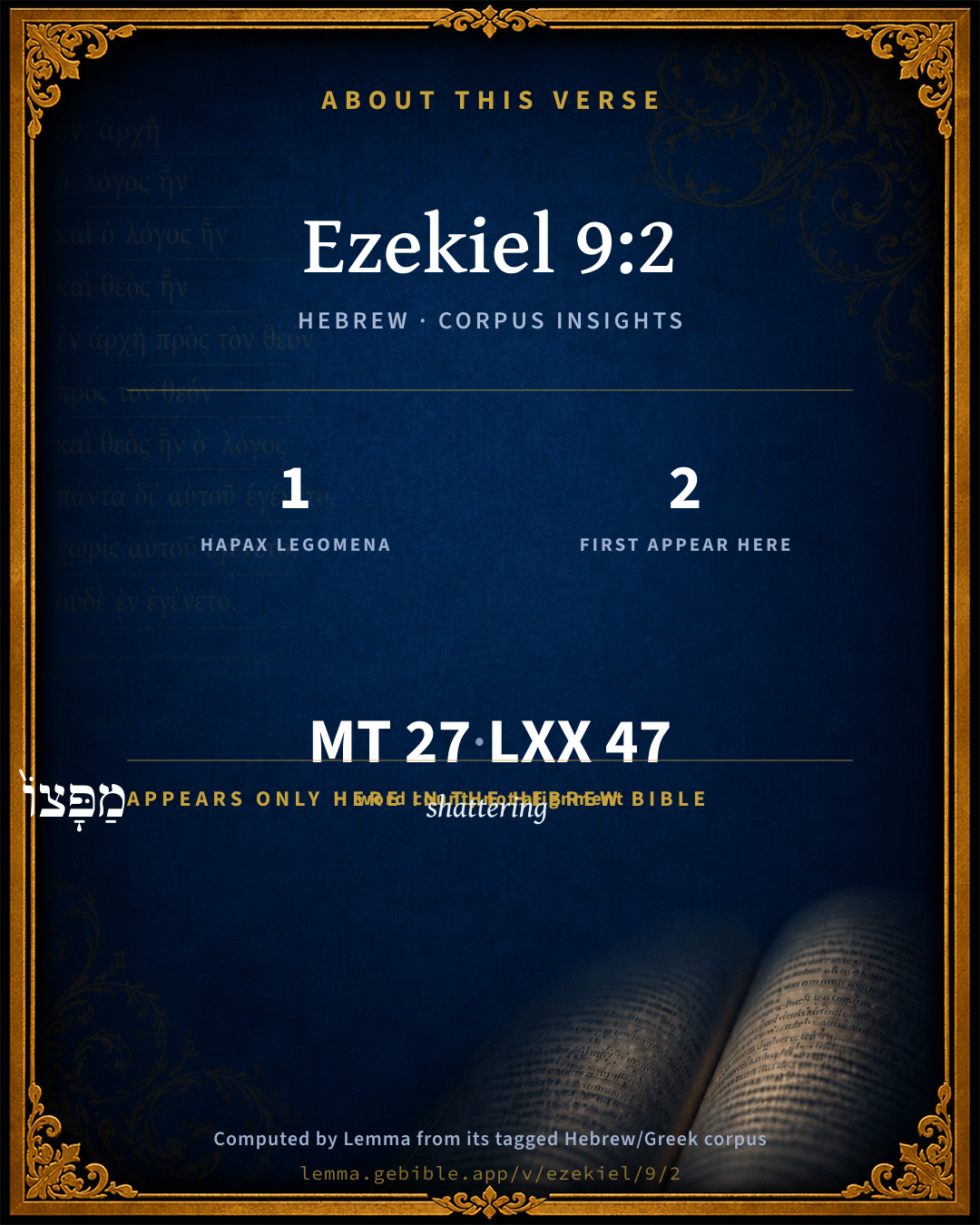
  • 1 hapax legomenon — only here in the Hebrew Bible
  • 2 first appearances in the Hebrew Bible
Full analysis ↓
Download a study sheet

One document with this verse’s original text, its word-by-word gloss line, the meaning frame, cross-references with their text, attributed commentary, and full source and license credits — printable, and it pastes into notes with its structure intact.

This verse Autodidact and up

Study sheet (.html) Plain text (.txt)

A passage Seminary Student

Up to 50 verses in one chapter. A passage sheet keeps up to 6 commentary sources and 12 cross-references per verse, in the order this page ranks them, and says so on the sheet whenever that leaves anything out. Ask for a single verse and you get the Autodidact verse sheet above.

Everything on this page stays free to read, with no account — the sheet is a download of what is already on screen, not access to it.

Want to remove ads? Support Godless Engineer
Compare translations 3

The same verse in 3 English versions, stacked beneath the original-language interlinear above. Click any original word for its lexicon entry.

Each is an independent rendering of the whole verse — the interlinear is not word-aligned to these translations.

Highlighted words mark where these versions differ — a whole-verse word diff, not a word-by-word alignment.

  • World English Bible Public Domain
    Behold, six men came from the way of the upper gate, which lies toward the north, every man with his slaughter weapon in his hand; and one man in the midst of them clothed in linen, with a writer's inkhorn by his side. They went in, and stood beside the brazen altar.
  • King James Version Public Domain
    And, behold, six men came from the way of the higher gate, which lieth toward the north, and every man a slaughter weapon in his hand; and one man among them was clothed with linen, with a writer's inkhorn by his side: and they went in, and stood beside the brasen altar.
  • unfoldingWord Literal Text CC BY-SA 4.0
    Then behold! Six men came from the pathway of the upper gate that faces north, each with his weapon of slaughter in his hand. There was a man in their midst dressed in linen with a scribe’s equipment at his side. So they went in and stood beside the bronze altar.

unfoldingWord Literal Text — © unfoldingWord, licensed CC BY-SA 4.0. Word-aligned USFM3 via Door43 (git.door43.org/unfoldingWord/en_ult).

Versions to compare (up to 4)

3 of 4 selected

Show all 18 translations

Every available English version of this verse, each an independent rendering of the whole verse.

  • World English Bible Public Domain
    Behold, six men came from the way of the upper gate, which lies toward the north, every man with his slaughter weapon in his hand; and one man in the midst of them clothed in linen, with a writer's inkhorn by his side. They went in, and stood beside the brazen altar.
  • Berean Standard Bible Public Domain
    And I saw six men coming from the direction of the Upper Gate, which faces north, each with a weapon of slaughter in his hand. With them was another man clothed in linen who had a writing kit at his side. And they came in and stood beside the bronze altar.
  • Majority Standard Bible Public Domain
    And I saw six men coming from the direction of the Upper Gate, which faces north, each with a weapon of slaughter in his hand. With them was another man clothed in linen who had a writing kit at his side. And they came in and stood beside the bronze altar.
  • King James Version Public Domain
    And, behold, six men came from the way of the higher gate, which lieth toward the north, and every man a slaughter weapon in his hand; and one man among them was clothed with linen, with a writer's inkhorn by his side: and they went in, and stood beside the brasen altar.
  • American Standard Version (1901) Public Domain
    And behold, six men came from the way of the upper gate, which lieth toward the north, every man with his slaughter weapon in his hand; and one man in the midst of them clothed in linen, with a writer's inkhorn by his side. And they went in, and stood beside the brazen altar.
  • Revised Version (1885) Public Domain
    And behold, six men came from the way of the upper gate, which lieth toward the north, every man with his slaughter weapon in his hand; and one man in the midst of them clothed in linen, with a writer’s inkhorn by his side. And they went in, and stood beside the brasen altar.
  • Geneva Bible (1599) Public Domain
    And beholde, sixe men came by the way of the hie gate, which lieth towarde the North, and euery man a weapon in his hande to destroy it: and one man among them was clothed with linen, with a writers ynkhorne by his side, and they went in and stoode beside the brasen altar.
  • Douay-Rheims (1899) Public Domain
    And behold six men came from the way of the upper gate, which looketh to the north: and each one had his weapon of destruction in his hand: and there was one man in the midst of them clothed with linen, with a writer's inkhorn at his reins: and they went in, and stood by the brazen altar.
  • Young's Literal Translation Public Domain
    And lo, six men are coming from the way of the upper gate, that is facing the north, and each his slaughter-weapon in his hand, and one man in their midst is clothed with linen, and a scribe's inkhorn at his loins, and they come in, and stand near the brazen altar.
  • Literal Standard Version CC BY-SA 4.0
    And behold, six men are coming from the way of the upper gate, that is facing the north, and each [with] his slaughter-weapon in his hand, and one man in their midst is clothed with linen, and a scribe’s inkhorn at his loins, and they come in, and stand near the bronze altar.
  • Unlocked Literal Bible CC BY-SA 4.0
    Then behold! Six men came from the pathway of the upper gate that faces north, each with his weapon of slaughter in his hand. There was a man in their midst dressed in linen with a scribe's equipment at his side. So they went in and stood beside the bronze altar.
  • unfoldingWord Literal Text CC BY-SA 4.0
    Then behold! Six men came from the pathway of the upper gate that faces north, each with his weapon of slaughter in his hand. There was a man in their midst dressed in linen with a scribe’s equipment at his side. So they went in and stood beside the bronze altar.
  • Darby Bible Public Domain
    And behold, six men came from the way of the upper gate, which is turned toward the north, and every man [with] his slaughter weapon in his hand; and in the midst of them, one man clothed with linen, with a writer's ink-horn by his side; and they went in, and stood beside the brazen altar.
  • World Messianic Bible Public Domain
    Behold, six men came from the way of the upper gate, which lies toward the north, every man with his slaughter weapon in his hand. One man in the middle of them was clothed in linen, with a writer’s inkhorn by his side. They went in, and stood beside the bronze altar.
  • Webster's Bible Public Domain
    And behold, six men came from the way of the higher gate, which lieth towards the north, and every man a slaughter-weapon in his hand; and one man among them was clothed with linen, with a writer's inkhorn by his side: and they went in and stood beside the brazen altar.
  • Free Bible Version CC BY-SA 4.0
    I watched as six men approached from the upper gate that faces north. All of them were carrying battle axes. There was another man with them. He was dressed in linen and had a scribe's writing kit at his side. They entered and stood next to the bronze altar.
  • Bible in Basic English Public Domain
    And six men came from the way of the higher doorway looking to the north, every man with his axe in his hand: and one man among them was clothed in linen, with a writer's inkpot at his side. And they went in and took their places by the brass altar.
  • JPS Tanakh (1917) Public Domain
    And, behold, six men came from the way of the upper gate, which lieth toward the north, every man with his weapon of destruction in his hand; and one man in the midst of them clothed in linen, with a writer's inkhorn on his side. And they went in, and stood beside the brazen altar.

Literal Standard Version (2020), Covenant Press — licensed CC BY-SA 4.0. Text via the HelloAO Bible API (eBible.org). Unlocked Literal Bible (unfoldingWord) — licensed CC BY-SA 4.0. Text via the HelloAO Bible API (eBible.org). unfoldingWord Literal Text — © unfoldingWord, licensed CC BY-SA 4.0. Word-aligned USFM3 via Door43 (git.door43.org/unfoldingWord/en_ult). Free Bible Version, Dr. Jonathan Gallagher — licensed CC BY-SA 4.0. Text via the HelloAO Bible API (eBible.org).

Word by word

More ways to search: Search by grammar → Find every occurrence → Compare this word →

Practice this passage: Drill this verse → Learn its vocabulary →

מַפָּצוֹ֙
mappâts
H4660
“shattering · his”
Noun, Common, Masculine, Singular, Construct + Suffix, Personal, 3rd Person, Masculine, Singular
Part of Speech
Noun
Type
Common
Gender
Masculine
Number
Singular
State
Construct
Full BDB Definition

Origin: from H5310

TWOT: 1394b

shattering (of type of weapon)
  1. וְהִנֵּ֣ה hinnêh H2009 “and · behold” Conjunction + Particle, Demonstrative
  2. שִׁשָּׁ֣ה shêsh H8337 “six” Adjective, Cardinal number, Masculine, Singular, Absolute
  3. אֲנָשִׁ֡ים ʼîysh H376 “men” Noun, Common, Masculine, Plural, Absolute
  4. בָּאִ֣ים bôwʼ H935 “entering” Verb, Qal, Participle Active, Masculine, Plural, Absolute
  5. מִדֶּרֶךְ derek H1870 “from · way of” Preposition + Noun, Common, Both, Singular, Construct
  6. שַׁ֨עַר shaʻar H8179 “gate of” Noun, Common, Masculine, Singular, Construct
  7. הָעֶלְי֜וֹן ʻelyôwn H5945 “the · Most High” Particle, Definite Article + Adjective, Adjective, Masculine, Singular, Absolute
  8. אֲשֶׁ֣ר ʼăsher H834 “which” Particle, Relative
  9. מָפְנֶ֣ה pânâh H6437 “turned” Verb, Hophal, Participle Passive, Masculine, Singular, Absolute
  10. צָפ֗וֹנָה tsâphôwn H6828 “north · toward” Noun, Common, Feminine, Singular, Absolute + Suffix, Demonstrative
  11. וְאִ֨ישׁ ʼîysh H376 “and · man” Conjunction + Noun, Common, Masculine, Singular, Absolute
  12. כְּלִ֤י kᵉlîy H3627 “vessel of” Noun, Common, Masculine, Singular, Construct
  13. בְּיָד֔וֹ yâd H3027 “in/at · hand · his” Preposition + Noun, Common, Both, Singular, Construct + Suffix, Personal, 3rd Person, Masculine, Singular
  14. וְאִישׁ ʼîysh H376 “and · man” Conjunction + Noun, Common, Masculine, Singular, Absolute
  15. אֶחָ֤ד ʼechâd H259 “one” Adjective, Cardinal number, Masculine, Singular, Absolute
  16. בְּתוֹכָם֙ tâvek H8432 “in/at · midst · their” Preposition + Noun, Common, Masculine, Singular, Construct + Suffix, Personal, 3rd Person, Masculine, Plural
  17. לָבֻ֣שׁ lâbash H3847 “clothed” Verb, Qal, Participle Passive, Masculine, Singular, Absolute
  18. בַּדִּ֔ים bad H906 “linen” Noun, Common, Masculine, Plural, Absolute
  19. וְקֶ֥סֶת qeçeth H7083 “and · inkpot of” Conjunction + Noun, Common, Feminine, Singular, Construct
  20. הַסֹּפֵ֖ר çâphar H5608 “the · scribe” Particle, Definite Article + Noun, Common, Masculine, Singular, Absolute
  21. בְּמָתְנָ֑יו môthen H4975 “in/at · loins · his” Preposition + Noun, Common, Masculine, Dual, Construct + Suffix, Personal, 3rd Person, Masculine, Singular
  22. וַיָּבֹ֨אוּ֙ bôwʼ H935 “and · to enter” Conjunction + Verb, Qal, Sequential Imperfect, 3rd Person, Masculine, Plural
  23. וַיַּ֣עַמְד֔וּ ʻâmad H5975 “and · to stand” Conjunction + Verb, Qal, Sequential Imperfect, 3rd Person, Masculine, Plural
  24. אֵ֖צֶל ʼêtsel H681 “beside” Preposition
  25. מִזְבַּ֥ח mizbêach H4196 “altar of” Noun, Common, Masculine, Singular, Construct
  26. הַנְּחֹֽשֶׁת nᵉchôsheth H5178 “the · bronze” Particle, Definite Article + Noun, Common, Feminine, Singular, Absolute

About this verse

These counts appear in no published source. They are computed here, from the morphology-tagged text and Lemma’s own curated glosses. What Lemma adds →

27
words
24
distinct lemmas
Prophets
section

Notable vocabulary

1 hapax legomenon — a word that appears only here in the entire Hebrew Bible:

  • מַפָּצוֹ֙ shattering H4660

First appearance in Scripture

These words make their first canonical appearance in the Hebrew Bible here:

  • מַפָּצוֹ֙ shattering H4660
  • וְקֶ֥סֶת inkpot H7083

Shared distinctive vocabulary

וְקֶ֥סֶת inkpot H7083 occurs in 3 verses of the Hebrew Bible. Also found in:

Grammatical profile

  • 5 verbs
  • 16 nouns
  • 3 adjectives
  • 1 preposition
  • 2 particles

Verb forms

  • בָּאִ֣ים Qal · Participle Active
  • מָפְנֶ֣ה Hophal · Participle Passive
  • לָבֻ֣שׁ Qal · Participle Passive
  • וַיָּבֹ֨אוּ֙ Qal · Sequential Imperfect
  • וַיַּ֣עַמְד֔וּ Qal · Sequential Imperfect

Repetition

Words recur within this verse — often emphatic in Hebrew:

  • אֲנָשִׁ֡ים man H376 ×3
  • בָּאִ֣ים to enter H935 ×2

Hebrew & Septuagint length

In English translation the verse runs 52 words from the Hebrew and 62 from the Septuagint (LXX English) — closely comparable.

A rough comparison of the two English renderings, which tokenize alike — not a word-level alignment.

Word counts can differ between the Hebrew and the Greek without any difference in meaning — e.g. the Hebrew direct-object marker אֵת has no separate Greek word, and Greek often adds the article ὁ.

In the original languages it is 27 Hebrew tokens and 47 Greek tokens — but the two are counted differently (Hebrew bundles its prefixes and suffixes into one token; the Greek is in lemma form), so that isn’t a like-for-like length.

Cross-references

14

Topical passages linked to Ezekiel 9:2 in the Treasury of Scripture Knowledge — connected by theme and wording, ordered by reader-vote popularity; previews shown in the World English Bible.

  • Leviticus 16:4 He shall put on the holy linen coat, and he shall have the linen breeches on his body, and shall put on the linen sash, and he shall be dressed with the linen turban. They are the holy garments. He shall bathe his body in water, and put them on.
  • Ezekiel 10:2 He spoke to the man clothed in linen, and said, Go in between the whirling [wheels], even under the cherub, and fill both your hands with coals of fire from between the cherubim, and scatter them over the city. He went in as I watched.
  • 2 Kings 15:35 However the high places were not taken away: the people still sacrificed and burned incense in the high places. He built the upper gate of the house of Yahweh.
  • Ezekiel 10:6–7 It came to pass, when he commanded the man clothed in linen, saying, Take fire from between the whirling wheels, from between the cherubim, that he went in, and stood beside a wheel.
  • Revelation 15:6 The seven angels who had the seven plagues came out, clothed with pure, bright linen, and wearing golden sashes around their breasts.
  • Exodus 27:1–7 "You shall make the altar of acacia wood, five cubits long, and five cubits broad; the altar shall be foursquare: and its height shall be three cubits.
  • Exodus 40:29 He set the altar of burnt offering at the door of the tent of the tent of meeting, and offered on it the burnt offering and the meal-offering, as Yahweh commanded Moses.
  • 2 Chronicles 4:1 Moreover he made an altar of brass, twenty cubits the length of it, and twenty cubits the breadth of it, and ten cubits the height of it.
  • 2 Chronicles 27:3 He built the upper gate of the house of Yahweh, and on the wall of Ophel he built much.
  • Jeremiah 1:15 For, behold, I will call all the families of the kingdoms of the north, says Yahweh; and they shall come, and they shall set everyone his throne at the entrance of the gates of Jerusalem, and against all the walls of it round about, and against all the cities of Judah.
  • Jeremiah 5:15–17 Behold, I will bring a nation on you from far, house of Israel, says Yahweh: it is a mighty nation, it is an ancient nation, a nation whose language you don't know, neither understand what they say.
  • Jeremiah 8:16–17 The snorting of his horses is heard from Dan: at the sound of the neighing of his strong ones the whole land trembles; for they are come, and have devoured the land and all that is in it; the city and those who dwell therein.
  • Jeremiah 25:9 behold, I will send and take all the families of the north, says Yahweh, and [I will send] to Nebuchadrezzar the king of Babylon, my servant, and will bring them against this land, and against the inhabitants of it, and against all these nations round about; and I will utterly destroy them, and make them an astonishment, and a hissing, and perpetual desolations.
  • Jeremiah 26:10 When the princes of Judah heard these things, they came up from the king's house to the house of Yahweh; and they sat in the entry of the new gate of Yahweh's [house].

Cross-references courtesy of OpenBible.info (CC BY 4.0).

Hebrew and Greek witnesses Masoretic Hebrew ↔ Greek Septuagint

The same verse in the two great witnesses to the Old Testament, shown verse-for-verse.

These are two independent witnesses, not word-aligned to each other, and the Septuagint is shown in lemma (dictionary) form.

Hebrew Ezekiel 9:2 Masoretic · Westminster Leningrad Codex

וְהִנֵּ֣ה שִׁשָּׁ֣ה אֲנָשִׁ֡ים בָּאִ֣ים מִדֶּרֶךְ שַׁ֨עַר הָעֶלְי֜וֹן אֲשֶׁ֣ר מָפְנֶ֣ה צָפ֗וֹנָה וְאִ֨ישׁ כְּלִ֤י מַפָּצוֹ֙ בְּיָד֔וֹ וְאִישׁ אֶחָ֤ד בְּתוֹכָם֙ לָבֻ֣שׁ בַּדִּ֔ים וְקֶ֥סֶת הַסֹּפֵ֖ר בְּמָתְנָ֑יו וַיָּבֹ֨אוּ֙ וַיַּ֣עַמְד֔וּ אֵ֖צֶל מִזְבַּ֥ח הַנְּחֹֽשֶׁת

Behold, six men came from the way of the upper gate, which lies toward the north, every man with his slaughter weapon in his hand; and one man in the midst of them clothed in linen, with a writer's inkhorn by his side. They went in, and stood beside the brazen altar.

World English Bible · Public Domain

Greek LXX Ezekiel 9:2 Septuagint · lemma form

καί ἰδού ἕξ ἀνήρ ἄρχω ἀπό ὁ ὁδός ὁ πύλη ὁ ὑψηλός ὁ βλέπω πρός βορέας καί ἕκαστος πέλυξ ἐν ὁ χείρ αὐτός καί εἷς ἀνήρ ἐν μέσος αὐτός ἐνδύω ποδήρης καί ζωνή σάπφειρος ἐπί ὁ ὀσφύς αὐτός καί εἰςἔρχομαι καί ἵστημι ἔχω ὁ θυσιαστήριον ὁ χαλκοῦς

And, behold, six men came from the way of the high gate that looks toward the north, and each one's axe was in his hand; and there was one man in the midst of them clothed with a long robe down to the feet, and a sapphire girdle was on his loins: and they came in and stood near the brazen altar.

LXX2012 (modern English Septuagint) · Public Domain

On this verse, The Cambridge Bible for Schools and Colleges discusses the Septuagint’s reading. Read the note in Commentary ↓

Hebrew: Westminster Leningrad Codex (CC BY 4.0). Greek: Septuagint (public domain); English from LXX2012 (modern English Septuagint) (Public Domain). How the Septuagint differs from the Hebrew →

Targum (Aramaic paraphrase)

1

The Targum is the ancient Jewish Aramaic paraphrase of the Hebrew Scriptures — an interpretive translation, not the Hebrew text itself. Onkelos (literal) and Pseudo-Jonathan (expansive) render the Torah, and Jonathan the Prophets. Coverage is partial: where no permissively-licensed English translation exists for a verse, only the Aramaic is shown. This is verse-level text, not a word-by-word alignment to the Hebrew.

  1. Targum Jonathan Prophets (Joshua–Malachi)
    וְהָא שִׁתָּא גַבְרִין אָתָן מֵאוֹרַח תַּרְעָא עִלָאָה דִפְתִיחַ לְצִפּוּנָא וּגְבַר מִן כִּידוּרֵיהּ בִּידֵיהּ וְגַבְרָא חָד בֵּינֵיהוֹן לָבֵישׁ לְבוּשִׁין וּפִנְקֵס סַפְרָא בְּחַרְצֵיהּ וַעֲלוּ וְקָמוּ בִּסְטַר מַדְבְּחָא דִנְחָשָׁא:

    (no public-domain English translation for this verse)

    Targum Jonathan — Aramaic: “Mikraot Gedolot” (public domain). English: “Sefaria Community Translation” (CC0 1.0 (public-domain dedication)); “London "Chaldee Paraphrase," 1871” (public domain). Text via Sefaria.

Commentary

Notes on Ezekiel 9:2 from classic Christian and Jewish commentators (each source and its license shown beneath its notes). The classic Christian expositions comment on the surrounding passage and are grouped to its opening verse, so a note may address several verses; the Jewish commentaries on the Tanakh (Rashi and others) are per-verse, so they appear only where the commentator wrote on this verse.

Lemma curates 59 commentaries, every one of them public domain or Creative Commons licensed, each selected and text-cleaned for this edition rather than reprinted as found. About our sources →

Trapp's Complete Commentary

John Trapp

Eze 9:2 And, behold, six men came from the way of the higher gate, which lieth toward the north, and every man a slaughter weapon in his hand; and one man among them [was] clothed with linen, with a writer’s inkhorn by his side: and they went in, and stood beside the brasen altar.

Ver. 2. And, behold, six men came.] Ad hunc Dei clamorem vel clangorem; the angels came, the Chaldees came, at the call of this Lord of hosts, who hath all creatures at his beck and check.

By the way of the higher gate.] Called also the new gate, {Jer 26:10} built by Jotham. {2Ch 27:3}

Toward the north.] Where stood the idol of jealousy, and whereby Nebuchadnezzar entered.

“ Per quod quis peccat, per idem punitur et ipse. ”

One man among them.] This was a created angel, say some; {Eze 10:2} Christ, the angel of the covenant, say others, with more likelihood of truth.

Clothed with linen.] As high priest of his people, and in addition an offering for them, and that without spot. {Heb 9:14}

And a writer’s inkhorn by his side.] An ensign of his prophetic office, say some, as his linen clothing was of his priestly; and of his kingly, that he was among, or in the midst of, the six slaughtermen, as their captain and commander.

They went in and stood beside the brazen altar.] Where they might receive further instructions from God. So in the Revelation, those angels that were to pour out the vials of divine vengeance, are said to come out of the temple.

John Trapp, A Commentary or Exposition upon All the Books of the Old and New Testament (1647–1656) — public domain. Text from a community e-Sword module.

Geneva Bible (1599)

Geneva Bible translators

Signifying, that the Babylonians should come from the North to destroy the city and the Temple.

Which were Angels in the similitude of men.

To mark them that should be saved.

Geneva Bible (1599) marginal notes — public domain. Text via Bolls.life.

Jamieson, Fausset & Brown

Robert Jamieson, A. R. Fausset & David Brown

clothed with linen-- (Dan 10:5; Dan 12:6-7). His clothing marked his office as distinct from that of the six officers of vengeance; "linen" characterized the high priest (Lev 16:4); emblematic of purity. The same garment is assigned to the angel of the Lord (for whom Michael is but another name) by the contemporary prophet Daniel (Dan 10:5; Dan 12:6-7). Therefore the intercessory High Priest in heaven must be meant (Zac 1:12). The six with Him are His subordinates; therefore He is said to be "among them," literally, "in the midst of them," as their recognized Lord (Heb 1:6). He appears as a "man," implying His incarnation; as "one" (compare Ti1 2:5). Salvation is peculiarly assigned to Him, and so He bears the "inkhorn" in order to "mark" His elect (Eze 9:4; compare Exo 12:7; Rev 7:3; Rev 9:4; Rev 13:16-17; Rev 20:4), and to write their names in His book of life (Rev 13:8). As Oriental scribes suspend their inkhorn at their side in the present day, and as a "scribe of the host is found in Assyrian inscriptions accompanying the host" to number the heads of the slain, so He stands ready for the work before Him. "The higher gate" was probably where now the gate of Damascus is. The six with Him make up the sacred and perfect number, seven (Zac 3:9; Rev 5:6). The executors of judgment on the wicked, in Scripture teaching, are good, not bad, angels; the bad have permitted to them the trial of the pious (Job 1:12; Co2 12:7). The judgment is executed by Him (Eze 10:2, Eze 10:7; Joh 5:22, Joh 5:27) through the six (Mat 13:41; Mat 25:31); so beautifully does the Old Testament harmonize with the New Testament. The seven come "from the way of the north"; for it was there the idolatries were seen, and from the same quarter must proceed the judgment (Babylon lying northeast of Judea). So Mat 24:28.

stood--the attitude of waiting reverently for Jehovah's commands.

brazen altar--the altar of burnt offerings, not the altar of incense, which was of gold. They "stood" there to imply reverent obedience; for there God gave His answers to prayer [CALVIN]; also as being about to slay victims to God's justice, they stand where sacrifices are usually slain [GROTIUS], (Eze 39:17; Isa 34:6; Jer 12:3; Jer 46:10).

Jamieson, Fausset & Brown — Commentary Critical and Explanatory on the Whole Bible (1871) — public domain (CC PDM 1.0). Text via the HelloAO Bible API.

Adam Clarke's Commentary

Verse 2. Stood beside the brazen altar.] To signify that the people against whom they had their commission were, for their crimes, to be sacrificed to the demands of Divine justice.

Adam Clarke's Commentary on the Bible (1810–1826) — public domain. Text from a community e-Sword/MySword module.

John Calvin's Commentaries

Now the Prophet writes that God’s command was not vain or empty, because the effect appears directly by vision. Therefore six men offered themselves. Why again he names six, rather than more or fewer, I have not found out. For some cite the thirty-ninth chapter of Jeremiah, where eight leaders are referred to who were in Nebuchadnezzar’s army, and had the chief authority; but first they vary in number, then they twist themselves in many ways. But I am not so anxiously curious, nor does it seem to me of any consequence, unless perhaps God wished to show his servant that a little band was sufficient, and that there was no need of a large army: or by six men he confusedly designated the whole army. It is certain indeed that Nebuchadnezzar came surrounded with a large force to destroy the city; but in the meantime God wished to destroy that pride and contumacy of the people, since he only shows to his servant six men who could destroy the whole city. He says therefore, that he came by the gate, or by way of a lofty gate, or higher one, which was towards the north, because Babylon lay towards that region with respect to Jerusalem. It appears therefore that the Chaldeans were here pointed out, to whom the way was direct through that gate, since it ascended from the north over against Jerusalem. He says, each man had an instrument of destruction, or of pounding. This word is derived from נפף, nephetz, which is to destroy and rub to pieces: therefore it can be taken as well for the mallet as for the act itself. There is no doubt that the Prophet meant that God’s command should not be without immediate effect: because as soon as he cried out, six men were directly at hand for obeying him, which he afterwards expresses more clearly when he says that they stood near the altar For it was a sign of their readiness to obey God’s commands when they placed themselves before the altar. But this passage is worthy of notice, because it shows us how anxiously we ought to give heed to God’s threats, which are for the most part directed against us. In order that we may learn to rouse ourselves from our torpor, here as in a glass the conjunction of God’s vengeance with his threats is proposed to us. For as soon as he had spoken, we see that there were six men armed and drawn up for destroying the city. But God wished to show his Prophet this vision, because his business was with a hard and stupid people, as we have already seen. God’s voice was as it were their final doom: just as if a trumpet resounded, and announced that there was no hope of pardon unless the enemy gave himself up directly. So therefore God exclaimed with a loud voice, but this was no empty cause of fright, because he directly joined the execution of it, when six men appeared before the altar. But he calls the altar which Solomon had built of square stones brazen: even the brazen altar was not sufficient, but it looks to its first origin.

Now he says that there was among them, one man clothed with a linen garment (1 Kings 8:64.) He is not placed among the multitude, as one among the others, but he is separated, because his signification is distinct. This man then doubtless sustained the character of an angel, and it is sufficiently customary in Scripture that angels, when they take a visible form, should be called men: not because they are really men, but because God endues them with such forms as he sees fit. Some, whose opinion I do not altogether reject, restrict this to Christ. But because the Prophet adds no remarkable traits, I had rather receive it generally of any angel. He says therefore, that there was among the Chaldeans, who were prepared to execute God’s vengeance, one man clad in a linen garment A distinct mark is sometimes given to angels which separates them from men. The linen garment was then a remarkable ornament. And the sacrificing Papists, as if they were apes, have imitated that custom in their garments called surplices. But since priests were accustomed to be clad in linen robes, here the angel was represented to the Prophet in this garb. Now let us go on, because in the next verse it will be evident why mention was made of that angel.

John Calvin's Commentaries (1540-1563) — public domain. Text from the Calvin Translation Society English edition (1840s-50s) via the Christian Classics Ethereal Library (ccel.org). Calvin's coverage is partial (roughly two-thirds of the Bible); uncommented books and verses are honest gaps, never fabricated. The 19th-century editor's footnotes and remarks are omitted so the notes are faithfully Calvin's own voice.

Ellicott's Commentary for English Readers

(2) One man among them was clothed with linen.—He was among them, but not of them. There were six with weapons, and this one without a weapon formed the seventh, thus making up the mystical number so often used in Scripture. He was “clothed in linen,” the ordinary priestly garment, and the special garment of the high priest at the ceremonies on the great Day of Atonement (Leviticus 16); yet also used by others, and on other occasions, simply as a garment of purity and of distinction (comp. Dan_10:5), so that there is no need here to suppose a priestly character attached to this one. He carried in his girdle the “inkhorn,” i.e., the little case, containing pens, knife, and ink, commonly worn by the Oriental scribe. There is no occasion to understand this person either, on the one hand, as a representation of the Babylonian god Nebo, “the scribe of heaven,” nor, on the other, as is done by many commentators, of our Lord. There is nothing mentioned which can give him any special identification. He is simply a necessity of the vision, an angelic messenger, to mark out those whose faithfulness to God amid the surrounding evil exempts them from the common doom (comp. Rev_7:3). This party are seen coming “from the way of the higher gate.” The courts of the Temple were built in stages, the innermost the highest. This, then, was the gate of the inner court, and was on the north, both as the place where the prophet had been shown the idolatries, and as the quarter from which the Chaldæan destruction was poured out upon the nation. They took their station “beside the brazen altar,” as the central point at once of the true worship of Israel and of the present profanation of that worship.

A Bible Commentary for English Readers, edited by Charles John Ellicott (1878–1897) — public domain. Text from a community e-Sword module.

The Cambridge Bible for Schools and Colleges

gen. ed. J. J. S. Perowne

2. six men] The symbolism represents the judgment of God as executed by supernatural agents, immediately under his command. These agents are called “men,” having the human form to the eyes of the prophet (cf. ch. Eze_40:3, Eze_43:6). Six of the men had instruments of destruction in their hands, and the seventh was clothed in linen garments with an inkhorn at his girdle. The inkhorn consisted of a case for holding the reed pens, with an inkholder attached near the mouth of the case. These inkhorns are carried in the girdle, and those worn by high officials are often of silver, richly chased and ornamented. The purpose of the inkhorn appears in Eze_9:4. The linen garments mark the man’s divine sanctity and eminence, not priestly rank (Ew.); the high angel, Dan_10:5; Dan_12:6, was so clothed, as were the seven angels having the vials of wrath, the last plagues of judgment upon the world, Rev_15:6. The seven men entering the inner court proceeded until they stood beside the brazen altar, in front of the house, whither the glory of the Lord had moved from the cherubim (Eze_9:3).

the higher gate] Or, upper. What this gate was is not quite clear. It is usually held to be the same gate of the inner court already mentioned, ch. Eze_8:3; Eze_8:5. In Ezekiel’s new temple the inner court is higher than the outer, and a flight of steps leads to the gate from the level of the outer court, but probably in the old temple the courts were much on a level. In 2Ki_15:35, Jotham is said to have built the “upper gate” of the house of the Lord. This gate seems identical with the upper Benjamin gate, Jer_20:2, probably also with the “new gate,” Jer_26:10; Jer_36:10. In the last passage this new gate is said to be in the “upper court,” which can hardly be the inner court, but rather a small court which lay at the northern extremity of the outer court, and was elevated some feet above the latter. (See plan in Encycl. Brit., Art. Temple.) At all events the “men” came from the north side of the house into the inner court. The abominations of the people are represented as practised on the north side (ch. 8), and the Instruments of God’s vengeance approach from the same quarter.

the brasen altar] This is again obscure. It is said in 1Ki_8:64 that the brazen altar was too small to receive the burnt-offerings and the fat of Solomon’s holocausts, and that the king consecrated the middle of the court, and there burnt his offerings. Ahaz caused his priest Uriah to “build” an altar after the pattern of the altar which he saw in Damascus. This new altar must have been of stone, terminating at the top in a platform or hearth for burning the fat and sacrifices upon; and somewhat after this model the altar in Ezekiel’s new temple is to be constructed (ch. Eze_43:13-17). The altar of Ahaz appears to have been placed in the middle of the court, further from the house than the original position of the brazen altar; and it is added that Ahaz removed the brazen altar from its former place, and set it on the north side of his new altar (2Ki_16:14). This sense is given both by the Heb. and LXX., though the texts differ in some points. The Heb. reading is not quite natural, and as construed by some it says nothing of a removal of the brazen altar from its former place. (See W. R. Smith, Rel. of Sem., p. 466 seq.) The seven men took up their position either in the middle of the court in the vicinity of the altar place, or considerably nearer the house than the altar of burnt-offering.

The Cambridge Bible for Schools and Colleges (gen. ed. J. J. S. Perowne; Cambridge University Press, 1878–1918) — public domain. Text from a community e-Sword module.

John Gill's Exposition

And, behold, six men,.... Either angels the form of men; or the generals of Nebuchadnezzar's army, as Kimchi interprets it; whose names are, Nergalsharezer, Samgarnebo, Sarsechim, Rabsaris, Nergalsharezer, Rabmag, Jer 39:3; these six executioners of God's vengeance are, in the Talmud (n), called

"wrath, anger, fury, destruction, breach, and consumption:''

came from the way of the higher gate, Kimchi observes, from the Rabbins, that this is the eastern gate called the higher or upper gate, because it was above the court of the Israelites. Maimonides (o) says, the upper gate is the gate Nicanor; and why is it called the upper gate? because it was above the court of the women; see Kg2 15:35;

which lieth toward the north: where were the image of jealousy, and the women weeping for Tammuz, and other idolatrous practices were committed; which were the cause of the coming of these destroyers: moreover, the Chaldean army with its generals came out of the north; for Babylon lay north or northeast of Jerusalem; and so this gate, as Kimchi says, was northeast; and he adds, and Babylon was northeast of the land of Israel; see Jer 1:13;

and every man a slaughter weapon in his hand; as ordered, Eze 9:1, a different word is here used; it signifies a hammer, with which rocks are broken in pieces, as the above mentioned Jewish writer observes. The Septuagint render it an axe or hatchet:

and one man among them; not one of the six, but who made a seventh. The Jews say this was Gabriel (p); but this was not a created angel, as they; nor the Holy Spirit as Cocceius; but the Son of God, in a human form; he was among the six, at the head of them, as their leader and commander; he was but one, they six; one Saviour, and six destroyers:

was clothed with linen; not in the habit of a warrior, but of a priest; who, as such, had made atonement for the sins of his people, and intercession for them; and this may also denote the purity of his human nature, and his unspotted righteousness, the fine linen, clean and white, which is the righteousness of the saints: and

with a writer's inkhorn by his side; or "at his loins" (q); nor a slaughter weapon, as the rest; but a writer's inkhorn; hence Kimchi takes him to be the king of Babylon's scribe; but a greater is here meant; even he who took down the names of God's elect in the book of life; and who takes an account, and keeps a book of the words, and even thoughts, of his people and also of their sighs, groans, and tears; see Mal 3:16; but now his business was to mark his people, and distinguish them from others, in a providential way; and keep and preserve them from the general ruin and destruction that was coming upon Jerusalem: or, "a girdle on his lions", as the Septuagint, Syriac, and Arabic versions render it; and so was prepared and fit for business; which sense of the word is approved of by Castel (r); and he asks, what has an inkhorn to do at a man's loins? but it should be observed, that it was the custom of the eastern people to carry inkhorns at their sides, and particularly in their girdles, as the Turks do now; who not only fix their knives and poniards in them, as Dr. Shaw (s) relates; but the "hojias", that is, the writers and secretaries, hang their inkhorns in them; and by whom it is observed, that that part of these inkhorns which passes between the girdle and the tunic, and holds their pens, is long and flat; but the vessel for the ink, which rests upon the girdle, is square, with a lid to clasp over it:

and they went in; to the temple, all seven:

and stood beside the brasen altar; the altar of burnt offering, so called to distinguish it from the altar of incense, which was of gold; here they stood not to offer sacrifice, but waiting for their orders, to take vengeance for the sins committed in the temple, and at this altar; near to which stood the image of jealousy, Eze 8:5.

(n) T. Bab. Sabbat, fol. 55. 1. (o) Hilchot Cele Hamikdash, c. 7. sect. 6. (p) T. Bab. Yoma, fol. 77. 1. & Gloss. in ib. (q) "in lumbis suis", Pagninus, Montanus, &c. (r) Lexic. Polyglott. col. 3393. (s) Travels, p. 227. Ed. 2.

John Gill's Exposition of the Whole Bible (1746–1763) — public domain (CC PDM 1.0). Text via the HelloAO Bible API.

Albert Barnes' Notes on the Bible

Six men - angels of wrath - figurative of destruction. They come from the north, the quarter from which invading armies entered the holy land. These “six” angels, with the “one among them,” a superior over the six, make up the number “seven,” a number symbolic of God’s covenant with His people.

The higher gate - The north gate of the court of the priests. The temple rose by platforms; as there was a north gate to the outer and also to the inner court, the latter was probably distinguished as the “higher gate.” It was built by Jotham 2Ki 15:35.

Clothed with linen - The priestly garment Exo 28:6, Exo 28:8; Lev 16:4. This “One Man” (Compare Dan 10:5; Rev 1:13) was the “angel of the covenant,” the great high priest, superior to those by whom He was surrounded, receiving direct communication from the Lord, taking the coals of vengeance from between the cherubim Eze 10:2, but coming with mercy to the contrite as well as with vengeance to the impenitent; these are attributes of Jesus Christ Joh 5:30; Luk 2:34; Mat 9:13; Joh 6:39.

A writer’s inkhorn - Usually a flat case about nine inches long, by an inch and a quarter broad, and half an inch thick, the hollow of which serves to contain the reed pens and penknife. At one end is the ink-vessel which is twice as heavy as the shaft. The latter is passed through the girdle and prevented from slipping through by the projecting ink-vessel. The whole is usually of polished metal, brass, copper or silver. The man with the inkhorn has to write in the Book of Life the names of those who shall be marked. The metaphor is from the custom of registering the names of the Israelites in public rolls. Compare Exo 32:33; Psa 69:28; Isa 4:3; Phi 4:3; Rev 3:5.

Albert Barnes' Notes on the Bible (1834–1885) — public domain. Text from a community e-Sword/MySword module.

Haydock's Catholic Bible Commentary

Upper, leading to the court of the priests. These were six angels, representing the army coming from Babylon. The seventh was an angel of peace. (Calmet) --- God never abandoned his whole Church. (Worthington)

George Leo Haydock (1774–1849), Haydock's Catholic Family Bible and Commentary, 1859 edition — public domain. Excludes Psalms (Douay-Rheims chapter numbering differs from Protestant) and Deuterocanonical books (Catholic canon only).

Matthew Poole's English Annotations

So soon as command was given out, these ministers of God’s just displeasure appear ready to execute.

Six; that was the precise number, neither more nor fewer.

Men. In appearance and vision they were men, and the prophet calls them as he saw them; whether angels in the shape of men, or whether really men, needs not much inquiry; they came without delay.

From the way of the higher gate; either because, being more inward, it is higher than the outward, as in all buildings upon ascents, where you go up by steps from the outward parts towards the inmost building; or because it was built more lofty than the other, enlarged likely by Jotham, 2Ch 27:3.

Toward the north; insinuating whence their destruction should come; from Babylon came that whirlwind, Eze 1:4, which was to overthrow Jerusalem. And this north gate was the weakest, both by their sins there committed, and by its situation, which invited Antiochus and Titus to pitch their tents on that side when they besieged it, and on this side the Chaldeans did first enter.

A slaughter weapon: see Eze 9:1.

One man; not companion, but as one of great authority over them, who are as officers waiting on him on every side.

Linen; a garment proper to the priesthood, whether ordinary priest or high priest, Exo 28:42,43; Le 6:10; in this habit appeared the angel, Dan 10:5; 12:6,7; and a very fit resemblance of Christ, who is the only Saviour of his elect, whose names he knows as if written by him.

They went in; all the seven, both the six executioners, and the single man clothed in linen, went into the inner court, where they stand waiting till the word be given for execution.

Stood beside the brazen altar; either showing that they were ready to offer up many sacrifices to the just revenge of God; or to show their value, zeal, and constancy to God’s appointment, for they are not where Ahaz’s altar was in the middle of the court, but near the brazen altar of God’s own direction.

Matthew Poole's English Annotations on the Holy Bible (1683–1685) — public domain. Text from a community e-Sword/MySword module.

Whedon's Commentary on the Bible

Daniel D. Whedon

2. Six men… every man a slaughter weapon in his hand — These were symbolic of the divine executioners. In what form they appeared, other than that they looked like men, is not stated. Did they to the prophet’s eyes appear as the temple butchers, or as angels (Eze_40:3; Eze_43:6), or as Assyrians? The latter actually were the future destroyers of Jerusalem. In any case they were symbolic representatives of supernaturally directed powers. As six was the usual symbol of the world and its satanic acts, and as a marked distinction is made between these and the seventh, it may be that these represented worldly heathen forces overruled and controlled by the heavenly.

From the way of the… gate — Which was the higher or upper gate is not made certain in the context. One thing is positive, however, that the agents of punishment came out of one of the northern gates; either entering the temple through the north gate of the outer court or coming out of the holy place from the northern gate of the sanctuary, thus passing through the very doors which had so recently opened for the abominable idol worshipers (chap. 8). The fact that in Ezekiel’s temple the innermost gate was the highest (Jer_36:10), together with the appropriateness of God’s agents of justice coming from his own holy place, makes it most probable that these ministers of Jehovah first appeared coming from the temple sanctuary.

One… clothed with linen — This man completes the sacred symbolic number of perfection. God’s ministers of justice are seven. No more are needed. This number suggests also the fact that these agents are engaged in holy work. To punish is as divine as to forgive. This seventh man is the divine scribe, who knows the names of all God’s people (Eze_9:4). He is the priestly mediator between God’s justice and human sin. He is the divine executive and evidently chief of the seven (Eze_9:3). Orelli and many others do not hesitate to see in him the “Angel of the Covenant” (Zec_1:11; Jos_5:14; Gen_17:1). White linen garments are always the symbol of purity. (Compare Dan_10:5; Dan_12:6; Lev_16:4; Rev_15:6.)

Stood beside the brazen altar — This was in the inner court. (Compare Eze_43:13-17.) Coming from the holy of holies, these mysterious messengers of Jehovah pause at the altar for further commands.

Daniel D. Whedon (gen. ed.), Commentary on the Old and New Testaments (1874–1909) — public domain. Text from a community e-Sword module.

The Pulpit Commentary

Ver. 2. A writer"s inkhorn.

Here was a singular contrast. When Jerusalem was about to be given over to slaughter, six armed men went forth for the work of destruction, their accoutrements and military bearing quite in harmony with the dread circumstances of the day; but accompanied by a most incongruous companion, a civilian, one of the city clerks, perhaps, with no better ammunition than an inkhorn. When, however, the work of this man of ink is apparent, his function is seen to be of supreme importance in regard to the events of the day; for he it is who is to set a mark on the foreheads of the penitent, which is to save them from the otherwise indiscriminate slaughter.

I THE INFLUENCE OF THE INKHORN. Writing was but slenderly used in those early days; yet even then the pen was known and used. Since that distant age how greatly has its power extended! It is now par excellence the tool and weapon of civilized society. From the inkhorn go forth influences that encircle the globe and endure to many generations. The writer at his desk uses his magic fluid as an elixir vitae for ideas which would otherwise he still born and be speedily buried in oblivion. By means of this potent agency he is able to give body and endurance to the fleeting fancies of the hour. The greatest truths are thus preserved and transmitted. If there had been no inkhorn, we should have had no Bible. Civilization has grown up on the food of literature. The sword destroys; the pen creates. When the work of the warrior is lost in the wreck of ages, the work of the writer still endures. The victories of Nebuchadnezzar have left not a shadow behind them; but the Psalms of David are more powerful today than when the sweet singer of Israel first chanted them to his shepherd"s harp.

II THE MISSION OF THE INKHORN. This fearful power of writing may be put to hurtful or frivolous uses. It may disseminate poisonous ideas. Bad literature is worse than the plague. In private life the pen may record scandal that had better have been forgotten; it may write spiteful words that will rankle in the mind of the leader who peruses them long years after the heedless writer has forgotten that he ever committed the folly of putting them to paper. The power of the pen is a warning to the humblest writer to beware of what he sets down. But there is a noble use of this power. The man with the inkhorn in Ezekiel"s vision was to mark the penitent, and so to secure their being passed over in the great slaughter by the men of the sword. It is nobler to save than to destroy. The arts of peace are better than the science of war. Pure literature should be a saving and protecting influence. They who have the thoughts of God written on their minds and hearts may be said to be marked against the advent of the destroyer. All who have the gift or the vocation of writing are called to a career which should be one of help to their fellow men. The literary man is tempted to be indolent and selfish, to dream his life away without coming into contact with the misery of his fellow men, and without doing much to alleviate that misery. Ezekiel"s man of the inkhorn, however, is to leave his desk and walk through the streets. He is to use his ink to save his fellows. When a city is perishing it is no time to write idle sonnets.

III THE RESPONSIBILITY OF THE INKHORN. The man with the inkhorn was required to give an account of his use of it (see ver. 11). This is a talent which the great Master expects to be used for his glory. Abuse of it is sin. Now, there are special temptations to such an abuse.

1. The love of fame. This leads to writing what will be admiral rather than what is good and true.

2. The greed of money. The gift of writing is prostituted to a shameful use when a man writes for pay contrary to his conscience and his convictions.

3. The sense of power. A writer is tempted to set down striking words, even if they should not be quite true, or though, perhaps, they should needlessly pain some fellow man. Smartness is often cruel. Writing, like every other act of life, needs to be consecrated to Christ and executed for his glory.

The Pulpit Commentary (1880–1919), ed. H.D.M. Spence-Jones & Joseph S. Exell — public domain. Text from a community e-Sword module.

John Wesley's Explanatory Notes

And - As soon as the command was given, the ministers of God's displeasure appear. Men - In appearance and vision they were men, and the prophet calls them as he saw them. The north - Insinuating whence their destruction should come. One man - Not a companion, but as one of authority over them. With linen - A garment proper to the priesthood. They - All the seven.

John Wesley, Explanatory Notes Upon the Whole Bible (1754–1765) — public domain. Text via the GEBible commentary corpus.

Rashi

Rabbi Shlomo Yitzchaki (Rashi)

six men Our Rabbis explained them in Tractate Shabbath (55a) as Anger, Wrath, Fury, Destroyer, Breaker, Annihilator.

his sledgehammer Heb. כְּלִי מַפַּצוֹ, which smashes everything, as in (Ps. 137: 9): “and dash (וְנִפֵּץ) your infants.”

with a scribe’s tablet [Synonymous with] פִּנְקַס. These are wax- covered tablets upon which they engrave with a stylus.

beside the copper altar This was the stone altar erected by Solomon instead of the copper altar that Moses had made in the desert.

Rashi on the Tanakh — English translations: “The Judaica Press complete Tanach with Rashi, translated by A. J. Rosenberg” (CC BY 4.0); “Pentateuch with Rashi's commentary by M. Rosenbaum and A.M. Silbermann, 1929-1934” (public domain); “The Metsudah Tanach series, Lakewood, N.J” (CC BY 4.0); and “The Book of Joshua, Metsudah Publications, 1997” (CC BY 4.0). Text via Sefaria.

Lesson kit

Teaching starters — assembled from the data on this page, not authored interpretation. Every prompt links to the verse data it draws on. Edit before teaching.

Ezekiel, in the Prophets, opens this verse with 27 words (24 distinct Hebrew lemmas). Its most distinctive word is mappâts (“shattering”). A historical commentator’s framing appears above. Read the whole chapter for the surrounding context.

Discussion questions

  1. The word mappâts carries the sense “shattering.” How does it shape the verse?
  2. This verse holds 1 word here found nowhere else in the Hebrew Bible. What might the rare word draw attention to?
  3. 2 words here appear for the first time in Scripture. What is being introduced at this debut?
  4. Ezekiel 9:3 shares the word «inkpot» with this verse. How do the two illuminate each other?
  5. “man” occurs 3× in this one verse. What is the effect of the repetition?
  6. These translations render this verse differently; the difference is in the English rendering, not the original. What questions does that raise?
  7. The verb «בָּאִ֣ים» is Qal Participle Active. How does its form color the action?
  8. Reading how Trapp's Complete Commentary and Geneva Bible (1599) read this verse, where do the two commentators agree and where do they part?

Things to notice

  • 1 word in this verse appears nowhere else in the Hebrew Bible.
  • 2 words make their first canonical appearance in Scripture here.
  • This verse counts 27 Hebrew ↔ 47 Greek words.
  • These translations choose different wording for 24 words in this verse.
  • “man” occurs 3× in this single verse.

Reading settings

Reading text

Shown beneath each verse's original-language words.

Old Testament
Old Testament edition

Read the OT as the Masoretic Hebrew (MT) or the Greek Septuagint (LXX).

English shown for the Greek Septuagint (in the Hebrew ↔ Greek comparison).

Comparing translations? Open the Compare panel on any verse page to stack up to four side by side.