
2 Samuel 19:14

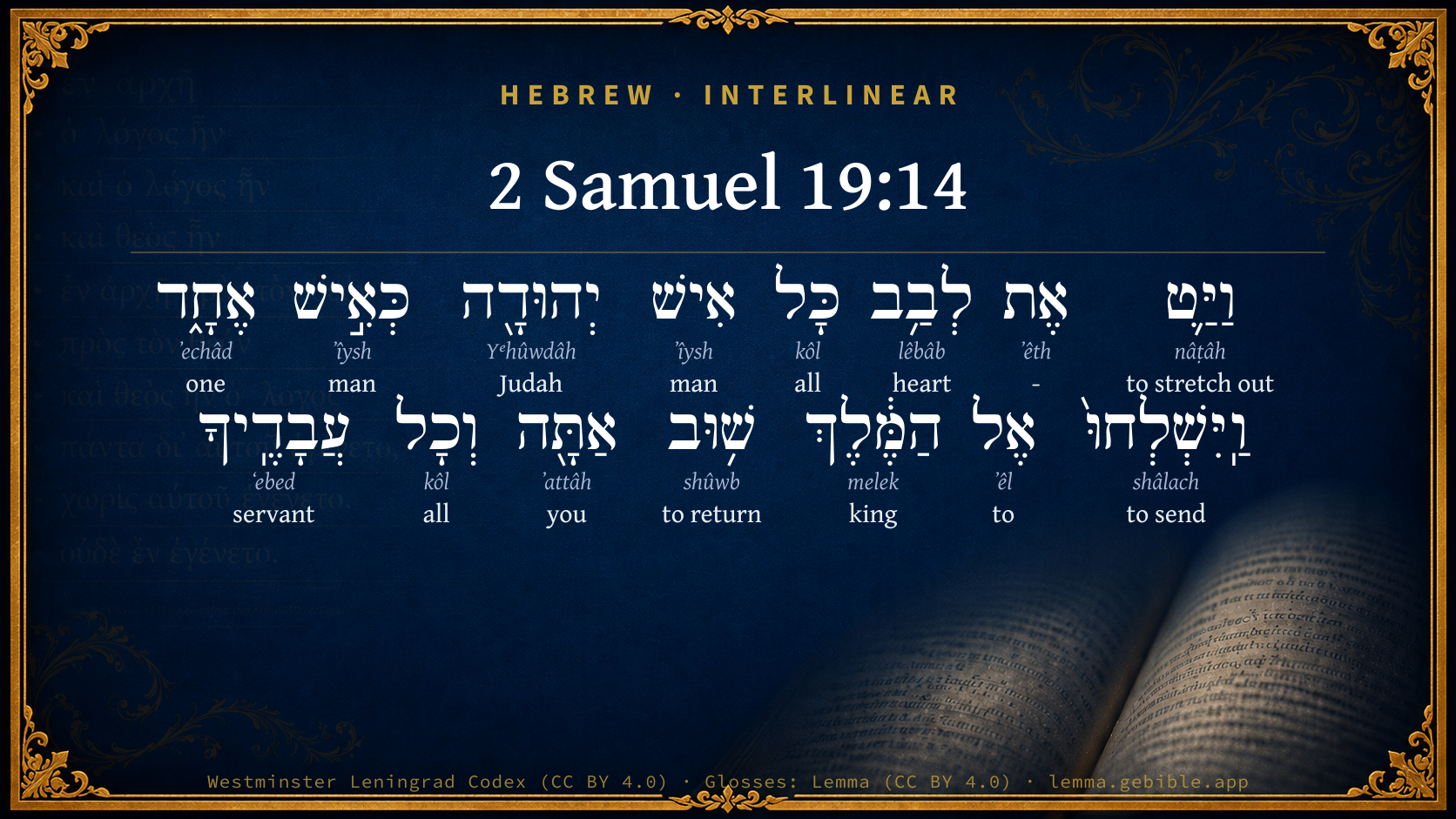
Hebrew (Westminster Leningrad Codex) 2 Samuel 19:14 appears in the Hebrew Old Testament. The text above is from the Westminster Leningrad Codex. Each word links to its Strong’s number, a concise gloss, and parsing drawn from the Open Scriptures Hebrew Bible morphology. Click any word for its full Brown-Driver-Briggs (BDB) entry.
Download image
Cite this verse

2 Samuel 19:14 (World English Bible). Public Domain. Lemma interlinear Bible study tool, https://lemma.gebible.app/v/2-samuel/19/14.

Show BibTeX & RIS
BibTeX
RIS
English Translation
He bowed the heart of all the men of Judah, even as [the heart of] one man; so that they sent to the king, [saying], Return you, and all your servants.
World English Bible · Public Domain
Download a study sheet

One document with this verse’s original text, its word-by-word gloss line, the meaning frame, cross-references with their text, attributed commentary, and full source and license credits — printable, and it pastes into notes with its structure intact.

This verse Autodidact and up

Study sheet (.html) Plain text (.txt)

A passage Seminary Student

Up to 50 verses in one chapter. A passage sheet keeps up to 6 commentary sources and 12 cross-references per verse, in the order this page ranks them, and says so on the sheet whenever that leaves anything out. Ask for a single verse and you get the Autodidact verse sheet above.

Everything on this page stays free to read, with no account — the sheet is a download of what is already on screen, not access to it.

Want to remove ads? Support Godless Engineer
Compare translations 3

The same verse in 3 English versions, stacked beneath the original-language interlinear above. Click any original word for its lexicon entry.

Each is an independent rendering of the whole verse — the interlinear is not word-aligned to these translations.

Highlighted words mark where these versions differ — a whole-verse word diff, not a word-by-word alignment.

  • World English Bible Public Domain
    He bowed the heart of all the men of Judah, even as [the heart of] one man; so that they sent to the king, [saying], Return you, and all your servants.
  • King James Version Public Domain
    And he bowed the heart of all the men of Judah, even as the heart of one man; so that they sent this word unto the king, Return thou, and all thy servants.
  • unfoldingWord Literal Text CC BY-SA 4.0
    And he inclined the heart of every man of Judah as one man. And they sent to the king, “Return, you and all of your servants.”

unfoldingWord Literal Text — © unfoldingWord, licensed CC BY-SA 4.0. Word-aligned USFM3 via Door43 (git.door43.org/unfoldingWord/en_ult).

Versions to compare (up to 4)

3 of 4 selected

Show all 18 translations

Every available English version of this verse, each an independent rendering of the whole verse.

  • World English Bible Public Domain
    He bowed the heart of all the men of Judah, even as [the heart of] one man; so that they sent to the king, [saying], Return you, and all your servants.
  • Berean Standard Bible Public Domain
    So he swayed the hearts of all the men of Judah as though they were one man, and they sent word to the king: “Return, you and all your servants.”
  • Majority Standard Bible Public Domain
    So he swayed the hearts of all the men of Judah as though they were one man, and they sent word to the king: “Return, you and all your servants.”
  • King James Version Public Domain
    And he bowed the heart of all the men of Judah, even as the heart of one man; so that they sent this word unto the king, Return thou, and all thy servants.
  • American Standard Version (1901) Public Domain
    And he bowed the heart of all the men of Judah, even as `the heart of' one man; so that they sent unto the king, `saying', Return thou, and all thy servants.
  • Revised Version (1885) Public Domain
    And he bowed the heart of all the men of Judah, even as the heart of one man; so that they sent unto the king, saying, Return thou, and all thy servants.
  • Geneva Bible (1599) Public Domain
    So he bowed the heartes of all the men of Iudah, as of one man: therefore they sent to the King, saying, Returne thou with all thy seruants.
  • Douay-Rheims (1899) Public Domain
    And be inclined the heart of all the men of Juda, as it were of one man: and they sent to the king, saying: Return thou, and all thy servants.
  • Young's Literal Translation Public Domain
    And he inclineth the heart of all the men of Judah as one man, and they send unto the king, `Turn back, thou, and all thy servants.'
  • Literal Standard Version CC BY-SA 4.0
    And he inclines the heart of all the men of Judah as one man, and they send to the king, “Return, you and all your servants.”
  • Unlocked Literal Bible CC BY-SA 4.0
    So he won the hearts of all the men of Judah as one man. They sent to the king saying, “Return, you and all your men.”
  • unfoldingWord Literal Text CC BY-SA 4.0
    And he inclined the heart of every man of Judah as one man. And they sent to the king, “Return, you and all of your servants.”
  • Darby Bible Public Domain
    And he bowed the heart of all the men of Judah as of one man; and they sent to the king, Return, thou and all thy servants.
  • World Messianic Bible Public Domain
    He bowed the heart of all the men of Judah, even as one man, so that they sent to the king, saying, “Return, you and all your servants.”
  • Webster's Bible Public Domain
    And he bowed the heart of all the men of Judah, even as the heart of one man; so that they sent this word to the king, Return thou, and all thy servants.
  • Free Bible Version CC BY-SA 4.0
    Amasa convinced all the people of Judah to unitedly support David, so they sent a message to the king: “Please come back, you and everyone with you.”
  • Bible in Basic English Public Domain
    And the hearts of the men of Judah were moved like one man; so that they sent to the king, saying, Come back, with all your servants.
  • JPS Tanakh (1917) Public Domain
    (19-15) And he bowed the heart of all the men of Judah, even as the heart of one man; so that they sent unto the king: 'Return thou, and all thy servants.'

Literal Standard Version (2020), Covenant Press — licensed CC BY-SA 4.0. Text via the HelloAO Bible API (eBible.org). Unlocked Literal Bible (unfoldingWord) — licensed CC BY-SA 4.0. Text via the HelloAO Bible API (eBible.org). unfoldingWord Literal Text — © unfoldingWord, licensed CC BY-SA 4.0. Word-aligned USFM3 via Door43 (git.door43.org/unfoldingWord/en_ult). Free Bible Version, Dr. Jonathan Gallagher — licensed CC BY-SA 4.0. Text via the HelloAO Bible API (eBible.org).

Word by word

More ways to search: Search by grammar → Find every occurrence → Compare this word →

Practice this passage: Drill this verse → Learn its vocabulary →

וַיַּ֛ט
nâṭâh
H5186
“and · to stretch out”
Conjunction + Verb, Hiphil, Sequential Imperfect, 3rd Person, Masculine, Singular
Part of Speech
Conjunction + Verb
Stem
Hiphil
Form
Sequential Imperfect
Person
3rd Person
Gender
Masculine
Number
Singular
Full BDB Definition

Origin: a primitive root

TWOT: 1352

to stretch out, extend, spread out, pitch, turn, pervert, incline, bend, bow - (Qal) - to stretch out, extend, stretch, offer - to spread out, pitch (tent) - to bend, turn, incline - to turn aside, incline, decline, bend down - to bend, bow - to hold out, extend (figuratively) - (Niphal) to be stretched out - (Hiphil) - to stretch out - to spread out - to turn, incline, influence, bend down, hold out, extend, thrust aside, thrust away
  1. אֶת ʼêth H853 “-” Particle, Direct Object
  2. לְבַ֥ב lêbâb H3824 “heart of” Noun, Common, Masculine, Singular, Construct
  3. כָּל kôl H3605 “all of” Noun, Common, Masculine, Singular, Construct
  4. אִישׁ ʼîysh H376 “man of” Noun, Common, Masculine, Singular, Construct
  5. יְהוּדָ֖ה Yᵉhûwdâh H3063 “Judah” Noun, Proper
  6. כְּאִ֣ישׁ ʼîysh H376 “like/as · man” Preposition + Noun, Common, Masculine, Singular, Absolute
  7. אֶחָ֑ד ʼechâd H259 “one” Adjective, Cardinal number, Masculine, Singular, Absolute
  8. וַֽיִּשְׁלְחוּ֙ shâlach H7971 “and · to send” Conjunction + Verb, Qal, Sequential Imperfect, 3rd Person, Masculine, Plural
  9. אֶל ʼêl H413 “to” Preposition
  10. הַמֶּ֔לֶךְ melek H4428 “the · king” Particle, Definite Article + Noun, Common, Masculine, Singular, Absolute
  11. שׁ֥וּב shûwb H7725 “return” Verb, Qal, Imperative, 2nd Person, Masculine, Singular
  12. אַתָּ֖ה ʼattâh H859 “you” Pronoun, Personal, 2nd Person, Masculine, Singular
  13. וְכָל kôl H3605 “and · all of” Conjunction + Noun, Common, Masculine, Singular, Construct
  14. עֲבָדֶֽיךָ ʻebed H5650 “servants · your” Noun, Common, Masculine, Plural, Construct + Suffix, Personal, 2nd Person, Masculine, Singular

About this verse

These counts appear in no published source. They are computed here, from the morphology-tagged text and Lemma’s own curated glosses. What Lemma adds →

15
words
13
distinct lemmas
Historical
section

Grammatical profile

  • 3 verbs
  • 8 nouns
  • 1 adjective
  • 1 pronoun
  • 1 preposition
  • 1 particle

Verb forms

  • וַיַּ֛ט Hiphil · Sequential Imperfect
  • וַֽיִּשְׁלְחוּ֙ Qal · Sequential Imperfect
  • שׁ֥וּב Qal · Imperative

Repetition

Words recur within this verse — often emphatic in Hebrew:

  • כָּל all H3605 ×2
  • אִישׁ man H376 ×2

Hebrew & Septuagint length

In English translation the verse runs 31 words from the Hebrew and 29 from the Septuagint (LXX English) — closely comparable.

A rough comparison of the two English renderings, which tokenize alike — not a word-level alignment.

Word counts can differ between the Hebrew and the Greek without any difference in meaning — e.g. the Hebrew direct-object marker אֵת has no separate Greek word, and Greek often adds the article ὁ.

Cross-references

3

Topical passages linked to 2 Samuel 19:14 in the Treasury of Scripture Knowledge — connected by theme and wording, ordered by reader-vote popularity; previews shown in the World English Bible.

  • Judges 20:1 Then all the children of Israel went out, and the congregation was assembled as one man, from Dan even to Beersheba, with the land of Gilead, to Yahweh at Mizpah.
  • Acts 4:32 The multitude of those who believed were of one heart and soul. Not one of them claimed that anything of the things which he possessed was his own, but they had all things in common.
  • Psalms 110:2–3 Yahweh will send forth the rod of your strength out of Zion. Rule in the midst of your enemies.

Cross-references courtesy of OpenBible.info (CC BY 4.0).

Hebrew and Greek witnesses Masoretic Hebrew ↔ Greek Septuagint

The same verse in the two great witnesses to the Old Testament, shown verse-for-verse.

These are two independent witnesses, not word-aligned to each other, and the Septuagint is shown in lemma (dictionary) form.

Hebrew 2 Samuel 19:14 Masoretic · Westminster Leningrad Codex

וַיַּ֛ט אֶת לְבַ֥ב כָּל אִישׁ יְהוּדָ֖ה כְּאִ֣ישׁ אֶחָ֑ד וַֽיִּשְׁלְחוּ֙ אֶל הַמֶּ֔לֶךְ שׁ֥וּב אַתָּ֖ה וְכָל עֲבָדֶֽיךָ

He bowed the heart of all the men of Judah, even as [the heart of] one man; so that they sent to the king, [saying], Return you, and all your servants.

World English Bible · Public Domain

Greek LXX 2 Samuel 19:14 Septuagint · lemma form

καί ὁ αμεσσαϊ εἶπον οὐ ὀστέον ἐγώ καί σάρξ ἐγώ σύ καί νῦν ὅδε ποιέω ἐγώ ὁ θεός καί ὅδε προςτίθημι εἰ μή ἄρχων δύναμις εἰμί ἐνώπιον ἐγώ πᾶς ὁ ἡμέρα ἀντί ιωαβ

And he bowed the heart of all the men of Juda as that of one man; and they sent to the king, saying, Return you, and all your servants.

LXX2012 (modern English Septuagint) · Public Domain

Hebrew: Westminster Leningrad Codex (CC BY 4.0). Greek: Septuagint (public domain); English from LXX2012 (modern English Septuagint) (Public Domain). How the Septuagint differs from the Hebrew →

Targum (Aramaic paraphrase)

1

The Targum is the ancient Jewish Aramaic paraphrase of the Hebrew Scriptures — an interpretive translation, not the Hebrew text itself. Onkelos (literal) and Pseudo-Jonathan (expansive) render the Torah, and Jonathan the Prophets. Coverage is partial: where no permissively-licensed English translation exists for a verse, only the Aramaic is shown. This is verse-level text, not a word-by-word alignment to the Hebrew.

  1. Targum Jonathan Prophets (Joshua–Malachi)
    וְלַעֲמָשָׂא תֵימְרוּן הֲלָא קְרִיבִי וּבִסְרִי אַתְּ כְּדֵין יַעְבֵּיד לִי יְיָ וּכְדֵין יוֹסִיף אִם לָא רַב חֵילָא תְּהֵי קֳדָמֵי כָּל יוֹמַיָא חֲלַף יוֹאָב:

    (no public-domain English translation for this verse)

    Targum Jonathan — Aramaic: “Mikraot Gedolot” (public domain). English: “Sefaria Community Translation” (CC0 1.0 (public-domain dedication)); “London "Chaldee Paraphrase," 1871” (public domain). Text via Sefaria.

Commentary

Notes on 2 Samuel 19:14 from classic Christian and Jewish commentators (each source and its license shown beneath its notes). The classic Christian expositions comment on the surrounding passage and are grouped to its opening verse, so a note may address several verses; the Jewish commentaries on the Tanakh (Rashi and others) are per-verse, so they appear only where the commentator wrote on this verse.

Lemma curates 59 commentaries, every one of them public domain or Creative Commons licensed, each selected and text-cleaned for this edition rather than reprinted as found. About our sources →

Trapp's Complete Commentary

John Trapp

2Sa 19:14 And he bowed the heart of all the men of Judah, even as [the heart of] one man; so that they sent [this word] unto the king, Return thou, and all thy servants.

Ver. 14. And he bowed the heart of all the men of Judah.] David did: so doth God bow and draw the hearts of his elect, by motions of mercy, and proffers of pardon upon their return unto him. See Isa 55:7-8.

John Trapp, A Commentary or Exposition upon All the Books of the Old and New Testament (1647–1656) — public domain. Text from a community e-Sword module.

Joseph Benson's Commentary

2Sa 19:14-15. He bowed the heart of all the men of Judah — This prudent and friendly message and free offer of pardon to them, and this kind treatment of the captain of the hostile host, and all his rebel adherents, had all the effect David could hope for; it touched their hearts, and melted them into loyalty and affection. They sent this word unto the king, Return thou, &c. — They immediately deputed the heads of their tribe to wait upon him, and invite him to return. So the king returned — He immediately complied with their request, and began his progress toward Jordan. And Judah came to Gilgal — David had not gone far before the principal persons of the whole tribe met him in a body, to conduct him over the river.

Joseph Benson's Commentary on the Old and New Testaments (1811–1818) — public domain. Text from a community e-Sword module.

Jamieson, Fausset & Brown

Robert Jamieson, A. R. Fausset & David Brown

he bowed the heart of all the men of Judah--that is, Amasa, who had been won over, used his great influence in re-attaching the whole tribe of Judah to the interest of David.

Jamieson, Fausset & Brown — Commentary Critical and Explanatory on the Whole Bible (1871) — public domain (CC PDM 1.0). Text via the HelloAO Bible API.

Adam Clarke's Commentary

Verse 14. And he bowed the heart of all the men of Judah] The measures that he pursued were the best calculated that could be to accomplish this salutary end. Appear to distrust those whom you have some reason to suspect, and you increase their caution and distrust. Put as much confidence in them as you safely can, and this will not fail to excite their confidence towards you.

Adam Clarke's Commentary on the Bible (1810–1826) — public domain. Text from a community e-Sword/MySword module.

The Cambridge Bible for Schools and Colleges

gen. ed. J. J. S. Perowne

14. And he bowed, &c.] By this message David inclined the hearts of the men of Judah to restore him to the throne.

The Cambridge Bible for Schools and Colleges (gen. ed. J. J. S. Perowne; Cambridge University Press, 1878–1918) — public domain. Text from a community e-Sword module.

John Gill's Exposition

And he bowed the heart of all the men of Judah, even as the heart of one man,.... This the Jewish commentators generally understand of Amasa that he used his interest with the men of Judah, and so wrought upon them, that they agreed as one man to send for the king, and bring him back; but it seems best to understand it of David, who by these gentle methods, kind messages, and affectionate speeches, powerfully inclined and engaged the hearts of the people towards him; so that they were unanimously and affectionately agreed to restore him: in this way David chose to return; he could have come without their leave, or any invitation from them, as he was their lawful king, and a victorious one, the rebellion being crushed; and had it in his power to chastise those concerned in it, and use them with severity; but he chose rather to gain the hearts of his people, and to come in a way peaceable to them, and honourable to himself:

so that they sent this word unto the king, return thou and all thy servants; perhaps by the same messengers that David sent; or it may be, rather for honour's sake they deputed some of their principal men to wait on David, and invite him to return to them with all his retinue and army, promising allegiance and fidelity to him.

John Gill's Exposition of the Whole Bible (1746–1763) — public domain (CC PDM 1.0). Text via the HelloAO Bible API.

Haydock's Catholic Bible Commentary

And he; God, David, or rather Amasa. (Calmet) --- All contributed, in different degrees, to bring about his happy union. (Haydock)

George Leo Haydock (1774–1849), Haydock's Catholic Family Bible and Commentary, 1859 edition — public domain. Excludes Psalms (Douay-Rheims chapter numbering differs from Protestant) and Deuterocanonical books (Catholic canon only).

Matthew Poole's English Annotations

He; either, first, Amasa, by his great influence upon them. Or rather, secondly, David, by his prudent and kind message, and his free offer of pardon and favour to them, as if they had never offended.

Matthew Poole's English Annotations on the Holy Bible (1683–1685) — public domain. Text from a community e-Sword/MySword module.

Whedon's Commentary on the Bible

Daniel D. Whedon

14. Bowed the heart — Affected them so powerfully by his appeal as to win all hearts to himself, and cause the whole tribe to rise as one man to his rescue and restoration.

Daniel D. Whedon (gen. ed.), Commentary on the Old and New Testaments (1874–1909) — public domain. Text from a community e-Sword module.

The Pulpit Commentary

And he bowed, etc. It was not Amasa, but David, who made all the members of his tribe unanimous in his recall. And not only were the high priests active in his cause, but David, He may feel sure, sent numerous messages to all the more powerful men, assuring them of forgiveness and favour. In his general policy he was right. After the solemn anointing of Absalom, it was necessary for him to wait until some equally public and national act authorized his resumption of the royal power; and delay was dangerous. Every day now spent at Mabanaim might give the opportunity for fresh troubles.

The Pulpit Commentary (1880–1919), ed. H.D.M. Spence-Jones & Joseph S. Exell — public domain. Text from a community e-Sword module.

John Wesley's Explanatory Notes

He bowed - David by this prudent and kind message and his free offer of pardon.

John Wesley, Explanatory Notes Upon the Whole Bible (1754–1765) — public domain. Text via the GEBible commentary corpus.

Keil & Delitzsch

C. F. Keil & F. Delitzsch

Thus he (David) inclined the heart of all the people as of one man, and they sent to the king, saying, "Return thou, with all thy servants." The result of David's message to the priests is given summarily here. The subject to ויּט is David, not Amasa or Zadok. So far as the fact itself is concerned, it was certainly wise of David to send to the members of his own tribe, and appeal to them not to be behind the rest of the tribes in taking part in his restoration to the kingdom, lest it should appear as though the tribe of Judah, to which David himself belonged, was dissatisfied with his victory, since it was in that tribe that the rebellion itself first broke out; and this would inevitably feed the jealousy between Judah and the rest of the tribes. But it was not only unwise, but unjust, to give to Amasa, the traitor-general of the rebels, a promise on oath that he should be commander-in-chief in the place of Joab; for even if the promise was only given privately at first, the fact that it had been given could not remain a secret from Joab very long, and would be sure to stir up his ambition, and lead him to the commission of fresh crimes, and in all probability the enmity of this powerful general would become dangerous to the throne of David. For however Joab might have excited David's anger by slaying Absalom, and by the offensive manner in which he had reproved the king for giving way to his grief, David ought to have suppressed his anger in his existing circumstances, and ought not to have rendered evil for evil, especially as he was not only about to pardon Amasa's crime, but even to reward him as one of his faithful servants.

Keil & Delitzsch — Biblical Commentary on the Old Testament (1861–1891) — public domain (CC PDM 1.0). Text via the HelloAO Bible API. (Old Testament only.)

Rashi

Rabbi Shlomo Yitzchaki (Rashi)

To Amosoh. Who is [Avsholom's] commanding officer you should say, 'You are my own sister's son.'

Rashi on the Tanakh — English translations: “The Judaica Press complete Tanach with Rashi, translated by A. J. Rosenberg” (CC BY 4.0); “Pentateuch with Rashi's commentary by M. Rosenbaum and A.M. Silbermann, 1929-1934” (public domain); “The Metsudah Tanach series, Lakewood, N.J” (CC BY 4.0); and “The Book of Joshua, Metsudah Publications, 1997” (CC BY 4.0). Text via Sefaria.

Lesson kit

Teaching starters — assembled from the data on this page, not authored interpretation. Every prompt links to the verse data it draws on. Edit before teaching.

2 Samuel, in the Historical, opens this verse with 15 words (13 distinct Hebrew lemmas). Its most distinctive word is nâṭâh (“to stretch out”). A historical commentator’s framing appears above. Read the whole chapter for the surrounding context.

Discussion questions

  1. What does “to stretch out” (nâṭâh) contribute to the verse as a whole?
  2. Judges 20:1 shares this passage’s theme. How do the two illuminate each other?
  3. “all” occurs 2× in this one verse. What is the effect of the repetition?
  4. The translations on this page render this verse differently — a whole-verse word diff, not a word-by-word alignment. What might account for the different wordings?
  5. The verb «וַיַּ֛ט» is Hiphil Sequential Imperfect. How does its form color the action?
  6. Reading how Trapp's Complete Commentary and Joseph Benson's Commentary read this verse, where do the two commentators agree and where do they part?

Things to notice

Reading settings

Reading text

Shown beneath each verse's original-language words.

Old Testament
Old Testament edition

Read the OT as the Masoretic Hebrew (MT) or the Greek Septuagint (LXX).

English shown for the Greek Septuagint (in the Hebrew ↔ Greek comparison).

Comparing translations? Open the Compare panel on any verse page to stack up to four side by side.