
Genesis 43:7

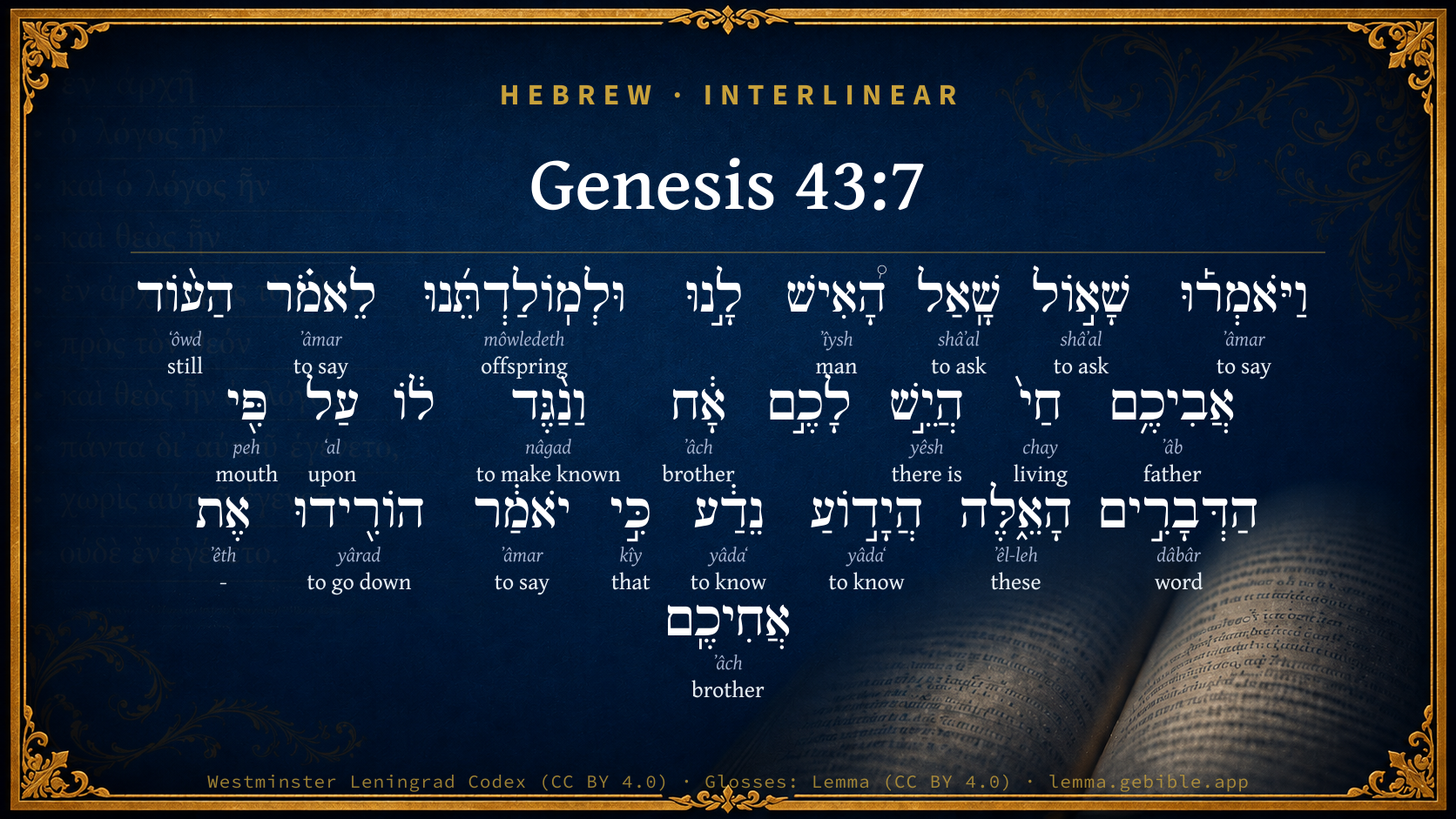
Hebrew (Westminster Leningrad Codex) Genesis 43:7 appears in the Hebrew Old Testament. The text above is from the Westminster Leningrad Codex. Each word links to its Strong’s number, a concise gloss, and parsing drawn from the Open Scriptures Hebrew Bible morphology. Click any word for its full Brown-Driver-Briggs (BDB) entry.
Download image
Cite this verse

Genesis 43:7 (World English Bible). Public Domain. Lemma interlinear Bible study tool, https://lemma.gebible.app/v/genesis/43/7.

Show BibTeX & RIS
BibTeX
RIS
English Translation
They said, "The man asked directly concerning ourselves, and concerning our relatives, saying, 'Is your father still alive? Have you another brother?' We just answered his questions. Is there any way we could know that he would say, 'Bring your brother down?'"
World English Bible · Public Domain
Download a study sheet

One document with this verse’s original text, its word-by-word gloss line, the meaning frame, cross-references with their text, attributed commentary, and full source and license credits — printable, and it pastes into notes with its structure intact.

This verse Autodidact and up

Study sheet (.html) Plain text (.txt)

A passage Seminary Student

Up to 50 verses in one chapter. A passage sheet keeps up to 6 commentary sources and 12 cross-references per verse, in the order this page ranks them, and says so on the sheet whenever that leaves anything out. Ask for a single verse and you get the Autodidact verse sheet above.

Everything on this page stays free to read, with no account — the sheet is a download of what is already on screen, not access to it.

Want to remove ads? Support Godless Engineer
Compare translations 3

The same verse in 3 English versions, stacked beneath the original-language interlinear above. Click any original word for its lexicon entry.

Each is an independent rendering of the whole verse — the interlinear is not word-aligned to these translations.

Highlighted words mark where these versions differ — a whole-verse word diff, not a word-by-word alignment.

  • World English Bible Public Domain
    They said, "The man asked directly concerning ourselves, and concerning our relatives, saying, 'Is your father still alive? Have you another brother?' We just answered his questions. Is there any way we could know that he would say, 'Bring your brother down?'"
  • King James Version Public Domain
    And they said, The man asked us straitly of our state, and of our kindred, saying, Is your father yet alive? have ye another brother? and we told him according to the tenor of these words: could we certainly know that he would say, Bring your brother down?
  • unfoldingWord Literal Text CC BY-SA 4.0
    And they said, “The man asked persistently about us and our relatives, saying, ‘Is your father still alive? Do you have brother?’ And we answered him according to those words. How could we possibly know that he would say, ‘Bring your brother down’?”

unfoldingWord Literal Text — © unfoldingWord, licensed CC BY-SA 4.0. Word-aligned USFM3 via Door43 (git.door43.org/unfoldingWord/en_ult).

Versions to compare (up to 4)

3 of 4 selected

Show all 18 translations

Every available English version of this verse, each an independent rendering of the whole verse.

  • World English Bible Public Domain
    They said, "The man asked directly concerning ourselves, and concerning our relatives, saying, 'Is your father still alive? Have you another brother?' We just answered his questions. Is there any way we could know that he would say, 'Bring your brother down?'"
  • Berean Standard Bible Public Domain
    They replied, “The man questioned us in detail about ourselves and our family: ‘Is your father still alive? Do you have another brother?’ And we answered him accordingly. How could we possibly know that he would say, ‘Bring your brother here’?”
  • Majority Standard Bible Public Domain
    They replied, “The man questioned us in detail about ourselves and our family: ‘Is your father still alive? Do you have another brother?’ And we answered him accordingly. How could we possibly know that he would say, ‘Bring your brother here’?”
  • King James Version Public Domain
    And they said, The man asked us straitly of our state, and of our kindred, saying, Is your father yet alive? have ye another brother? and we told him according to the tenor of these words: could we certainly know that he would say, Bring your brother down?
  • American Standard Version (1901) Public Domain
    And they said, The man asked straitly concerning ourselves, and concerning our kindred, saying, Is your father yet alive? have ye `another' brother? and we told him according to the tenor of these words: could we in any wise know that he would say, Bring your brother down?
  • Revised Version (1885) Public Domain
    And they said, The man asked straitly concerning ourselves, and concerning our kindred, saying, Is your father yet alive? have ye another brother? and we told him according to the tenor of these words: could we in any wise know that he would say, Bring your brother down?
  • Geneva Bible (1599) Public Domain
    And they answered, The man asked straitly of our selues and of our kinred, saying, Is your father yet aliue? haue ye any brother? And wee tolde him according to these wordes: could we knowe certainely that he would say, Bring your brother downe?
  • Douay-Rheims (1899) Public Domain
    But they answered: The man asked us in order concerning our kindred: if our father lived: if we had a brother: and we answered him regularly, according to what he demanded: Bring hither your brother with you?
  • Young's Literal Translation Public Domain
    and they say, `The man asked diligently concerning us, and concerning our kindred, saying, Is your father yet alive? have ye a brother? and we declare to him according to the tenor of these things; do we certainly know that he will say, Bring down your brother?'
  • Literal Standard Version CC BY-SA 4.0
    And they say, “The man asked diligently concerning us, and concerning our family, saying, Is your father yet alive? Have you a brother? And we declare to him according to the tenor of these things; do we certainly know that he will say, Bring down your brother?”
  • Unlocked Literal Bible CC BY-SA 4.0
    They said, “The man asked details about us and our family. He said, 'Is your father still alive? Do you have another brother?' We answered him according to these questions. How could we have known that he would say, 'Bring your brother down?'”
  • unfoldingWord Literal Text CC BY-SA 4.0
    And they said, “The man asked persistently about us and our relatives, saying, ‘Is your father still alive? Do you have brother?’ And we answered him according to those words. How could we possibly know that he would say, ‘Bring your brother down’?”
  • Darby Bible Public Domain
    And they said, The man asked very closely after us, and after our kindred, saying, Is your father yet alive? have ye a brother? And we told him according to the tenor of these words. Could we at all know that he would say, Bring your brother down?
  • World Messianic Bible Public Domain
    They said, “The man asked directly concerning ourselves, and concerning our relatives, saying, ‘Is your father still alive? Have you another brother?’ We just answered his questions. Is there any way we could know that he would say, ‘Bring your brother down’?”
  • Webster's Bible Public Domain
    \\43:8\\And Judah said to Israel, his father, Send the lad with me, and we will arise and go; that we may live, and not die, both we, and thou, and also our little ones.
  • Free Bible Version CC BY-SA 4.0
    “The man kept on asking direct questions about us and our family like ‘Is your father still alive?’ and ‘Do you have another brother?’” they replied. “We just answered his questions. How were we to know he'd say, ‘Bring your brother here!’?”
  • Bible in Basic English Public Domain
    Then Judah said to Israel, his father, Send the boy with me, and let us be up and going, so that we and you and our little ones may not come to destruction.
  • JPS Tanakh (1917) Public Domain
    And they said: 'The man asked straitly concerning ourselves, and concerning our kindred, saying: Is your father yet alive? have ye another brother? and we told him according to the tenor of these words; could we in any wise know that he would say: Bring your brother down?'

Literal Standard Version (2020), Covenant Press — licensed CC BY-SA 4.0. Text via the HelloAO Bible API (eBible.org). Unlocked Literal Bible (unfoldingWord) — licensed CC BY-SA 4.0. Text via the HelloAO Bible API (eBible.org). unfoldingWord Literal Text — © unfoldingWord, licensed CC BY-SA 4.0. Word-aligned USFM3 via Door43 (git.door43.org/unfoldingWord/en_ult). Free Bible Version, Dr. Jonathan Gallagher — licensed CC BY-SA 4.0. Text via the HelloAO Bible API (eBible.org).

Word by word

More ways to search: Search by grammar → Find every occurrence → Compare this word →

Practice this passage: Drill this verse → Learn its vocabulary →

וּלְמֽוֹלַדְתֵּ֜נוּ
môwledeth
H4138
“and · to/for · offspring · our”
Conjunction + Preposition + Noun, Common, Feminine, Singular, Construct + Suffix, Personal, 1st Person, Common, Plural
Part of Speech
Conjunction + Preposition + Noun
Type
Common
Gender
Feminine
Number
Singular
State
Construct
Full BDB Definition

Origin: from H3205

TWOT: 867f

kindred, birth, offspring, relatives - kindred - birth, circumstances of birth - one born, begotten, issue, offspring, female offspring
  1. וַיֹּאמְר֡וּ ʼâmar H559 “and · to say” Conjunction + Verb, Qal, Sequential Imperfect, 3rd Person, Masculine, Plural
  2. שָׁא֣וֹל shâʼal H7592 “to ask” Verb, Qal, Infinitive Absolute
  3. שָֽׁאַל shâʼal H7592 “to ask” Verb, Qal, Perfect, 3rd Person, Masculine, Singular
  4. הָ֠אִישׁ ʼîysh H376 “the · man” Particle, Definite Article + Noun, Common, Masculine, Singular, Absolute
  5. לֵאמֹ֗ר ʼâmar H559 “to say” Preposition + Verb, Qal, Infinitive Construct
  6. הַע֨וֹד ʻôwd H5750 “still” Particle, Interrogative + Adverb
  7. אֲבִיכֶ֥ם ʼâb H1 “father · your” Noun, Common, Masculine, Singular, Construct + Suffix, Personal, 2nd Person, Masculine, Plural
  8. חַי֙ chay H2416 “living” Adjective, Adjective, Masculine, Singular, Absolute
  9. הֲיֵ֣שׁ yêsh H3426 “there is” Particle, Interrogative + Particle, Demonstrative
  10. אָ֔ח ʼâch H251 “brother” Noun, Common, Masculine, Singular, Absolute
  11. וַנַ֨גֶּד nâgad H5046 “and · to make known” Conjunction + Verb, Hiphil, Sequential Imperfect, 1st Person, Common, Plural
  12. עַל ʻal H5921 “upon” Preposition
  13. פִּ֖י peh H6310 “mouth of” Noun, Common, Masculine, Singular, Construct
  14. הַדְּבָרִ֣ים dâbâr H1697 “the · words” Particle, Definite Article + Noun, Common, Masculine, Plural, Absolute
  15. הָאֵ֑לֶּה ʼêl-leh H428 “the · these” Particle, Definite Article + Pronoun, Demonstrative, Common, Plural
  16. הֲיָד֣וֹעַ yâdaʻ H3045 “to know” Particle, Interrogative + Verb, Qal, Infinitive Absolute
  17. נֵדַ֔ע yâdaʻ H3045 “to know” Verb, Qal, Imperfect, 1st Person, Common, Plural
  18. כִּ֣י kîy H3588 “that” Conjunction
  19. יֹאמַ֔ר ʼâmar H559 “to say” Verb, Qal, Imperfect, 3rd Person, Masculine, Singular
  20. הוֹרִ֖ידוּ yârad H3381 “go down” Verb, Hiphil, Imperative, 2nd Person, Masculine, Plural
  21. אֶת ʼêth H853 “-” Particle, Direct Object
  22. אֲחִיכֶֽם ʼâch H251 “brother · your” Noun, Common, Masculine, Singular, Construct + Suffix, Personal, 2nd Person, Masculine, Plural

About this verse

These counts appear in no published source. They are computed here, from the morphology-tagged text and Lemma’s own curated glosses. What Lemma adds →

26
words
18
distinct lemmas
Pentateuch
section

Notable vocabulary

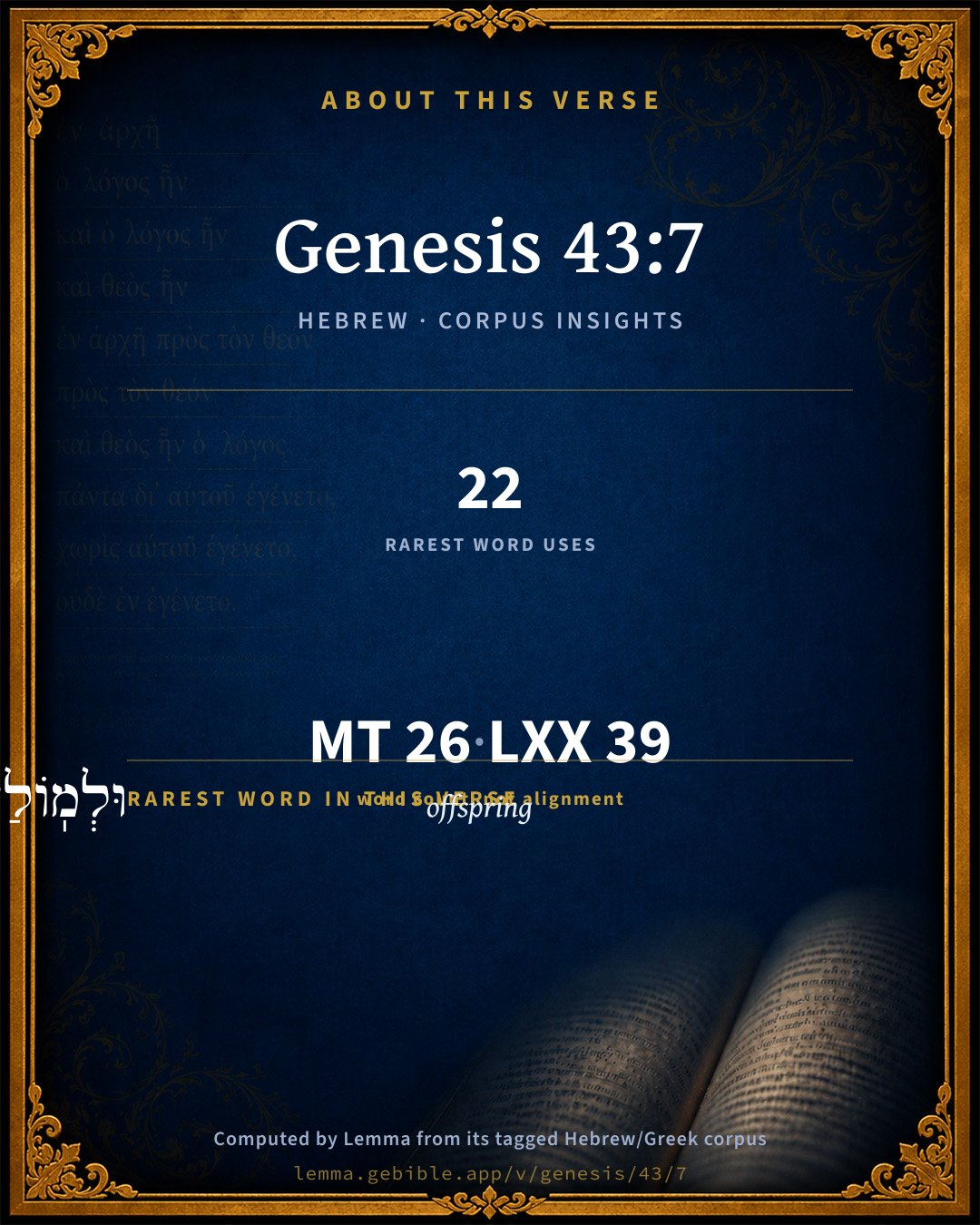
The rarest word here is וּלְמֽוֹלַדְתֵּ֜נוּ offspring H4138 — appearing just 22 times in the whole Hebrew Bible.

Shared distinctive vocabulary

וּלְמֽוֹלַדְתֵּ֜נוּ offspring H4138 occurs in 21 verses of the Hebrew Bible. Also found in:

Grammatical profile

  • 9 verbs
  • 7 nouns
  • 1 adjective
  • 1 pronoun
  • 4 prepositions
  • 1 conjunction
  • 1 adverb
  • 2 particles

Verb forms

  • וַיֹּאמְר֡וּ Qal · Sequential Imperfect
  • שָׁא֣וֹל Qal · Infinitive Absolute
  • שָֽׁאַל Qal · Perfect
  • לֵאמֹ֗ר Qal · Infinitive Construct
  • וַנַ֨גֶּד Hiphil · Sequential Imperfect
  • הֲיָד֣וֹעַ Qal · Infinitive Absolute
  • נֵדַ֔ע Qal · Imperfect
  • יֹאמַ֔ר Qal · Imperfect
  • הוֹרִ֖ידוּ Hiphil · Imperative

Repetition

Words recur within this verse — often emphatic in Hebrew:

  • וַיֹּאמְר֡וּ to say H559 ×3
  • שָׁא֣וֹל to ask H7592 ×2
  • אָ֔ח brother H251 ×2
  • הֲיָד֣וֹעַ to know H3045 ×2

Hebrew & Septuagint length

In English translation the verse runs 42 words from the Hebrew and 43 from the Septuagint (LXX English) — closely comparable.

A rough comparison of the two English renderings, which tokenize alike — not a word-level alignment.

Word counts can differ between the Hebrew and the Greek without any difference in meaning — e.g. the Hebrew direct-object marker אֵת has no separate Greek word, and Greek often adds the article ὁ.

In the original languages it is 26 Hebrew tokens and 39 Greek tokens — but the two are counted differently (Hebrew bundles its prefixes and suffixes into one token; the Greek is in lemma form), so that isn’t a like-for-like length.

Cross-references

3

Topical passages linked to Genesis 43:7 in the Treasury of Scripture Knowledge — connected by theme and wording, ordered by reader-vote popularity; previews shown in the World English Bible.

  • Genesis 43:3 Judah spoke to him, saying, "The man solemnly warned us, saying, 'You shall not see my face, unless your brother is with you.'
  • Genesis 42:13 They said, "We, your servants, are twelve brothers, the sons of one man in the land of Canaan; and, behold, the youngest is this day with our father, and one is no more."
  • Genesis 43:27 He asked them of their welfare, and said, "Is your father well, the old man of whom you spoke? Is he yet alive?"

Cross-references courtesy of OpenBible.info (CC BY 4.0).

Hebrew and Greek witnesses Masoretic Hebrew ↔ Greek Septuagint

The same verse in the two great witnesses to the Old Testament, shown verse-for-verse.

These are two independent witnesses, not word-aligned to each other, and the Septuagint is shown in lemma (dictionary) form.

Hebrew Genesis 43:7 Masoretic · Westminster Leningrad Codex

וַיֹּאמְר֡וּ שָׁא֣וֹל שָֽׁאַל הָ֠אִישׁ לָ֣נוּ וּלְמֽוֹלַדְתֵּ֜נוּ לֵאמֹ֗ר הַע֨וֹד אֲבִיכֶ֥ם חַי֙ הֲיֵ֣שׁ לָכֶ֣ם אָ֔ח וַנַ֨גֶּד ל֔וֹ עַל פִּ֖י הַדְּבָרִ֣ים הָאֵ֑לֶּה הֲיָד֣וֹעַ נֵדַ֔ע כִּ֣י יֹאמַ֔ר הוֹרִ֖ידוּ אֶת אֲחִיכֶֽם

They said, "The man asked directly concerning ourselves, and concerning our relatives, saying, 'Is your father still alive? Have you another brother?' We just answered his questions. Is there any way we could know that he would say, 'Bring your brother down?'"

World English Bible · Public Domain

Greek LXX Genesis 43:7 Septuagint · lemma form

ὁ δέ εἶπον ἐρωτάω ἐπιἐρωτάω ἐγώ ὁ ἄνθρωπος καί ὁ γενεά ἐγώ λέγω εἰ ἔτι ὁ πατήρ σύ ζάω εἰ εἰμί σύ ἀδελφός καί ἀποἀγγέλλω αὐτός κατά ὁ ἐπερώτησις οὗτος μή οἶδα εἰ εἶπον ἐγώ ἄγω ὁ ἀδελφός σύ

And they said, The man closely questioned us about our family also, saying, Does your father yet live, and have you⌃ a brother? and we answered him according to this question: did we know that he would say to us, Bring your brother?

LXX2012 (modern English Septuagint) · Public Domain

On this verse, The Pulpit Commentary discusses the Septuagint’s reading. Read the note in Commentary ↓

Hebrew: Westminster Leningrad Codex (CC BY 4.0). Greek: Septuagint (public domain); English from LXX2012 (modern English Septuagint) (Public Domain). How the Septuagint differs from the Hebrew →

Targum (Aramaic paraphrase)

2

The Targum is the ancient Jewish Aramaic paraphrase of the Hebrew Scriptures — an interpretive translation, not the Hebrew text itself. Onkelos (literal) and Pseudo-Jonathan (expansive) render the Torah, and Jonathan the Prophets. Coverage is partial: where no permissively-licensed English translation exists for a verse, only the Aramaic is shown. This is verse-level text, not a word-by-word alignment to the Hebrew.

  1. Targum Onkelos Torah (Genesis–Deuteronomy)
    וַאֲמָרוּ מִשְׁאַל שָׁאֵל גַּבְרָא לָנָא וּלְיַלָּדוּתָנָא לְמֵימַר הַעַד כְּעַן אֲבוּכוֹן קַיָּם הַאִית לְכוֹן אָחָא וְחַוֵּינָא לֵהּ עַל מֵימַר פִּתְגָּמַיָּא הָאִלֵּין הֲמִדַּע הֲוֵינָא יָדְעִין אֲרֵי יֵימַר אוֹחִיתוּ יָת אֲחוּכוֹן

    (no public-domain English translation for this verse)

    Targum Onkelos — Aramaic: “Onkelos Genesis” (public domain); “Onkelos Exodus” (public domain); “Onkelos Leviticus” (public domain); “Onkelos Numbers” (public domain); “Onkelos Deuteronomy” (public domain). English: “Sefaria Community Translation” (CC0 1.0 (public-domain dedication)); “J.W. Etheridge. The Targums of Onkelos and Jonathan Ben Uzziel on the Pentateuch. London: Longmans, Green, 1862” (public domain). Text via Sefaria.

  2. Targum Pseudo-Jonathan Torah (Genesis–Deuteronomy)
    וַאֲמָרוּ מִישְׁאַל שְׁאֵיל גַבְרָא לָנָא וּלְיִחוּסָנָא לְמֵימָר הַעַד כְּדוּן אֲבוּכוֹן קַיָים הַאִית לְכוֹן אָחָא וּתְנֵינָא לֵיהּ עַל מֵימָר פִּתְגָמַיָיא הָאִלֵין הֲמֵידַע הֲוֵינָא יָדְעִין דְיֵימַר אָחִיתוּ יַת אֲחוּכוֹן

    And they said, The man demanding demanded (to know) about us, and about our family, saying Is your father yet living? Have you a brother? And we informed him according to the word of these things. Could we know that be would say, Bring your brother down?

    Targum Pseudo-Jonathan — Aramaic: “Targum Jonathan on Genesis” (public domain); “Targum Jonathan on Exodus” (public domain); “Targum Jonathan on Leviticus” (public domain); “Targum Jonathan on Numbers” (public domain); “Targum Jonathan on Deuteronomy” (public domain). English: “The Targum of Jonathan ben Uzziel, trans. J. W. Etheridge, London, 1862” (public domain). Text via Sefaria.

Commentary

Notes on Genesis 43:7 from classic Christian and Jewish commentators (each source and its license shown beneath its notes). The classic Christian expositions comment on the surrounding passage and are grouped to its opening verse, so a note may address several verses; the Jewish commentaries on the Tanakh (Rashi and others) are per-verse, so they appear only where the commentator wrote on this verse.

Lemma curates 59 commentaries, every one of them public domain or Creative Commons licensed, each selected and text-cleaned for this edition rather than reprinted as found. About our sources →

Trapp's Complete Commentary

John Trapp

Gen 43:7 And they said, The man asked us straitly of our state, and of our kindred, saying, [Is] your father yet alive? have ye [another] brother? and we told him according to the tenor of these words: could we certainly know that he would say, Bring your brother down?

Ver. 7. Could we certainly know, &c.] Inferences many times axe made upon what we say or do, such as we never thought of, Arbitror nonnullos in quibusdam locis librorum meorum opinaturos, me sensisse quod non sensi, aut non sensisse quod sensi, saith Augustine. {a} And it fell out accordingly. For, as Baronius witnesseth, after St Austin’s death, there arose up divisions, who, out of his writings, wrested and misconstrued, brought in many errors; which they endeavoured to maintain by the name and authority of St Augustine. {b} And the like may be said of Luther.

{a} Aug., lib. i., De Trin., cap. 3, ad finem.

{b} Qui ex eius scriptis male perceptis complures invexerunt errores. - Annal, tom. vi., ad Ann. 450.

John Trapp, A Commentary or Exposition upon All the Books of the Old and New Testament (1647–1656) — public domain. Text from a community e-Sword module.

Geneva Bible (1599)

Geneva Bible translators

Hebrew, to the mouth of these words: that is, that thing which he asked us.

Or, of our estate and condition.

Geneva Bible (1599) marginal notes — public domain. Text via Bolls.life.

The Cambridge Bible for Schools and Colleges

gen. ed. J. J. S. Perowne

7. The man asked straitly] The word “straitly” (i.e. “strictly, closely,” cf. Jos_6:1), like “solemnly” in Gen_43:3, simply emphasizes the force of the verb in Heb. Shakespeare, Rich. III, i. 3:

“His majesty hath straitly given in charge

That no man shall have private conference

… with his brother.”

This verse is evidently independent of Gen_42:13 (E), where the information was voluntarily given by the brethren in proof of their sincerity.

The Cambridge Bible for Schools and Colleges (gen. ed. J. J. S. Perowne; Cambridge University Press, 1878–1918) — public domain. Text from a community e-Sword module.

Haydock's Catholic Bible Commentary

Asked us. This is perfectly consonant with what they say, chap. xlii. 13, and chap. xliv. 19. They mentioned their having a brother at home, without the smallest suspicion of doing wrong.

George Leo Haydock (1774–1849), Haydock's Catholic Family Bible and Commentary, 1859 edition — public domain. Excludes Psalms (Douay-Rheims chapter numbering differs from Protestant) and Deuterocanonical books (Catholic canon only).

Matthew Poole's English Annotations

We told him according to the tenor of these words; we gave answers suitable to his questions, or such as his words required.

Matthew Poole's English Annotations on the Holy Bible (1683–1685) — public domain. Text from a community e-Sword/MySword module.

The Pulpit Commentary

And they said, The man asked us straitly of our state, and of our kindred, saying, Is your father yet alive? have ye another brother? Though not appearing in the preceding narrative of the historian, (Gen_42:13, Gen_42:32) it must yet be held as accurate that the information given to Joseph about Jacob and Benjamin was supplied in answer to direct inquiries, since Judah afterwards gives the same account of it (Gen_44:19) when pleading before Joseph in behalf of Benjamin. And we told him according to the tenor of these words literally, according to these words, i.e. either in conformity to his questions (Ainsworth, Rosenm Keil), kata ththsin tauthn (LXX.), juxta id quod fuerat sciscitatus (Vulgate), or like those words we have told thee (Kalisch). Could we certainly know (literally, knowing could we know) that he would say, Bring your brother down?

The Pulpit Commentary (1880–1919), ed. H.D.M. Spence-Jones & Joseph S. Exell — public domain. Text from a community e-Sword module.

Rashi

Rabbi Shlomo Yitzchaki (Rashi)

לנו ולמולדתנו CONCERNING OURSELVES AND CONCERNING OUR KINDRED — concerning our families. A Midrashic comment based upon the meaning of מולדת, “birth” — He asked of us concerning the circumstances of our birth — is: he could even tell us of what kind of wood our cradles were made (Genesis Rabbah 91:10).

ונגד לו AND WE TOLD HIM that we had a father and a brother.

על פי הדברים האלה ACCORDING TO THE TENOR OF THESE WORDS — we were forced to tell him according to the tenor of the questions he put to us.

כי יאמר THAT HE WOULD SAY — The word כי is used here in the sense of אשר “that”. The word כי may be used in the sense of אם and אם may be used in the sense of אשר; therefore this (i.e. אשר) is one of the four meanings in which כי, according to the Rabbis, is used, viz., אם (Rosh Hashanah 3a), for the word כי here has the same meaning as אם, as in (24:33) עד אם דברתי דברי “until that I have spoken my words” (where אם is the same as כי or אשר).

Rashi on the Tanakh — English translations: “The Judaica Press complete Tanach with Rashi, translated by A. J. Rosenberg” (CC BY 4.0); “Pentateuch with Rashi's commentary by M. Rosenbaum and A.M. Silbermann, 1929-1934” (public domain); “The Metsudah Tanach series, Lakewood, N.J” (CC BY 4.0); and “The Book of Joshua, Metsudah Publications, 1997” (CC BY 4.0). Text via Sefaria.

Lesson kit

Teaching starters — assembled from the data on this page, not authored interpretation. Every prompt links to the verse data it draws on. Edit before teaching.

Genesis, in the Pentateuch, opens this verse with 26 words (18 distinct Hebrew lemmas). Its most distinctive word is môwledeth (“offspring”). A historical commentator’s framing appears above. Read the whole chapter for the surrounding context.

Discussion questions

  1. What does “offspring” (môwledeth) contribute to the verse as a whole?
  2. Genesis 11:28 shares the word «offspring» with this verse. How do the two illuminate each other?
  3. “to say” occurs 3× in this one verse. What is the effect of the repetition?
  4. The translations on this page render this verse differently — a whole-verse word diff, not a word-by-word alignment. What might account for the different wordings?
  5. The verb «וַיֹּאמְר֡וּ» is Qal Sequential Imperfect. How does its form color the action?
  6. Reading how Trapp's Complete Commentary and Geneva Bible (1599) read this verse, where do the two commentators agree and where do they part?

Things to notice

Reading settings

Reading text

Shown beneath each verse's original-language words.

Old Testament
Old Testament edition

Read the OT as the Masoretic Hebrew (MT) or the Greek Septuagint (LXX).

English shown for the Greek Septuagint (in the Hebrew ↔ Greek comparison).

Comparing translations? Open the Compare panel on any verse page to stack up to four side by side.