
Ezekiel 21:31

Hebrew (Westminster Leningrad Codex) Ezekiel 21:31 appears in the Hebrew Old Testament. The text above is from the Westminster Leningrad Codex. Each word links to its Strong’s number, a concise gloss, and parsing drawn from the Open Scriptures Hebrew Bible morphology. Click any word for its full Brown-Driver-Briggs (BDB) entry.
Download image
Cite this verse

Ezekiel 21:31 (World English Bible). Public Domain. Lemma interlinear Bible study tool, https://lemma.gebible.app/v/ezekiel/21/31.

Show BibTeX & RIS
BibTeX
RIS
English Translation
I will pour out my indignation on you; I will blow on you with the fire of my wrath; and I will deliver you into the hand of brutish men, skillful to destroy.
World English Bible · Public Domain
Download a study sheet

One document with this verse’s original text, its word-by-word gloss line, the meaning frame, cross-references with their text, attributed commentary, and full source and license credits — printable, and it pastes into notes with its structure intact.

This verse Autodidact and up

Study sheet (.html) Plain text (.txt)

A passage Seminary Student

Up to 50 verses in one chapter. A passage sheet keeps up to 6 commentary sources and 12 cross-references per verse, in the order this page ranks them, and says so on the sheet whenever that leaves anything out. Ask for a single verse and you get the Autodidact verse sheet above.

Everything on this page stays free to read, with no account — the sheet is a download of what is already on screen, not access to it.

Want to remove ads? Support Godless Engineer
Compare translations 3

The same verse in 3 English versions, stacked beneath the original-language interlinear above. Click any original word for its lexicon entry.

Each is an independent rendering of the whole verse — the interlinear is not word-aligned to these translations.

Highlighted words mark where these versions differ — a whole-verse word diff, not a word-by-word alignment.

  • World English Bible Public Domain
    I will pour out my indignation on you; I will blow on you with the fire of my wrath; and I will deliver you into the hand of brutish men, skillful to destroy.
  • King James Version Public Domain
    And I will pour out mine indignation upon thee, I will blow against thee in the fire of my wrath, and deliver thee into the hand of brutish men, and skilful to destroy.
  • unfoldingWord Literal Text CC BY-SA 4.0
    I will pour out my indignation on you! I will fan the fire of my rage against you and put you into the hand of cruel men, craftsmen of destruction!

unfoldingWord Literal Text — © unfoldingWord, licensed CC BY-SA 4.0. Word-aligned USFM3 via Door43 (git.door43.org/unfoldingWord/en_ult).

Versions to compare (up to 4)

3 of 4 selected

Show all 18 translations

Every available English version of this verse, each an independent rendering of the whole verse.

  • World English Bible Public Domain
    I will pour out my indignation on you; I will blow on you with the fire of my wrath; and I will deliver you into the hand of brutish men, skillful to destroy.
  • Berean Standard Bible Public Domain
    I will pour out My anger upon you; I will breathe the fire of My fury against you; I will hand you over to brutal men, skilled in destruction.
  • Majority Standard Bible Public Domain
    I will pour out My anger upon you; I will breathe the fire of My fury against you; I will hand you over to brutal men, skilled in destruction.
  • King James Version Public Domain
    And I will pour out mine indignation upon thee, I will blow against thee in the fire of my wrath, and deliver thee into the hand of brutish men, and skilful to destroy.
  • American Standard Version (1901) Public Domain
    And I will pour out mine indignation upon thee; I will blow upon thee with the fire of my wrath; and I will deliver thee into the hand of brutish men, skilful to destroy.
  • Revised Version (1885) Public Domain
    And I will pour out mine indignation upon thee; I will blow upon thee with the fire of my wrath: and I will deliver thee into the hand of brutish men, skilful to destroy.
  • Geneva Bible (1599) Public Domain
    And I wil powre out mine indignation vpon thee, and will blowe against thee in the fire of my wrath, and deliuer thee into the hand of beastly men, and skilfull to destroy.
  • Douay-Rheims (1899) Public Domain
    And I will pour out upon thee my indignation: in the fire of my rage will I blow upon thee, and will give thee into the hands of men that are brutish and contrive thy destruction.
  • Young's Literal Translation Public Domain
    And I have poured on thee Mine indignation, With fire of My wrath I blow against thee, And have given thee into the hand of brutish men -- artificers of destruction.
  • Literal Standard Version CC BY-SA 4.0
    And I have poured My indignation on you, || I blow against you with [the] fire of My wrath, || And have given you into the hand of brutish men—craftsmen of destruction.
  • Unlocked Literal Bible CC BY-SA 4.0
    I will pour out my indignation on you! I will fan the fire of my rage against you and put you into the hand of cruel men, craftsmen of destruction!
  • unfoldingWord Literal Text CC BY-SA 4.0
    I will pour out my indignation on you! I will fan the fire of my rage against you and put you into the hand of cruel men, craftsmen of destruction!
  • Darby Bible Public Domain
    And I will pour out mine indignation upon thee, I will blow upon thee the fire of my wrath, and give thee into the hand of brutish men, skilful to destroy.
  • World Messianic Bible Public Domain
    I will pour out my indignation on you. I will blow on you with the fire of my wrath. I will deliver you into the hand of brutish men, skillful to destroy.
  • Webster's Bible Public Domain
    And I will pour out my indignation upon thee, I will blow against thee in the fire of my wrath, and deliver thee into the hand of brutish men, and skillful to destroy.
  • Free Bible Version CC BY-SA 4.0
    I will deal with you in my anger; I will breathe my fire of anger on you; I will hand you over to cruel men who are experts in destruction.
  • Bible in Basic English Public Domain
    And I will let loose my burning passion on you, breathing out on you the fire of my wrath: and I will give you up into the hands of men like beasts, trained to destruction.
  • JPS Tanakh (1917) Public Domain
    (21-36) And I will pour out My indignation upon thee, I will blow upon thee with the fire of My wrath; and I will deliver thee into the hand of brutish men, skilful to destroy.

Literal Standard Version (2020), Covenant Press — licensed CC BY-SA 4.0. Text via the HelloAO Bible API (eBible.org). Unlocked Literal Bible (unfoldingWord) — licensed CC BY-SA 4.0. Text via the HelloAO Bible API (eBible.org). unfoldingWord Literal Text — © unfoldingWord, licensed CC BY-SA 4.0. Word-aligned USFM3 via Door43 (git.door43.org/unfoldingWord/en_ult). Free Bible Version, Dr. Jonathan Gallagher — licensed CC BY-SA 4.0. Text via the HelloAO Bible API (eBible.org).

Word by word

More ways to search: Search by grammar → Find every occurrence → Compare this word →

Practice this passage: Drill this verse → Learn its vocabulary →

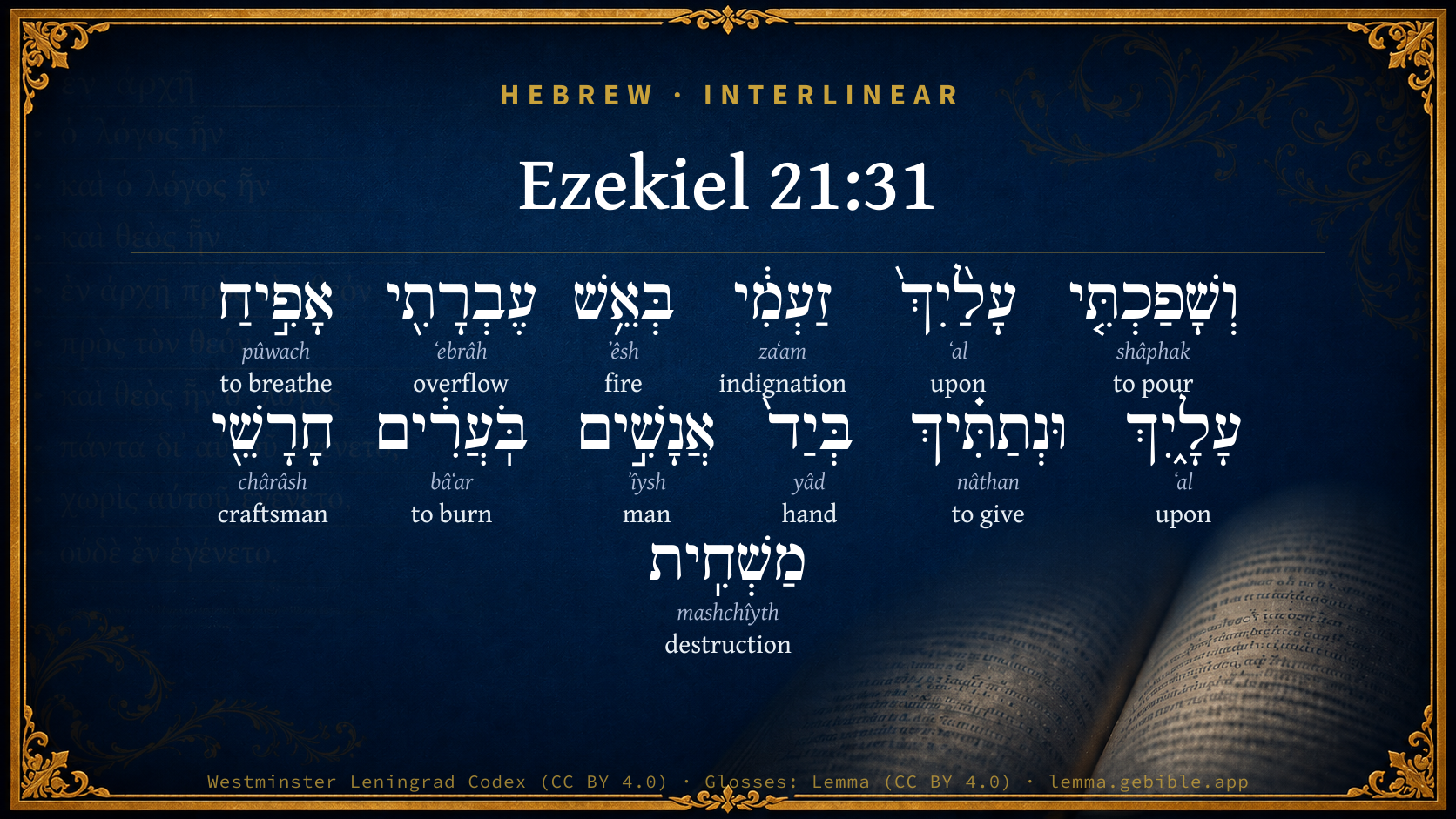
מַשְׁחִֽית
mashchîyth
H4889
“destruction”
Noun, Common, Masculine, Singular, Absolute
Part of Speech
Noun
Type
Common
Gender
Masculine
Number
Singular
State
Absolute
Full BDB Definition

Origin: from H7843

TWOT: 2370a

ruin, destruction
  1. וְשָׁפַכְתִּ֤י shâphak H8210 “and · to pour” Conjunction + Verb, Qal, Sequential Perfect, 1st Person, Common, Singular
  2. עָלַ֨יִךְ֙ ʻal H5921 “upon · you” Preposition + Suffix, Personal, 2nd Person, Feminine, Singular
  3. זַעְמִ֔י zaʻam H2195 “indignation · my” Noun, Common, Masculine, Singular, Construct + Suffix, Personal, 1st Person, Common, Singular
  4. בְּאֵ֥שׁ ʼêsh H784 “in/at · fire of” Preposition + Noun, Common, Both, Singular, Construct
  5. עֶבְרָתִ֖י ʻebrâh H5678 “overflow · my” Noun, Common, Feminine, Singular, Construct + Suffix, Personal, 1st Person, Common, Singular
  6. אָפִ֣יחַ pûwach H6315 “to breathe” Verb, Hiphil, Imperfect, 1st Person, Common, Singular
  7. עָלָ֑יִךְ ʻal H5921 “upon · you” Preposition + Suffix, Personal, 2nd Person, Feminine, Singular
  8. וּנְתַתִּ֗יךְ nâthan H5414 “and · to give · you” Conjunction + Verb, Qal, Sequential Perfect, 1st Person, Common, Singular + Suffix, Personal, 2nd Person, Feminine, Singular
  9. בְּיַד֙ yâd H3027 “in/at · hand of” Preposition + Noun, Common, Both, Singular, Construct
  10. אֲנָשִׁ֣ים ʼîysh H376 “men” Noun, Common, Masculine, Plural, Absolute
  11. בֹּֽעֲרִ֔ים bâʻar H1197 “burning” Verb, Qal, Participle Active, Masculine, Plural, Absolute
  12. חָרָשֵׁ֖י chârâsh H2796 “craftsmen of” Noun, Common, Masculine, Plural, Construct

About this verse

These counts appear in no published source. They are computed here, from the morphology-tagged text and Lemma’s own curated glosses. What Lemma adds →

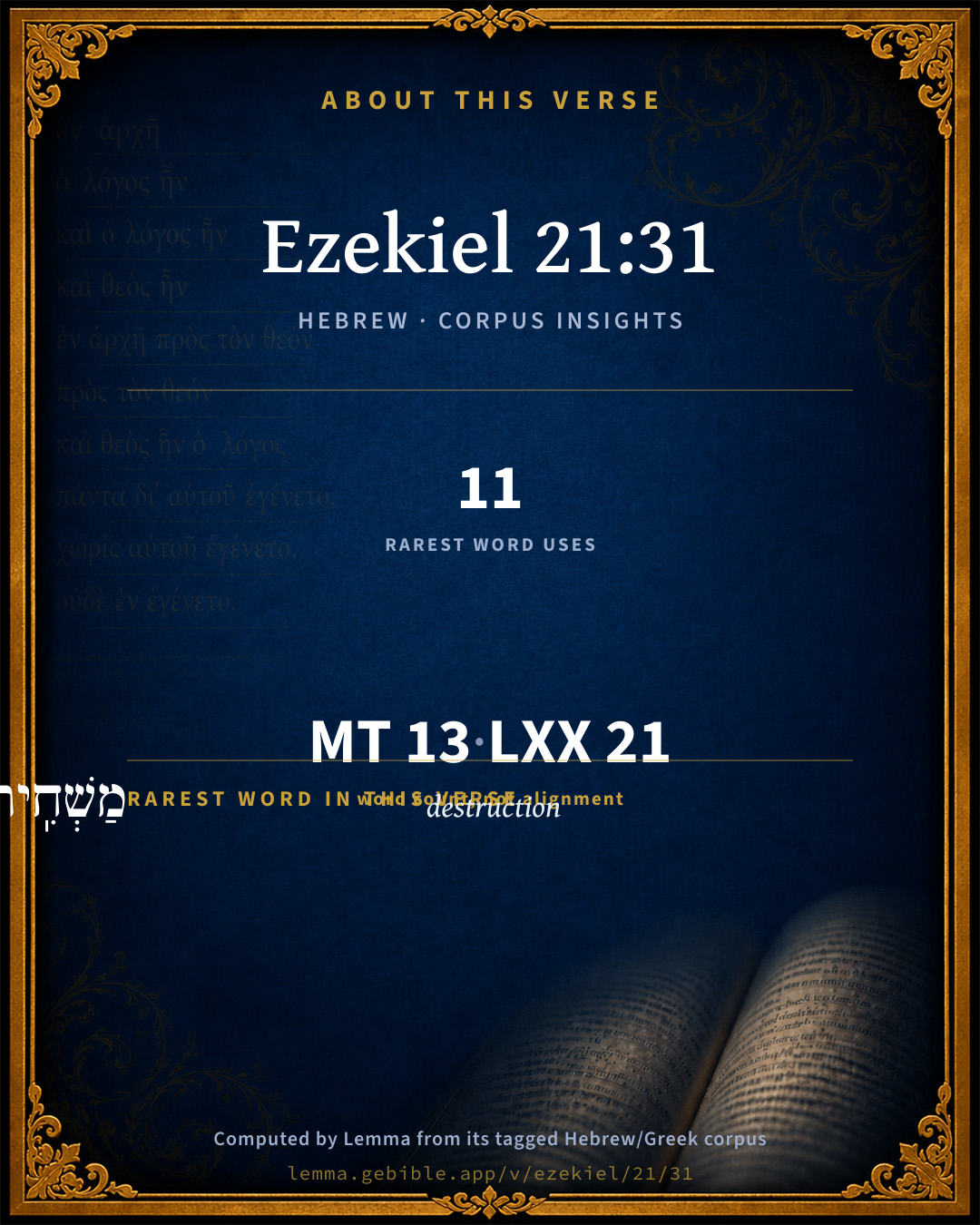
13
words
12
distinct lemmas
Prophets
section

Notable vocabulary

The rarest word here is מַשְׁחִֽית destruction H4889 — appearing just 11 times in the whole Hebrew Bible.

Shared distinctive vocabulary

מַשְׁחִֽית destruction H4889 occurs in 11 verses of the Hebrew Bible. Also found in:

Grammatical profile

  • 4 verbs
  • 7 nouns
  • 2 prepositions

Verb forms

  • וְשָׁפַכְתִּ֤י Qal · Sequential Perfect
  • אָפִ֣יחַ Hiphil · Imperfect
  • וּנְתַתִּ֗יךְ Qal · Sequential Perfect
  • בֹּֽעֲרִ֔ים Qal · Participle Active

Repetition

A word recurs within this verse — often emphatic in Hebrew:

  • עָלַ֨יִךְ֙ upon H5921 ×2

Hebrew & Septuagint length

In English translation the verse runs 33 words from the Hebrew and 34 from the Septuagint (LXX English) — closely comparable.

A rough comparison of the two English renderings, which tokenize alike — not a word-level alignment.

Word counts can differ between the Hebrew and the Greek without any difference in meaning — e.g. the Hebrew direct-object marker אֵת has no separate Greek word, and Greek often adds the article ὁ.

In the original languages it is 13 Hebrew tokens and 21 Greek tokens — but the two are counted differently (Hebrew bundles its prefixes and suffixes into one token; the Greek is in lemma form), so that isn’t a like-for-like length.

Cross-references

14

Topical passages linked to Ezekiel 21:31 in the Treasury of Scripture Knowledge — connected by theme and wording, ordered by reader-vote popularity; previews shown in the World English Bible.

  • Psalms 18:15 Then the channels of waters appeared, The foundations of the world were laid bare at your rebuke, Yahweh, At the blast of the breath of your nostrils.
  • Isaiah 30:33 For a Topheth is prepared of old; yes, for the king it is made ready; he has made it deep and large; the pile of it is fire and much wood; the breath of Yahweh, like a stream of sulfur, does kindle it.
  • Jeremiah 4:7 A lion is gone up from his thicket, and a destroyer of nations; he is on his way, he is gone forth from his place, to make your land desolate, that your cities be laid waste, without inhabitant.
  • Jeremiah 6:22–23 Thus says Yahweh, Behold, a people comes from the north country; and a great nation shall be stirred up from the uttermost parts of the earth.
  • Ezekiel 7:8 Now will I shortly pour out my wrath on you, and accomplish my anger against you, and will judge you according to your ways; and I will bring on you all your abominations.
  • Ezekiel 14:19 Or if I send a pestilence into that land, and pour out my wrath on it in blood, to cut off from it man and animal;
  • Nahum 1:6 Who can stand before his indignation? Who can endure the fierceness of his anger? His wrath is poured out like fire, and the rocks are broken apart by him.
  • Haggai 1:9 "You looked for much, and, behold, it came to little; and when you brought it home, I blew it away. Why?" says Yahweh of Hosts, "Because of my house that lies waste, while each of you is busy with his own house.
  • Isaiah 14:4–6 that you shall take up this parable against the king of Babylon, and say, How has the oppressor ceased! the golden city ceased!
  • Isaiah 37:7 Behold, I will put a spirit in him, and he shall hear news, and shall return to his own land; and I will cause him to fall by the sword in his own land.
  • Isaiah 40:7 The grass withers, the flower fades, because the breath of Yahweh blows on it; surely the people is grass.
  • Jeremiah 51:20–23 You are my battle-axe and weapons of war: and with you will I break in pieces the nations; and with you will I destroy kingdoms;
  • Ezekiel 22:20–22 As they gather silver and brass and iron and lead and tin into the midst of the furnace, to blow the fire on it, to melt it; so will I gather you in my anger and in my wrath, and I will lay you there, and melt you.
  • Habakkuk 1:6–10 For, behold, I raise up the Chaldeans, that bitter and hasty nation, that march through the breadth of the earth, to possess dwelling places that are not theirs.

Cross-references courtesy of OpenBible.info (CC BY 4.0).

Hebrew and Greek witnesses Masoretic Hebrew ↔ Greek Septuagint

The same verse in the two great witnesses to the Old Testament, shown verse-for-verse.

These are two independent witnesses, not word-aligned to each other, and the Septuagint is shown in lemma (dictionary) form.

Hebrew Ezekiel 21:31 Masoretic · Westminster Leningrad Codex

וְשָׁפַכְתִּ֤י עָלַ֨יִךְ֙ זַעְמִ֔י בְּאֵ֥שׁ עֶבְרָתִ֖י אָפִ֣יחַ עָלָ֑יִךְ וּנְתַתִּ֗יךְ בְּיַד֙ אֲנָשִׁ֣ים בֹּֽעֲרִ֔ים חָרָשֵׁ֖י מַשְׁחִֽית

I will pour out my indignation on you; I will blow on you with the fire of my wrath; and I will deliver you into the hand of brutish men, skillful to destroy.

World English Bible · Public Domain

Greek LXX Ezekiel 21:31 Septuagint · lemma form

ὅδε λέγω κύριος ἀποαἱρέω ὁ κίδαρις καί ἐπιτίθημι ὁ στέφανος οὗτος οὐ τοιοῦτος εἰμί ταπεινόω ὁ ὑψηλός καί ὁ ταπεινός ὑψόω

And I will pour out my wrath upon you, I will blow upon you with the fire of my wrath, and I will deliver you into the hands of barbarians skilled in working destruction.

LXX2012 (modern English Septuagint) · Public Domain

Hebrew: Westminster Leningrad Codex (CC BY 4.0). Greek: Septuagint (public domain); English from LXX2012 (modern English Septuagint) (Public Domain). How the Septuagint differs from the Hebrew →

Targum (Aramaic paraphrase)

1

The Targum is the ancient Jewish Aramaic paraphrase of the Hebrew Scriptures — an interpretive translation, not the Hebrew text itself. Onkelos (literal) and Pseudo-Jonathan (expansive) render the Torah, and Jonathan the Prophets. Coverage is partial: where no permissively-licensed English translation exists for a verse, only the Aramaic is shown. This is verse-level text, not a word-by-word alignment to the Hebrew.

  1. Targum Jonathan Prophets (Joshua–Malachi)
    כִּדְנַן אֲמַר יְיָ אֱלֹהִים אַעְדֵי מִצְנָפְתָּא מִשְׁרָיָה כַּהֲנָא רַבָּא וַאֲבַטֵיל כִּתְרָא מִצִדְקִיָה מַלְכָּא אֲמַר דֵין וְדֵין בְּאַתְרֵיהּ לָא יִתְקַיֵם מִגְלָא יִגְלוֹן גְדַלְיָה בַּר אֲחִיקָם דְלָא הֲוָה דִילֵיהּ יִסְבִינָהּ וְצִדְקִיָה דְדִילֵיהּ הִיא תַּעְדֵי מִנֵיהּ:

    (no public-domain English translation for this verse)

    Targum Jonathan — Aramaic: “Mikraot Gedolot” (public domain). English: “Sefaria Community Translation” (CC0 1.0 (public-domain dedication)); “London "Chaldee Paraphrase," 1871” (public domain). Text via Sefaria.

Commentary

Notes on Ezekiel 21:31 from classic Christian and Jewish commentators (each source and its license shown beneath its notes). The classic Christian expositions comment on the surrounding passage and are grouped to its opening verse, so a note may address several verses; the Jewish commentaries on the Tanakh (Rashi and others) are per-verse, so they appear only where the commentator wrote on this verse.

Lemma curates 59 commentaries, every one of them public domain or Creative Commons licensed, each selected and text-cleaned for this edition rather than reprinted as found. About our sources →

Trapp's Complete Commentary

John Trapp

Eze 21:31 And I will pour out mine indignation upon thee, I will blow against thee in the fire of my wrath, and deliver thee into the hand of brutish men, [and] skilful to destroy.

Ver. 31. Into the hand of brutish men.] Or, Of burning men, Ardelionum, artificum perditionis.

John Trapp, A Commentary or Exposition upon All the Books of the Old and New Testament (1647–1656) — public domain. Text from a community e-Sword module.

Jamieson, Fausset & Brown

Robert Jamieson, A. R. Fausset & David Brown

blow against thee in, &c.--rather, "blow upon thee with the fire," &c. Image from smelting metals (Eze 22:20-21).

brutish--ferocious.

skilful to destroy--literally, "artificers of destruction"; alluding to Isa 54:16.

Jamieson, Fausset & Brown — Commentary Critical and Explanatory on the Whole Bible (1871) — public domain (CC PDM 1.0). Text via the HelloAO Bible API.

Ellicott's Commentary for English Readers

(31) Mine indignation.—The figure of the sword, which has been kept up through the entire chapter, is here dropped; but the language immediately falls into another figure, already employed in Eze_20:47, “I will blow against thee in” (rather, with) “the fire of my wrath.” (Comp. the same expression in Eze_22:21.) The image is that of the consuming fire of God’s wrath blown by His power against Ammon, as fire is turned by the wind upon a forest to its destruction. (Comp. Isa_54:16.) The word “brutish” of the text in the last clause is better than the “burning” of the margin.

A Bible Commentary for English Readers, edited by Charles John Ellicott (1878–1897) — public domain. Text from a community e-Sword module.

The Cambridge Bible for Schools and Colleges

gen. ed. J. J. S. Perowne

31. brutish men] i.e. wild and savage men. So in Eze_25:4 it is the “men of the east,” the children of the desert, who are to execute the judgment on Ammon.

skilful to destroy] lit. the smiths or forgers of destruction. Ewald’s “smiths of hell,” i.e. demons who forge in hell, is fanciful.

The Cambridge Bible for Schools and Colleges (gen. ed. J. J. S. Perowne; Cambridge University Press, 1878–1918) — public domain. Text from a community e-Sword module.

Haydock's Catholic Bible Commentary

Brutish, or devoid of sense. (Haydock) --- Hebrew, "burning;" smiths. (Calmet)

George Leo Haydock (1774–1849), Haydock's Catholic Family Bible and Commentary, 1859 edition — public domain. Excludes Psalms (Douay-Rheims chapter numbering differs from Protestant) and Deuterocanonical books (Catholic canon only).

Matthew Poole's English Annotations

Pour out; as a flood sweeps all away, so God will let out his indignation to overwhelm the Ammonites.

I will blow against thee; as those who melt down metals blow upon the metal in the fire, that the fire might burn the fiercer, and consume the dross.

Deliver thee; or, as there is no hope to one delivered up to barbarous, merciless ruffians, whose trade is to destroy, so will God deal with these Ammonites.

Matthew Poole's English Annotations on the Holy Bible (1683–1685) — public domain. Text from a community e-Sword/MySword module.

The Pulpit Commentary

I will blow against, etc. The imagery of fire takes the place of that of the sword. The brutish men (same word as in Psa_49:10 Psa_92:6) are the Chaldean conquerors. The fact that the adjective may also mean "those that burn" may, in part, have determined Ezekiel"s choice of it.

The Pulpit Commentary (1880–1919), ed. H.D.M. Spence-Jones & Joseph S. Exell — public domain. Text from a community e-Sword module.

John Wesley's Explanatory Notes

I will blow - As those who melt down metals blow upon the metal in the fire, that the fire may burn the fiercer.

John Wesley, Explanatory Notes Upon the Whole Bible (1754–1765) — public domain. Text via the GEBible commentary corpus.

Rashi

Rabbi Shlomo Yitzchaki (Rashi)

I shall remove the turban and lift off the crown, etc. This is to be explained as the Targum renders: I shall remove the turban from Seraiah the High Priest, and I shall abolish the crown from King Zedekiah. He said: Neither this nor that will remain in its place.

the humble will be uplifted Gedaliah the son of Ahikam, to whom it did not belong, will take it, and Zedekiah, to whom it did belong it will be taken from him.

Rashi on the Tanakh — English translations: “The Judaica Press complete Tanach with Rashi, translated by A. J. Rosenberg” (CC BY 4.0); “Pentateuch with Rashi's commentary by M. Rosenbaum and A.M. Silbermann, 1929-1934” (public domain); “The Metsudah Tanach series, Lakewood, N.J” (CC BY 4.0); and “The Book of Joshua, Metsudah Publications, 1997” (CC BY 4.0). Text via Sefaria.

Lesson kit

Teaching starters — assembled from the data on this page, not authored interpretation. Every prompt links to the verse data it draws on. Edit before teaching.

Ezekiel, in the Prophets, opens this verse with 13 words (12 distinct Hebrew lemmas). Its most distinctive word is mashchîyth (“destruction”). A historical commentator’s framing appears above. Read the whole chapter for the surrounding context.

Discussion questions

  1. The word mashchîyth carries the sense “destruction.” How does it shape the verse?
  2. Exodus 12:13 shares the word «destruction» with this verse. How do the two illuminate each other?
  3. “upon” occurs 2× in this one verse. What is the effect of the repetition?
  4. These translations render this verse differently; the difference is in the English rendering, not the original. What questions does that raise?
  5. The verb «וְשָׁפַכְתִּ֤י» is Qal Sequential Perfect. How does its form color the action?
  6. Reading how Trapp's Complete Commentary and Jamieson, Fausset & Brown read this verse, where do the two commentators agree and where do they part?

Things to notice

Reading settings

Reading text

Shown beneath each verse's original-language words.

Old Testament
Old Testament edition

Read the OT as the Masoretic Hebrew (MT) or the Greek Septuagint (LXX).

English shown for the Greek Septuagint (in the Hebrew ↔ Greek comparison).

Comparing translations? Open the Compare panel on any verse page to stack up to four side by side.