

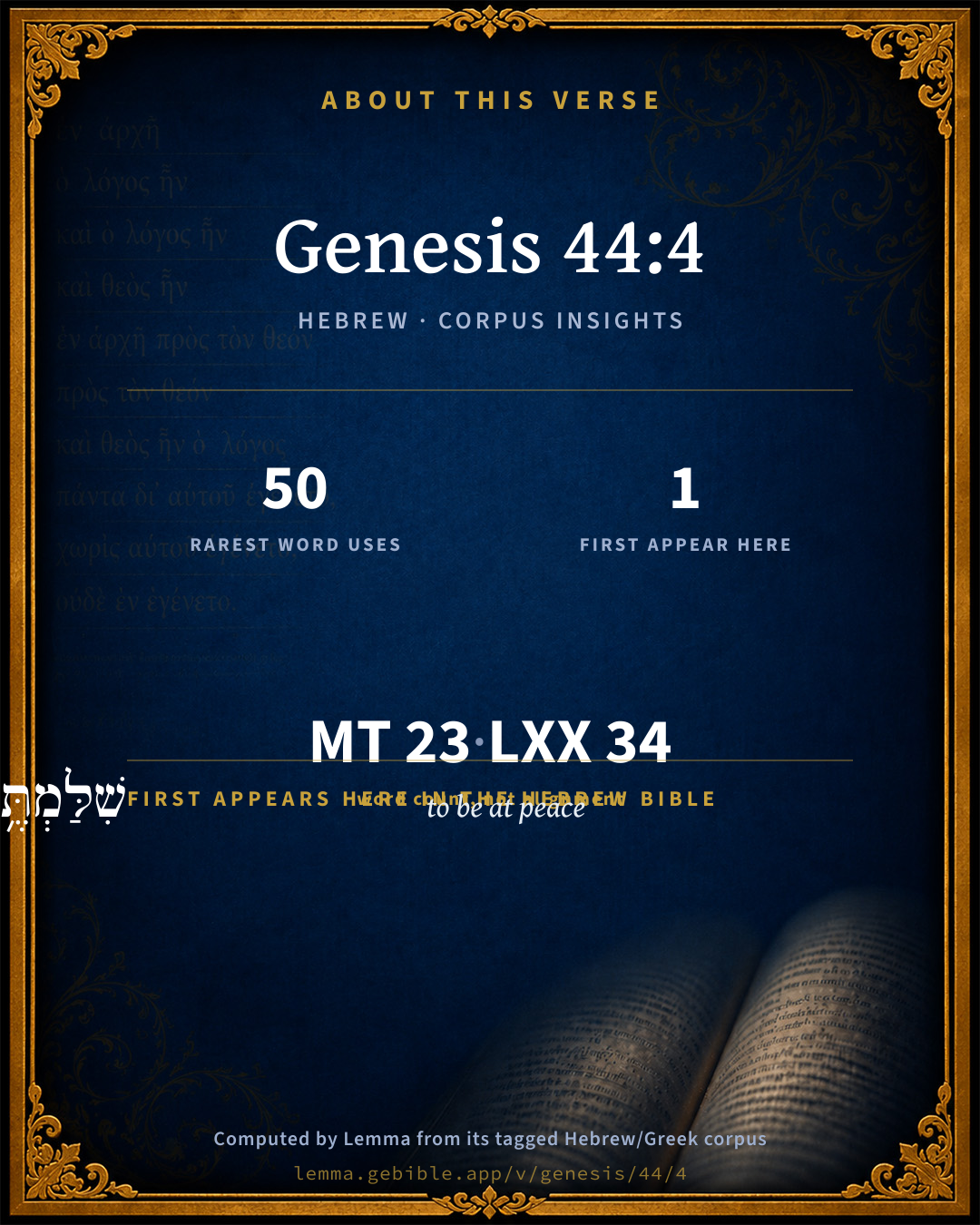
Genesis 44:4

Hebrew (Westminster Leningrad Codex) Genesis 44:4 appears in the Hebrew Old Testament. The text above is from the Westminster Leningrad Codex. Each word links to its Strong’s number, a concise gloss, and parsing drawn from the Open Scriptures Hebrew Bible morphology. Click any word for its full Brown-Driver-Briggs (BDB) entry.
Download image
Cite this verse

Genesis 44:4 (World English Bible). Public Domain. Lemma interlinear Bible study tool, https://lemma.gebible.app/v/genesis/44/4.

Show BibTeX & RIS
BibTeX
RIS
English Translation
When they had gone out of the city, and were not yet far off, Joseph said to his steward, "Up, follow after the men. When you overtake them, ask them, 'Why have you rewarded evil for good?
World English Bible · Public Domain
Highlights
  • 1 first appearance in the Hebrew Bible
Full analysis ↓
Download a study sheet

One document with this verse’s original text, its word-by-word gloss line, the meaning frame, cross-references with their text, attributed commentary, and full source and license credits — printable, and it pastes into notes with its structure intact.

This verse Autodidact and up

Study sheet (.html) Plain text (.txt)

A passage Seminary Student

Up to 50 verses in one chapter. A passage sheet keeps up to 6 commentary sources and 12 cross-references per verse, in the order this page ranks them, and says so on the sheet whenever that leaves anything out. Ask for a single verse and you get the Autodidact verse sheet above.

Everything on this page stays free to read, with no account — the sheet is a download of what is already on screen, not access to it.

Want to remove ads? Support Godless Engineer
Compare translations 3

The same verse in 3 English versions, stacked beneath the original-language interlinear above. Click any original word for its lexicon entry.

Each is an independent rendering of the whole verse — the interlinear is not word-aligned to these translations.

Highlighted words mark where these versions differ — a whole-verse word diff, not a word-by-word alignment.

  • World English Bible Public Domain
    When they had gone out of the city, and were not yet far off, Joseph said to his steward, "Up, follow after the men. When you overtake them, ask them, 'Why have you rewarded evil for good?
  • King James Version Public Domain
    And when they were gone out of the city, and not yet far off, Joseph said unto his steward, Up, follow after the men; and when thou dost overtake them, say unto them, Wherefore have ye rewarded evil for good?
  • unfoldingWord Literal Text CC BY-SA 4.0
    They had left the city, they had not gone far, and Joseph said to who over his house, “Get up, follow after the men, and you overtake them, then say to them, ‘Why have you repaid evil for good?

unfoldingWord Literal Text — © unfoldingWord, licensed CC BY-SA 4.0. Word-aligned USFM3 via Door43 (git.door43.org/unfoldingWord/en_ult).

Versions to compare (up to 4)

3 of 4 selected

Show all 18 translations

Every available English version of this verse, each an independent rendering of the whole verse.

  • World English Bible Public Domain
    When they had gone out of the city, and were not yet far off, Joseph said to his steward, "Up, follow after the men. When you overtake them, ask them, 'Why have you rewarded evil for good?
  • Berean Standard Bible Public Domain
    They had not gone far from the city when Joseph told his steward, “Pursue the men at once, and when you overtake them, ask, ‘Why have you repaid good with evil?
  • Majority Standard Bible Public Domain
    They had not gone far from the city when Joseph told his steward, “Pursue the men at once, and when you overtake them, ask, ‘Why have you repaid good with evil?
  • King James Version Public Domain
    And when they were gone out of the city, and not yet far off, Joseph said unto his steward, Up, follow after the men; and when thou dost overtake them, say unto them, Wherefore have ye rewarded evil for good?
  • American Standard Version (1901) Public Domain
    `And' when they were gone out of the city, and were not yet far off, Joseph said unto his steward, Up, follow after the men; and when thou dost overtake them, say unto them, Wherefore have ye rewarded evil for good?
  • Revised Version (1885) Public Domain
    And when they were gone out of the city, and were not yet far off, Joseph said unto his steward, Up, follow after the men; and when thou dost overtake them, say unto them, Wherefore have ye rewarded evil for good?
  • Geneva Bible (1599) Public Domain
    And when they went out of the citie not farre off, Ioseph sayd to his stewarde, Vp, follow after the men: and when thou doest ouertake them, say vnto them, Wherefore haue ye rewarded euill for good?
  • Douay-Rheims (1899) Public Domain
    And when they were now departed out of the city, and had gone forward a little way; Joseph sendingfor the steward of his house, said: Arise, and pursue after the men: and when thou hast overtaken them, say to them: Why have you returned evil for good?
  • Young's Literal Translation Public Domain
    they have gone out of the city -- they have not gone far off -- and Joseph hath said to him who `is' over his house, `Rise, pursue after the men; and thou hast overtaken them, and thou hast said unto them, Why have ye recompensed evil for good?
  • Literal Standard Version CC BY-SA 4.0
    they have gone out of the city—they have not gone far off—and Joseph has said to him who [is] over his house, “Rise, pursue after the men; and you have overtaken them, and you have said to them: Why have you repaid evil for good?
  • Unlocked Literal Bible CC BY-SA 4.0
    When they were out of the city but were not yet far off, Joseph said to his steward, “Get up, follow after the men, and when you overtake them, say to them, 'Why have you returned evil for good?
  • unfoldingWord Literal Text CC BY-SA 4.0
    They had left the city, they had not gone far, and Joseph said to who over his house, “Get up, follow after the men, and you overtake them, then say to them, ‘Why have you repaid evil for good?
  • Darby Bible Public Domain
    They were gone out of the city, [and] not [yet] far off, when Joseph said to him who was over his house, Up! follow after the men; and when thou overtakest them, thou shalt say to them, Why have ye rewarded evil for good?
  • World Messianic Bible Public Domain
    When they had gone out of the city, and were not yet far off, Joseph said to his steward, “Up, follow after the men. When you overtake them, ask them, ‘Why have you rewarded evil for good?
  • Webster's Bible Public Domain
    And when they had gone out of the city, and were not yet far off, Joseph said to his steward, Arise, follow after the men; and when thou dost overtake them, say to them, Why have ye rewarded evil for good?
  • Free Bible Version CC BY-SA 4.0
    They had hardly left the city when Joseph told his household supervisor, “Go after those men, and when you catch up with them, ask them, ‘Why have you paid back good with evil by stealing my master's silver cup?
  • Bible in Basic English Public Domain
    And when they had gone only a little way out of the town, Joseph said to the servant who was over his house, Go after them; and when you overtake them, say to them, Why have you done evil in reward for good?
  • JPS Tanakh (1917) Public Domain
    And when they were gone out of the city, and were not yet far off, Joseph said unto his steward: 'Up, follow after the men; and when thou dost overtake them, say unto them: Wherefore have ye rewarded evil for good?

Literal Standard Version (2020), Covenant Press — licensed CC BY-SA 4.0. Text via the HelloAO Bible API (eBible.org). Unlocked Literal Bible (unfoldingWord) — licensed CC BY-SA 4.0. Text via the HelloAO Bible API (eBible.org). unfoldingWord Literal Text — © unfoldingWord, licensed CC BY-SA 4.0. Word-aligned USFM3 via Door43 (git.door43.org/unfoldingWord/en_ult). Free Bible Version, Dr. Jonathan Gallagher — licensed CC BY-SA 4.0. Text via the HelloAO Bible API (eBible.org).

Word by word

More ways to search: Search by grammar → Find every occurrence → Compare this word →

Practice this passage: Drill this verse → Learn its vocabulary →

וְהִשַּׂגְתָּם֙
nâsag
H5381
“and · to overtake · them”
Conjunction + Verb, Hiphil, Sequential Perfect, 2nd Person, Masculine, Singular + Suffix, Personal, 3rd Person, Masculine, Plural
Part of Speech
Conjunction + Verb
Stem
Hiphil
Form
Sequential Perfect
Person
2nd Person
Gender
Masculine
Number
Singular
Full BDB Definition

Origin: a primitive root

TWOT: 1422

to reach, overtake, take hold upon - (Hiphil) - to overtake - to reach, attain to, cause to reach - to be able to secure, reach, have enough
  1. הֵ֠ם hêm H1992 “they” Pronoun, Personal, 3rd Person, Masculine, Plural
  2. יָֽצְא֣וּ yâtsâʼ H3318 “to go out” Verb, Qal, Perfect, 3rd Person, Common, Plural
  3. אֶת ʼêth H853 “-” Particle, Direct Object
  4. הָעִיר֮ ʻîyr H5892 “the · city” Particle, Definite Article + Noun, Common, Feminine, Singular, Absolute
  5. לֹ֣א lôʼ H3808 “not” Particle, Negative
  6. הִרְחִיקוּ֒ râchaq H7368 “to be far” Verb, Hiphil, Perfect, 3rd Person, Common, Plural
  7. וְיוֹסֵ֤ף Yôwçêph H3130 “and · Joseph” Conjunction + Noun, Proper
  8. אָמַר֙ ʼâmar H559 “to say” Verb, Qal, Perfect, 3rd Person, Masculine, Singular
  9. לַֽאֲשֶׁ֣ר ʼăsher H834 “to/for · which” Preposition + Particle, Relative
  10. עַל ʻal H5921 “upon” Preposition
  11. בֵּית֔וֹ bayith H1004 “house · his” Noun, Common, Masculine, Singular, Construct + Suffix, Personal, 3rd Person, Masculine, Singular
  12. ק֥וּם qûwm H6965 “rise” Verb, Qal, Imperative, 2nd Person, Masculine, Singular
  13. רְדֹ֖ף râdaph H7291 “pursue” Verb, Qal, Imperative, 2nd Person, Masculine, Singular
  14. אַחֲרֵ֣י ʼachar H310 “after” Preposition
  15. הָֽאֲנָשִׁ֑ים ʼîysh H376 “the · men” Particle, Definite Article + Noun, Common, Masculine, Plural, Absolute
  16. וְאָמַרְתָּ֣ ʼâmar H559 “and · to say” Conjunction + Verb, Qal, Sequential Perfect, 2nd Person, Masculine, Singular
  17. אֲלֵהֶ֔ם ʼêl H413 “to · them” Preposition + Suffix, Personal, 3rd Person, Masculine, Plural
  18. לָ֛מָּה mâh H4100 “to/for · what” Preposition + Particle, Interrogative
  19. שִׁלַּמְתֶּ֥ם shâlam H7999 “to be at peace” Verb, Piel, Perfect, 2nd Person, Masculine, Plural
  20. רָעָ֖ה raʻ H7451 “evil” Noun, Common, Feminine, Singular, Absolute
  21. תַּ֥חַת tachath H8478 “under” Preposition
  22. טוֹבָֽה ṭôwb H2896 “good” Adjective, Adjective, Feminine, Singular, Absolute

About this verse

These counts appear in no published source. They are computed here, from the morphology-tagged text and Lemma’s own curated glosses. What Lemma adds →

23
words
22
distinct lemmas
Pentateuch
section

First appearance in Scripture

This word makes its first canonical appearance in the Hebrew Bible here:

  • שִׁלַּמְתֶּ֥ם to be at peace H7999

Shared distinctive vocabulary

וְהִשַּׂגְתָּם֙ to overtake H5381 occurs in 47 verses of the Hebrew Bible. Also found in:

Grammatical profile

  • 8 verbs
  • 5 nouns
  • 1 adjective
  • 1 pronoun
  • 4 prepositions
  • 4 particles

Verb forms

  • יָֽצְא֣וּ Qal · Perfect
  • הִרְחִיקוּ֒ Hiphil · Perfect
  • אָמַר֙ Qal · Perfect
  • ק֥וּם Qal · Imperative
  • רְדֹ֖ף Qal · Imperative
  • וְהִשַּׂגְתָּם֙ Hiphil · Sequential Perfect
  • וְאָמַרְתָּ֣ Qal · Sequential Perfect
  • שִׁלַּמְתֶּ֥ם Piel · Perfect

Repetition

A word recurs within this verse — often emphatic in Hebrew:

  • אָמַר֙ to say H559 ×2

Hebrew & Septuagint length

In English translation the verse runs 37 words from the Hebrew and 42 from the Septuagint (LXX English) — closely comparable.

A rough comparison of the two English renderings, which tokenize alike — not a word-level alignment.

Word counts can differ between the Hebrew and the Greek without any difference in meaning — e.g. the Hebrew direct-object marker אֵת has no separate Greek word, and Greek often adds the article ὁ.

In the original languages it is 23 Hebrew tokens and 34 Greek tokens — but the two are counted differently (Hebrew bundles its prefixes and suffixes into one token; the Greek is in lemma form), so that isn’t a like-for-like length.

Cross-references

7

Topical passages linked to Genesis 44:4 in the Treasury of Scripture Knowledge — connected by theme and wording, ordered by reader-vote popularity; previews shown in the World English Bible.

  • John 10:32 Jesus answered them, "I have shown you many good works from my Father. For which of those works do you stone me?"
  • Psalms 35:12 They reward me evil for good, To the bereaving of my soul.
  • Deuteronomy 2:16 So it happened, when all the men of war were consumed and dead from among the people,
  • 1 Samuel 24:17 He said to David, You are more righteous than I; for you have rendered to me good, whereas I have rendered to you evil.
  • Psalms 109:5 They have rewarded me evil for good, And hatred for my love.
  • Proverbs 17:13 Whoever rewards evil for good, Evil shall not depart from his house.
  • 2 Chronicles 20:11 behold, how they reward us, to come to cast us out of your possession, which you have given us to inherit.

Cross-references courtesy of OpenBible.info (CC BY 4.0).

Hebrew and Greek witnesses Masoretic Hebrew ↔ Greek Septuagint

The same verse in the two great witnesses to the Old Testament, shown verse-for-verse.

These are two independent witnesses, not word-aligned to each other, and the Septuagint is shown in lemma (dictionary) form.

Hebrew Genesis 44:4 Masoretic · Westminster Leningrad Codex

הֵ֠ם יָֽצְא֣וּ אֶת הָעִיר֮ לֹ֣א הִרְחִיקוּ֒ וְיוֹסֵ֤ף אָמַר֙ לַֽאֲשֶׁ֣ר עַל בֵּית֔וֹ ק֥וּם רְדֹ֖ף אַחֲרֵ֣י הָֽאֲנָשִׁ֑ים וְהִשַּׂגְתָּם֙ וְאָמַרְתָּ֣ אֲלֵהֶ֔ם לָ֛מָּה שִׁלַּמְתֶּ֥ם רָעָ֖ה תַּ֥חַת טוֹבָֽה

When they had gone out of the city, and were not yet far off, Joseph said to his steward, "Up, follow after the men. When you overtake them, ask them, 'Why have you rewarded evil for good?

World English Bible · Public Domain

Greek LXX Genesis 44:4 Septuagint · lemma form

ἐκἔρχομαι δέ αὐτός ὁ πόλις οὐ ἀποἔχω μακράν καί ιωσηφ εἶπον ὁ ἐπί ὁ οἰκία αὐτός ἀναἵστημι ἐπιδιώκω ὀπίσω ὁ ἄνθρωπος καί καταλαμβάνω αὐτός καί εἶπον αὐτός τίς ὅτι ἀντι ἀποδίδωμι πονηρός ἀντί καλός

And when they had gone out of the city, and were not far off, then Joseph said to his steward, Arise, and pursue after the men; and you shall overtake them, and say to them, Why have you⌃ returned evil for good?

LXX2012 (modern English Septuagint) · Public Domain

On this verse, The Cambridge Bible for Schools and Colleges discusses the Septuagint’s reading. Read the note in Commentary ↓

Hebrew: Westminster Leningrad Codex (CC BY 4.0). Greek: Septuagint (public domain); English from LXX2012 (modern English Septuagint) (Public Domain). How the Septuagint differs from the Hebrew →

Targum (Aramaic paraphrase)

2

The Targum is the ancient Jewish Aramaic paraphrase of the Hebrew Scriptures — an interpretive translation, not the Hebrew text itself. Onkelos (literal) and Pseudo-Jonathan (expansive) render the Torah, and Jonathan the Prophets. Coverage is partial: where no permissively-licensed English translation exists for a verse, only the Aramaic is shown. This is verse-level text, not a word-by-word alignment to the Hebrew.

  1. Targum Onkelos Torah (Genesis–Deuteronomy)
    אִנּוּן נְפָקוּ מִן קַרְתָּא לָא אַרְחִיקוּ וְיוֹסֵף אֲמַר לְדִי מְמַנָּא עַל בֵּיתֵהּ קוּם רְדַף בָּתַר גֻּבְרַיָּא וְתַדְבְּקִנּוּן וְתֵימַר לְהוֹן לְמָה שַׁלֶמְתּוּן בִּישָׁא חֳלָף טַבְתָא

    (no public-domain English translation for this verse)

    Targum Onkelos — Aramaic: “Onkelos Genesis” (public domain); “Onkelos Exodus” (public domain); “Onkelos Leviticus” (public domain); “Onkelos Numbers” (public domain); “Onkelos Deuteronomy” (public domain). English: “Sefaria Community Translation” (CC0 1.0 (public-domain dedication)); “J.W. Etheridge. The Targums of Onkelos and Jonathan Ben Uzziel on the Pentateuch. London: Longmans, Green, 1862” (public domain). Text via Sefaria.

  2. Targum Pseudo-Jonathan Torah (Genesis–Deuteronomy)
    הִינוּן נְפָקוּ מִן קַרְתָּא לָא אַרְחִיקוּ וְיוֹסֵף אָמַר לִמְנַשֶׁה דִי מְמַנָא אַפִּיטְרוֹפּוֹס עַל בֵּיתֵיהּ קוּם רְדַף בָּתַר גוּבְרַיָא וְתַדְבִּיקִינוּן וְתֵמַר לְהוֹם לְמָה שְׁלֵימְתּוּן בִּישְׁתָּא חוֹלַף טַבְתָא

    They had not gone far from city, when Joseph said to Measheh whom he had appointed the intendant of his house, Arise, follow after the men, overtake them and say to them, Why have ye returned evil for good?

    Targum Pseudo-Jonathan — Aramaic: “Targum Jonathan on Genesis” (public domain); “Targum Jonathan on Exodus” (public domain); “Targum Jonathan on Leviticus” (public domain); “Targum Jonathan on Numbers” (public domain); “Targum Jonathan on Deuteronomy” (public domain). English: “The Targum of Jonathan ben Uzziel, trans. J. W. Etheridge, London, 1862” (public domain). Text via Sefaria.

Commentary

Notes on Genesis 44:4 from classic Christian and Jewish commentators (each source and its license shown beneath its notes). The classic Christian expositions comment on the surrounding passage and are grouped to its opening verse, so a note may address several verses; the Jewish commentaries on the Tanakh (Rashi and others) are per-verse, so they appear only where the commentator wrote on this verse.

Lemma curates 59 commentaries, every one of them public domain or Creative Commons licensed, each selected and text-cleaned for this edition rather than reprinted as found. About our sources →

The Cambridge Bible for Schools and Colleges

gen. ed. J. J. S. Perowne

4. the city] The name of the city is most unfortunately not given. Memphis would be suitable: cf. Gen_45:10. The moment of the men’s arrest is well timed. Everything had gone off well. They had got their corn; they had been acquitted of any complicity in the return of the money; they had been hospitably treated by the “lord”; they were well on their way homeward.

Wherefore have ye rewarded] The guilt of Joseph’s brethren is presented in an ascending scale of enormity: (1) it was theft; (2) by guests from their host’s table; (3) of an article of special sanctity. The LXX, in order to supply the connexion between Gen_44:4-5, inserts at the end of Gen_44:4, Ἵνα τί ἐκλέψατέ μου τὸ κόνδυ τὸ ἀργυροῦν; = “Wherefore have ye stolen my silver cup?”

The Cambridge Bible for Schools and Colleges (gen. ed. J. J. S. Perowne; Cambridge University Press, 1878–1918) — public domain. Text from a community e-Sword module.

Trapp's Complete Commentary

John Trapp

Gen 44:4 [And] when they were gone out of the city, [and] not [yet] far off, Joseph said unto his steward, Up, follow after the men; and when thou dost overtake them, say unto them, Wherefore have ye rewarded evil for good?

Ver. 4. Wherefore have ye rewarded evil for good?] This, blind nature saw to be the sum of all sins. Ingratum dixeris, omnia dixeris. Some vices are such as nature smiles upon, though frowned at by divine justice; not so this. Hercules is much condemned by the heathens for killing his schoolmaster Linus; Alexander, for doing the like by his friend Clitus; Nero, by his tutor Seneca: Muleasses, king of Tunis, is cried out on, for torturing to death the Manifet and Mesnar, by whose means especially he had aspired to the kingdom. {a} Philip, king of Macedonia, caused a soldier of his, that had offered unkindness to one that had kindly entertained him, to be branded in the forehead, with these two words; Hospes ingratus. Unthankfulness is a monster in nature, a solecism in manners, a paradox in divinity, a parching wind to dry up the fountain of further favour. Benjamin’s five fold mess was no small aggravation to the theft here laid to his charge. {b}

{a} Turk. Hist., fol. 642.

{b} Manlii, loc. com.

John Trapp, A Commentary or Exposition upon All the Books of the Old and New Testament (1647–1656) — public domain. Text from a community e-Sword module.

Jamieson, Fausset & Brown

Robert Jamieson, A. R. Fausset & David Brown

When they were gone out of the city . . . Joseph said unto his steward--They were brought to a sudden halt by the stunning intelligence that an article of rare value was missing from the governor's house. It was a silver cup; so strong suspicions were entertained against them that a special messenger was despatched to search them.

Jamieson, Fausset & Brown — Commentary Critical and Explanatory on the Whole Bible (1871) — public domain (CC PDM 1.0). Text via the HelloAO Bible API.

John Gill's Exposition

And when they were gone out of the city, and not yet far off,.... Which perhaps was Tanis, the Zoan of the Scriptures; see Eze 30:14, margin:

Joseph said unto his steward, up, follow after the men; who no doubt was ready provided with men and horses, to go out and pursue when Joseph should give the orders, he being privy to Joseph's intentions, and with whom the scheme was concerted, and the secret was. Joseph appears to have been up very early this morning, and had observed the exact time of his brethren's departure, and guessed whereabouts they might be when he sent his steward, and others after them; for it can hardly be thought he was sent alone after eleven men, and to charge them with a theft, and bring them back again:

and when thou dost overtake them, say unto them, wherefore have ye rewarded evil for good? in taking away the silver cup, when they had been so kindly and bountifully entertained. This he was to represent as base ingratitude, as it would have appeared, had it been fact. In much such manner was Esop used by the inhabitants of Delphos; they, being displeased with him, put a sacred cup or vial into his bags, which he, being ignorant of, went on his way towards Phocis; and they ran after him, and seized him, and charged him with sacrilege (h).

(h) Scholia ad Vespes Aristophanis, p. 534. Ed. Genev. 1607.

John Gill's Exposition of the Whole Bible (1746–1763) — public domain (CC PDM 1.0). Text via the HelloAO Bible API.

Haydock's Catholic Bible Commentary

Pursue; escorted by a troop of horsemen, to prevent resistance. (Menochius)

George Leo Haydock (1774–1849), Haydock's Catholic Family Bible and Commentary, 1859 edition — public domain. Excludes Psalms (Douay-Rheims chapter numbering differs from Protestant) and Deuterocanonical books (Catholic canon only).

Radak

Rabbi David Kimhi (Radak)

הם יצאו את העיר, the word את in this verse means “from.” A similar construction is found in Exodus 9,29 כצאתי את העיר, “when I leave the boundaries of the city.”

הרחיקו, a verb in the intransitive mode. A similar construction of the same verb occurs in Judges 18,22 המה הרחיקו מבית מיכה, “they had traveled a certain distance from the house of Micah.”

והשגתם, hurry in order that you catch up with them.

Radak on the Tanakh — English translations: “Sefaria Community Translation” (CC0 1.0 (public-domain dedication)); “Eliyahu Munk, HaChut Hameshulash” (CC BY 4.0); “Rabbi Mike Feuer, Jerusalem Anthology” (CC BY 4.0); and “R. David Kimhi on the first book of Psalms, Translated by R.G. Finch, London, 1919” (public domain). Text via Sefaria.

Lesson kit

Teaching starters — assembled from the data on this page, not authored interpretation. Every prompt links to the verse data it draws on. Edit before teaching.

Genesis, in the Pentateuch, opens this verse with 23 words (22 distinct Hebrew lemmas). Its most distinctive word is nâsag (“to overtake”). A historical commentator’s framing appears above. Read the whole chapter for the surrounding context.

Discussion questions

  1. How does “to overtake” (nâsag) shape what this verse is saying?
  2. The word “to be at peace” first appears here in Scripture. What is being introduced at this debut?
  3. Genesis 31:25 shares the word «to overtake» with this verse. How do the two illuminate each other?
  4. “to say” occurs 2× in this one verse. What is the effect of the repetition?
  5. These translations render this verse differently; the difference is in the English rendering, not the original. What questions does that raise?
  6. The verb «יָֽצְא֣וּ» is Qal Perfect. How does its form color the action?
  7. Reading how The Cambridge Bible for Schools and Colleges and Trapp's Complete Commentary read this verse, where do the two commentators agree and where do they part?

Things to notice

Reading settings

Reading text

Shown beneath each verse's original-language words.

Old Testament
Old Testament edition

Read the OT as the Masoretic Hebrew (MT) or the Greek Septuagint (LXX).

English shown for the Greek Septuagint (in the Hebrew ↔ Greek comparison).

Comparing translations? Open the Compare panel on any verse page to stack up to four side by side.