
Genesis 41:33

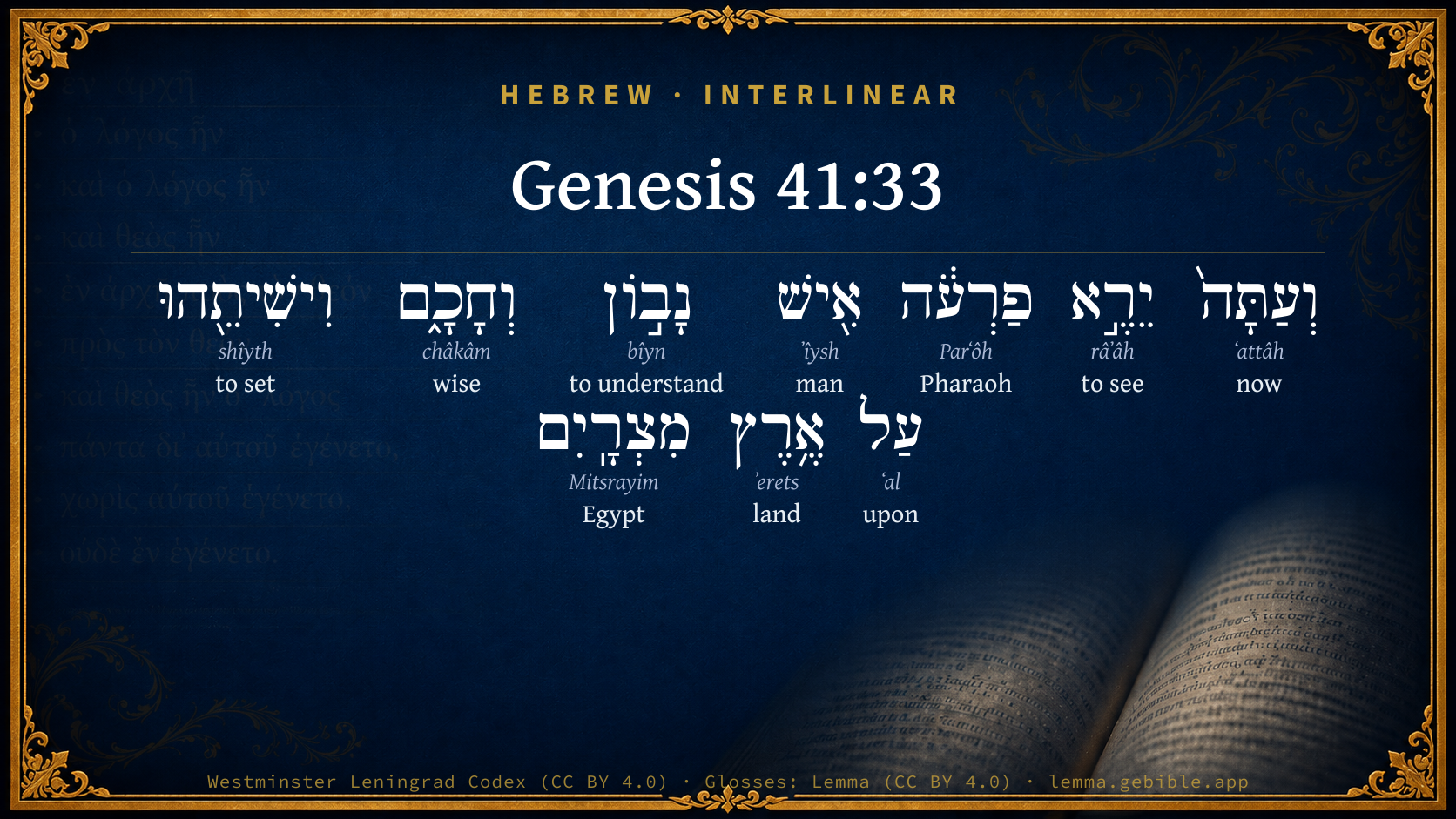
Hebrew (Westminster Leningrad Codex) Genesis 41:33 appears in the Hebrew Old Testament. The text above is from the Westminster Leningrad Codex. Each word links to its Strong’s number, a concise gloss, and parsing drawn from the Open Scriptures Hebrew Bible morphology. Click any word for its full Brown-Driver-Briggs (BDB) entry.
Download image
Cite this verse

Genesis 41:33 (World English Bible). Public Domain. Lemma interlinear Bible study tool, https://lemma.gebible.app/v/genesis/41/33.

Show BibTeX & RIS
BibTeX
RIS
English Translation
Now therefore let Pharaoh look for a discreet and wise man, and set him over the land of Egypt.
World English Bible · Public Domain
Highlights
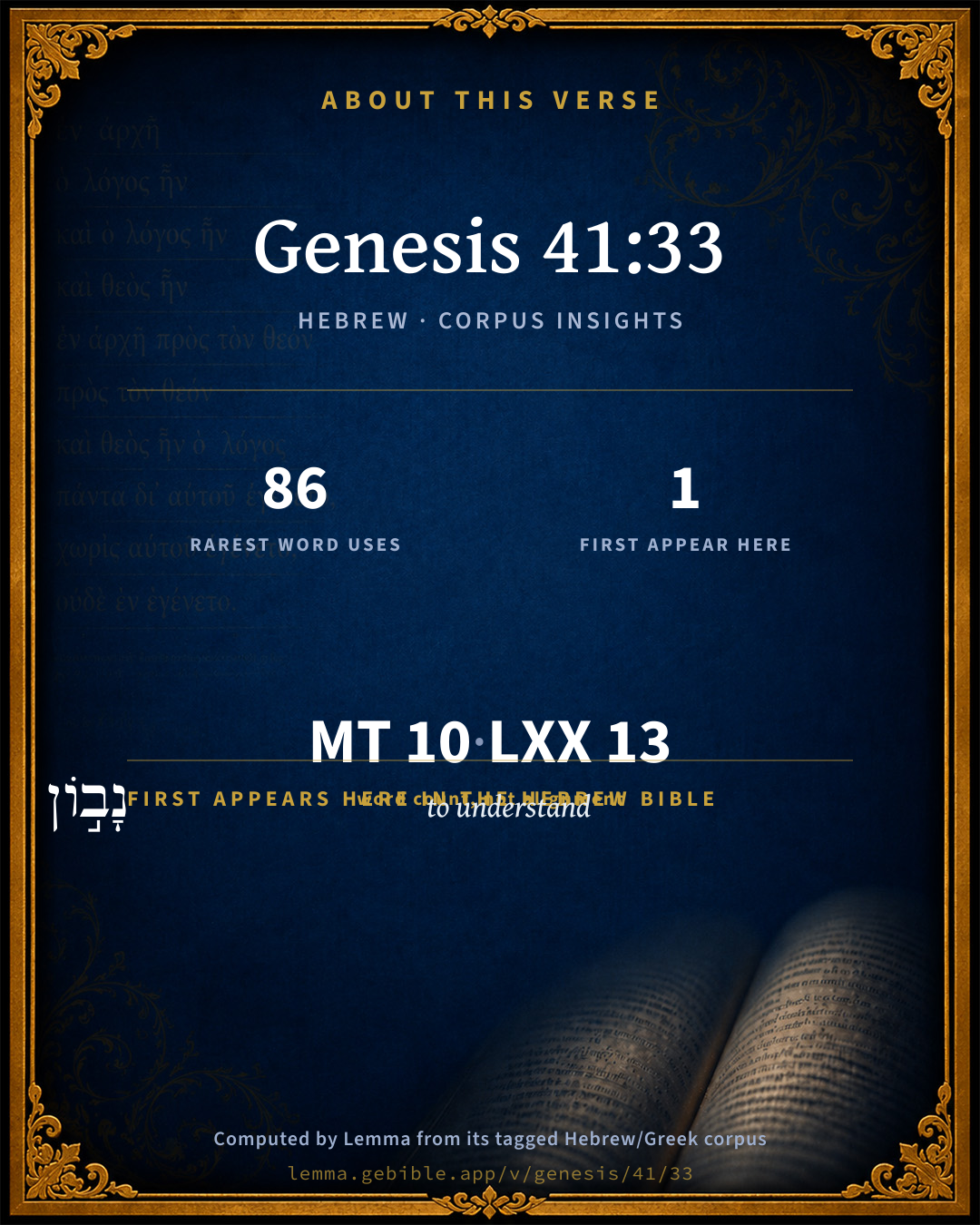
  • 1 first appearance in the Hebrew Bible
Full analysis ↓
Download a study sheet

One document with this verse’s original text, its word-by-word gloss line, the meaning frame, cross-references with their text, attributed commentary, and full source and license credits — printable, and it pastes into notes with its structure intact.

This verse Autodidact and up

Study sheet (.html) Plain text (.txt)

A passage Seminary Student

Up to 50 verses in one chapter. A passage sheet keeps up to 6 commentary sources and 12 cross-references per verse, in the order this page ranks them, and says so on the sheet whenever that leaves anything out. Ask for a single verse and you get the Autodidact verse sheet above.

Everything on this page stays free to read, with no account — the sheet is a download of what is already on screen, not access to it.

Want to remove ads? Support Godless Engineer
Compare translations 3

The same verse in 3 English versions, stacked beneath the original-language interlinear above. Click any original word for its lexicon entry.

Each is an independent rendering of the whole verse — the interlinear is not word-aligned to these translations.

Highlighted words mark where these versions differ — a whole-verse word diff, not a word-by-word alignment.

  • World English Bible Public Domain
    Now therefore let Pharaoh look for a discreet and wise man, and set him over the land of Egypt.
  • King James Version Public Domain
    Now therefore let Pharaoh look out a man discreet and wise, and set him over the land of Egypt.
  • unfoldingWord Literal Text CC BY-SA 4.0
    And now let Pharaoh seek a man discerning and wise, and set him over the land of Egypt.

unfoldingWord Literal Text — © unfoldingWord, licensed CC BY-SA 4.0. Word-aligned USFM3 via Door43 (git.door43.org/unfoldingWord/en_ult).

Versions to compare (up to 4)

3 of 4 selected

Show all 18 translations

Every available English version of this verse, each an independent rendering of the whole verse.

  • World English Bible Public Domain
    Now therefore let Pharaoh look for a discreet and wise man, and set him over the land of Egypt.
  • Berean Standard Bible Public Domain
    Now, therefore, Pharaoh should look for a discerning and wise man and set him over the land of Egypt.
  • Majority Standard Bible Public Domain
    Now, therefore, Pharaoh should look for a discerning and wise man and set him over the land of Egypt.
  • King James Version Public Domain
    Now therefore let Pharaoh look out a man discreet and wise, and set him over the land of Egypt.
  • American Standard Version (1901) Public Domain
    Now therefore let Pharaoh look out a man discreet and wise, and set him over the land of Egypt.
  • Revised Version (1885) Public Domain
    Now therefore let Pharaoh look out a man discreet and wise, and set him over the land of Egypt.
  • Geneva Bible (1599) Public Domain
    Nowe therefore let Pharaoh prouide for a man of vnderstanding and wisedome, and set him ouer the land of Egypt.
  • Douay-Rheims (1899) Public Domain
    And the greatness of the scarcity shall destroy the greatness of the plenty.
  • Young's Literal Translation Public Domain
    `And now, let Pharaoh provide a man, intelligent and wise, and set him over the land of Egypt;
  • Literal Standard Version CC BY-SA 4.0
    And now, let Pharaoh provide a man, intelligent and wise, and set him over the land of Egypt;
  • Unlocked Literal Bible CC BY-SA 4.0
    Now let Pharaoh look for a man discerning and wise, and put him over the land of Egypt.
  • unfoldingWord Literal Text CC BY-SA 4.0
    And now let Pharaoh seek a man discerning and wise, and set him over the land of Egypt.
  • Darby Bible Public Domain
    And now let Pharaoh look himself out a man discreet and wise, and set him over the land of Egypt.
  • World Messianic Bible Public Domain
    “Now therefore let Pharaoh look for a discreet and wise man, and set him over the land of Egypt.
  • Webster's Bible Public Domain
    Now therefore let Pharaoh look out a man discreet and wise, and set him over the land of Egypt.
  • Free Bible Version CC BY-SA 4.0
    So Your Majesty should choose a man with insight and wisdom, and put him in charge of the whole country of Egypt.
  • Bible in Basic English Public Domain
    And now let Pharaoh make search for a man of wisdom and good sense, and put him in authority over the land of Egypt.
  • JPS Tanakh (1917) Public Domain
    Now therefore let Pharaoh look out a man discreet and wise, and set him over the land of Egypt.

Literal Standard Version (2020), Covenant Press — licensed CC BY-SA 4.0. Text via the HelloAO Bible API (eBible.org). Unlocked Literal Bible (unfoldingWord) — licensed CC BY-SA 4.0. Text via the HelloAO Bible API (eBible.org). unfoldingWord Literal Text — © unfoldingWord, licensed CC BY-SA 4.0. Word-aligned USFM3 via Door43 (git.door43.org/unfoldingWord/en_ult). Free Bible Version, Dr. Jonathan Gallagher — licensed CC BY-SA 4.0. Text via the HelloAO Bible API (eBible.org).

Word by word

More ways to search: Search by grammar → Find every occurrence → Compare this word →

Practice this passage: Drill this verse → Learn its vocabulary →

וִישִׁיתֵ֖הוּ
shîyth
H7896
“and · to set · him”
Conjunction + Verb, Qal, Jussive, 3rd Person, Masculine, Singular + Suffix, Personal, 3rd Person, Masculine, Singular
Part of Speech
Conjunction + Verb
Stem
Qal
Form
Jussive
Person
3rd Person
Gender
Masculine
Number
Singular
Full BDB Definition

Origin: a primitive root

TWOT: 2380

to put, set - (Qal) - to put, lay (hand upon) - to set, station, appoint, fix, set mind to - to constitute, make (one something), make like, perform - to take one's stand - to lay waste - (Hophal) to be imposed, be set upon
  1. וְעַתָּה֙ ʻattâh H6258 “and · now” Conjunction + Adverb
  2. יֵרֶ֣א râʼâh H7200 “to see” Verb, Qal, Jussive, 3rd Person, Masculine, Singular
  3. פַרְעֹ֔ה Parʻôh H6547 “Pharaoh” Noun, Proper
  4. אִ֖ישׁ ʼîysh H376 “man” Noun, Common, Masculine, Singular, Absolute
  5. נָב֣וֹן bîyn H995 “understanding” Verb, Niphal, Participle Active, Masculine, Singular, Absolute
  6. וְחָכָ֑ם châkâm H2450 “and · wise” Conjunction + Adjective, Adjective, Masculine, Singular, Absolute
  7. עַל ʻal H5921 “upon” Preposition
  8. אֶ֥רֶץ ʼerets H776 “land of” Noun, Common, Both, Singular, Construct
  9. מִצְרָֽיִם Mitsrayim H4714 “Egypt” Noun, Proper

About this verse

These counts appear in no published source. They are computed here, from the morphology-tagged text and Lemma’s own curated glosses. What Lemma adds →

10
words
10
distinct lemmas
Pentateuch
section

First appearance in Scripture

This word makes its first canonical appearance in the Hebrew Bible here:

  • נָב֣וֹן to understand H995

Grammatical profile

  • 3 verbs
  • 4 nouns
  • 1 adjective
  • 1 preposition
  • 1 adverb

Verb forms

  • יֵרֶ֣א Qal · Jussive
  • נָב֣וֹן Niphal · Participle Active
  • וִישִׁיתֵ֖הוּ Qal · Jussive

Hebrew & Septuagint length

In English translation the verse runs 19 words from the Hebrew and 17 from the Septuagint (LXX English) — closely comparable.

A rough comparison of the two English renderings, which tokenize alike — not a word-level alignment.

Word counts can differ between the Hebrew and the Greek without any difference in meaning — e.g. the Hebrew direct-object marker אֵת has no separate Greek word, and Greek often adds the article ὁ.

In the original languages it is 10 Hebrew tokens and 13 Greek tokens — but the two are counted differently (Hebrew bundles its prefixes and suffixes into one token; the Greek is in lemma form), so that isn’t a like-for-like length.

Cross-references

5

Topical passages linked to Genesis 41:33 in the Treasury of Scripture Knowledge — connected by theme and wording, ordered by reader-vote popularity; previews shown in the World English Bible.

  • Genesis 41:39 Pharaoh said to Joseph, "Because God has shown you all of this, there is none so discreet and wise as you.
  • Acts 6:3 Therefore select from among you, brothers, seven men of good report, full of the Holy Spirit and of wisdom, whom we may appoint over this business.
  • Deuteronomy 1:13 Take wise men of understanding and well known according to your tribes, and I will make them heads over you.
  • Daniel 4:27 Therefore, O king, let my counsel be acceptable to you, and break off your sins by righteousness, and your iniquities by showing mercy to the poor; if there may be a lengthening of your tranquillity.
  • Exodus 18:19–22 Listen now to my voice. I will give you counsel, and God be with you. You represent the people before God, and bring the causes to God.

Cross-references courtesy of OpenBible.info (CC BY 4.0).

Hebrew and Greek witnesses Masoretic Hebrew ↔ Greek Septuagint

The same verse in the two great witnesses to the Old Testament, shown verse-for-verse.

These are two independent witnesses, not word-aligned to each other, and the Septuagint is shown in lemma (dictionary) form.

Hebrew Genesis 41:33 Masoretic · Westminster Leningrad Codex

וְעַתָּה֙ יֵרֶ֣א פַרְעֹ֔ה אִ֖ישׁ נָב֣וֹן וְחָכָ֑ם וִישִׁיתֵ֖הוּ עַל אֶ֥רֶץ מִצְרָֽיִם

Now therefore let Pharaoh look for a discreet and wise man, and set him over the land of Egypt.

World English Bible · Public Domain

Greek LXX Genesis 41:33 Septuagint · lemma form

νῦν οὖν σκέπτομαι ἄνθρωπος φρόνιμος καί συνετός καί καταἵστημι αὐτός ἐπί γῆ αἴγυπτος

Now then, look out a wise and prudent man, and set him over the land of Egypt.

LXX2012 (modern English Septuagint) · Public Domain

On this verse, The Pulpit Commentary discusses the Septuagint’s reading. Read the note in Commentary ↓

Hebrew: Westminster Leningrad Codex (CC BY 4.0). Greek: Septuagint (public domain); English from LXX2012 (modern English Septuagint) (Public Domain). How the Septuagint differs from the Hebrew →

Targum (Aramaic paraphrase)

2

The Targum is the ancient Jewish Aramaic paraphrase of the Hebrew Scriptures — an interpretive translation, not the Hebrew text itself. Onkelos (literal) and Pseudo-Jonathan (expansive) render the Torah, and Jonathan the Prophets. Coverage is partial: where no permissively-licensed English translation exists for a verse, only the Aramaic is shown. This is verse-level text, not a word-by-word alignment to the Hebrew.

  1. Targum Onkelos Torah (Genesis–Deuteronomy)
    וּכְעַן יֶחֱזֵי פַרְעֹה גְּבַר סוּכְלְתָן וְחַכִּים וִימַנִינֵיהּ עַל אַרְעָא דְמִצְרָיִם

    (no public-domain English translation for this verse)

    Targum Onkelos — Aramaic: “Onkelos Genesis” (public domain); “Onkelos Exodus” (public domain); “Onkelos Leviticus” (public domain); “Onkelos Numbers” (public domain); “Onkelos Deuteronomy” (public domain). English: “Sefaria Community Translation” (CC0 1.0 (public-domain dedication)); “J.W. Etheridge. The Targums of Onkelos and Jonathan Ben Uzziel on the Pentateuch. London: Longmans, Green, 1862” (public domain). Text via Sefaria.

  2. Targum Pseudo-Jonathan Torah (Genesis–Deuteronomy)
    וּכְדוּן יֶחְמֵי פַּרְעה גְבַר סוּכְלְתָן וְחַכִּים וְיִמְנִינֵיהּ עַל אַרְעָא דְמִצְרָיִם

    But now let Pharoh look out a man prudent and wise, and appoint him over the land of Mizraim.

    Targum Pseudo-Jonathan — Aramaic: “Targum Jonathan on Genesis” (public domain); “Targum Jonathan on Exodus” (public domain); “Targum Jonathan on Leviticus” (public domain); “Targum Jonathan on Numbers” (public domain); “Targum Jonathan on Deuteronomy” (public domain). English: “The Targum of Jonathan ben Uzziel, trans. J. W. Etheridge, London, 1862” (public domain). Text via Sefaria.

Commentary

Notes on Genesis 41:33 from classic Christian and Jewish commentators (each source and its license shown beneath its notes). The classic Christian expositions comment on the surrounding passage and are grouped to its opening verse, so a note may address several verses; the Jewish commentaries on the Tanakh (Rashi and others) are per-verse, so they appear only where the commentator wrote on this verse.

Lemma curates 59 commentaries, every one of them public domain or Creative Commons licensed, each selected and text-cleaned for this edition rather than reprinted as found. About our sources →

Matthew Henry's Commentary

Here is, I. The good advice that Joseph gave to Pharaoh, which was, 1. That in the years of plenty he should lay up for the years of famine, buy up corn when it was cheap, that he might both enrich himself and supply the country when it would be dear and scarce. Note, Fair warning should always be followed with good counsel. Therefore the prudent man foresees the evil, that he may hide himself. God has in his word told us of a day of trial and exigence before us, when we shall need all the grace we can get, and all little enough, "Now, therefore, provide accordingly." Note, further, Times of gathering must be diligently improved, because there will come a time of spending. Let us go to the ant, and learn of her this wisdom, Pro 6:6-8. 2. Because that which is everybody's work commonly proves nobody's work, he advises Pharaoh to appoint officers who should make it their business, and to select some one person to preside in the affair, Gen 41:33. Probably, if Joseph had not advised this, it would not have been done; Pharaoh's counsellors could no more improve the dream than his magicians interpret it; therefore it is said of him (Psa 105:22) that he taught the senators wisdom. Hence we may justly infer with Solomon (Ecc 4:13), Better is a poor and a wise child than an old and foolish king.

II. The great honour that Pharaoh did to Joseph. 1. He gave him an honourable testimony: He is a man in whom the Spirit of God is; and this puts a great excellency upon any man; such men ought to be valued, Gen 41:38. He is a nonsuch for prudence: There is none so discreet and wise as thou art, Gen 41:39. Now he is abundantly recompensed for the disgrace that had been done him; and his righteousness is as the morning light, Psa 37:6. 2. He put him into an honourable office; not only employed him to buy up corn, but made him prime-minister of state, comptroller of the household - Thou shalt be over my house, chief justice of the kingdom - according to thy word shall all my people be ruled, or armed, as some read it, and then it bespeaks him general of the forces. Him commission was very ample: I have set thee over all the land of Egypt (Gen 41:41); without thee shall no man life up his hand or foot (Gen 41:44); all the affairs of the kingdom must pass through his hand. Nay (Gen 41:40), only in the throne will I be greater than thou. Note, It is the wisdom of princes to prefer those, and the happiness of people to have those preferred, to places of power and trust, in whom the Spirit of God is. It is probable that there were those about the court who opposed Joseph's preferment, which occasioned Pharaoh so often to repeat the grant, and with that solemn sanction (Gen 41:44), I am Pharaoh. When the proposal was made that there should be a corn-master-general nominated, it is said (Gen 41:37), Pharaoh's servants were all pleased with the proposal, each hoping for the place; but when Pharaoh said to them, "Joseph shall be the man," we do not read that they made him any answer, being uneasy at it, and acquiescing only because they could not help it. Joseph had enemies, no doubt, archers that shot at him, and hated him (Gen 49:23), as Daniel, Dan 6:4. 3. He put upon him all the marks of honour imaginable, to recommend him to the esteem and respect of the people as the king's favourite, and one whom he delighted to honour. (1.) He gave him his own ring, as a ratification of his commission, and in token of peculiar favour; or it was like delivering him the great seal. (2.) He put fine clothes upon him, instead of his prison garments. For those that are in kings' palaces must wear soft clothing; he that, in the morning, was dragging his fetters of iron, before night was adorned with a chain of gold. (3.) He made him ride in the second chariot to his own, and ordered all to do homage to him: "Bow the knee, as to Pharaoh himself." (4.) He gave him a new name, to show his authority over him, and yet such a name as bespoke the value he had for him, Zaphnathpaaneah - A revealer of secrets. (5.) He married him honourably to a prince's daughter. Where God had been liberal in giving wisdom and other merits, Pharaoh was not sparing in conferring honours. Now this preferment of Joseph was, [1.] An abundant recompense for his innocent and patient suffering, a lasting instance of the equity and goodness of Providence, and an encouragement to all good people to trust in a good God. [2.] It was typical of the exaltation of Christ, that great revealer of secrets (Joh 1:18), or, as some translate Joseph's new name, the Saviour of the world. The brightest glories of the upper world are put upon him, the highest trust is lodged in his hand, and all power is given to him both in heaven and earth. He is gatherer, keeper, and disposer, of all the stores of divine grace, and chief ruler of the kingdom of God among men. The work of minsters is to cry before him, "Bow the knee; kiss the Son."

Matthew Henry's Commentary on the Whole Bible (1708–1710) — public domain (CC PDM 1.0). Text via the HelloAO Bible API.

Trapp's Complete Commentary

John Trapp

Gen 41:33 Now therefore let Pharaoh look out a man discreet and wise, and set him over the land of Egypt.

Ver. 33. Now therefore let Pharaoh, &c.] This was good counsel, and it proved best to the counsellor. The Jews injuriously charge him with ambitious self-seeking: so they did Noah, as is above noted, with hard-heartedness and incompassionateness to the old world. These made the worst of things, and so condemned the generation of God’s children. How much better had it been to have followed that golden rule of Epictetus! Take every man by that name whereby he may best be held; {a} as Virgil dealt by Ennius, Cyprian by Tertullian, Jerome by Origen, Augustine by Tichonius. If an action had a hundred various faces, we should always cast our sight upon the fairest; and make the best of everything. What Joseph did here, he did doubtless by divine direction. {b}

{a} Ea quemque ansa prehendamus qua commode teneri queat. - Epictet.

{b} Fran. de Sales, cap. 28.

John Trapp, A Commentary or Exposition upon All the Books of the Old and New Testament (1647–1656) — public domain. Text from a community e-Sword module.

The Biblical Illustrator

Joseph S. Exell

Gen_41:33-36

Let them gather all the food of those good years that come, and lay up corn

Joseph as the adviser of Pharaoh

I.

HIS PRESENCE OF MIND. Equal to the situation.

II. THE KINDNESS AND OPENNESS OF HIS NATURE.

III. HIS SELF-COMMAND.

IV. HIS PRACTICAL GOOD SENSE. (T. H. Leale.)

Providence for the future

1. His wisdom and prudential sagacity in counsel. The interpretation of Pharaohs dreams was from God. Joseph knew it to be so. He had, therefore, the most assured and unshaken confidence of the correspondence of the coming facts with the Divine pre-intimation; and in this confidence he tenders his advice to the king, in the prospect of what was before him, without hesitation. The word of the God of truth is always sure. The counsel of Joseph was obviously wise and excellent. Like many similar counsels, it commends itself, when suggested, to instant approbation, while yet to many minds it might not at once occur. How very difficult it is, both in public and in private life, to get men to judge and to act with single-eyed simplicity, according to the real merits of measures, when these measures happen not to be their own! If they chance to originate with political opponents--or, in more private life, with those who are not in the number of their friends--how difficult it is to get them treated with fairness! Another important practical lesson is suggested by the counsel of Joseph: the general lesson of providence for the future. This is a duty incumbent on all. It is virtuous prudence; the prudence which forseeth the evil and hideth itself. The remark has a special bearing on the labouring classes of the community. This laying up for the time of scarcity bore a close resemblance to the principle of friendly societies and provident or savings banks. There is such perpetual alteration and exchange of conditions, that no man can say with certainty to-day what his own circumstances, or those of any other person, may be to-morrow.

1. There may, surely, be providence, without over-anxiety.

2. But surely there may be providence, without covetousness.

3. The duty of providence, then, must not be an excuse for refusing the claims of benevolence.

There may be scriptural providence, without cold-hearted and close-handed selfishness. (R. Wardlaw, M. A.)

Providence and forethought

Lay not up for yourselves treasures on earth, says our Lord, where moth and rust do corrupt, and where thieves break through and steal. But this rule is not intended to prohibit us from providing in the time of plenty for a time of scarcity, as far as it can be done without neglecting the necessary duties of charity and piety, according to our circumstances. The poor ought not to want what their present necessities demand; but a provident care, in public governors, to guard against the mischiefs of famine, is requisite, chiefly for the sake of the lower ranks in society. If the superfluous produce of the earth had been given to the poor in the years of plenty, they must have been starved in the time of famine. No liberality to the poor ever deserved greater praise than Josephs care to secure needful supplies both to the poor and rich. It was well ordered by the providence of God, for the safety of the people, that the years of famine were preceded by the years of plenty. If the seven years of famine had come before the years of plenty, few men would have been left to enjoy them. But from the years of plenty a sufficiency could be reserved to maintain life with comfort in the years of famine. (G. Lawson, D. D.)

Lessons

1. Seek from above wisdom and prudence for the discreet guidance of all your own affairs, and of those of others still more especially, when they are entrusted to your management. The Lord giveth wisdom.

2. Be thankful for the blessings of plenty and of freedom, in the measure in which providence has, in this favoured land, seen meet to bestow them.

3. The marvellous and lamentable difference between the manner in which mankind in general are affected by what relates to the life of the body and what relates to the life of the soul--to temporal and to eternal interests. Oh, how much in earnest about the life that now is--and about the means of its sustenance and prolongation, though it can last at the longest but for a few years, and, even in the midst of the abundance of all that is fitted to support it, may not last a few days. (R. Wardlaw, D. D,)

Storing harvests against famine years

Mr. Scarlett Campbell has contributed some information concerning the mastery of famine conditions in Bohemia in the years 1770-71, which may illustrate the plan which Joseph recommended to the King of Egypt. In those years the Bohemian harvests totally failed, and over a million human beings died of hunger. In order to prevent such a catastrophe in the future, a law was made, obliging every commune to keep a large store of corn, each landowner being obliged to contribute a certain quantity; in times of scarcity he could borrow corn from the public granary, but had to pay it back after the ensuing harvest. This system was kept in force till within a few years ago, but, owing to the introduction of roads and railways, it is no longer necessary. (Things not Generally Known.)

The Biblical Illustrator, edited by Joseph S. Exell (c. 1880s–1900s) — public domain. Text from a community e-Sword module.

Joseph Benson's Commentary

Gen 41:33. Let Pharaoh look out a man — It was not presumption in Joseph to offer this advice to Pharaoh, considering that God, by him, had given Pharaoh the fore-knowledge of what was about to come to pass, and what greatly concerned both him and his whole kingdom. Indeed, the advice was only that he should make a practical and proper use of the revelation now made to him. Joseph, in giving this counsel, could have no view to his own advancement to this office; as any thing of that kind, at that time, when he was just brought out of prison, and did not know but he must be sent back thither, must have appeared highly improbable.

Joseph Benson's Commentary on the Old and New Testaments (1811–1818) — public domain. Text from a community e-Sword module.

The Preacher's Complete Homiletical Commentary

Joseph S. Exell (gen. ed.)

CRITICAL NOTES.—

Gen_41:34. Take up the fifth part of the land of Egypt.] Lay on a tax of a fifth of the produce. “The exaction of a fifth or two tithes, during the period of plenty, may have been an extraordinary measure, which the absolute power of the monarch enabled him to enforce for the public safety.”—(Murphy.) “The Egyptians were accustomed to a tax of a tenth in ordinary years, for the public granaries. The extra crop would enable them easily to double the tax or rent.”—(Jacobus.)—

MAIN HOMILETICS OF THE PARAGRAPH.—Gen_41:33-36

JOSEPH AS THE ADVISER OF PHARAOH

The occasion was important and critical, but Joseph was quite himself. The marked and well-known features of his character are manifest.

I. His presence of mind. Joseph was not one of those men whose dull faculties move slowly and require a long time to rouse them to exertion. He was a man of energy and spirit, and of ready resource. He proved himself equal to this present situation by fearlessly offering advice which was at once rational and practical.

II. The kindness and openness of his nature. He wanted to preserve the country from a great calamity; and in all the simplicity of his heart offers this sound advice, not as one who merely wished to be officious, but as one who could sympathise with the sorrows of others.

III. His self-command. He is not embarrased nor over-awed by the situation in which he suddenly found himself placed. He allows himself to think soberly.

IV. His practical good sense. He does not show any fanaticism by taking refuge in a presumptuous dependence upon Providence, but imparts counsels worthy of a great statesman who has the interests of his country at heart. He counsels that excellent prudence which provides for the future. Pharaoh was to lay up, in the time of plenty, for the time of famine. Joseph’s practical good sense is especially seen when he advises his king to chose a man for the times. In great crises of human affairs one wise and strong director is needed. It is those great men who have proved their sufficiency for the times that make history. The qualities of such a man are—

1. That he should be discreet. He should be intelligent and capable of understanding the signs of the times. He must be able to distinguish things that differ, to resist the temptation of what is merely plausible, to look fairly and every side of him and to point out the more excellent way.

2. That he should be wise. He should be a prudent man, one who was capable of using his knowledge rightly, that prudence which foreseeth the evil and hides itself in the impregnable fortress of wisdom. He should be a man of action as well as of thought and of knowledge. Such a man was Joseph, a man truly raised up for the times. He had no interested designs. He did not, like Haman, give advice merely to recommend himself. His only aim was the good of his country and the glory of his God.

SUGGESTIVE COMMENTS ON THE VERSES

Gen_41:33-36. The good counsel which Joseph adds to the interpretation of the dream makes the answer of God an answer of peace, and not of evil. It may be justly questioned whether Pharaoh would have made any good improvement of his dreams if Joseph had merely interpreted them, without speaking of the use that ought to be made of the Divine discovery. God reveals nothing before it happens without some good end in view. The intention of prophecies concerning judgments to come is to excite those threatened with them to take proper measures for averting them. The grand purpose of God in Pharaoh’s dreams was not to gratify a vain curiosity about the future, but to procure deliverance and honour to Joseph, and to preserve Egypt, and the family of Jacob, and the countries around from destruction.—(Bush.)

One practical inference is to be drawn from this history, the same that was taught by our Master in the parable of the unjust steward. He commended the unjust steward because he had done wisely; he was wiser in his generation than the children of light; he had used his opportunity. Our Redeemer tells us that where he gained we fail; we have our advantages, and we, the children of light neglect to use them for the future. The same lesson is taught by Joseph’s history. To us, the years in which we are living are those of plenty, abundance of spiritual instruction; but the years of dearth will come. Blessed is the man who shall use the present well. Blessed is he who makes use of the present opportunity, who is using the present in acquiring spiritual strength. Blessed is he who is laying up for himself, while on earth, a treasure in the heavens which shall never fail.—(Robertson.)

The counsel of Joseph stands good both in regard to earthly and heavenly things; and is all the more necessary, for men generally make a bad use of abundance.

The Preacher's Complete Homiletical Commentary (gen. ed. Joseph S. Exell; Funk & Wagnalls, c. 1892) — public domain (pre-1929). A full-Bible homiletical/sermon-outline anthology covering 65 of 66 books (2 John is absent from the source module). Text from a community e-Sword module.

Tyndale Open Study Notes

Tyndale Open Resources

41:33-36 God’s revelation demanded a response—it was not given just to satisfy curiosity about the future. Joseph’s advice about planning and preparing showed that he was the kind of intelligent and wise man that Pharaoh needed (41:37-40). • Joseph instituted central planning and control with a supervisor, local managers, a 20 percent tax on grain, and a rationing system. Later wisdom literature (see study note on 37:2–50:26) teaches the principle of planning ahead rather than living just for the moment (see Prov 6:6-8; 27:12).

Tyndale Open Study Notes — © Tyndale Open Resources, licensed CC BY-SA 4.0. Text via the HelloAO Bible API.

Geneva Bible (1599)

Geneva Bible translators

The office of a true Prophet is not only to show the evils to come, but also the remedies for the same.

Geneva Bible (1599) marginal notes — public domain. Text via Bolls.life.

Jamieson, Fausset & Brown

Robert Jamieson, A. R. Fausset & David Brown

Now therefore let Pharaoh look out a man--The explanation given, when the key to the dreams was supplied, appears to have been satisfactory to the king and his courtiers; and we may suppose that much and anxious conversation arose, in the course of which Joseph might have been asked whether he had anything further to say. No doubt the providence of God provided the opportunity of his suggesting what was necessary.

Jamieson, Fausset & Brown — Commentary Critical and Explanatory on the Whole Bible (1871) — public domain (CC PDM 1.0). Text via the HelloAO Bible API.

Adam Clarke's Commentary

Verse 33. A man discreet and wise] As it is impossible that Joseph could have foreseen his own elevation, consequently he gave this advice without any reference to himself. The counsel therefore was either immediately inspired by God, or was dictated by policy, prudence, and sound sense.

Adam Clarke's Commentary on the Bible (1810–1826) — public domain. Text from a community e-Sword/MySword module.

John Calvin's Commentaries

33. Now therefore let Pharaoh look out a man. Joseph does more than he had been asked to do; for he is not merely the interpreter of the dream; but, as fulfilling the office of a prophet, he adds instruction and counsel. For we know that the true and lawful prophets of God do not barely predict what will happen in future; but propose remedies for impending evils. Therefore Joseph, after he had uttered a prophecy of the changes which would take place in fourteen years, now teaches what ought to be done; and exhorts Pharaoh to be vigilant in the discharge of this duty. And one of the marks by which God always distinguished his own prophets from false prognosticators, was to endue them with the power of teaching and exhorting, that they might not uselessly predict future events. Let us grant that the predictions of Apollo, and of all the magicians were true, and were not entangled with ambiguous expressions; yet whither did they tend, but either to drive men headlong in perverse confidence, or to plunge them into despair? A very different method of prophesying was divinely prescribed, which would form men to piety, would lead them to repentance, and would excite them to prayer when oppressed with fear. Moreover, because the prophecy of which mention is here made, was published only for the temporal advantage of this fleeting life, Joseph proceeds no further than to show the king for what purpose the dream had been sent to him; as if he had said, “Be not sorry on account of this revelation; accept this advantage from it, that thou mayest succor the poverty of thy kingdom.” However, there is no doubt that God guided his tongue, in order that Pharaoh might entrust him with this office. For he does not craftily insinuate himself into the king’s favor; nor abuse the gift of revelation to his private gain: but, what had been divinely ordained was brought to its proper issue without his knowledge; namely, that the famishing house of Jacob should find unexpected sustenance.

John Calvin's Commentaries (1540-1563) — public domain. Text from the Calvin Translation Society English edition (1840s-50s) via the Christian Classics Ethereal Library (ccel.org). Calvin's coverage is partial (roughly two-thirds of the Bible); uncommented books and verses are honest gaps, never fabricated. The 19th-century editor's footnotes and remarks are omitted so the notes are faithfully Calvin's own voice.

The Cambridge Bible for Schools and Colleges

gen. ed. J. J. S. Perowne

33–36. Joseph’s Counsel

33. let Pharaoh, &c.] Joseph leaves the office of interpreter, and takes upon himself to give political counsel to the king of Egypt.

The Cambridge Bible for Schools and Colleges (gen. ed. J. J. S. Perowne; Cambridge University Press, 1878–1918) — public domain. Text from a community e-Sword module.

John Gill's Exposition

And that food shall be for store to the land,.... A deposit in the said cities, to be brought forth and used in a time of public distress; the Targum of Jonathan is, it"shall be hidden in a cave in the earth:"

against the seven years of famine which shall be in the land of Egypt: and so be a supply to the inhabitants of the land, when they should be sore pressed with a famine, and know not what to do, nor where to go for food:

that the land perish not through the famine; that is, that the people of the land perish not, as the above Targum, which, without such a provision, they would have been in great danger of perishing. Justin, an Heathen writer (q), confirms this account of the advice of Joseph, of whom he says, that"he was exceeding sagacious of things wonderful, and first found out the meaning of dreams; and nothing of right, divine or human, seemed unknown to him, so that he could foresee the barrenness of land many years beforehand; and all Egypt would have perished with the famine, if the king, by his advice, had not commanded an edict, that the fruits of the earth, for many years, should be preserved.''

(q) E. Trogo, l. 36. c. 32.

John Gill's Exposition of the Whole Bible (1746–1763) — public domain (CC PDM 1.0). Text via the HelloAO Bible API.

Whedon's Commentary on the Bible

Daniel D. Whedon

33. Now therefore let Pharaoh — “Joseph now naturally passes from the interpreter to the adviser. He is all himself on this critical occasion. His presence of mind never forsakes him. The openness of heart and readiness of speech for which he was early distinguished, now stand him in good stead. His thorough self-command arises from spontaneously throwing himself with all his heart into the great national emergency which is before his mind. And his native simplicity of heart, practical good sense, and force of character, break forth into unasked but not unaccepted counsel.” — Murphy.

Daniel D. Whedon (gen. ed.), Commentary on the Old and New Testaments (1874–1909) — public domain. Text from a community e-Sword module.

The Pulpit Commentary

Vers. 33-36. Now therefore (adds Joseph, passing on to suggest measures suitable to meet the extraordinary emergency predicted) let Pharaoh look out a man discreet (wObn niph. part. of yBi, intelligent, discerning), and wise, and set him over the land of Egypt. Let Pharaoh do this, and let him appoint officers (literally, let him set overseers, from dqP; to look after, in hiph. to cause to look after) over the land, and take up the fifth part of the land of Egypt literally, let him fifth the land, i.e. levy. a tax upon its produce to that extent (LXX, Vulgate), which was double the annual impost exacted from Egyptian farmers, but which the unprecedented fertility of the soil enabled them to bear without complaint, if, indeed, adequate compensation was not given for the second tenth (Rosenmin the Seven plenteous years. Diodorus mentions the payment of a fifth in productive years as a primitive custom (vide Havernick, p. 219). And let them (the officers) gather all the food of those good years that come, and lay up corn under the hand of Pharaoh, and lot them keep feed in the cities (or, food in the cities, and let them keep it). And that food shall be for store (literally, something deposited) to the land against the seven years of famine, which shall be in the land of Egypt; that the land perish not through the famine literally; and the land (i.e. the people of the land) shall not be cut off in, or by, the famine.

The Pulpit Commentary (1880–1919), ed. H.D.M. Spence-Jones & Joseph S. Exell — public domain. Text from a community e-Sword module.

unfoldingWord translationNotes

Door43 World Missions Community

General Information:

Joseph continues to address Pharaoh

Now

This does not mean "at this moment," but is used to draw attention to the important point that follows.

let Pharaoh look

Joseph speaks to Pharaoh in third person. This is a way of showing respect. It can be stated in second person. AT: "You, Pharaoh, should look" (See: First, Second, or Third Person)

put him over the land of Egypt

The phrase "put him over" means to give someone authority. AT: "give him authority over the kingdom of Egypt" or "put him in charge of the kingdom of Egypt" (See: Idiom)

land of Egypt

Here "land" stands for all the people and everything in Egypt. (See: Metonymy)

let them take a fifth of the crops of Egypt

The word "fifth" is a fraction. AT: "let them divide the crops of Egypt into five equal parts, then take one of those parts" (See: Fractions)

in the seven abundant years

"during the seven years in which there is plenty of food"

translationWords

Pharaoh

discern

wise

Egypt

appoint

oversee

unfoldingWord translationNotes — © Distant Shores Media and the Door43 World Missions Community, licensed CC BY-SA 4.0. Source: git.door43.org/Door43/en_tn.

Ramban (Nachmanides)

Rabbi Moshe ben Nachman (Ramban / Nachmanides)

NOW THEREFORE LET PHARAOH FIND A MAN UNDERSTANDING AND WISE. Joseph told Pharaoh that he will need an understanding and wise man who will be appointed to administer the entire land, and he in turn will appoint overseers under him who will go through the land and gather all the food since the ruler cannot travel throughout the entire land. He told him that the man must be understanding and wise. Understanding, in order to know how to support the people of Egypt from his hand with bread, in accordance with their family requirements, to supply them with their sustenance, and sell the balance to other countries in order to accumulate wealth and money for Pharaoh. Wise, in order to know how to preserve the produce so that it should not rot, by mixing with each kind some natural preservative such as the salty substances used for the preservation of wheat, which our Rabbis have mentioned, and some raw silver dust, which prevents the grain from getting mothy, and similar things. Thus the Sages said in Bereshith Rabbah: “He mixed the grain with earth and sawdust, things which preserve the grain.” Joseph mentioned all this so that they should choose him for this task, for the wise man’s eyes are in his head.

Ramban (Nachmanides) on the Tanakh — English translation: “Commentary on the Torah by Ramban (Nachmanides). Translated and annotated by Charles B. Chavel. New York, Shilo Pub. House, 1971-1976” (CC BY 4.0). Text via Sefaria.

Lesson kit

Teaching starters — assembled from the data on this page, not authored interpretation. Every prompt links to the verse data it draws on. Edit before teaching.

Genesis, in the Pentateuch, opens this verse with 10 words (10 distinct Hebrew lemmas). Its most distinctive word is shîyth (“to set”). A historical commentator’s framing appears above. Read the whole chapter for the surrounding context.

Discussion questions

  1. The word shîyth carries the sense “to set.” How does it shape the verse?
  2. This is the first place “to understand” appears in Scripture (first appears here). What does its debut here establish?
  3. How does Genesis 41:39, which shares this passage’s theme, read alongside this verse?
  4. The translations on this page render this verse differently — a whole-verse word diff, not a word-by-word alignment. What might account for the different wordings?
  5. «יֵרֶ֣א» is a Qal Jussive verb. How does that grammatical form shape the action described?
  6. Compare how Matthew Henry's Commentary and Trapp's Complete Commentary read this verse. Where do they agree or differ?

Things to notice

Reading settings

Reading text

Shown beneath each verse's original-language words.

Old Testament
Old Testament edition

Read the OT as the Masoretic Hebrew (MT) or the Greek Septuagint (LXX).

English shown for the Greek Septuagint (in the Hebrew ↔ Greek comparison).

Comparing translations? Open the Compare panel on any verse page to stack up to four side by side.