Genesis 32:28

Hebrew (Westminster Leningrad Codex) Genesis 32:28 appears in the Hebrew Old Testament. The text above is from the Westminster Leningrad Codex. Each word links to its Strong’s number, a concise gloss, and parsing drawn from the Open Scriptures Hebrew Bible morphology. Click any word for its full Brown-Driver-Briggs (BDB) entry.
Download image
Cite this verse

Genesis 32:28 (World English Bible). Public Domain. Lemma interlinear Bible study tool, https://lemma.gebible.app/v/genesis/32/28.

Show BibTeX & RIS
BibTeX
RIS
English Translation
He said, "Your name will no longer be called 'Jacob,' but, 'Israel,' for you have fought with God and with men, and have prevailed."
World English Bible · Public Domain
Highlights
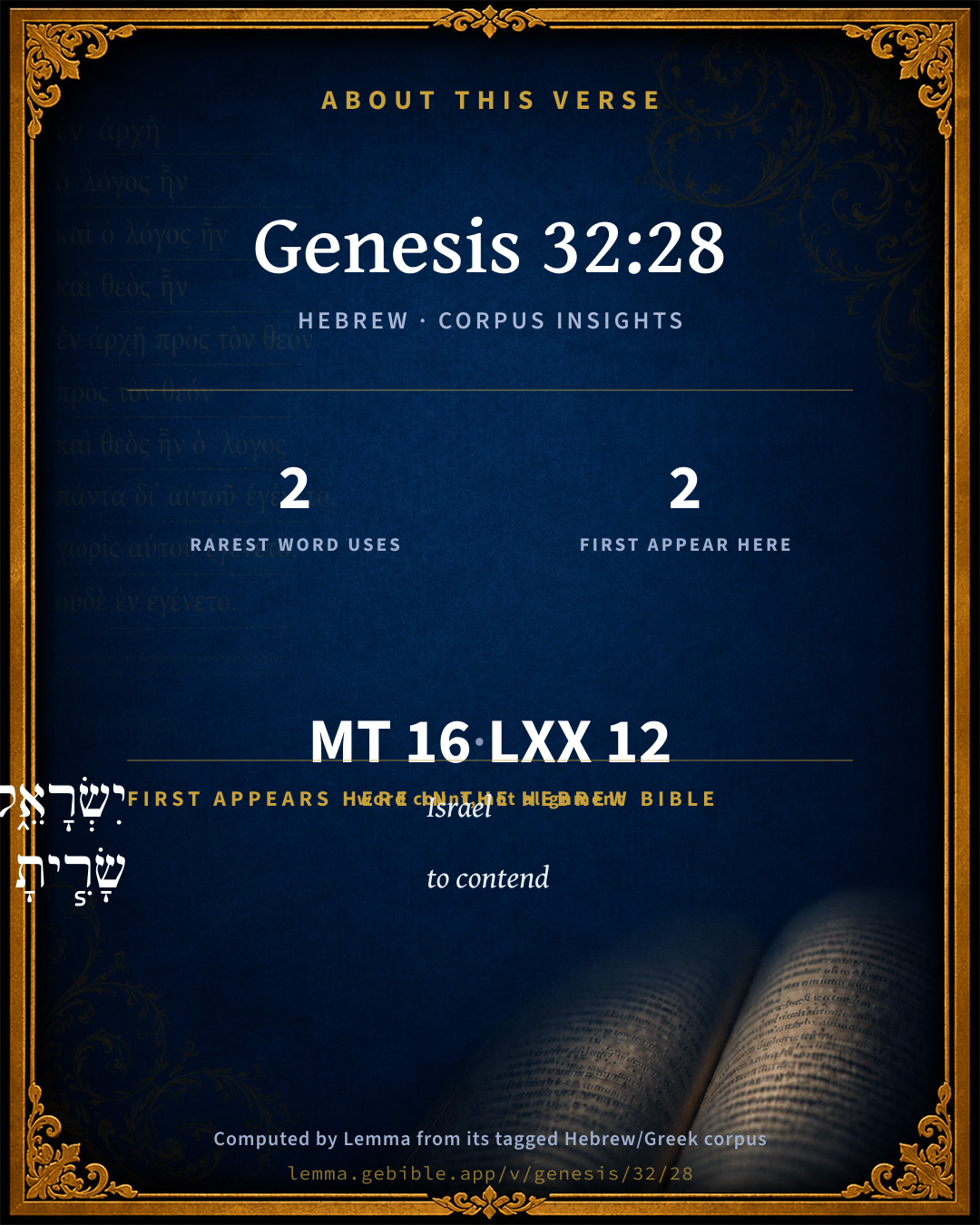
  • 2 first appearances in the Hebrew Bible
Full analysis ↓
Download a study sheet

One document with this verse’s original text, its word-by-word gloss line, the meaning frame, cross-references with their text, attributed commentary, and full source and license credits — printable, and it pastes into notes with its structure intact.

This verse Autodidact and up

Study sheet (.html) Plain text (.txt)

A passage Seminary Student

Up to 50 verses in one chapter. A passage sheet keeps up to 6 commentary sources and 12 cross-references per verse, in the order this page ranks them, and says so on the sheet whenever that leaves anything out. Ask for a single verse and you get the Autodidact verse sheet above.

Everything on this page stays free to read, with no account — the sheet is a download of what is already on screen, not access to it.

Want to remove ads? Support Godless Engineer
Compare translations 3

The same verse in 3 English versions, stacked beneath the original-language interlinear above. Click any original word for its lexicon entry.

Each is an independent rendering of the whole verse — the interlinear is not word-aligned to these translations.

Highlighted words mark where these versions differ — a whole-verse word diff, not a word-by-word alignment.

  • World English Bible Public Domain
    He said, "Your name will no longer be called 'Jacob,' but, 'Israel,' for you have fought with God and with men, and have prevailed."
  • King James Version Public Domain
    And he said, Thy name shall be called no more Jacob, but Israel: for as a prince hast thou power with God and with men, and hast prevailed.
  • unfoldingWord Literal Text CC BY-SA 4.0
    Then he said, “Your name will not be called Jacob anymore, but Israel, because you have struggled with God and with men, and you have prevailed.”

unfoldingWord Literal Text — © unfoldingWord, licensed CC BY-SA 4.0. Word-aligned USFM3 via Door43 (git.door43.org/unfoldingWord/en_ult).

Versions to compare (up to 4)

3 of 4 selected

Show all 18 translations

Every available English version of this verse, each an independent rendering of the whole verse.

  • World English Bible Public Domain
    He said, "Your name will no longer be called 'Jacob,' but, 'Israel,' for you have fought with God and with men, and have prevailed."
  • Berean Standard Bible Public Domain
    Then the man said, “Your name will no longer be Jacob, but Israel, because you have struggled with God and with men, and you have prevailed.”
  • Majority Standard Bible Public Domain
    Then the man said, “Your name will no longer be Jacob, but Israel, because you have struggled with God and with men, and you have prevailed.”
  • King James Version Public Domain
    And he said, Thy name shall be called no more Jacob, but Israel: for as a prince hast thou power with God and with men, and hast prevailed.
  • American Standard Version (1901) Public Domain
    And he said, Thy name shall be called no more Jacob, but Israel: for thou hast striven with God and with men, and hast prevailed.
  • Revised Version (1885) Public Domain
    And he said, Thy name shall be called no more Jacob, but Israel: for thou hast striven with God and with men, and hast prevailed.
  • Geneva Bible (1599) Public Domain
    Then said he, Thy name shalbe called Iaakob no more, but Israel: because thou hast had power with God, thou shalt also preuaile with men.
  • Douay-Rheims (1899) Public Domain
    But he said: Thy name shall not be called Jacob, but Israel: for if thou hast been strong against God, how much more shalt thou prevail against men?
  • Young's Literal Translation Public Domain
    And he saith, `Thy name is no more called Jacob, but Israel; for thou hast been a prince with God and with men, and dost prevail.'
  • Literal Standard Version CC BY-SA 4.0
    And He says, “Your name is no longer called Jacob, but Israel; for you have reigned with God and with men, and prevail.”
  • Unlocked Literal Bible CC BY-SA 4.0
    The man said, “Your name will no longer be called Jacob, but Israel. For you have struggled with God and with men and have prevailed.”
  • unfoldingWord Literal Text CC BY-SA 4.0
    Then he said, “Your name will not be called Jacob anymore, but Israel, because you have struggled with God and with men, and you have prevailed.”
  • Darby Bible Public Domain
    And he said, Thy name shall not henceforth be called Jacob, but Israel; for thou hast wrestled with God, and with men, and hast prevailed.
  • World Messianic Bible Public Domain
    He said, “Your name will no longer be called Jacob, but Israel; for you have fought with God and with men, and have prevailed.”
  • Webster's Bible Public Domain
    And he said, Thy name shall be called no more Jacob, but Israel: for as a prince hast thou power with God, and with men, and hast prevailed.
  • Free Bible Version CC BY-SA 4.0
    “Jacob will no longer be your name,” said the man. “Instead you will be called Israel, because you fought with God and with men and you won.”
  • Bible in Basic English Public Domain
    And he said, Your name will no longer be Jacob, but Israel: for in your fight with God and with men you have overcome.
  • JPS Tanakh (1917) Public Domain
    (32-29) And he said: 'Thy name shall be called no more Jacob, but Israel; for thou hast striven with God and with men, and hast prevailed.'

Literal Standard Version (2020), Covenant Press — licensed CC BY-SA 4.0. Text via the HelloAO Bible API (eBible.org). Unlocked Literal Bible (unfoldingWord) — licensed CC BY-SA 4.0. Text via the HelloAO Bible API (eBible.org). unfoldingWord Literal Text — © unfoldingWord, licensed CC BY-SA 4.0. Word-aligned USFM3 via Door43 (git.door43.org/unfoldingWord/en_ult). Free Bible Version, Dr. Jonathan Gallagher — licensed CC BY-SA 4.0. Text via the HelloAO Bible API (eBible.org).

Word by word

More ways to search: Search by grammar → Find every occurrence → Compare this word →

Practice this passage: Drill this verse → Learn its vocabulary →

שָׂרִ֧יתָ
sârâh
H8280
“to contend”
Verb, Qal, Perfect, 2nd Person, Masculine, Singular
Part of Speech
Verb
Stem
Qal
Form
Perfect
Person
2nd Person
Gender
Masculine
Number
Singular
Full BDB Definition

Origin: a primitive root

TWOT: 2287

contend, have power, contend with, persist, exert oneself, persevere - (Qal) to persevere, contend with
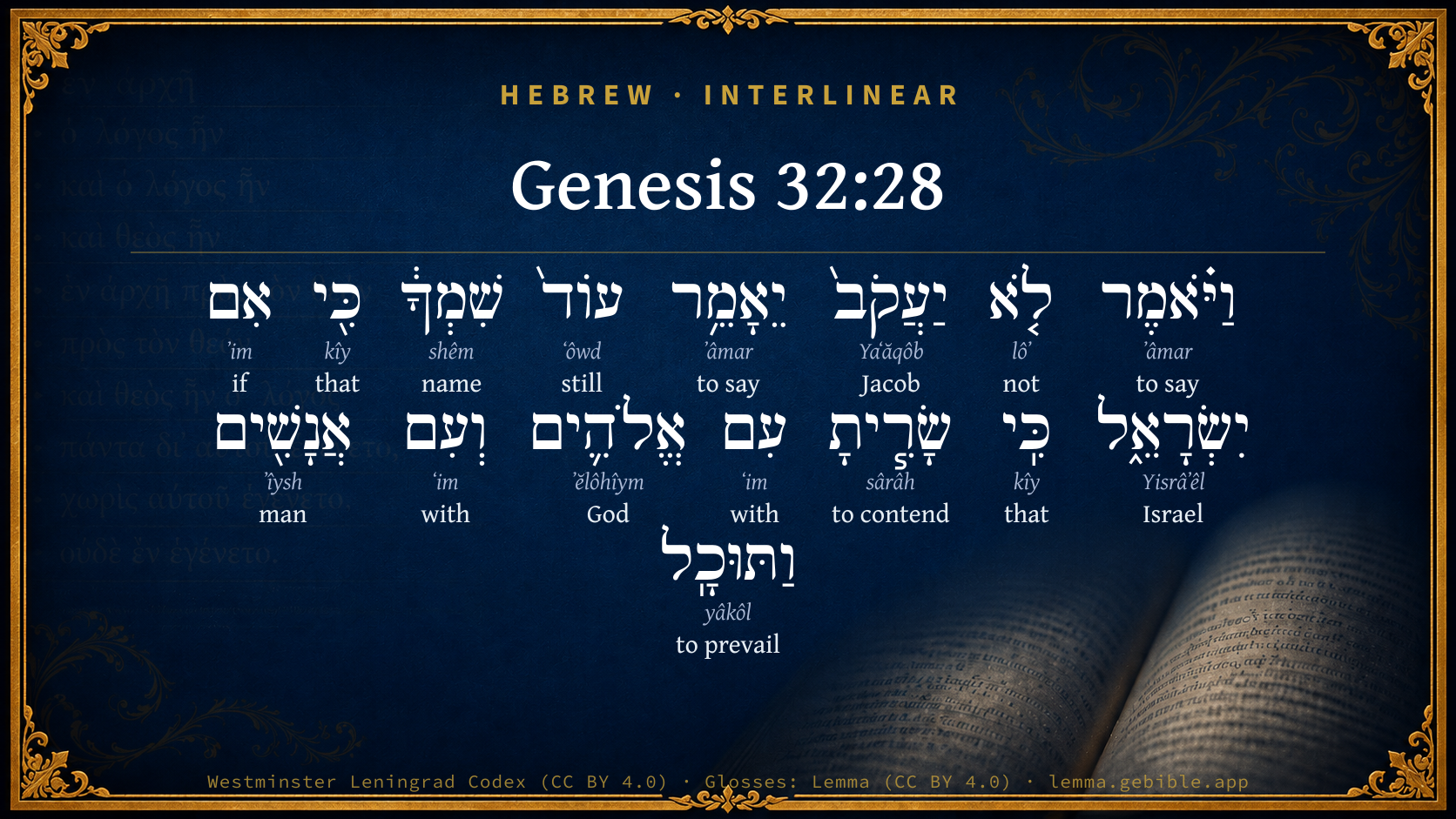
  1. וַיֹּ֗אמֶר ʼâmar H559 “and · to say” Conjunction + Verb, Qal, Sequential Imperfect, 3rd Person, Masculine, Singular
  2. לֹ֤א lôʼ H3808 “not” Particle, Negative
  3. יַעֲקֹב֙ Yaʻăqôb H3290 “Jacob” Noun, Proper
  4. יֵאָמֵ֥ר ʼâmar H559 “to say” Verb, Niphal, Imperfect, 3rd Person, Masculine, Singular
  5. עוֹד֙ ʻôwd H5750 “still” Adverb
  6. שִׁמְךָ֔ shêm H8034 “name · your” Noun, Common, Masculine, Singular, Construct + Suffix, Personal, 2nd Person, Masculine, Singular
  7. כִּ֖י kîy H3588 “that” Conjunction
  8. אִם ʼim H518 “if” Conjunction
  9. יִשְׂרָאֵ֑ל Yisrâʼêl H3478 “Israel” Noun, Proper
  10. כִּֽי kîy H3588 “that” Conjunction
  11. עִם ʻim H5973 “with” Preposition
  12. אֱלֹהִ֛ים ʼĕlôhîym H430 “God(s)” Noun, Common, Masculine, Plural, Absolute
  13. וְעִם ʻim H5973 “and · with” Conjunction + Preposition
  14. אֲנָשִׁ֖ים ʼîysh H376 “men” Noun, Common, Masculine, Plural, Absolute
  15. וַתּוּכָֽל yâkôl H3201 “and · to prevail” Conjunction + Verb, Qal, Sequential Imperfect, 2nd Person, Masculine, Singular

About this verse

These counts appear in no published source. They are computed here, from the morphology-tagged text and Lemma’s own curated glosses. What Lemma adds →

16
words
13
distinct lemmas
Pentateuch
section

Notable vocabulary

The rarest word here is שָׂרִ֧יתָ to contend H8280 — appearing just 2 times in the whole Hebrew Bible.

First appearance in Scripture

These words make their first canonical appearance in the Hebrew Bible here:

  • יִשְׂרָאֵ֑ל Israel H3478
  • שָׂרִ֧יתָ to contend H8280

Shared distinctive vocabulary

שָׂרִ֧יתָ to contend H8280 occurs in 2 verses of the Hebrew Bible. Also found in:

Grammatical profile

  • 4 verbs
  • 5 nouns
  • 2 prepositions
  • 3 conjunctions
  • 1 adverb
  • 1 particle

Verb forms

  • וַיֹּ֗אמֶר Qal · Sequential Imperfect
  • יֵאָמֵ֥ר Niphal · Imperfect
  • שָׂרִ֧יתָ Qal · Perfect
  • וַתּוּכָֽל Qal · Sequential Imperfect

Repetition

Words recur within this verse — often emphatic in Hebrew:

  • וַיֹּ֗אמֶר to say H559 ×2
  • כִּ֖י that H3588 ×2
  • עִם with H5973 ×2

Hebrew & Septuagint length

In English translation the verse runs 24 words from the Hebrew and 31 from the Septuagint (LXX English) — closely comparable.

A rough comparison of the two English renderings, which tokenize alike — not a word-level alignment.

Word counts can differ between the Hebrew and the Greek without any difference in meaning — e.g. the Hebrew direct-object marker אֵת has no separate Greek word, and Greek often adds the article ὁ.

In the original languages it is 16 Hebrew tokens and 12 Greek tokens — but the two are counted differently (Hebrew bundles its prefixes and suffixes into one token; the Greek is in lemma form), so that isn’t a like-for-like length.

Cross-references

21

Topical passages linked to Genesis 32:28 in the Treasury of Scripture Knowledge — connected by theme and wording, ordered by reader-vote popularity; previews shown in the World English Bible.

  • Revelation 2:17 He who has an ear, let him hear what the Spirit says to the assemblies. To him who overcomes, to him I will give of the hidden manna, and I will give him a white stone, and on the stone a new name written, which no one knows but he who receives it.
  • Genesis 35:10 God said to him, "Your name is Jacob. Your name shall not be Jacob any more, but your name will be Israel." He named him Israel.
  • Isaiah 62:2–4 The nations shall see your righteousness, and all kings your glory, and you shall be called by a new name, which the mouth of Yahweh shall name.
  • Hosea 12:3–5 In the womb he took his brother by the heel; And in his manhood he had power with God.
  • Genesis 27:33–36 Isaac trembled violently, and said, "Who, then, is he who has taken venison, and brought it me, and I have eaten of all before you came, and have blessed him? Yes, he will be blessed."
  • Genesis 17:5 Neither will your name any more be called Abram, but your name will be Abraham; for the father of a multitude of nations have I made you.
  • Genesis 17:15 God said to Abraham, "As for Sarai your wife, you shall not call her name Sarai, but her name will be Sarah.
  • Genesis 25:31 Jacob said, "First, sell me your birthright."
  • Genesis 33:4 Esau ran to meet him, embraced him, fell on his neck, kissed him, and they wept.
  • Proverbs 16:7 When a man's ways please Yahweh, He makes even his enemies to be at peace with him.
  • Isaiah 65:15 You shall leave your name for a curse to my chosen; and the Lord Yahweh will kill you; and he will call his servants by another name:
  • John 1:42 He brought him to Jesus. Jesus looked at him, and said, "You are Simon the son of Jonah. You shall be called Cephas" (which is by interpretation, Peter).
  • 2 Samuel 12:25 and he sent by the hand of Nathan the prophet; and he named him Jedidiah, for Yahweh's sake.
  • Genesis 31:24 God came to Laban, the Syrian, in a dream of the night, and said to him, "Take heed to yourself that you don't speak to Jacob either good or bad."
  • Genesis 31:36–55 Jacob was angry, and argued with Laban. Jacob answered Laban, "What is my trespass? What is my sin, that you have hotly pursued after me?
  • Genesis 32:24 Jacob was left alone, and wrestled with a man there until the breaking of the day.
  • 1 Samuel 26:25 Then Saul said to David, Blessed be you, my son David: you shall both do mightily, and shall surely prevail. So David went his way, and Saul returned to his place.
  • 2 Kings 17:34 To this day they do after the former manner: they don't fear Yahweh, neither do they after their statutes, or after their ordinances, or after the law or after the commandment which Yahweh commanded the children of Jacob, whom he named Israel;
  • Numbers 13:16 These are the names of the men who Moses sent to spy out the land. Moses called Hoshea the son of Nun Joshua.
  • 1 Kings 18:31 Elijah took twelve stones, according to the number of the tribes of the sons of Jacob, to whom the word of Yahweh came, saying, Israel shall be your name.
  • Genesis 33:20 He erected an altar there, and called it El Elohe Israel.

Cross-references courtesy of OpenBible.info (CC BY 4.0).

Hebrew and Greek witnesses Masoretic Hebrew ↔ Greek Septuagint

The same verse in the two great witnesses to the Old Testament, shown verse-for-verse.

These are two independent witnesses, not word-aligned to each other, and the Septuagint is shown in lemma (dictionary) form.

Hebrew Genesis 32:28 Masoretic · Westminster Leningrad Codex

וַיֹּ֗אמֶר לֹ֤א יַעֲקֹב֙ יֵאָמֵ֥ר עוֹד֙ שִׁמְךָ֔ כִּ֖י אִם יִשְׂרָאֵ֑ל כִּֽי שָׂרִ֧יתָ עִם אֱלֹהִ֛ים וְעִם אֲנָשִׁ֖ים וַתּוּכָֽל

He said, "Your name will no longer be called 'Jacob,' but, 'Israel,' for you have fought with God and with men, and have prevailed."

World English Bible · Public Domain

Greek LXX Genesis 32:28 Septuagint · lemma form

εἶπον δέ αὐτός τίς ὁ ὄνομα σύ εἰμί ὁ δέ εἶπον ἰακώβ

And he said to him, Your name shall no longer be called Jacob, but Israel shall be your name; for you have prevailed with God, and shall be mighty with men.

LXX2012 (modern English Septuagint) · Public Domain

On this verse, The Cambridge Bible for Schools and Colleges discusses the Septuagint’s reading. Read the note in Commentary ↓

Hebrew: Westminster Leningrad Codex (CC BY 4.0). Greek: Septuagint (public domain); English from LXX2012 (modern English Septuagint) (Public Domain). How the Septuagint differs from the Hebrew →

Targum (Aramaic paraphrase)

2

The Targum is the ancient Jewish Aramaic paraphrase of the Hebrew Scriptures — an interpretive translation, not the Hebrew text itself. Onkelos (literal) and Pseudo-Jonathan (expansive) render the Torah, and Jonathan the Prophets. Coverage is partial: where no permissively-licensed English translation exists for a verse, only the Aramaic is shown. This is verse-level text, not a word-by-word alignment to the Hebrew.

  1. Targum Onkelos Torah (Genesis–Deuteronomy)
    וַאֲמַר לֵהּ מָה שְׁמָךְ וַאֲמַר יַעֲקֹב

    (no public-domain English translation for this verse)

    Targum Onkelos — Aramaic: “Onkelos Genesis” (public domain); “Onkelos Exodus” (public domain); “Onkelos Leviticus” (public domain); “Onkelos Numbers” (public domain); “Onkelos Deuteronomy” (public domain). English: “Sefaria Community Translation” (CC0 1.0 (public-domain dedication)); “J.W. Etheridge. The Targums of Onkelos and Jonathan Ben Uzziel on the Pentateuch. London: Longmans, Green, 1862” (public domain). Text via Sefaria.

  2. Targum Pseudo-Jonathan Torah (Genesis–Deuteronomy)
    וַאֲמַר לֵיהּ מַה שְׁמָךְ וַאֲמַר יַעֲקב

    And he said, What is thy name? He answered, Jakob.

    Targum Pseudo-Jonathan — Aramaic: “Targum Jonathan on Genesis” (public domain); “Targum Jonathan on Exodus” (public domain); “Targum Jonathan on Leviticus” (public domain); “Targum Jonathan on Numbers” (public domain); “Targum Jonathan on Deuteronomy” (public domain). English: “The Targum of Jonathan ben Uzziel, trans. J. W. Etheridge, London, 1862” (public domain). Text via Sefaria.

Commentary

Notes on Genesis 32:28 from classic Christian and Jewish commentators (each source and its license shown beneath its notes). The classic Christian expositions comment on the surrounding passage and are grouped to its opening verse, so a note may address several verses; the Jewish commentaries on the Tanakh (Rashi and others) are per-verse, so they appear only where the commentator wrote on this verse.

Lemma curates 59 commentaries, every one of them public domain or Creative Commons licensed, each selected and text-cleaned for this edition rather than reprinted as found. About our sources →

Trapp's Complete Commentary

John Trapp

Gen 32:28 And he said, Thy name shall be called no more Jacob, but Israel: for as a prince hast thou power with God and with men, and hast prevailed.

Ver. 28. No more Jacob, but Israel.] That is, not only, or not so much Jacob as Israel. Both these names he had given him, of striving and struggling. All God’s Israel are wrestlers by calling, {Eph 6:12} and, "as good soldiers of Jesus Christ," must "suffer hardness". {2Ti 2:3} Nothing is to be "seen in the Shulamite, but as the appearance of two armies," {Son 6:13} maintaining civil broils within her. {a} The spirit would always get the better of the flesh, were it upon equal terms: but when the flesh shall get the hill, as it were, of temptation, and shall have the wind to drive the smoke upon the eyes of the combatant, and so to blind him, - upon such a disadvantage, he is overcome. For it is "not flesh and blood only" that "we wrestle against," - whether we take the apostle’s meaning, for the weakness of our nature or the corruption of it, - "but against principalities, against powers," &e.; against many, mighty, malicious adversaries; "spiritual wickednesses in high places," that are above us, and hang over our necks. Wherefore, we have more than need to "take unto us the whole armour of God," and to strengthen ourselves with every piece of it: whether those of defence, as "the girdle of truth, the breastplate of righteousness, the shoes of peace" and patience, "the shield of faith, the helmet of hope"; or those of offence, as, "the sword of the spirit," and the darts of prayer. {Eph 6:14} At no place must we lie open; for our enemy is a serpent. If he can but bite the heel, he will transfuse his venom to the heart and head. God’s "Spirit" in us "sets up a standard". {Isa 59:19} The apostle sounds the alarm, Arm, arm. {Eph 6:10-17} The Holy Scripture is our armoury, like "Solomon’s tower, where hang a thousand shields, and all the weapons of strong men". {Son 4:4} God himself is the ’Aγωνοθεπης, that both ordaineth and ordereth our temptations with his own hand, as he dealt with Jacob. And the Lord Christ stands over us, as he did once over Stephen, {Act 7:55} with a crown upon his head and another in his hand, with this inscription, Vincenti dabo, "To him that overcometh will I give," &c. {Rev 2:7; Rev 2:11; Rev 2:17; Rev 2:26; Rev 3:5; Rev 3:12; Rev 3:21} Fight but with his arms and with his armour, and we are sure to overcome before we fight; for he hath made all our foes our footstool, and hath "caused us to triumph". {2Co 2:14} Let therefore the assaults of our already vanquished enemies not weaken, but waken us: let their faint oppositions and spruntings before death encourage us, or rather enrage us, to do them to death: we are sure to be "more than conquerors," {Rom 8:37} and to have Victoriam Halleluiatieam, as the Britons, fighting for their religion, had once against the Saxons and Picts in this kingdom. {b}

{a} Nunquam bella bonis, nunquam discrimina desunt.

{b} Dr. Ussher, De Britan. Eccles. Primord. u. 332.

John Trapp, A Commentary or Exposition upon All the Books of the Old and New Testament (1647–1656) — public domain. Text from a community e-Sword module.

The Biblical Illustrator

Joseph S. Exell

Gen_32:28

And He said, Thy name shall be called no more Jacob, but Israel; for as a prince hast thou power with God and with men, and hast prevailed

Jacob the prince

Some surprise may be felt at first at the term prince being applied to the patriarch Jacob; for whatever good qualities distinguish his character, we hardly regard him as possessing princely ones.

He has the quiet virtues of resignation, meekness and caution, but we hardly attribute to him that spirit and mettle, that vigorous temper and fire, which belong to the princely character. Yet when we consider Jacob we find that he had virtues which lie at the foundation of the royal and grand form of human character.

I. His patience was a princely virtue. How patiently he bore the long delays in Labans service I the plots of his sons, Simeon and Levi! We sometimes think of patience as the virtue of the weak, the sufferer, the inferior. Yet a great prime minister of England, when asked what was the most important virtue for a prime minister, gave this answer, Patience is the first, patience is the second, patience is the third.

II. Hopefulness was another of Jacobs regal virtues. He looked forward with trust and confidence to the future; he believed firmly in Gods promises. His was a religious spirit; the religious mind is sustained by hope. I have waited for Thy salvation, O Lord, he says in his last address, when he summed up the purpose of his life. He had waited, but never ceased to hope; the Divine reward had always been before him.

III. But it was in prayer specially that Jacob showed his princely character. What a nobility is attributed to prayer in this episode of Jacobs life! What a description the text gives us of the royal attributes of prayer that it sets in motion the sovereign agency which settles all human events! (J. B.Mozley, D. D.)

Jacobs twofold name and nature

I. The very twofold name of Jacob and of Israel is but the symbol of the blending of contradictions in Jacobs character. A strange paradox--the hero of faith, and the quick, sharp-witted schemer.

II. The character of Jacob is a form which is to be found among the Gentiles no less than among the Jews. There are in our days prudential vices, marring what would otherwise be worthy of all praise. And that which makes them most formidable is that they are the cleaving, besetting temptations of the religious temperament.

1. Untruthfulness--the want of perfect sincerity and frankness.

2. Thinking much of ease and comfort, and shrinking from hardship and danger.

III. The religious temperament, with all its faults, may pass into the the matured holiness of him who is not religious only, but godly. How the work is to be clone thou knowest not now, but thou shalt know hereafter, when thou too hast wrestled with the angel and hast become a prince with God. (Dean Plumptre.)

Jacobs new name

I. EVERY SOUL NEEDS THE NEW NAME.

II. EVERYONE MAY HAVE THE NEW NAME.

III. EVERY ONE MUST SECURE THE NEW NAME AS JACOB HAD.

1. By repentance.

2. By faith. (T. J. Holmes.)

The new man

I. THE SYMBOL OF THE NEW LIFE. He was no longer to be called Jacob, but Israel. In this change of name was intimated an entire change of character. He was sent back in recollection over the years to the time when he had been a wicked man; and then he was sent forward in anticipation across the years, under the command that he should begin a fresh career. From that night onward, he was to leave off his worldly cunning, and surrender his craft. He must become a new man, and, above all, a true man. His early and continuous sins might now be forgiven; but he must lead an altered life.

II. THE REACH TO WHICH THIS NEW LIFE EXTENDS.

1. When once a believer is truly in Christ, his standing with God is entirely changed. Every barrier is broken down. Gods displeasure is over, and mans enmity is ended.

2. Not only in state but in character is the true believer a new man. If he be in Christ, he will grow assuredly to resemble Christ.

3. The new creation of a believer in Christ extends even to his experience, as well as to his state and character.

(1) Confidence.

(2) Freedom.

(3) Contentment. (C. S. Robinson, D. D.)

Israel; or, Jacob at Penuel

I. THAT GOD MANIFESTS HIMSELF FOE THE COMFORT AND PROTECTION OF THOSE WHO TRUST IN HIM ACCORDING TO THEIR NEED (2Ki_6:17; Psa_46:1; Act_27:23-24).

II. WHAT COWARDS A GUILTY CONSCIENCE MAKES OF US ALL.

III. THE TRANSFORMING POWER OF PRAYER. Mark:

1. The kind forbearance and long-suffering patience of God.

2. The purpose of God concerning us. (A. F. Joscelyne, B. A.)

Power with God

I. WHAT THIS POWER CANNOT BE.

1. Cannot be physical force.

2. Cannot be mental energy.

3. Cannot be magical.

4. Cannot be meritorious.

5. Cannot be independent.

II. WHENCE THIS POWER PROCEEDS.

1. It arises from the Lords nature. His goodness and tenderness are excited by the sight of our sorrow and weakness.

2. It comes out of Gods promise (Isa_43:26).

3. It springs out of the relationships of grace.

4. It grows out of the Lords previous acts. Each blessing draws on another, like links of a chain.

III. How CAN IT BE EXERCISED.

1. There must be a deep sense of weakness (2Co_12:10).

2. There must be simple faith in the goodness of the Lord (Joh_14:12).

3. There must be earnest obedience to His will (Joh_9:31).

4. There must be fixed resolve (Gen_32:26).

5. With this must be blended importunity (Gen_32:24).

6. The whole heart must be poured out (Hos_12:4).

7. Increased weakness must not make us cease (Isa_33:23).

IV. To WHAT USE THIS POWER MAY BE TURNED.

1. For ourselves.

(1) For our own deliverance from special trial.

(2) An honourable preferment.

(3) Our future comfort, strength, and growth, when, like Jacob, we are called to successive trials.

2. For others. Jacobs wives and children were preserved, and Esaus heart was softened. If we had more power with God, we should have a happier influence among our relatives. (C. H. Spurgeon.)

Power with God

What is power with God? Knowledge of God in Christ, as revealed in the Scriptures, forms the basis of all power with God.

I. How DID JACOB OBTAIN THIS KNOWLEDGE OF GOD? In two ways--

1. By the instrumentality of pious parents. Isaac and Rebecca were the most Godly couple of the Old Testament families. They taught Jacob the first principles of, and the parental character of God; His wisdom, love, and power.

2. By a direct revelation of Gods loving kindness to him in a time of great distress.

II. POWER WITH GOD IS THE RIGHT APPLICATION OF THE KNOWLEDGE OF GOD IN CHRIST AT THE RIGHT TIME, IN THE USE OF RIGHT MEANS TO ACCOMPLISH THE RIGHT END.

1. A crisis in the life of Jacob had arrived. A fearful episode in his life is revealed in the words, And Jacob sent messengers before him to Esau his brother, &c. (Gen_32:3-6). Jacob wisely flies to God in prayer. In this crisis he makes a right application of his knowledge.

2. Jacob uses successful means to appease his brothers wrath. Knowledge of God in the Covenant of Grace by Jesus Christ, contains the knowledge of man. The greater includes the less.

3. Jacob uses the right means to secure the blessing of God. Power with God is knowledge of God applied by faith until the end is accomplished. (J. Brewster.)

The proper design and influence of prayer

Both the letter and spirit of the text suggest this general observation:

I. THAT IT IS THE DESIGN OF PRAYER TO MOVE GOD TO BESTOW MERCY. This will appear if we consider--

1. That prayer properly and essentially consists in pleading. Though it may be divided into distinct parts or branches, yet all these ultimately unite and centre in supplication. In adoration, confession, petition, and thanksgiving, we ultimately plead for Divine mercy.

2. It appears from the prayers of good men, which are recorded in scripture, that they meant to move God to grant their petitions.

3. The friends of God are urged to pray with fervency and importunity, in order to make the Divine compassion.

4. That the prayers of good men have actually prevailed upon God to grant great and signal favours.

II. But now some may be ready to ask, How CAN THIS BE? How can prayer have the least influence to move the heart of God, who is of one mind, and with whom there is no variableness, nor shadow of turning?

1. Here we ought to consider, in the first place, that the prayers of good men are proper reasons why an infinitely wise and good being should grant their requests.

2. We ought to consider, in the next place, that though God formed all his purposes from eternity, yet he formed them in the view of all the pious petitions which should ever be presented to Him, and gave to these petitions all the weight that they deserved, in fixing his determinations.

3. This leads us, in the last place, to consider pious prayers as the proper means of bringing about the events with which they are connected in the Divine purpose. Though God is able to work without means, yet He has been pleased to adopt means into His plan of operation.

III. IMPROVEMENT.

1. If it be the design of prayer to move God to bestow temporal and spiritual favours, then there is a propriety in praying for others, as well as for ourselves.

2. We are led to conclude from what has been said upon this subject, that we have as fair an opportunity Of obtaining Divine favours, as if God were to form His determinations at the time we present our petitions. For God has determined, from eternity, to hear every prayer that ought to be heard.

3. We learn the propriety of praying for future, as well as for present blessings.

4. It appears from what has been said, that saints are in a safe and happy condition. They enjoy the benefit of the prayers of all the people of God.

5. This subject may remind sinners of what they haw to fear from the prayers of saints. Their united supplications for the honour of God, the accomplishment of His designs, and the overthrow of all His incorrigible enemies, forebode terrible and eternal evils to impenitent sinners.

6. Since prayer has such a prevailing influence upon the heart of the Deity, saints have great encouragement to abound in this duty. They are formed for this devout and holy exercise. Having become the children of God, they possess the spirit of adoption, which is the spirit of grace and supplication. (N. Emmons, D. D.)

What is our name?

He is asking us to-day as He asked Jacob, What is thy name? For when God asks, What is thy name? He means, What is it that lies behind the name, that is really thee? And Jacob had grace and honesty at last to own up and say, Oh, unknown wrestler! my name is trick and quirk and cunning. My name is Jacob. My name is craft, my name is cunning. He owned up at last: I am of the earth, earthy. My name is Jacob--Supplanter. My brother, what is your name? After bearing a Christian profession; after, it may be, being an office-bearer in Gods house for twenty or forty years, the great God with whom we have to do comes in mercy to-day simply because perhaps we are soon to get to heaven, and we need a lot to make us ready; we need a lot yet to make us ready. God has to come to you this morning with my lips, and says: What is thy name? If you tell the truth you will say: My name is Jacob. You will say, My name is money, my name is cent--per cent., my name is profit--my very name is that, O God. My name is moderation and religion. O God, dost Thou ask my name? My name is lust. Right down at bottom that wriggling thing is me My name is lust, uncleanness, vileness. I have kept it in; I have veneered it over; but I admit to-day that, that is me. This is the one thing in me. It is my name. What is thy name? What is at bottom in us, that is us? What is it? How few of us can say honestly, My name, O God, is religion; my name is settled principle; my name is candour, openness, honesty, sincerity. My name is singleness of heart, childlike simplicity. What is our name? I cannot give all the names. It is not the actual Johns and Roberts that were named over us here in baptism. Jacobs name was a name of significance; and God gives us all a significant name, and He is asking us to-day, What is your name? What is it? Oh, let us be honest and tell Him. I know mine. You could stand up in this church, and in one sentence could tell this meeting what is your prevailing characteristic. Young girl, young woman, you can stand up before God and say, My name is frivolity. That is nay prevailing characteristic. I come to church on Sunday, but the thing that engrosses and consumes me is a ball and a dance and the theatre. That is my name. That sets my whole soul abounding and a-pulsing. With some of us, our whole creed is just a determination not to yield ourselves utterly unto God, but to keep on the safe side. What is your name? Ananias is the name for some, and Sapphira is the true name for others. It was not a nice name. It may be that Jacobs swarthy cheek got a little swarthier even in the darkness, as he said, Supplanter is my name. I am a wrestler, I depend on cunning, I call on God even occasionally, to help my cunning. I use religion for a cloak for my cunning. My name, in Thy sight, and with shame I confess it, my name is double-tongue, or facing-both-ways. (J. McNeill.)

The new name

I. THE CIRCUMSTANCES OF THE EVENT. It will occur to our recollection that, after the intimation of Esaus approach, Jacob had almost immediately addressed himself to the duty of prayer, and that he had earnestly sought deliverance from the threatening danger; but he had as yet received no favourable answer. He remained still in suspense, and in the anxious exercise of faith upon the promise of his Divine protector. His previous experience seems to have consecrated to him the shades of night. It was during the night that God appeared to him at Bethel. It was in a dream at night that he received the instruction to depart from Syria. A degree of obscurity hangs over the passage, from the difficulty of affixing a meaning satisfactorily to the word which we translate wrestled, and which implies intense occupation and effort; yet upon the whole, the general statement seems to render it unequivocal, that on this occasion a bodily struggle did actually take place. It was, however, at the same time, a contest in which the chief interest lay in the spiritual blessing to be obtained. The external effort for victory was evidently in Jacobs mind intimately associated with the deliverance that he was then seeking by prayer. And with the external wrestling to detain this nocturnal visitant, Jacob still continued the ardent pleading of his soul for the indulgence of his request. Jacob evidently regarded them as being one and the same. And the prophet Hosea confirms this view of the case when he tells us (in chap. 12.) that Jacob had power over the angel and prevailed; that he wept and made supplication unto him; a passage which brings the spiritual object prominently forward, and excludes the idea of a contention of mere muscular strength. Probably the appearance of a human form, on these occasions of revelation, was at this time new to Jacob. It appears, however, to have given him a peculiar encouragement. Where was the created frame that would not instantly crumble into its original nothingness, if, for one instant, it was placed in the attitude of resistance against Him who is a consuming fire? But the terrors of the Godhead were veiled in humanity. It was a man that appeared to Jacob. The sequel of the history ascertains, beyond a doubt, the Divine character of the person who appeared to Jacob.

II. THE DOCTRINE WHICH WE MAY GATHER FROM IT. Viewed in this light, the doctrine which this event inculcates on the Church of God is--the permitted prevalency of the prayer of man with God, through the mystery of the incarnation of His eternal Son.

III. THE DUTIES WHICH THIS EVENT INCULCATES.

1. It teaches gratitude. It becomes us to be thankful. It is indeed an unspeakable mercy that God has vouchsafed to provide so graciously for the approach of our guilty race to Himself.

2. A second duty inculcated by this event is humility. If you know yourselves you will be ashamed of the history of your closets; and many an humbling memento will teach you that if ever you prevailed at the throne of God, it was not because you were worthy, but because that throne was the throne of grace.

3. Observe, thirdly, the duty which this passage inculcates of seeking God earnestly. It is vain to offer to God that listless, heartless service, which too frequently constitutes the whole of a Christians devotions.

4. Learn, fourthly, the duty of persevering importunity in prayer.

5. But, lastly, a word is due to those who have never yet thought seriously of prayer. How energetically a case like this speaks to you. (E. Craig.)

Jacob and Israel

Before this time, he had been Jacob, the worker with wiles, who supplanted his brother, and met his foes with duplicity and astuteness like their own. He had been mainly of the earth, earthy. But that solemn hour had led him into the presence chamber, the old craft had been mortally wounded, he had seen some glimpse of God as his friend, whose presence was not awful, as he had thought it long ago, nor enigmatical and threatening, as he had at first deemed it that night, but the fountain of blessing, and the one thing needful. A man who has once learned that lesson, though imperfectly, has passed into a purer region, and left behind him his old crookednesses. He has learned to pray, not as before, prayers for mere deliverance from Esau and the like, but his whole being has gone out in yearning for the continual nearness of his mysterious antagonist--friend. So, though still the old nature remains, its power is broken, and he is a new creature. Therefore he needs a new name, and gets it from Him who can name men, because He sees the hearts depths, and because He has the right over them. To impose a name is the sign of authority, possession, insight into character. The change of name indicates a new epoch in a life, or a transformation of the inner man. The meaning of Israel is He (who) strives with God; and the reason for its being conferred is more accurately given by the Revised version, which translates, For thou hast striven with God and with men, than in the Authorized rendering. His victory with God involved the certainty of his power with men. All his life he had been trying to get the advantage of them, and to conquer them, not by spear and sword, but by his brains. But now the true way to true sway among men is opened to him. All men are the servants of the servant and the friend of God. He who has the ear of the emperor is master of many men. Jacob is not always called Israel in his subsequent history. His new name was a name of character and of spiritual standing, and that might fluctuate, and the old self resume its power; so he is still called by the former appellation, just as, at certain points in his life, the apostle forfeits the right to be Peter, and has to hear from Christs lips the old name, the use of which is more poignant than many reproachful words--Simon, Simon, behold, Satan hath desired to have you. But in the last death-bed scene, when the patriarch lifted himself in his bed, and with prophetic dignity pronounced his parting benediction on Josephs sons, the new name re-appears with solemn pathos. That name was transmitted to his descendants, and has passed over to the company of believing men, who have been overcome by God, and have prevailed with God. It is a charter and a promise. It is a stringent reminder of duty and a lofty ideal. A true Christian is an Israel. His office is to wrestle with God. (A. Maclaren, D. D.)

Power in prayer

Jacob, though a man, a single man, a travelling man, a tired man, yea, though a worm, that is easily crushed and trodden under foot, and no man (Isa_41:14), yet in private prayer he is so potent that he overcomes the Omnipotent God; he is so mighty, that he overcomes the Almighty. (Thomas Brooks.)

Successful importunity

A stern father has been conquered by a tear in the eye of his daughter. An unwilling heart has relented and bestowed an alms at the sight of the disappointment caused by a refusal. Sorrow constrains to pity. When importunity takes the hand of grief, and the two go together to the gate of mercy, it opens of its own accord. Sincerity, earnestness, perseverance, confidence, and expectancy are all potent instruments of power with God.

God yields to importunity

How often have I seen a little child throw its arms around its fathers neck, and win, by kisses and importunities and tears, what had else been refused. Who has not yielded to importunity, even when a dumb animal looked up in our face with suppliant eyes for food? Is God less pitiful than we? (T. Guthrie.)

A praying prince

In a certain town (says the Rev. Mr. Finney), there had been no revival for many years; the church was nearly run out, the youth were all unconverted, and desolation reigned unbroken. There lived in a retired part of the town an aged man, a blacksmith by trade, and of so stammering a tongue that it was painful to hear him speak. On one Friday, as he was at work in his shop alone, his mind became greatly exercised about the state of the church, and of the impenitent. His agony became so great that he was induced to lay aside his work, lock the shop door, and spend the afternoon in prayer. He prevailed, and on the Sabbath called in the minister and desired him to appoint a conference meeting. After some hesitation, the minister consented, observing, however, that he feared but few would attend. He appointed it the same evening, at a large private house. When evening came, more assembled than could be accommodated in the house. All were silent for a time, until one sinner broke out in tears, and said, if any one could pray, he begged him to pray for him. Another followed, and another, and still another, until it was found that persons from every quarter of the town were under deep convictions. And what was remarkable, was that they all dated their conviction at the hour when the old man was praying in his shop. A powerful revival followed. Then this old stammering man prevailed, and as a prince, had power with God.

Power with God

The mightiest man on earth is the man who has most power with God. For God is almighty, and man is omnipotent for the accomplishment of His purpose when he has the promise of all needed help from the Most High. The hiding of the power which determines the destiny of nations is not in the cabinets of kings or the heavy battalions of war, but in the closets of praying men, who have been raised by faith to the exalted rank of princes with God. The conflict which gained the greatest victory for Scotland, and gave her such freedom and intelligence as she enjoys to-day, did not originate in Holyrood Palace, nor was it waged upon the high places of the field, but in the solitary chamber of the man who prayed all night, crying in the agony and desperation of faith, Give me Scotland or I die. (D. March, D. D.)

The conflict and its result

I. THE CONFLICT, AND--

II. ITS RESULT. Thou hast power with God, said He who had wrestled the whole night with Jacob. Unequal conflict! God against man! Unheard of, incredible result! The man overcomes! Jacob now learnt with whom he had had to do--not with a foe, but with his best Friend. How is the soul astonished, when at the end of the darkest paths, in which it was inclined to think that God had in wrath forgotten to be merciful, and to say, Is His mercy clean gone for ever? it perceives in these very paths the most striking condescension of the Lord, and the greatest kindness in a guidance which seemed only to aim at its destruction. Then indeed a wonderful and glorious morning dawns. He wrestled with God. God, therefore, seemed in some respects not to be for him, but against him. God seemed not to be for him; for why was it otherwise with him with regard to Esau than it had been with regard to Laban? Why did fear obtain such possession of his mind without his being able to defend himself against it? Why did it not depart at his humble prayer and thanksgiving? If God intended to do him good, why did tie expose him to so much danger--and he at the same time so defenceless? If He loved him, why did He ask him to let Him go? And why did He put him so entirely to shame?. The Lord, however, seemed to be entirely against Jacob; against him with words; for He must have said bitter things to him, otherwise why did he weep, as Hosed informs us? He must have reproached, reproved, rejected, and threatened him; otherwise why did he entreat Him? It did not rest in mere words: actions are added to them. He increases Jacobs distress by wrestling with him, and that so violently that Jacob, according to the expression of Hosea, is obliged to resist with all his might. He chooses for this purpose the night, a season the most appalling of all; and the period when Jacobs distress had, besides that, reached a terrific height, and when his fear was great. By the dislocation of his thigh He deprived him of all strength, and rendered it impossible for him to continue the conflict, although the ceasing from it was equally impossible. He caused him pain. He casts him, as it were, defenceless before his enemy by making escape impracticable. Jacob therefore found it necessary to defend himself, and to strive against his adversary, be He who He might. And the Lord bears him witness that he had struggled with God and had prevailed. With God? How wonderful!

What!-does God act in such a manner with men? Does He so degrade Himself as to wrestle with a man--as man against man? It is not credible! Not credible? Thou shalt see still greater and more unaccountable things than these. How wilt thou believe the latter if the former are incredible to thee? Go to Bethlehem; there thou wilt find Him lying in a manger as a little needy infant. Go to Jerusalem; there thou wilt see Him in the hands of the wicked, who nail Him to the cross; there thou wilt behold Him crucified between two malefactors, hear Him complain of being forsaken of God, see Him die, and witness His interment. What sayest thou to these astonishing mysteries? If thou canst not believe the less, how will it be with the greater? Jacob wrestled with God first with the exertion of all his powers, in the most determined struggle, as long as he felt any power in himself; but this only served to convince him that we do not gain the prize by our own efforts and that the kingdom of peace is not taken by violence. This mode of wrestling was rendered impracticable to him since he was deprived of the requisite power for it by the dislocation of his thigh. The conflict was now obliged to be continued in an entirely different manner--that is, by a passive conduct which the circumstances pointed out. The paralyzed combatant had no alternative than that of casting himself into the arms of Him who had thus disabled him, and, instead of exerting himself, to let himself be carried; in other words--instead of caring for himself, to cast his burden upon the Lord--to believe, and to turn from the law to the gospel. But why did God enter into such a conflict with Jacob?

1. Because it pleased Him.

2. To give a particular proof of His condescension, how minutely He concerns Himself about His people.

3. It serves also as a representation to others of the ways by which the Lord may lead them in a similar manner to Jacob. It is true the Lord will scarcely think it needful to enter into a bodily conflict with any one, although He is able, and really does, exercise His children by temporal occurrences. There are instances in which, from the time the individual was converted to God success no longer attends him, but sicknesses or misfortunes befal himself or his family; nay, it may even be the case that he himself is deprived of his natural ability to take charge of his affairs, and they fall into confusion, however much he may exert himself and however cautiously he may act, so that even in natural things he is put to shame. Generally speaking, those to whom the Lord is willing to manifest Himself more intimately, as He did to Jacob, experience many trials and much adversity for a period; and at length an Esau stands in their way who threatens them with destruction--nay, not only an Esau, but the Lord Himself. They are brought low in themselves that the Lord may be magnified. They desire to be holy, strong, righteous, wise, believing, and good; they pray and labour as much as possible; but instead of advancing forward they go back. They increasingly exert themselves like Jacob, but only dislocate their limbs the more. Whatever they lay hold of eludes their grasp; what they seek they do not obtain. Jesus makes sinners of them without mercy, and their sin appears extremely sinful to them by means of the commandment, however much they may moan and groan on account of it. At length their very hip is dislocated; they can no longer maintain their former footing, and nothing is left them but to yield themselves to the Son of God at discretion, and creep, as chickens, under His expanded wings. O glorious result, but highly disagreeable path to nature, to which nothing is left, and to which nothing ought to be left! Here it is manifest that the mystery of godliness is great. But what was the result of the conflict? It is described in the unparalleled words, Thou hast had power with God, and hast prevailed. Jacob therefore, gained the victory over God; nay, he gained it of necessity. And why? God could not strive with him as the Almighty, or as the Holy One, because He had bound His own hands by His truth and by His promise, I will do thee good. God had rendered it impossible for Him to strive with Jacob in such a manner as would have resulted in his ruin. This would have been at complete variance with His truth, the thoughts of peace He had towards him, and with the whole contents of the covenant of grace, as well as the spiritual espousals of the Lord with His Church. He could, therefore, only strive against him in love, and do him no further injury than the glory of God and Jacobs salvation necessarily required. Under these circumstances, therefore, Jacob could not fail to succeed. He saves sinners and justifies the ungodly. Now, since He has said this Himself, He cannot treat those who are sinners and ungodly in any other manner. As a prince thou hast had power with God. Wherein consisted his princely conduct? He was sincere, and did not wish to appear before God better than he really was. He confessed his sins by frankly owning that he was afraid. He believed the word which the Lord had spoken. (D. C. Krummacher.)

Jacob at Penuel; or, the interpretation of life

I. Jacob had at Penuel the mystery of his past life interpreted to him. His miseries and hardships were in consequence of his mingling fraud and treachery with his Divinely-ordered destiny. Had he never fallen into crooked ways, he had never halted on his thigh.

II. Jacob had at Peniel the secret of true life interpreted to him. An attitude of supplication and submission, rather than resistance. Human ends are best achieved by Divine assistance.

III. Jacob at Penuel had the highest type of human life revealed to him. He feels himself brought into more immediate personal relations with God at Peniel, than when visited by the Angels of God at Bethel So higher subjects occupy his thoughts. And his desires are now elevated and enlarged. (W. Roberts.)

The changed name

There is one result of this change of name, which is familiar to us all, and will continue to the end of time: the descendants of the patriarch Jacob became known as the Children of Israel. My text, in this connection, shows the origin of the change. Jacob was a man of prayer. It was good for him to draw near to God; and surely God drew near to him this memorable night. In the likeness of a man He approached, and wrestled with Jacob until the breaking of the day. It was an age of figures and emblems; things physical were used to denote things spiritual; and doubtless, in this midnight conflict, Jacobs prayerfulness was tried. And how does he stand the test? The Divine wrestler prevailed not against him Jacobs faith was not weakened by the protraction of the struggle. Here is a model for us--a model of closeness of communion, of unwavering confidence, of pious importunity in prayer. And if a model, what an encouragement! The change of name. Observe his first name--Jacob. This is a word which conveys no favourable omen; it means supplanter--one taking hold of the heel--a layer of snares. It suggests a very faulty character. A man who is ready to descend to petty shifts and crafty stratagems, in order to gain some personal advantage, can never be ranked with the loftiest of his fellows. Jacob, the supplanter does not show to advantage besides Daniel, or beside his own son, Joseph. But now observe his second name Israel. What a difference of meaning--a prince of God. The difference between the two names is immense; so that it is difficult to imagine how both could belong to one man. For here is a prince of loftiest creation--other titles are bestowed by earthly sovereigns, but this by the King of kings.

1. It is a title implying the loftiest service. Some royal commissions are of doubtful dignity, but this is given by One glorious in holiness.

2. It implies the loftiest communion. A prince has access to the throne at times when others are debarred. A prince of God is one who holds intimate fellowship with Jehovah.

3. It implies, also, the loftiest influence. All ranks look up to the prince. So, O Israel, shall all people look up to thee. And why this change? It was the reward of faith in God; as a prince hast thou power with God and with men, and hast prevailed. The blessing Isaac gave him, he got by fraud; but this which God gives him, he got by faith. Brother, what is your first name? What does God call you in your unregenerate state? Names that you might well blush to bear; names that your natural pride can hardly tolerate to listen to; names which often perhaps awake your anger and your enmity! Listen! for it is God that speaks. He calls you names of complaint, of reproach, of threatening. He calls you unmindful, unjust, ungrateful; calls you foolish, depraved, corrupt; earthly, sensual, devilish; a child of wrath and heir of perdition. These, and such as these, are the names you bear. And, O my brother! these names are more than names--they denote facts; they express realities! What complacency can you have, then, in your degenerate state? how bear to reflect on the being that you arc? One might fancy that Jacob never thought on the meaning of his first name without being ashamed! and can you think of the names that belong to you without burning shame? But is it not possible to change your name? Must you always go about with the brand on your brow? Read this sacred book and see! Here I find the record of not a few whose names God changed. And the change--O how marvellous! They were sinners against God--now they are called Saints of God. They were condemned--but are now justified; pronounced guilty--but are now declared righteous. They were once rebels--they are now subjects, servants, friends. They are called Gods people, that were not Gods people; and those beloved, that were not beloved. Nay, brethren, there are dearer titles still--titles which admit them into Gods family, and permit them to share His glory. And it is no mockery to say that these are given to the same persons who once bore those hard and repellent names. The monarchs sword has been ]aid on the shoulder--or rather, instead of the sword, the golden sceptre of Divine favour; and the name has been declared changed. Down, child of wrath--Rise, child of God! Down, heir of perdition--Rise, heir of heaven! It is this that has moved the wonder and fired the praise of multitudes gone before us. Behold, what manner of love the Father hath bestowed upon us, that we should be called the children of God. And if children, then heirs; heirs of God, and joint-heirs with Christ. How has this change been brought about? By faith in God! Taking Him at His word--meeting Him as He approaches--laying hold of His strength--and resolving not to let Him go until He bless you! (F. Tucker, B. A.)

Love the true interpreter

There is no such thing as interpreting the will of God unless we have in us the spirit of children. What is the spirit of children? Love--confidence. If a man comes to the interpretation of adverse or of fortunate events in the spirit of pride, he will never know their meaning: God locks up His best blessings, but gives to every man a key wherewith to open the lock. One man takes his key, and goes up to the lock and tries to unlock it; but his key will not fit; it will not go in, because it is pride that he has been trying to unlock with. Another man says, Let me try my key. He takes vanity; but he finds that vanity will not unlock the door of Divine Providence and reveal the secrets that are within. Another man comes up with the key of wilful selfishness. His key is three times as big as the keyhole, and he cant get in. They all fail to unlock the door, and go away. By and by another man comes. He puts his key to the lock, it slides in; there is not a ward that it does not touch; the bolt slides back without a sound, and the door swings open. He knows the secret. He comes in the spirit of love, obedience, and resignation, and to him Gods will is revealed. Pride could not open the door; vanity could not open it; selfishness could not open it: love could open it. (H. W. Beecher.)

Power of young men

Ah! young men, what power you have! I remember reading in a fairy-tale that a whole city was in one night changed into stone. There stood a war horse, with nostrils distended, caparisoned for the battle. There stood the warrior, with his stone hand on the cold mane of that petrified horse. All is still, lifeless, death-like, silent. Then the trumpets blast is heard ringing through the clear atmosphere; the warrior leaps upon his steed; the horse utters the war-neigh, and starts forth to battle; and the warrior, with his lance in rest, rides on to victory. Now, young men, put the trumpet to your lips, blow a blast that shall wake the dead stocks and stones, and on, on--upward to victory over all evil habits and evil influences surrounding you. (J. B. Gough.)

Prevailing prayer

A little more than two centuries ago a thoroughly devoted English minister was full of anxiety in view of the dangers that threatened many of the seamen who belonged to his parish. They were about to engage in a fearful battle with the French, and be exposed to all the perils of the fight. His heart yearning over them, he calls together his people, and appoints a day of fasting and prayer, that the shield of the Almighty might be thrown before them in the day of battle. It is said the good man wrestled in prayer as in an agony, that the seamen might be preserved in the hour of danger. When the battle was over, it was found that John Flavel too had wrestled with the angel; that he was a prince with God, and had prevailed. His prayers were a wall of defence round about those for whom he pleaded. Not a single sailor from Dartmouth was lost, though many of them were in the hottest of the fight. If the real history of many a soldier in our fearful civil war were written, it would doubtless be found that he came forth unscathed because defended by the believing prayers of a Christian wife, mother, or sister.

The Biblical Illustrator, edited by Joseph S. Exell (c. 1880s–1900s) — public domain. Text from a community e-Sword module.

Tyndale Open Study Notes

Tyndale Open Resources

32:28 Jacob: See study note on 25:26. • Israel (“God fights”): God first had to fight with him, but now God would fight for him. Jacob’s name was thus full of promise for Jacob and his descendants. • you have fought with God and with men: Through his entire life, Jacob had been seizing God’s blessing by his own abilities and by any means possible. Jacob knew the importance of the blessing, but he was too self-sufficient and proud to let the blessing be given to him. He had been fighting God long before this encounter. • and have won: He had prevailed in his struggles with Esau and with Laban; now he prevailed in obtaining God’s blessing.

Tyndale Open Study Notes — © Tyndale Open Resources, licensed CC BY-SA 4.0. Text via the HelloAO Bible API.

Geneva Bible (1599)

Geneva Bible translators

God gave Jacob both power to overcome, and also the praise of the victory.

Geneva Bible (1599) marginal notes — public domain. Text via Bolls.life.

Jamieson, Fausset & Brown

Robert Jamieson, A. R. Fausset & David Brown

Thy name shall be called no more Jacob, but Israel--The old name was not to be abandoned; but, referring as it did to a dishonorable part of the patriarch's history, it was to be associated with another descriptive of his now sanctified and eminently devout character.

Jamieson, Fausset & Brown — Commentary Critical and Explanatory on the Whole Bible (1871) — public domain (CC PDM 1.0). Text via the HelloAO Bible API.

Adam Clarke's Commentary

Verse 28. Thy name shall be called no more Jacob, but Israel] ושראל Yisrael, from שר sar, a prince, or שרה sarah, he ruled as a prince, and אל el, God; or rather from איש ish, a man, (the א aleph being dropped,) and ראה raah, he saw, אל el, God; and this corresponds with the name which Jacob imposed on the place, calling it פניאל peniel, the faces of God, or of Elohim, which faces being manifested to him caused him to say, Ge 32:30, ראיתי אלהים פנים אל פנים raithi Elohim panim el panim, i.e., "I have seen the Elohim faces to faces, (i.e., fully and completely, without any medium), ותנצל נפשי vattinnatsel napshi, and my soul is redeemed."

We may learn from this that the redemption of the soul will be the blessed consequence of wrestling by prayer and supplication with God: "The kingdom of heaven suffereth violence, and the violent take it by force." From this time Jacob became a new man; but it was not till after a severe struggle that he got his name, his heart, and his character changed. After this he was no more Jacob the supplanter, but Israel - the man who prevails with God, and sees him face to face.

And hast prevailed.] More literally, Thou hast had power with God, and with man thou shalt also prevail. עם אלהים Im Elohim, with the strong God; עם אנשים im anashim, with weak, feeble man. There is a beautiful opposition here between the two words: Seeing thou hast been powerful with the Almighty, surely thou shalt prevail over perishing mortals; as thou hast prevailed with God, thou shalt also prevail with men: God calling the things that were not as though they had already taken place, because the prevalency of this people, the Israelites, by means of the Messiah, who should proceed from them, was already determined in the Divine counsel. He has never said to the seed of Jacob, Seek ye my face in vain. He who wrestles must prevail.

Adam Clarke's Commentary on the Bible (1810–1826) — public domain. Text from a community e-Sword/MySword module.

John Calvin's Commentaries

28. Thy name shall be called no more Jacob. Jacob, as we have seen, received his name from his mother’s womb, because he had seized the heel of his brother’s foot, and had attempted to hold him back. God now gives him a new and more honorable name; not that he may entirely abolish the other, which was a token of memorable grace, but that he may testify a still higher progress of his grace. Therefore, of the two names the second is preferred to the former, as being more honorable. The name is derived from שרה(sarah) or שור (sur,) which signifies to rule, as if he were called a Prince of God: for I have said, a little before, that God had transferred the praise of his own strength to Jacob, for the purpose of triumphing in his person. The explanation of the name which is immediately annexed, is thus given literally by Moses, “Because thou hast ruled with, or, towards God and towards man, and shalt prevail.” Yet the sense seems to be faithfully rendered by Jerome: but if Jacob acted thus heroically with God, much more should he prove superior to men; for certainly it was the purpose of God to send forth his servant to various combats, inspired with the confidence resulting from so great a victory, lest he should afterwards become vacillating. For he does not merely impose a name, as risen are accustomed to do, but with the name he gives the thing itself which the name implies, that the event may correspond with it.

John Calvin's Commentaries (1540-1563) — public domain. Text from the Calvin Translation Society English edition (1840s-50s) via the Christian Classics Ethereal Library (ccel.org). Calvin's coverage is partial (roughly two-thirds of the Bible); uncommented books and verses are honest gaps, never fabricated. The 19th-century editor's footnotes and remarks are omitted so the notes are faithfully Calvin's own voice.

Ellicott's Commentary for English Readers

(28) Israel.—That is, a prince of God, or, one powerful with God. (See Note on Gen_17:15.) Esau had given a bad meaning to the name of Jacob, nor had it been undeserved. But a change has now come over Jacob’s character, and he is henceforth no longer the crafty schemer who was ever plotting for his own advantage, but one humble and penitent, who can trust himself and all he has in God’s hands. The last words signify, for thou art a prince with God and men; or possibly, for thou hast striven with God and men.

A Bible Commentary for English Readers, edited by Charles John Ellicott (1878–1897) — public domain. Text from a community e-Sword module.

The Cambridge Bible for Schools and Colleges

gen. ed. J. J. S. Perowne

28. Israel] That is, He who striveth with God, or, God striveth. The name is clearly a title of victory, from a root meaning “to persevere.” (a) The meaning seems here to be applied to Jacob as “the perseverer with God.” It is commonly compared with Jerubbaal = “he that striveth with Baal” (Jdg_6:32). The prophet Hosea gives this meaning in Gen_12:3-4, “in his manhood [or ‘strength’] he had power [or ‘persevered,’ ‘strove’] with God; yea, he had power over the angel, and prevailed.” (b) The meaning, on the analogy of similarly formed words, would be “El persevereth”; and would be exactly similar to Seraiah = “Jah perseveres”; Ishmael = “God hears.” Another suggested derivation is from sar = “prince.” See another account of the origin of the name “Israel” given by P in Gen_35:10.

The narrative of

J, from this point onwards, shews a marked preference for the name “Israel” in its application to the patriarch.

The name of “Israel” has been found, as is generally believed, in the inscription of the Egyptian king, Merneptah (circ. 1230 b.c.), as Ysir’r; and in Assyrian inscriptions as Sirlai.

thou hast striven, &c.] R.V. marg. thou hast had power with God, and thou shalt prevail against men. LXX ἐνίσχυσας … δυνατὸς ἔσῃ; Lat. fortis fuisti … praevalebis. Jacob had prevailed in his contest with Laban; now, also, the promise of deliverance from Esau is contained in the past tense, “hast striven and hast prevailed.” The rendering of the R.V. text gives the literal translation of the Hebrew. The past and the future are embraced in one thought.

The Cambridge Bible for Schools and Colleges (gen. ed. J. J. S. Perowne; Cambridge University Press, 1878–1918) — public domain. Text from a community e-Sword module.

John Gill's Exposition

And he said, thy name shall be called no more Jacob, but Israel,.... That is, not Jacob only, but Israel also, as Ben Melech interprets it, or the one as well as the other; or the one rather and more frequently than the other: for certain it is, that he is often after this called Jacob, and his posterity also the seed of Jacob, though more commonly Israel, and Israelites:

for as a prince hast thou power with God and with men, and hast prevailed: this is given as a reason of his name Israel, which signifies a prince of God, or one who as a prince prevails with God; which confutes all other etymologies of the name, as the upright one of God, the man that sees God, or any other: he now prevailed with God in prayer, and by faith got the blessing, as he had prevailed before with Esau and Laban, and got the better of them, and so would again of the former: hence some render the word, "and shall prevail" (i); and indeed this transaction was designed to fortify Jacob against the fear of his brother Esau; and from whence he might reasonably conclude, that if he had power with God, and prevailed to obtain what he desired of him, he would much more be able to prevail over his brother, and even over all that should rise up against him, and oppose him; and this may not only be prophetic of what should hereafter be fulfilled in the person of Jacob, but in his posterity in future times, who should prevail over their enemies, and enjoy all good things by the favour of God: for it may be rendered, "thou hast behaved like a prince with God, and with men", or, "over men thou shalt prevail".

(i) "praevalebis", V. L. Sept. so the Targum of Onkelos.

John Gill's Exposition of the Whole Bible (1746–1763) — public domain (CC PDM 1.0). Text via the HelloAO Bible API.

Haydock's Catholic Bible Commentary

Israel. This name was more honourable, and that by which his posterity were afterwards known; being called Israelites, and not Jacobites. God ratifies the title, chap. xxxv. 10. It means a prince of God, (St. Jerome, q. Heb.; Calmet) or one standing upright, and contending victoriously with God, rectus Dei, yisrael. (Haydock) --- Many have expounded it, a man seeing God; aiss-rae-al. (Philo, &c.)

George Leo Haydock (1774–1849), Haydock's Catholic Family Bible and Commentary, 1859 edition — public domain. Excludes Psalms (Douay-Rheims chapter numbering differs from Protestant) and Deuterocanonical books (Catholic canon only).

Matthew Poole's English Annotations

No more Jacob, not Jacob only. See the like manner of expression 1Sa 8:7; Jer 23:7; Joh 7:16; 1Co 1:17.

Israel signifies a prince or prevailer with God; or, a prince of God, i.e. a great prince and conqueror. Thou hast in some sort conquered both God in this conflict and men, Laban, Esau, &c.,

and hast prevailed; or, and shalt prevail over Esau, of whom thou art afraid.

Matthew Poole's English Annotations on the Holy Bible (1683–1685) — public domain. Text from a community e-Sword/MySword module.

Whedon's Commentary on the Bible

Daniel D. Whedon

28. No more Jacob, but Israel — No more the supplanter; no more the self-seeker, filled with all artifice, and cunning, and deceit. This was the grand crisis and turning-point in Jacob’s life and history. Hereafter he shall be called Israel, princely contender with God. This was the new name by which the chosen people should be chiefly known among themselves, and in their sacred books. Israel, rather than Hebrews, and rather than Jews, shall be their covenant name. The word is compounded of אל, God, and ישׂר, from שׂרה, akin to שׂורand שׂרר, in which are combined the ideas of prince and power. The common version beautifully and forcibly presents both meanings, as a prince hast thou power. The oft-occurring word שׂר, sar — prince, noble, chief — is of the same root. We deem it best in every rendering of the verb to preserve the idea of princely power. In this new name is suggested the glorious attainments and prerogatives of the true spiritual sons of God. They become “a kingdom of priests,” (Exo_19:6,) or, according to Rev_5:10, “a kingdom and priests.” In every case, the leading thought is that of princely power before God and from God.

Daniel D. Whedon (gen. ed.), Commentary on the Old and New Testaments (1874–1909) — public domain. Text from a community e-Sword module.

The Pulpit Commentary

And he said, Thy name shall be called no more (i.e. exclusively, since both he and his descendants are in Scripture sometimes after this styled) Jacob, but Israel: laercyi, from hrc to be chief, to fight, though, after the example of Ishmael, God hears, it might be rendered "God governs" (Kalisch), yet seems in this place to signify either Prince of El (Calvin, Ainsworth, Dathe, Murphy, Wordsworth, and others), or wrestler with God (Furst, Keil, Kurtz, Lange, et alii, rather than warrior of God (Gesenius), if indeed both ideas may not be combined in the name as the princely wrestler with God ("Speaker"s Commentary," Bush), an interpretation adopted by the A.Vfor as a prince hast thou power with God literally, for thou hast contended with Elohim Keil, Alford, &c.), oti ejniscusav meta qeou (LXX), ;contra deumfortis fuisti (Vulgate), thou hast obtained the mastery with God (Kalisch), rather than, thou hast striven to be a prince with God (Murphy)and with men, and but prevailed. So are the words rendered by the best authorities (Keil, Kalisch, Murphy, Wordsworth), though the translation kai metapwn dunatov esh (LXX), quanto magis contra heroines prevalebis (Vulgate) is By some preferred (Calvin, Rosenm &c.). ;

HOMILIES BY J.F. MONTGOMERY Ver. 28.

A new name.

"Thy name shall be called no more Jacob, but Israel." Twenty years before Jacob learned at Bethel to know God as a living and present Protector. This a great step in spiritual life; belief of God in heaven, becoming consciousness of God "in this place," guiding all events. It is the first step towards walking with God. But his training not yet complete. Truth is usually grasped by degrees. Unbelief, cast out, returns in new forms and under new pretences. A common mistake at beginning of Christian life is to think that the battle is at an end when decision made. The soul may have passed from death to life; but much still to be done, much to be learned. Many a young Christian little knows the weakness of his faith. During these years Jacob shows real faith, but not perfect reliance. (Gen_30:37 Gen_31:20) Returning home greatly enriched, he heard of Esau at hand. He feared his anger. No help in man; God"s promise his only refuge. Could he trust to it? His wrestling. We cannot picture its outward form; but its essence a spiritual struggle. His endurance tried by bodily infirmity (cf. Job_2:5) and by the apparent unwillingness of the Being with whom he strove (cf. Mat_15:26) His answer showed determination (cf. 2Ki_4:30) This prevailed; weak as he was, he received the blessing. (Heb_11:34) And the new name was the sign of his victory (cf. Mat_21:22; 1Jn_5:4)

I THE STRUGGLE. Why thus protracted? It was not merely a prolonged prayer, like (Luk_6:12. There was some hindrance to be overcome; (cf. Mat_11:12) not by muscular force, but by earnest supplication. Where Scripture is silent we must speak cautiously. But probable explanation is the state of Jacob"s own mind. Hitherto faith had been mixed with faithlessness; belief in the promise with hesitation to commit the means to God. Against this divided mind (Jam_1:8) the Lord contended. No peace while this remained (cf. Isa_26:3) And the lesson of that night was to trust God"s promise entirely (cf. Psa_37:3) When this was learned the wrestling of the Spirit against the double mind was at an end. Such a struggle may be going on in the hearts of some here. A craving for peace, yet a restless disquiet. The gospel believed, yet failing to bring comfort. Prayer for peace apparently unanswered, so that there seemed to be some power contending against us. Why is this? Most probably from failing to commit all to God. Perhaps requiring some sign, (Joh_20:25) some particular state of feeling, or change of disposition; perhaps looking for faith within as the ground of trust; perhaps choosing the particular blessing self-will as to the morsel of the bread of life to satisfy us, instead of taking every word of God. There is the evil. It is against self thou must strive. Behold thy loving Savior; will he fail thee in the hour of need? Tell all to him; commit thyself into his hands; not once or twice, but habitually.

II THE NEW NAME (Cf. Rev_3:12) No more Jacob, the crafty, but Israel, God"s prince (cf. Rev_1:6) The token of victory over distrust, self-will, self-confidence. In knowledge of poverty is wealth; (Mat_5:3) in knowledge of weakness, strength. (2Co_12:10) That name is offered to all. The means, persevering prayer; but prayer not to force our will upon God, but that trust may be so entire that our wills may in all things embrace his. M.

The Pulpit Commentary (1880–1919), ed. H.D.M. Spence-Jones & Joseph S. Exell — public domain. Text from a community e-Sword module.

Scofield Reference Notes

C. I. Scofield

shall be no more called Jacob

Both names are applied to the nation descended from Jacob. When used characteristically "Jacob" is the name for the natural posterity of Abraham, Isaac, and Jacob; "Israel" for the spiritual part of the nation. See Isa 9:8. The "word" was sent to all the people, "Jacob," but it "lighted upon Israel," i.e. was comprehended by the spiritual part of the people. See "Israel" Gen 12:2; Gen 12:3.

(See Scofield "Rom 11:26").

The Scofield Reference Bible (1917 edition), notes by C. I. Scofield — public domain. Text from a community e-Sword module.

Radak

Rabbi David Kimhi (Radak)

?ויאמר..מה שמך?, this question is only an opener for the dialogue that follows. We have several such examples, as in Genesis 3,9 where G’d asks Adam איכה?, “where are you?,” though He was perfectly aware of Adam’s whereabouts. Similarly, in Exodus 4,2 G’d asks Moses “what is this in your hand?,” knowing full well that Moses was holding a staff in his hand. Here too, Yaakov was well aware who the angel was seeing he had been sent to him specifically.

Radak on the Tanakh — English translations: “Sefaria Community Translation” (CC0 1.0 (public-domain dedication)); “Eliyahu Munk, HaChut Hameshulash” (CC BY 4.0); “Rabbi Mike Feuer, Jerusalem Anthology” (CC BY 4.0); and “R. David Kimhi on the first book of Psalms, Translated by R.G. Finch, London, 1919” (public domain). Text via Sefaria.

Lesson kit

Teaching starters — assembled from the data on this page, not authored interpretation. Every prompt links to the verse data it draws on. Edit before teaching.

Genesis, in the Pentateuch, opens this verse with 16 words (13 distinct Hebrew lemmas). Its most distinctive word is sârâh (“to contend”). A historical commentator’s framing appears above. Read the whole chapter for the surrounding context.

Discussion questions

  1. How does “to contend” (sârâh) shape what this verse is saying?
  2. 2 words make their first appearance in Scripture here. What does this debut establish?
  3. How does Hosea 12:3, which shares the word «to contend», read alongside this verse?
  4. What does the repetition of “to say” (2× in this one verse) do in this verse?
  5. These translations render this verse differently; the difference is in the English rendering, not the original. What questions does that raise?
  6. «וַיֹּ֗אמֶר» is a Qal Sequential Imperfect verb. How does that grammatical form shape the action described?
  7. Compare how Trapp's Complete Commentary and The Biblical Illustrator read this verse. Where do they agree or differ?

Things to notice

Reading settings

Reading text

Shown beneath each verse's original-language words.

Old Testament
Old Testament edition

Read the OT as the Masoretic Hebrew (MT) or the Greek Septuagint (LXX).

English shown for the Greek Septuagint (in the Hebrew ↔ Greek comparison).

Comparing translations? Open the Compare panel on any verse page to stack up to four side by side.