
Exodus 17:9

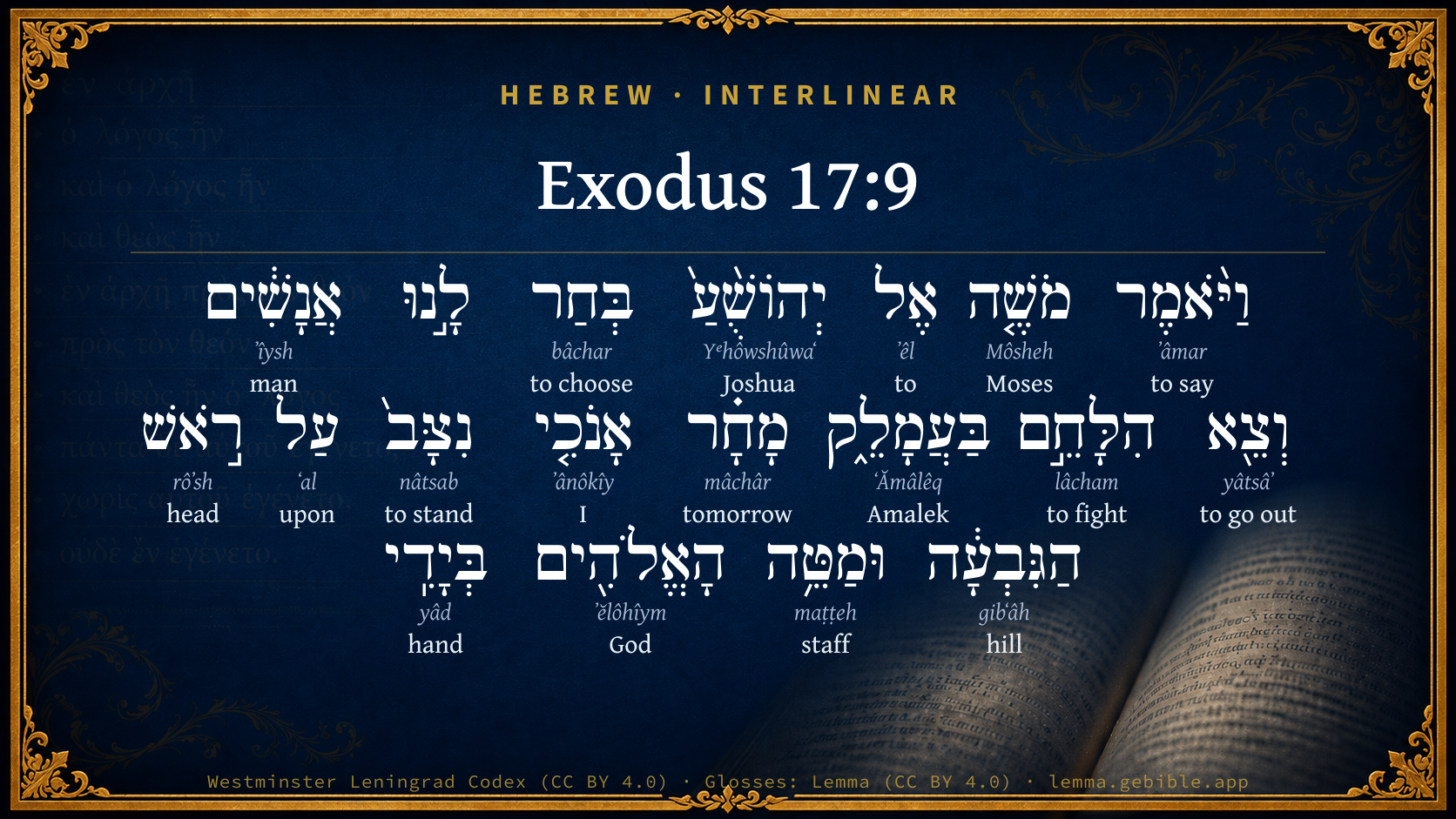
Hebrew (Westminster Leningrad Codex) Exodus 17:9 appears in the Hebrew Old Testament. The text above is from the Westminster Leningrad Codex. Each word links to its Strong’s number, a concise gloss, and parsing drawn from the Open Scriptures Hebrew Bible morphology. Click any word for its full Brown-Driver-Briggs (BDB) entry.
Download image
Cite this verse

Exodus 17:9 (World English Bible). Public Domain. Lemma interlinear Bible study tool, https://lemma.gebible.app/v/exodus/17/9.

Show BibTeX & RIS
BibTeX
RIS
English Translation
Moses said to Joshua, "Choose men for us, and go out, fight with Amalek. Tomorrow I will stand on the top of the hill with God's rod in my hand."
World English Bible · Public Domain
Highlights Full analysis ↓
Download a study sheet

One document with this verse’s original text, its word-by-word gloss line, the meaning frame, cross-references with their text, attributed commentary, and full source and license credits — printable, and it pastes into notes with its structure intact.

This verse Autodidact and up

Study sheet (.html) Plain text (.txt)

A passage Seminary Student

Up to 50 verses in one chapter. A passage sheet keeps up to 6 commentary sources and 12 cross-references per verse, in the order this page ranks them, and says so on the sheet whenever that leaves anything out. Ask for a single verse and you get the Autodidact verse sheet above.

Everything on this page stays free to read, with no account — the sheet is a download of what is already on screen, not access to it.

Want to remove ads? Support Godless Engineer
Compare translations 3

The same verse in 3 English versions, stacked beneath the original-language interlinear above. Click any original word for its lexicon entry.

Each is an independent rendering of the whole verse — the interlinear is not word-aligned to these translations.

Highlighted words mark where these versions differ — a whole-verse word diff, not a word-by-word alignment.

  • World English Bible Public Domain
    Moses said to Joshua, "Choose men for us, and go out, fight with Amalek. Tomorrow I will stand on the top of the hill with God's rod in my hand."
  • King James Version Public Domain
    And Moses said unto Joshua, Choose us out men, and go out, fight with Amalek: to morrow I will stand on the top of the hill with the rod of God in mine hand.
  • unfoldingWord Literal Text CC BY-SA 4.0
    And Moses said to Joshua, “Choose men for us and go out. Fight with Amalek. Tomorrow I will be stationed on top of the hill, and the staff of God will be in my hand.”

unfoldingWord Literal Text — © unfoldingWord, licensed CC BY-SA 4.0. Word-aligned USFM3 via Door43 (git.door43.org/unfoldingWord/en_ult).

Versions to compare (up to 4)

3 of 4 selected

Show all 18 translations

Every available English version of this verse, each an independent rendering of the whole verse.

  • World English Bible Public Domain
    Moses said to Joshua, "Choose men for us, and go out, fight with Amalek. Tomorrow I will stand on the top of the hill with God's rod in my hand."
  • Berean Standard Bible Public Domain
    So Moses said to Joshua, “Choose some of our men and go out to fight the Amalekites. Tomorrow I will stand on the hilltop with the staff of God in my hand.”
  • Majority Standard Bible Public Domain
    So Moses said to Joshua, “Choose some of our men and go out to fight the Amalekites. Tomorrow I will stand on the hilltop with the staff of God in my hand.”
  • King James Version Public Domain
    And Moses said unto Joshua, Choose us out men, and go out, fight with Amalek: to morrow I will stand on the top of the hill with the rod of God in mine hand.
  • American Standard Version (1901) Public Domain
    And Moses said unto Joshua, Choose us out men, and go out, fight with Amalek: to-morrow I will stand on the top of the hill with the rod of God in my hand.
  • Revised Version (1885) Public Domain
    And Moses said unto Joshua, Choose us out men, and go out, fight with Amalek: tomorrow I will stand on the top of the hill with the rod of God in mine hand.
  • Geneva Bible (1599) Public Domain
    And Moses sayde to Ioshua, Chuse vs out men, and go fight with Amalek: to morowe I will stande on the toppe of the hill with the rod of God in mine hand.
  • Douay-Rheims (1899) Public Domain
    And Moses said to Josue: Choose out men: and go out and fight against Amalec: to morrow I will stand on the top of the hill having the rod of God in my hand.
  • Young's Literal Translation Public Domain
    and Moses saith unto Joshua, `Choose for us men, and go out, fight with Amalek: to-morrow I am standing on the top of the hill, and the rod of God in my hand.'
  • Literal Standard Version CC BY-SA 4.0
    and Moses says to Joshua, “Choose men for us, and go out, fight with Amalek: tomorrow I am standing on the top of the hill, and the rod of God in my hand.”
  • Unlocked Literal Bible CC BY-SA 4.0
    So Moses said to Joshua, “Choose some men and go out. Fight with Amalek. Tomorrow I will stand on top of the hill with the staff of God in my hand.”
  • unfoldingWord Literal Text CC BY-SA 4.0
    And Moses said to Joshua, “Choose men for us and go out. Fight with Amalek. Tomorrow I will be stationed on top of the hill, and the staff of God will be in my hand.”
  • Darby Bible Public Domain
    And Moses said to Joshua, Choose us men, and go out, fight with Amalek; to-morrow I will stand on the top of the hill with the staff of God in my hand.
  • World Messianic Bible Public Domain
    Moses said to Joshua, “Choose men for us, and go out to fight with Amalek. Tomorrow I will stand on the top of the hill with God’s rod in my hand.”
  • Webster's Bible Public Domain
    And Moses said to Joshua, Choose us out men, and go out, fight with Amalek: to-morrow I will stand on the top of the hill with the rod of God in my hand.
  • Free Bible Version CC BY-SA 4.0
    Moses told Joshua, “Choose some men and go out and fight the Amalekites. Tomorrow I'll stand on the top of this hill holding the walking stick of God.”
  • Bible in Basic English Public Domain
    And Moses said to Joshua, Get together a band of men for us and go out, make war on Amalek: tomorrow I will take my place on the top of the hill with the rod of God in my hand.
  • JPS Tanakh (1917) Public Domain
    And Moses said unto Joshua: 'Choose us out men, and go out, fight with Amalek; tomorrow I will stand on the top of the hill with the rod of God in my hand.'

Literal Standard Version (2020), Covenant Press — licensed CC BY-SA 4.0. Text via the HelloAO Bible API (eBible.org). Unlocked Literal Bible (unfoldingWord) — licensed CC BY-SA 4.0. Text via the HelloAO Bible API (eBible.org). unfoldingWord Literal Text — © unfoldingWord, licensed CC BY-SA 4.0. Word-aligned USFM3 via Door43 (git.door43.org/unfoldingWord/en_ult). Free Bible Version, Dr. Jonathan Gallagher — licensed CC BY-SA 4.0. Text via the HelloAO Bible API (eBible.org).

Word by word

More ways to search: Search by grammar → Find every occurrence → Compare this word →

Practice this passage: Drill this verse → Learn its vocabulary →

בַּעֲמָלֵ֑ק
ʻĂmâlêq
H6002
“in/at · Amalek”
Preposition + Noun, Proper
Part of Speech
Preposition + Noun
Type
Proper
Full BDB Definition

Origin: probably of foreign origin

TWOT: None

Amalek = "dweller in a valley" - son of Eliphaz by his concubine Timnah, grandson of Esau, and progenitor of a tribe of people in southern Canaan - descendants of Amalek
  1. וַיֹּ֨אמֶר ʼâmar H559 “and · to say” Conjunction + Verb, Qal, Sequential Imperfect, 3rd Person, Masculine, Singular
  2. מֹשֶׁ֤ה Môsheh H4872 “Moses” Noun, Proper
  3. אֶל ʼêl H413 “to” Preposition
  4. יְהוֹשֻׁ֨עַ֙ Yᵉhôwshûwaʻ H3091 “Joshua” Noun, Proper
  5. בְּחַר bâchar H977 “choose” Verb, Qal, Imperative, 2nd Person, Masculine, Singular
  6. אֲנָשִׁ֔ים ʼîysh H376 “men” Noun, Common, Masculine, Plural, Absolute
  7. וְצֵ֖א yâtsâʼ H3318 “and · go out” Conjunction + Verb, Qal, Imperative, 2nd Person, Masculine, Singular
  8. הִלָּחֵ֣ם lâcham H3898 “fight” Verb, Niphal, Imperative, 2nd Person, Masculine, Singular
  9. מָחָ֗ר mâchâr H4279 “tomorrow” Noun, Common, Masculine, Singular, Absolute
  10. אָנֹכִ֤י ʼânôkîy H595 “I” Pronoun, Personal, 1st Person, Common, Singular
  11. נִצָּב֙ nâtsab H5324 “standing” Verb, Niphal, Participle Active, Masculine, Singular, Absolute
  12. עַל ʻal H5921 “upon” Preposition
  13. רֹ֣אשׁ rôʼsh H7218 “head of” Noun, Common, Masculine, Singular, Construct
  14. הַגִּבְעָ֔ה gibʻâh H1389 “the · hill” Particle, Definite Article + Noun, Common, Feminine, Singular, Absolute
  15. וּמַטֵּ֥ה maṭṭeh H4294 “and · staff of” Conjunction + Noun, Common, Masculine, Singular, Construct
  16. הָאֱלֹהִ֖ים ʼĕlôhîym H430 “the · God(s)” Particle, Definite Article + Noun, Common, Masculine, Plural, Absolute
  17. בְּיָדִֽי yâd H3027 “in/at · hand · my” Preposition + Noun, Common, Both, Singular, Construct + Suffix, Personal, 1st Person, Common, Singular

About this verse

These counts appear in no published source. They are computed here, from the morphology-tagged text and Lemma’s own curated glosses. What Lemma adds →

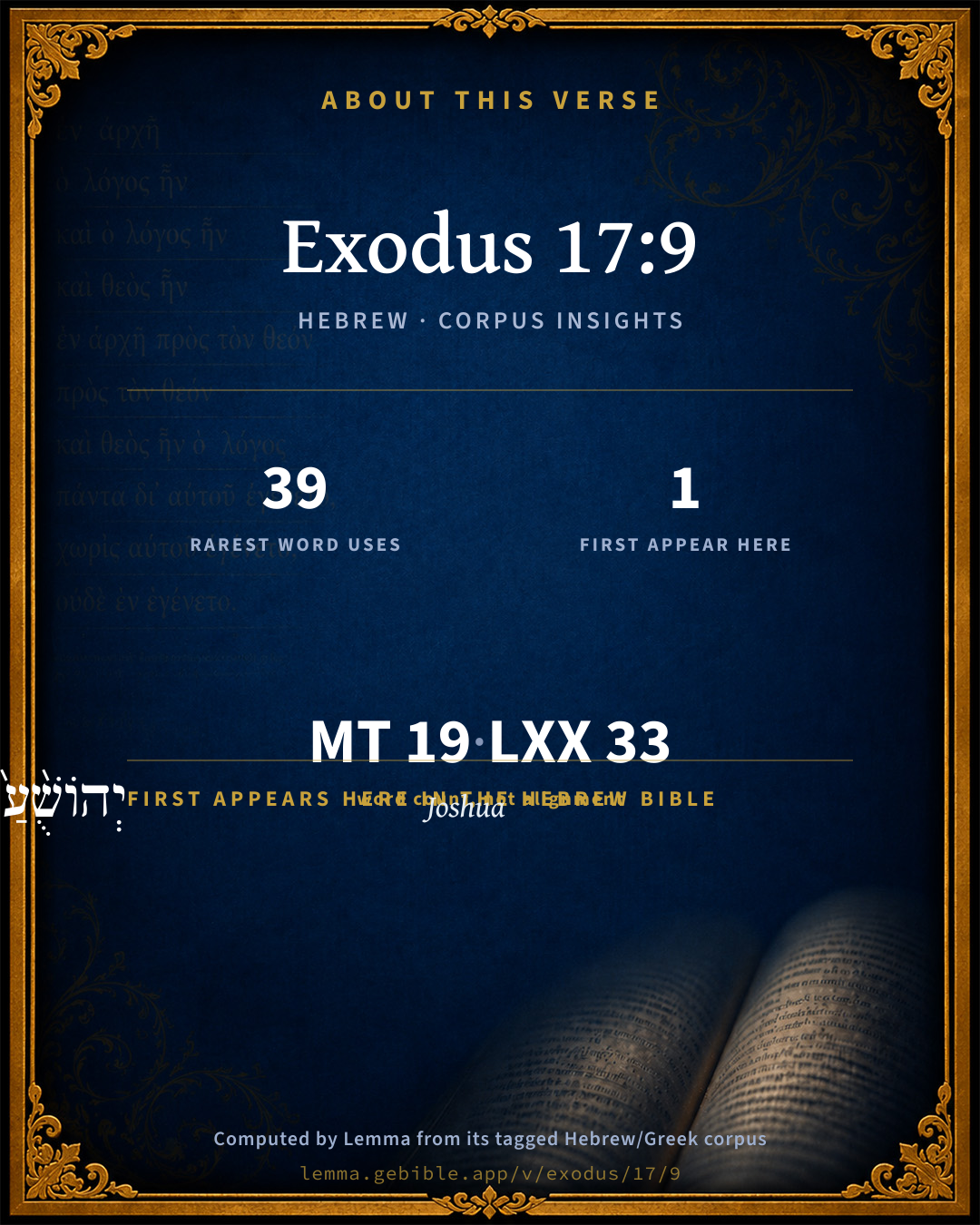
19
words
18
distinct lemmas
Pentateuch
section

First appearance in Scripture

This word makes its first canonical appearance in the Hebrew Bible here:

  • יְהוֹשֻׁ֨עַ֙ Joshua H3091

Shared distinctive vocabulary

בַּעֲמָלֵ֑ק Amalek H6002 occurs in 37 verses of the Hebrew Bible. Also found in:

Grammatical profile

  • 5 verbs
  • 10 nouns
  • 1 pronoun
  • 3 prepositions

Verb forms

  • וַיֹּ֨אמֶר Qal · Sequential Imperfect
  • בְּחַר Qal · Imperative
  • וְצֵ֖א Qal · Imperative
  • הִלָּחֵ֣ם Niphal · Imperative
  • נִצָּב֙ Niphal · Participle Active

Hebrew & Septuagint length

In English translation the verse runs 30 words from the Hebrew and 44 from the Septuagint (LXX English) — the Septuagint runs noticeably longer here. See the side-by-side →

A rough comparison of the two English renderings, which tokenize alike — not a word-level alignment.

Word counts can differ between the Hebrew and the Greek without any difference in meaning — e.g. the Hebrew direct-object marker אֵת has no separate Greek word, and Greek often adds the article ὁ.

In the original languages it is 19 Hebrew tokens and 33 Greek tokens — but the two are counted differently (Hebrew bundles its prefixes and suffixes into one token; the Greek is in lemma form), so that isn’t a like-for-like length.

Cross-references

10

Topical passages linked to Exodus 17:9 in the Treasury of Scripture Knowledge — connected by theme and wording, ordered by reader-vote popularity; previews shown in the World English Bible.

  • Exodus 4:20 Moses took his wife and his sons, and set them on a donkey, and he returned to the land of Egypt. Moses took God's rod in his hand.
  • Exodus 24:13 Moses rose up with Joshua, his servant, and Moses went up onto God's Mountain.
  • Deuteronomy 32:44 Moses came and spoke all the words of this song in the ears of the people, he and Joshua the son of Nun.
  • Exodus 4:2 Yahweh said to him, "What is that in your hand?" He said, "A rod."
  • Hebrews 4:8 For if Joshua had given them rest, he would not have spoken afterward of another day.
  • Exodus 17:13 Joshua defeated Amalek and his people with the edge of the sword.
  • Numbers 11:28 Joshua the son of Nun, the minister of Moses, one of his chosen men, answered, My lord Moses, forbid them.
  • Numbers 31:3–4 Moses spoke to the people, saying, Arm you men from among you for the war, that they may go against Midian, to execute Yahweh's vengeance on Midian.
  • Acts 7:45 which also our fathers, in their turn, brought in with Joshua when they entered into the possession of the nations, whom God drove out before the face of our fathers, to the days of David,
  • Numbers 13:16 These are the names of the men who Moses sent to spy out the land. Moses called Hoshea the son of Nun Joshua.

Cross-references courtesy of OpenBible.info (CC BY 4.0).

Hebrew and Greek witnesses Masoretic Hebrew ↔ Greek Septuagint

The same verse in the two great witnesses to the Old Testament, shown verse-for-verse.

Here the Septuagint runs noticeably longer than the Hebrew — LXX2012 (modern English Septuagint) 44 words vs World English Bible 30. A rough length comparison of the two English translations, not a word-level alignment — read both below.

These are two independent witnesses, not word-aligned to each other, and the Septuagint is shown in lemma (dictionary) form.

Hebrew Exodus 17:9 Masoretic · Westminster Leningrad Codex

וַיֹּ֨אמֶר מֹשֶׁ֤ה אֶל יְהוֹשֻׁ֨עַ֙ בְּחַר לָ֣נוּ אֲנָשִׁ֔ים וְצֵ֖א הִלָּחֵ֣ם בַּעֲמָלֵ֑ק מָחָ֗ר אָנֹכִ֤י נִצָּב֙ עַל רֹ֣אשׁ הַגִּבְעָ֔ה וּמַטֵּ֥ה הָאֱלֹהִ֖ים בְּיָדִֽי

Moses said to Joshua, "Choose men for us, and go out, fight with Amalek. Tomorrow I will stand on the top of the hill with God's rod in my hand."

World English Bible · Public Domain

Greek LXX Exodus 17:9 Septuagint · lemma form

εἶπον δέ μωυσῆς ὁ ἰησοῦς ἐπιλέγω σεαυτοῦ ἀνήρ δυνατός καί ἐκἔρχομαι παρατάσσω ὁ αμαληκ αὔριον καί ἰδού ἐγώ ἵστημι ἐπί ὁ κορυφή ὁ βουνός καί ὁ ῥάβδος ὁ θεός ἐν ὁ χείρ ἐγώ

And Moses said to Joshua, Choose out for yourself mighty men, and go forth and set the army in array against Amalec to-morrow; and, behold, I shall stand on the top of the hill, and the rod of God will be in my hand.

LXX2012 (modern English Septuagint) · Public Domain

On this verse, Adam Clarke's Commentary discusses the Septuagint’s reading. Read the note in Commentary ↓

Hebrew: Westminster Leningrad Codex (CC BY 4.0). Greek: Septuagint (public domain); English from LXX2012 (modern English Septuagint) (Public Domain). How the Septuagint differs from the Hebrew →

Targum (Aramaic paraphrase)

2

The Targum is the ancient Jewish Aramaic paraphrase of the Hebrew Scriptures — an interpretive translation, not the Hebrew text itself. Onkelos (literal) and Pseudo-Jonathan (expansive) render the Torah, and Jonathan the Prophets. Coverage is partial: where no permissively-licensed English translation exists for a verse, only the Aramaic is shown. This is verse-level text, not a word-by-word alignment to the Hebrew.

  1. Targum Onkelos Torah (Genesis–Deuteronomy)
    וַאֲמַר משֶׁה לִיהוֹשֻׁעַ בְּחַר לָנָא גֻבְרַיָא וּפוּק אֲגַח קְרָבָא בַּעֲמָלֵק מְחָר אֲנָא קָאֵם עַל רֵישׁ רָמָתָא וְחוּטְרָא דְאִתְעֲבִידוּ בֵהּ נִסִין מִן קֳדָם יְיָ בִּידִי:

    (no public-domain English translation for this verse)

    Targum Onkelos — Aramaic: “Onkelos Genesis” (public domain); “Onkelos Exodus” (public domain); “Onkelos Leviticus” (public domain); “Onkelos Numbers” (public domain); “Onkelos Deuteronomy” (public domain). English: “Sefaria Community Translation” (CC0 1.0 (public-domain dedication)); “J.W. Etheridge. The Targums of Onkelos and Jonathan Ben Uzziel on the Pentateuch. London: Longmans, Green, 1862” (public domain). Text via Sefaria.

  2. Targum Pseudo-Jonathan Torah (Genesis–Deuteronomy)
    וַאֲמַר משֶׁה לִיהוֹשֻׁעַ בְּחַר לָנָא גּוּבְרִין גִּבָּרִין וְתַקִּיפִין בְּפִקּוּדַיָא וְנִצְחָנֵי קְרָבָא וּפוּק מִתְּחוֹת עֲנָנֵי יְקָרָא וּסְדַר סִדְרֵי קְרָבָא לִקְבֵיל מַשִׁירְיַין עֲמָלֵק מְחַר אֲנָא קָאִים בְּצוֹמָא מֵעַתַּד בְּזַכְוָות אַבְהָתָא רֵישֵׁי עַמָּא וְזַכְוַות אִימְהָתָא דִמְתִילַן לִגְלִימָתָא וְחוּטְרָא דְאִתְעֲבִידוּ בֵיהּ נִיסִין מִן קֳדָם יְיָ בִּידִי

    And Mosheh said to Jehoshua, Choose such men as are strong in the precepts, and victorious in fight; and go, under the Cloud of glory, and set battle in array against the hosts of Amalek. Tomorrow I will stand, prepared with fasting, with the righteous fathers of the chiefs of the people, and the righteous mothers who are like the hills, with the rod with which the miracles have been wrought from before the Lord, in my hand.

    Targum Pseudo-Jonathan — Aramaic: “Targum Jonathan on Genesis” (public domain); “Targum Jonathan on Exodus” (public domain); “Targum Jonathan on Leviticus” (public domain); “Targum Jonathan on Numbers” (public domain); “Targum Jonathan on Deuteronomy” (public domain). English: “The Targum of Jonathan ben Uzziel, trans. J. W. Etheridge, London, 1862” (public domain). Text via Sefaria.

Commentary

Notes on Exodus 17:9 from classic Christian and Jewish commentators (each source and its license shown beneath its notes). The classic Christian expositions comment on the surrounding passage and are grouped to its opening verse, so a note may address several verses; the Jewish commentaries on the Tanakh (Rashi and others) are per-verse, so they appear only where the commentator wrote on this verse.

Lemma curates 59 commentaries, every one of them public domain or Creative Commons licensed, each selected and text-cleaned for this edition rather than reprinted as found. About our sources →

Trapp's Complete Commentary

John Trapp

Exo 17:9 And Moses said unto Joshua, Choose us out men, and go out, fight with Amalek: to morrow I will stand on the top of the hill with the rod of God in mine hand.

Ver. 9. I will stand on the top.] Where the people might see him with that ensign in his hand, and be encouraged. Xerxes used to pitch his tent on high, and stand looking on his army when in fight, for their encouragment.

John Trapp, A Commentary or Exposition upon All the Books of the Old and New Testament (1647–1656) — public domain. Text from a community e-Sword module.

The Biblical Illustrator

Joseph S. Exell

Exo_17:9

The rod of God.

Moses rod, the emblem of power and faith

I. The rod served to join man and God in the work of the Lord. At the one end, Faith; at the other, Almighty Power.

II. The rod served to increase the confidence of the people in their God, Success everywhere attended the rod.

III. The rod served to teach the people dependence upon God for their success in battle.

IV. The rod served to teach the people the need of holy and devout men. (Homilist.)

Man as a servant of God

The words (Exo_4:17) lead us to contemplate man as a servant of God--a servant to promote the true progress of the race. They suggest four things which God requires man to do in this grand service.

I. To use the instrument most at his command,

II. To turn old things to new uses.

III. To aim at mighty ends by apparently insignificant means.

IV. To follow gods will, rather than the dictates of our own wisdom. (Homilist.)

The old rod, or the inspiration of common ministries

Wondrous is one little line in the history:--And thy rod, wherewith thou smotest the river, take in thine hand, and go, and afterward Moses, having spoken to Joshua, said, I will stand on the top of the hill with the rod of God in mine hand. Never forget the old rod, the old book, the old truth;--the sword that cut off the head of Goliath--Give me that, said David, there is none like it. Thus God hides inspiration in things of apparently little value, and touches the imagination and the faith by books, ministries, churches, altars, which we thought had passed away into desuetude, perhaps oblivion. Your first prayer may help you to-day. The faith of your youth may be the only thing to win the battle which now challenges your strength. One little hour with the old, old book may be all you need to obtain the sufficiency of light which will drive away the cloud of mystery and bring in the heaven of explanation. (J. Parker, D. D.)

The Biblical Illustrator, edited by Joseph S. Exell (c. 1880s–1900s) — public domain. Text from a community e-Sword module.

Joseph Benson's Commentary

Exo 17:9. I will stand on the top of the hill with the rod of God in my hand — See how God qualifies his people for, and calls them to various services for the good of his church; Joshua fights, Moses prays, and both minister to Israel. This rod Moses held up, not so much to Israel, to animate them, as to God, by way of appeal to him. Is not the battle the Lord’s? Is not he able to help, and engaged to help? Witness this rod! Moses was not only a standard-bearer, but an intercessor, pleading with God for success and victory.

Joseph Benson's Commentary on the Old and New Testaments (1811–1818) — public domain. Text from a community e-Sword module.

Tyndale Open Study Notes

Tyndale Open Resources

17:9-13 This victory was a gift from God, as the description here makes clear. The determining factor was God’s blessing, as indicated by Moses’ upraised hands. This principle was illustrated again and again in the conquest of the land of Canaan. Without God’s blessing, Israel could do nothing (see Num 14:42-45; Josh 7:10-12).

17:9 Joshua was Moses’ trusted assistant (33:11) who would eventually become his successor (Deut 31:7-8). This early experience was important training for leading the people later in the conquest of the land. The Hebrew name Joshua, which means “savior,” is equivalent to the Greek name Jesus (see also study note on Heb 4:8).

Tyndale Open Study Notes — © Tyndale Open Resources, licensed CC BY-SA 4.0. Text via the HelloAO Bible API.

Geneva Bible (1599)

Geneva Bible translators

That is, Horeb, which is also called Sinai.

Geneva Bible (1599) marginal notes — public domain. Text via Bolls.life.

Jamieson, Fausset & Brown

Robert Jamieson, A. R. Fausset & David Brown

Moses said unto Joshua--or, "Jesus" (Act 7:45; Heb 4:8). This is the earliest notice of a young warrior destined to act a prominent part in the history of Israel. He went with a number of picked men. There is not here a wide open plain on which the battle took place, as according to the rules of modern warfare. The Amalekites were a nomadic tribe, making an irregular attack on a multitude probably not better trained than themselves, and for such a conflict the low hills and open country around this wady would afford ample space [ROBINSON].

Jamieson, Fausset & Brown — Commentary Critical and Explanatory on the Whole Bible (1871) — public domain (CC PDM 1.0). Text via the HelloAO Bible API.

Adam Clarke's Commentary

Verse 9. Moses said unto Joshua] This is the first place in which Joshua the son of Nun is mentioned: the illustrious part which he took in Jewish affairs, till the settlement of his countrymen in the promised land, is well known. He was captain-general of the Hebrews under Moses; and on this great man's death he became his successor in the government. Joshua was at first called Hoshea, Nu 13:16, and afterwards called Joshua by Moses. Both in the Septuagint and Greek Testament he is called Jesus: the name signifies Saviour; and he is allowed to have been a very expressive type of our blessed Lord. He fought with and conquered the enemies of his people, brought them into the promised land, and divided it to them by lot. The parallel between him and the Saviour of the world is too evident to require pointing out.

Top of the hill] Probably some part of Horeb or Sinai, to which they were then near.

Adam Clarke's Commentary on the Bible (1810–1826) — public domain. Text from a community e-Sword/MySword module.

Ellicott's Commentary for English Readers

(9) Moses said unto Joshua.—This is the first mention of Joshua. He was an Ephraimite, the son of a man called Nun, and the tenth in descent from Joseph (see Note on Exo_6:16), in the prime of life—about 45 years old—and probably known as possessing military capacity. His actual name at the timo was Hoshea, which might have been viewed as a good omen, since the word meant “Saviour.” Moses afterwards changed his name to Jehoshua (Num_13:16), which became by contraction Joshua. We find him, later in Exodus, acting as Moses’ personal attendant, or “minister” (Num_24:13; Num_32:17; Num_33:11), accompanying him to the top of Sinai, and placed by him in charge of the first “Tabernacle.” Afterwards he, with Caleb, was the only one of the spies who brought back a true report of Canaan. (Num_14:6-9.) His choice as leader to succeed Moses resulted naturally from his antecedents, and is related in Num_27:18-23.

Choose us out men.—The weakness of Israel was in its unwieldy numbers. Moses saw this, and, after deciding that he was himself unfit for battle, and passing the command on to Joshua, made the one suggestion that a select body of troops should be employed against the assailants. The advice was good, and “Joshua did as Moses had said to him” (Exo_17:10).

I will stand on the top of the hill.—A particular “hill” was no doubt meant—a “hill,” and not a mountain. But the exact scene of the battle is too uncertain to make it possible to fix on any one particular eminence.

A Bible Commentary for English Readers, edited by Charles John Ellicott (1878–1897) — public domain. Text from a community e-Sword module.

The Cambridge Bible for Schools and Colleges

gen. ed. J. J. S. Perowne

9. Joshua] mentioned here for the first time. Afterwards he appears frequently in the Pent. as Moses’ attendant, Exo_24:13, Exo_32:17, Exo_33:11, Num_11:28, and elsewhere. According to P, he only received the name of Joshua at Kadesh, Num_13:8; Num_13:16, having been till then called Hoshea.

the rod of God] as Exo_4:20.

The Cambridge Bible for Schools and Colleges (gen. ed. J. J. S. Perowne; Cambridge University Press, 1878–1918) — public domain. Text from a community e-Sword module.

John Gill's Exposition

And Moses said unto Joshua,.... The son of Nun, who was his minister, and was a man of war from his youth, trained up in the art of war, and afterwards succeeded Moses, and was captain of the armies of Israel, and fought at the head of them, and subdued the Canaanites. Moses knew he was a fit person for the present purpose, and therefore gave him the following orders:

choose us out men; the stoutest and most courageous, best able to bear arms, and engage in war; for the multitude in common was not qualified for such service, nor was there any necessity of engaging them all in it:

and go out; out of the camp, and meet them at some distance, that the women and children might not be terrified with the enemy:

fight with Amalek; for their cause was just, Amalek was the aggressor, Israel was on the defensive part; and should it be asked where they had arms to fight with, it may be remembered that the Egyptian army that was drowned in the Red sea, and whose bodies were cast upon the shore, might furnish them with a large quantity of armour, which they stripped them of, and arrayed themselves with:

tomorrow I will stand upon the top of the hill, with the rod of God in my hand: on the top of Mount Horeb or Sinai, where he might be seen by the army of Israel with that rod in his hand, lifted up as a banner, by which God had done so many wonderful things; and by which they might be encouraged to hope that victory would go on their side, and this he promised to do "tomorrow", the day following; for sooner a select body of men could not be taken out from the people, and accoutred for war, and go forth to meet the enemy.

John Gill's Exposition of the Whole Bible (1746–1763) — public domain (CC PDM 1.0). Text via the HelloAO Bible API.

Albert Barnes' Notes on the Bible

Joshua - This is the first mention of the great follower and successor of Moses. He died at the age of 110, some 65 years after this transaction. His original name was Hosea, but Moses calls him by the full name, which was first given about forty years afterward, as that by which he was to be known to succeeding generations. From this it may perhaps be inferred that this portion of Exodus was written, or revised, toward the end of the sojourn in the wilderness.

The rod of God - See Exo 4:20. The hill is supposed to be the height now called Feria an the north side of the plain Er Rahah; (or, Jebel Tahuneh over Feiran. Palmer).

Albert Barnes' Notes on the Bible (1834–1885) — public domain. Text from a community e-Sword/MySword module.

Haydock's Catholic Bible Commentary

Josue, who was before called Osee, or Ausem, was the son of Nun. From the victory obtained over the Amalecites, he was ever after called Josue, Jehosuah, or Jesus, "Saviour." He attached himself to Moses, and is styled his servant, as Patroclus and Merione are called servants of Achilles and of Idomen, by Homer; though they were men of high birth. --- Hand, to defend the cause of the Hebrews by a miracle, if it be requisite.

George Leo Haydock (1774–1849), Haydock's Catholic Family Bible and Commentary, 1859 edition — public domain. Excludes Psalms (Douay-Rheims chapter numbering differs from Protestant) and Deuterocanonical books (Catholic canon only).

Matthew Poole's English Annotations

Go out; out of the camp to meet the enemy.

I will stand on the top of the hill, both to observe thy carriage, and success or defeat, that I may govern myself accordingly, and that I may in that retirement pour out my soul unto the Lord of hosts, that he may give thee victory.

With the rod of God; by which having done so great exploits formerly, doubt not of the same Divine assistance to accompany it, and make thee victorious.

Matthew Poole's English Annotations on the Holy Bible (1683–1685) — public domain. Text from a community e-Sword/MySword module.

Whedon's Commentary on the Bible

Daniel D. Whedon

9-13. Moses said unto Joshua, Choose us out men — Moses’s great successor, the second leader of Israel, and the type of the great Redeemer both in name and in office, now first abruptly appears before us. His name was originally Hoshea, (or Oshea,) which means Help, or Deliverance; but it was changed by Moses, (Num_13:16,) probably after this victory over Amalek, into Jehoshua, or Joshua, by the addition of the Memorial Name, JAH, thus making it mean, JAH (is) DELIVERANCE or SALVATION, the JEHOVAH SAVIOUR. This name is rendered Ιησους in Greek, in English JESUS, the “Name which is above every name,” before which one day “every knee shall bow.” Joshua was an Ephraimite, the son of Nun, and was now about forty years old. See note on Mat_1:1. He was the military leader of Israel under Moses’s direction through all the desert sojourn, and now in this, his first recorded expedition, is ordered to pick a body of warriors to carry on the main battle with Amalek in the plain and valleys of Rephidim.

With the rod of God in mine hand — He calls his rod “the rod of God,” for all the wonders wrought by it were revelations of God’s power, not of his. This rod he was to elevate as a standard, a symbol of God’s presence with Israel. It was the rod that had smitten the Nile, and the Red Sea, and the rock of Meribah; and the sight of it would inspire the warriors of Israel with a consciousness that Jehovah was their real leader in this their first conflict with heathen powers. The gesture was at the same time an act of prayer, as he stood on the hill, above the battle, pointing heavenward with “the rod of God.”

Aaron and Hur — This Hur is said by Josephus to have been the husband of Miriam, and identical with the Hur who was the father of Uri and grandfather of the artist Bezaleel. Exo_31:2. Moses was thus accompanied by his near kinsmen — his brother and the husband of his sister — as he went up into the hill to inspire Israel and plead with God.

When Moses held up his hand — The hand that held the rod. It will be noticed that the word hand is used in the singular. We are not to think of him as kneeling, with both hands stretched to heaven in prayer, as the scene is generally represented in paintings. At first he stood, raising the rod first in the right hand and then in the left, until he became weary; then he sat upon the stone which Aaron and Hur put under him, Aaron on the one side helping him keep the rod raised, and Hur on the other. Had both hands been constantly elevated, and Aaron and Hur thus constantly employed in staying them up, they would soon have become as weary as he; but they relieved each other in this toil. Elevating the hands is not essential to prayer; and the Scripture nowhere represents success in prayer as dependent upon any posture or gesture: but continuance in prayer and faith was essential to success, and the elevated rod was the symbol of this continuance. Aaron and Hur not only stayed up his hands, but his heart, blending their prayer with his. When, through weariness, Moses ceased to exercise and inspire faith, the battle turned against Israel; but by the help and sympathy of his brethren he was strengthened to continue his spiritual struggle till Amalek was defeated. The leader chosen by God, whom they had just been ready to stone, and the rod, which was the symbol of Jehovah’s power, were thus shown to be essential to Israel’s success. Here also is beautifully shown the divine-human partnership in fulfilling the plans of Providence. The rod of Moses and the sword of Joshua were both essential to the victory over Amalek; the prayer upon the hill and the battle upon the plain were both necessary to Israel’s success. Joshua could not have conquered unless Moses had prayed and inspired prayer; he could not have kept up this spiritual struggle without the help of his two brethren; yet his soul would have wrestled in vain unless Joshua had fought. The battling host was victorious only while struggling both in earth and heaven.

Daniel D. Whedon (gen. ed.), Commentary on the Old and New Testaments (1874–1909) — public domain. Text from a community e-Sword module.

The Pulpit Commentary

And Moses said to Joshua. On hearing what had happened, Moses summoned to his presence an Ephraimite in the prime of life about 45 years old and devolved on him the military command. The man"s name at the time was Hoshea or Oshea. (Num_13:8) lie was the son of a certain Nun (ibid. ) or Non, (1Ch_7:27) and the tenth in descent from Ephraim, the son of Joseph (ib, 23-27). Some forty years later Moses changed his name from Hoshea to Jehoshua. which became contracted into Joshua. The occurrence of this form in the present passage may be accounted for.

1. By Moses having written (or reviewed) Exodus late in his life; or

2. By a later authorised reviser (Ezra?) having altered the text. Choose out for us meni.e. "Select from the congregation such a number of fit men as appear to thee sufficient, and with them fight Amalek." To-morrow. It was probably evening, when Moses heard of the attack on his rear, and there was consequently no possibility of retrieving the disaster till the next day. lie could but make his arrangements for retrieving it. I will stand on the top of the hill. It is implied that there was a conspicuous hill (gibeah), not a rock (tsur) in the near vicinity of Rephidim, whence Moses could see the fight, and be seen by those engaged in it. Dean Stanley finds all the conditions answered by an eminence on the south side of the Wady Feiran (Sinai and Palestine, p. 41). Others suggest the Jebel Tahuneh north of the same wady. With the rod of God in my hand. Moses meant to indicate by this, that he looked for victory to God alone, and did not trust in an "arm of flesh," while, nevertheless, he sent his soldiers to the combat.

Vers. 9-13. Diversities of gifts, but the same spirit.

DIVERSITIES OF GIFTS. The needs of life are various, and the gifts which God imparts to his saints are correspondingly diversified. In Moses, at the age of eighty, (Exo_7:7) the qualities required for the successful conduct of military matters were not present. It may be doubted whether he would at any period of his life have been a good general But his age, his temperament, and his training made him emphatically a man of prayer. Joshua, on the other hand, in the full vigour of middle life, active, energetic, bold, intrepid, indefatigable, was a born soldier, and a man well suited for military command. To Moses belongs the credit of having recognised the needs of the occasion, and the "diversity of gifts" in himself and his "minister." He took the duties, for which he felt himself fit, upon himself; he delegated those, for which he knew that he was unfit, to the individual who, among the thousands of Israel, appeared to him, and. no doubt was, the most perfectly fitted for them. In a minor way, it may be noticed that Aaron and Hur, unsuited for either military command or the leading part in sustained intercessory prayer, had yet gifts which enabled them to play a useful secondary part in support of Moses, and were selected by him for their fitness. The recognition of DIVERSITIES OF GIFTS is required

1. For the best utilisation of all the powers possessed by God"s people at any given time. Unless diversity be recognised, all aspirants naturally seek the same posts. All are rivals. Jealousies, sure to arise, are intensified. Discontents multiply. Rulers find the difficulty of government augmented. Again, special talents are wasted. The man most suited to one post occupies another. The gifts which he needs he often does not possess; those which he possesses he cannot exercise.

2. For the satisfaction of individuals. It is a sore grief to feel unfit for the work which we have to do; but it is a still sorer grief to be conscious of powers which have no field of exercise, while we see others in possession of the field without the powers. Individuals perhaps ought to be content if they can -perform satisfactorily the work that is set them. But minds of superior capacity are not, and never will be, thus satisfied. They want a congenial sphere, an occupation which would put their powers to the proof, a task which they would feel that they, and they alone, could perform properly. Hence, it is of great importance, for the contentation of those under their charge, that such as have the rule over men should both recognise the fact of "diversity of gifts," and seek to obtain a full knowledge of the special gifts of those to whose services they have to give employment.

3. For the general advance of God"s kingdom. It is only by utilising to the utmost all the gifts possessed by members of the Church at any given time, that the Church can be brought into the highest possible state of efficiency. "Diversities of gifts" are a fact. (1Co_12:4) "To one is given the word of wisdom; to another, the word of knowledge; to another, faith; to another, the gifts of healing; to another, the working of miracles; to another, prophecy; to another, discerning of spirits; to another, divers kinds of tongues; to another, the interpretation of tongues" (ib, 8-11). Unless this be recognised, unless each gifted one is put to his proper use, there is a waste of power an absolute loss to the Church a stoppage of possibilities which might have occurred, had things been better ordered.

THE SAME SPIRIT. Different as are the duties of life, various as are the calls made upon the individuals who compose the Christian community now for courage, now for counsel, now for governmental capacity, now for military skill, anon for earnest and prolonged prayer there is, after all, but one spirit in which all have to act, as there is also but One Spirit from whom the power to act aright in all cases comes. The merchant in his trade, the soldier on the battle field, the minister in his parish, the man of learning in his study, all may and all ought to act in one and the same spirit, diligently, manfully, earnestly, striving to do their duty, under their various circumstances, in singleness of heart, as unto the Lord and not unto man. The true Christian temper is one and the same, whatever a man"s occupation may be; and it is not very difficult to recognise in a Havelock or a Lawrence the identical tone and temper which we have admired in a Channing and a Wesley, a Pascal and a Fenelon. From One Spirit flow all the graces that adorn the Christian character; and the unity of the source is traceable in the graces themselves, which, amid all their diversity, have an element of likeness.

HOMILIES BY G. A. GOODHART Ver. 9. Thou hast given a banner unto them that fear thee.

1. THE ATTACK BY AMALEK. It was cowardly, malicious, merciless (Deu_25:17; 1Sa_15:2) not open, straightforward enmity; cutting off the feeble and the stragglers; a vulture-like hostility; a type and sample of diabolical hatred. Notice the parallel between Israel"s position with regard to Amalek and our position with regard to Satan and his emissaries.

1. Israel was. passing through the wilderness. So God"s people are passingthrough this world. (Heb_11:14) The country through which the route lies is not claimed by those who use it.

2. Amalek considered the wilderness as their own. So Satan claims to be the prince of this world. In either case the authority is usurped.

3. Amalek took Israel at a disadvantage. No cause of enmity assigned, only apparently the right assumed for the stronger to prey upon the weaker. Satan, too, always endeavours to take us at a disadvantage. He did not attack Christ until "he was a hungered;" he attacks us, also, when we are weakest.

II THE DEFENCE AND CONFLICT.

1. A chosen captain. Joshua is hell)." Perhaps name changed from Hoshea at this time; shows, at any rate, whence the leader derived his ability to lead. Our captain, "manifested to destroy the works of the devil." Had it not been for Satan"s enmity, how should we have known the power of Christ?

2. Selected soldiers. Not all the people, but chosen from the people. All share the danger, but the defence may best be undertaken by a few, though, no doubt, these few are supported and encouraged by the general sympathy. In the war with Satan the brunt of the battle must fall on the selected soldiers Christ chose apostles, and in every age the majority has been protected by representative champions. Satan must make more headway than he does, were it not that the weaker and more ignorant are sheltered from direct attack behind the bulwarks raised by the stronger and the wiser.

3. An uplifted banner. Usually the colours go before the army; here the banner God"s rod is upheld upon the mountain

(1) in full sight of all;

(2) in a position of comparative security. Notice

1. This banner was a sign of God"s helpful presence.

2. It was in full view of the fighters, and the fortune of the battle variedaccording as it was raised or lowered. Two things were necessary to ensure victory

(1) that the banner should be held up;

(2) that the fighters should keep looking at it. In the fight with Satan the same principle applies. God"s law, God"s righteous purpose, must be upheld by the Prophet, supported on one hand by the priest, on the other by the noble; but, further, the fighters must keep it well in view, nothing less than the assurance of its fixedness can nerve them so as to ensure victory.

III THE MEMORIAL.

1. A book. This victory a pledge of Amalek"s final exterruination.

2. An altar. "Jehovah our Banner," sign of a continuous war to be endedonly with the fulfilment of God"s purpose.

In the fight with Satan our Lord"s victory in the wilderness and on the cross, a pledge of final victory for all.

1. It is written in a book. Who has not read of it?

2. It is commemorated by a memorial, which all may see. "This do as amemorial of me." So long as there is evil in the world, so long there must be war. God"s soldiers must fight from generation to generation until the final victory be achieved. What is the secret of their strength? The banner uplifted upon the mountain. The rod of God. "It is written." The prophet uprears it. Priest and noble, in so far as they fulfil their office, unite to support the prophet. The fighters h,ok up to the banner, and, encouraged by its steadfast maintenance, fight on till victory be secured. G.

The Pulpit Commentary (1880–1919), ed. H.D.M. Spence-Jones & Joseph S. Exell — public domain. Text from a community e-Sword module.

John Wesley's Explanatory Notes

I will stand on the top of the hill with the rod of God in my land - See how God qualifies his people for, and calls them to various services for the good of his church; Joshua fights, Moses prays, and both minister to Israel. This rod Moses held up, not so much to Israel as to animate them; as to God by way of appeal to him; Is not the battle the Lord's? Is not he able to help, and engaged to help? Witness this rod! Moses was not only a standard-bearer, but an intercessor, pleading with God for success and victory.

John Wesley, Explanatory Notes Upon the Whole Bible (1754–1765) — public domain. Text via the GEBible commentary corpus.

Rashi

Rabbi Shlomo Yitzchaki (Rashi)

בחר לנו CHOOSE OUT MEN FOR US — for me and for you: he (Moses) placed him (Joshua) on the same level with himself. They (the Rabbis) derived from here the teaching: let thy disciple’s honour be as dear to thee as thy own. And whence may we derive the next statement in thee well-known passage: and thy colleague’s honour as dear to thee as the reverence due to thy teacher? Because it is said, (Numbers 12:11) “And Aaron spake to Moses, “I beseech thee, my lord” — but surely Aaron was older than his brother and yet by addressing him as “my lord” he treated his colleague (Moses) as his teacher! “And the reverence due to thy teacher as the reverence due to God” — whence may this be derived? Because it is said, (Numbers 11:28) “[And he (Joshua) said (to his teacher, Moses)] “My lord, Moses, כלאם”, destroy them (כַּלֵּם) from out of the world! they who rebel against thee deserve to be destroyed just the same as though they had rebelled against the Holy One, blessed be He (Mekhilta).

וצא הלחם GO OUT, FIGHT — go out from the cloud and fight against him (Mekhilta),

מחר TO-MORROW, at the time of the battle, I will take my stand.

בחר לנו אנשים CHOOSE US MEN — brave men, and men who fear sin (אנשים does not mean merely men — males, but men fit for war and at the same time God-fearing) — choose these so that their merit may stand them in good stead (cf. (Mekhilta). Another explanation: בחר לנו אנשים Choose us men who know how to make witchcraft of none effect; he said this because the sons of Amalek were wizards (cf. Rashi on v. 12)

Rashi on the Tanakh — English translations: “The Judaica Press complete Tanach with Rashi, translated by A. J. Rosenberg” (CC BY 4.0); “Pentateuch with Rashi's commentary by M. Rosenbaum and A.M. Silbermann, 1929-1934” (public domain); “The Metsudah Tanach series, Lakewood, N.J” (CC BY 4.0); and “The Book of Joshua, Metsudah Publications, 1997” (CC BY 4.0). Text via Sefaria.

Ramban (Nachmanides)

Rabbi Moshe ben Nachman (Ramban / Nachmanides)

AND MOSES SAID TO JOSHUA. It would appear from here that from the day he came before him, Moses called him Joshua, and so it is also written: And Joshua heard the noise of the people. Scripture which states in the case of the spies, And Moses called Hoshea the son of Nun, Joshua, must then be referring to the beginning, [when Joshua first came to minister before him]. The verse informs us that this Hoshea the son of Nun, who was chosen to be among the spies, is the same one that Moses called Joshua. Our Rabbis commented [that Moses gave him this name of Yehoshua, which is a compound of Y-ah (G-d) and hoshea (help), because] he in effect prayed for him, “May G-d help thee that thou mayest not follow the [evil] counsel of the spies.” The intent of this comment is to state that because of this event of which Moses knew in advance, i.e., that Joshua was destined to go with the spies, he called him by that name [Yehoshua — Joshua] at the outset. We may also say that at that time [when the spies were chosen], Moses designated that name in front of the assembly, i.e., that his name henceforth be not Hoshea but Joshua.The reason that Moses commanded Joshua to fight with Amalek was so that he [Moses] might pray with the raising of hands on the top of the hill. He went up there so that he might see the Israelites engage in battle and train his sight on them to bring them blessing. They too, upon seeing him with his hands spread heavenward and saying many prayers, would have trust in him, and they would thus be endowed with additional valor and strength.In Pirke d’Rabbi Eliezer, we find additionally: “All Israel went outside of their tents, and they saw Moses kneeling on his knees, and they did likewise. He fell on his face to the earth and they did likewise. He spread his hands heavenward, and they also did so. [From here, you learn the principle that] as the public reader of prayers recites, so do all the people respond after him. And thus the Holy One, blessed be He, caused Amalek and his people to fall by the hand of Joshua.” But if so, [i.e., if Moses’ hands were spread heavenward], the sense of the expression, with the rod of G-d in my hand, must be that when Moses went up to the top of the hill and saw Amalek, he stretched forth his hand with the rod to bring down [upon the Amalekites] strokes of pestilence, the sword and destruction, just as it is said in the case of Joshua: Stretch out the javelin that is in thy hand toward Ai, for I will give it into thy hand. From the moment Moses began to pray and his hands were spread heavenward, he held nothing in his hand.Moses our teacher did all this because Amalek was an enduring nation and very powerful. The Israelites, on the other hand, were not accustomed to battle and had never seen it, just as Scripture says, lest peradventure the people repent when they see war. In addition they were faint and weary, as it is written in the Book of Deuteronomy. Therefore, he [Moses] feared them, and it became necessary for all this prayer and supplication.It is possible that Moses feared lest Amalek be victorious with the sword, for he was the nation that inherited the sword by virtue of the blessing of the patriarch [Isaac], who said [to Esau, Amalek’s ancestor], and on thy sword you shall live. The first and final wars against Israel stem from this family, as Amalek is of the descendants of Esau., 36:12. It is from him who stood at the head of the nations [in power]. See Ramban, ibid., where he interprets it to mean: “Amalek is the ‘mightiest’ of the nations. This was why he dared to come to fight Israel,” it is clear that Ramban’s intent here is similar. that the [first] war came against us. From Esau’s descendants, [namely, Rome], the [present] exile and the last destruction of the Sanctuary came upon us, just as our Rabbis have said that today we are in the exile of Edom. When he will be vanquished, and he together with the many nations that are with him will be discomfited, we shall be saved out of it [i.e., the exile] forever, just as [the prophet] said, And saviors shall come up on Mount Zion, to judge the mount of Esau; and the kingdom shall be the Eternal’s. Now whatever Moses and Joshua did with them [the Amalekites] at first, Elijah and Mashiach ben Yoseph will do with their descendants. This was why Moses strained himself in this matter.

Ramban (Nachmanides) on the Tanakh — English translation: “Commentary on the Torah by Ramban (Nachmanides). Translated and annotated by Charles B. Chavel. New York, Shilo Pub. House, 1971-1976” (CC BY 4.0). Text via Sefaria.

Lesson kit

Teaching starters — assembled from the data on this page, not authored interpretation. Every prompt links to the verse data it draws on. Edit before teaching.

Exodus, in the Pentateuch, opens this verse with 19 words (18 distinct Hebrew lemmas). Its most distinctive word is ʻĂmâlêq (“Amalek”). The Greek Septuagint runs longer here. A historical commentator’s framing appears above. Read the whole chapter for the surrounding context.

Discussion questions

  1. What does “Amalek” (ʻĂmâlêq) contribute to the verse as a whole?
  2. This is the first place “Joshua” appears in Scripture (first appears here). What does its debut here establish?
  3. How does Genesis 36:12, which shares the word «Amalek», read alongside this verse?
  4. The Septuagint runs longer here than the Hebrew. What might account for the difference?
  5. These translations render this verse differently; the difference is in the English rendering, not the original. What questions does that raise?
  6. «וַיֹּ֨אמֶר» is a Qal Sequential Imperfect verb. How does that grammatical form shape the action described?
  7. Compare how Trapp's Complete Commentary and The Biblical Illustrator read this verse. Where do they agree or differ?

Things to notice

Reading settings

Reading text

Shown beneath each verse's original-language words.

Old Testament
Old Testament edition

Read the OT as the Masoretic Hebrew (MT) or the Greek Septuagint (LXX).

English shown for the Greek Septuagint (in the Hebrew ↔ Greek comparison).

Comparing translations? Open the Compare panel on any verse page to stack up to four side by side.