
Exodus 15:3

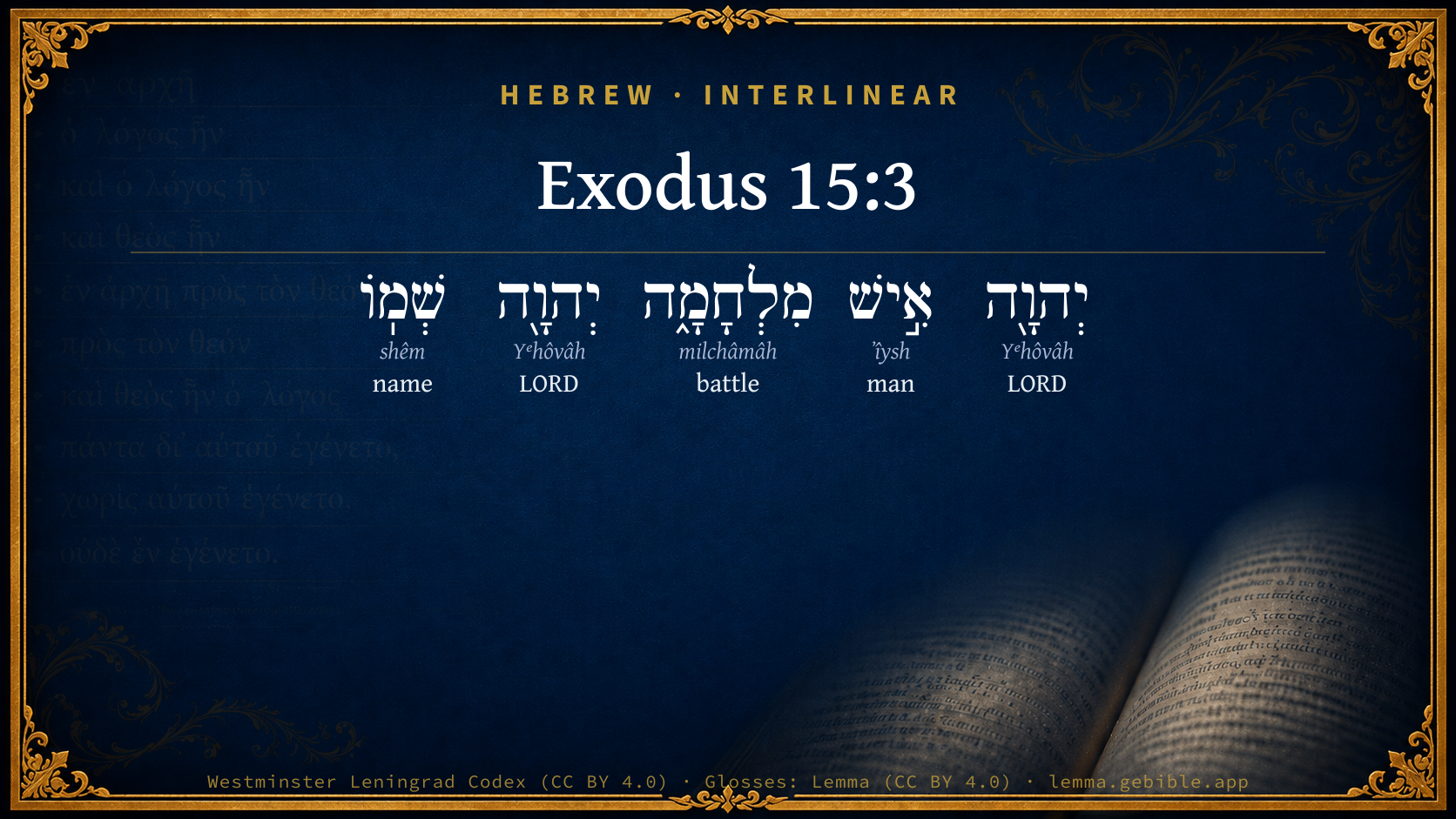
Hebrew (Westminster Leningrad Codex) Exodus 15:3 appears in the Hebrew Old Testament. The text above is from the Westminster Leningrad Codex. Each word links to its Strong’s number, a concise gloss, and parsing drawn from the Open Scriptures Hebrew Bible morphology. Click any word for its full Brown-Driver-Briggs (BDB) entry.
Download image
Cite this verse

Exodus 15:3 (World English Bible). Public Domain. Lemma interlinear Bible study tool, https://lemma.gebible.app/v/exodus/15/3.

Show BibTeX & RIS
BibTeX
RIS
English Translation
Yahweh is a man of war. Yahweh is his name.
World English Bible · Public Domain
Download a study sheet

One document with this verse’s original text, its word-by-word gloss line, the meaning frame, cross-references with their text, attributed commentary, and full source and license credits — printable, and it pastes into notes with its structure intact.

This verse Autodidact and up

Study sheet (.html) Plain text (.txt)

A passage Seminary Student

Up to 50 verses in one chapter. A passage sheet keeps up to 6 commentary sources and 12 cross-references per verse, in the order this page ranks them, and says so on the sheet whenever that leaves anything out. Ask for a single verse and you get the Autodidact verse sheet above.

Everything on this page stays free to read, with no account — the sheet is a download of what is already on screen, not access to it.

Want to remove ads? Support Godless Engineer
Compare translations 3

The same verse in 3 English versions, stacked beneath the original-language interlinear above. Click any original word for its lexicon entry.

Each is an independent rendering of the whole verse — the interlinear is not word-aligned to these translations.

Highlighted words mark where these versions differ — a whole-verse word diff, not a word-by-word alignment.

  • World English Bible Public Domain
    Yahweh is a man of war. Yahweh is his name.
  • King James Version Public Domain
    The LORD is a man of war: the LORD is his name.
  • unfoldingWord Literal Text CC BY-SA 4.0
    Yahweh is a man of war; Yahweh is his name.

unfoldingWord Literal Text — © unfoldingWord, licensed CC BY-SA 4.0. Word-aligned USFM3 via Door43 (git.door43.org/unfoldingWord/en_ult).

Versions to compare (up to 4)

3 of 4 selected

Show all 18 translations

Every available English version of this verse, each an independent rendering of the whole verse.

  • World English Bible Public Domain
    Yahweh is a man of war. Yahweh is his name.
  • Berean Standard Bible Public Domain
    The LORD is a warrior, the LORD is His name.
  • Majority Standard Bible Public Domain
    The LORD is a warrior, the LORD is His name.
  • King James Version Public Domain
    The LORD is a man of war: the LORD is his name.
  • American Standard Version (1901) Public Domain
    Jehovah is a man of war: Jehovah is his name.
  • Revised Version (1885) Public Domain
    The LORD is a man of war: the LORD is his name.
  • Geneva Bible (1599) Public Domain
    The Lord is a man of warre, his Name is Iehouah.
  • Douay-Rheims (1899) Public Domain
    The Lord is as a man of war, Almighty is his name.
  • Young's Literal Translation Public Domain
    Jehovah `is' a man of battle; Jehovah `is' His name.
  • Literal Standard Version CC BY-SA 4.0
    YHWH [is] a man of battle; YHWH [is] His Name.
  • Unlocked Literal Bible CC BY-SA 4.0
    Yahweh is a warrior; Yahweh is his name.
  • unfoldingWord Literal Text CC BY-SA 4.0
    Yahweh is a man of war; Yahweh is his name.
  • Darby Bible Public Domain
    Jehovah is a man of war; Jehovah, his name.
  • World Messianic Bible Public Domain
    The LORD is a man of war. The LORD is his name.
  • Webster's Bible Public Domain
    The LORD is a man of war: the LORD is his name.
  • Free Bible Version CC BY-SA 4.0
    The Lord is like a warrior. His name is the Lord.
  • Bible in Basic English Public Domain
    The Lord is a man of war: the Lord is his name.
  • JPS Tanakh (1917) Public Domain
    The LORD is a man of war, The LORD is His name.

Literal Standard Version (2020), Covenant Press — licensed CC BY-SA 4.0. Text via the HelloAO Bible API (eBible.org). Unlocked Literal Bible (unfoldingWord) — licensed CC BY-SA 4.0. Text via the HelloAO Bible API (eBible.org). unfoldingWord Literal Text — © unfoldingWord, licensed CC BY-SA 4.0. Word-aligned USFM3 via Door43 (git.door43.org/unfoldingWord/en_ult). Free Bible Version, Dr. Jonathan Gallagher — licensed CC BY-SA 4.0. Text via the HelloAO Bible API (eBible.org).

Word by word

More ways to search: Search by grammar → Find every occurrence → Compare this word →

Practice this passage: Drill this verse → Learn its vocabulary →

About this verse

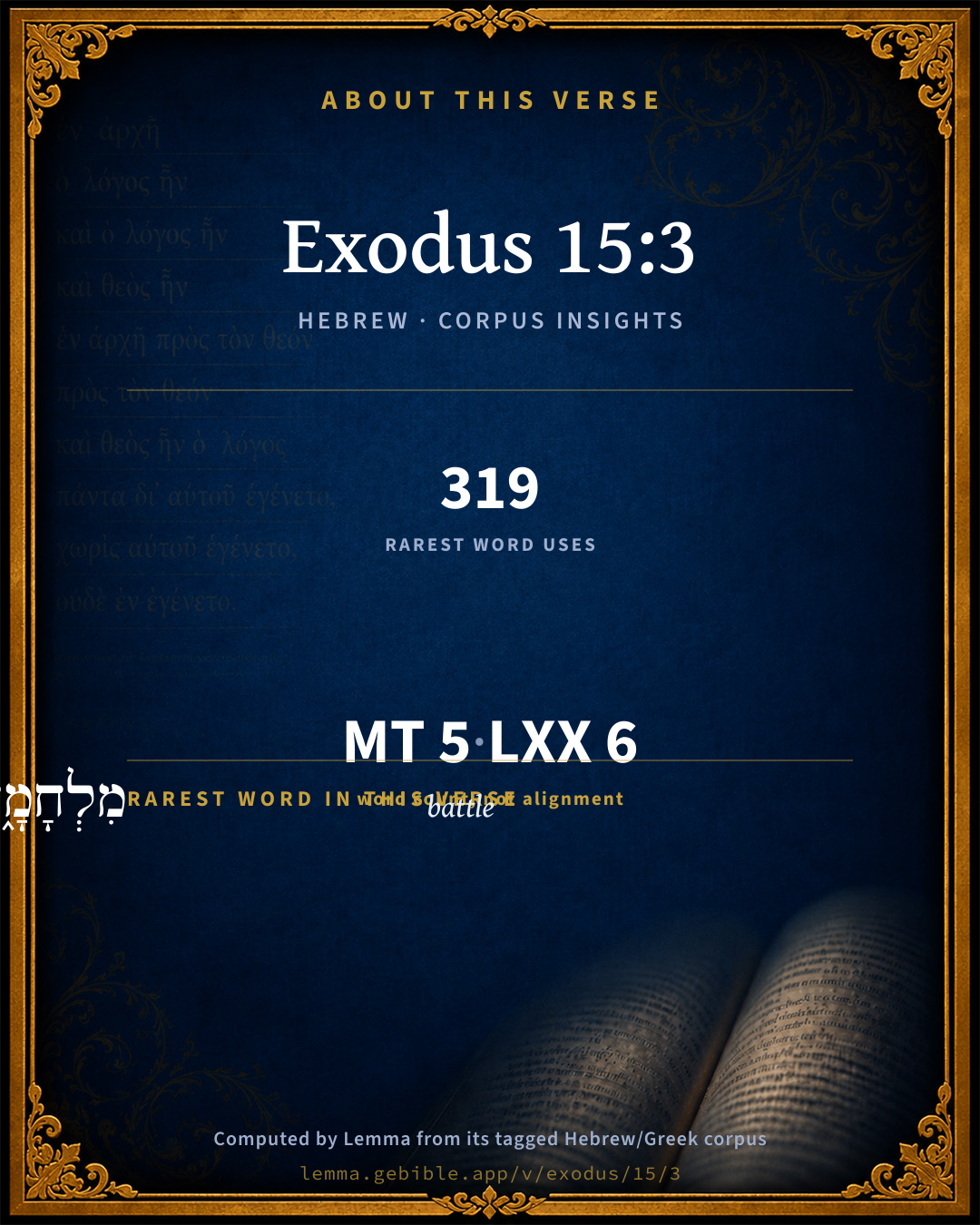
These counts appear in no published source. They are computed here, from the morphology-tagged text and Lemma’s own curated glosses. What Lemma adds →

5
words
4
distinct lemmas
Pentateuch
section

Grammatical profile

  • 5 nouns

Repetition

A word recurs within this verse — often emphatic in Hebrew:

  • יְהוָ֖ה LORD H3068 ×2

Hebrew & Septuagint length

In English translation the verse runs 10 words from the Hebrew and 11 from the Septuagint (LXX English) — closely comparable.

A rough comparison of the two English renderings, which tokenize alike — not a word-level alignment.

Word counts can differ between the Hebrew and the Greek without any difference in meaning — e.g. the Hebrew direct-object marker אֵת has no separate Greek word, and Greek often adds the article ὁ.

In the original languages it is 5 Hebrew tokens and 6 Greek tokens — but the two are counted differently (Hebrew bundles its prefixes and suffixes into one token; the Greek is in lemma form), so that isn’t a like-for-like length.

Cross-references

10

Topical passages linked to Exodus 15:3 in the Treasury of Scripture Knowledge — connected by theme and wording, ordered by reader-vote popularity; previews shown in the World English Bible.

  • Psalms 24:8 Who is the King of glory? Yahweh strong and mighty, Yahweh mighty in battle.
  • Exodus 14:14 Yahweh will fight for you, and you shall be still."
  • Revelation 19:11–21 I saw the heaven opened, and behold, a white horse, and he who sat on it is called Faithful and True. In righteousness he judges and makes war.
  • Isaiah 42:8 I am Yahweh, that is my name; and my glory will I not give to another, neither my praise to engraved images.
  • Exodus 6:6–8 Therefore tell the children of Israel, 'I am Yahweh, and I will bring you out from under the burdens of the Egyptians, and I will rid you out of their bondage, and I will redeem you with an outstretched arm, and with great judgments:
  • Psalms 83:18 That they may know that you alone, whose name is Yahweh, Are the Most High over all the earth.
  • Psalms 45:3 Gird your sword on your thigh, mighty one: Your splendor and your majesty.
  • Exodus 3:15 God said moreover to Moses, "You shall tell the children of Israel this, 'Yahweh, the God of your fathers, the God of Abraham, the God of Isaac, and the God of Jacob, has sent me to you.' This is my name forever, and this is my memorial to all generations.
  • Exodus 3:13 Moses said to God, "Behold, when I come to the children of Israel, and tell them, 'The God of your fathers has sent me to you;' and they ask me, 'What is his name?' What should I tell them?"
  • Exodus 6:2–3 God spoke to Moses, and said to him, "I am Yahweh;

Cross-references courtesy of OpenBible.info (CC BY 4.0).

Hebrew and Greek witnesses Masoretic Hebrew ↔ Greek Septuagint

The same verse in the two great witnesses to the Old Testament, shown verse-for-verse.

These are two independent witnesses, not word-aligned to each other, and the Septuagint is shown in lemma (dictionary) form.

Hebrew Exodus 15:3 Masoretic · Westminster Leningrad Codex

יְהוָ֖ה אִ֣ישׁ מִלְחָמָ֑ה יְהוָ֖ה שְׁמֽוֹ

Yahweh is a man of war. Yahweh is his name.

World English Bible · Public Domain

Greek LXX Exodus 15:3 Septuagint · lemma form

κύριος συντρίβω πόλεμος κύριος ὄνομα αὐτός

The Lord bringing wars to nothing, the Lord is his name.

LXX2012 (modern English Septuagint) · Public Domain

On this verse, Joseph Benson's Commentary discusses the Septuagint’s reading. Read the note in Commentary ↓

Hebrew: Westminster Leningrad Codex (CC BY 4.0). Greek: Septuagint (public domain); English from LXX2012 (modern English Septuagint) (Public Domain). How the Septuagint differs from the Hebrew →

Targum (Aramaic paraphrase)

2

The Targum is the ancient Jewish Aramaic paraphrase of the Hebrew Scriptures — an interpretive translation, not the Hebrew text itself. Onkelos (literal) and Pseudo-Jonathan (expansive) render the Torah, and Jonathan the Prophets. Coverage is partial: where no permissively-licensed English translation exists for a verse, only the Aramaic is shown. This is verse-level text, not a word-by-word alignment to the Hebrew.

  1. Targum Onkelos Torah (Genesis–Deuteronomy)
    יְיָ מָרֵי נִצְחָן קְרָבַיָא יְיָ שְׁמֵהּ:

    (no public-domain English translation for this verse)

    Targum Onkelos — Aramaic: “Onkelos Genesis” (public domain); “Onkelos Exodus” (public domain); “Onkelos Leviticus” (public domain); “Onkelos Numbers” (public domain); “Onkelos Deuteronomy” (public domain). English: “Sefaria Community Translation” (CC0 1.0 (public-domain dedication)); “J.W. Etheridge. The Targums of Onkelos and Jonathan Ben Uzziel on the Pentateuch. London: Longmans, Green, 1862” (public domain). Text via Sefaria.

  2. Targum Pseudo-Jonathan Torah (Genesis–Deuteronomy)
    אָמְרִין בְּנֵי יִשְרָאֵל יְיָ גַבְרָא עָבֵיד קְרָבֵינָן בְּכָל דַּר וָדַר מִנְדַע גְּבוּרְתֵּיהּ לְעַמֵּיהּ בֵּית יִשְרָאֵל יְיָ שְׁמֵיהּ כִּשְׁמֵיהּ כֵּן גְּבוּרְתֵּיהּ יְהֵי שְׁמֵיהּ מְבָרַךְ לְעָלְמֵי עַלְמִין

    The sons of Israel said, The Lord is a man making war for us: from generation to generation He maketh known His power unto the people of the house of Israel. The Lord is His Name; according to His Name, so is His power; His Name shall be blessed for ever and ever.

    Targum Pseudo-Jonathan — Aramaic: “Targum Jonathan on Genesis” (public domain); “Targum Jonathan on Exodus” (public domain); “Targum Jonathan on Leviticus” (public domain); “Targum Jonathan on Numbers” (public domain); “Targum Jonathan on Deuteronomy” (public domain). English: “The Targum of Jonathan ben Uzziel, trans. J. W. Etheridge, London, 1862” (public domain). Text via Sefaria.

Commentary

Notes on Exodus 15:3 from classic Christian and Jewish commentators (each source and its license shown beneath its notes). The classic Christian expositions comment on the surrounding passage and are grouped to its opening verse, so a note may address several verses; the Jewish commentaries on the Tanakh (Rashi and others) are per-verse, so they appear only where the commentator wrote on this verse.

Lemma curates 59 commentaries, every one of them public domain or Creative Commons licensed, each selected and text-cleaned for this edition rather than reprinted as found. About our sources →

Trapp's Complete Commentary

John Trapp

Exo 15:3 The LORD [is] a man of war: the LORD [is] his name.

Ver. 3. The Lord is a man of war.] Yea, he alone is a whole army of men, van and rear both. {Isa 52:12} He sends the sword; {Eze 14:17} musters the men; {Isa 13:4} orders the ammunition; {Jer 50:25} gives the victory: whence he is here styled by the Chaldee, The Lord and Victor of wars.

John Trapp, A Commentary or Exposition upon All the Books of the Old and New Testament (1647–1656) — public domain. Text from a community e-Sword module.

The Biblical Illustrator

Joseph S. Exell

Exo_15:3

The Lord is a man of war.

The triumphs of Jehovah

I. The thought of Gods triumphs as a man of war seems to be valuable as giving in its degree a proof of the truth of Holy Writ. The moral expectations raised by our Lords first sermon on the Mount are being actually realized in many separate souls now. The prayer for strength to triumph against the devil, the world, and the flesh is becoming daily more visibly proved in the triumph of the Spirit, in the individual lives of the redeemed.

II. The triumphs of the Lord in the individual hearts among us give an increasing hope for unity throughout Christendom. We cannot deny the debt we owe to the labours of Nonconformists in the days of the Churchs lethargy and neglect. We cannot join them now, but we are preparing for a more close and lasting union, in Gods own time, by the individual progress in spiritual things.

III. We must do our part to set our seal to the triumphant power of Divine grace. It is the half-lives of Christians which are such a poor proof of the truth of our Lords words. They do not begin early enough; they do not work thoroughly enough. We have the promise that this song shall be at last on the lips of all who prevail, for St. John tells us in the Revelation that he saw those who had overcome standing on the sea of glass, having the harps of God, singing the song of Moses and the Lamb. (Bp. King.)

The Biblical Illustrator, edited by Joseph S. Exell (c. 1880s–1900s) — public domain. Text from a community e-Sword module.

Joseph Benson's Commentary

Exo 15:3. The Lord is a man of war — Able to deal with all those that strive with their Maker. Houbigant renders the words bellator fortis, Jehovah is a strong warrior, or, mighty in war, a translation countenanced by the Samaritan Hebrew copy, and by the Septuagint, the Chaldee of Onkelos, the Syriac, and the Arabic versions. Jehovah, instead of Lord, should have been retained throughout this song, and especially in the last clause of this verse, Jehovah is his name.

Joseph Benson's Commentary on the Old and New Testaments (1811–1818) — public domain. Text from a community e-Sword module.

Tyndale Open Study Notes

Tyndale Open Resources

15:3 The Lord is a warrior: He will aggressively defend his own. He is not an oppressor, nor does he fight for the love of violence. But when his people are helpless before the enemy, whether external or internal, they can know that Yahweh, “He Who Is,” is their defender (Isa 59:15-19; 63:1-6; Rev 11:17-18). Regarding the name Yahweh, see study note on Exod 3:15.

Tyndale Open Study Notes — © Tyndale Open Resources, licensed CC BY-SA 4.0. Text via the HelloAO Bible API.

Geneva Bible (1599)

Geneva Bible translators

Ever constant in his promise.

In battle he overcometh ever.

Geneva Bible (1599) marginal notes — public domain. Text via Bolls.life.

Adam Clarke's Commentary

Verse 3. The Lord is a man of war] Perhaps it would be better to translate the words, Jehovah is the man or hero of the battle. As we scarcely ever apply the term to any thing but first-rate armed vessels, the change of the translation seems indispensable, though the common rendering is literal enough. Besides, the object of Moses was to show that man had no part in this victory, but that the whole was wrought by the miraculous power of God, and that therefore he alone should have all the glory.

The LORD is his name.] That is, JEHOVAH. He has now, as the name implies, given complete existence to all his promises. See Clarke on Ge 2:4, and "Ex 6:3".

Adam Clarke's Commentary on the Bible (1810–1826) — public domain. Text from a community e-Sword/MySword module.

Ellicott's Commentary for English Readers

(3) The Lord is a man of war.—The directness and boldness of the anthropomorphism is markedly archaic, and is wisely retained by our translators. How turgid and yet weak are the Samaritan, “mighty in battle,” and the LXX., “crusher of wars,” in comparison!

The Lord is his name.—In the very name, Jehovah, is implied all might, all power, and so necessarily the strength to prevail in battle. The name, meaning “the Existent,” implies that nothing else has any real existence independently of Him; and if no existence, then necessarily no strength.

A Bible Commentary for English Readers, edited by Charles John Ellicott (1878–1897) — public domain. Text from a community e-Sword module.

The Cambridge Bible for Schools and Colleges

gen. ed. J. J. S. Perowne

3. a man of war] one who understands how to fight, and to vanquish his foes. The same figure, of Jehovah, Isa_42:13 (‘a man of wars’), Psa_24:8 (‘the mighty man [gibbôr] of battle [or of war]’); cf. also ch. Exo_14:14.

Yahweh is his name] an exultant ejaculation: ‘Yahweh’ is to the poet the great and powerful God, who helps, defends, and delivers His people. Cf. Amo_5:8; Amo_9:6; and ‘Yahweh of hosts is his name,’ Amo_4:13; Amo_5:27, Isa_47:4; Isa_48:2 al.

The Cambridge Bible for Schools and Colleges (gen. ed. J. J. S. Perowne; Cambridge University Press, 1878–1918) — public domain. Text from a community e-Sword module.

John Gill's Exposition

The Lord is a man of war,.... A "man", which has respect to the future incarnation of Christ, for as yet he was not really man; though it was purposed, covenanted, agreed to, and prophesied of, that he should, as he after was; not a mere man, as appears by the following clause: "a man of war"; or a warrior; being engaged in war, and inured to it; having to do with very powerful enemies, Satan and his principalities and powers, the world, and the great men of it, antichrist, and all the antichristian states. A warrior well versed in all the arts of war, and abundantly qualified for it, having consummate wisdom, strength, and courage, and thoroughly furnished and accoutred for it; having on the breastplate of righteousness, the helmet of salvation, the garment of vengeance, and cloak of zeal, and a vesture dipped in blood; and with a sword girt on his thigh, or drawn, or coming out of his mouth; and with a bow and arrows, going forth conquering, and to conquer; for he is a victorious one, who has conquered sin, Satan, and the world, and will subdue all others, and make his people more than conquerors, through him. He is not a common man of war or warrior; he is the Captain of the Lord's host, the Leader and Commander of the people, the Generalissimo of the armies in heaven and earth, and is a Prince and King at the head of them:

the Lord is his name; or Jehovah, which proves him to be more than a man; and being so, it is no wonder that he is so mighty, powerful, and victorious.

John Gill's Exposition of the Whole Bible (1746–1763) — public domain (CC PDM 1.0). Text via the HelloAO Bible API.

Haydock's Catholic Bible Commentary

The Lord. Septuagint, "breaking wars in pieces," a man of war, a conqueror. (Calmet) --- Almighty. Jehova, I am. This is the most awful and incommunicable name. (Haydock)

George Leo Haydock (1774–1849), Haydock's Catholic Family Bible and Commentary, 1859 edition — public domain. Excludes Psalms (Douay-Rheims chapter numbering differs from Protestant) and Deuterocanonical books (Catholic canon only).

Matthew Poole's English Annotations

A man of war; an eminent warrior; as the phrase is used 1Sa 17:33. Thus an eloquent man is called a man of words, Exo 4:10, and a mighty man, a man of arm, Job 22:8.

Matthew Poole's English Annotations on the Holy Bible (1683–1685) — public domain. Text from a community e-Sword/MySword module.

The Pulpit Commentary

a man of war. A strong anthropomorphism, but one that could scarcely be misunderstood man of war," meaning commonly "a warrior," or "one mighty in battle". (Psa_24:8) God"s might had just been proved, in that he alone had discomfited and destroyed the most potent armed force in the whole world. The Lord is his name. Jehovah the alone-existing One "truly describes him," before whom all other existence fades and falls into nothingness. On the full meaning of the name, see the comment on Exo_3:14.

Vers. 3-21. The results of deliverance to God"s people.

I THE KNOWLEDGE OF THE MARVELLOUSNESS OF GOD"S POWER (3-12).

1. The might of Egypt, when measured with the strength of God, was uttervanity (4, 5). The Lord"s right hand had dashed in pieces the enemy. What can make the heart afraid which knows the power of God?

2. The deadly malice of Egypt was extinguished in a moment like a sparkbeneath the heel. The picture of the foe"s deadly purpose set side by side with God"s deed: "Thou didst blow with thy wind they sank as lead in the mighty waters.

II CONFIDENCE FOE THE ONWARD WAY.

1. In his mercy and strength God will lead them to the rest he has promised( 13).

2. This deliverance will fight for them (14-16). The heart of their foes willdie within them. And when led into their land this fear of the Lord will be a wall between them and the nations round about. They shall not only be led in, but planted there in undisturbed security.

3. God will, as now, triumph through all the ages, and accomplish, nomatter how his people may fear and his enemies may vaunt themselves, all his righteous will. U

The Pulpit Commentary (1880–1919), ed. H.D.M. Spence-Jones & Joseph S. Exell — public domain. Text from a community e-Sword module.

John Wesley's Explanatory Notes

The Lord is a man of war - Able to deal with all those that strive with their maker.

John Wesley, Explanatory Notes Upon the Whole Bible (1754–1765) — public domain. Text via the GEBible commentary corpus.

Rashi

Rabbi Shlomo Yitzchaki (Rashi)

ה' איש מלחמה means The Lord is a Master of war; just as, (Ruth 1:3) “the איש (i. e. the master) of Naomi”. (Cf. Rashi on that verse). Wherever the words איש and אישך occur they must be translated by בעל; so, too, (1 Kings 2:2) “Be thou strong and show thyself an איש” — a mighty person.

ה' שמו THE LORD IS HIS NAME — His wars are not waged with martial weapons but He fights by means of His Name, just as David said, (I Samuel 17:45) “But I come against thee in the name of the Lord of Hosts”. Another explanation of ה׳ שמו — He is a man of war, but His Name is the Lord (the God of Mercy): even at the time when He battles against and avenges Himself upon His enemies He retains His attribute (that expressed by His name ה׳) showing pity to His creatures and feeding all the inhabitants of the world; not as is the nature of the kings of the world each one of whom when he is engaged in war turns aside from all other engagements, and has not the power to do both this and that (cf. Mekhilta).

Rashi on the Tanakh — English translations: “The Judaica Press complete Tanach with Rashi, translated by A. J. Rosenberg” (CC BY 4.0); “Pentateuch with Rashi's commentary by M. Rosenbaum and A.M. Silbermann, 1929-1934” (public domain); “The Metsudah Tanach series, Lakewood, N.J” (CC BY 4.0); and “The Book of Joshua, Metsudah Publications, 1997” (CC BY 4.0). Text via Sefaria.

Sforno

Rabbi Ovadia Sforno

Ad-noy is the master of war, Ad-noy is His name. Even though as the master of war He executes strict judgment against the wicked, His name remains “Ad-noy,” signifying the attribute of mercy. Moreover, the eradication of those who cause the world to be destroyed is in itself a form of mercy.

Sforno on the Tanakh — English translation: “Yalkut, Sifsei Chachomim Chumash, Metsudah Publications, 2009” (CC BY 4.0). Text via Sefaria.

Lesson kit

Teaching starters — assembled from the data on this page, not authored interpretation. Every prompt links to the verse data it draws on. Edit before teaching.

Exodus, in the Pentateuch, opens this verse with 5 words (4 distinct Hebrew lemmas). Its most distinctive word is milchâmâh (“battle”). A historical commentator’s framing appears above. Read the whole chapter for the surrounding context.

Discussion questions

  1. How does “battle” (milchâmâh) shape what this verse is saying?
  2. How does Psalms 24:8, which shares this passage’s theme, read alongside this verse?
  3. What does the repetition of “LORD” (2× in this one verse) do in this verse?
  4. These translations render this verse differently. What is at stake in choosing one wording over another?
  5. Compare how Trapp's Complete Commentary and The Biblical Illustrator read this verse. Where do they agree or differ?

Things to notice

Reading settings

Reading text

Shown beneath each verse's original-language words.

Old Testament
Old Testament edition

Read the OT as the Masoretic Hebrew (MT) or the Greek Septuagint (LXX).

English shown for the Greek Septuagint (in the Hebrew ↔ Greek comparison).

Comparing translations? Open the Compare panel on any verse page to stack up to four side by side.