
Genesis 42:13

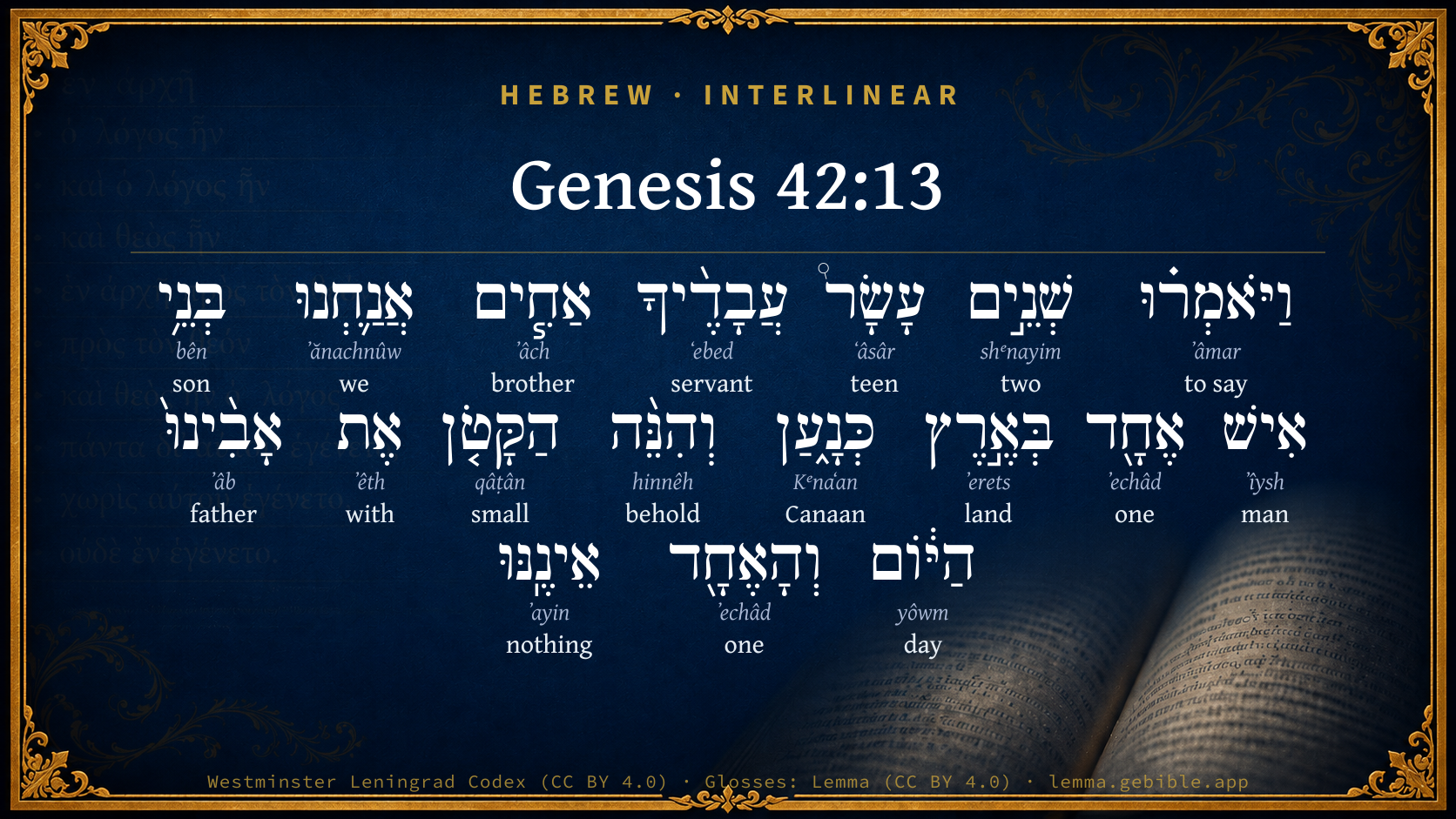
Hebrew (Westminster Leningrad Codex) Genesis 42:13 appears in the Hebrew Old Testament. The text above is from the Westminster Leningrad Codex. Each word links to its Strong’s number, a concise gloss, and parsing drawn from the Open Scriptures Hebrew Bible morphology. Click any word for its full Brown-Driver-Briggs (BDB) entry.
Download image
Cite this verse

Genesis 42:13 (World English Bible). Public Domain. Lemma interlinear Bible study tool, https://lemma.gebible.app/v/genesis/42/13.

Show BibTeX & RIS
BibTeX
RIS
English Translation
They said, "We, your servants, are twelve brothers, the sons of one man in the land of Canaan; and, behold, the youngest is this day with our father, and one is no more."
World English Bible · Public Domain
Download a study sheet

One document with this verse’s original text, its word-by-word gloss line, the meaning frame, cross-references with their text, attributed commentary, and full source and license credits — printable, and it pastes into notes with its structure intact.

This verse Autodidact and up

Study sheet (.html) Plain text (.txt)

A passage Seminary Student

Up to 50 verses in one chapter. A passage sheet keeps up to 6 commentary sources and 12 cross-references per verse, in the order this page ranks them, and says so on the sheet whenever that leaves anything out. Ask for a single verse and you get the Autodidact verse sheet above.

Everything on this page stays free to read, with no account — the sheet is a download of what is already on screen, not access to it.

Want to remove ads? Support Godless Engineer
Compare translations 3

The same verse in 3 English versions, stacked beneath the original-language interlinear above. Click any original word for its lexicon entry.

Each is an independent rendering of the whole verse — the interlinear is not word-aligned to these translations.

Highlighted words mark where these versions differ — a whole-verse word diff, not a word-by-word alignment.

  • World English Bible Public Domain
    They said, "We, your servants, are twelve brothers, the sons of one man in the land of Canaan; and, behold, the youngest is this day with our father, and one is no more."
  • King James Version Public Domain
    And they said, Thy servants are twelve brethren, the sons of one man in the land of Canaan; and, behold, the youngest is this day with our father, and one is not.
  • unfoldingWord Literal Text CC BY-SA 4.0
    But they said, “Your servants twelve brothers. We sons of one man in the land of Canaan. And behold, the youngest with our father today, and the one is not.”

unfoldingWord Literal Text — © unfoldingWord, licensed CC BY-SA 4.0. Word-aligned USFM3 via Door43 (git.door43.org/unfoldingWord/en_ult).

Versions to compare (up to 4)

3 of 4 selected

Show all 18 translations

Every available English version of this verse, each an independent rendering of the whole verse.

  • World English Bible Public Domain
    They said, "We, your servants, are twelve brothers, the sons of one man in the land of Canaan; and, behold, the youngest is this day with our father, and one is no more."
  • Berean Standard Bible Public Domain
    But they answered, “Your servants are twelve brothers, the sons of one man in the land of Canaan. The youngest is now with our father, and one is no more.”
  • Majority Standard Bible Public Domain
    But they answered, “Your servants are twelve brothers, the sons of one man in the land of Canaan. The youngest is now with our father, and one is no more.”
  • King James Version Public Domain
    And they said, Thy servants are twelve brethren, the sons of one man in the land of Canaan; and, behold, the youngest is this day with our father, and one is not.
  • American Standard Version (1901) Public Domain
    And they said, We thy servants are twelve brethren, the sons of one man in the land of Canaan; and, behold, the youngest is this day with our father, and one is not.
  • Revised Version (1885) Public Domain
    And they said, We thy servants are twelve brethren, the sons of one man in the land of Canaan; and, behold, the youngest is this day with our father, and one is not.
  • Geneva Bible (1599) Public Domain
    And they said, We thy seruants are twelue brethren, the sonnes of one man in the lande of Canaan: and beholde, the yongest is this day with our father, and one is not.
  • Douay-Rheims (1899) Public Domain
    But they said: We thy servants are twelve brethren, the sons of one man in the land of Chanaan: the youngest is with our father, the other is not living.
  • Young's Literal Translation Public Domain
    and they say, `Thy servants `are' twelve brethren; we `are' sons of one man in the land of Canaan, and lo, the young one `is' with our father to-day, and the one is not.'
  • Literal Standard Version CC BY-SA 4.0
    and they say, “Your servants [are] twelve brothers; we [are] sons of one man in the land of Canaan, and behold, the young one [is] with our father today, and one is not.”
  • Unlocked Literal Bible CC BY-SA 4.0
    They said, “We your servants are twelve brothers, the sons of one man in the land of Canaan. See, the youngest is this day with our father, and one brother is no longer alive.”
  • unfoldingWord Literal Text CC BY-SA 4.0
    But they said, “Your servants twelve brothers. We sons of one man in the land of Canaan. And behold, the youngest with our father today, and the one is not.”
  • Darby Bible Public Domain
    And they said, Thy servants were twelve brethren, sons of one man, in the land of Canaan; and behold, the youngest is this day with our father, and one is not.
  • World Messianic Bible Public Domain
    They said, “We, your servants, are twelve brothers, the sons of one man in the land of Canaan; and behold, the youngest is today with our father, and one is no more.”
  • Webster's Bible Public Domain
    And they said, Thy servants are twelve brethren, the sons of one man in the land of Canaan; and behold, the youngest is this day with our father, and one is not.
  • Free Bible Version CC BY-SA 4.0
    “Your servants are twelve brothers, the sons of one man living in the country of Canaan,” they explained. “The youngest is right now with our father, and one has passed away.”
  • Bible in Basic English Public Domain
    Then they said, We your servants are twelve brothers, sons of one man in the land of Canaan; the youngest of us is now with our father, and one is dead.
  • JPS Tanakh (1917) Public Domain
    And they said: 'We thy servants are twelve brethren, the sons of one man in the land of Canaan; and, behold, the youngest is this day with our father, and one is not.'

Literal Standard Version (2020), Covenant Press — licensed CC BY-SA 4.0. Text via the HelloAO Bible API (eBible.org). Unlocked Literal Bible (unfoldingWord) — licensed CC BY-SA 4.0. Text via the HelloAO Bible API (eBible.org). unfoldingWord Literal Text — © unfoldingWord, licensed CC BY-SA 4.0. Word-aligned USFM3 via Door43 (git.door43.org/unfoldingWord/en_ult). Free Bible Version, Dr. Jonathan Gallagher — licensed CC BY-SA 4.0. Text via the HelloAO Bible API (eBible.org).

Word by word

More ways to search: Search by grammar → Find every occurrence → Compare this word →

Practice this passage: Drill this verse → Learn its vocabulary →

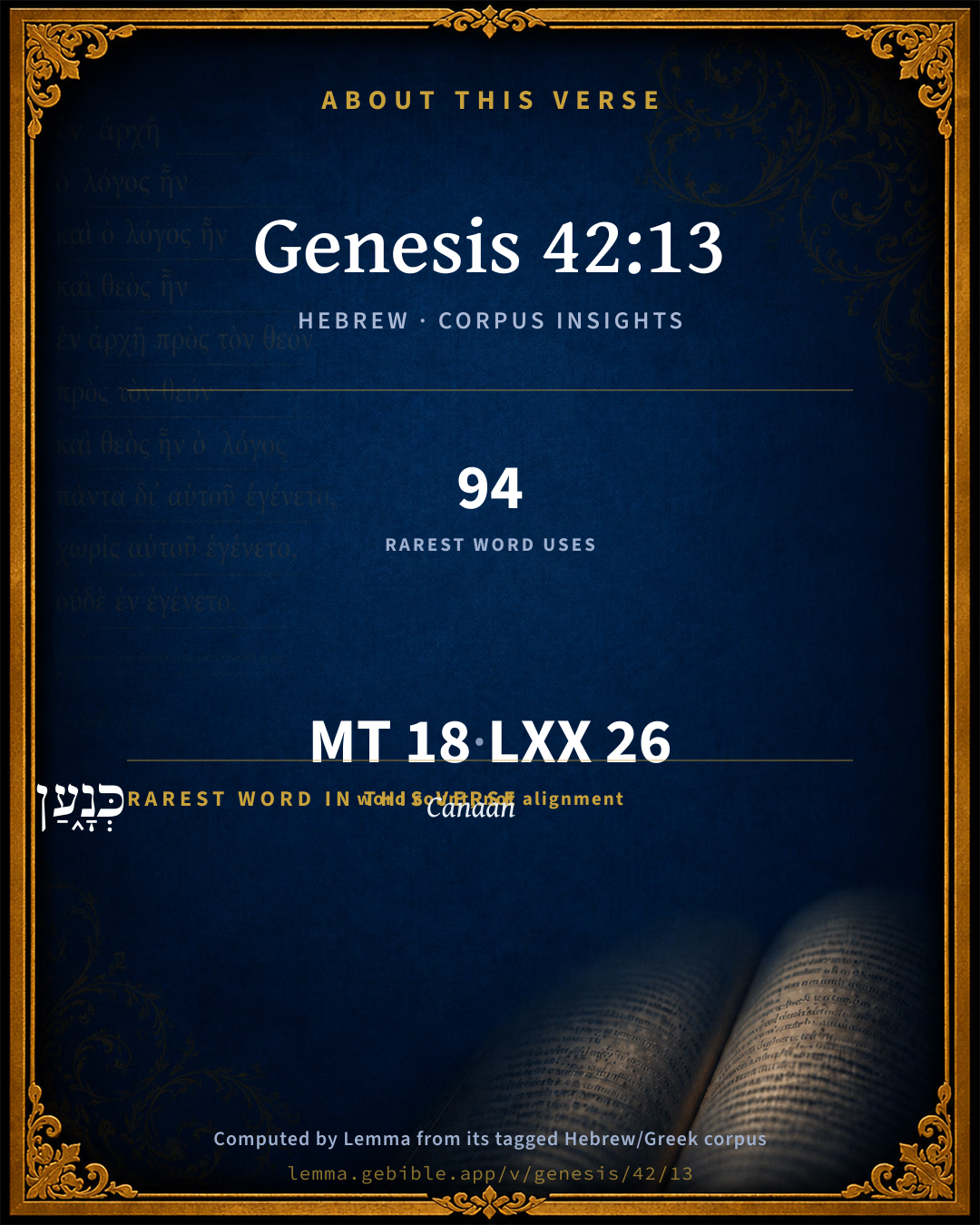
כְּנָ֑עַן
Kᵉnaʻan
H3667
“Canaan”
Noun, Proper
Part of Speech
Noun
Type
Proper
Full BDB Definition

Origin: from H3665

TWOT: 1002 , 1002b

Canaan = "lowland" - the 4th son of Ham and the progenitor of the Phoenicians and of the various nations who peopled the seacoast of Palestine (noun proper masculine) - the land west of the Jordan peopled by the descendants of Canaan and subsequently conquered by the Israelites under Joshua (noun proper locative) - merchant, trader (noun masculine)
  1. וַיֹּאמְר֗וּ ʼâmar H559 “and · to say” Conjunction + Verb, Qal, Sequential Imperfect, 3rd Person, Masculine, Plural
  2. שְׁנֵ֣ים shᵉnayim H8147 “two” Adjective, Cardinal number, Masculine, Dual, Absolute
  3. עָשָׂר֩ ʻâsâr H6240 “teen” Adjective, Cardinal number, Masculine, Singular, Absolute
  4. עֲבָדֶ֨יךָ ʻebed H5650 “servants · your” Noun, Common, Masculine, Plural, Construct + Suffix, Personal, 2nd Person, Masculine, Singular
  5. אַחִ֧ים ʼâch H251 “brothers” Noun, Common, Masculine, Plural, Absolute
  6. אֲנַ֛חְנוּ ʼănachnûw H587 “we” Pronoun, Personal, 1st Person, Common, Plural
  7. בְּנֵ֥י bên H1121 “sons of” Noun, Common, Masculine, Plural, Construct
  8. אִישׁ ʼîysh H376 “man” Noun, Common, Masculine, Singular, Absolute
  9. אֶחָ֖ד ʼechâd H259 “one” Adjective, Cardinal number, Masculine, Singular, Absolute
  10. בְּאֶ֣רֶץ ʼerets H776 “in/at · land of” Preposition + Noun, Common, Both, Singular, Construct
  11. וְהִנֵּ֨ה hinnêh H2009 “and · behold” Conjunction + Particle, Demonstrative
  12. הַקָּטֹ֤ן qâṭân H6996 “the · small” Particle, Definite Article + Adjective, Adjective, Masculine, Singular, Absolute
  13. אֶת ʼêth H854 “with” Preposition
  14. אָבִ֨ינוּ֙ ʼâb H1 “father · our” Noun, Common, Masculine, Singular, Construct + Suffix, Personal, 1st Person, Common, Plural
  15. הַיּ֔וֹם yôwm H3117 “the · day” Particle, Definite Article + Noun, Common, Masculine, Singular, Absolute
  16. וְהָאֶחָ֖ד ʼechâd H259 “and · the · one” Conjunction + Particle, Definite Article + Adjective, Cardinal number, Masculine, Singular, Absolute
  17. אֵינֶֽנּוּ ʼayin H369 “nothing · him” Particle, Negative + Suffix, Personal, 3rd Person, Masculine, Singular

About this verse

These counts appear in no published source. They are computed here, from the morphology-tagged text and Lemma’s own curated glosses. What Lemma adds →

18
words
17
distinct lemmas
Pentateuch
section

Grammatical profile

  • 1 verb
  • 8 nouns
  • 5 adjectives
  • 1 pronoun
  • 1 preposition
  • 2 particles

Verb forms

  • וַיֹּאמְר֗וּ Qal · Sequential Imperfect

Repetition

A word recurs within this verse — often emphatic in Hebrew:

  • אֶחָ֖ד one H259 ×2

Hebrew & Septuagint length

In English translation the verse runs 33 words from the Hebrew and 29 from the Septuagint (LXX English) — closely comparable.

A rough comparison of the two English renderings, which tokenize alike — not a word-level alignment.

Word counts can differ between the Hebrew and the Greek without any difference in meaning — e.g. the Hebrew direct-object marker אֵת has no separate Greek word, and Greek often adds the article ὁ.

In the original languages it is 18 Hebrew tokens and 26 Greek tokens — but the two are counted differently (Hebrew bundles its prefixes and suffixes into one token; the Greek is in lemma form), so that isn’t a like-for-like length.

Cross-references

23

Topical passages linked to Genesis 42:13 in the Treasury of Scripture Knowledge — connected by theme and wording, ordered by reader-vote popularity; previews shown in the World English Bible.

  • Genesis 37:30 He returned to his brothers, and said, "The child is no more; and I, where will I go?"
  • Genesis 42:32 We are twelve brothers, sons of our father; one is no more, and the youngest is this day with our father in the land of Canaan.'
  • Genesis 44:20 We said to my lord, 'We have a father, an old man, and a child of his old age, a little one; and his brother is dead, and he alone is left of his mother; and his father loves him.'
  • Genesis 43:7 They said, "The man asked directly concerning ourselves, and concerning our relatives, saying, 'Is your father still alive? Have you another brother?' We just answered his questions. Is there any way we could know that he would say, 'Bring your brother down?'"
  • Genesis 29:32–35 Leah conceived, and bore a son, and she named him Reuben. For she said, "Because Yahweh has looked at my affliction. For now my husband will love me."
  • Genesis 30:6–24 Rachel said, "God has judged me, and has also heard my voice, and has given me a son." Therefore called she his name Dan.
  • Genesis 35:16–26 They traveled from Bethel. There was still some distance to come to Ephrath, and Rachel travailed. She had hard labor.
  • Genesis 42:11 We are all one man's sons; we are honest men. Your servants are not spies."
  • Genesis 42:36 Jacob, their father, said to them, "You have bereaved me of my children! Joseph is no more, Simeon is no more, and you want to take Benjamin away. All these things are against me."
  • Genesis 42:38 He said, "My son shall not go down with you; for his brother is dead, and he only is left. If harm happens to him by the way in which you go, then you will bring down my gray hairs with sorrow to Sheol."
  • Genesis 44:28 and the one went out from me, and I said, "Surely he is torn in pieces;" and I haven't seen him since.
  • Genesis 45:26 They told him, saying, "Joseph is still alive, and he is ruler over all the land of Egypt." His heart fainted, for he didn't believe them.
  • Genesis 46:8–27 These are the names of the children of Israel, who came into Egypt, Jacob and his sons: Reuben, Jacob's firstborn.
  • Exodus 1:2–5 Reuben, Simeon, Levi, and Judah,
  • Numbers 1:1–54 Yahweh spoke to Moses in the wilderness of Sinai, in the Tent of Meeting, on the first day of the second month, in the second year after they had come out of the land of Egypt, saying,
  • Numbers 10:1–36 Yahweh spoke to Moses, saying,
  • Numbers 26:1–65 It happened after the plague, that Yahweh spoke to Moses and to Eleazar the son of Aaron the priest, saying,
  • Numbers 34:1–29 Yahweh spoke to Moses, saying,
  • 1 Chronicles 2:1–8 These are the sons of Israel: Reuben, Simeon, Levi, and Judah, Issachar, and Zebulun,
  • Jeremiah 31:15 Thus says Yahweh: A voice is heard in Ramah, lamentation, and bitter weeping, Rachel weeping for her children; she refuses to be comforted for her children, because they are no more.
  • Lamentations 5:7 Our fathers sinned, and are no more; We have borne their iniquities.
  • Matthew 2:16 Then Herod, when he saw that he was mocked by the wise men, was exceedingly angry, and sent out, and killed all the male children who were in Bethlehem and in all the surrounding countryside, from two years old and under, according to the exact time which he had learned from the wise men.
  • Matthew 2:18 "A voice was heard in Ramah, Lamentation, weeping and great mourning, Rachel weeping for her children; She wouldn't be comforted, Because they are no more."

Cross-references courtesy of OpenBible.info (CC BY 4.0).

Hebrew and Greek witnesses Masoretic Hebrew ↔ Greek Septuagint

The same verse in the two great witnesses to the Old Testament, shown verse-for-verse.

These are two independent witnesses, not word-aligned to each other, and the Septuagint is shown in lemma (dictionary) form.

Hebrew Genesis 42:13 Masoretic · Westminster Leningrad Codex

וַיֹּאמְר֗וּ שְׁנֵ֣ים עָשָׂר֩ עֲבָדֶ֨יךָ אַחִ֧ים אֲנַ֛חְנוּ בְּנֵ֥י אִישׁ אֶחָ֖ד בְּאֶ֣רֶץ כְּנָ֑עַן וְהִנֵּ֨ה הַקָּטֹ֤ן אֶת אָבִ֨ינוּ֙ הַיּ֔וֹם וְהָאֶחָ֖ד אֵינֶֽנּוּ

They said, "We, your servants, are twelve brothers, the sons of one man in the land of Canaan; and, behold, the youngest is this day with our father, and one is no more."

World English Bible · Public Domain

Greek LXX Genesis 42:13 Septuagint · lemma form

ὁ δέ εἶπον δώδεκα εἰμί ὁ παῖς σύ ἀδελφός ἐν γῆ χανααν καί ἰδού ὁ νέος μετά ὁ πατήρ ἐγώ σήμερον ὁ δέ ἕτερος οὐ ὑποἄρχω

And they said, We your servants are twelve brethren, in the land of Chanaan; and, behold, the youngest is with our father today, but the other one is not.

LXX2012 (modern English Septuagint) · Public Domain

On this verse, The Pulpit Commentary discusses the Septuagint’s reading. Read the note in Commentary ↓

Hebrew: Westminster Leningrad Codex (CC BY 4.0). Greek: Septuagint (public domain); English from LXX2012 (modern English Septuagint) (Public Domain). How the Septuagint differs from the Hebrew →

Targum (Aramaic paraphrase)

2

The Targum is the ancient Jewish Aramaic paraphrase of the Hebrew Scriptures — an interpretive translation, not the Hebrew text itself. Onkelos (literal) and Pseudo-Jonathan (expansive) render the Torah, and Jonathan the Prophets. Coverage is partial: where no permissively-licensed English translation exists for a verse, only the Aramaic is shown. This is verse-level text, not a word-by-word alignment to the Hebrew.

  1. Targum Onkelos Torah (Genesis–Deuteronomy)
    וַאֲמָרוּ תְּרֵין עֲשַׂר עַבְדָיךְ אַחִין אֲנַחְנָא בְּנֵי גַּבְרָא חַד בְּאַרְעָא דִּכְנָעַן וְהָא זְעֵירָא עִם אָבוּנָא יוֹמָא דֵּין וְחַד לֵיתוֹהִי

    (no public-domain English translation for this verse)

    Targum Onkelos — Aramaic: “Onkelos Genesis” (public domain); “Onkelos Exodus” (public domain); “Onkelos Leviticus” (public domain); “Onkelos Numbers” (public domain); “Onkelos Deuteronomy” (public domain). English: “Sefaria Community Translation” (CC0 1.0 (public-domain dedication)); “J.W. Etheridge. The Targums of Onkelos and Jonathan Ben Uzziel on the Pentateuch. London: Longmans, Green, 1862” (public domain). Text via Sefaria.

  2. Targum Pseudo-Jonathan Torah (Genesis–Deuteronomy)
    וַאֲמָרוּ תְּרֵיסַר עַבְדָךְ אַחִין אֲנַחְנָא בְּנֵי גַבְרָא חָד בְּאַרְעָא דִכְנָעַן וְהָא זְעֵירָא עִם אָבוּנָא יוֹמָא דֵין וְחַד נְפַק מִלְוָותָן וְלֵית אֲנַחְנָא יָדְעִין מַה הֲוָה בְּסֵיפֵיהּ

    They answered, Thy servants are twelve brothers, the sons of one man, in the land of Kenaan; and, behold, the youngest is tojday with our father, and one went from us, and we know not what hath been in his end!

    Targum Pseudo-Jonathan — Aramaic: “Targum Jonathan on Genesis” (public domain); “Targum Jonathan on Exodus” (public domain); “Targum Jonathan on Leviticus” (public domain); “Targum Jonathan on Numbers” (public domain); “Targum Jonathan on Deuteronomy” (public domain). English: “The Targum of Jonathan ben Uzziel, trans. J. W. Etheridge, London, 1862” (public domain). Text via Sefaria.

Commentary

Notes on Genesis 42:13 from classic Christian and Jewish commentators (each source and its license shown beneath its notes). The classic Christian expositions comment on the surrounding passage and are grouped to its opening verse, so a note may address several verses; the Jewish commentaries on the Tanakh (Rashi and others) are per-verse, so they appear only where the commentator wrote on this verse.

Lemma curates 59 commentaries, every one of them public domain or Creative Commons licensed, each selected and text-cleaned for this edition rather than reprinted as found. About our sources →

Trapp's Complete Commentary

John Trapp

Gen 42:13 And they said, Thy servants [are] twelve brethren, the sons of one man in the land of Canaan; and, behold, the youngest [is] this day with our father, and one [is] not.

Ver. 13. And one is not.] They tell Joseph that Joseph is not. When God holds men’s eyes, they see not the truth that lies before them; "Who is blind as my servant?" {Isa 42:19}

John Trapp, A Commentary or Exposition upon All the Books of the Old and New Testament (1647–1656) — public domain. Text from a community e-Sword module.

Geneva Bible (1599)

Geneva Bible translators

Or, is dead.

Geneva Bible (1599) marginal notes — public domain. Text via Bolls.life.

Adam Clarke's Commentary

Verse 13. One is not.] An elliptical sentence, One is not alive.

Adam Clarke's Commentary on the Bible (1810–1826) — public domain. Text from a community e-Sword/MySword module.

The Cambridge Bible for Schools and Colleges

gen. ed. J. J. S. Perowne

13. We … twelve brethren] In this verse, as in Gen_42:32, it appears that Joseph’s brethren proffer this information of their own accord, in order to convince the ruler that they were simple private persons. According to J (Gen_43:7, Gen_44:19), Joseph extracted the information by direct questioning.

one is not] See Gen_37:30.

The Cambridge Bible for Schools and Colleges (gen. ed. J. J. S. Perowne; Cambridge University Press, 1878–1918) — public domain. Text from a community e-Sword module.

John Gill's Exposition

Send one of you, and let him fetch your brother,.... He proposes that one of them might be sent by them to their father's house, and bring, Benjamin down to Egypt:

and ye shall be kept in prison; the rest of them till he came:

that your words may be proved, whether there be any truth in you; by this it would be seen whether they were men of truth and honesty or not; and should their brother be brought they would appear to be good men and true:

or else, by the life of Pharaoh, surely ye are spies; should not their brother they spoke of be produced, it would be a plain case that they were not the honest men they pretended to be, nor did they come merely to buy corn, but had an ill intention.

John Gill's Exposition of the Whole Bible (1746–1763) — public domain (CC PDM 1.0). Text via the HelloAO Bible API.

Matthew Poole's English Annotations

i.e. Is dead, as that phrase often signifies both in Scripture, as Gen 37:30; 44:20; Jer 31:15; Mat 2:17,18, and in other authors, as Homer, Euripides, &c. They concluded with great probability that he was dead, Gen 44:20, because for twenty years together they had heard nothing, either of him or from him; which may seem strange, considering the nearness of Egypt and Canaan: but this came to pass partly from his own long imprisonment, and afterwards from his great and high employment; partly, from his lothness to bring so much mischief to his father and brethren, as the discovery of his case might have produced; and principally, from the overruling providence of God, which for its own glorious design disposed of Joseph’s mind and affairs, so that he either did not send to his father’s house, or that the messages were intercepted, there being not then those conveniencies for mutual correspondencies which now there are. And it is not improbable that Joseph might be further acquainted with the mind of God in this matter by dreams, which may seem to have been familiarly afforded to him, together with the interpretation of them. See Gen 40:8; 41:16.

Matthew Poole's English Annotations on the Holy Bible (1683–1685) — public domain. Text from a community e-Sword/MySword module.

The Pulpit Commentary

And they said, Thy servants are twelve brethren, the sons of one man in the land of Canaan; and, behold, the youngest literally, the little one (cf. Gen_9:24) is this day with our father, and one literally, the one, i.e. the other one, oJ de eterov (LXX)is noti.e. is dead (cf. Gen_5:24 Gen_37:30) in which statement have been seen a sufficient proof that Joseph"s brethren had not yet truly repented of their cruelty towards him (Keil); an evidence that time had assuaged all their bitter feelings, both of exasperation against Joseph and of remorse for their unbrotherly conduct (Murphy); a suppression of the truth (Words. worth), if not a direct falsehood (Lawson), since they wished it to be understood that their younger brother was dead, while of that they had no evidence beyond their own cunningly-invented lie (Gen_37:20) and their own probable surmisings. But in point of fact the inference was natural and reasonable that Joseph was no more, since twenty years had elapsed without any tidings of his welfare, and there was no absolute necessity requiring them to explain to the Egyptian governor all the particulars of their early life. Yet the circumstance that their assertion regarding himself was incorrect may have tended to awaken his suspicions concerning Benjamin.

The Pulpit Commentary (1880–1919), ed. H.D.M. Spence-Jones & Joseph S. Exell — public domain. Text from a community e-Sword module.

Rashi

Rabbi Shlomo Yitzchaki (Rashi)

'ויאמרו שנים עשר עבדיך וגו AND THEY SAID, THY SERVANTS WERE TWELVE BRETHREN — [AND ONE IS NO MORE], and it is on account of that one who is no more that we dispersed ourselves through the city in order that we might search for him (Genesis Rabbah 91:6).

Rashi on the Tanakh — English translations: “The Judaica Press complete Tanach with Rashi, translated by A. J. Rosenberg” (CC BY 4.0); “Pentateuch with Rashi's commentary by M. Rosenbaum and A.M. Silbermann, 1929-1934” (public domain); “The Metsudah Tanach series, Lakewood, N.J” (CC BY 4.0); and “The Book of Joshua, Metsudah Publications, 1997” (CC BY 4.0). Text via Sefaria.

Radak

Rabbi David Kimhi (Radak)

ויאמרו...בני איש אחד, they now felt the need to assert further that they were in fact honest and forthcoming by revealing that actually there were twelve of them, all sons of the same father, etc.

את אבינו, they had left one brother to attend to the needs of their father during their absence

איננו; the reason why they chose this ambiguous way of referring to the fate of their missing brother was to avoid being trapped. If they had said that their missing bother was dead, Joseph could have accused them of lying –in the event Joseph was alive and this ruler had knowledge of the fact.- They knew that Joseph had been sold to Egypt but had no knowledge beyond this. They had reason to fear that while a slave in Egypt and wanting to obtain his freedom he might have revealed his origins, implicating the brothers in having sold him. The fact that this slave, like they themselves was of Hebrew origin, may well have become known as he had been bought from Hebrews. Even the wife of Potiphar, when thwarted in her advances too him, suddenly refers to him in a derogatory fashion as “the Hebrew man her husband had brought into the house to belittle them, etc.” (39,14) The Chief of the cup-bearers had also referred to him as Hebrew slave. (41,12) However, while Joseph may have revealed or may not have been able to conceal that he was a Hebrew, it was by no means certain that he had also revealed details about his family, his father, etc. Neither would he have had reason to reveal how many brothers he had\, etc. Therefore, when referring to him, they decided to use the non committal ואיננו, meaning that they had no knowledge of where he was if he was still alive.

Radak on the Tanakh — English translations: “Sefaria Community Translation” (CC0 1.0 (public-domain dedication)); “Eliyahu Munk, HaChut Hameshulash” (CC BY 4.0); “Rabbi Mike Feuer, Jerusalem Anthology” (CC BY 4.0); and “R. David Kimhi on the first book of Psalms, Translated by R.G. Finch, London, 1919” (public domain). Text via Sefaria.

Lesson kit

Teaching starters — assembled from the data on this page, not authored interpretation. Every prompt links to the verse data it draws on. Edit before teaching.

Genesis, in the Pentateuch, opens this verse with 18 words (17 distinct Hebrew lemmas). Its most distinctive word is Kᵉnaʻan (“Canaan”). A historical commentator’s framing appears above. Read the whole chapter for the surrounding context.

Discussion questions

  1. What does “Canaan” (Kᵉnaʻan) contribute to the verse as a whole?
  2. Genesis 37:30 shares this passage’s theme. How do the two illuminate each other?
  3. “one” occurs 2× in this one verse. What is the effect of the repetition?
  4. These translations render this verse differently. What is at stake in choosing one wording over another?
  5. The verb «וַיֹּאמְר֗וּ» is Qal Sequential Imperfect. How does its form color the action?
  6. Reading how Trapp's Complete Commentary and Geneva Bible (1599) read this verse, where do the two commentators agree and where do they part?

Things to notice

Reading settings

Reading text

Shown beneath each verse's original-language words.

Old Testament
Old Testament edition

Read the OT as the Masoretic Hebrew (MT) or the Greek Septuagint (LXX).

English shown for the Greek Septuagint (in the Hebrew ↔ Greek comparison).

Comparing translations? Open the Compare panel on any verse page to stack up to four side by side.