Exodus 21:18

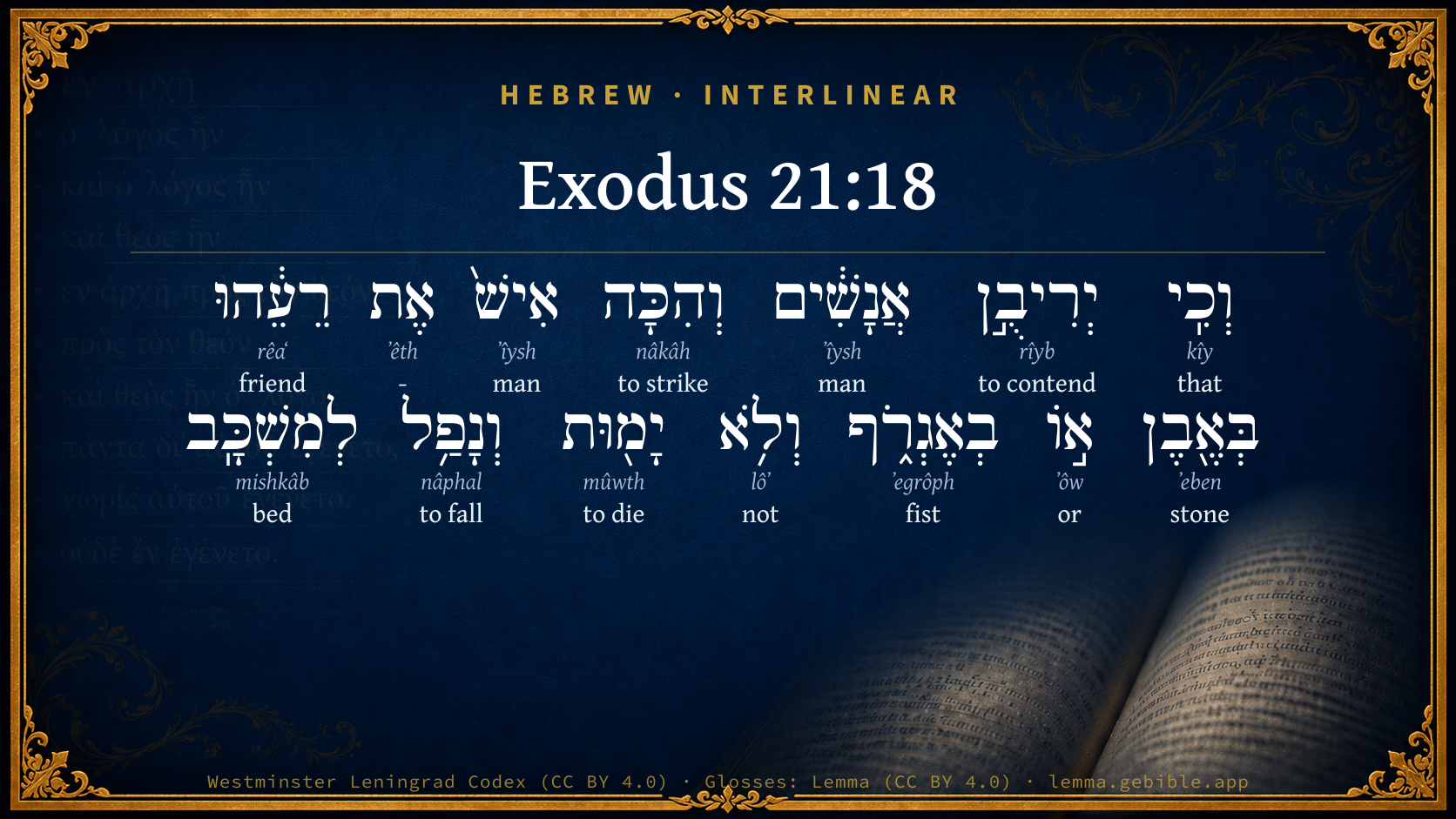
Hebrew (Westminster Leningrad Codex) Exodus 21:18 appears in the Hebrew Old Testament. The text above is from the Westminster Leningrad Codex. Each word links to its Strong’s number, a concise gloss, and parsing drawn from the Open Scriptures Hebrew Bible morphology. Click any word for its full Brown-Driver-Briggs (BDB) entry.
Download image
Cite this verse

Exodus 21:18 (World English Bible). Public Domain. Lemma interlinear Bible study tool, https://lemma.gebible.app/v/exodus/21/18.

Show BibTeX & RIS
BibTeX
RIS
English Translation
"If men quarrel and one strikes the other with a stone, or with his fist, and he doesn't die, but is confined to bed;
World English Bible · Public Domain
Highlights
  • 1 first appearance in the Hebrew Bible
Full analysis ↓
Download a study sheet

One document with this verse’s original text, its word-by-word gloss line, the meaning frame, cross-references with their text, attributed commentary, and full source and license credits — printable, and it pastes into notes with its structure intact.

This verse Autodidact and up

Study sheet (.html) Plain text (.txt)

A passage Seminary Student

Up to 50 verses in one chapter. A passage sheet keeps up to 6 commentary sources and 12 cross-references per verse, in the order this page ranks them, and says so on the sheet whenever that leaves anything out. Ask for a single verse and you get the Autodidact verse sheet above.

Everything on this page stays free to read, with no account — the sheet is a download of what is already on screen, not access to it.

Want to remove ads? Support Godless Engineer
Compare translations 3

The same verse in 3 English versions, stacked beneath the original-language interlinear above. Click any original word for its lexicon entry.

Each is an independent rendering of the whole verse — the interlinear is not word-aligned to these translations.

Highlighted words mark where these versions differ — a whole-verse word diff, not a word-by-word alignment.

  • World English Bible Public Domain
    "If men quarrel and one strikes the other with a stone, or with his fist, and he doesn't die, but is confined to bed;
  • King James Version Public Domain
    And if men strive together, and one smite another with a stone, or with his fist, and he die not, but keepeth his bed:
  • unfoldingWord Literal Text CC BY-SA 4.0
    If men fight and a man hits his neighbor with a stone or with his fist, and he does not die but falls to bed,

unfoldingWord Literal Text — © unfoldingWord, licensed CC BY-SA 4.0. Word-aligned USFM3 via Door43 (git.door43.org/unfoldingWord/en_ult).

Versions to compare (up to 4)

3 of 4 selected

Show all 18 translations

Every available English version of this verse, each an independent rendering of the whole verse.

  • World English Bible Public Domain
    "If men quarrel and one strikes the other with a stone, or with his fist, and he doesn't die, but is confined to bed;
  • Berean Standard Bible Public Domain
    If men are quarreling and one strikes the other with a stone or a fist, and he does not die but is confined to bed,
  • Majority Standard Bible Public Domain
    If men are quarreling and one strikes the other with a stone or a fist, and he does not die but is confined to bed,
  • King James Version Public Domain
    And if men strive together, and one smite another with a stone, or with his fist, and he die not, but keepeth his bed:
  • American Standard Version (1901) Public Domain
    And if men contend, and one smite the other with a stone, or with his fist, and he die not, but keep his bed;
  • Revised Version (1885) Public Domain
    And if men contend, and one smiteth the other with a stone, or with his fist, and he die not, but keep his bed:
  • Geneva Bible (1599) Public Domain
    When men also striue together, and one smite another with a stone, or with the fist, and he die not, but lieth in bed,
  • Douay-Rheims (1899) Public Domain
    If men quarrel, and the one strike his neighbour with a stone or with his fist, and he die not, but keepeth his bed:
  • Young's Literal Translation Public Domain
    `And when men contend, and a man hath smitten his neighbour with a stone, or with the fist, and he die not, but hath fallen on the bed;
  • Literal Standard Version CC BY-SA 4.0
    And when men contend, and a man has struck his neighbor with a stone, or with the fist, and he does not die, but has fallen on the bed;
  • Unlocked Literal Bible CC BY-SA 4.0
    If men fight and one hits the other with a stone or with his fist, and that person does not die, but is confined to his bed;
  • unfoldingWord Literal Text CC BY-SA 4.0
    If men fight and a man hits his neighbor with a stone or with his fist, and he does not die but falls to bed,
  • Darby Bible Public Domain
    And if men dispute, and one strike the other with a stone, or with the fist, and he die not, but take to [his] bed,
  • World Messianic Bible Public Domain
    “If men quarrel and one strikes the other with a stone, or with his fist, and he doesn’t die, but is confined to bed;
  • Webster's Bible Public Domain
    And if men contend together, and one shall smite another with a stone, or with his fist, and he shall not die, but keep his bed:
  • Free Bible Version CC BY-SA 4.0
    If men are fighting and one hits the other with a stone or with his fist, and the injured man doesn't die but has to stay in bed,
  • Bible in Basic English Public Domain
    If, in a fight, one man gives another a blow with a stone, or with the shut hand, not causing his death, but making him keep in bed;
  • JPS Tanakh (1917) Public Domain
    And if men contend, and one smite the other with a stone, or with his fist, and he die not, but keep his bed;

Literal Standard Version (2020), Covenant Press — licensed CC BY-SA 4.0. Text via the HelloAO Bible API (eBible.org). Unlocked Literal Bible (unfoldingWord) — licensed CC BY-SA 4.0. Text via the HelloAO Bible API (eBible.org). unfoldingWord Literal Text — © unfoldingWord, licensed CC BY-SA 4.0. Word-aligned USFM3 via Door43 (git.door43.org/unfoldingWord/en_ult). Free Bible Version, Dr. Jonathan Gallagher — licensed CC BY-SA 4.0. Text via the HelloAO Bible API (eBible.org).

Word by word

More ways to search: Search by grammar → Find every occurrence → Compare this word →

Practice this passage: Drill this verse → Learn its vocabulary →

בְאֶגְרֹ֑ף
ʼegrôph
H106
“in/at · fist”
Preposition + Noun, Common, Masculine, Singular, Absolute
Part of Speech
Preposition + Noun
Type
Common
Gender
Masculine
Number
Singular
State
Absolute
Full BDB Definition

Origin: from H1640 (in the sense of grasping)

TWOT: 385a

fist
  1. וְכִֽי kîy H3588 “and · that” Conjunction + Conjunction
  2. יְרִיבֻ֣ן rîyb H7378 “to contend” Verb, Qal, Imperfect, 3rd Person, Masculine, Plural + Suffix, n
  3. אֲנָשִׁ֔ים ʼîysh H376 “men” Noun, Common, Masculine, Plural, Absolute
  4. וְהִכָּה nâkâh H5221 “and · to strike” Conjunction + Verb, Hiphil, Sequential Perfect, 3rd Person, Masculine, Singular
  5. אִישׁ֙ ʼîysh H376 “man” Noun, Common, Masculine, Singular, Absolute
  6. אֶת ʼêth H853 “-” Particle, Direct Object
  7. רֵעֵ֔הוּ rêaʻ H7453 “friend · his” Noun, Common, Masculine, Singular, Construct + Suffix, Personal, 3rd Person, Masculine, Singular
  8. בְּאֶ֖בֶן ʼeben H68 “in/at · stone” Preposition + Noun, Common, Feminine, Singular, Absolute
  9. א֣וֹ ʼôw H176 “or” Conjunction
  10. וְלֹ֥א lôʼ H3808 “and · not” Conjunction + Particle, Negative
  11. יָמ֖וּת mûwth H4191 “to die” Verb, Qal, Imperfect, 3rd Person, Masculine, Singular
  12. וְנָפַ֥ל nâphal H5307 “and · to fall” Conjunction + Verb, Qal, Sequential Perfect, 3rd Person, Masculine, Singular
  13. לְמִשְׁכָּֽב mishkâb H4904 “to/for · bed” Preposition + Noun, Common, Masculine, Singular, Absolute

About this verse

These counts appear in no published source. They are computed here, from the morphology-tagged text and Lemma’s own curated glosses. What Lemma adds →

14
words
13
distinct lemmas
Pentateuch
section

Notable vocabulary

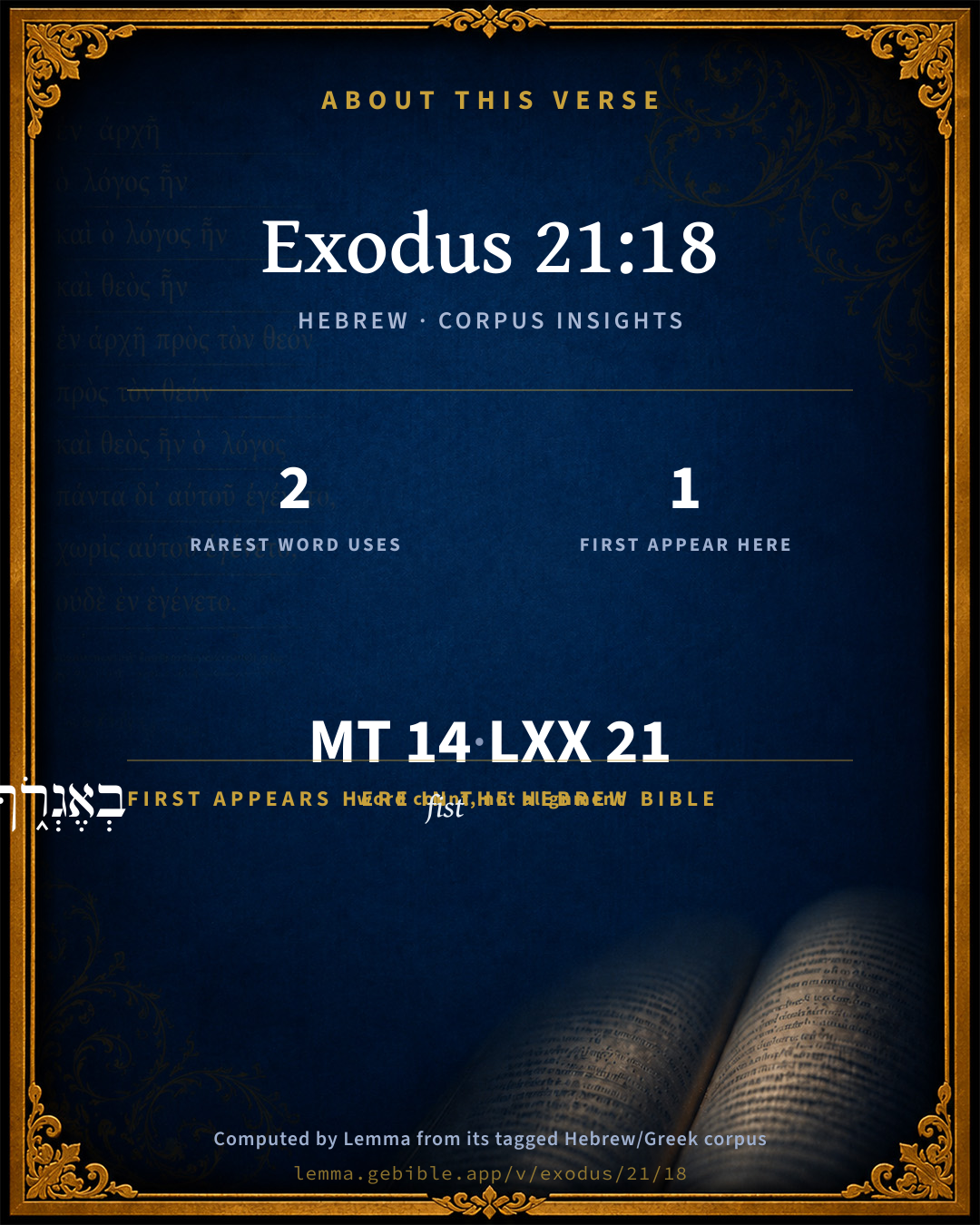
The rarest word here is בְאֶגְרֹ֑ף fist H106 — appearing just 2 times in the whole Hebrew Bible.

First appearance in Scripture

This word makes its first canonical appearance in the Hebrew Bible here:

  • בְאֶגְרֹ֑ף fist H106

Shared distinctive vocabulary

בְאֶגְרֹ֑ף fist H106 occurs in 2 verses of the Hebrew Bible. Also found in:

Grammatical profile

  • 4 verbs
  • 6 nouns
  • 2 conjunctions
  • 2 particles

Verb forms

  • יְרִיבֻ֣ן Qal · Imperfect
  • וְהִכָּה Hiphil · Sequential Perfect
  • יָמ֖וּת Qal · Imperfect
  • וְנָפַ֥ל Qal · Sequential Perfect

Repetition

A word recurs within this verse — often emphatic in Hebrew:

  • אֲנָשִׁ֔ים man H376 ×2

Hebrew & Septuagint length

In English translation the verse runs 24 words from the Hebrew and 29 from the Septuagint (LXX English) — closely comparable.

A rough comparison of the two English renderings, which tokenize alike — not a word-level alignment.

Word counts can differ between the Hebrew and the Greek without any difference in meaning — e.g. the Hebrew direct-object marker אֵת has no separate Greek word, and Greek often adds the article ὁ.

In the original languages it is 14 Hebrew tokens and 21 Greek tokens — but the two are counted differently (Hebrew bundles its prefixes and suffixes into one token; the Greek is in lemma form), so that isn’t a like-for-like length.

Cross-references

6

Topical passages linked to Exodus 21:18 in the Treasury of Scripture Knowledge — connected by theme and wording, ordered by reader-vote popularity; previews shown in the World English Bible.

  • Exodus 21:20 "If a man strikes his servant or his maid with a rod, and he dies under his hand, he shall surely be punished.
  • Exodus 2:13 He went out the second day, and, behold, two men of the Hebrews were fighting with each other. He said to him who did the wrong, "Why do you strike your fellow?"
  • Exodus 21:22 "If men fight and hurt a pregnant woman so that she gives birth prematurely, and yet no harm follows, he shall be surely fined as much as the woman's husband demands and the judges allow.
  • Numbers 35:16–24 But if he struck him with an instrument of iron, so that he died, he is a murderer: the murderer shall surely be put to death.
  • Deuteronomy 25:11 When men strive together one with another, and the wife of the one draws near to deliver her husband out of the hand of him who strikes him, and puts forth her hand, and takes him by the secrets;
  • 2 Samuel 14:6 Your handmaid had two sons, and they two strove together in the field, and there was none to part them, but the one struck the other, and killed him.

Cross-references courtesy of OpenBible.info (CC BY 4.0).

Hebrew and Greek witnesses Masoretic Hebrew ↔ Greek Septuagint

The same verse in the two great witnesses to the Old Testament, shown verse-for-verse.

These are two independent witnesses, not word-aligned to each other, and the Septuagint is shown in lemma (dictionary) form.

Hebrew Exodus 21:18 Masoretic · Westminster Leningrad Codex

וְכִֽי יְרִיבֻ֣ן אֲנָשִׁ֔ים וְהִכָּה אִישׁ֙ אֶת רֵעֵ֔הוּ בְּאֶ֖בֶן א֣וֹ בְאֶגְרֹ֑ף וְלֹ֥א יָמ֖וּת וְנָפַ֥ל לְמִשְׁכָּֽב

"If men quarrel and one strikes the other with a stone, or with his fist, and he doesn't die, but is confined to bed;

World English Bible · Public Domain

Greek LXX Exodus 21:18 Septuagint · lemma form

ἐάν δέ λοιδορέω δύο ἀνήρ καί πατάσσω τις ὁ πλησίον λίθος ἤ πυγμή καί μή ἀποθνήσκω κατακλίνω δέ ἐπί ὁ κοίτη

And if two men revile each other and strike the one the other with a stone or his fist, and he die not, but be laid upon his bed;

LXX2012 (modern English Septuagint) · Public Domain

On this verse, Keil & Delitzsch discusses the Septuagint’s reading. Read the note in Commentary ↓

Hebrew: Westminster Leningrad Codex (CC BY 4.0). Greek: Septuagint (public domain); English from LXX2012 (modern English Septuagint) (Public Domain). How the Septuagint differs from the Hebrew →

Targum (Aramaic paraphrase)

2

The Targum is the ancient Jewish Aramaic paraphrase of the Hebrew Scriptures — an interpretive translation, not the Hebrew text itself. Onkelos (literal) and Pseudo-Jonathan (expansive) render the Torah, and Jonathan the Prophets. Coverage is partial: where no permissively-licensed English translation exists for a verse, only the Aramaic is shown. This is verse-level text, not a word-by-word alignment to the Hebrew.

  1. Targum Onkelos Torah (Genesis–Deuteronomy)
    וַאֲרֵי יִנְצוּן גֻבְרִין וְיִמְחֵי גְבַר יָת חַבְרֵהּ בְּאַבְנָא אוֹ בְכוּרְמֵיזָא וְלָא יְמוּת וְיִפּוֹל לְבוּטְלָן:

    (no public-domain English translation for this verse)

    Targum Onkelos — Aramaic: “Onkelos Genesis” (public domain); “Onkelos Exodus” (public domain); “Onkelos Leviticus” (public domain); “Onkelos Numbers” (public domain); “Onkelos Deuteronomy” (public domain). English: “Sefaria Community Translation” (CC0 1.0 (public-domain dedication)); “J.W. Etheridge. The Targums of Onkelos and Jonathan Ben Uzziel on the Pentateuch. London: Longmans, Green, 1862” (public domain). Text via Sefaria.

  2. Targum Pseudo-Jonathan Torah (Genesis–Deuteronomy)
    וַאֲרוּם יִנְצוּן גּוּבְרִין וְיִמְחוּן חַד לְחַבְרֵיהּ בְּאַבְנָא אוֹ בְּמַרְתּוֹקָא (נ"א מוֹרְנִיתָא) וְלָא יְמוּת וְיִפּוֹל לְמֵירַע

    And when men strive together, and one smite his neighbour with a stone, or with his fist, so that he die not, but fall ill,

    Targum Pseudo-Jonathan — Aramaic: “Targum Jonathan on Genesis” (public domain); “Targum Jonathan on Exodus” (public domain); “Targum Jonathan on Leviticus” (public domain); “Targum Jonathan on Numbers” (public domain); “Targum Jonathan on Deuteronomy” (public domain). English: “The Targum of Jonathan ben Uzziel, trans. J. W. Etheridge, London, 1862” (public domain). Text via Sefaria.

Commentary

Notes on Exodus 21:18 from classic Christian and Jewish commentators (each source and its license shown beneath its notes). The classic Christian expositions comment on the surrounding passage and are grouped to its opening verse, so a note may address several verses; the Jewish commentaries on the Tanakh (Rashi and others) are per-verse, so they appear only where the commentator wrote on this verse.

Lemma curates 59 commentaries, every one of them public domain or Creative Commons licensed, each selected and text-cleaned for this edition rather than reprinted as found. About our sources →

Trapp's Complete Commentary

John Trapp

Exo 21:18 And if men strive together, and one smite another with a stone, or with [his] fist, and he die not, but keepeth [his] bed:

Ver. 18. If men strive together.] This is counted manhood, when indeed it is doghood rather: heathens condemned it; {a} and yet Navarrus, a Popish casuist, Caedem recte admitti putat, ut alapa vitetur, et ad honorem recuperandum.

{a} Qui ulciscitur, excusatius peccat. - Ibid.

John Trapp, A Commentary or Exposition upon All the Books of the Old and New Testament (1647–1656) — public domain. Text from a community e-Sword module.

The Biblical Illustrator

Joseph S. Exell

Exo_21:18-19

If men strive together.

Lessons

1. Passions and contentions breed many sad events among neighbours.

2. Smitings, and wounds, and sickness, and death are usual effects of sudden passions.

3. In case it proceed not to death, God will not suffer injuries unpunished by men.

4. Not only the death, but the hurts of men, are in Gods heart to prevent (Exo_21:18).

5. It is just with God that he who wounds must look to thorough healing of his neighbour.

6. Mans loss of time, as well as health, God will have recompensed by the injurious.

7. Security and prosperity of creatures is the end cf Gods judgments against violent men (Exo_21:18-19). (G. Hughes, B. D.)

Human strife

Are our little personal strifes noted in heaven? Yes, every one of them. But can men strive together? Properly looked at that would seem to be the harder question of the two. Coming suddenly upon a line of this kind we should exclaim in surprise, The assumption is impossible. We must begin our criticism of a statement of this kind by rejecting its probability, and, that being done, there is no case left. How can men strive together? Men are brothers, men are rational creatures, men recognize one anothers rights, and interests, and welfare; society is not a competition, but a fraternal and sacred emulation; therefore, the assumption that men can strive together is a false one, and, the foundation being false, the whole edifice totters down. That would-be fine theory, that would be sweet poetry, it might almost be thrown into rhyme, but there are the facts staring us in the face. What are those facts? That all life is a strife, that every man in some way or degree, or at some time, begrudges the room which every other man takes up. The tragedy of Cain and Abel has never ceased, and can never cease until we become children of the Second Adam. Great degrees of modification may, of course, take effect. The vulgarity of smiting may be left to those who are in a low state of life--who are, in fact, in barbarous conditions; but they who smite with the fist are not the cruellest of men. There is a refined smiting--a daily, bitter, malignant opposition; there is a process of mutual undermining, or outreaching, or outrunning, in the very spirit of which is found the purpose of murder. But mark how beneficence enters into the arrangement here laid down. Not only is the man who smote his brother to pay for the loss of his brothers time; that would be a mere cash transaction. There are men ready enough to buy themselves out of any obligation; a handful of gold is nothing. Their language is, Take it, and let us be free. That would be poor legislation in some cases, though heavy enough in others. To some men money has no meaning; they have outlived all its influences; they are so rich that they can bribe and pay, and secure silence or liberty by a mere outputting of the hand. But the beneficence is in the next clause, and shall cause him to be thoroughly healed. The man must be made as good as he was before, therefore he must be inquired about; he must be taken an interest in; he must become a quantity in the life of the man who injured him, and, however impartial the man who inflicted the injury may become under such chafing, the impatience itself may be turned to good account. Some men can only be taught philanthropy by such rough and urgent schoolmasters. (J. Parker, D. D.)

The Biblical Illustrator, edited by Joseph S. Exell (c. 1880s–1900s) — public domain. Text from a community e-Sword module.

Joseph Benson's Commentary

Exo 21:18-19. With a stone — Or any other instrument fit for such a mischievous purpose. The loss of his time — Of the profit which he commonly made of his time in the way of his calling. Shall cause him to be healed — Shall pay the charges of his cure.

Joseph Benson's Commentary on the Old and New Testaments (1811–1818) — public domain. Text from a community e-Sword module.

The Preacher's Complete Homiletical Commentary

Joseph S. Exell (gen. ed.)

MAIN HOMILETICS OF THE PARAGRAPH.—Exo_21:11-19

GOD’S DISAPPROBATION OF BRUTE FORCE.—Exo_21:22-25

I. One of the great underlying principles and fundamental axioms of the Mosaic legislation was the sanctity of human life. Hence the number of hedges and guards by which it was surrounded.

1. Life is everywhere regarded as the gift of God. It is therefore taken for granted that He alone has a right to interfere with it or take it away.

2. Life is everywhere regarded as given for the express purpose of promoting the Creator’s glory, and fulfilling those duties which He has laid down. To injure or destroy that life, therefore, is to make it fail of the end for which it was given.

3. Life, therefore, is to be protected from—

(1) attacks which would inflict a temporary injury upon it, under the penalty of remuneration for loss of time and medical attendance (Exo_21:18-19); or, according to the lex talionis (Exo_21:22-25), and which might become

(2) murder, in which case the punishment was death.

4. Life, however, was so precious that even the manslayer, if his crime was accidental, might have an opportunity for clearing himself (Exo_21:13); thus in the wilderness, anticipating the cities of refuge (Numbers 35; Deuteronomy 4; Deuteronomy 19; Joshua 20)

5. But life was so sacred that even the sanctuary was no protection to the deliberate murderer (Exo_21:14.) (See 1Ki_1:50; 1Ki_2:28; Lev_4:7).

II. This principle, properly applied, means the extinction of all strife, whether between individuals or nations. There may be circumstances under which personal encounter or national war may be justifiable, as when rights are invaded or the helpless oppressed. But, in the great majority of cases, quarrels may be settled by arbitration or mutual concession. At any rate, this grand principle of the sanctity of human life, if acted on all round, would discourage all violence and inaugurate the era of universal peace and good will towards man.

GOD DISAPPROVES OF BRUTE FORCE

I. Because it is beneath the true dignity of man. Such contests as described in the text are the outcome of the animal and lower part of our nature (Jas_4:1-2), and reduce man to the level of the beast. But God has given man reason, discretion, self-control; and fighting degrades the man. This applies

(1) to what, by a solemn irony, is described as the “noble (?) art of self-defence;”

(2) to the vast majority of those wars undertaken to gratify an individual’s or a nation’s lust of glory, revenge, or spoil.

II. Because it is unnatural. Humanity is a brotherhood. “God has made of one blood all the nations of men.” Therefore men should be prepared

(1) to make concessions;

(2) to forgive;

(3) to live in peace and unity together.

III. Because it is dangerous—

1. To the victor in the struggle.

(1.) He may disable his adversary, and have to pay a heavy indemnification (18, 19).

(2.) He may have to pay with his life the murderer’s forfeit (Exo_21:12).

2. To the vanquished. It may mean (a) serious injury, or (b) death.

IV. Because no worthy object is gained. Strength, time, skill, money, and, it may be, life are expended for what? Merely the ascendency of the strongest and the compulsory subjection of the weak.

V. Because it is eminently unchristian. “God, who at sundry times and in divers manners spake in time past unto the fathers by the prophets, hath in these last days spoken unto us by His Son.”

1. It is contrary to the example of Christ, “who, when he was reviled, reviled not again (1Pe_2:23), and who “did not strive.”

2. It is contrary to the precept of Christ. “Love one another;” “Love your enemies;” “They that use the sword shall perish by the sword;” “My kingdom is not of this world else would My servants fight.”

3. It is contrary to the whole body of Christian teaching. Paul (2Ti_2:24; Heb_12:14); Peter (1 Epis. Exo_3:8-11); James (Exo_3:13-16), Jude (Ep. 9); and as for John every chapter in his epistles is against it. This principle applies (I.) To the dogmatist. (II.) To the controversialist. The instrument need not be fist or stones. God disapproves of the employment of—(i.) force of intellect; (ii.) fluency of speech; (iii.) power of lung when exerted against moral principles.—J. W. Burn.

STRIVERS AND SMITERS.—Exo_21:18-27

There is in this passage no punishment appointed for the mere striver. He is simply held responsible for any evil consequences that may ensue from the strife. So that he who would be on the safe side, as regards either the being injured or being the cause of injury to another, must learn to “walk honestly, as in the day;—not in strife and envying.” For mental strife stirreth up anger; and this leadeth to physical strife; and this to violent smiting; and this sometimes terminates in death. “He loveth transgression that loveth strife.”

I. The striver who injures his opponent. The man smitten with a stone in a contention, and forced to take to his bed, is entitled to compensation. The smiter must pay for the loss sustained during enforced absence from work, and must also be responsible for all the injured man’s medical requirements. Acts have consequences, and men are to be held responsible for such consequences. On this principle we still proceed in great measure; and especially is this true when the consequences are immediate. Move with caution. Let every deed be the result of prayerful deliberation. Who can tell what the deed of to-day may produce in the far off to-morrow?

II. The smiter who injures his servant. The man who smites his servant or his maid with a rod, and causes death, is to be surely punished. It is plain that capital punishment is not to be inflicted on this smiter; for it is left to the discretion of the judges to award the damages. If capital punishment were intended, it is strange that it is not stated, as in the foregoing passages. Perhaps the term “rod” is here employed designedly; for where an iron was used malicious intention was supposed, and death was the punishment where death was caused. If, however, the injured servant continue a day or two, the striker shall not be punished; for the servant is the master’s money. The master suffers the loss of his servant’s services, and therefore receives sufficient punishment. If the servant or the maid lose either an eye or a tooth, through being struck by the master, then the servant or maid so suffering is entitled to liberty as a compensation. Such is the merciful provision for the slave’s physical welfare. A tooth is but a small price to pay for liberty. Many slaves have risked their lives in order to purchase the precious boon of freedom. Even the physical part of man’s nature is important. A slave’s body is God’s workmanship, and must be treated with respect.

III. The striver who injures a pregnant woman. Very often women meddle with the strifes of husbands or brothers. It is natural that women should seek to separate the contending parties. And if such women get injured in their efforts, we sometimes say it serves them right for interfering. But the Mosaic code did not so affirm; and we think rightly. Strivers should be held responsible for the results of their quarrels. It would greatly alter the condition of things if warlike strivers could be held responsible for the results of their contentions. As the result of the pregnant woman suffering permanent injury we have an enforcement of the law of retaliation. In rude states of society we may proceed on the principle of an eye for an eye, &c. but we may aspire to and work up to a state of society, thoroughly permeated with Gospel principles, where all the members of the state will be members of Christ’s mystical body—when this law shall vanish, and the higher laws of Christian love and forbearance shall be in full operation. It will then be an easy thing not to resist evil, for this will be reduced to a minimum. And, till those Elysian days appear, “Let every soul be subject unto the higher powers. For there is no power but of God; the powers that be are ordained of God.” “If thou do that which is evil, be afraid; for he beareth not the sword in vain; for he is the minister of God, a revenger to execute wrath upon him that doeth evil.”

—W. Burrows, B.A.

SUGGESTIVE COMMENTS ON THE VERSES

Exo_21:18-27. Passion and contention breed very bad events amongst neighbours.

Not only death, but the injury of man, God desires to prevent.

It is just with God that he who wounds must look to the healing of his neighbours.

Security and prosperity of creatures is the end of God’s judgments against violent men. The lives and comforts of the poorest slaves are dear to God, and secured by Him.

ILLUSTRATIONS

BY

REV. WILLIAM ADAMSON

Homicide! Exo_21:20. Dr. Leland writes concerning the Spartans, that nothing could exceed their cruelty to their serfs—their helots, as they called them. Not only did they treat them in their general conduct with great harshness and insolence, but it was part of their policy to massacre them on several occasions in cold blood, and without provocation. Several authors have mentioned their kruptia—so called from their lying in ambuscade in thickets and clefts of rocks, from which they issued out upon the serfs, and killed all they met. Sometimes they set upon them in the open day, and murdered the ablest and stoutest of them as they were in the fields at work. But English and American writers have been forced to admit the record of many such homicides in more modern times. Murdered “Uncle Toms” are no myth.

“Ah! for the tale the slave could speak,

Ah! for the shame of England’s sway;

On Afric’s sands the madden’d shriek,

’Neath southern suns the burning day;

Ye sounds of guilt—ye sights of gore—

Away! for slavery is no more.”

Slave-Sorrows! Exo_21:23-25. All honour Livingstone’s righteous indignation against the cruelties which he was obliged to witness as he travelled amid the horror of the slave-traffic. On the Luongo, he describes an incident in words which show this feeling. Six men were singing as if they did not feel the weight and degradation of the slave-sticks. I asked the cause of their mirth, and was told that they rejoiced at the idea of coming back after death, and hunting and killing those who had sold them. Some of the words I had to inquire about; for instance, the meaning of the words “to hunt and kill by spirit power.” Then the song started afresh: “Oh! you sent us off to the sea-coast, but the yoke is off when we die, and back we shall come to haunt and to kill you.” Then all joined in the chorus, which was the name of each seller. The strain told not of fun, but of the bitterness and tears of such as were oppressed.

“O for a lodge in some vast wilderness,

Some boundless contiguity of shade,

Where rumour of oppression and deceit

Might never reach me more.”

—Cowper.

Eye for Eye! Exo_21:25. Selden says that this does not mean that if I put out another man’s eye, therefore I must lose my own (for what is he better for that?), though this is commonly received. It means that I must give him what satisfaction an eye shall be janlged to be worth. Accordingly, Cruickshank relates the case of a slave, who appealed to a traditionary law which entitled him to freedom for the loss of an eye, in his master’s service, from the recoil of a branch of a tree. Compensation, then, and not retribution, is the essential element in this law. Substitution is here, and not revenge.

“You satisfy your anger and revenge;

Suppose this, it will not

Repair your loss.”

—Massinger.

The Preacher's Complete Homiletical Commentary (gen. ed. Joseph S. Exell; Funk & Wagnalls, c. 1892) — public domain (pre-1929). A full-Bible homiletical/sermon-outline anthology covering 65 of 66 books (2 John is absent from the source module). Text from a community e-Sword module.

Keil & Delitzsch

C. F. Keil & F. Delitzsch

Fatal blows and the crimes placed on a par with them are now followed in simple order by the laws relating to bodily injuries.

Exo 21:18-19

If in the course of a quarrel one man should hit another with a stone or with his fist, so that, although he did not die, he "lay upon his bed," i.e., became bedridden; if the person struck should get up again and walk out with his staff, the other would be innocent, he should "only give him his sitting and have him cured," i.e., compensate him for his loss of time and the cost of recovery. This certainly implies, on the one hand, that if the man died upon his bed, the injury was to be punished with death, according to Exo 21:12; and on the other hand, that if he died after getting up and going out, no further punishment was to be inflicted for the injury done.

Exo 21:20-21

The case was different with regard to a slave. The master had always the right to punish or "chasten" him with a stick (Pro 10:13; Pro 13:24); this right was involved in the paternal authority of the master over the servants in his possession. The law was therefore confined to the abuse of this authority in outbursts of passion, in which case, "if the servant or the maid should die under his hand (i.e., under his blows), he was to be punished" (ינּקם נקם: "vengeance shall surely be taken"). But in what the נקם was to consist is not explained; certainly not in slaying by the sword, as the Jewish commentators maintain. The lawgiver would have expressed this by יוּמת מות. No doubt it was left to the authorities to determine this according to the circumstances. The law in Exo 21:12 could hardly be applied to a case of this description, although it was afterwards extended to foreigners as well as natives (Lev 24:21-22), for the simple reason, that it is hardly conceivable that a master would intentionally kill his slave, who was his possession and money. How far the lawgiver was from presupposing any such intention here, is evident from the law which follows in Exo 21:21, "Notwithstanding, if he continue a day or two (i.e., remain alive), it shall not be avenged, for he is his money." By the continuance of his life, if only for a day or two, it would become perfectly evident that the master did not wish to kill his servant; and if nevertheless he died after this, the loss of the slave was punishment enough for the master. There is no ground whatever for restricting this regulation, as the Rabbins do, to slaves who were not of Hebrew extraction.

Exo 21:22-25

If men strove and thrust against a woman with child, who had come near or between them for the purpose of making peace, so that her children come out (come into the world), and no injury was done either to the woman or the child that was born,

(Note: The words ילדיה ויצאוּ are rendered by the lxx καὶ ἐξέλθη τὸ παιδίον αὐτῆς μὴ ἐξεικονισμένον and the corresponding clause יהיה אסון ואם by ἐὰν δὲ ἐξεικονισμένον ᾖ; consequently the translators have understood the words as meaning that the fruit, the premature birth of which was caused by the blow, if not yet developed into a human form, was not to be regarded as in any sense a human being, so that the giver of the blow was only required to pay a pecuniary compensation, - as Philo expresses it, "on account of the injury done to the woman, and because he prevented nature, which forms and shapes a man into the most beautiful being, from bringing him forth alive." But the arbitrary character of this explanation is apparent at once; for ילד only denotes a child, as a fully developed human being, and not the fruit of the womb before it has assumed a human form. In a manner no less arbitrary אסון has been rendered by Onkelos and the Rabbins מותא, death, and the clause is made to refer to the death of the mother alone, in opposition to the penal sentence in Exo 21:23, Exo 21:24, which not only demands life for life, but eye for eye, etc., and therefore presupposes not death alone, but injury done to particular members. The omission of להּ, also, apparently renders it impracticable to refer the words to injury done to the woman alone.)

a pecuniary compensation was to be paid, such as the husband of the woman laid upon him, and he was to give it בּפללים by (by an appeal to) arbitrators. A fine is imposed, because even if no injury had been done to the woman and the fruit of her womb, such a blow might have endangered life. (For יצא roF( to go out of the womb, see Gen 25:25-26.) The plural ילדיה is employed for the purpose of speaking indefinitely, because there might possibly be more than one child in the womb. "But if injury occur (to the mother or the child), thou shalt give soul for soul, eye for eye,...wound for wound:" thus perfect retribution was to be made.

Exo 21:26-27

But the lex talionis applied to the free Israelite only, not to slaves. In the case of the latter, if the master struck out an eye and destroyed it, i.e., blinded him with the blow, or struck out a tooth, he was to let him go free, as a compensation for the loss of the member. Eye and tooth are individual examples selected to denote all the members, from the most important and indispensable down to the very least.

Exo 21:28-30

The life of man is also protected against injury from cattle (cf. Gen 9:5). "If an ox gore a man or a woman, that they die, the ox shall be stoned, and its flesh shall not be eaten;" because, as the stoning already shows, it was laden with the guilt of murder, and therefore had become unclean (cf. Num 35:33). The master or owner of the ox was innocent, sc., if his ox had not bee known to do so before. But if this were the case, "if his master have been warned (בּבעליו הוּעד, lit., testimony laid against its master), and notwithstanding this he have not kept it in," then the master was to be put to death, because through his carelessness in keeping the ox he had caused the death, and therefore shared the guilt. As this guilt, however, had not been incurred through an intentional crime, but had arisen simply from carelessness, he was allowed to redeem his forfeited life by the payment of expiation money (כּפר, lit., covering, expiation, cf. Exo 30:12), "according to all that was laid upon him," sc., by the judge.

Exo 21:31-32

The death of a son or a daughter through the goring of an ox was also to be treated in the same way; but that of a slave (man-servant or maid-servant) was to be compensated by the payment of thirty shekels of silver (i.e., probably the ordinary price for the redemption of a slave, as the redemption price of a free Israelite was fifty shekels, Lev 27:3) on the part of the owner of the ox; but the ox was to be killed in this case also. There are other ancient nations in whose law books we find laws relating to the punishment of animals for killing or wounding a man, but not one of them had a law which made the owner of the animal responsible as well, for they none of them looked upon human life in its likeness of God.

Keil & Delitzsch — Biblical Commentary on the Old Testament (1861–1891) — public domain (CC PDM 1.0). Text via the HelloAO Bible API. (Old Testament only.)

Tyndale Open Study Notes

Tyndale Open Resources

21:18-27 These laws governed compensation for injuries that did not lead to death.

Tyndale Open Study Notes — © Tyndale Open Resources, licensed CC BY-SA 4.0. Text via the HelloAO Bible API.

Geneva Bible (1599)

Geneva Bible translators

Either far off him or near.

Geneva Bible (1599) marginal notes — public domain. Text via Bolls.life.

Ellicott's Commentary for English Readers

(18) With a stone, or with his fist.—Comp. The difference made under the English law between wounding with a sharp or a blunt instrument.

(18, 19) Severe assault, endangering life, but not actually taking it, is placed under the same head with homicide, as approaching to it, but is not to be punished in the same way. If death ensues in such a case, the crime is, of course, murder or manslaughter, according to the attendant circumstances; but if death does not ensue, it is aggravated assault only. In such cases punishment could not be inflicted by retaliation—the usual penalty under the Mosaic Law (Exo_21:24-25)—without a risk of killing the man, which would have been an excessive punishment. The law therefore imposed a fine, which was to be fixed at such an amount as would at once compensate the sufferer for the loss of his time (Exo_21:19), and defray the cost of his cure.

A Bible Commentary for English Readers, edited by Charles John Ellicott (1878–1897) — public domain. Text from a community e-Sword module.

The Cambridge Bible for Schools and Colleges

gen. ed. J. J. S. Perowne

18. contend] or dispute, wrangle in words: rendered strive, Gen_26:20-21, contend, as here, Neh_13:11; Neh_13:17.

fist] Isa_58:4 †. So LXX. Vulg. Di.: the Heb. ’egrôph has also this sense in the Talm. The meaning spade or hoe, which Ryssel in Di.2 argues for, would be possible etymologically (for the root signifies to scoop or sweep away, Jdg_5:21): but it does not suit Isa_58:4. The rend. of the Targums, club or cudgel, would suit both passages, but lacks philological justification.

and he die not] for, if he did, the case would be regulated presumably by the mishpâṭ of v. 12.

18, 19. Bodily injury inflicted in a quarrel.

18–27. Bodily injuries caused by human beings. Four cases are taken, two arising out of a quarrel, and two out of rough treatment of a slave (vv. 22–25 would more naturally follow vv. 18, 19). In fixing the penalties, consideration is taken of the status and sex of the persons involved, as also of the character of the injury, and the consequences following from it.

18–36. Bodily injuries, caused (a) by human beings, vv. 18–27; (b) by animals, or through the neglect of reasonable precautions, vv. 28–36.

The Cambridge Bible for Schools and Colleges (gen. ed. J. J. S. Perowne; Cambridge University Press, 1878–1918) — public domain. Text from a community e-Sword module.

John Gill's Exposition

And if men strive together,.... Quarrel and fight, and wrestle with and box one another:

and one smite another with a stone; which lying near him he might take up, and in his passion throw it at his antagonist:

or with his fist; with his double fist, as we express it, with his hand closed, that it might come with the greater force, and give the greater blow:

and he die not, but keepeth his bed; does not die with the blow of the stone or fist, yet receives so much damage by it that he is obliged to take to his bed; or, as the Targum of Jerusalem paraphrases it, is cast on the bed sick; or, as the Targum of Jonathan, falls into a disease, as a fever, or the like, through the force of the blow, so that he is confined to his room and to his bed.

John Gill's Exposition of the Whole Bible (1746–1763) — public domain (CC PDM 1.0). Text via the HelloAO Bible API.

Matthew Poole's English Annotations

With a stone, or any other instrument fit for such a mischievous purpose. A usual synecdoche.

Matthew Poole's English Annotations on the Holy Bible (1683–1685) — public domain. Text from a community e-Sword/MySword module.

Whedon's Commentary on the Bible

Daniel D. Whedon

18, 19. He die not, but keepeth his bed — Observe in this statute the careful purpose to maintain equity and right. He who smote and injured his fellowman in personal contest was responsible for all losses or damage resulting therefrom.

Daniel D. Whedon (gen. ed.), Commentary on the Old and New Testaments (1874–1909) — public domain. Text from a community e-Sword module.

The Pulpit Commentary

Vers. 18, 19Severe assault. Assault was punishable by the law in two ways. Ordinarily, the rule was that of strict retaliation" " Eye for eye, tooth for tooth, hand for hand, foot for foot, burning for burning, wound for wound, stripe for stripe". (vers. 24, 25; compare Lev_24:20, and Deu_19:21) But where the assault was severe, causing a man to take to his bed, and call in the physician"s aid, something more was needed. The Rabbinical commentators tell us that in this case he was arrested, and sent to prison until it was ascertained whether the person hurt would die or no. If he died, the man was tried for murder; if he recovered, a fine was imposed. This was axed at such a sum as would at once compensate the injured man for his loss of time and defray the expense of his cure. A similar principle is adopted under our own law in many cases of civil action.

If men strive together. If there is a quarrel and a personal encounter. In our own law this would reduce this offence, if death ensued, to manslaughter. With a stone, or with his fist. The use of either would show absence of premeditation, and of any design to kill. A weapon would have to be prepared beforehand: a stone might be readily caught up.

Vers. 18-36. Bodily injuries.

The laws in this section may be thus classified:

I INJURIES BY MAN.

1. Strivers (vers. 18, 19). The man who injured another in strife was required to pay for the loss of his time, and to cause him to be thoroughly healed. Had the man died, the case would have come under the law of ver.

2. As it was, blame attached to both parties, and the law waived the rightto further satisfaction. Note

(1) One way of atoning for wrong is to seek in every way in our power to undo the mischief we have caused. This, alas! cannot always be accomplished. Not always is "thorough healing whether bodily, mental, or moral possible. So far as it is possible we are bound to attempt it.

(2) Justice obtains her highest satisfaction when the wrongdoer can be made to contribute to the undoing of his own wrong. This principle might be more acted on than it is.

1. Servants (vers. 20, 21; 26, 27). A master was not to be allowed to injure with impunity even a slave purchased with his "money." If the slave was wantonly murdered, the case would come under the law of murder. If he died under chastisement, the master was punished at discretion of the judges. If the slave was in any way maimed, he obtained his freedom. It has been remarked that this is the earliest certain trace of legislation for the protection of the slave. See below.

2. A woman with child (vers. 22-26). The injury here is indirect. The woman is hurt in interfering in the strife between two men. Yet the law holds the man who has injured her responsible for his fault, and decrees that he shall pay heavy damages. If evil effects follow, he is to be punished under the jus talionis.

II INJURIES BY BEASTS. The distinction formerly observed as made by the law between voluntary and involuntary actions (vers. 13, 14) meets here with fresh illustrations.

1. If an ox gore a man or a woman, and the gored person dies, the ox is tobe stoned a testimony to the sacredness of human life, (cf. Gen_9:5) but the owner shall be quit (ver. 28).

2. If, however, the owner had been previously warned of the dangeroushabits of the animal, and had not kept it in, there devolved on him the entire responsibility of the fatal occurrence.

(1) If the person gored was a free Israelite (male or female), the life of the owner of the ox was forfeited; but an opportunity was given him of redeeming it by payment of a ransom (vers. 29-32).

(2) If the person gored was a slave, the owner of the ox had to compensate the owner of the slave for the loss of his servant. The price fixed was thirty shekels of silver (ver. 32). In either case the ox was to be stoned.

III INJURIES TO BEASTS. The same principles of equity apply here.

1. If an ox or an ass fall into a pit which has been carelessly left uncovered,the owner of the pit is required to pay in full (vers. 33, 34).

2. If one man"s ox kill another"s, the loss is to fall equally on both owners (ver. 35).

3. If the owner of the ox was aware of its propensity to gore, and had notkept it in, he must, as before, bear the whole loss (ver. 36). The equity of this series of precepts is not more conspicuous than their humanity. The important lesson taught by these enactments is, that we cannot evade responsibility for our actions. Our actions abide with us. They cleave to us. We cannot shake ourselves rid of them. We are responsible, not only for the actions themselves, but for the consequences which flow from them for the influences they set in motion. And we are responsible, not onlyfor direct, but for indirect consequences (ver. 22). Involuntary acts are not imputed to us, but all voluntary ones are. We are responsible, as well for what we do not do (having the power to do it), as for what we actually perform. We are responsible for the effects of negligence and carelessness. These principles have wide application. They cover the whole range of conduct. They apply to the moral sphere as well as to the physical. They apply, not simply to definite acts, but to the entire influence exerted by our lives. What a responsibility is this! Only grace will enable us to bear its burden. J.O.

The Pulpit Commentary (1880–1919), ed. H.D.M. Spence-Jones & Joseph S. Exell — public domain. Text from a community e-Sword module.

unfoldingWord translationNotes

Door43 World Missions Community

is confined to his bed

This can be stated in active form. AT: "cannot get out of bed" or "has to stay in bed" (See: Active or Passive)

he recovers

"he gets better"

staff

This is a stick that can be leaned on for support while walking.

the loss of his time

This refers to a situation when someone cannot work to earn money. You can express this clearly in the translation. AT: "the time he could not work" (See: Assumed Knowledge and Implicit Information)

pay for his complete recovery

"pay his medical costs" or "pay for his costs for healing"

translationWords

guilt

unfoldingWord translationNotes — © Distant Shores Media and the Door43 World Missions Community, licensed CC BY-SA 4.0. Source: git.door43.org/Door43/en_tn.

Rashi

Rabbi Shlomo Yitzchaki (Rashi)

וכי יריבן אנשים AND IF MEN QUARREL — Why is this (vv. 18, 19) stated in this particular form? Since Scripture states, (v. 24) “Eye for eye”, we learn from this only that compensation for the loss of limbs has to be paid, but we cannot infer from it that indemnity for loss of time (during which the injured has been disabled from work) and cost of medical treatment have also to be paid; consequently this section (vv. 18 and 19) is said (Mekhilta).

ונפל למשכב BUT KEEPETH HIS BED — The meaning is as the Targum gives it: ויפל לבוטלן “and he falls into inactivity”, i. e. he falls into an illness that prevents him from working.

Rashi on the Tanakh — English translations: “The Judaica Press complete Tanach with Rashi, translated by A. J. Rosenberg” (CC BY 4.0); “Pentateuch with Rashi's commentary by M. Rosenbaum and A.M. Silbermann, 1929-1934” (public domain); “The Metsudah Tanach series, Lakewood, N.J” (CC BY 4.0); and “The Book of Joshua, Metsudah Publications, 1997” (CC BY 4.0). Text via Sefaria.

Ramban (Nachmanides)

Rabbi Moshe ben Nachman (Ramban / Nachmanides)

WITH A STONE OR ‘B’EGROF’ (WITH HIS FIST). Judging from certain expressions of the Rabbis, egrof is the hand closed tightly, with the fingers gathered into the palm for the purpose of striking someone with it. Thus they speak of ba’alei egrofin [literally: “men of fists,” or men of power]; “egrofo (the fist) of Ben Abtiach.” Similarly ‘b’egrof’ of wickedness means the hand of wickedness that strikes. Scripture thus mentioned two kinds of hitting — the hard one, with a stone, and the lighter one, with the fist, which in most cases does not cause death — in order to declare that in both cases an estimate [of the power of the stone or the fist with which he struck him] is needed, and the assailant is meanwhile imprisoned. If the assailed person dies, such as where he struck him a mortal blow, he is a murderer; he shall surely be put to death, but if he does not die, the assailant has to pay him for the loss of his labor and for the cost of the healing.In the Mechilta [we find the following text]: “Rabbi Nathan says: He has likened the stone to the fist and the fist to the stone. Just as the stone can cause death, so also the blow of the fist must be such that it is capable of causing death. And just as the fist is something that can be identified [and measured for the power of its blow], so also the stone must be such as can be identified. But if the stone with which he struck him became mixed up with other stones, the assailant is free.” This means if the stone became mixed up with other stones, they [e.i., the judges] estimate the lightest one and if it is incapable of causing death, they free the assailant.Other scholars ). have said that the word egrof means “a clod of earth,” the term being derived from the expression: the grains shrivel under ‘megr’fotheihem’ (their clods of earth), and the letter alef [in the word egrof is redundant], as is the alef in the word ezro’a [“arm,” where the word is really zro’a]. And this is the opinion of Onkelos who translated b’egrof — b’churmeiza (a piece of white stone or glazed tile). He mentioned these things also in order to tell us that the assailant who hits him with a clod of earth is also liable to be put to death, if he struck him on a sensitive spot where it is capable of causing death. This is to distinguish the law of the sword from the stone and egrof, for no estimate [of a sword or weapon] needs to be taken [since even a minute piece of metal — such as a needle — can also cause death], as the Sages have mentioned.

Ramban (Nachmanides) on the Tanakh — English translation: “Commentary on the Torah by Ramban (Nachmanides). Translated and annotated by Charles B. Chavel. New York, Shilo Pub. House, 1971-1976” (CC BY 4.0). Text via Sefaria.

Lesson kit

Teaching starters — assembled from the data on this page, not authored interpretation. Every prompt links to the verse data it draws on. Edit before teaching.

Exodus, in the Pentateuch, opens this verse with 14 words (13 distinct Hebrew lemmas). Its most distinctive word is ʼegrôph (“fist”). A historical commentator’s framing appears above. Read the whole chapter for the surrounding context.

Discussion questions

  1. How does “fist” (ʼegrôph) shape what this verse is saying?
  2. The word “fist” first appears here in Scripture. What is being introduced at this debut?
  3. Isaiah 58:4 shares the word «fist» with this verse. How do the two illuminate each other?
  4. “man” occurs 2× in this one verse. What is the effect of the repetition?
  5. The translations on this page render this verse differently — a whole-verse word diff, not a word-by-word alignment. What might account for the different wordings?
  6. The verb «יְרִיבֻ֣ן» is Qal Imperfect. How does its form color the action?
  7. Reading how Trapp's Complete Commentary and The Biblical Illustrator read this verse, where do the two commentators agree and where do they part?

Things to notice

Reading settings

Reading text

Shown beneath each verse's original-language words.

Old Testament
Old Testament edition

Read the OT as the Masoretic Hebrew (MT) or the Greek Septuagint (LXX).

English shown for the Greek Septuagint (in the Hebrew ↔ Greek comparison).

Comparing translations? Open the Compare panel on any verse page to stack up to four side by side.