Genesis 2:24

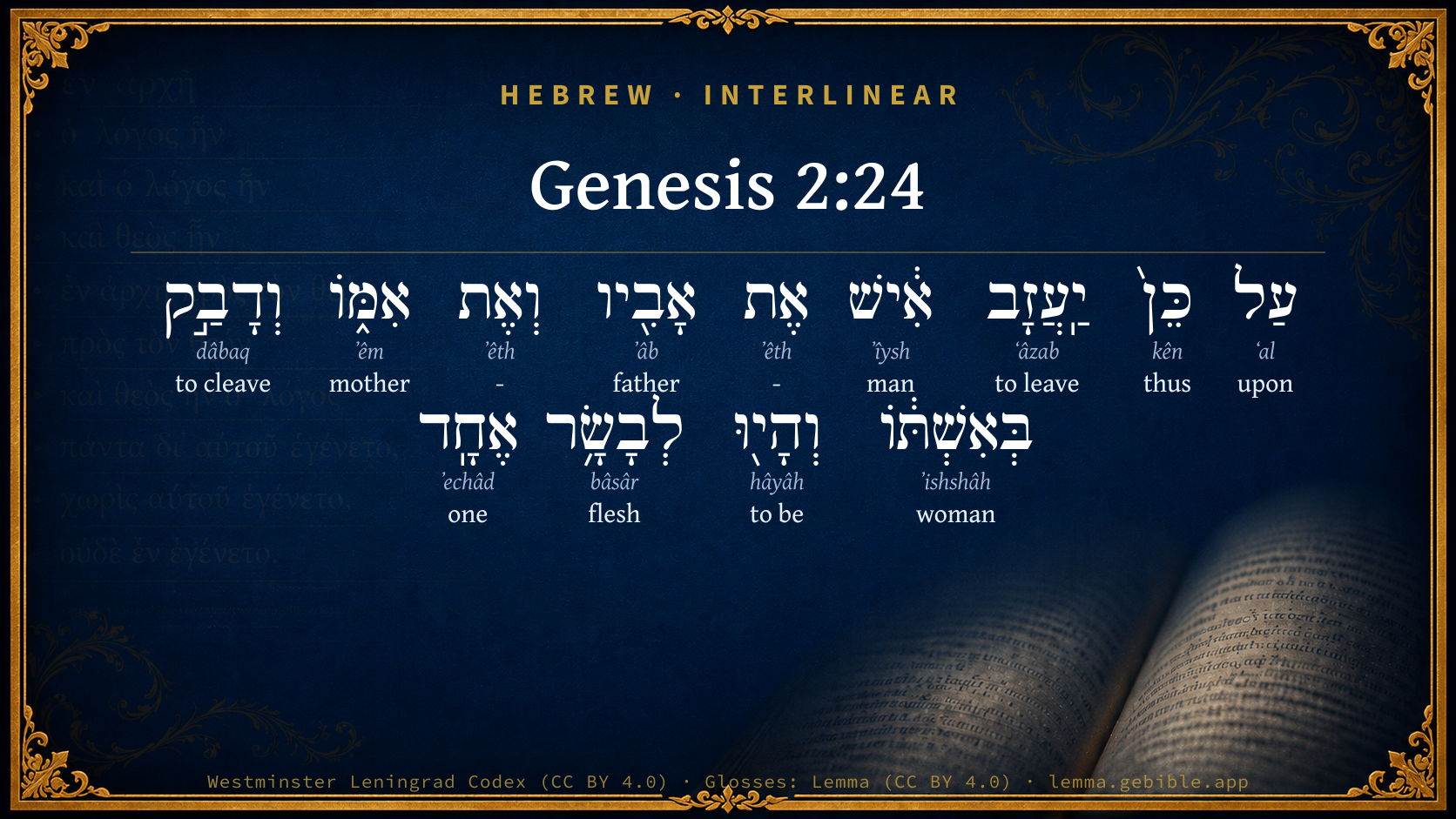
Hebrew (Westminster Leningrad Codex) Genesis 2:24 appears in the Hebrew Old Testament. The text above is from the Westminster Leningrad Codex. Each word links to its Strong’s number, a concise gloss, and parsing drawn from the Open Scriptures Hebrew Bible morphology. Click any word for its full Brown-Driver-Briggs (BDB) entry.
Download image
Cite this verse

Genesis 2:24 (World English Bible). Public Domain. Lemma interlinear Bible study tool, https://lemma.gebible.app/v/genesis/2/24.

Show BibTeX & RIS
BibTeX
RIS
English Translation
Therefore a man will leave his father and his mother, and will join with his wife, and they will be one flesh.
World English Bible · Public Domain
Highlights
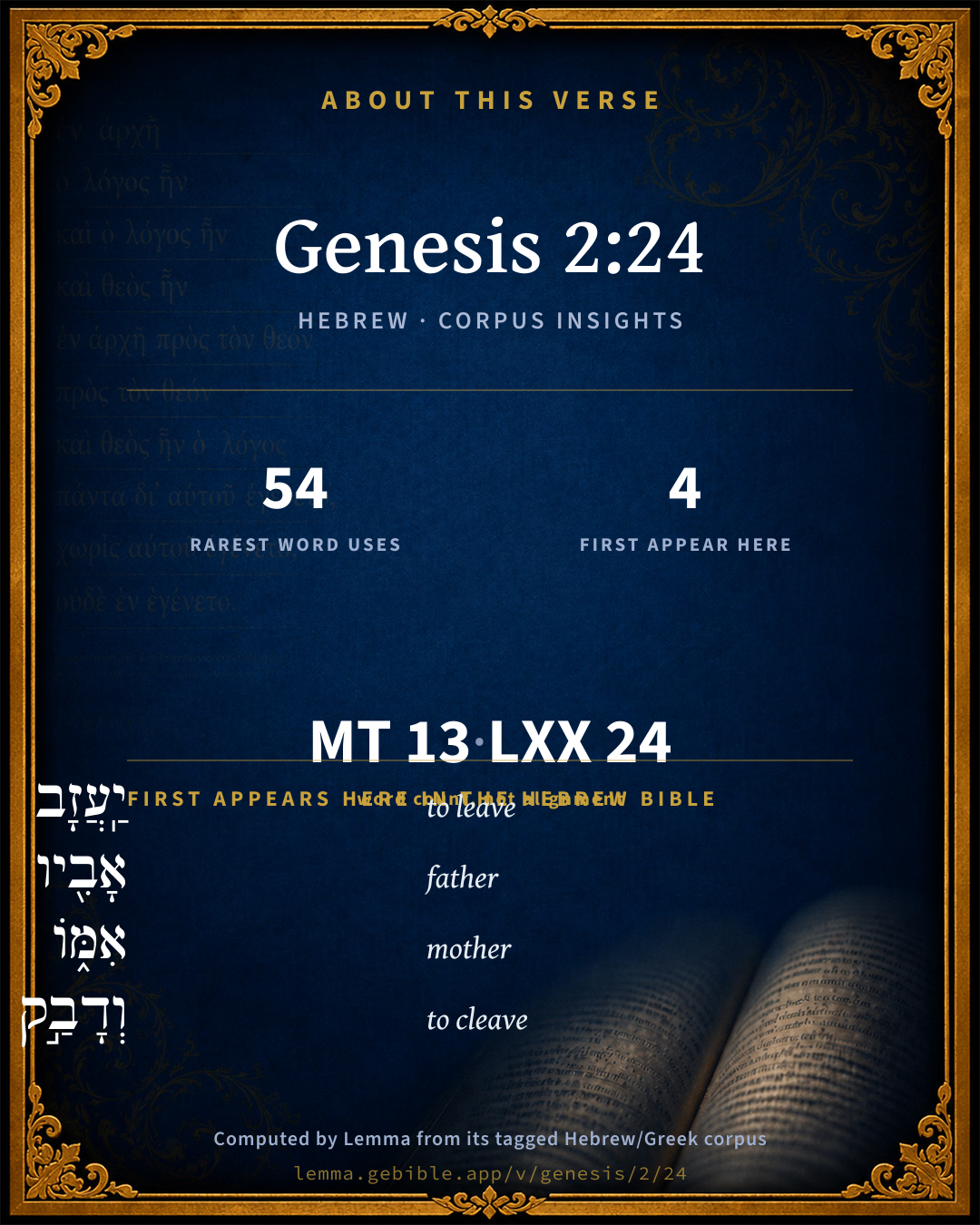
  • 4 first appearances in the Hebrew Bible
Full analysis ↓
Download a study sheet

One document with this verse’s original text, its word-by-word gloss line, the meaning frame, cross-references with their text, attributed commentary, and full source and license credits — printable, and it pastes into notes with its structure intact.

This verse Autodidact and up

Study sheet (.html) Plain text (.txt)

A passage Seminary Student

Up to 50 verses in one chapter. A passage sheet keeps up to 6 commentary sources and 12 cross-references per verse, in the order this page ranks them, and says so on the sheet whenever that leaves anything out. Ask for a single verse and you get the Autodidact verse sheet above.

Everything on this page stays free to read, with no account — the sheet is a download of what is already on screen, not access to it.

Want to remove ads? Support Godless Engineer
Compare translations 3

The same verse in 3 English versions, stacked beneath the original-language interlinear above. Click any original word for its lexicon entry.

Each is an independent rendering of the whole verse — the interlinear is not word-aligned to these translations.

Highlighted words mark where these versions differ — a whole-verse word diff, not a word-by-word alignment.

  • World English Bible Public Domain
    Therefore a man will leave his father and his mother, and will join with his wife, and they will be one flesh.
  • King James Version Public Domain
    Therefore shall a man leave his father and his mother, and shall cleave unto his wife: and they shall be one flesh.
  • unfoldingWord Literal Text CC BY-SA 4.0
    For that a man will leave his father and his mother, and he will cling to his wife, and they will become one flesh.

unfoldingWord Literal Text — © unfoldingWord, licensed CC BY-SA 4.0. Word-aligned USFM3 via Door43 (git.door43.org/unfoldingWord/en_ult).

Versions to compare (up to 4)

3 of 4 selected

Show all 18 translations

Every available English version of this verse, each an independent rendering of the whole verse.

  • World English Bible Public Domain
    Therefore a man will leave his father and his mother, and will join with his wife, and they will be one flesh.
  • Berean Standard Bible Public Domain
    For this reason a man will leave his father and mother and be united to his wife, and they will become one flesh.
  • Majority Standard Bible Public Domain
    For this reason a man will leave his father and mother and be united to his wife, and they will become one flesh.
  • King James Version Public Domain
    Therefore shall a man leave his father and his mother, and shall cleave unto his wife: and they shall be one flesh.
  • American Standard Version (1901) Public Domain
    Therefore shall a man leave his father and his mother, and shall cleave unto his wife: and they shall be one flesh.
  • Revised Version (1885) Public Domain
    Therefore shall a man leave his father and his mother, and shall cleave unto his wife: and they shall be one flesh.
  • Geneva Bible (1599) Public Domain
    Therefore shall man leaue his father and his mother, and shall cleaue to his wife, and they shall be one flesh.
  • Douay-Rheims (1899) Public Domain
    Wherefore a man shall leave father and mother, and shall cleave to his wife: and they shall be two in one flesh.
  • Young's Literal Translation Public Domain
    therefore doth a man leave his father and his mother, and hath cleaved unto his wife, and they have become one flesh.
  • Literal Standard Version CC BY-SA 4.0
    therefore a man leaves his father and his mother, and has cleaved to his wife, and they have become one flesh.
  • Unlocked Literal Bible CC BY-SA 4.0
    Therefore a man will leave his father and his mother, he will be united to his wife, and they will become one flesh.
  • unfoldingWord Literal Text CC BY-SA 4.0
    For that a man will leave his father and his mother, and he will cling to his wife, and they will become one flesh.
  • Darby Bible Public Domain
    Therefore shall a man leave his father and his mother, and cleave to his wife; and they shall become one flesh.
  • World Messianic Bible Public Domain
    Therefore a man will leave his father and his mother, and will join with his wife, and they will be one flesh.
  • Webster's Bible Public Domain
    Therefore shall a man leave his father and his mother, and shall cleave to his wife: and they shall be one flesh.
  • Free Bible Version CC BY-SA 4.0
    This is the reason a man leaves his father and mother and is joined to his wife, and the two become one being.
  • Bible in Basic English Public Domain
    For this cause will a man go away from his father and his mother and be joined to his wife; and they will be one flesh.
  • JPS Tanakh (1917) Public Domain
    Therefore shall a man leave his father and his mother, and shall cleave unto his wife, and they shall be one flesh.

Literal Standard Version (2020), Covenant Press — licensed CC BY-SA 4.0. Text via the HelloAO Bible API (eBible.org). Unlocked Literal Bible (unfoldingWord) — licensed CC BY-SA 4.0. Text via the HelloAO Bible API (eBible.org). unfoldingWord Literal Text — © unfoldingWord, licensed CC BY-SA 4.0. Word-aligned USFM3 via Door43 (git.door43.org/unfoldingWord/en_ult). Free Bible Version, Dr. Jonathan Gallagher — licensed CC BY-SA 4.0. Text via the HelloAO Bible API (eBible.org).

Word by word

More ways to search: Search by grammar → Find every occurrence → Compare this word →

Practice this passage: Drill this verse → Learn its vocabulary →

וְדָבַ֣ק
dâbaq
H1692
“and · to cleave”
Conjunction + Verb, Qal, Sequential Perfect, 3rd Person, Masculine, Singular
Part of Speech
Conjunction + Verb
Stem
Qal
Form
Sequential Perfect
Person
3rd Person
Gender
Masculine
Number
Singular
Full BDB Definition

Origin: a primitive root

TWOT: 398

to cling, stick, stay close, cleave, keep close, stick to, stick with, follow closely, join to, overtake, catch - (Qal) - to cling, cleave to - to stay with - (Pual) to be joined together - (Hiphil) - to cause to cleave to - to pursue closely - to overtake - (Hophal) to be made to cleave
  1. עַל ʻal H5921 “upon” Preposition
  2. כֵּן֙ kên H3651 “thus” Particle, Demonstrative
  3. יַֽעֲזָב ʻâzab H5800 “to leave” Verb, Qal, Imperfect, 3rd Person, Masculine, Singular
  4. אִ֔ישׁ ʼîysh H376 “man” Noun, Common, Masculine, Singular, Absolute
  5. אֶת ʼêth H853 “-” Particle, Direct Object
  6. אָבִ֖יו ʼâb H1 “father · his” Noun, Common, Masculine, Singular, Construct + Suffix, Personal, 3rd Person, Masculine, Singular
  7. וְאֶת ʼêth H853 “and · -” Conjunction + Particle, Direct Object
  8. אִמּ֑וֹ ʼêm H517 “mother · his” Noun, Common, Feminine, Singular, Construct + Suffix, Personal, 3rd Person, Masculine, Singular
  9. בְּאִשְׁתּ֔וֹ ʼishshâh H802 “in/at · woman · his” Preposition + Noun, Common, Feminine, Singular, Construct + Suffix, Personal, 3rd Person, Masculine, Singular
  10. וְהָי֖וּ hâyâh H1961 “and · to be” Conjunction + Verb, Qal, Sequential Perfect, 3rd Person, Common, Plural
  11. לְבָשָׂ֥ר bâsâr H1320 “to/for · flesh” Preposition + Noun, Common, Masculine, Singular, Absolute
  12. אֶחָֽד ʼechâd H259 “one” Adjective, Cardinal number, Masculine, Singular, Absolute

About this verse

These counts appear in no published source. They are computed here, from the morphology-tagged text and Lemma’s own curated glosses. What Lemma adds →

13
words
12
distinct lemmas
Pentateuch
section

First appearance in Scripture

These words make their first canonical appearance in the Hebrew Bible here:

  • יַֽעֲזָב to leave H5800
  • אָבִ֖יו father H1
  • אִמּ֑וֹ mother H517
  • וְדָבַ֣ק to cleave H1692

Shared distinctive vocabulary

וְדָבַ֣ק to cleave H1692 occurs in 52 verses of the Hebrew Bible. Also found in:

Grammatical profile

  • 3 verbs
  • 5 nouns
  • 1 adjective
  • 1 preposition
  • 3 particles

Verb forms

  • יַֽעֲזָב Qal · Imperfect
  • וְדָבַ֣ק Qal · Sequential Perfect
  • וְהָי֖וּ Qal · Sequential Perfect

Hebrew & Septuagint length

In English translation the verse runs 22 words from the Hebrew and 23 from the Septuagint (LXX English) — closely comparable.

A rough comparison of the two English renderings, which tokenize alike — not a word-level alignment.

Word counts can differ between the Hebrew and the Greek without any difference in meaning — e.g. the Hebrew direct-object marker אֵת has no separate Greek word, and Greek often adds the article ὁ.

In the original languages it is 13 Hebrew tokens and 24 Greek tokens — but the two are counted differently (Hebrew bundles its prefixes and suffixes into one token; the Greek is in lemma form), so that isn’t a like-for-like length.

Cross-references

20

Topical passages linked to Genesis 2:24 in the Treasury of Scripture Knowledge — connected by theme and wording, ordered by reader-vote popularity; previews shown in the World English Bible.

  • Matthew 19:3–9 Pharisees came to him, testing him, and saying, "Is it lawful for a man to divorce his wife for any reason?"
  • Ephesians 5:28–31 Even so ought husbands also to love their own wives as their own bodies. He who loves his own wife loves himself.
  • Mark 10:6–12 But from the beginning of the creation, 'God made them male and female.
  • Romans 7:2 For the woman that has a husband is bound by law to the husband while he lives, but if the husband dies, she is discharged from the law of the husband.
  • 1 Peter 3:1–7 In like manner, wives, be in subjection to your own husbands; so that, even if any don't obey the Word, they may be won by the behavior of their wives without a word;
  • 1 Corinthians 6:16–17 Or don't you know that he who is joined to a prostitute is one body? For, "The two," says he, "will become one flesh."
  • 1 Corinthians 7:2–4 But, because of sexual immoralities, let each man have his own wife, and let each woman have her own husband.
  • Proverbs 31:10 Who can find a worthy woman? For her price is far above rubies.
  • Malachi 2:14–16 Yet you say, 'Why?' Because Yahweh has been witness between you and the wife of your youth, against whom you have dealt treacherously, though she is your companion, and the wife of your covenant.
  • 1 Corinthians 7:10–11 But to the married I command--not I, but the Lord--that the wife not leave her husband
  • Proverbs 12:4 A worthy woman is the crown of her husband, But a disgraceful wife is as rottenness in his bones.
  • Leviticus 22:12–13 If a priest's daughter is married to an outsider, she shall not eat of the heave offering of the holy things.
  • Psalms 45:10 Listen, daughter, consider, and turn your ear. Forget your own people, and also your father's house.
  • 1 Timothy 5:14 I desire therefore that the younger widows marry, bear children, rule the household, and give no occasion to the adversary for reviling.
  • Genesis 24:58–59 They called Rebekah, and said to her, "Will you go with this man?" She said, "I will go."
  • Deuteronomy 4:4 But you who did cleave to Yahweh your God are alive everyone of you this day.
  • Deuteronomy 10:20 You shall fear Yahweh your God; him shall you serve; and to him shall you cleave, and by his name shall you swear.
  • Genesis 31:14–15 Rachel and Leah answered him, "Is there yet any portion or inheritance for us in our father's house?
  • Joshua 23:8 but cleave to Yahweh your God, as you have done to this day.
  • Acts 11:23 who, when he had come, and had seen the grace of God, was glad. He exhorted them all, that with purpose of heart they should remain near to the Lord.

Cross-references courtesy of OpenBible.info (CC BY 4.0).

Hebrew and Greek witnesses Masoretic Hebrew ↔ Greek Septuagint

The same verse in the two great witnesses to the Old Testament, shown verse-for-verse.

These are two independent witnesses, not word-aligned to each other, and the Septuagint is shown in lemma (dictionary) form.

Hebrew Genesis 2:24 Masoretic · Westminster Leningrad Codex

עַל כֵּן֙ יַֽעֲזָב אִ֔ישׁ אֶת אָבִ֖יו וְאֶת אִמּ֑וֹ וְדָבַ֣ק בְּאִשְׁתּ֔וֹ וְהָי֖וּ לְבָשָׂ֥ר אֶחָֽד

Therefore a man will leave his father and his mother, and will join with his wife, and they will be one flesh.

World English Bible · Public Domain

Greek LXX Genesis 2:24 Septuagint · lemma form

ἕνεκεν οὗτος καταλείπω ἄνθρωπος ὁ πατήρ αὐτός καί ὁ μήτηρ αὐτός καί προςκολλάω πρός ὁ γυνή αὐτός καί εἰμί ὁ δύο εἰς σάρξ εἷς

Therefore shall a man leave his father and his mother and shall cleave to his wife, and they two shall be one flesh.

LXX2012 (modern English Septuagint) · Public Domain

On this verse, Adam Clarke's Commentary discusses the Septuagint’s reading. Read the note in Commentary ↓

Hebrew: Westminster Leningrad Codex (CC BY 4.0). Greek: Septuagint (public domain); English from LXX2012 (modern English Septuagint) (Public Domain). How the Septuagint differs from the Hebrew →

Targum (Aramaic paraphrase)

2

The Targum is the ancient Jewish Aramaic paraphrase of the Hebrew Scriptures — an interpretive translation, not the Hebrew text itself. Onkelos (literal) and Pseudo-Jonathan (expansive) render the Torah, and Jonathan the Prophets. Coverage is partial: where no permissively-licensed English translation exists for a verse, only the Aramaic is shown. This is verse-level text, not a word-by-word alignment to the Hebrew.

  1. Targum Onkelos Torah (Genesis–Deuteronomy)
    עַל כֵּן יִשְׁבּוֹק גְּבַר בֵּית מִשְׁכְּבֵי אַבוּהִי וְאִמֵּהּ וְיִדְבַּק בְּאִתְּתֵהּ וִיהוֹן לְבִסְרָא חָדּ

    (no public-domain English translation for this verse)

    Targum Onkelos — Aramaic: “Onkelos Genesis” (public domain); “Onkelos Exodus” (public domain); “Onkelos Leviticus” (public domain); “Onkelos Numbers” (public domain); “Onkelos Deuteronomy” (public domain). English: “Sefaria Community Translation” (CC0 1.0 (public-domain dedication)); “J.W. Etheridge. The Targums of Onkelos and Jonathan Ben Uzziel on the Pentateuch. London: Longmans, Green, 1862” (public domain). Text via Sefaria.

  2. Targum Pseudo-Jonathan Torah (Genesis–Deuteronomy)
    בְּגִין כֵּן יִשְׁבּוֹק גְבַר וּמִתְפְּרַשׁ מִן בֵּית מְדַמְכֵיהּ דְאָבוֹהִי וּדְאִימֵיהּ וְיִתְחַבֵּר בְּאִינְתְּתֵיהּ וִיהוֹן תַּרְוֵויהוֹן לְבִישְרָא חָד

    Therefore a man shall leave, and be separate from the house of the bed of his father and of his mother, and shall consociate with his wife, and both of them shall be one flesh.

    Targum Pseudo-Jonathan — Aramaic: “Targum Jonathan on Genesis” (public domain); “Targum Jonathan on Exodus” (public domain); “Targum Jonathan on Leviticus” (public domain); “Targum Jonathan on Numbers” (public domain); “Targum Jonathan on Deuteronomy” (public domain). English: “The Targum of Jonathan ben Uzziel, trans. J. W. Etheridge, London, 1862” (public domain). Text via Sefaria.

Commentary

Notes on Genesis 2:24 from classic Christian and Jewish commentators (each source and its license shown beneath its notes). The classic Christian expositions comment on the surrounding passage and are grouped to its opening verse, so a note may address several verses; the Jewish commentaries on the Tanakh (Rashi and others) are per-verse, so they appear only where the commentator wrote on this verse.

Lemma curates 59 commentaries, every one of them public domain or Creative Commons licensed, each selected and text-cleaned for this edition rather than reprinted as found. About our sources →

Adam Clarke's Commentary

Verse 24. Therefore shall a man leave his father and his mother]

There shall be, by the order of God, a more intimate connection formed between the man and woman, than can subsist even between parents and children.

And they shall be one flesh.] These words may be understood in a twofold sense.

1. These two shall be one flesh, shall be considered as one body, having no separate or independent rights, privileges, cares, concerns, c., each being equally interested in all things that concern the marriage state.

2. These two shall be for the production of one flesh from their union a posterity shall spring, as exactly resembling themselves as they do each other.

Our Lord quotes these words, Mt 19:5, with some variation from this text: They TWAIN shall be one flesh. So in Mr 10:8. St. Paul quotes in the same way, 1Co 6:16, and in Eph 5:31. The Vulgate Latin, the Septuagint, the Syriac, the Arabic, and the Samaritan, all read the word TWO. That this is the genuine reading I have no doubt. The word שניהם sheneyhem, they two or both of them, was, I suppose, omitted at first from the Hebrew text, by mistake, because it occurs three words after in the following verse, or more probably it originally occurred in Ge 2:24, and not in Ge 2:25; and a copyist having found that he had written it twice, in correcting his copy, struck out the word in Ge 2:24 instead of Ge 2:25. But of what consequence is it? In the controversy concerning polygamy, it has been made of very great consequence. Without the word, some have contended a man may have as many wives as he chooses, as the terms are indefinite, THEY shall be, c., but with the word, marriage is restricted. A man can have in legal wedlock but ONE wife at the same time.

We have here the first institution of marriage, and we see in it several particulars worthy of our most serious regard.

1. God pronounces the state of celibacy to be a bad state, or, if the reader please, not a good one and the Lord God said, It is not good for man to be alone. This is GOD'S judgment. Councils, and fathers, and doctors, and synods, have given a different judgment; but on such a subject they are worthy of no attention. The word of God abideth for ever.

2. God made the woman for the man, and thus he has shown us that every son of Adam should be united to a daughter of Eve to the end of the world. 1Co 7:3. God made the woman out of the man, to intimate that the closest union, and the most affectionate attachment, should subsist in the matrimonial connection, so that the man should ever consider and treat the woman as a part of himself: and as no one ever hated his own flesh, but nourishes and supports it, so should a man deal with his wife; and on the other hand the woman should consider that the man was not made for her, but that she was made for the man, and derived, under God, her being from him; therefore the wife should see that she reverence her husband, Eph 5:33.

Ge 2:23-24; Gen 2:24 contain the very words of the marriage ceremony: This is flesh of my flesh, and bone of my bone, therefore shall a man leave his father and his mother, and shall cleave unto his wife, and they two shall be one flesh. How happy must such a state be where God's institution is properly regarded, where the parties are married, as the apostle expresses it, in the Lord; where each, by acts of the tenderest kindness, lives only to prevent the wishes and contribute in every possible way to the comfort and happiness of the other! Marriage might still be what it was in its original institution, pure and suitable; and in its first exercise, affectionate and happy; but how few such marriages are there to be found! Passion, turbulent and irregular, not religion; custom, founded by these irregularities, not reason; worldly prospects, originating and ending in selfishness and earthly affections, not in spiritual ends, are the grand producing causes of the great majority of matrimonial alliances. How then can such turbid and bitter fountains send forth pure and sweet waters? See the ancient allegory of Cupid and Psyche, by which marriage is so happily illustrated, explained in the notes on Mt 19:4-6.

Adam Clarke's Commentary on the Bible (1810–1826) — public domain. Text from a community e-Sword/MySword module.

Trapp's Complete Commentary

John Trapp

Gen 2:24 Therefore shall a man leave his father and his mother, and shall cleave unto his wife: and they shall be one flesh.

Ver. 24. Therefore shall a man leave, &c.] Whether these are the words of God, Adam, or Moses, it is uncertain, and not much material. {a} The husband is bound more to love his wife than his parents, in regard of domestical communion, adhesion, and cohabitation, not in regard of honour, obedience, and recompense.

And they two shall be one flesh.] Two in one flesh; not three or four, as the patriarchs of old, through ignorance, or inobservance of that plain prohibition. {Lev 18:18} It is possible they might mistake the word sister for one so by blood, which was spoken of a sister by nation, as those clauses, "to vex her," and "during her life," do evince.

{a} Paraeus ad locum.

John Trapp, A Commentary or Exposition upon All the Books of the Old and New Testament (1647–1656) — public domain. Text from a community e-Sword module.

Albert Barnes' Notes on the Bible

These might be the words of the first man Gen 2:24. As he thoroughly understood the relation between himself and the woman, there is no new difficulty in conceiving him to become acquainted at the same time with the relationship of son to father and mother, which was in fact only another form of that in which the newly-formed woman stood to himself. The latter is really more intimateand permanent than the former, and naturally therefore takes its place, especially as the practical of the filial tie, - that of being trained to maturity, - is already accomplished, when the conjugal one begins.

But it seems more probable that this sentence is the reflection of the inspired author on the special mode in which the female was formed from the male. Such remarks of the writer are frequently introduced by the word “therefore” (על־כן kēn-‛al). It is designed to inculcate on the race that was to spring from them the inviolable sanctity of the conjugal relation. In the primeval wedlock one man was joined to one woman only for life. Hence, in the marriage relation the animal is subordinate to the rational. The communication of ideas; the cherishing of the true, the right, the good; the cultivation of the social affections; the spontaneous outflow of mutual good offices; the thousand nameless little thoughts, looks, words, and deeds that cheer the brow and warm the heart; the common care of children, servants, and dependents; the constant and heartfelt worship of the Father of all, constitute the main ends and joys of the married state.

After the exclamation of the man on contemplating the woman, as bone of his bones and flesh of his flesh, and therefore physically, intellectually, and morally qualified to be his mate, we may suppose immediately to follow the blessing of man, and the general endowment of himself and the animals with the fruits of the soil as recorded in the preceding chapter Gen 1:28-30. The endowment of man embraces every tree in which is the fruit of a tree yielding seed. This general grant was of course understood by man to exclude the tree of the knowledge of good and evil, which was excepted, if not by its specific nature, yet by the previous command given to man. This command we find was given before the formation of the woman, and therefore sometime before the events recorded in the second and third clauses of Gen 1:27. Hence, it preceded the blessing and the endowment. It was not special, however, to the tree of the knowledge of good and evil to be intended for other purposes than the food of man, as there are very many other trees that afford no proper nutriment to man. The endowment, therefore, refers to such trees as were at the same time nutritive and not expressly and previously forbidden.

This chapter is occupied with the “generations, issues or products of the skies and the land,” or, in other words, of the things created in the six days. It is the meet preface to the more specific history of man, as it records his constitution, his provision, his moral and intellectual cultivation, and his social perfection. It brings us up to the close of the sixth day. As the Creator pronounced a sentence of approbation on all that he had made at the end of that day, we have reason to believe that no moral derangement had yet taken place in man’s nature.

Albert Barnes' Notes on the Bible (1834–1885) — public domain. Text from a community e-Sword/MySword module.

The Biblical Illustrator

Joseph S. Exell

Gen_2:24

Cleave unto his wife

Marriage

I.

THE NATURE AND END OF MARRIAGE. It is a vow of perpetual and indissoluble friendship.

1. It has long been observed that friendship is to be confined to one: or that, to use the words of the axiom, He that hath friends, has no friend. That ardour of kindness, that unbounded confidence, that unsuspecting security which friendship requires, cannot be extended beyond a single object.

2. It is remarked, that friendship amongst equals is the most lasting, and perhaps there are few causes to which more unhappy marriages are to be ascribed than a disproportion between the original condition of the two persons.

3. Strict friendship is to have the same desires and the same aversions. Whoever is to choose a friend is to consider first the resemblance or the dissimilitude of tempers. How necessary this caution is to be urged as preparatory to marriage, the misery of those who neglect it sufficiently evinces.

4. Friends, says the proverbial observation, have everything in common. This is likewise implied in the marriage covenant. Matrimony admits of no separate possessions, no incommunicable interests.

5. There is yet another precept equally relating to friendship and to marriage, a precept which, in either case, can never be too strongly inculcated, or too scrupulously observed; Contract friendship only with the good. Virtue is the first quality to be considered in the choice of a friend, and yet more in a fixed and irrevocable choice.

II. BY WHAT MEANS THE END OF MARRIAGE IS TO BE ATTAINED. The duties, by the practice of which a married life is to be made happy, are the same with those of friendship, but exalted to higher perfection. Love must be more ardent, and confidence without limits. It is therefore necessary on each part to deserve that confidence by the most unshaken fidelity, and to preserve their love unextinguished by continual acts of tenderness: not only to detest all real, but seeming offences: and to avoid suspicion and guilt, with almost equal solicitude. (John Taylor, LL. D.)

Marriage

I. MARRIAGE OF MAN AND WOMAN IS AN ORDINANCE OF GOD HIMSELF. And is therefore called the covenant of God (Pro_2:17). By which He is said to join the married persons together (Mat_19:6). Of which conjunction especially the apostle speaks, when he warns every man to walk as God hath called him (1Co_7:17). Neither in reason can it be otherwise; seeing--

1. We are Gods and not our own; and therefore none of us having power over his own person, can be disposed of otherwise than He directs (1Co_6:19-20).

2. We bring forth children unto God (Mal_2:15). Which He therefore calls His own (Eze_16:21), as born unto Him.

II. MARRIED PERSONS MUST BE WHOLLY AND ENTIRELY ONE TO ANOTHER. According to the form of that stipulation mentioned (Hos_3:3), which extends unto all conjugal duties only. One may love other friends, but only his wife with a conjugal love and affection, rejoicing in her alone Pro_5:18-19); dwelling with her as an inseparable companion; advising and jointly labouring with her for upholding and governing of the family (1Co_7:3) and the like--in those the married persons must be wholly one to another. But so that they also, as well as others, must still hold themselves obliged to those general duties of love, due reverence, and service, unto all other persons, according to their several relations.

III. MARRIED PERSONS ARE NOT ONLY TO REFRAIN THEMSELVES FROM ALL OTHERS, BUT RESIDES TO ADHERE AND CLEAVE FIRMLY ONE TO ANOTHER. (J. White, M. A.)

The unity of husband and wife

Husband and wife should be like two candles burning together, which make the house more lightsome; or like two fragrant flowers bound up in one nosegay, that augment its sweetness; or like two well-tuned instruments, which, sounding together, make the more melodious music. Husband and wife--what are they but as two springs meeting, and so joining their streams that they make but one current? (W. Secker.)

Two hallowed institutions

Two hallowed institutions have descended to us from the days of primeval innocence, the wedding and the Sabbath. The former indicates communion of the purest and most perfect kind between equals of the same class. The latter implies communion of the highest and holiest kind between the Creator and the intelligent creature. The two combined, import communion with each other in communion with God. Wedded union is the sum and type of every social tie. It gives rise and scope to all the nameless joys of home. It is the native field for the cultivation of all the social virtues. It provides for the due framing and checking of the overgrowth of interest in self, and for the gentle training and fostering of a growing interest in others. It unfolds the graces and charms of mutual love, and imparts to the susceptible heart all the peace and joy, all the light and fire, all the frankness and life of conscious and constant purity and goodwill. Friendship, brotherly kindness and love, are still hopeful and sacred names among mankind. Sabbath keeping lifts the wedded pair, the brethren, the friends, the one-minded, up to communion with God. The joy of achievement is a feeling common to God and man. The commemoration of the auspicious beginning of a holy and happy existence will live in man while memory lasts. The anticipation also of joyful repose after the end of a work well done will gild the future while hope survives. Thus the idea of the Sabbath spans the whole of mans existence. History and prophecy commingle in its peaceful meditations, and both are linked with God. God is; He is the author of all being and the rewarder of them that diligently seek Him. This is the noble lesson of the Sabbath. Each seventh day is well spent in attending to the realization of these great thoughts. (Prof. J. G. Murphy.)

The Biblical Illustrator, edited by Joseph S. Exell (c. 1880s–1900s) — public domain. Text from a community e-Sword module.

Joseph Benson's Commentary

Gen 2:24. The sabbath and marriage were two ordinances instituted in innocence, the former for the preservation of the church, the latter for the preservation of mankind. It appears by Mat 19:4-5, that it was God himself who said here, a man must leave all his relations to cleave to his wife; but whether he spake this by Moses or by Adam, is uncertain. The virtue of a divine ordinance, and the bonds of it, are stronger even than those of nature. See how necessary it is that children should take their parents’ consent with them in their marriage; and how unjust those are to their parents, as well as undutiful, who marry without it; for they rob them of their right to them and interest in them, and alienate it to another fraudulently and unnaturally.

Joseph Benson's Commentary on the Old and New Testaments (1811–1818) — public domain. Text from a community e-Sword module.

Tyndale Open Study Notes

Tyndale Open Resources

2:24 Marriage between a man and a woman is not just a human social construct but is rooted in the created order. • a man leaves . . . and is joined: Marriage entails a shift of loyalty from parents to spouse. • the two are united into one: Marriage and its commitments make it the most fundamental covenant relationship observed among humans. Marriage is a powerful image of Israel’s covenant with God (Hos 2:14-23) and of Christ’s relationship to the church (Eph 5:22-32). Marriage is designed as an inseparable, exclusive relationship between a man and a woman. The family unit it creates is the basic building block of human society.

Tyndale Open Study Notes — © Tyndale Open Resources, licensed CC BY-SA 4.0. Text via the HelloAO Bible API.

Geneva Bible (1599)

Geneva Bible translators

So that marriage requireth a greater duty of us toward our wives, than otherwise we are bound to show to our parents.

Geneva Bible (1599) marginal notes — public domain. Text via Bolls.life.

Jamieson, Fausset & Brown

Robert Jamieson, A. R. Fausset & David Brown

one flesh--The human pair differed from all other pairs, that by peculiar formation of Eve, they were one. And this passage is appealed to by our Lord as the divine institution of marriage (Mat 19:4-5; Eph 5:28). Thus Adam appears as a creature formed after the image of God--showing his knowledge by giving names to the animals, his righteousness by his approval of the marriage relation, and his holiness by his principles and feelings, and finding gratification in the service and enjoyment of God.

Next: Genesis Chapter 3

Jamieson, Fausset & Brown — Commentary Critical and Explanatory on the Whole Bible (1871) — public domain (CC PDM 1.0). Text via the HelloAO Bible API.

John Calvin's Commentaries

24. Therefore shall a man leave It is doubted whether Moses here introduces God as speaking, or continues the discourse of Adam, or, indeed, has added this, in virtue of his office as teacher, in his own person. The last of these is that which I most approve. Therefore, after he has related historically what God had done, he also demonstrates the end of the divine institution. The sum of the whole is, that among the offices pertaining to human society, this is the principal, and as it were the most sacred, that a man should cleave unto his wife. And he amplifies this by a superadded comparison, that the husband ought to prefer his wife to his father. But the father is said to be left not because marriage severs sons from their fathers, or dispenses with other ties of nature, for in this way God would be acting contrary to himself. While, however, the piety of the son towards his father is to be most assiduously cultivated and ought in itself to be deemed inviolable and sacred, yet Moses so speaks of marriage as to show that it is less lawful to desert a wife than parents. Therefore, they who, for slight causes, rashly allow of divorces, violate, in one single particular, all the laws of nature, and reduce them to nothing. If we should make it a point of conscience not to separate a father from his son, it is a still greater wickedness to dissolve the bond which God has preferred to all others.

They shall be one flesh Although the ancient Latin interpreter has translated the passage ‘in one flesh,’ yet the Greek interpreters have expressed it more forcibly: ‘They two shall be into one flesh,’ and thus Christ cites the place in Matthew 19:5. But though here no mention is made of two, yet there is no ambiguity in the sense; for Moses had not said that God has assigned many wives, but only one to one man; and in the general direction given, he had put the wife in the singular number. It remains, therefore, that the conjugal bond subsists between two persons only, whence it easily appears, that nothing is less accordant with the divine institution than polygamy. Now, when Christ, in censuring the voluntary divorces of the Jews, adduces as his reason for doing it, that ‘it was not so in the beginning,’ (Matthew 19:5,) he certainly commands this institution to be observed as a perpetual rule of conduct. To the same point also Malachi recalls the Jews of his own time:

‘Did he not make them one from the beginning? and yet the Spirit was abounding in him.’ (Malachi 2:15.)

Wherefore, there is no doubt that polygamy is a corruption of legitimate marriage.

John Calvin's Commentaries (1540-1563) — public domain. Text from the Calvin Translation Society English edition (1840s-50s) via the Christian Classics Ethereal Library (ccel.org). Calvin's coverage is partial (roughly two-thirds of the Bible); uncommented books and verses are honest gaps, never fabricated. The 19th-century editor's footnotes and remarks are omitted so the notes are faithfully Calvin's own voice.

Ellicott's Commentary for English Readers

(24) Therefore shall a man leave . . . —These are evidently the words of the narrator. Adam names this new product of creative power, as he had named others, but he knew nothing about young men leaving their father’s house for the wife’s sake. Moreover, in Mat_19:5, our Lord quotes these words as spoken by God, and the simplest interpretation of this declaration is that the inspired narrator was moved by the Spirit of God to give this solemn sanction to marriage, founded upon Adam’s words. The great and primary object of this part of the narrative is to set forth marriage as a Divine ordinance. The narrator describes Adam’s want, pictures him as examining all animal life, and studying the habits of all creatures so carefully as to be able to give them names, but as returning from his search unsatisfied. At last one is solemnly brought to him who is his counterpart, and he calls her Ishah, his feminine self, and pronounces her to be his very bone and flesh. Upon this, “He who at the beginning made them male and female “pronounced the Divine marriage law that man and wife are one flesh.

A Bible Commentary for English Readers, edited by Charles John Ellicott (1878–1897) — public domain. Text from a community e-Sword module.

The Cambridge Bible for Schools and Colleges

gen. ed. J. J. S. Perowne

24. Therefore shall a man, &c.] This verse contains the comment which the narrator makes upon the words of the man in Gen_2:23. The word “therefore” introduces his inference. As in Gen_10:9, Gen_26:33, Gen_32:32, a sentence beginning with “therefore” supplies the application, or relation, of the ancient narrative to later times. It is the man who is to leave “father and mother,” not “the woman.” Some compare the story in Jdg_15:1, where the woman remains with her family or clan, and Samson comes to live with her. This feature has been thought to illustrate the primitive usage of “the matriarchate.” But it is unlikely that the Hebrew narrative would contain a reference to such conditions.

Instead of “shall leave,” the full force of the tense in the Hebrew would be given by “doth leave” and “cleaveth.” The sanctity of marital relations is thus referred back to the very birthday of human society, being based on a principle laid down before the Fall.

The relation of the man to his wife is proclaimed to be closer than that to his father and mother. By the words, “shall cleave unto his wife … one flesh,” is asserted the sanctity of marriage. Polygamy is not definitely excluded; but the principle of monogamy seems to be implied in the words “cleave” and “shall be one flesh”: and this principle is upheld by the prophets as the ideal of marriage, in their representation of the relation of Jehovah and Israel under the metaphor of the married state.

This is the classical passage dealing with marriage to which our Lord appeals, Mat_19:4-6, Mar_10:6-8, in His argument against divorce.

St Paul quotes it in 1Co_6:16, in condemnation of unchastity, and in Eph_5:31, when describing the ideal relationships of Christ and His Church.

and they shall be one flesh] Lit., as LXX καὶ ἔσονται οἱ δύο εἰς σάρκα μίαν, Lat. erunt duo in carne una, where the addition of “the two” is supported by the Syriac Peshitto, the Targum of Pseudo-Jonathan, and the quotations in the N.T., Mat_19:5; Mar_10:8; 1Co_6:16.

The Cambridge Bible for Schools and Colleges (gen. ed. J. J. S. Perowne; Cambridge University Press, 1878–1918) — public domain. Text from a community e-Sword module.

John Gill's Exposition

Therefore shall a man leave his father, and his mother,.... These are thought by some to be the words of Moses, inferring from the above fact, what ought to be among men; and by others, the words of Adam under divine inspiration, as the father of mankind instructing his sons what to do, and foretelling what would be done in all succeeding ages: though they rather seem to be the words of God himself, by whom marriage was now instituted; and who here gives direction about it, and declares the case and circumstance of man upon it, and how he would and should behave: and thus our Lord Jesus Christ, quoting these words, makes them to be the words of him that made man, male and female, and supplies and prefaces them thus, and said, "for this cause", &c. Mat 19:5 so Jarchi paraphrases them,"the Holy Ghost said so:''not that a man upon his marriage is to drop his affections to his parents, or be remiss in his obedience to them, honour of them, and esteem for then, or to neglect the care of them, if they stand in need of his assistance; but that he should depart from his father's house, and no more dwell with him, or bed and board in his house; but having taken a wife to himself, should provide an habitation for him and her to dwell together: so all the three Targums interpret it, of quitting "the house of his father, and his mother's bed":

and shall cleave unto his wife; with a cordial affection, taking care of her, nourishing and cherishing her, providing all things comfortable for her, continuing to live with her, and not depart from her as long as they live: the phrase is expressive of the near union by marriage between man and wife; they are, as it were, glued together, and make but one; which is more fully and strongly expressed in the next clause:

and they shall be one flesh; that is, "they two", the man and his wife, as it is supplied and interpreted by Christ, Mat 19:5 and so here in the Targum of Jonathan, and in the Septuagint and Samaritan versions: the union between them is so close, as if they were but one person, one soul, one body; and which is to be observed against polygamy, unlawful divorces, and all uncleanness, fornication, and adultery: only one man and one woman, being joined in lawful wedlock, have a right of copulation with each other, in order to produce a legitimate offspring, partaking of the same one flesh, as children do of their parents, without being able to distinguish the flesh of the one from the other, they partake of: and from hence it appears to be a fabulous notion, that Cecrops, the first king of Athens, was the first institutor of matrimony and joiner of one man to one woman; whence he was said to be "biformis" (p), and was called unless, as some (q) have thought, that he and Moses were one and the same who delivered out the first institution of marriage, which is this.

(p) Justin. e Trogo, l. 2. c. 6. (q) Vid. Saldeni Otia Theolog. Exercitat. 1. sect. 14. p. 13, 14.

John Gill's Exposition of the Whole Bible (1746–1763) — public domain (CC PDM 1.0). Text via the HelloAO Bible API.

Haydock's Catholic Bible Commentary

One flesh, connected by the closest ties of union, producing children, the blood of both. St. Paul, Ephesians v. 23, discloses to us the mystery of Christ’s union with his church for ever, prefigured by this indissoluble marriage of our first parents. (Calmet)

George Leo Haydock (1774–1849), Haydock's Catholic Family Bible and Commentary, 1859 edition — public domain. Excludes Psalms (Douay-Rheims chapter numbering differs from Protestant) and Deuterocanonical books (Catholic canon only).

Matthew Poole's English Annotations

These are the words of Moses by Divine instinct, or his inference from Adam’s words.

Shall a man leave his father and his mother; in regard of habitation and society, but not as to natural duty and affection; and in conjugal relation and highest affection, even above what they owe to their parents, they two (as it is in the Samaritan, Syriac, and Arabic translations, and Mat 19:5) shall be esteemed by themselves and others to be as entirely and inseparably united, and shall have as intimate and universal commmunion, as if they were one person, one soul, one body. And this first institution shows the sinfulness of divorces, and polygamy, however God might upon a particular reason for a time dispense with his own institution, or remit the punishment due to the violators of it.

Matthew Poole's English Annotations on the Holy Bible (1683–1685) — public domain. Text from a community e-Sword/MySword module.

Whedon's Commentary on the Bible

Daniel D. Whedon

24. Therefore shall a man leave his father and his mother, and shall cleave unto his wife: and they shall be one flesh — Some interpreters (Delitzsch, Lange) regard these as the words of Adam, spoken as by a prophetic impulse from God; while others (Keil, Gerlach, Turner) regard them as the words of the inspired historian. The latter is the more probable view. In Mat_19:3-6, Jesus showed from this passage that the marriage tie is most holy and inviolable. Says Otto von Gerlach: “There will be times and circumstances when a man is permitted, nay, is commanded, to leave his father and his mother, but his wife he is never permitted to leave — they both shall be one. This is not said of the woman, because she already, by her marriage, has left father and mother, and become subject to her husband. Here it is not spoken of leaving father and mother for the sake of marrying, but of a leaving after marriage.”

Daniel D. Whedon (gen. ed.), Commentary on the Old and New Testaments (1874–1909) — public domain. Text from a community e-Sword module.

The Pulpit Commentary

Therefore shall a man leave his father and mother, and shall cleave unto his wife. There is nothing in the use of such terms as father and mother, or in the fact that the sentiment is prophetic, to prevent the words from being regarded as a continuation of Adam"s speech, although, on the other hand, the statement of Christ (Mat_19:5) does not preclude the possibility of Moses being their author; but whether uttered by the first husband (Delitzsch, Macdonald) or by the historian (Calvin, Murphy), they must be viewed as an inspired declaration of the law of marriage. Its basis (fundamental reason and predisposing cause) they affirm to be

(1) the original relationship of man and woman, on the platform of creation; and

(2) the marriage union effected between the first pair.

Its nature they explain to be

(1) a forsaking (on the part of the woman as well as the man) of father and mother not filially, in respect of duty, but locally, in respect of habitation, and comparatively, in respect of affection; and

(2) a cleaving unto his wife, in a conjugium corporis atque animce. Its result is stated in the words which follow: and they shall be one flesh (literally, into one flesh; eijv sarka mian. (Mat_19:5, Mat_19:10) The language points to a unity of persons, and not simply to a conjunction of bodies, or a community of interests, or even a reciprocity of affections.

Malachi (Gen_2:15) and Christ (Mat_19:5) explain this verse as teaching the indissoluble character of marriage and condemning the practice of polygamy.

The Pulpit Commentary (1880–1919), ed. H.D.M. Spence-Jones & Joseph S. Exell — public domain. Text from a community e-Sword module.

John Wesley's Explanatory Notes

The sabbath and marriage were two ordinances instituted in innocency, the former for the preservation of the church, the latter for the preservation of mankind. It appears by Matt. xix, 4, 5, that it was God himself who said here, a man must leave all his relations to cleave to his wife; but whether he spake it by Moses or by Adam who spake, ver. 23 is uncertain: It should seem they are the words of Adam in God's name, laying down this law to all his posterity. The virtue of a divine ordinance, and the bonds of it, are stronger even than those of nature. See how necessary it is that children should take their parents consent with them in their marriage; and how unjust they are to their parents, as well as undutiful, if they marry without it; for they rob them of their right to them, and interest in them, and alienate it to another fraudulently and unnaturally.

John Wesley, Explanatory Notes Upon the Whole Bible (1754–1765) — public domain. Text via the GEBible commentary corpus.

unfoldingWord translationNotes

Door43 World Missions Community

General Information:

What follows is written by the author. The man did not say these things.

Therefore a man

"That is why a man"

a man will leave his father and his mother

"a man will stop living in his father and mother's home." This is about men in general. It does not refer to any particular man at any particular time.

they will become one flesh

This idiom speaks of sexual activity as though the bodies that are together become one body. AT: "their two bodies will become one body" (See: Idiom)

They were both naked

The word "they" refers to the man and the woman that God had created.

naked

"not wearing clothing"

but were not ashamed

"they were not ashamed about being naked"

translationWords

flesh

unfoldingWord translationNotes — © Distant Shores Media and the Door43 World Missions Community, licensed CC BY-SA 4.0. Source: git.door43.org/Door43/en_tn.

Rashi

Rabbi Shlomo Yitzchaki (Rashi)

על כן יעזב איש THEREFORE A MAN LEAVETH — The Divine Spirit says this, thus prohibiting immoral relationship to the “Sons of Noah” also (Sanhedrin 57b).

לבשר אחד ONE FLESH — Both parents are united in the child.

Rashi on the Tanakh — English translations: “The Judaica Press complete Tanach with Rashi, translated by A. J. Rosenberg” (CC BY 4.0); “Pentateuch with Rashi's commentary by M. Rosenbaum and A.M. Silbermann, 1929-1934” (public domain); “The Metsudah Tanach series, Lakewood, N.J” (CC BY 4.0); and “The Book of Joshua, Metsudah Publications, 1997” (CC BY 4.0). Text via Sefaria.

Ramban (Nachmanides)

Rabbi Moshe ben Nachman (Ramban / Nachmanides)

THEREFORE SHALL A MAN LEAVE HIS FATHER AND HIS MOTHER, AND SHALL CLEAVE TO HIS WIFE. The Divine Spirit says this, thus prohibiting immoral relationships to “the sons of Noah.”

AND THEY SHALL BE ONE FLESH. The child is created by both parents, and there in the child, their flesh is united into one. Thus the words of Rashi. But there is no point to this since in beast and cattle too, their flesh is united into one in their offspring.The correct interpretation appears to me to be that in cattle and beast the males have no attachment to their females. Rather, the male mates with any female he finds, and then they go their separate ways. It is for this reason that Scripture states that because the female of man was bone of his bones and flesh of his flesh, he therefore cleaves to her and she nestles in his bosom as his own flesh, and he desires to be with her always. And just as it was with Adam, so was his nature transmitted to his offspring, that the males among them should cleave to their women, leaving their fathers and their mothers, and considering their wives as if they are one flesh with them. A similar sense is found in the verses: For he is our brother, our flesh; to any that is near of his flesh. Those who are close members of the family are called sh’eir basar (near of flesh). Thus man will leave “the flesh” of his father and his mother and their kin and will see that his wife is nearer to him than they.

Ramban (Nachmanides) on the Tanakh — English translation: “Commentary on the Torah by Ramban (Nachmanides). Translated and annotated by Charles B. Chavel. New York, Shilo Pub. House, 1971-1976” (CC BY 4.0). Text via Sefaria.

Radak

Rabbi David Kimhi (Radak)

על כן יעזב איש, some commentators believe that these words were spoken by Moses, not by Adam. The correct interpretation is that they were spoken by Adam, seeing that he was aware that he would father children, for this was why he had been created, in order to populate earth and ensure that his species would be perpetuated on earth, just as all the other species of living creatures. The plain meaning of our verse is close to the words of Targum Onkelos: על כן ישבוק גבר בית משכבי אבוהי ואמיה, “for this purpose a man will leave the house of his father and mother, etc.” The point of all this is that the Torah did not give permission for man to leave, move away from his parents, in order to devote himself to his wife instead, but in order to fulfill the commandment to found his own family, have children. Man is supposed to live in a separate dwelling, separate from that of his parents, in order to have and raise his children.

והיו לבשר אחד, this means that they are to be as if they were made of the same flesh. It is a reminder to man that the wife of the first male was indeed made of the same flesh as his own. When the two joined in marital intercourse, they did indeed become once more one flesh. In the future, when engaging in the act of procreation, they would relive the experience Adam and Chavah had when their separate bodies joined for the first time after Chavah had become a person in her own right. Our sages (Sanhedrin 58) explained this verse as words uttered by Adam with holy spirit, i.e. prophetic vision. The words were meant as a warning to the descendants of Noach not to engage in incestuous sexual relations with one another. The reason the Torah mentioned this as a warning to mankind in general is because mankind in general is responsible for the survival of the human race, having come so close to being wiped out altogether because of promiscuous sexual practices. The line does not mean that this prohibition commenced only as something applicable at a later stage in history, it applied to Adam himself and his direct offspring. All the seven “Noachide” laws applied to Adam already, with the exception of the prohibition of consuming flesh or tissue from animals that were still alive. This law did not have to be promulgated until after the deluge, seeing that consumption of any kind of meat was forbidden until then. The same folio (58) in the Talmud understands the word ודבק in our verse literally, meaning a prohibition of engaging in homosexuality. Only embracing one’s wife in an intimate sexual embrace is permitted, not embracing any other human being in such fashion. Even embracing one’s fellow’s wife in such an intimate embrace, though something heterosexual, is prohibited, this is why the Torah added the pronoun “his” when referring to “his wife, באשתו.”

Radak on the Tanakh — English translations: “Sefaria Community Translation” (CC0 1.0 (public-domain dedication)); “Eliyahu Munk, HaChut Hameshulash” (CC BY 4.0); “Rabbi Mike Feuer, Jerusalem Anthology” (CC BY 4.0); and “R. David Kimhi on the first book of Psalms, Translated by R.G. Finch, London, 1919” (public domain). Text via Sefaria.

Lesson kit

Teaching starters — assembled from the data on this page, not authored interpretation. Every prompt links to the verse data it draws on. Edit before teaching.

Genesis, in the Pentateuch, opens this verse with 13 words (12 distinct Hebrew lemmas). Its most distinctive word is dâbaq (“to cleave”). A historical commentator’s framing appears above. Read the whole chapter for the surrounding context.

Discussion questions

  1. The word dâbaq carries the sense “to cleave.” How does it shape the verse?
  2. 4 words here appear for the first time in Scripture. What is being introduced at this debut?
  3. Genesis 19:19 shares the word «to cleave» with this verse. How do the two illuminate each other?
  4. These translations render this verse differently; the difference is in the English rendering, not the original. What questions does that raise?
  5. The verb «יַֽעֲזָב» is Qal Imperfect. How does its form color the action?
  6. Reading how Adam Clarke's Commentary and Trapp's Complete Commentary read this verse, where do the two commentators agree and where do they part?

Things to notice

Reading settings

Reading text

Shown beneath each verse's original-language words.

Old Testament
Old Testament edition

Read the OT as the Masoretic Hebrew (MT) or the Greek Septuagint (LXX).

English shown for the Greek Septuagint (in the Hebrew ↔ Greek comparison).

Comparing translations? Open the Compare panel on any verse page to stack up to four side by side.