Genesis 39:2

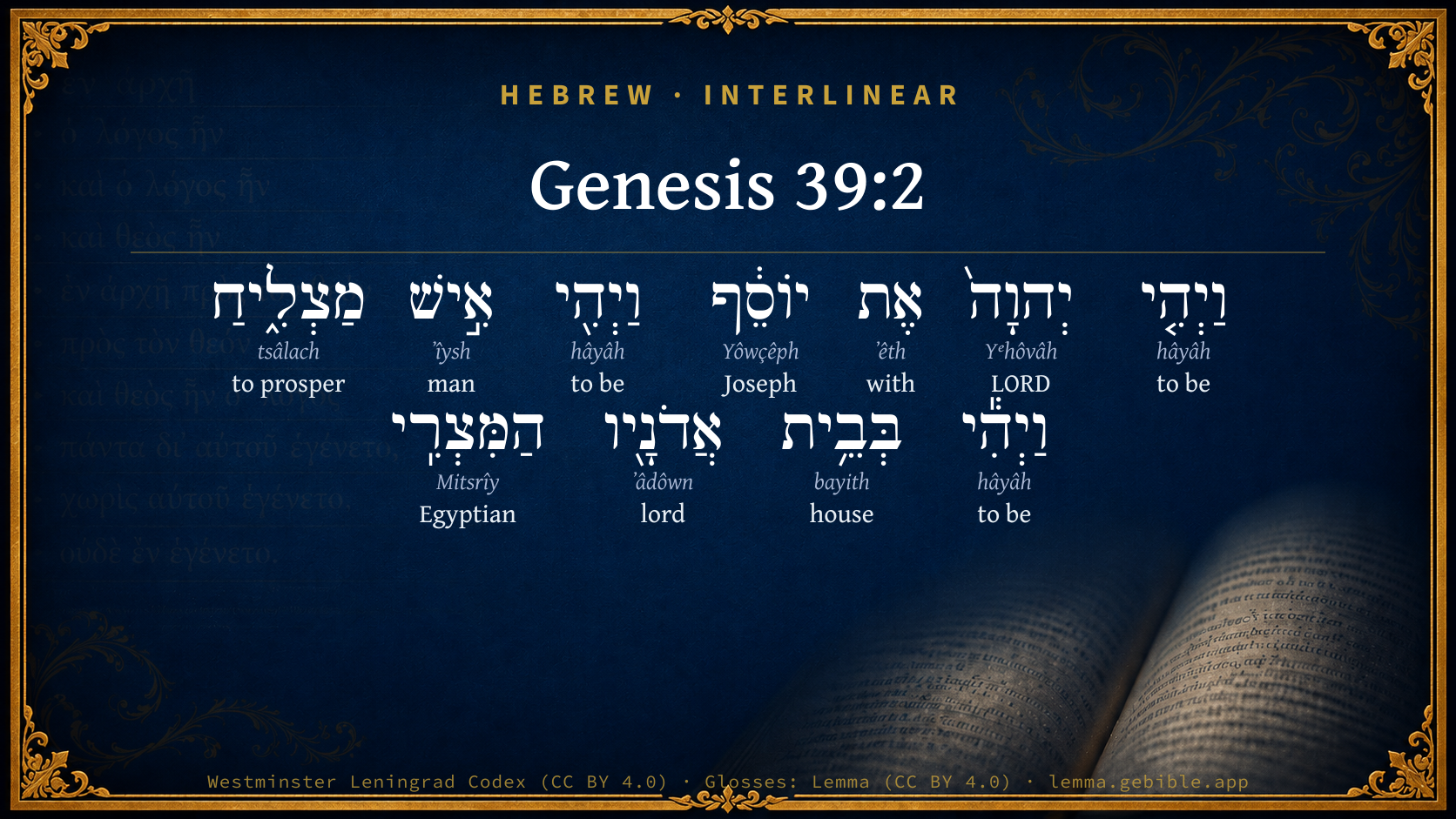
Hebrew (Westminster Leningrad Codex) Genesis 39:2 appears in the Hebrew Old Testament. The text above is from the Westminster Leningrad Codex. Each word links to its Strong’s number, a concise gloss, and parsing drawn from the Open Scriptures Hebrew Bible morphology. Click any word for its full Brown-Driver-Briggs (BDB) entry.
Download image
Cite this verse

Genesis 39:2 (World English Bible). Public Domain. Lemma interlinear Bible study tool, https://lemma.gebible.app/v/genesis/39/2.

Show BibTeX & RIS
BibTeX
RIS
English Translation
Yahweh was with Joseph, and he was a prosperous man. He was in the house of his master the Egyptian.
World English Bible · Public Domain
Download a study sheet

One document with this verse’s original text, its word-by-word gloss line, the meaning frame, cross-references with their text, attributed commentary, and full source and license credits — printable, and it pastes into notes with its structure intact.

This verse Autodidact and up

Study sheet (.html) Plain text (.txt)

A passage Seminary Student

Up to 50 verses in one chapter. A passage sheet keeps up to 6 commentary sources and 12 cross-references per verse, in the order this page ranks them, and says so on the sheet whenever that leaves anything out. Ask for a single verse and you get the Autodidact verse sheet above.

Everything on this page stays free to read, with no account — the sheet is a download of what is already on screen, not access to it.

Want to remove ads? Support Godless Engineer
Compare translations 3

The same verse in 3 English versions, stacked beneath the original-language interlinear above. Click any original word for its lexicon entry.

Each is an independent rendering of the whole verse — the interlinear is not word-aligned to these translations.

Highlighted words mark where these versions differ — a whole-verse word diff, not a word-by-word alignment.

  • World English Bible Public Domain
    Yahweh was with Joseph, and he was a prosperous man. He was in the house of his master the Egyptian.
  • King James Version Public Domain
    And the LORD was with Joseph, and he was a prosperous man; and he was in the house of his master the Egyptian.
  • unfoldingWord Literal Text CC BY-SA 4.0
    And Yahweh was with Joseph, and he was a successful man, and he was in the house of his Egyptian master.

unfoldingWord Literal Text — © unfoldingWord, licensed CC BY-SA 4.0. Word-aligned USFM3 via Door43 (git.door43.org/unfoldingWord/en_ult).

Versions to compare (up to 4)

3 of 4 selected

Show all 18 translations

Every available English version of this verse, each an independent rendering of the whole verse.

  • World English Bible Public Domain
    Yahweh was with Joseph, and he was a prosperous man. He was in the house of his master the Egyptian.
  • Berean Standard Bible Public Domain
    And the LORD was with Joseph, and he became a successful man, serving in the household of his Egyptian master.
  • Majority Standard Bible Public Domain
    And the LORD was with Joseph, and he became a successful man, serving in the household of his Egyptian master.
  • King James Version Public Domain
    And the LORD was with Joseph, and he was a prosperous man; and he was in the house of his master the Egyptian.
  • American Standard Version (1901) Public Domain
    And Jehovah was with Joseph, and he was a prosperous man; and he was in the house of his master the Egyptian.
  • Revised Version (1885) Public Domain
    And the LORD was with Joseph, and he was a prosperous man; and he was in the house of his master the Egyptian.
  • Geneva Bible (1599) Public Domain
    And the Lord was with Ioseph, and he was a man that prospered and was in the house of his master the Egyptian.
  • Douay-Rheims (1899) Public Domain
    And the Lord was with him, and he was a prosperous man in all things: and he dwelt in his master's house,
  • Young's Literal Translation Public Domain
    And Jehovah is with Joseph, and he is a prosperous man, and he is in the house of his lord the Egyptian,
  • Literal Standard Version CC BY-SA 4.0
    And YHWH is with Joseph, and he is a prosperous man, and he is in the house of his lord the Egyptian,
  • Unlocked Literal Bible CC BY-SA 4.0
    Yahweh was with Joseph and he became a prosperous man. He lived in the house of his Egyptian master.
  • unfoldingWord Literal Text CC BY-SA 4.0
    And Yahweh was with Joseph, and he was a successful man, and he was in the house of his Egyptian master.
  • Darby Bible Public Domain
    And Jehovah was with Joseph, and he was a prosperous man; and he was in the house of his master the Egyptian.
  • World Messianic Bible Public Domain
    The LORD was with Joseph, and he was a prosperous man. He was in the house of his master the Egyptian.
  • Webster's Bible Public Domain
    And the LORD was with Joseph, and he was a prosperous man: and he was in the house of his master the Egyptian.
  • Free Bible Version CC BY-SA 4.0
    The Lord was with Joseph and made him successful. He lived in his Egyptian master's house.
  • Bible in Basic English Public Domain
    And the Lord was with Joseph, and he did well; and he was living in the house of his master the Egyptian.
  • JPS Tanakh (1917) Public Domain
    And the LORD was with Joseph, and he was a prosperous man; and he was in the house of his master the Egyptian.

Literal Standard Version (2020), Covenant Press — licensed CC BY-SA 4.0. Text via the HelloAO Bible API (eBible.org). Unlocked Literal Bible (unfoldingWord) — licensed CC BY-SA 4.0. Text via the HelloAO Bible API (eBible.org). unfoldingWord Literal Text — © unfoldingWord, licensed CC BY-SA 4.0. Word-aligned USFM3 via Door43 (git.door43.org/unfoldingWord/en_ult). Free Bible Version, Dr. Jonathan Gallagher — licensed CC BY-SA 4.0. Text via the HelloAO Bible API (eBible.org).

Word by word

More ways to search: Search by grammar → Find every occurrence → Compare this word →

Practice this passage: Drill this verse → Learn its vocabulary →

מַצְלִ֑יחַ
tsâlach
H6743
“prospering”
Verb, Hiphil, Participle Active, Masculine, Singular, Absolute
Part of Speech
Verb
Stem
Hiphil
Form
Participle Active
Gender
Masculine
Number
Singular
State
Absolute
Full BDB Definition

Origin: a primitive root

TWOT: 1916 , 1917

(Qal) to rush - to advance, prosper, make progress, succeed, be profitable - (Qal) to prosper - (Hiphil) - to make prosperous, bring to successful issue, cause to prosper - to show or experience prosperity, prosper
  1. וַיְהִ֤י hâyâh H1961 “and · to be” Conjunction + Verb, Qal, Sequential Imperfect, 3rd Person, Masculine, Singular
  2. יְהוָה֙ Yᵉhôvâh H3068 “LORD” Noun, Proper
  3. אֶת ʼêth H854 “with” Preposition
  4. יוֹסֵ֔ף Yôwçêph H3130 “Joseph” Noun, Proper
  5. וַיְהִ֖י hâyâh H1961 “and · to be” Conjunction + Verb, Qal, Sequential Imperfect, 3rd Person, Masculine, Singular
  6. אִ֣ישׁ ʼîysh H376 “man of” Noun, Common, Masculine, Singular, Construct
  7. וַיְהִ֕י hâyâh H1961 “and · to be” Conjunction + Verb, Qal, Sequential Imperfect, 3rd Person, Masculine, Singular
  8. בְּבֵ֥ית bayith H1004 “in/at · house of” Preposition + Noun, Common, Masculine, Singular, Construct
  9. אֲדֹנָ֖יו ʼâdôwn H113 “lords · his” Noun, Common, Masculine, Plural, Construct + Suffix, Personal, 3rd Person, Masculine, Singular
  10. הַמִּצְרִֽי Mitsrîy H4713 “the · Egyptian” Particle, Definite Article + Noun, Gentilic, Masculine, Singular, Absolute

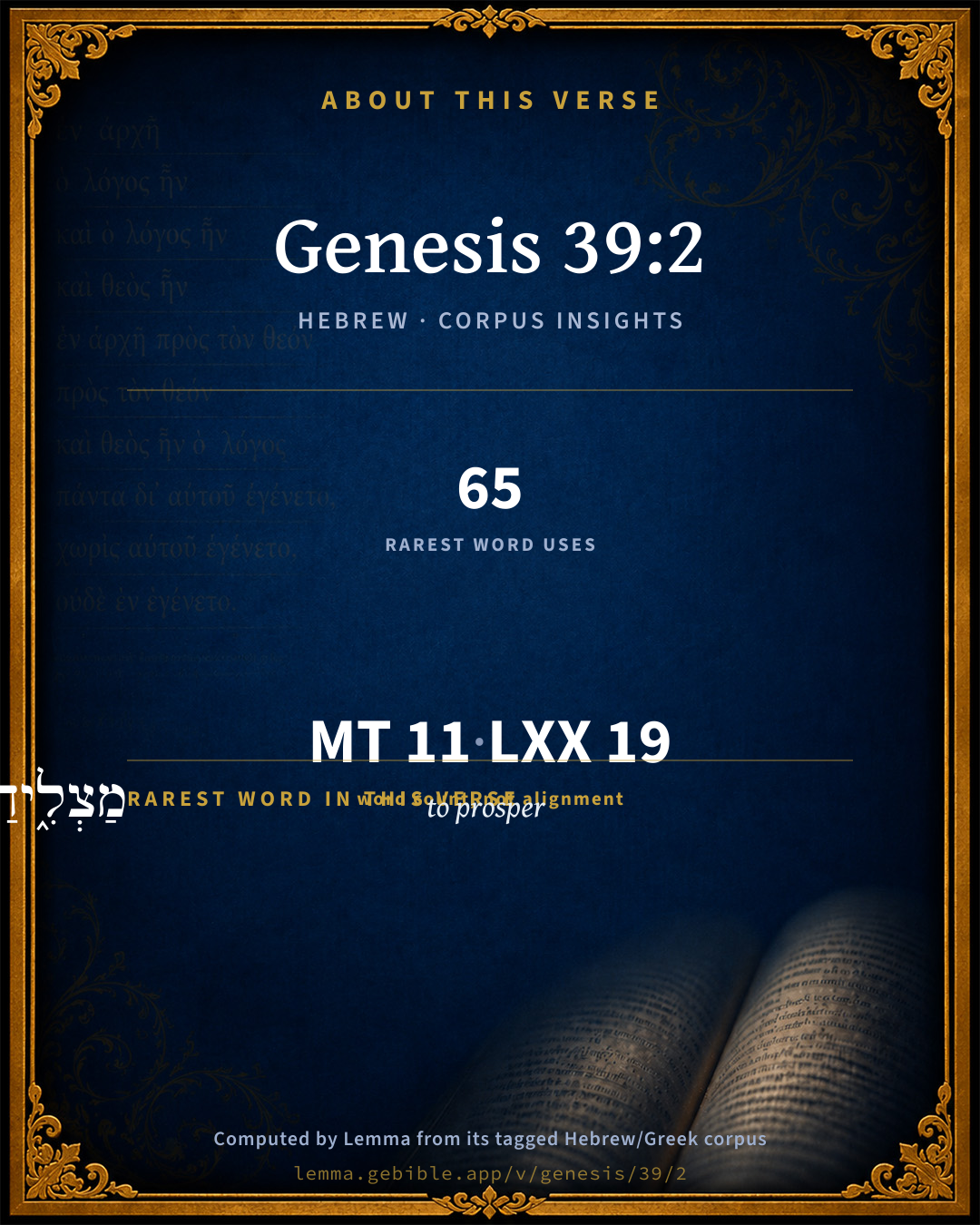
About this verse

These counts appear in no published source. They are computed here, from the morphology-tagged text and Lemma’s own curated glosses. What Lemma adds →

11
words
9
distinct lemmas
Pentateuch
section

Grammatical profile

  • 4 verbs
  • 6 nouns
  • 1 preposition

Verb forms

  • וַיְהִ֤י Qal · Sequential Imperfect
  • וַיְהִ֖י Qal · Sequential Imperfect
  • מַצְלִ֑יחַ Hiphil · Participle Active
  • וַיְהִ֕י Qal · Sequential Imperfect

Repetition

A word recurs within this verse — often emphatic in Hebrew:

  • וַיְהִ֤י to be H1961 ×3

Hebrew & Septuagint length

In English translation the verse runs 20 words from the Hebrew and 23 from the Septuagint (LXX English) — closely comparable.

A rough comparison of the two English renderings, which tokenize alike — not a word-level alignment.

Word counts can differ between the Hebrew and the Greek without any difference in meaning — e.g. the Hebrew direct-object marker אֵת has no separate Greek word, and Greek often adds the article ὁ.

In the original languages it is 11 Hebrew tokens and 19 Greek tokens — but the two are counted differently (Hebrew bundles its prefixes and suffixes into one token; the Greek is in lemma form), so that isn’t a like-for-like length.

Cross-references

23

Topical passages linked to Genesis 39:2 in the Treasury of Scripture Knowledge — connected by theme and wording, ordered by reader-vote popularity; previews shown in the World English Bible.

  • 1 Samuel 18:14 David behaved himself wisely in all his ways; and Yahweh was with him.
  • Psalms 91:15 He will call on me, and I will answer him. I will be with him in trouble. I will deliver him, and honor him.
  • Jeremiah 15:20 I will make you to this people a fortified brazen wall; and they shall fight against you, but they shall not prevail against you; for I am with you to save you and to deliver you, says Yahweh.
  • Genesis 26:28 They said, "We saw plainly that Yahweh was with you. We said, 'Let there now be an oath between us, even between us and you, and let us make a covenant with you,
  • Acts 7:9–10 "The patriarchs, moved with jealousy against Joseph, sold him into Egypt. God was with him,
  • Genesis 21:22 It happened at that time, that Abimelech and Phicol the captain of his host spoke to Abraham, saying, "God is with you in all that you do.
  • Genesis 26:24 Yahweh appeared to him the same night, and said, "I am the God of Abraham your father. Don't be afraid, for I am with you, and will bless you, and multiply your seed for my servant Abraham's sake."
  • Isaiah 43:2 When you pass through the waters, I will be with you; and through the rivers, they shall not overflow you: when you walk through the fire, you shall not be burned, neither shall the flame kindle on you.
  • Genesis 39:21–22 But Yahweh was with Joseph, and showed kindness to him, and gave him favor in the sight of the keeper of the prison.
  • Genesis 28:15 Behold, I am with you, and will keep you, wherever you go, and will bring you again into this land. For I will not leave you, until I have done that which I have spoken of to you."
  • Psalms 1:3 He will be like a tree planted by the streams of water, That brings forth its fruit in its season, Whose leaf also does not wither. Whatever he does shall prosper.
  • Isaiah 41:10 Don't you be afraid, for I am with you; don't be dismayed, for I am your God; I will strengthen you; yes, I will help you; yes, I will uphold you with the right hand of my righteousness.
  • 1 Samuel 16:18 Then answered one of the young men, and said, Behold, I have seen a son of Jesse the Bethlehemite, who is skillful in playing, and a mighty man of valor, and a man of war, and prudent in speech, and a comely person; and Yahweh is with him.
  • Psalms 46:7 Yahweh of Hosts is with us. The God of Jacob is our refuge. Selah.
  • Psalms 46:11 Yahweh of Hosts is with us. The God of Jacob is our refuge. Selah.
  • 1 Samuel 3:19 Samuel grew, and Yahweh was with him, and did let none of his words fall to the ground.
  • 1 Corinthians 7:20–24 Let each man stay in that calling in which he was called.
  • 1 Samuel 18:28 Saul saw and knew that Yahweh was with David; and Michal, Saul's daughter, loved him.
  • Isaiah 8:9–10 Make an uproar, O you peoples, and be broken in pieces! And give ear, all you of far countries: gird yourselves, and be broken in pieces! Gird yourselves, and be broken in pieces!
  • Titus 2:9–10 Exhort servants to be in subjection to their own masters, and to be well-pleasing in all things; not contradicting;
  • Matthew 1:23 "Behold, the virgin shall be with child, And shall bring forth a son. They shall call his name Immanuel;" Which is, being interpreted, "God with us."
  • Acts 8:31 He said, "How can I, unless someone explains it to me?" He begged Philip to come up and sit with him.
  • 1 Timothy 6:1 Let as many as are bondservants under the yoke count their own masters worthy of all honor, that the name of God and the doctrine not be blasphemed.

Cross-references courtesy of OpenBible.info (CC BY 4.0).

Hebrew and Greek witnesses Masoretic Hebrew ↔ Greek Septuagint

The same verse in the two great witnesses to the Old Testament, shown verse-for-verse.

These are two independent witnesses, not word-aligned to each other, and the Septuagint is shown in lemma (dictionary) form.

Hebrew Genesis 39:2 Masoretic · Westminster Leningrad Codex

וַיְהִ֤י יְהוָה֙ אֶת יוֹסֵ֔ף וַיְהִ֖י אִ֣ישׁ מַצְלִ֑יחַ וַיְהִ֕י בְּבֵ֥ית אֲדֹנָ֖יו הַמִּצְרִֽי

Yahweh was with Joseph, and he was a prosperous man. He was in the house of his master the Egyptian.

World English Bible · Public Domain

Greek LXX Genesis 39:2 Septuagint · lemma form

καί εἰμί κύριος μετά ιωσηφ καί εἰμί ἀνήρ ἐπιτυγχάνω καί γίγνομαι ἐν ὁ οἶκος παρά ὁ κύριος ὁ αἰγύπτιος

And the Lord was with Joseph, and he was a prosperous man; and he was in the house with his lord the Egyptian.

LXX2012 (modern English Septuagint) · Public Domain

Hebrew: Westminster Leningrad Codex (CC BY 4.0). Greek: Septuagint (public domain); English from LXX2012 (modern English Septuagint) (Public Domain). How the Septuagint differs from the Hebrew →

Targum (Aramaic paraphrase)

2

The Targum is the ancient Jewish Aramaic paraphrase of the Hebrew Scriptures — an interpretive translation, not the Hebrew text itself. Onkelos (literal) and Pseudo-Jonathan (expansive) render the Torah, and Jonathan the Prophets. Coverage is partial: where no permissively-licensed English translation exists for a verse, only the Aramaic is shown. This is verse-level text, not a word-by-word alignment to the Hebrew.

  1. Targum Onkelos Torah (Genesis–Deuteronomy)
    וַהֲוָה מֵימְרָא דַּיְיָ בְּסַעְדֵּהּ דְּיוֹסֵף וַהֲוָה גְּבַר מַצְלָח וַהֲוָה בְּבֵית רִבּוֹנֵהּ מִצְרָאָה

    (no public-domain English translation for this verse)

    Targum Onkelos — Aramaic: “Onkelos Genesis” (public domain); “Onkelos Exodus” (public domain); “Onkelos Leviticus” (public domain); “Onkelos Numbers” (public domain); “Onkelos Deuteronomy” (public domain). English: “Sefaria Community Translation” (CC0 1.0 (public-domain dedication)); “J.W. Etheridge. The Targums of Onkelos and Jonathan Ben Uzziel on the Pentateuch. London: Longmans, Green, 1862” (public domain). Text via Sefaria.

  2. Targum Pseudo-Jonathan Torah (Genesis–Deuteronomy)
    וַהֲוָה מֵימְרָא דַיְיָ בְּסַעֲדָא דְיוֹסֵף וַהֲוָה גְבַר מַצְלָח וַהֲוָה בְּבֵית רִבּוֹנֵיהּ מִצְרָאֵי

    And the Word of the Lord was Joseph's Helper, and he became a prosperous man in the house of his Mizraite master.

    Targum Pseudo-Jonathan — Aramaic: “Targum Jonathan on Genesis” (public domain); “Targum Jonathan on Exodus” (public domain); “Targum Jonathan on Leviticus” (public domain); “Targum Jonathan on Numbers” (public domain); “Targum Jonathan on Deuteronomy” (public domain). English: “The Targum of Jonathan ben Uzziel, trans. J. W. Etheridge, London, 1862” (public domain). Text via Sefaria.

Commentary

Notes on Genesis 39:2 from classic Christian and Jewish commentators (each source and its license shown beneath its notes). The classic Christian expositions comment on the surrounding passage and are grouped to its opening verse, so a note may address several verses; the Jewish commentaries on the Tanakh (Rashi and others) are per-verse, so they appear only where the commentator wrote on this verse.

Lemma curates 59 commentaries, every one of them public domain or Creative Commons licensed, each selected and text-cleaned for this edition rather than reprinted as found. About our sources →

Trapp's Complete Commentary

John Trapp

Gen 39:2 And the LORD was with Joseph, and he was a prosperous man; and he was in the house of his master the Egyptian.

Ver. 2. And the Lord was with Joseph, and he, &c.] "The Lord" also "is with you, while ye be with him": {2Ch 15:2} and so long you may promise yourselves prosperity; that of Gaius, howsoever, - that your souls shall prosper; and for most part also, your outward estates. If it fall out otherwise, it is because God will have godliness admired for itself. If ungodly men prosper, it is that ease may slay them, {Pro 1:32} and "that they may perish for ever." {Psa 37:20} Moritur Zacharias Papa, rebus pro Ecclesiae salute et Apostolicae sedis dignitate, non tam pie quam prospere gestis, saith Sigonius. This was little to his commendation, - that he was not so pious as he was prosperous.

John Trapp, A Commentary or Exposition upon All the Books of the Old and New Testament (1647–1656) — public domain. Text from a community e-Sword module.

Joseph Benson's Commentary

Gen 39:2. The Lord was with Joseph — Those that can separate us from all our friends cannot deprive us of the gracious presence of our God. When Joseph had none of his relations with him, he had his God with him, even in the house of the Egyptian: Joseph was banished from his father’s house, but the Lord was with him. It is God’s presence with us that makes all we do prosperous. Those that would prosper must therefore make God their friend; and those that do prosper must therefore give God the praise. He was in the house of his master the Egyptian — He did not endeavour, as might have been expected, to effect an escape to his father, but demeaned himself patiently and faithfully in the station into which God’s providence had brought him.

Joseph Benson's Commentary on the Old and New Testaments (1811–1818) — public domain. Text from a community e-Sword module.

Whedon's Commentary on the Bible

Daniel D. Whedon

2. The Lord was with Joseph — The holy covenant God of Israel was not absent from his faithful servant. He ever encampeth round about them that fear him.

A prosperous man — Making to prosper whatever he undertook. Compare the Psalmist’s description of the blessed or happy man. Psa_1:3.

He was in the house of his master — First as a house-servant, then overseer of all his possessions. Gen_39:4-6. Potiphar quickly discerned Joseph’s integrity and pious attention to all his affairs. He probably did not concern himself about the religious ideas of his slave, or learn from him any special doctrines of Jehovah. He doubtless adhered to his own Egyptian idolatries. But in Gen_39:2-6 the sacred historian shows that the integrity and prosperity of Joseph were due to the divine providence which favoured the faithful son of Israel.

“The great pictures of Egyptian civilization which are found in the monumental sepulchres, abound in representations of overseership in the house and in the field. Workmen are represented as engaged in various kinds of labour, such as gardening, farming, fishing, while the overseer watches and directs, and keeps the record of the work with a reed pen in a papyrus register. Division and subdivision of labour, and minute supervision, had at this time been carried to a high degree in this home of science and civilization. Great native talent as well as integrity is displayed in this sudden rise of a shepherd-lad, sold as a slave into such a land as Egypt. We see here unmistakable signs of superior abilities, which serve to explain the previous envy of his brethren. A man so clearly born to command must have displayed something of his power and the natural bent of his genius in early youth.” — Newhall.

Daniel D. Whedon (gen. ed.), Commentary on the Old and New Testaments (1874–1909) — public domain. Text from a community e-Sword module.

Tyndale Open Study Notes

Tyndale Open Resources

39:2 God is mentioned for the first time (apart from 38:7-10) since Jacob built his altar in Bethel (35:1-15); his covenant name, “the Lord,” is used for the first time since Jacob left Laban (31:49).

Tyndale Open Study Notes — © Tyndale Open Resources, licensed CC BY-SA 4.0. Text via the HelloAO Bible API.

Geneva Bible (1599)

Geneva Bible translators

The favor of God is the fountain of all prosperity.

Geneva Bible (1599) marginal notes — public domain. Text via Bolls.life.

Jamieson, Fausset & Brown

Robert Jamieson, A. R. Fausset & David Brown

he was in the house of his master--Those slaves who had been war captives were generally sent to labor in the field and subjected to hard treatment under the "stick" of taskmasters. But those who were bought with money were employed in domestic purposes, were kindly treated, and enjoyed as much liberty as the same class does in modern Egypt.

Jamieson, Fausset & Brown — Commentary Critical and Explanatory on the Whole Bible (1871) — public domain (CC PDM 1.0). Text via the HelloAO Bible API.

The Cambridge Bible for Schools and Colleges

gen. ed. J. J. S. Perowne

2. the Lord was with Joseph] This is the motif of the whole section. Jehovah stands by Joseph whether in trouble or in prosperity, in good report or in evil; cf. Gen_39:3; Gen_39:5; Gen_39:21; Gen_39:23. Joseph was one of those rare characters in which great personal attractiveness in manner and appearance was combined with high principle and good intellectual powers.

in the house] i.e. not sent out to labour in the field.

The Cambridge Bible for Schools and Colleges (gen. ed. J. J. S. Perowne; Cambridge University Press, 1878–1918) — public domain. Text from a community e-Sword module.

John Gill's Exposition

And the Lord was with Joseph,.... Blessing him with his gracious presence, with discoveries of his love, and communion with himself, though destitute of the means of grace and ordinances of worship he enjoyed in his father's house; favouring him with bodily health, and protecting him from all evils and enemies:

and he was a prosperous man; in worldly things, and which was owing to the presence of God with him, and his blessing on him:

and he was in the house of his master the Egyptian; he continued there, and did not attempt to make his escape; or his employment lay chiefly, if not altogether, in the house, and herein he was prosperous, and continued to be so as long as he was in it; the Jews (n) say, he remained here twelve months. Near the pyramids built in the neighbourhood of Memphis, as is affirmed unanimously by the ancients, to this day is shown a hill, on which they say the house of Potiphar was built, whose servant the patriarch Joseph was, and some of the rubbish of the bricks are yet to be seen (o).

(n) Seder Olam Rabba, c. 2. p. 5. (o) Jablonski de Terra Goshen, Dissert. 6. sect. 6.

John Gill's Exposition of the Whole Bible (1746–1763) — public domain (CC PDM 1.0). Text via the HelloAO Bible API.

John Wesley's Explanatory Notes

Those that can separate us from all our friends, cannot deprive us of the gracious presence of our God. When Joseph had none of his relations with him, he had his God with him, even in the house of the Egyptian: Joseph was banished from his father's house, but the Lord was with him. It is God's presence with us that makes all we do prosperous. Those that would prosper, must therefore make God their friend; and those that do prosper, must therefore give God the praise.

John Wesley, Explanatory Notes Upon the Whole Bible (1754–1765) — public domain. Text via the GEBible commentary corpus.

Radak

Rabbi David Kimhi (Radak)

ויהי ה' את יוסף ויהי איש מצליח, he was successful in all things he undertook on his own behalf and also was successful in the house of his Egyptian master. Every task that was assigned to him he managed to carry out successfully.

Radak on the Tanakh — English translations: “Sefaria Community Translation” (CC0 1.0 (public-domain dedication)); “Eliyahu Munk, HaChut Hameshulash” (CC BY 4.0); “Rabbi Mike Feuer, Jerusalem Anthology” (CC BY 4.0); and “R. David Kimhi on the first book of Psalms, Translated by R.G. Finch, London, 1919” (public domain). Text via Sefaria.

Lesson kit

Teaching starters — assembled from the data on this page, not authored interpretation. Every prompt links to the verse data it draws on. Edit before teaching.

Genesis, in the Pentateuch, opens this verse with 11 words (9 distinct Hebrew lemmas). Its most distinctive word is tsâlach (“to prosper”). A historical commentator’s framing appears above. Read the whole chapter for the surrounding context.

Discussion questions

  1. What does “to prosper” (tsâlach) contribute to the verse as a whole?
  2. 1 Samuel 18:14 shares this passage’s theme. How do the two illuminate each other?
  3. “to be” occurs 3× in this one verse. What is the effect of the repetition?
  4. The translations on this page render this verse differently — a whole-verse word diff, not a word-by-word alignment. What might account for the different wordings?
  5. The verb «וַיְהִ֤י» is Qal Sequential Imperfect. How does its form color the action?
  6. Reading how Trapp's Complete Commentary and Joseph Benson's Commentary read this verse, where do the two commentators agree and where do they part?

Things to notice

Reading settings

Reading text

Shown beneath each verse's original-language words.

Old Testament
Old Testament edition

Read the OT as the Masoretic Hebrew (MT) or the Greek Septuagint (LXX).

English shown for the Greek Septuagint (in the Hebrew ↔ Greek comparison).

Comparing translations? Open the Compare panel on any verse page to stack up to four side by side.