
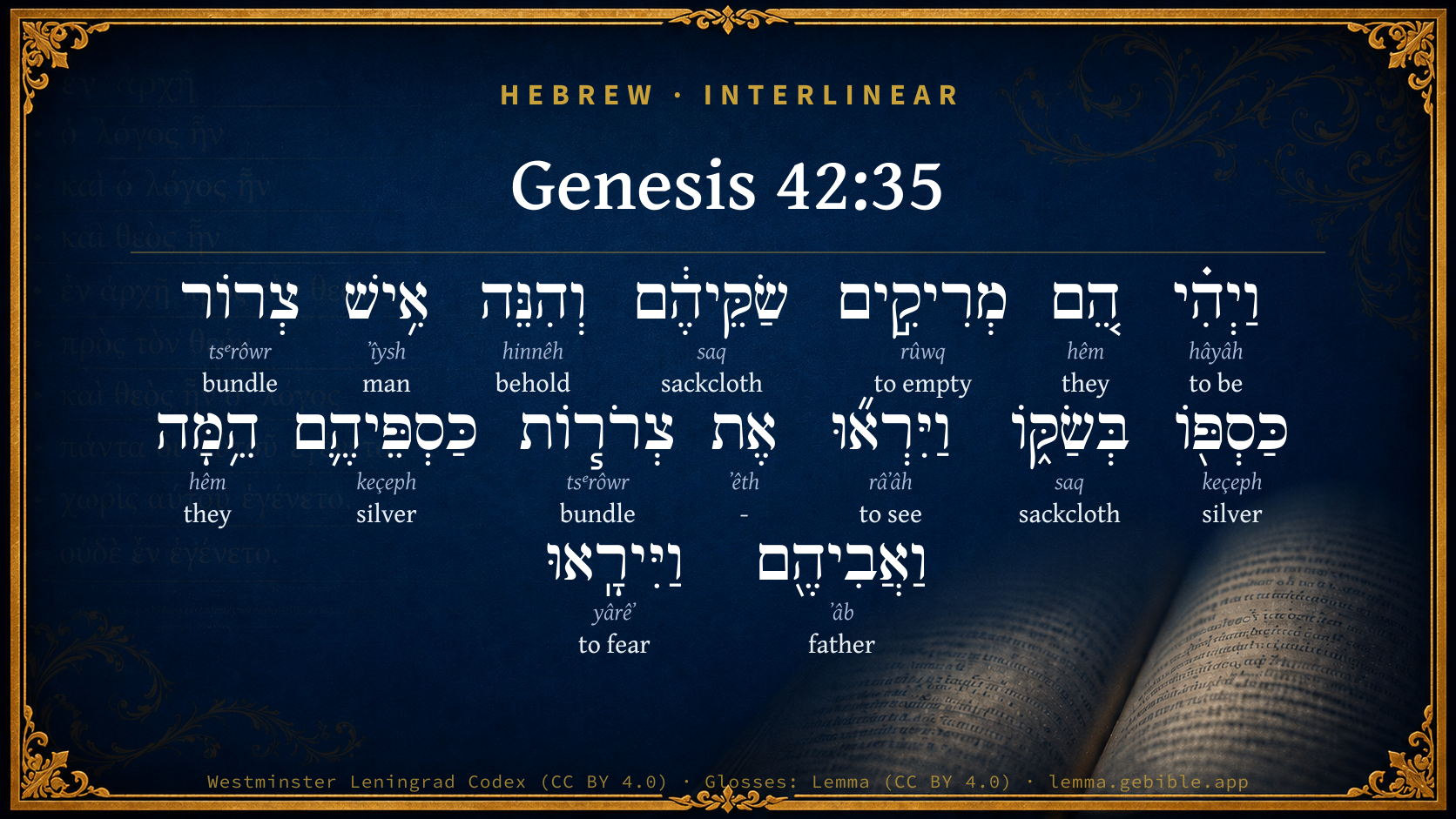
Genesis 42:35

Hebrew (Westminster Leningrad Codex) Genesis 42:35 appears in the Hebrew Old Testament. The text above is from the Westminster Leningrad Codex. Each word links to its Strong’s number, a concise gloss, and parsing drawn from the Open Scriptures Hebrew Bible morphology. Click any word for its full Brown-Driver-Briggs (BDB) entry.
Download image
Cite this verse

Genesis 42:35 (World English Bible). Public Domain. Lemma interlinear Bible study tool, https://lemma.gebible.app/v/genesis/42/35.

Show BibTeX & RIS
BibTeX
RIS
English Translation
It happened as they emptied their sacks, that behold, every man's bundle of money was in his sack. When they and their father saw their bundles of money, they were afraid.
World English Bible · Public Domain
Highlights
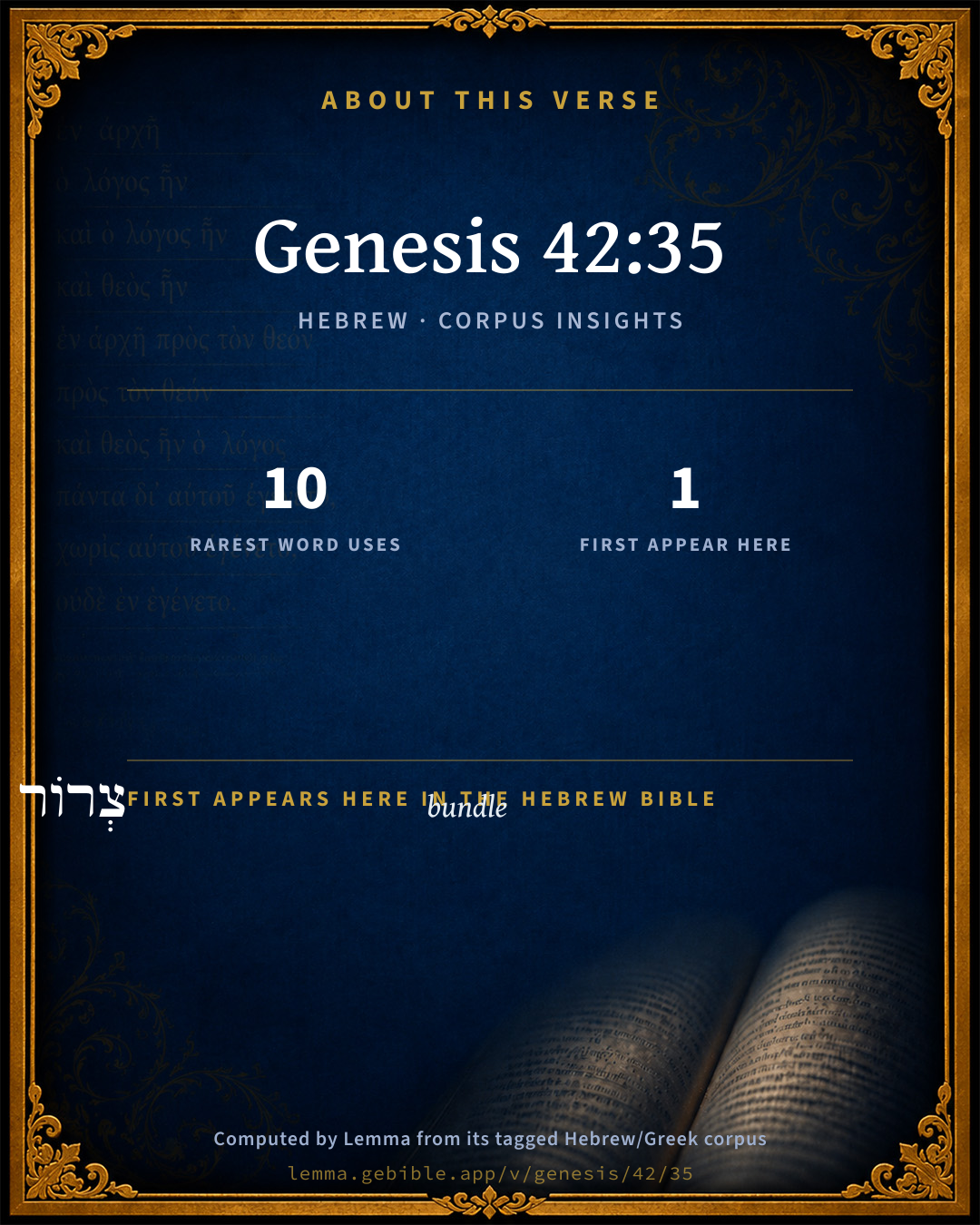
  • 1 first appearance in the Hebrew Bible
Full analysis ↓
Download a study sheet

One document with this verse’s original text, its word-by-word gloss line, the meaning frame, cross-references with their text, attributed commentary, and full source and license credits — printable, and it pastes into notes with its structure intact.

This verse Autodidact and up

Study sheet (.html) Plain text (.txt)

A passage Seminary Student

Up to 50 verses in one chapter. A passage sheet keeps up to 6 commentary sources and 12 cross-references per verse, in the order this page ranks them, and says so on the sheet whenever that leaves anything out. Ask for a single verse and you get the Autodidact verse sheet above.

Everything on this page stays free to read, with no account — the sheet is a download of what is already on screen, not access to it.

Want to remove ads? Support Godless Engineer
Compare translations 3

The same verse in 3 English versions, stacked beneath the original-language interlinear above. Click any original word for its lexicon entry.

Each is an independent rendering of the whole verse — the interlinear is not word-aligned to these translations.

Highlighted words mark where these versions differ — a whole-verse word diff, not a word-by-word alignment.

  • World English Bible Public Domain
    It happened as they emptied their sacks, that behold, every man's bundle of money was in his sack. When they and their father saw their bundles of money, they were afraid.
  • King James Version Public Domain
    And it came to pass as they emptied their sacks, that, behold, every man's bundle of money was in his sack: and when both they and their father saw the bundles of money, they were afraid.
  • unfoldingWord Literal Text CC BY-SA 4.0
    Then it happened they were emptying their sacks, and behold, each pouch of his silver inside his sack! And they and their father saw the pouches of their silver, and they were afraid.

unfoldingWord Literal Text — © unfoldingWord, licensed CC BY-SA 4.0. Word-aligned USFM3 via Door43 (git.door43.org/unfoldingWord/en_ult).

Versions to compare (up to 4)

3 of 4 selected

Show all 18 translations

Every available English version of this verse, each an independent rendering of the whole verse.

  • World English Bible Public Domain
    It happened as they emptied their sacks, that behold, every man's bundle of money was in his sack. When they and their father saw their bundles of money, they were afraid.
  • Berean Standard Bible Public Domain
    As they began emptying their sacks, there in each man’s sack was his bag of silver! And when they and their father saw the bags of silver, they were dismayed.
  • Majority Standard Bible Public Domain
    As they began emptying their sacks, there in each man’s sack was his bag of silver! And when they and their father saw the bags of silver, they were dismayed.
  • King James Version Public Domain
    And it came to pass as they emptied their sacks, that, behold, every man's bundle of money was in his sack: and when both they and their father saw the bundles of money, they were afraid.
  • American Standard Version (1901) Public Domain
    And it came to pass as they emptied their sacks, that, behold, every man's bundle of money was in his sack: and when they and their father saw their bundles of money, they were afraid.
  • Revised Version (1885) Public Domain
    And it came to pass as they emptied their sacks, that, behold, every man’s bundle of money was in his sack: and when they and their father saw their bundles of money, they were afraid.
  • Geneva Bible (1599) Public Domain
    And as they emptied their sacks, behold, euery mans bundel of money was in his sacke: and when they and their father sawe the bundels of their money, they were afrayde.
  • Douay-Rheims (1899) Public Domain
    When they had told this, they poured out their corn and every man found his money tied in the mouth of his sack: and all being astonished together,
  • Young's Literal Translation Public Domain
    And it cometh to pass, they are emptying their sacks, and lo, the bundle of each man's silver `is' in his sack, and they see their bundles of silver, they and their father, and are afraid;
  • Literal Standard Version CC BY-SA 4.0
    And it comes to pass, they are emptying their sacks, and behold, the bundle of each man’s silver [is] in his sack, and they see their bundles of silver, they and their father, and are afraid;
  • Unlocked Literal Bible CC BY-SA 4.0
    It came about as they emptied their sacks, that, behold, every man's bag of silver was in his sack. When they and their father saw their bags of silver, they were afraid.
  • unfoldingWord Literal Text CC BY-SA 4.0
    Then it happened they were emptying their sacks, and behold, each pouch of his silver inside his sack! And they and their father saw the pouches of their silver, and they were afraid.
  • Darby Bible Public Domain
    And it came to pass as they emptied their sacks, that behold, every man had his bundle of money in his sack; and they saw their bundles of money, they and their father, and were afraid.
  • World Messianic Bible Public Domain
    As they emptied their sacks, behold, each man’s bundle of money was in his sack. When they and their father saw their bundles of money, they were afraid.
  • Webster's Bible Public Domain
    And it came to pass as they emptied their sacks, that behold, every man's bundle of money was in his sack; and when they and their father saw the bundles of money, they were afraid.
  • Free Bible Version CC BY-SA 4.0
    As they emptied their sacks, each one's money bag was there in his sack! When they and their father saw the money bags, they were horrified.
  • Bible in Basic English Public Domain
    And when they took the grain out of their bags, it was seen that every man's parcel of money was in his bag; and when they and their father saw the money, they were full of fear.
  • JPS Tanakh (1917) Public Domain
    And it came to pass as they emptied their sacks, that, behold, every man's bundle of money was in his sack; and when they and their father saw their bundles of money, they were afraid.

Literal Standard Version (2020), Covenant Press — licensed CC BY-SA 4.0. Text via the HelloAO Bible API (eBible.org). Unlocked Literal Bible (unfoldingWord) — licensed CC BY-SA 4.0. Text via the HelloAO Bible API (eBible.org). unfoldingWord Literal Text — © unfoldingWord, licensed CC BY-SA 4.0. Word-aligned USFM3 via Door43 (git.door43.org/unfoldingWord/en_ult). Free Bible Version, Dr. Jonathan Gallagher — licensed CC BY-SA 4.0. Text via the HelloAO Bible API (eBible.org).

Word by word

More ways to search: Search by grammar → Find every occurrence → Compare this word →

Practice this passage: Drill this verse → Learn its vocabulary →

צְרוֹר
tsᵉrôwr
H6872
“bundle of”
Noun, Common, Masculine, Singular, Construct
Part of Speech
Noun
Type
Common
Gender
Masculine
Number
Singular
State
Construct
Full BDB Definition

Origin: from H6887

TWOT: 1973e , 1975c

bundle, parcel, pouch, bag (as packed) - pebble
  1. וַיְהִ֗י hâyâh H1961 “and · to be” Conjunction + Verb, Qal, Sequential Imperfect, 3rd Person, Masculine, Singular
  2. הֵ֚ם hêm H1992 “they” Pronoun, Personal, 3rd Person, Masculine, Plural
  3. מְרִיקִ֣ים rûwq H7324 “emptying” Verb, Hiphil, Participle Active, Masculine, Plural, Absolute
  4. שַׂקֵּיהֶ֔ם saq H8242 “sacks · their” Noun, Common, Masculine, Plural, Construct + Suffix, Personal, 3rd Person, Masculine, Plural
  5. וְהִנֵּה hinnêh H2009 “and · behold” Conjunction + Particle, Demonstrative
  6. אִ֥ישׁ ʼîysh H376 “man” Noun, Common, Masculine, Singular, Absolute
  7. כַּסְפּ֖וֹ keçeph H3701 “silver · his” Noun, Common, Masculine, Singular, Construct + Suffix, Personal, 3rd Person, Masculine, Singular
  8. בְּשַׂקּ֑וֹ saq H8242 “in/at · sackcloth · his” Preposition + Noun, Common, Masculine, Singular, Construct + Suffix, Personal, 3rd Person, Masculine, Singular
  9. וַיִּרְא֞וּ râʼâh H7200 “and · to see” Conjunction + Verb, Qal, Sequential Imperfect, 3rd Person, Masculine, Plural
  10. אֶת ʼêth H853 “-” Particle, Direct Object
  11. צְרֹר֧וֹת tsᵉrôwr H6872 “bundles of” Noun, Common, Masculine, Plural, Construct
  12. כַּסְפֵּיהֶ֛ם keçeph H3701 “silver · their” Noun, Common, Masculine, Plural, Construct + Suffix, Personal, 3rd Person, Masculine, Plural
  13. הֵ֥מָּה hêm H1992 “they” Pronoun, Personal, 3rd Person, Masculine, Plural
  14. וַאֲבִיהֶ֖ם ʼâb H1 “and · father · their” Conjunction + Noun, Common, Masculine, Singular, Construct + Suffix, Personal, 3rd Person, Masculine, Plural
  15. וַיִּירָֽאוּ yârêʼ H3372 “and · to fear” Conjunction + Verb, Qal, Sequential Imperfect, 3rd Person, Masculine, Plural

About this verse

These counts appear in no published source. They are computed here, from the morphology-tagged text and Lemma’s own curated glosses. What Lemma adds →

16
words
12
distinct lemmas
Pentateuch
section

Notable vocabulary

The rarest word here is צְרוֹר bundle H6872 — appearing just 10 times in the whole Hebrew Bible.

First appearance in Scripture

This word makes its first canonical appearance in the Hebrew Bible here:

  • צְרוֹר bundle H6872

Shared distinctive vocabulary

צְרוֹר bundle H6872 occurs in 9 verses of the Hebrew Bible. Also found in:

Grammatical profile

  • 4 verbs
  • 8 nouns
  • 2 pronouns
  • 2 particles

Verb forms

  • וַיְהִ֗י Qal · Sequential Imperfect
  • מְרִיקִ֣ים Hiphil · Participle Active
  • וַיִּרְא֞וּ Qal · Sequential Imperfect
  • וַיִּירָֽאוּ Qal · Sequential Imperfect

Repetition

Words recur within this verse — often emphatic in Hebrew:

  • שַׂקֵּיהֶ֔ם sackcloth H8242 ×2
  • צְרוֹר bundle H6872 ×2
  • כַּסְפּ֖וֹ silver H3701 ×2
  • הֵ֚ם they H1992 ×2

Hebrew & Septuagint length

In English translation the verse runs 31 words from the Hebrew and 35 from the Septuagint (LXX English) — closely comparable.

A rough comparison of the two English renderings, which tokenize alike — not a word-level alignment.

Word counts can differ between the Hebrew and the Greek without any difference in meaning — e.g. the Hebrew direct-object marker אֵת has no separate Greek word, and Greek often adds the article ὁ.

Cross-references

4

Topical passages linked to Genesis 42:35 in the Treasury of Scripture Knowledge — connected by theme and wording, ordered by reader-vote popularity; previews shown in the World English Bible.

  • Genesis 43:21 and it happened, when we came to the lodging-place, that we opened our sacks, and, behold, every man's money was in the mouth of his sack, our money in full weight. We have brought it again in our hand.
  • Genesis 42:27–28 As one of them opened his sack to give his donkey food in the lodging-place, he saw his money. Behold, it was in the mouth of his sack.
  • Genesis 43:12 and take double money in your hand, with the money that was returned in the mouth of your sacks carry again in your hand. Perhaps it was an oversight.
  • Genesis 43:15 The men took that present, and they took double money in their hand, and Benjamin; and rose up, went down to Egypt, and stood before Joseph.

Cross-references courtesy of OpenBible.info (CC BY 4.0).

Hebrew and Greek witnesses Masoretic Hebrew ↔ Greek Septuagint

The same verse in the two great witnesses to the Old Testament, shown verse-for-verse.

These are two independent witnesses, not word-aligned to each other, and the Septuagint is shown in lemma (dictionary) form.

Hebrew Genesis 42:35 Masoretic · Westminster Leningrad Codex

וַיְהִ֗י הֵ֚ם מְרִיקִ֣ים שַׂקֵּיהֶ֔ם וְהִנֵּה אִ֥ישׁ צְרוֹר כַּסְפּ֖וֹ בְּשַׂקּ֑וֹ וַיִּרְא֞וּ אֶת צְרֹר֧וֹת כַּסְפֵּיהֶ֛ם הֵ֥מָּה וַאֲבִיהֶ֖ם וַיִּירָֽאוּ

It happened as they emptied their sacks, that behold, every man's bundle of money was in his sack. When they and their father saw their bundles of money, they were afraid.

World English Bible · Public Domain

Greek LXX Genesis 42:35 Septuagint · lemma form

γίγνομαι δέ ἐν ὁ κατακενόω αὐτός ὁ σάκκος αὐτός καί εἰμί ἕκαστος ὁ δεσμός ὁ ἀργύριον ἐν ὁ σάκκος αὐτός καί ὁράω ὁ δεσμός ὁ ἀργύριον αὐτός αὐτός καί ὁ πατήρ αὐτός καί φοβέω

And it came to pass as they were emptying their sacks, there was each man's bundle of money in his sack; and they and their father saw their bundles of money, and they were afraid.

LXX2012 (modern English Septuagint) · Public Domain

Hebrew: Westminster Leningrad Codex (CC BY 4.0). Greek: Septuagint (public domain); English from LXX2012 (modern English Septuagint) (Public Domain). How the Septuagint differs from the Hebrew →

Targum (Aramaic paraphrase)

2

The Targum is the ancient Jewish Aramaic paraphrase of the Hebrew Scriptures — an interpretive translation, not the Hebrew text itself. Onkelos (literal) and Pseudo-Jonathan (expansive) render the Torah, and Jonathan the Prophets. Coverage is partial: where no permissively-licensed English translation exists for a verse, only the Aramaic is shown. This is verse-level text, not a word-by-word alignment to the Hebrew.

  1. Targum Onkelos Torah (Genesis–Deuteronomy)
    וַהֲוָה אִנּוּן מְרִיקִין סַקֵּיהוֹן וְהָא גְּבַר צְרִיר כַּסְפֵּהּ בְּסַקֵּהּ וַחֲזוֹ יָת צְרָרֵי כַסְפֵּיהוֹן אִנּוּן וַאֲבוּהוֹן וּדְחִילוּ

    (no public-domain English translation for this verse)

    Targum Onkelos — Aramaic: “Onkelos Genesis” (public domain); “Onkelos Exodus” (public domain); “Onkelos Leviticus” (public domain); “Onkelos Numbers” (public domain); “Onkelos Deuteronomy” (public domain). English: “Sefaria Community Translation” (CC0 1.0 (public-domain dedication)); “J.W. Etheridge. The Targums of Onkelos and Jonathan Ben Uzziel on the Pentateuch. London: Longmans, Green, 1862” (public domain). Text via Sefaria.

  2. Targum Pseudo-Jonathan Torah (Genesis–Deuteronomy)
    וַהֲוָה כַּד אִינוּן מְרִיקִין דִיסַקְיֵיהוֹן וְהָא גְבַר קְטַר כַּסְפֵּיהּ בְּדִיסְקְיֵיהּ וְחָמוֹן יַת קִטְרֵי כַּסְפֵּיהוֹן הִינוּן וַאֲבוּהוֹן וּדְחִילוּ עַל שִׁמְעוֹן דְשָׁבְקוּ תַּמָן

    And it was as they emptied their baggages, behold, every man's bundle of money was in his baggage; and they and their father saw the bundles of money, and they were afraid on account of Shimeon whom they had left there.

    Targum Pseudo-Jonathan — Aramaic: “Targum Jonathan on Genesis” (public domain); “Targum Jonathan on Exodus” (public domain); “Targum Jonathan on Leviticus” (public domain); “Targum Jonathan on Numbers” (public domain); “Targum Jonathan on Deuteronomy” (public domain). English: “The Targum of Jonathan ben Uzziel, trans. J. W. Etheridge, London, 1862” (public domain). Text via Sefaria.

Commentary

Notes on Genesis 42:35 from classic Christian and Jewish commentators (each source and its license shown beneath its notes). The classic Christian expositions comment on the surrounding passage and are grouped to its opening verse, so a note may address several verses; the Jewish commentaries on the Tanakh (Rashi and others) are per-verse, so they appear only where the commentator wrote on this verse.

Lemma curates 59 commentaries, every one of them public domain or Creative Commons licensed, each selected and text-cleaned for this edition rather than reprinted as found. About our sources →

Trapp's Complete Commentary

John Trapp

Gen 42:35 And it came to pass as they emptied their sacks, that, behold, every man’s bundle of money [was] in his sack: and when [both] they and their father saw the bundles of money, they were afraid.

Ver. 35. And it came to pass as they emptied.] Calvin’s note on this text is, that Joseph was misunderstood, and ill-advised; for that intending to help his father, by sending back his money, he grieved and frighted him. But this might be Jacob’s fault more than Joseph’s. We many times mistake God himself, through self-guiltiness, as if he meant to kill us with kindness, which is a great unthankfulness. See my "Love Tokens," p. 32.

John Trapp, A Commentary or Exposition upon All the Books of the Old and New Testament (1647–1656) — public domain. Text from a community e-Sword module.

Jamieson, Fausset & Brown

Robert Jamieson, A. R. Fausset & David Brown

as they emptied their sacks, that, behold, every man's . . . money was in his sack--It appears that they had been silent about the money discovery at the resting-place, as their father might have blamed them for not instantly returning. However innocent they knew themselves to be, it was universally felt to be an unhappy circumstance, which might bring them into new and greater perils.

Jamieson, Fausset & Brown — Commentary Critical and Explanatory on the Whole Bible (1871) — public domain (CC PDM 1.0). Text via the HelloAO Bible API.

Adam Clarke's Commentary

Verse 35. As they emptied their sacks] See Clarke on Ge 42:27.

Adam Clarke's Commentary on the Bible (1810–1826) — public domain. Text from a community e-Sword/MySword module.

John Calvin's Commentaries

35. As they emptied their sacks. Here, again, it appears how greatly they had been alarmed in their journey, seeing that each had not at least examined his sack, after money had been found in one. But these things are written to show that, as soon as men are smitten with fear, they have no particle of wisdom and of soundness of mind, until God tranquilizes them. Moreover, Joseph did not act with sufficient consideration, in that he occasioned very great grief to his father, whose poverty he really intended to relieve. Whence we learn that even the most prudent are not always so careful, but that something may flow from their acts which they do not wish.

John Calvin's Commentaries (1540-1563) — public domain. Text from the Calvin Translation Society English edition (1840s-50s) via the Christian Classics Ethereal Library (ccel.org). Calvin's coverage is partial (roughly two-thirds of the Bible); uncommented books and verses are honest gaps, never fabricated. The 19th-century editor's footnotes and remarks are omitted so the notes are faithfully Calvin's own voice.

The Cambridge Bible for Schools and Colleges

gen. ed. J. J. S. Perowne

35. And it came to pass, &c.] This verse, interposed between the brethren’s report and their father’s reply, seems to emphasize the difficulty of their position; the money has been returned, and Simeon is a prisoner.

The Cambridge Bible for Schools and Colleges (gen. ed. J. J. S. Perowne; Cambridge University Press, 1878–1918) — public domain. Text from a community e-Sword module.

Haydock's Catholic Bible Commentary

Astonished. One had before made the discovery, ver. 28. Now all find their purses among the corn, which renews their astonishment. (Calmet)

George Leo Haydock (1774–1849), Haydock's Catholic Family Bible and Commentary, 1859 edition — public domain. Excludes Psalms (Douay-Rheims chapter numbering differs from Protestant) and Deuterocanonical books (Catholic canon only).

Matthew Poole's English Annotations

i.e. Their fear returned upon them with more violence, having now more leisure to consider things, and their wise and experienced father suggesting new matters to them, which might more deeply affect them.

Matthew Poole's English Annotations on the Holy Bible (1683–1685) — public domain. Text from a community e-Sword/MySword module.

The Pulpit Commentary

And it came to pass as they emptied (literally, they emptying) their sacks, that (literally, and), behold, every man"s bundle of money (or silver) was in his sack: and when (literally, and ) both they and their father saw the bundles of money, they (literally, and they) were afraid.

The Pulpit Commentary (1880–1919), ed. H.D.M. Spence-Jones & Joseph S. Exell — public domain. Text from a community e-Sword module.

Keil & Delitzsch

C. F. Keil & F. Delitzsch

But when they emptied their sacks, and, to their own and their father's terror, found their bundles of money in their separate sacks, Jacob burst out with the complaint, "Ye are making me childless! Joseph is gone, and Simeon is gone, and will ye take Benjamin! All this falls upon me" (כּלּנה for כּלּן as in Pro 31:29).

Keil & Delitzsch — Biblical Commentary on the Old Testament (1861–1891) — public domain (CC PDM 1.0). Text via the HelloAO Bible API. (Old Testament only.)

Kretzmann's Popular Commentary

Paul E. Kretzmann

Jacob’s Grief

v. 35. And it came to pass, as they emptied their sacks, that, behold, every man’s bundle of money was in his sack; and when both they and their father saw the bundles of money, the little sacks of silver with which they thought they had paid their grain, they were afraid. Surely the ruler of Egypt would now regard them as thieves. This fear was to have a wholesome effect, for it was intended to soften the hard hearts still more, just as the Lord even after conversion exhibits our sinfulness to us, in order that our knowledge of His grace may be all the sweeter.

v. 36. And Jacob, their father, said unto them, Me have ye bereaved of my children: Joseph is not, and Simeon is not, and ye will take Benjamin away; all these-things are against me. The renewed grief over the disappearance of Joseph, the apparent loss of Simeon, and now the anguish concerning Benjamin caused Jacob to cry out in bitterness that he was being made childless, that he was losing his children, one after another.

v. 37. And Reuben spake unto his father, saying, Slay my two sons if I bring him not to thee. He thus offered his dearest and best as hostages, as a guarantee for the safe return of Benjamin. Deliver him into my hand, and I will bring him to thee again.

v. 38. And he said, My son shall not go down with you; for his brother is dead, and he is left alone; if mischief befall him by the way in the which ye go, then shall ye bring down my gray hairs with sorrow to the grave, to the realm of the dead. That was Jacob’s decision at that time, and his sons could not get him to change his mind. Thus the Lord visits His children with manifold sorrows, but His chastisement always reveals His goodness.

Paul E. Kretzmann, Popular Commentary of the Bible (1921–1924) — public domain. Text from a community e-Sword module.

unfoldingWord translationNotes

Door43 World Missions Community

It came about

This phrase is used here to mark an important event in the story. If your language has a way for doing this, you could consider using it here.

behold, every

"they were surprised because every"

You have bereaved me of my children

"you have deprived me of my children" or "you have caused me to lose two of my children"

All these things are against me

"all these things hurt me"

translationWords

silver

ancestor

fear

Joseph (OT)

Simeon

Benjamin

unfoldingWord translationNotes — © Distant Shores Media and the Door43 World Missions Community, licensed CC BY-SA 4.0. Source: git.door43.org/Door43/en_tn.

Rashi

Rabbi Shlomo Yitzchaki (Rashi)

צרור כספו means HIS BUNDLE OF MONEY.

Rashi on the Tanakh — English translations: “The Judaica Press complete Tanach with Rashi, translated by A. J. Rosenberg” (CC BY 4.0); “Pentateuch with Rashi's commentary by M. Rosenbaum and A.M. Silbermann, 1929-1934” (public domain); “The Metsudah Tanach series, Lakewood, N.J” (CC BY 4.0); and “The Book of Joshua, Metsudah Publications, 1997” (CC BY 4.0). Text via Sefaria.

Radak

Rabbi David Kimhi (Radak)

בשקו, in the actual text it does not say בפי שקו, as we already mentioned on verse 27.

וייראו; they now worried if the sellers of the grain had not deliberately replaced their money in order to set a trap for them when they would return when they would be accused of being thieves.

Radak on the Tanakh — English translations: “Sefaria Community Translation” (CC0 1.0 (public-domain dedication)); “Eliyahu Munk, HaChut Hameshulash” (CC BY 4.0); “Rabbi Mike Feuer, Jerusalem Anthology” (CC BY 4.0); and “R. David Kimhi on the first book of Psalms, Translated by R.G. Finch, London, 1919” (public domain). Text via Sefaria.

Lesson kit

Teaching starters — assembled from the data on this page, not authored interpretation. Every prompt links to the verse data it draws on. Edit before teaching.

Genesis, in the Pentateuch, opens this verse with 16 words (12 distinct Hebrew lemmas). Its most distinctive word is tsᵉrôwr (“bundle”). A historical commentator’s framing appears above. Read the whole chapter for the surrounding context.

Discussion questions

  1. How does “bundle” (tsᵉrôwr) shape what this verse is saying?
  2. The word “bundle” first appears here in Scripture. What is being introduced at this debut?
  3. 1 Samuel 9:1 shares the word «bundle» with this verse. How do the two illuminate each other?
  4. “sackcloth” occurs 2× in this one verse. What is the effect of the repetition?
  5. These translations render this verse differently; the difference is in the English rendering, not the original. What questions does that raise?
  6. The verb «וַיְהִ֗י» is Qal Sequential Imperfect. How does its form color the action?
  7. Reading how Trapp's Complete Commentary and Jamieson, Fausset & Brown read this verse, where do the two commentators agree and where do they part?

Things to notice

  • 1 word makes its first canonical appearance in Scripture here.
  • These translations choose different wording for 17 words in this verse.
  • “sackcloth” occurs 2× in this single verse.
  • 12 distinct Hebrew lemmas span 16 words in this verse.

Reading settings

Reading text

Shown beneath each verse's original-language words.

Old Testament
Old Testament edition

Read the OT as the Masoretic Hebrew (MT) or the Greek Septuagint (LXX).

English shown for the Greek Septuagint (in the Hebrew ↔ Greek comparison).

Comparing translations? Open the Compare panel on any verse page to stack up to four side by side.