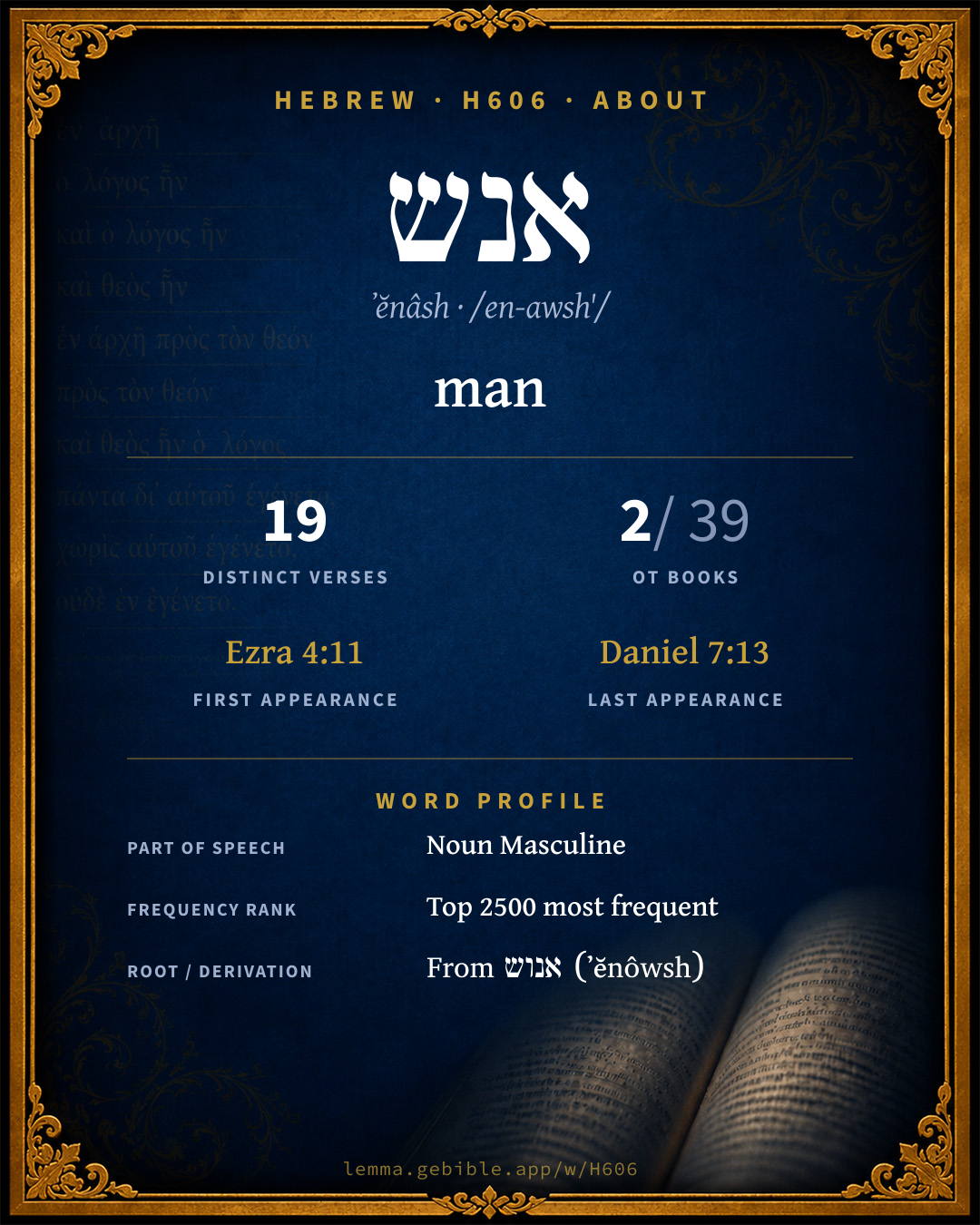
אֱנָשׁ
man
‘man’ is one of 2 main senses fuller range ↓
Full lexicon entry — Brown-Driver-Briggs (BDB)
From Brown-Driver-Briggs (BDB)
Where this word appears
See every Absolute-state word in the Hebrew Bible →
Grammar key — what these labels mean
Part of speech
- Noun
- A naming word — a person, place, thing, or idea.
Noun type
- Common
- A common noun — a general class of person, place, or thing (“king,” “city,” “water”), not a specific name.
State
- Absolute
- The independent form of a noun, not bound to a following word.
- Construct
- A noun bound to a following noun in a possessive / “of” relationship (the construct chain).
Gender
- Masculine
- Grammatically masculine.
Number
- Singular
- One.
- Plural
- More than one (in Hebrew, generally three or more).
Grammatical forms
- Particle, Definite Article 14 times (52%)
- Noun, Common, Masculine, Singular, Absolute 11 times (41%)
- Noun, Common, Masculine, Plural, Absolute 1 time (4%)
- Noun, Common, Masculine, Singular, Construct 1 time (4%)
Parsed forms decoded from the imported morphology (morphhb / Westminster Leningrad Codex — WLC text public domain, morphhb tagging CC BY 4.0), counted across 27 parsed occurrences — not distinct verses.
Every verse where H606 appears — 19 distinct verses across 2 books. Click any verse to open its interlinear word-by-word view. Verse text shown in the World English Bible for context — . Each verse’s Hebrew form is shown with its reference; the English is not keyword-highlighted, since the data carries no word-level English alignment. Use “Compare translations” on any verse to read it across multiple English versions. This concordance covers the Hebrew Bible; Septuagint (Greek Old Testament) occurrences are not indexed here.
Ezra 2 verses
- Ezra 4:11 אֱנָ֥שׁ n c ms cs This is the copy of the letter that they sent to Artaxerxes the king: Your servants the men beyond the River, and so forth.
- Ezra 6:11 אֱנָ֗שׁ n c ms Also I have made a decree, that whoever shall alter this word, let a beam be pulled out from his house, and let him be lifted up and fastened thereon; and let his house be made a dunghill for this:
Daniel 17 verses
- Daniel 2:10 אֲנָשׁ֙ n c ms The Chaldeans answered before the king, and said, There is not a man on the earth who can show the king's matter, because no king, lord, or ruler, has asked such a thing of any magician, or enchanter, or Chaldean.
- Daniel 2:38 אֲ֠נָשָׁ/א n c ms det + ptcl def.art and wherever the children of men dwell, the animals of the field and the birds of the sky has he given into your hand, and has made you to rule over them all: you are the head of gold.
- Daniel 2:43 אֲנָשָׁ֔/א n c ms det + ptcl def.art Whereas you saw the iron mixed with miry clay, they shall mingle themselves with the seed of men; but they shall not cling to one another, even as iron does not mingle with clay.
- Daniel 3:10 אֱנָ֡שׁ n c ms You, O king, have made a decree, that every man that shall hear the sound of the horn, flute, zither, lyre, harp, pipe, and all kinds of music, shall fall down and worship the golden image;
- Daniel 4:16 אנוש/א אֲנָשָׁ֣/א n c ms det + ptcl def.art n c ms det + ptcl def.art let his heart be changed from man's, and let a animal's heart be given to him; and let seven times pass over him.
- Daniel 4:17 אנוש/א אֲנָשָׁ֗/א אֲנָשִׁ֖ים n c ms det + ptcl def.art n c ms det + ptcl def.art n c mp The sentence is by the decree of the watchers, and the demand by the word of the holy ones; to the intent that the living may know that the Most High rules in the kingdom of men, and gives it to whoever he will, and sets up over it the lowest of men.
- Daniel 4:25 אֲנָשָׁ֡/א אֲנָשָׁ֔/א n c ms det + ptcl def.art n c ms det + ptcl def.art that you shall be driven from men, and your dwelling shall be with the animals of the field, and you shall be made to eat grass as oxen, and shall be wet with the dew of the sky, and seven times shall pass over you; until you know that the Most High rules in the kingdom of men, and gives it to whoever he will.
- Daniel 4:32 אֲנָשָׁ/א֩ אֲנָשָׁ֔/א n c ms det + ptcl def.art n c ms det + ptcl def.art and you shall be driven from men; and they dwelling shall be with the animals of the field; you shall be made to eat grass as oxen; and seven times shall pass over you; until you know that the Most High rules in the kingdom of men, and gives it to whoever he will.
- Daniel 4:33 אֲנָשָׁ֣/א n c ms det + ptcl def.art The same hour was the thing fulfilled on Nebuchadnezzar: and he was driven from men, and ate grass as oxen, and his body was wet with the dew of the sky, until his hair was grown like eagles' [feathers], and his nails like birds' [claws].
- Daniel 5:5 אֱנָ֔שׁ n c ms In the same hour came forth the fingers of a man's hand, and wrote over against the lampstand on the plaster of the wall of the king's palace: and the king saw the part of the hand that wrote.
- Daniel 5:7 אֱ֠נָשׁ n c ms The king cried aloud to bring in the enchanters, the Chaldeans, and the soothsayers. The king spoke and said to the wise men of Babylon, Whoever shall read this writing, and show me the interpretation of it, shall be clothed with purple, and have a chain of gold about his neck, and shall be the third ruler in the kingdom.
- Daniel 5:21 אֲנָשָׁ֨/א אֲנָשָׁ֔/א n c ms det + ptcl def.art n c ms det + ptcl def.art and he was driven from the sons of men, and his heart was made like the animals', and his dwelling was with the wild donkeys; he was fed with grass like oxen, and his body was wet with the dew of the sky; until he knew that the Most High God rules in the kingdom of men, and that he sets up over it whoever he will.
- Daniel 6:7 וֶֽ/אֱנָ֜שׁ conj + n c ms All the presidents of the kingdom, the deputies and the satraps, the counselors and the governors, have consulted together to establish a royal statute, and to make a strong interdict, that whoever shall ask a petition of any god or man for thirty days, save of you, O king, he shall be cast into the den of lions.
- Daniel 6:12 אֱנָ֡שׁ וֶֽ/אֱנָ֜שׁ n c ms conj + n c ms Then they came near, and spoke before the king concerning the king's interdict: Haven't you signed an interdict, that every man who shall make petition to any god or man within thirty days, save to you, O king, shall be cast into the den of lions? The king answered, The thing is true, according to the law of the Medes and Persians, which doesn't alter.
- Daniel 7:4 כֶּ/אֱנָ֣שׁ אֱנָ֖שׁ prep + n c ms n c ms The first was like a lion, and had eagle's wings: I saw until the wings of it were plucked, and it was lifted up from the earth, and made to stand on two feet as a man; and a man's heart was given to it.
- Daniel 7:8 אֲנָשָׁ/א֙ n c ms det + ptcl def.art I considered the horns, and, behold, there came up among them another horn, a little one, before which three of the first horns were plucked up by the roots: and, behold, in this horn were eyes like the eyes of a man, and a mouth speaking great things.
- Daniel 7:13 אֱנָ֖שׁ n c ms I saw in the night-visions, and, behold, there came with the clouds of the sky one like a son of man, and he came even to the ancient of days, and they brought him near before him.
About this entry
At a glance — auto-summarized from this page’s data, not written by a person. Every figure links to its source below. This summary describes the numbers; it doesn’t interpret them.
אנש (ʼĕnâsh) is a Hebrew noun most often rendered “man.” Daniel dominates its distribution — 17 of 19 verses. The Hebrew Bible uses it across 19 verses — uncommon. Its lexical range runs to 2 senses. Where the King James Version says “men,” newer translations reach for “mankind” (Berean Standard Bible); the renderings breakdown has the detail. The sections below give every sense, occurrence, and version rendering.
Gloss history
Strong's 1890 vs modern scholarship
About this word
Strong's H606 catalogs a Hebrew word from the Hebrew Old Testament.
These counts are not copied from any lexicon or concordance. They are computed here, from the morphology-tagged Hebrew Old Testament. What Lemma adds →
- 19
- distinct verses
- The word appears in 19 distinct verses.
- 2 / 39
- OT books
- The word appears in 2 of 39 Old Testament books.
- #1,226
- by frequency
- Top 2500 most frequent Hebrew words (rank 1,226 of 8,640 Hebrew words by occurrence).
View all 19 occurrences in the concordance →
By traditional corpus
Conventional, traditional groupings — biblical authorship is debated, so this is a traditional corpus grouping, not an authorship claim. Each share is this word’s portion of its verses in that division of the Hebrew canon. Each figure is a share of the word’s 19 distinct verses.
- Writings (Ketuvim) 19 verses · 100%
How translations render this word
Counts come from each version’s own published word-to-Strong’s tagging or interlinear alignment — an approximate guide to how each version renders this word, not a word-level alignment the data otherwise carries. Because each total is that version’s own tagged count, the per-version totals vary from one another and need not match the appearance or distinct-verse counts above. These counts may also differ from a printed concordance because Lemma counts each distinctly tagged rendering and does not collapse phrase taggings into a single head-word total. This is a fixed set of word-tagged versions (KJV, ASV, BSB, ULT) and does not change with the reading translation you choose elsewhere. Each version’s license is shown beside its name below (and on Sources).
- King James Version: Men 12×, Man 6×, Man's 3×
- American Standard Version: Men 12×, Man 9×, Or man 2×
- Berean Standard Bible: Mankind 7×, Man 6×, Men 3×
- unfoldingWord Literal Text: Man 9×, Men 9×, Mankind 2×
King James Version Public Domain
Renders H606 across 24 tagged occurrences — most commonly:
Plus 1 rendering that appears only once — usually multi-word phrases or single function words the recovered tagging swept in, not distinct renderings. Not rendered by a distinct English word in 1 further occurrence.
American Standard Version Public Domain
Renders H606 across 24 tagged occurrences — most commonly:
Plus 1 rendering that appears only once — usually multi-word phrases or single function words the recovered tagging swept in, not distinct renderings.
Berean Standard Bible Public Domain
Renders H606 across 20 tagged occurrences — most commonly:
Plus 2 renderings that appear only once — usually multi-word phrases or single function words the recovered tagging swept in, not distinct renderings. Not rendered by a distinct English word in 5 further occurrences.
unfoldingWord Literal Text CC BY-SA 4.0
Renders H606 across 26 tagged occurrences — most commonly:
Plus 4 renderings that appear only once — usually multi-word phrases or single function words the recovered tagging swept in, not distinct renderings.
Senses in BDB
The 2 senses BDB distinguishes for this word, in lexicon order (not ranked by frequency or importance). The full entry — with sub-senses — is in the Lexicon Entry tab.
- man, human being
- mankind (collective)
Word origin
אֱנָשׁ n.m. man, mankind
— Brown-Driver-Briggs (Oxford 1906, public domain), digitized via Sefaria, supplemented by the OpenScriptures HebrewLexicon (CC BY 4.0). See Sources.
Derived from אנוש (ʼĕnôwsh) (H582) — man.
Jastrow Dictionary
A second Hebrew/Aramaic lexicon for comparison, covering Aramaic and post-biblical (Talmudic, Targumic, Midrashic) usage that the biblical-Hebrew BDB does not. Matched by lemma rather than by Strong’s number, so a lemma may carry more than one Jastrow headword (shown separately below), and the entries cover usage well beyond the Bible.
אֱנָשׁ
- , v. אִינָשׁ
A Dictionary of the Targumim, the Talmud Babli and Yerushalmi, and the Midrashic Literature (Marcus Jastrow; London, Luzac, 1903) — Public Domain. Digitized via Sefaria. Digitized via Sefaria. Full attribution on Sources.
Forms in the corpus
The 19 distinct written forms H606 takes in the Hebrew Bible, most frequent first — each parse links to that state’s occurrences in the concordance. Hebrew forms include their vowel points and cantillation, so a single lemma takes many written forms.
Same root — word family
Other BDB entries built from the same root as H606, grouped by Strong’s listed origin. These share a root / origin per the lexicon — not necessarily a shared meaning. Each links to that word’s own entry.
Derives from
Shares the same root
Derived from this word
Proper names from this root
People and places named from this root — a name, not an additional meaning of the word.
Compare all same-root words → Showing 4 of 5 — not the complete family. 1 of the same-root words is a proper name (a person or place). They share a root, not necessarily a meaning.
Septuagint verse parallels
This word appears in 16 verses that also exist in the Greek Old Testament (Septuagint), out of the 19 Hebrew verses it occurs in. You can read those verses in Greek by switching the Old Testament edition to the Septuagint.
Read these verses in the Septuagint
This is a verse-level parallel only — the same verses exist in both the Hebrew and Greek Old Testaments. No word-level Hebrew↔Greek correspondence is claimed: the data carries no such alignment, so no Greek word is shown as this Hebrew word’s translation. Coverage is not total — the Septuagint omits the deuterocanon and renumbers the Psalms, so some Hebrew verses have no direct Greek parallel.