
Genesis 17:23

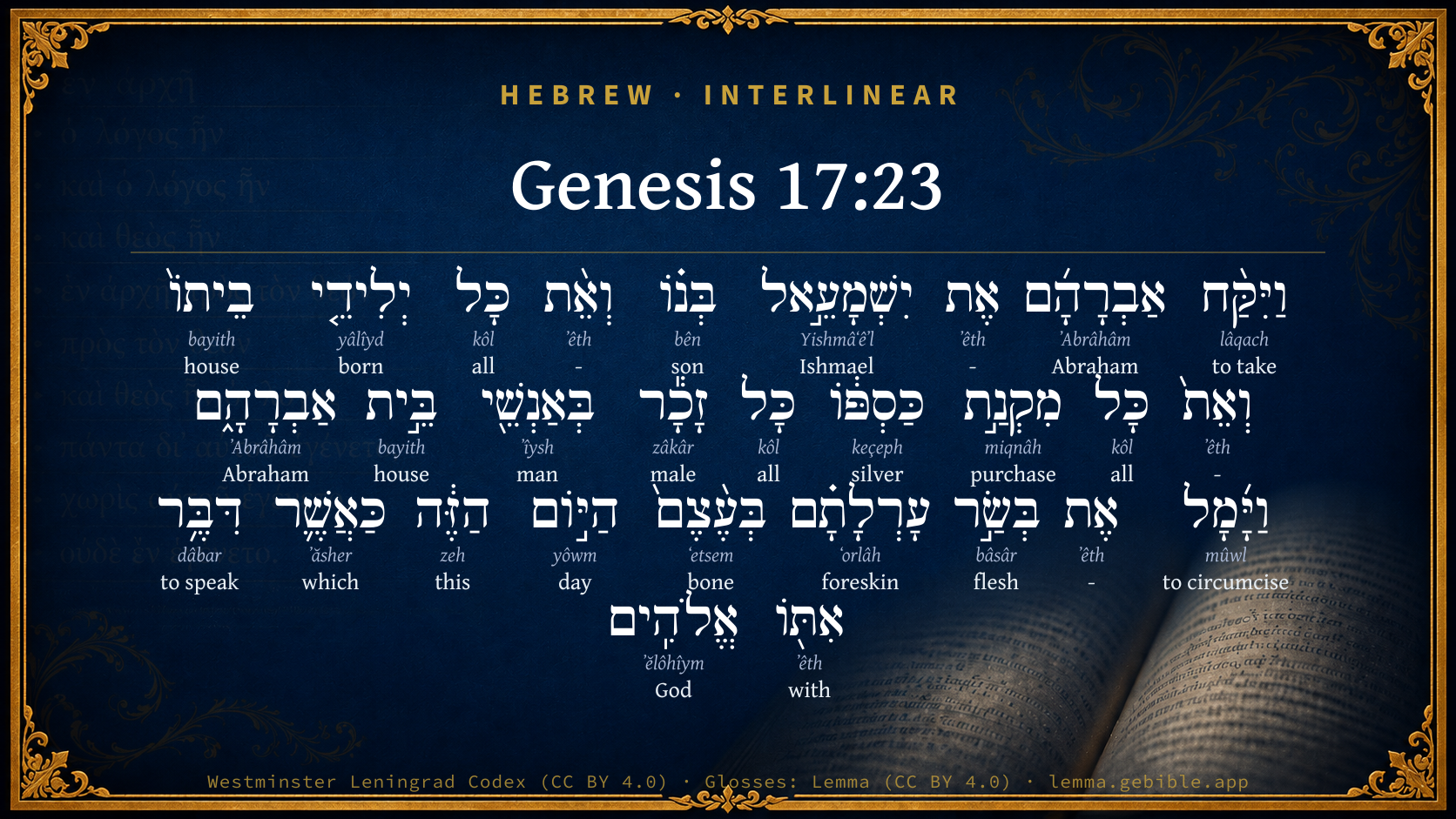
Hebrew (Westminster Leningrad Codex) Genesis 17:23 appears in the Hebrew Old Testament. The text above is from the Westminster Leningrad Codex. Each word links to its Strong’s number, a concise gloss, and parsing drawn from the Open Scriptures Hebrew Bible morphology. Click any word for its full Brown-Driver-Briggs (BDB) entry.
Download image
Cite this verse

Genesis 17:23 (World English Bible). Public Domain. Lemma interlinear Bible study tool, https://lemma.gebible.app/v/genesis/17/23.

Show BibTeX & RIS
BibTeX
RIS
English Translation
Abraham took Ishmael his son, all who were born in his house, and all who were bought with his money; every male among the men of Abraham's house, and circumcised the flesh of their foreskin in the same day, as God had said to him.
World English Bible · Public Domain
Download a study sheet

One document with this verse’s original text, its word-by-word gloss line, the meaning frame, cross-references with their text, attributed commentary, and full source and license credits — printable, and it pastes into notes with its structure intact.

This verse Autodidact and up

Study sheet (.html) Plain text (.txt)

A passage Seminary Student

Up to 50 verses in one chapter. A passage sheet keeps up to 6 commentary sources and 12 cross-references per verse, in the order this page ranks them, and says so on the sheet whenever that leaves anything out. Ask for a single verse and you get the Autodidact verse sheet above.

Everything on this page stays free to read, with no account — the sheet is a download of what is already on screen, not access to it.

Want to remove ads? Support Godless Engineer
Compare translations 3

The same verse in 3 English versions, stacked beneath the original-language interlinear above. Click any original word for its lexicon entry.

Each is an independent rendering of the whole verse — the interlinear is not word-aligned to these translations.

Highlighted words mark where these versions differ — a whole-verse word diff, not a word-by-word alignment.

  • World English Bible Public Domain
    Abraham took Ishmael his son, all who were born in his house, and all who were bought with his money; every male among the men of Abraham's house, and circumcised the flesh of their foreskin in the same day, as God had said to him.
  • King James Version Public Domain
    And Abraham took Ishmael his son, and all that were born in his house, and all that were bought with his money, every male among the men of Abraham's house; and circumcised the flesh of their foreskin in the selfsame day, as God had said unto him.
  • unfoldingWord Literal Text CC BY-SA 4.0
    Then Abraham took Ishmael his son and all those born in his house and everyone bought with his money, every male among the men of Abraham’s house, and he circumcised the flesh of their foreskins on that very day, just as God had told him.

unfoldingWord Literal Text — © unfoldingWord, licensed CC BY-SA 4.0. Word-aligned USFM3 via Door43 (git.door43.org/unfoldingWord/en_ult).

Versions to compare (up to 4)

3 of 4 selected

Show all 18 translations

Every available English version of this verse, each an independent rendering of the whole verse.

  • World English Bible Public Domain
    Abraham took Ishmael his son, all who were born in his house, and all who were bought with his money; every male among the men of Abraham's house, and circumcised the flesh of their foreskin in the same day, as God had said to him.
  • Berean Standard Bible Public Domain
    On that very day Abraham took his son Ishmael and all those born in his household or purchased with his money—every male among the members of Abraham’s household—and he circumcised them, just as God had told him.
  • Majority Standard Bible Public Domain
    On that very day Abraham took his son Ishmael and all those born in his household or purchased with his money—every male among the members of Abraham’s household—and he circumcised them, just as God had told him.
  • King James Version Public Domain
    And Abraham took Ishmael his son, and all that were born in his house, and all that were bought with his money, every male among the men of Abraham's house; and circumcised the flesh of their foreskin in the selfsame day, as God had said unto him.
  • American Standard Version (1901) Public Domain
    And Abraham took Ishmael his son, and all that were born in his house, and all that were bought with his money, every male among the men of Abraham's house, and circumcised the flesh of their foreskin in the selfsame day, as God had said unto him.
  • Revised Version (1885) Public Domain
    And Abraham took Ishmael his son, and all that were born in his house, and all that were bought with his money, every male among the men of Abraham’s house, and circumcised the flesh of their foreskin in the selfsame day, as God had said unto him.
  • Geneva Bible (1599) Public Domain
    Then Abraham tooke Ishmael his sonne and all that were borne in his house, and all that was bought with his money, that is, euery man childe among the men of Abrahams house, and he circumcised the foreskinne of their flesh in that selfe same day, as God had comaunded him.
  • Douay-Rheims (1899) Public Domain
    And Abraham took Ismael his son, and all that were born in his house: and all whom he had bought, every male among the men of his house: and he circumcised the flesh of their foreskin forthwith the very same day, as God had commanded him.
  • Young's Literal Translation Public Domain
    And Abraham taketh Ishmael his son, and all those born in his house, and all those bought with his money -- every male among the men of Abraham's house -- and circumciseth the flesh of their foreskin, in this self-same day, as God hath spoken with him.
  • Literal Standard Version CC BY-SA 4.0
    And Abraham takes his son Ishmael, and all those born in his house, and all those bought with his money—every male among the men of Abraham’s house and circumcises the flesh of their foreskin, in this very same day, as God has spoken with him.
  • Unlocked Literal Bible CC BY-SA 4.0
    Then Abraham took Ishmael his son, and all those who were born into his household, and all those who were bought with his money, every male among the men of Abraham's household, and circumcised the flesh of their foreskin in that same day, as God had said to him.
  • unfoldingWord Literal Text CC BY-SA 4.0
    Then Abraham took Ishmael his son and all those born in his house and everyone bought with his money, every male among the men of Abraham’s house, and he circumcised the flesh of their foreskins on that very day, just as God had told him.
  • Darby Bible Public Domain
    And Abraham took Ishmael his son, and all who were born in his house, and all who were bought with his money -- every male among the people of Abraham's house -- and circumcised the flesh of their foreskin on that same day, as God had said to him.
  • World Messianic Bible Public Domain
    Abraham took Ishmael his son, all who were born in his house, and all who were bought with his money: every male among the men of Abraham’s house, and circumcised the flesh of their foreskin in the same day, as God had said to him.
  • Webster's Bible Public Domain
    And Abraham took Ishmael his son, and all that were born in his house, and all that were bought with his money, every male among the men of Abraham's house; and circumcised the flesh of their foreskin, in the same day, as God had said to him.
  • Free Bible Version CC BY-SA 4.0
    That day Abraham circumcised his son Ishmael as well as all those born in his household or purchased, in fact every male among the members of Abraham's household, just as God had told him.
  • Bible in Basic English Public Domain
    And Abraham took Ishmael, his son, and all whose birth had taken place in his house, and all his servants whom he had made his for a price, every male of his house, and on that very day he gave them circumcision in the flesh of their private parts as God had said to him.
  • JPS Tanakh (1917) Public Domain
    And Abraham took Ishmael his son, and all that were born in his house, and all that were bought with his money, every male among the men of Abraham's house, and circumcised the flesh of their foreskin in the selfsame day, as God had said unto him.

Literal Standard Version (2020), Covenant Press — licensed CC BY-SA 4.0. Text via the HelloAO Bible API (eBible.org). Unlocked Literal Bible (unfoldingWord) — licensed CC BY-SA 4.0. Text via the HelloAO Bible API (eBible.org). unfoldingWord Literal Text — © unfoldingWord, licensed CC BY-SA 4.0. Word-aligned USFM3 via Door43 (git.door43.org/unfoldingWord/en_ult). Free Bible Version, Dr. Jonathan Gallagher — licensed CC BY-SA 4.0. Text via the HelloAO Bible API (eBible.org).

Word by word

More ways to search: Search by grammar → Find every occurrence → Compare this word →

Practice this passage: Drill this verse → Learn its vocabulary →

יְלִידֵ֤י
yâlîyd
H3211
“those born of”
Noun, Common, Masculine, Plural, Construct
Part of Speech
Noun
Type
Common
Gender
Masculine
Number
Plural
State
Construct
Full BDB Definition

Origin: from H3205

TWOT: 867e

born
  1. וַיִּקַּ֨ח lâqach H3947 “and · to take” Conjunction + Verb, Qal, Sequential Imperfect, 3rd Person, Masculine, Singular
  2. אַבְרָהָ֜ם ʼAbrâhâm H85 “Abraham” Noun, Proper
  3. אֶת ʼêth H853 “-” Particle, Direct Object
  4. יִשְׁמָעֵ֣אל Yishmâʻêʼl H3458 “Ishmael” Noun, Proper
  5. בְּנ֗וֹ bên H1121 “son · his” Noun, Common, Masculine, Singular, Construct + Suffix, Personal, 3rd Person, Masculine, Singular
  6. וְאֵ֨ת ʼêth H853 “and · -” Conjunction + Particle, Direct Object
  7. כָּל kôl H3605 “all of” Noun, Common, Masculine, Singular, Construct
  8. בֵיתוֹ֙ bayith H1004 “house · his” Noun, Common, Masculine, Singular, Construct + Suffix, Personal, 3rd Person, Masculine, Singular
  9. וְאֵת֙ ʼêth H853 “and · -” Conjunction + Particle, Direct Object
  10. כָּל kôl H3605 “all of” Noun, Common, Masculine, Singular, Construct
  11. מִקְנַ֣ת miqnâh H4736 “purchase of” Noun, Common, Feminine, Singular, Construct
  12. כַּסְפּ֔וֹ keçeph H3701 “silver · his” Noun, Common, Masculine, Singular, Construct + Suffix, Personal, 3rd Person, Masculine, Singular
  13. כָּל kôl H3605 “all of” Noun, Common, Masculine, Singular, Construct
  14. זָכָ֕ר zâkâr H2145 “male” Adjective, Adjective, Masculine, Singular, Absolute
  15. בְּאַנְשֵׁ֖י ʼîysh H376 “in/at · men of” Preposition + Noun, Common, Masculine, Plural, Construct
  16. בֵּ֣ית bayith H1004 “house of” Noun, Common, Masculine, Singular, Construct
  17. אַבְרָהָ֑ם ʼAbrâhâm H85 “Abraham” Noun, Proper
  18. וַיָּ֜מָל mûwl H4135 “and · to circumcise” Conjunction + Verb, Qal, Sequential Imperfect, 3rd Person, Masculine, Singular
  19. אֶת ʼêth H853 “-” Particle, Direct Object
  20. בְּשַׂ֣ר bâsâr H1320 “flesh of” Noun, Common, Masculine, Singular, Construct
  21. עָרְלָתָ֗ם ʻorlâh H6190 “foreskin · their” Noun, Common, Feminine, Singular, Construct + Suffix, Personal, 3rd Person, Masculine, Plural
  22. בְּעֶ֨צֶם֙ ʻetsem H6106 “in/at · bone of” Preposition + Noun, Common, Feminine, Singular, Construct
  23. הַיּ֣וֹם yôwm H3117 “the · day” Particle, Definite Article + Noun, Common, Masculine, Singular, Absolute
  24. הַזֶּ֔ה zeh H2088 “the · this” Particle, Definite Article + Pronoun, Demonstrative, Masculine, Singular
  25. כַּאֲשֶׁ֛ר ʼăsher H834 “like/as · which” Preposition + Particle, Relative
  26. דִּבֶּ֥ר dâbar H1696 “to speak” Verb, Piel, Perfect, 3rd Person, Masculine, Singular
  27. אִתּ֖וֹ ʼêth H854 “with · him” Preposition + Suffix, Personal, 3rd Person, Masculine, Singular
  28. אֱלֹהִֽים ʼĕlôhîym H430 “God(s)” Noun, Common, Masculine, Plural, Absolute

About this verse

These counts appear in no published source. They are computed here, from the morphology-tagged text and Lemma’s own curated glosses. What Lemma adds →

29
words
22
distinct lemmas
Pentateuch
section

Notable vocabulary

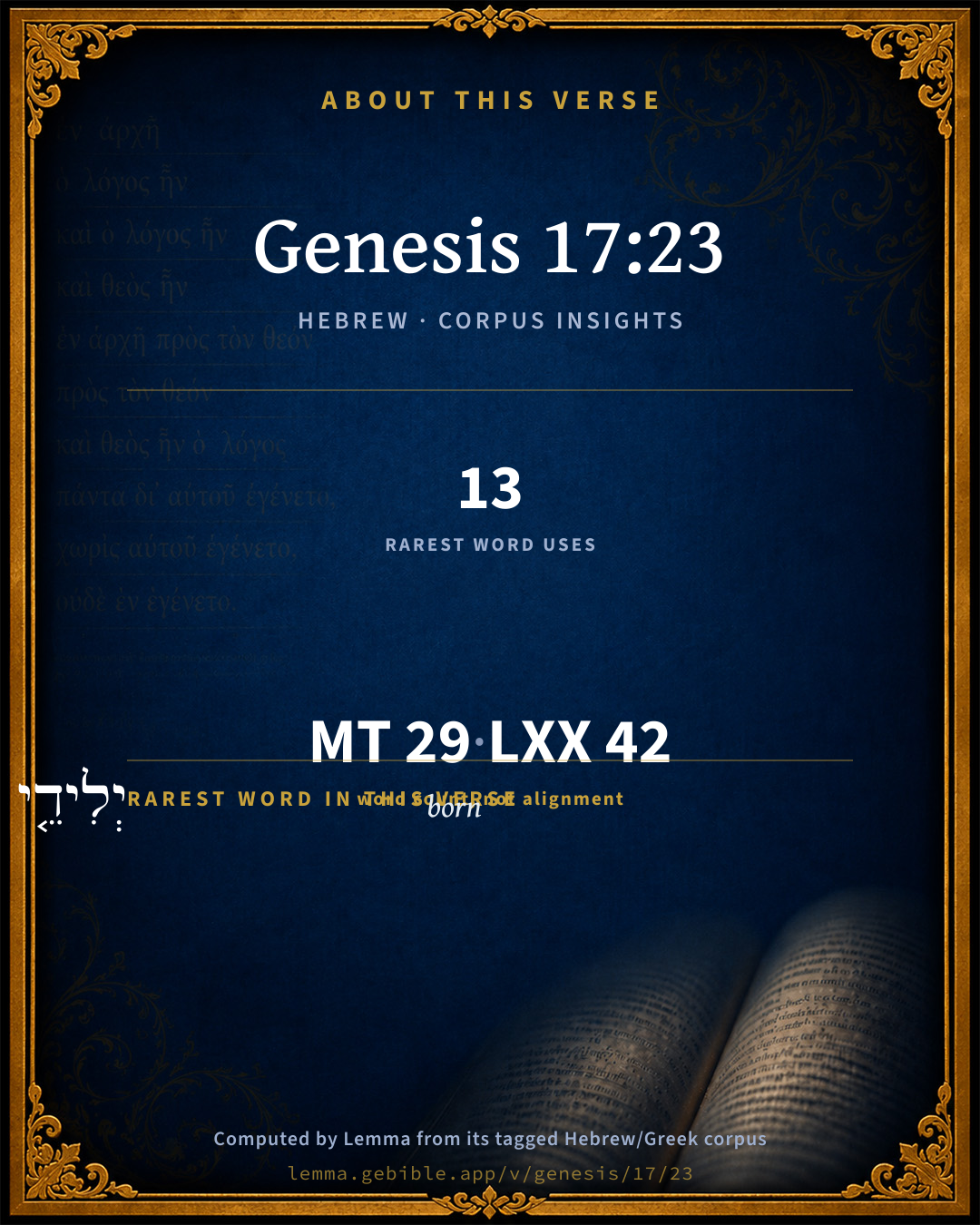
The rarest word here is יְלִידֵ֤י born H3211 — appearing just 13 times in the whole Hebrew Bible.

Shared distinctive vocabulary

יְלִידֵ֤י born H3211 occurs in 13 verses of the Hebrew Bible. Also found in:

Grammatical profile

  • 3 verbs
  • 18 nouns
  • 1 adjective
  • 1 pronoun
  • 1 preposition
  • 5 particles

Verb forms

  • וַיִּקַּ֨ח Qal · Sequential Imperfect
  • וַיָּ֜מָל Qal · Sequential Imperfect
  • דִּבֶּ֥ר Piel · Perfect

Repetition

Words recur within this verse — often emphatic in Hebrew:

  • כָּל all H3605 ×3
  • אַבְרָהָ֜ם Abraham H85 ×2
  • בֵיתוֹ֙ house H1004 ×2

Hebrew & Septuagint length

In English translation the verse runs 45 words from the Hebrew and 45 from the Septuagint (LXX English) — the same length.

A rough comparison of the two English renderings, which tokenize alike — not a word-level alignment.

Word counts can differ between the Hebrew and the Greek without any difference in meaning — e.g. the Hebrew direct-object marker אֵת has no separate Greek word, and Greek often adds the article ὁ.

In the original languages it is 29 Hebrew tokens and 42 Greek tokens — but the two are counted differently (Hebrew bundles its prefixes and suffixes into one token; the Greek is in lemma form), so that isn’t a like-for-like length.

Cross-references

14

Topical passages linked to Genesis 17:23 in the Treasury of Scripture Knowledge — connected by theme and wording, ordered by reader-vote popularity; previews shown in the World English Bible.

  • Psalms 119:60 I will hurry, and not delay, To obey your commandments.
  • Genesis 17:10–14 This is my covenant, which you shall keep, between me and you and your seed after you. Every male among you shall be circumcised.
  • Genesis 17:26–27 In the same day both Abraham and Ishmael, his son, were circumcised.
  • Genesis 18:19 For I have known him, to the end that he may command his children and his household after him, that they may keep the way of Yahweh, to do righteousness and justice; to the end that Yahweh may bring on Abraham that which he has spoken of him."
  • Proverbs 27:1 Don't boast about tomorrow; For you don't know what a day may bring forth.
  • Genesis 34:24 All who went out of the gate of his city listened to Hamor, and to Shechem his son; and every male was circumcised, all who went out of the gate of his city.
  • Joshua 5:2–9 At that time Yahweh said to Joshua, Make you flint knives, and circumcise again the children of Israel the second time.
  • Ecclesiastes 9:10 Whatever your hand finds to do, do it with your might; for there is no work, nor device, nor knowledge, nor wisdom, in Sheol, where you are going.
  • Acts 16:3 Paul wanted to have him go out with him, and he took and circumcised him because of the Jews who were in those parts; for they all knew that his father was a Greek.
  • Romans 2:25–29 For circumcision indeed profits, if you are a doer of the law, but if you are a transgressor of the law, your circumcision has become uncircumcision.
  • Romans 4:9–12 Is this blessing then pronounced on the circumcised, or on the uncircumcised also? For we say that faith was accounted to Abraham for righteousness.
  • 1 Corinthians 7:18–19 Was anyone called having been circumcised? Let him not become uncircumcised. Has anyone been called in uncircumcision? Let him not be circumcised.
  • Galatians 5:6 For in Christ Jesus neither circumcision amounts to anything, nor uncircumcision, but faith working through love.
  • Galatians 6:15 For in Christ Jesus neither is circumcision anything, nor uncircumcision, but a new creation.

Cross-references courtesy of OpenBible.info (CC BY 4.0).

Hebrew and Greek witnesses Masoretic Hebrew ↔ Greek Septuagint

The same verse in the two great witnesses to the Old Testament, shown verse-for-verse.

These are two independent witnesses, not word-aligned to each other, and the Septuagint is shown in lemma (dictionary) form.

Hebrew Genesis 17:23 Masoretic · Westminster Leningrad Codex

וַיִּקַּ֨ח אַבְרָהָ֜ם אֶת יִשְׁמָעֵ֣אל בְּנ֗וֹ וְאֵ֨ת כָּל יְלִידֵ֤י בֵיתוֹ֙ וְאֵת֙ כָּל מִקְנַ֣ת כַּסְפּ֔וֹ כָּל זָכָ֕ר בְּאַנְשֵׁ֖י בֵּ֣ית אַבְרָהָ֑ם וַיָּ֜מָל אֶת בְּשַׂ֣ר עָרְלָתָ֗ם בְּעֶ֨צֶם֙ הַיּ֣וֹם הַזֶּ֔ה כַּאֲשֶׁ֛ר דִּבֶּ֥ר אִתּ֖וֹ אֱלֹהִֽים

Abraham took Ishmael his son, all who were born in his house, and all who were bought with his money; every male among the men of Abraham's house, and circumcised the flesh of their foreskin in the same day, as God had said to him.

World English Bible · Public Domain

Greek LXX Genesis 17:23 Septuagint · lemma form

καί λαμβάνω αβρααμ ισμαηλ ὁ υἱός αὐτός καί πᾶς ὁ οἰκογενής αὐτός καί πᾶς ὁ ἀργυρώνητος καί πᾶς ἄρσην ὁ ἀνήρ ὁ ἐν ὁ οἶκος αβρααμ καί περιτέμνω ὁ ἀκροβυστία αὐτός ἐν ὁ καιρός ὁ ἡμέρα ἐκεῖνος καθά λαλέω αὐτός ὁ θεός

And Abraam took Ismael his son, and all his home-born servants, and all those bought with money, and every male of the men in the house of Abraam, and he circumcised their foreskins in the time of that day, according as God spoke to him.

LXX2012 (modern English Septuagint) · Public Domain

Hebrew: Westminster Leningrad Codex (CC BY 4.0). Greek: Septuagint (public domain); English from LXX2012 (modern English Septuagint) (Public Domain). How the Septuagint differs from the Hebrew →

Targum (Aramaic paraphrase)

2

The Targum is the ancient Jewish Aramaic paraphrase of the Hebrew Scriptures — an interpretive translation, not the Hebrew text itself. Onkelos (literal) and Pseudo-Jonathan (expansive) render the Torah, and Jonathan the Prophets. Coverage is partial: where no permissively-licensed English translation exists for a verse, only the Aramaic is shown. This is verse-level text, not a word-by-word alignment to the Hebrew.

  1. Targum Onkelos Torah (Genesis–Deuteronomy)
    וּדְבַר אַבְרָהָם יָת יִשְׁמָעֵאל בְּרֵהּ וְיָת כָּל יְלִידֵי בֵיתֵהּ וְיָת כָּל זְבִינֵי כַסְפֵּה כָּל דְּכוּרָא בַּאֲנָשֵׁי בֵּית אַבְרָהָם וּגְזַר יָת בִּשְׂרָא דְעָרְלָתְהוֹן בִּכְרַן יוֹמָא הָדֵין כְּמָא דִי מַלֵיל עִמֵּהּ יְיָ

    (no public-domain English translation for this verse)

    Targum Onkelos — Aramaic: “Onkelos Genesis” (public domain); “Onkelos Exodus” (public domain); “Onkelos Leviticus” (public domain); “Onkelos Numbers” (public domain); “Onkelos Deuteronomy” (public domain). English: “Sefaria Community Translation” (CC0 1.0 (public-domain dedication)); “J.W. Etheridge. The Targums of Onkelos and Jonathan Ben Uzziel on the Pentateuch. London: Longmans, Green, 1862” (public domain). Text via Sefaria.

  2. Targum Pseudo-Jonathan Torah (Genesis–Deuteronomy)
    וּדְבַר אַבְרָהָם יַת יִשְׁמָעֵאל בְּרֵיהּ וְיַת כָּל מַרְבְּיָינֵי בֵיתֵיהּ וְיַת כָּל זְבִינֵי כַּסְפֵּיהּ כָּל דְכוּרָא בְּאֵינָשָׁא בֵּיתָא דְאַבְרָהָם וּגְזַר יַת בִּשְרָא דְעוּרְלַתְהוֹן בִּכְרַן יוֹמָא הָדֵין כְּמָה דְמַלֵיל עִמֵיהּ יְיָ

    And Abraham took Ishmael his son, and all brought up in his house, and all bought with money, every male among the household people of Abraham, and he circumcised the flesh of their foreskin in the same day in which the Lord spake with him.

    Targum Pseudo-Jonathan — Aramaic: “Targum Jonathan on Genesis” (public domain); “Targum Jonathan on Exodus” (public domain); “Targum Jonathan on Leviticus” (public domain); “Targum Jonathan on Numbers” (public domain); “Targum Jonathan on Deuteronomy” (public domain). English: “The Targum of Jonathan ben Uzziel, trans. J. W. Etheridge, London, 1862” (public domain). Text via Sefaria.

Commentary

Notes on Genesis 17:23 from classic Christian and Jewish commentators (each source and its license shown beneath its notes). The classic Christian expositions comment on the surrounding passage and are grouped to its opening verse, so a note may address several verses; the Jewish commentaries on the Tanakh (Rashi and others) are per-verse, so they appear only where the commentator wrote on this verse.

Lemma curates 59 commentaries, every one of them public domain or Creative Commons licensed, each selected and text-cleaned for this edition rather than reprinted as found. About our sources →

Matthew Henry's Commentary

We have here Abraham's obedience to the law of circumcision. He himself and all his family were circumcised, so receiving the token of the covenant and distinguishing themselves from other families, that had no part nor lot in the matter. 1. It was an implicit obedience: He did as God had said to him, and did not ask why or wherefore. God's will was not only a law to him, but a reason; he did it because God told him. 2. It was a speedy obedience: In the self-same day, Gen 17:23, Gen 17:26. Sincere obedience is not dilatory, Psa 119:60. While the command is yet sounding in our ears, and the sense of duty is fresh, it is good to apply ourselves to it immediately, lest we deceive ourselves by putting it off to a more convenient season. 3. It was a universal obedience: He did not circumcise his family and excuse himself, but set them an example; nor did he take the comfort of the seal of the covenant to himself only, but desired that all his might share with him in it. This is a good example to masters of families; they and their houses must serve the Lord. Though God's covenant was not established with Ishmael, yet he was circumcised; for children of believing parents, as such, have a right to the privileges of the visible church, and the seals of the covenant, whatever they may prove afterwards. Ishmael is blessed, and therefore circumcised. 4. Abraham did this though much might be objected against it. Though circumcision was painful, - though to grown men it was shameful, - though, while they were sore and unfit for action, their enemies might take advantage against them, as Simeon and Levi did against the Shechemites, - though Abraham was ninety-nine years old, and had been justified and accepted of God long since, - though so strange a thing done religiously might be turned to his reproach by the Canaanite and the Perizzite that dwelt then in the land, - yet God's command was sufficient to answer these and a thousand such objection: what God requires we must do, not conferring with flesh and blood.

Matthew Henry's Commentary on the Whole Bible (1708–1710) — public domain (CC PDM 1.0). Text via the HelloAO Bible API.

Trapp's Complete Commentary

John Trapp

Gen 17:23 And Abraham took Ishmael his son, and all that were born in his house, and all that were bought with his money, every male among the men of Abraham’s house; and circumcised the flesh of their foreskin in the selfsame day, as God had said unto him.

Ver. 23. Abraham took Ishmael.] To make the other more willing.

Circumcised the flesh.] Not regarding the affliction, danger, scandal, shame of the action in the eyes of the world.

John Trapp, A Commentary or Exposition upon All the Books of the Old and New Testament (1647–1656) — public domain. Text from a community e-Sword module.

The Biblical Illustrator

Joseph S. Exell

Gen_17:23-27

In the self-same day was Abraham circumcised, and Ishmael his son

Obedience to the Divine voice

I.

PROMPT.

1. To delay is to despise Gods authority.

2. It is safest to act upon moral impulses immediately.

II. UNQUESTIONING. Gods will is both law and reason.

III. COMPLETE. A particular and intense regard to Gods known will is the essence of piety. (T. H. Leale.)

Abrahams obedience to Gods command

There are three things in particular in the obedience of Abraham worthy of notice.

1. It was prompt. In the self-same day that God had spoken unto him, the command was put in execution. This was making haste, and delaying not to keep His commandments. To treat the Divine precept as matters of small importance, or to put off what is manifestly our duty to another time, is to trifle with supreme authority. So did not Abraham.

2. It was punctilious. The correspondence between the command of God and the obedience of His servant is minutely exact. The words of the former are, Thou shalt keep My covenant and thy seed after thee,. . .and he that is born in thy house, or bought with money of any stranger, which is not of thy seed. With this agrees the account of the latter; In the self-same day was Abraham circumcised, and Ishmael his son; and all the men of his house, born in the house, and bought with money of the stranger, were circumcised with him. A rigid regard to the revealed will of God enters deeply into true religion; that spirit which dispenses with it, though it may pass under the specious name of liberality, is antichristian.

3. Lastly: It was yielded in old age, when many would have pleaded off from engaging in anything new, or different from what they had before received; and when, as some think, it would be a further trial to his faith as to the fulfilment of the promise. Ninety-and-nine years old was Abraham when he was circumcised. It is one of the temptations of old age to be tenacious of what we have believed and practised from our youth; to shut our eyes and ears against everything that may prove it to have been erroneous or defective, and to find excuses for being exempted from hard and dangerous duties. But Abraham to the last was ready to receive farther instruction, and to do as he was commanded, leaving consequences with God. This shows that the admonition to walk before Him, and be perfect, had not been given him in vain. (A. Fuller.)

.

The Biblical Illustrator, edited by Joseph S. Exell (c. 1880s–1900s) — public domain. Text from a community e-Sword module.

The Preacher's Complete Homiletical Commentary

Joseph S. Exell (gen. ed.)

CRITICAL NOTES.—

Gen_17:25. And Ishmael his son was thirteen years old when he was circumcised.] From this circumstance has followed the usage of the Arabians, who circumcise their males in the thirteenth year.

MAIN HOMILETICS OF THE PARAGRAPH.—Gen_17:23-27

OBEDIENCE TO THE DIVINE VOICE

God had ceased speaking, and went up from Abraham (Gen_17:22). The end of every Divine revelation is not to satisfy curiosity, or even our desire of knowledge for its own sake, but to impart unto us light and strength for our duty. God’s word is intended to teach us how to live. Nothing remained for Abraham but to do what he had heard. He had to turn all his thought and feeling into action. Like St. Paul, he was not disobedient unto the heavenly vision. We have here some characteristics of his obedience.

I. It was prompt. In that self-same day Abraham carried God’s command into execution (Gen_17:23). He made haste and delayed not. He reasoned not with himself, he did not leisurely survey his duty, but rushed into it at once. When God once commands, so that we are clear as to what our duty really is, we should not hesitate, but immediately obey.

1. To delay is to despise God’s authority. In some cases we have to dispute the commands of our fellow-creatures, because they may be unreasonable or opposed to virtue. But when such commands are lawful, when the authority is properly constituted, it is our duty to obey. To despise it is lawlessness. God’s authority is paramount, and admits of no dispute. To refuse to submit at once to it is rebellion.

2. It is safest to act upon moral impulses immediately. In the affairs of this life, it is wise to act upon the maxim that “second thoughts are best.” They often prove themselves to be a “wiser first.” The prudence of business is deliberation—taking time to consider. The first prospects of schemes which promise us riches or advancement may be dazzling, but how often is the charm dissolved when we have taken time to weigh and consider. But this maxim of worldly prudence does not stand good in the things of religion. In all matters regarding duty and conscience first thoughts are best. On questions concerning the lawfulness of actions, the nature and obligation of duty, our first convictions are sure to be right. If we take time to consider we only give temptation the opportunity to acquire a dangerous strength. The light which comes from conscience is instantaneous, and our highest wisdom is to accept it at once as our guide. St. Paul, in giving an account of his conversion, tells us how he made no pause, but suddenly acted upon his conviction: “When it pleased God … to reveal His Son in me … immediately I conferred not with flesh and blood.” Moral convictions are only weakened by delay to obey them. Our safety lies in turning them at once into duty.

II. It was unquestioning. Abraham did not begin to argue or dispute—to trouble himself with inquiries as to why such a painful rite had been so long delayed in his own case, or why it should be necessary at all. He stayed not to investigate the rational grounds of the command. It is sufficient for faith that God has spoken, and His will is both law and reason. Our position as creatures forbids all questioning. He who made us has the right to command us. He knows the reasons of all His dealings with us, though to us they seem obscure. The servants of God should have the spirit of true soldiers who have devoted their lives to maintain the honour and power of their country. “Their’s not to reason why; their’s but to do and die.”

III. It was complete. God’s word was literally obeyed, and in every particular. Abraham caused the command to be extended to all who were the subjects of it. His son was circumcised and all his servants. He did not exempt himself (Gen_17:24). Thus obedience should not be partial, nor measured by our own inclinations, but should respect the whole of the commandment. A particular and intense regard to God’s known will is the essence of piety. Thus did Abraham, and thus completely had he followed the Divine injunction given to him at this second stage of the Covenant—“Walk before Me, and be thou perfect” (Gen_17:1).

SUGGESTIVE COMMENTS ON THE VERSES

Gen_17:23. That is, ordered it to be done; saw that it was done. As no express directions were given as to the operator, such agents might be employed as the head of the household saw fit. In Exo_4:25, we see a mother performing it; but in modern times it is usually performed by some experienced person; and it is not only considered a great honour to be a circumciser (mohel), but the occasion is made one of great rejoicing and festivity. The conduct of Abraham on this occasion furnished a bright example to all succeeding ages of the manner in which Divine ordinances should be complied with.—(Bush.)

It is necessary that all the circumstances belonging to positive ordinances should be minutely detailed. Hence the particular description here given.

In selecting Ishmael as the first to receive the token of the Covenant, the rest would be encouraged to follow. They would see that Abraham was in earnest. He began with those nearest and dearest to him. We can only hope to bring others into the ways of obedience when we first set the example ourselves.

Nothing was said as to the time at which Abraham should begin to perform this rite. But he makes haste to obey. Such is always the impulse of a truly devoted and affectionate heart. To delay in keeping His commandments is an evidence of lack of love for God and His law.

The fact that even those who were bought with Abraham’s money submitted to this painful rite, is a proof of the strong influence of his religious character upon them. Not sudden enthusiasm, but a life of piety and obedience can command such influence.

It was a household dedication. The aged patriarch and the youthful son, and all the men-servants, no matter how they came into the household, were thus marked as sharers in the Covenant, and the patriarch’s house was stamped in their very flesh as the Lord’s. Domestic piety is beautiful. The Passover and Circumcision were both of them household seals, and so are Baptism and the Lord’s Supper. Everywhere there are the simple elements—a little bread and wine, and a little water—and what doth hinder? (Act_8:36). And God is faithful. Christ is the Head of His house, as the Covenant Son, in whom we have all blessings. Parental fidelity God covenants to bless (ch. Gen_18:19). (Jacobus).

Gen_17:24. This obedience was yielded in old age, when the infirmity of nature is prone to plead off from engaging in anything new or different from that to which it has been accustomed. Yet it seems to be for the purpose of putting honour upon Abraham’s obedience that it is so expressly said, “Ninety and nine years old was Abraham when he was circumcised.” It is one of the temptations of old age to be tenacious of what we have believed and practised from our youth; to shut our eyes and ears to everything that may prove it to have been erroneous or defective, and to find excuses for being exempted from hard and dangerous duties. But Abraham to the last was ready to receive further instruction, and to do as he was commanded, leaving consequences with God.—(Bush.)

Gen_17:25. He commanded his children and his household after him, that they might keep the way of the Lord (ch. Gen_18:19). This boy of thirteen years of age, poor Ishmael, might have claimed to judge for himself, if he had been so trained as to be left to himself. This is the age at which a boy became a son of the law, and was regarded as of age to take the Sacrament of the Passover—twelve to thirteen years of age. Jesus went up to the Passover at twelve. Ishmael was now thirteen. Children, when they come to such years of discretion, should be taught their duty in regard to assuming sacramental obligations, and coming forward to the full benefit of the Christian church.—(Jacobus).

Gen_17:26-27. The head of the household is responsible for the religious training of those committed to his charge—his children, his servants. All should receive the signs of God’s Covenant, and be placed in a position to obtain the blessings appended to it.

It is God’s plan to make good men the centres of light and privilege to others. All who in any way come under their influence are placed at a superior advantage, and may partake with them of the same blessings.

The Preacher's Complete Homiletical Commentary (gen. ed. Joseph S. Exell; Funk & Wagnalls, c. 1892) — public domain (pre-1929). A full-Bible homiletical/sermon-outline anthology covering 65 of 66 books (2 John is absent from the source module). Text from a community e-Sword module.

Tyndale Open Study Notes

Tyndale Open Resources

17:23-27 Having received God’s word about Isaac, Abraham immediately complied with God’s instructions. He implemented the rite of circumcision as an act of faith; it signified their participation in the covenant (cp. Rom 4:11-12; Gal 5:2-6, 11; 6:15; Phil 3:2-3; Col 2:11-12; 1 Pet 3:21).

Tyndale Open Study Notes — © Tyndale Open Resources, licensed CC BY-SA 4.0. Text via the HelloAO Bible API.

Geneva Bible (1599)

Geneva Bible translators

They were well instructed which obeyed to be circumcised without resistance: which thing declareth that masters in their houses ought to be as preachers to their families, that from the highest to the lowest they may obey the will of God.

Geneva Bible (1599) marginal notes — public domain. Text via Bolls.life.

Adam Clarke's Commentary

Verse 23. And Abraham took Ishmael, c.] Had not Abraham, his son, (who was of age to judge for himself,) and all the family, been fully convinced that this thing was of God, they could not have submitted to it. A rite so painful, so repugnant to every feeling of delicacy, and every way revolting to nature, could never have sprung up in the imagination of man. To this day the Jews practise it as a Divine ordinance and all the Arabians do the same. As a distinction between them and other people it never could have been designed, because it was a sign that was never to appear. The individual alone knew that he bore in his flesh this sign of the covenant, and he bore it by the order of God, and he knew it was a sign and seal of spiritual blessings, and not the blessings themselves, though a proof that these blessings were promised, and that he had a right to them. Those who did not consider it in this spiritual reference are by the apostle denominated the concision, Php 3:2, i.e., persons whose flesh was cut, but whose hearts were not purified.

THE contents of this chapter may be summed up in a few propositions: -

1. God, in renewing his covenant with Abram, makes an important change in his and Sarai's name; a change which should ever act as a help to their faith, that the promises by which God had bound himself should be punctually fulfilled. However difficult it may be for us to ascertain the precise import of the change then made, we may rest assured that it was perfectly understood by both; and that, as they had received this name from God, they considered it as placing them in a new relation both to their Maker and to their posterity. From what we have already seen, the change made in Abram's name is inscrutable to us; there is something like this in Re 2:17: To him that overcometh will I give a white stone, and a NEW NAME-which no man knoweth, saving he that receiveth it. The full import of the change made in a soul that enters into covenant with God through Christ, is only known to itself; a stranger intermeddleth not with its joy. Hence, even men of learning and the world at large have considered experimental religion as enthusiasm, merely because they have not understood its nature, and have permitted themselves to be carried away by prejudices which they have imbibed perhaps at first through the means of ignorant or hypocritical pretenders to deep piety; but while they have the sacred writings before them, their prejudices and opposition to that without which they cannot be saved are as unprincipled as they are absurd.

2. God gives Abraham a precept, which should be observed, not only by himself, but by all his posterity; for this was to be a permanent sign of that covenant which was to endure for ever. Though the sign is now changed from circumcision to baptism, each of them equally significant, yet the covenant is not changed in any part of its essential meaning. Faith in God through the great sacrifice, remission of sins, and sanctification of the heart, are required by the new covenant as well as by the old.

3. The rite of circumcision was painful and humiliating, to denote that repentance, self-denial, c., are absolutely necessary to all who wish for redemption in the blood of the covenant and the putting away this filth of the flesh showed the necessity of a pure heart and a holy life.

4. As eternal life is the free gift of God, he has a right to give it in what way he pleases, and on what terms. He says to Abraham and his seed, Ye shall circumcise the flesh of your foreskin, and he that doth not so shall be cut off from his people. He says also to sinners in general, Let the wicked forsake his way, and the unrighteous man his thoughts; Repent, and believe the Gospel; and, Except ye repent, ye shall perish. These are the terms on which he will bestow the blessings of the old and new covenants. And let it be remembered that stretching out the hand to receive an alms can never be considered as meriting the bounty received, neither can repentance or faith merit salvation, although they are the conditions on which it is bestowed.

5. The precepts given under both covenants were accompanied with a promise of the Messiah. God well knows that no religious rite can be properly observed, and no precept obeyed, unless he impart strength from on high; and he teaches us that that strength must ever come through the promised seed. Hence, with the utmost propriety, we ask every blessing through him, in whom God is well pleased.

6. The precept, the promise, and the rite, were prefaced with, "I am God all-sufficient; walk before me, and be thou perfect." God, who is the sole object of religious worship, has the sole authority to prescribe that worship, and the rites and ceremonies which shall be used in it; hence he prescribed circumcision and sacrifices under the old law, and baptism and the eucharist under the Gospel; and to render both effectual to the end of their institution, faith in God was indispensably necessary.

7. Those who profess to believe in him must not live as they list, but as he pleases. Though redeemed from the curse of the law, and from the rites and ceremonies of the Jewish Church, they are under the law to Christ, and must walk before him - be in all things obedient to that moral law which is an emanation from the righteousness of God, and of eternal obligation; and let it ever be remembered that Christ is "the author of eternal salvation to all that obey him." Without faith and obedience there can be no holiness, and without holiness none can see the Lord. Be all that God would have thee to be, and God will be to the"' all that thou canst possibly require. He never gives a precept but he offers sufficient grace to enable thee to perform it. Believe as he would have thee, and act as he shall strengthen thee, and thou wilt believe all things savingly, and do all things well.

Adam Clarke's Commentary on the Bible (1810–1826) — public domain. Text from a community e-Sword/MySword module.

John Calvin's Commentaries

23. And Abraham took Ishmael Moses now commends the obedience of Abraham because he circumcised the whole of his family as he had been commanded. For he must, of necessity, have been entirely devoted to God, since he did not hesitate to inflict upon himself a wound attended with acute pain, and not without danger of life. To this may be added the circumstance of the time; namely, that he does not defer the work to another day, but immediately obeys the Divine mandate. There is, however, no doubt, that he had to contend with various perplexing thoughts. Not to mention innumerable others, this might come into his mind, ‘As for me, who have been so long harassed with many adverse affairs, and tossed about in different exiles, and yet have never swerved from the word of God; if, by this symbol, he would consecrate me to himself as a servant, why has he put me off to extreme old age? What does this mean, that I cannot be saved unless I, with one foot almost in the grave, thus mutilate myself?’ But this was an illustrious proof of obedience, that having overcome all difficulties, he quickly, and without delay, followed where God called him. And he gave, in so doing, an example of faith not less excellent; because, unless he had certainly embraced the promises of God, he would by no means have become so prompt to obey. Hence, therefore, arose his great alacrity, because he set the word of God in opposition to the various temptations which might disturb his mind, and draw him in contrary directions.

Two things also here are worthy of observation. First, that Abraham was not deterred by the difficulty of the work from yielding to God the duty which he owed him. We know that he had a great multitude in his house, nearly equal to a people. It was scarcely credible that so many men would have suffered themselves to be wounded apparently to be made a laughingstock. Therefore it was justly to be feared, that he would excite a great tumult in his tranquil family; yea, that, by a common impulses the major part of his servants would rise up against him; nevertheless, relying upon the word of God, he strenuously attempts what seemed impossible.

We next see, how faithfully his family was instructed; because not only his home-born slaves, but foreigners, and men bought with money, meekly receive the wounds which was both troublesome, and the occasion of shame to carnal sense. It appears then that Abraham diligently took care to have them prepared for due obedience. And since he held them under holy discipline, he received the reward of his own diligences in finding them so tractable in a most arduous affair. So, at this day, God seems to enjoin a thing impossible to be done, when he requires his gospel to be preached every where in the whole world, for the purpose of restoring it from death to life. For we see how great is the obstinacy of nearly all men, and what numerous and powerful methods of resistance Satan employs; so that, in short, all the ways of access to these principles are obstructed. Yet it behoves individuals to do their duty, and not to yield to impediments; and, finally our endeavors and our labors shall by no means fail of that success which is not yet apparent.

John Calvin's Commentaries (1540-1563) — public domain. Text from the Calvin Translation Society English edition (1840s-50s) via the Christian Classics Ethereal Library (ccel.org). Calvin's coverage is partial (roughly two-thirds of the Bible); uncommented books and verses are honest gaps, never fabricated. The 19th-century editor's footnotes and remarks are omitted so the notes are faithfully Calvin's own voice.

The Cambridge Bible for Schools and Colleges

gen. ed. J. J. S. Perowne

23–27. Abraham circumcises his Household

23. And Abraham took, &c.] This verse repeats the directions contained in Gen_17:11-13.

in the selfsame day] As in Gen_17:26 : see note on Gen_7:13. The expression is characteristic of P. The performance of this rite upon all the males of Abraham’s household, consisting of several hundred (cf. Gen_14:14), in one day is hardly to be understood literally. The narrative is more concerned with the thought of the symbolism of a ritual precept, than with its literal practicability. The operation for full-grown males is a serious one, and not unattended with risk, cf. 34.

The Cambridge Bible for Schools and Colleges (gen. ed. J. J. S. Perowne; Cambridge University Press, 1878–1918) — public domain. Text from a community e-Sword module.

John Gill's Exposition

And Abraham took Ishmael his son,.... To circumcise him; he took his son first, to set an example to his servants, and that they might the more readily comply when they saw that Abraham's son, and at that time his only son, was circumcised before their eyes:

and all that were born in his house; which were three hundred and eighteen when he rescued Lot from the kings, Gen 14:14; and perhaps they might be now increased:

and all that were bought with his money; how many those were, it is not easy to say, no doubt they were many:

every male among the men of Abraham's house; whether children or servants, and those little or grown up:

and circumcised the flesh of their foreskin, in the selfsame day, as God had said unto him; he performed this operation in the manner God directed him, the same day he spoke to him of it; he was not disobedient, nor dilatory to obey the command of God, but at once complied with it, not consulting flesh and blood, not regarding the pain he and his should endure, or the shame or danger they should be exposed unto through the Heathens about them; but trusting in God, and committing himself to him, and having his fear before his eyes, he hesitated not, but cheerfully did the will of God. In doing this work he might have some assistance: it is highly probable he began it himself, and circumcised several; and having taught some of his servants how to perform it according to the divine prescription, they might assist him in going through with it.

John Gill's Exposition of the Whole Bible (1746–1763) — public domain (CC PDM 1.0). Text via the HelloAO Bible API.

Haydock's Catholic Bible Commentary

His house. All wee kept in such good order by their master, that none was found unwilling to submit, if indeed it was left to their choice. (Haydock) --- Abraham loses no time in complying with God’s commands. (Menochius)

George Leo Haydock (1774–1849), Haydock's Catholic Family Bible and Commentary, 1859 edition — public domain. Excludes Psalms (Douay-Rheims chapter numbering differs from Protestant) and Deuterocanonical books (Catholic canon only).

Matthew Poole's English Annotations

Circumcised the flesh of their foreskin; partly by his own hand, and partly by the help of others, whom he by Divine instinct called to and directed in that work;

in the self-same day, in which God appeared to him and gave the command. So he made haste and delayed not to execute God’s command. And his servants also yielded a ready and cheerful obedience to this severe and painful precept, being moved thereunto by Abraham’s example and sovereign authority, by God’s powerful presence some way or other manifested to them, and by the prospect and hope of God’s blessing to accompany and follow his own ordinance.

Matthew Poole's English Annotations on the Holy Bible (1683–1685) — public domain. Text from a community e-Sword/MySword module.

Whedon's Commentary on the Bible

Daniel D. Whedon

23. Abraham… in the selfsame day — The promptness of his obedience is noticeable. Abraham’s “faith wrought with his works, and by works was faith made perfect.” Jas_2:22.

Daniel D. Whedon (gen. ed.), Commentary on the Old and New Testaments (1874–1909) — public domain. Text from a community e-Sword module.

The Pulpit Commentary

And Abraham took Ishmael his son, and all that were born in his house, and all that were bought with his money, every male among the men of Abraham"s house; and circumcised the flesh of their foreskin in the self-same day. Literally, in the bone of that day, an expression occurring in Gen_7:13, which is commonly regarded as Jehovistic, while this is Elohistic; though Quarry suggests that the ensuing section should commence with this verse, in which case the present paragraph would also be Jehovistic, and the appearance of unnecessary repetition in its statements avoided by viewing them as the customary recapitulations that mark the opening of a new division of the history (vide Genesis, p. 440) against which, however, is the name of God which continues to be here employed. As God (Elohim) had said unto him.

The Pulpit Commentary (1880–1919), ed. H.D.M. Spence-Jones & Joseph S. Exell — public domain. Text from a community e-Sword module.

Kretzmann's Popular Commentary

Paul E. Kretzmann

Abraham’s Obedience

v. 23. And Abraham took Ishmael, his son, and all that were born in his house, and all that were bought with his money, every male among the men of Abraham’s house, and circumcised the flesh of their foreskin in the selfsame day, as God had said unto him. The prompt and literal obedience which Abraham rendered is an evidence of his faith; for that very day he performed the rite of circumcision upon Ishmael and upon all his men, whether born while in his possession or bought with his money, and upon himself.

v. 24. And Abraham was ninety years old and nine when he was circumcised in the flesh of his foreskin.

v. 25. And Ishmael, his son, was thirteen years old when he was circumcised in the flesh of his foreskin.

v. 26. In the selfsame day was Abraham circumcised and Ishmael, his son.

v. 27. And all the men of his house, born in the house and bought with money of the stranger, were circumcised with him. Thus was the first congregation under the Old Testament covenant organized.

Paul E. Kretzmann, Popular Commentary of the Bible (1921–1924) — public domain. Text from a community e-Sword module.

Rashi

Rabbi Shlomo Yitzchaki (Rashi)

בעצם היום IN THE SELFSAME DAY — on the very day when he received the command of circumcision: by day and not by night — he was afraid neither of the heathens nor of the cynics. And he did it in broad daylight in order that his enemies and other people should not say, “If we had seen him we would never have allowed him to practise circumcision and carry out the commandment of the Omnipresent (Genesis Rabbah 47:9).

וימל AND HE CURCUMCISED — This is a Kal form (active).

Rashi on the Tanakh — English translations: “The Judaica Press complete Tanach with Rashi, translated by A. J. Rosenberg” (CC BY 4.0); “Pentateuch with Rashi's commentary by M. Rosenbaum and A.M. Silbermann, 1929-1934” (public domain); “The Metsudah Tanach series, Lakewood, N.J” (CC BY 4.0); and “The Book of Joshua, Metsudah Publications, 1997” (CC BY 4.0). Text via Sefaria.

Radak

Rabbi David Kimhi (Radak)

ויקח, as soon as G'd had withdrawn Avraham proceeded to make all the preparations necessary to perform the circumcision on all the members of his household who qualified for this, followed by his circumcising himself. He waited with circumcising himself, realizing that if he would circumcise himself first, he would be too weak to perform this operation on all the male member of his household immediately afterwards.

כל זכר באנשי בית אברהם, both adults and minors.

וימול בשר ערלתם, both the removal of the foreskin and the removal of the membrane underneath it. (פריעה). Some of our sages (Yevamot 71) claim that Avraham had not been commanded to perform פריעה also. The majority opinion is that he had been commanded concerning both these stages of circumcision. This is also the opinion expressed in Bereshit Rabbah (compare Torah Shleymah 157)

בעצם היום הזה, on the very day G'd had issued these instructions.

Radak on the Tanakh — English translations: “Sefaria Community Translation” (CC0 1.0 (public-domain dedication)); “Eliyahu Munk, HaChut Hameshulash” (CC BY 4.0); “Rabbi Mike Feuer, Jerusalem Anthology” (CC BY 4.0); and “R. David Kimhi on the first book of Psalms, Translated by R.G. Finch, London, 1919” (public domain). Text via Sefaria.

Lesson kit

Teaching starters — assembled from the data on this page, not authored interpretation. Every prompt links to the verse data it draws on. Edit before teaching.

Genesis, in the Pentateuch, opens this verse with 29 words (22 distinct Hebrew lemmas). Its most distinctive word is yâlîyd (“born”). A historical commentator’s framing appears above. Read the whole chapter for the surrounding context.

Discussion questions

  1. How does “born” (yâlîyd) shape what this verse is saying?
  2. How does Genesis 14:14, which shares the word «born», read alongside this verse?
  3. What does the repetition of “all” (3× in this one verse) do in this verse?
  4. The translations on this page render this verse differently — a whole-verse word diff, not a word-by-word alignment. What might account for the different wordings?
  5. «וַיִּקַּ֨ח» is a Qal Sequential Imperfect verb. How does that grammatical form shape the action described?
  6. Compare how Matthew Henry's Commentary and Trapp's Complete Commentary read this verse. Where do they agree or differ?

Things to notice

Reading settings

Reading text

Shown beneath each verse's original-language words.

Old Testament
Old Testament edition

Read the OT as the Masoretic Hebrew (MT) or the Greek Septuagint (LXX).

English shown for the Greek Septuagint (in the Hebrew ↔ Greek comparison).

Comparing translations? Open the Compare panel on any verse page to stack up to four side by side.