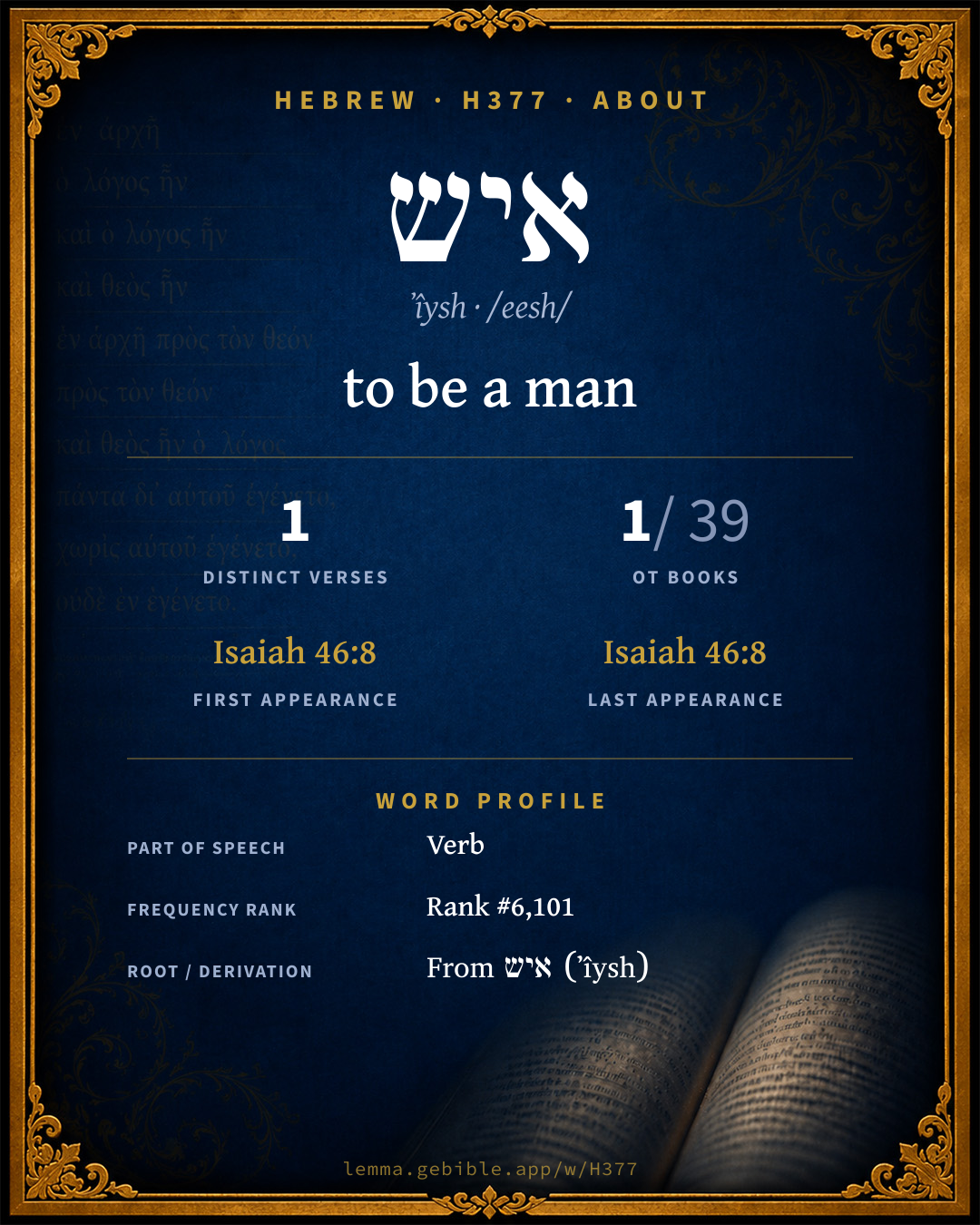
אשׁשׁ
to be a man
Full lexicon entry — Brown-Driver-Briggs (BDB)
From Brown-Driver-Briggs (BDB)
Where this word appears
Grammar key — what these labels mean
Stem
- Hithpolel
- The reflexive counterpart of the Polel.
Form
- Imperative
- A direct command (“write!”).
Person
- 2nd Person
- The one addressed (“you”).
Gender
- Masculine
- Grammatically masculine.
Number
- Plural
- More than one (in Hebrew, generally three or more).
Every verse where H377 appears — 1 distinct verse across 1 book. Click any verse to open its interlinear word-by-word view. Verse text shown in the World English Bible for context — . Each verse’s Hebrew form is shown with its reference; the English is not keyword-highlighted, since the data carries no word-level English alignment. Use “Compare translations” on any verse to read it across multiple English versions. This concordance covers the Hebrew Bible; Septuagint (Greek Old Testament) occurrences are not indexed here.
Isaiah 1 verse
About this entry
At a glance — auto-summarized from this page’s data, not written by a person. Every figure links to its source below. This summary describes the numbers; it doesn’t interpret them.
At its core, איש (ʼîysh) means “to be a man.” A scarce word — 1 verse in all of the Hebrew Bible. Its uses cluster heavily in Isaiah (100% of all occurrences). Found nowhere else but Isaiah 46:8. From the same root come איש, אישון and אישחיל. See the sense tree, 1-verse concordance, and the renderings breakdown below.
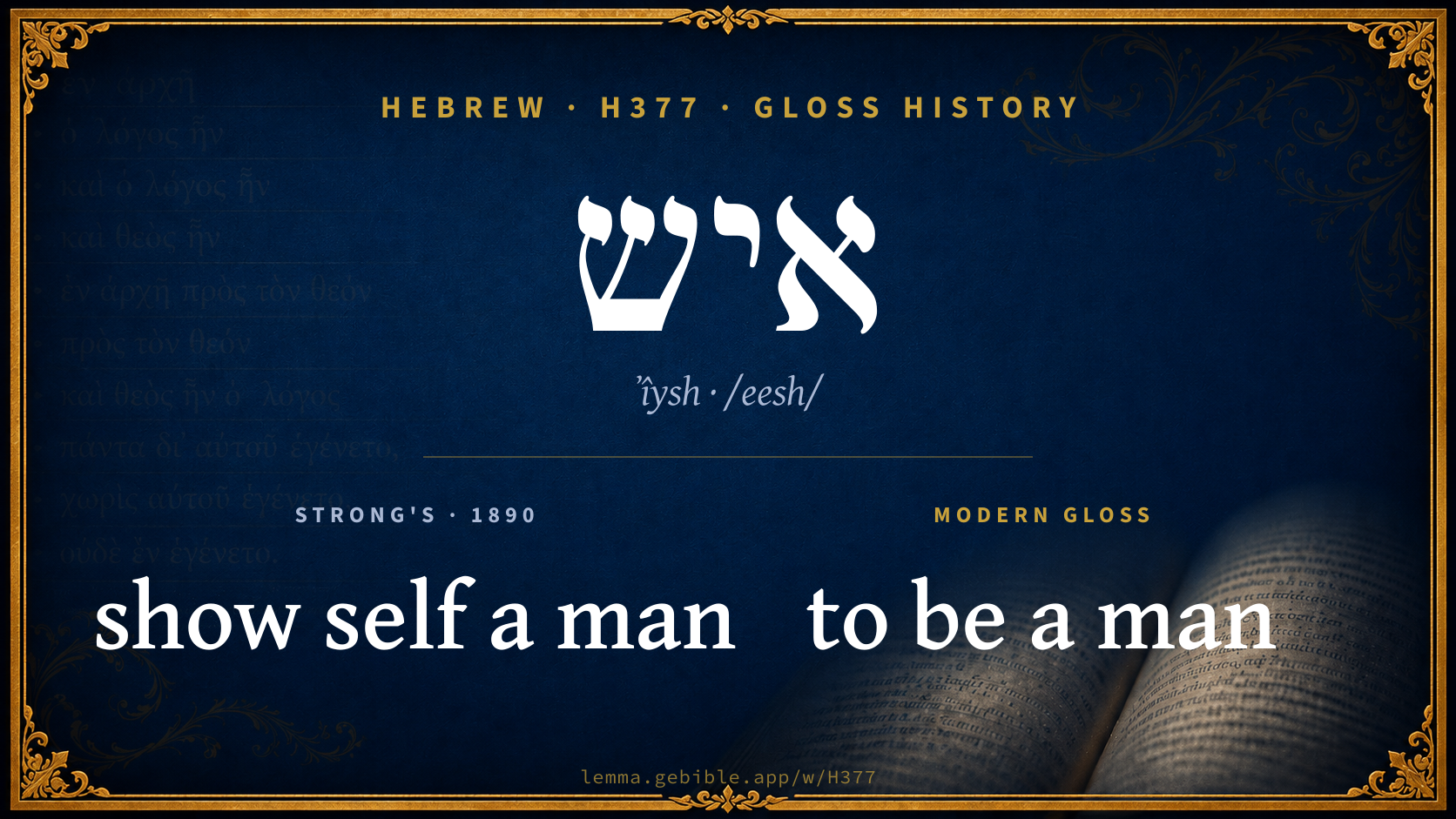
Gloss history
Strong's 1890 vs modern scholarship
About this word
Strong's H377 catalogs a Hebrew word from the Hebrew Old Testament.
These counts are not copied from any lexicon or concordance. They are computed here, from the morphology-tagged Hebrew Old Testament. What Lemma adds →
- 1
- distinct verses
- The word appears in 1 distinct verse.
- 1 / 39
- OT books
- The word appears in 1 of 39 Old Testament books.
- #6,101
- by frequency
- Rank #6,101 (rank 6,101 of 8,640 Hebrew words by occurrence).
View all 1 occurrence in the concordance →
Most concentrated in
- Isaiah 1 verse 100%
By section of the Old Testament
By traditional corpus
Conventional, traditional groupings — biblical authorship is debated, so this is a traditional corpus grouping, not an authorship claim. Each share is this word’s portion of its verses in that division of the Hebrew canon. Each figure is a share of the word’s 1 distinct verse.
- Prophets (Nevi'im) 1 verse · 100%
How translations render this word
Counts come from each version’s own published word-to-Strong’s tagging or interlinear alignment — an approximate guide to how each version renders this word, not a word-level alignment the data otherwise carries. Because each total is that version’s own tagged count, the per-version totals vary from one another and need not match the appearance or distinct-verse counts above. These counts may also differ from a printed concordance because Lemma counts each distinctly tagged rendering and does not collapse phrase taggings into a single head-word total. This is a fixed set of word-tagged versions (KJV, ASV, BSB, ULT) and does not change with the reading translation you choose elsewhere. Each version’s license is shown beside its name below (and on Sources).
- King James Version: Shew yourselves men 1×
- American Standard Version: This 1×
- Berean Standard Bible: Be brave 1×
- unfoldingWord Literal Text: Establish yourselves 1×
King James Version Public Domain
Renders H377 across 1 tagged occurrence — most commonly:
American Standard Version Public Domain
Renders H377 across 1 tagged occurrence — most commonly:
Berean Standard Bible Public Domain
Renders H377 across 1 tagged occurrence — most commonly:
unfoldingWord Literal Text CC BY-SA 4.0
Renders H377 across 1 tagged occurrence — most commonly:
Senses in BDB
The 1 sense BDB distinguishes for this word, in lexicon order (not ranked by frequency or importance). The full entry — with sub-senses — is in the Lexicon Entry tab.
- (Hithpalel) to be a man, show masculinity, champion, great man
Word origin
n.m. man (= vir) (MI, SI, Ph. אש, perh. also Sab. אסם cf. Prät l.c., but DHMZMG 1883, 330)—א׳ abs. Gn 2:23 +; cstr. Gn 25:27 +; sf. אִישִׁי Gn 29:32 +, etc.; pl. אִישִׁים ψ 141:4 + 2 textual (Ph. אשם); usually אֲנָשִׁים Gn 12:20 +, fr. √ אנשׁ q.v.; cstr. אַנְשֵׁי Ju 6:27 +; sf. אֲנָשַׁי 1 S 23:12 etc.;—man, opp. woman Gn 2:23, 24 Lv 20:27 Nu 5:6 Dt 17:2f Jos 6:21; 8:25 Je 40:7, emph. on sexual distinction & relation Gn 19:8; 24:16; 38:25 Ex 22:15 Lv 15:16 (שִׁכְבַת זָ֑רַע) v 18 (וְאִשָּׁה אֲשֶׁר יִשְׁכַּב אִישׁ אֹתָהּ שׁ׳־ז׳) 20:10f Nu 5:13f Dt 22:22f Is 4:1 +; thence = husband, especially c. sf. Gn 3:6, 16; 16:3; 29:32, 34 Lv 21:7 Nu 30:7f Dt 28:56 Ju 13:6f Ru 1:3f 1 S 25:19 Je 29:6 Ez 16:45 +; fig. of י׳ as husb. of Isr. אִישִׁי Ho 2:18 (opp. בַּעְלִי); man as procreator, father Ec 6:3; of male child Gn 4:1 cf. זֶרַע אֲנָשִׁים 1 S 1:11, man, opp. beast Ex 11:7 Lv 20:15 (cf. אָדָם); cf. fig. ψ 22:7 but also of male of animals Gn 7:2(×2) (אִישׁ וְאִשְׁתּוֹ); man, opp. God Gn 32:29 Nu 23:19 לֹא אִישׁ אֵל וִיכַזֵּב (‖ וּבֶן־אָדָם וְיִתְנֶחָ֑ם); Jb 9:32; 32:13 Ho 11:9 cf. Is 31:8 Jb 12:10 (רוּחַ כָּל־בְּשַׂר־אִישׁ); hence in phrases to denote ordinary, customary, common שֵׁבֶט אֲנָשִׁים 2 S 7:14 (‖ נִגְעֵי בְּנֵי אָדָם); לֶחֶם אֲנָשִׁים Ez 24:17, 22 (cf. Is 8:1); אֲנָשִׁים Ez 24:17, 22 is textual error; We (ap. Sm) אֲנֻשִׁים; ToyHpt אוֹנִים (Ho 9:4). אַמַּת־אִישׁ Dt 3:11; but also contr. אָדָם ψ 49:3; 62:10; man, as valiant 1 S 4:9(×2) (וִהְיוּ לַאֲנָשִׁים) so 1 K 2:2 cf. 1 S 26:15; so אִישׁ חַיִל 31:12 2 S 24:9 1 K 1:42 +; also אִישׁ מִלְחָמָה Nu 31:49 Dt 2:14, 16 Jos 5:4, 6 +; even of י׳ Ex 15:3 יהוה אִישׁ מִלְחָמָה; oft. prefixed to other nouns in app. הא׳ אָדוֹן Gn 42:30, 33, א׳ שַׂר וְשֹׁפֵט Ex 2:14, א׳ כֹּהֵן Lv 21:9, א׳ סָרִיס Je 38:7; partic. bef. adj. gent. אִישׁ מִצְרִי Gn 39:1 Ex 2:11, 19 cf. Gn 37:28; 38:1, 2; 39:14 1 S 17:12; 30:11, 13 +; a man as resident in, or belonging to a place or people Nu 25:6 Ju 10:1 + (so Ph.); usually pl. אַנְשֵׁי יִשְׂרָאֵל 1 S 7:11; 31:7(×2) cf. Jos 7:4, 5 +; also sg. coll. Dt 27:14 Jos 9:6, 7 Ju 20:11 1 S 11:8 (v. Dr) +; 2 S 10:6, 8 (א׳ טוֹב); (so MI 10. 13); men = retainers, followers, soldiers 1 S 18:27; 23:3f; 24:3; 25:13 + cf. Dt 33:8 sg. coll. v. Di; אִישׁ אֱלֹהִים man of God = proph. Dt 33:1 Jos 14:6 1 S 9:6f 1 K 12:22; 13:1f + (v. אלהים); in phrase sq. abstr. v. supr.; א׳ רִיב Ju 12:2 Je 15:10, א׳ שֵׂיבָה Dt 32:25, א׳ הַדָּמִים 2 S 16:7 cf. v. 8, א׳ הַבְּלִיַּעַל 2 S 16:7, א׳ מָוֶת 1 K 2:26, א׳ חָמָס ψ 140:12 Pr 3:31 +; sq. word of occupation, etc. א׳ שָׂדֶה Gn 25:27, א׳ הָאֲדָמָה Gn 9:20 (cf. Zc 13:5), א׳ הַבֵּנַיִם champion 1 S 17:4 (cf. Dr) v 23, א׳ בְּשֹׂרָה 2 S 18:20, אִישׁ עֲצָתוֹ his counsellor Is 40:13, cf. אִישׁ חֶרְמִי 1 K 20:42, א׳ רֵעִים Pr 18:24; oft. distrib. = each, every Gn 9:5; 10:5; 40:5(×2) Ex 12:3 +; incl. women Jb 42:11 1 Ch 16:3 וַיְחַלֵּק לְכָל־אִישׁ יִשְׂרָאֵל מֵאִישׁ וְעַד אִשָּׁה לְאִישׁ כִּכַּר־לֶחֶם; of inanim. things 1 K 7:30, 36; also אִישׁ אִישׁ Ex 36:4 Nu 4:19, 49 Ez 14:4, 7 +; any one Ex 34:3(×2), 24 +; also אִישׁ אִישׁ Lv 15:2; 22:4, 18 +; of gods 2 K 18:33 = Is 36:18; one … another וְהִרְגוּ אִישׁ־אֶת־אָחִיו וְאִישׁ אֶת־רֵעֵהוּ וְאִישׁ אֶת־קְרֹבוֹ Ex 32:27, אִישׁ … אָחִיו Dt 1:16 Mi 7:2 (v. אָח), אִישׁ … רֵעֵהוּ Gn 11:3, 7 + (v. רֵעַ) of inanimate things Gn 15:10.
— Brown-Driver-Briggs (Oxford 1906, public domain), digitized via Sefaria, supplemented by the OpenScriptures HebrewLexicon (CC BY 4.0). See Sources.
Derived from איש (ʼîysh) (H376) — man.
Jastrow Dictionary
A second Hebrew/Aramaic lexicon for comparison, covering Aramaic and post-biblical (Talmudic, Targumic, Midrashic) usage that the biblical-Hebrew BDB does not. Matched by lemma rather than by Strong’s number, so a lemma may carry more than one Jastrow headword (shown separately below), and the entries cover usage well beyond the Bible.
אִישׁ
- , v. אֱינָשׁ) being, man; husband; lord.—א׳ ירושלים a native or citizen of Jerusalem Aboth I, 4; a. fr.—Yoma I, 7 אִישִׁי כה"ג my lord the High-priest. Sot. 17ᵃ א׳ ואשה husband and wife; a. fr.—Pl. אֲנָשִׁים, v. אֱנוֹשׁ.
A Dictionary of the Targumim, the Talmud Babli and Yerushalmi, and the Midrashic Literature (Marcus Jastrow; London, Luzac, 1903) — Public Domain. Digitized via Sefaria. Digitized via Sefaria. Full attribution on Sources.
Same root — word family
Other BDB entries built from the same root as H377, grouped by Strong’s listed origin. These share a root / origin per the lexicon — not necessarily a shared meaning. Each links to that word’s own entry.
Derives from
Shares the same root
- אישון ʼîyshôwn H380 pupil
- אישחיל ʼÎysh-Chayil H381 a mighty man, valiant man
- אשה ʼishshâh H802 woman
Proper names from this root
People and places named from this root — a name, not an additional meaning of the word.
- אישבשת ʼÎysh-Bôsheth H378 Ishbosheth
- אישהוד ʼÎyshᵉhôwd H379 Ishod
- אישטוב ʼÎysh-Ṭôwb H382 Ish-tob
- אשבעל ʼEshbaʻal H792 Eshbaal
- בןימיני Ben-yᵉmîynîy H1145 Benjamite
Compare all same-root words → Showing 4 of 10 — not the complete family. 5 of the same-root words are proper names (people or places). They share a root, not necessarily a meaning.
Septuagint verse parallels
This word appears in 1 verse that also exists in the Greek Old Testament (Septuagint), out of the 1 Hebrew verse it occurs in. You can read those verses in Greek by switching the Old Testament edition to the Septuagint.
Read these verses in the Septuagint
This is a verse-level parallel only — the same verses exist in both the Hebrew and Greek Old Testaments. No word-level Hebrew↔Greek correspondence is claimed: the data carries no such alignment, so no Greek word is shown as this Hebrew word’s translation. Coverage is not total — the Septuagint omits the deuterocanon and renumbers the Psalms, so some Hebrew verses have no direct Greek parallel.