
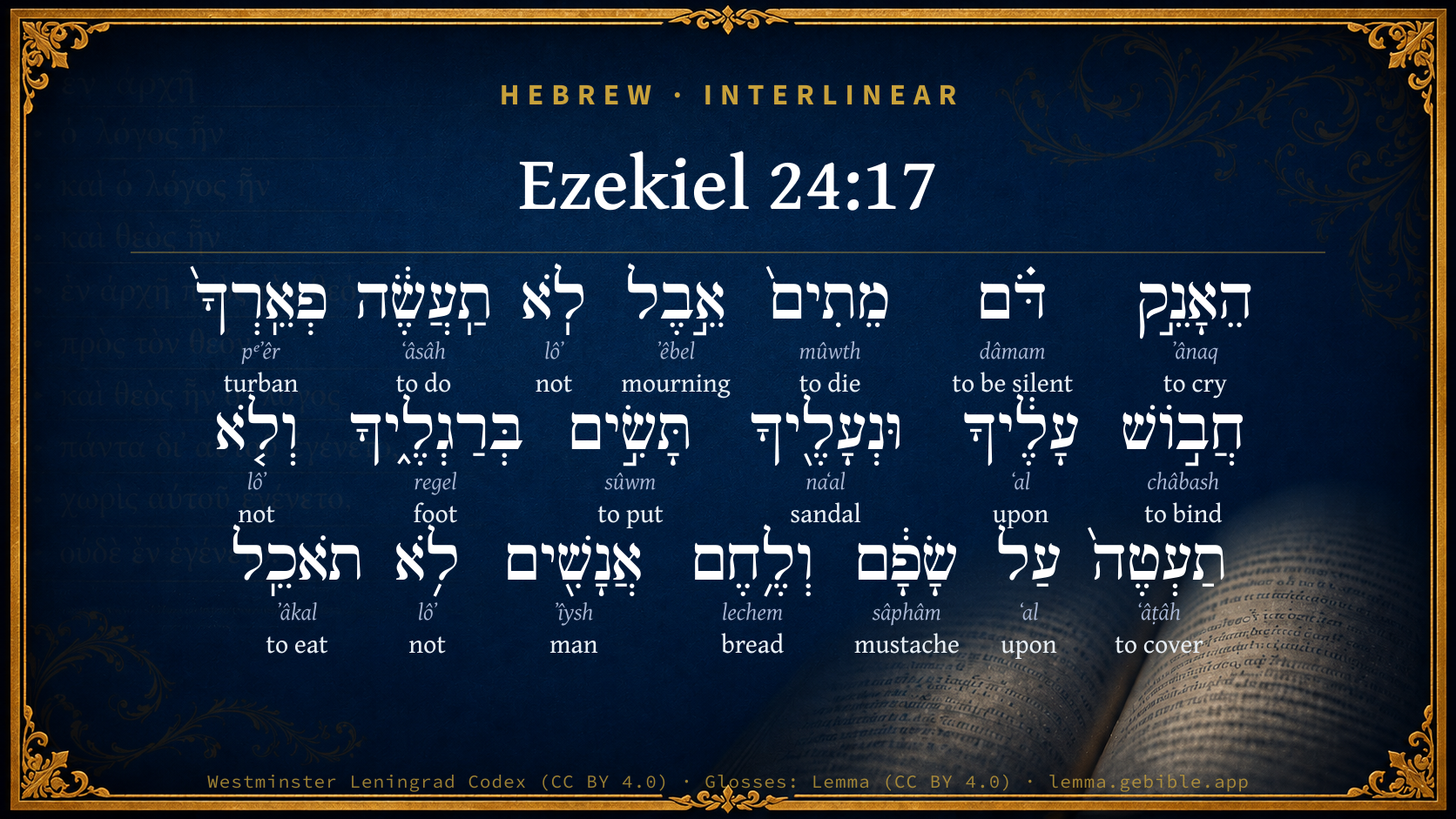
Ezekiel 24:17

Hebrew (Westminster Leningrad Codex) Ezekiel 24:17 appears in the Hebrew Old Testament. The text above is from the Westminster Leningrad Codex. Each word links to its Strong’s number, a concise gloss, and parsing drawn from the Open Scriptures Hebrew Bible morphology. Click any word for its full Brown-Driver-Briggs (BDB) entry.
Download image
Cite this verse

Ezekiel 24:17 (World English Bible). Public Domain. Lemma interlinear Bible study tool, https://lemma.gebible.app/v/ezekiel/24/17.

Show BibTeX & RIS
BibTeX
RIS
English Translation
Sigh, but not aloud, make no mourning for the dead; bind your headdress on you, and put your shoes on your feet, and don't cover your lips, and don't eat men's bread.
World English Bible · Public Domain
Download a study sheet

One document with this verse’s original text, its word-by-word gloss line, the meaning frame, cross-references with their text, attributed commentary, and full source and license credits — printable, and it pastes into notes with its structure intact.

This verse Autodidact and up

Study sheet (.html) Plain text (.txt)

A passage Seminary Student

Up to 50 verses in one chapter. A passage sheet keeps up to 6 commentary sources and 12 cross-references per verse, in the order this page ranks them, and says so on the sheet whenever that leaves anything out. Ask for a single verse and you get the Autodidact verse sheet above.

Everything on this page stays free to read, with no account — the sheet is a download of what is already on screen, not access to it.

Want to remove ads? Support Godless Engineer
Compare translations 3

The same verse in 3 English versions, stacked beneath the original-language interlinear above. Click any original word for its lexicon entry.

Each is an independent rendering of the whole verse — the interlinear is not word-aligned to these translations.

Highlighted words mark where these versions differ — a whole-verse word diff, not a word-by-word alignment.

  • World English Bible Public Domain
    Sigh, but not aloud, make no mourning for the dead; bind your headdress on you, and put your shoes on your feet, and don't cover your lips, and don't eat men's bread.
  • King James Version Public Domain
    Forbear to cry, make no mourning for the dead, bind the tire of thine head upon thee, and put on thy shoes upon thy feet, and cover not thy lips, and eat not the bread of men.
  • unfoldingWord Literal Text CC BY-SA 4.0
    You must groan silently. Do not conduct a funeral for the dead. Tie your turban on you and place your sandals on your feet, but do not veil your facial hair or eat the bread of men who mourn for having lost their wives.”

unfoldingWord Literal Text — © unfoldingWord, licensed CC BY-SA 4.0. Word-aligned USFM3 via Door43 (git.door43.org/unfoldingWord/en_ult).

Versions to compare (up to 4)

3 of 4 selected

Show all 18 translations

Every available English version of this verse, each an independent rendering of the whole verse.

  • World English Bible Public Domain
    Sigh, but not aloud, make no mourning for the dead; bind your headdress on you, and put your shoes on your feet, and don't cover your lips, and don't eat men's bread.
  • Berean Standard Bible Public Domain
    Groan quietly; do not mourn for the dead. Put on your turban and strap your sandals on your feet; do not cover your lips or eat the bread of mourners.”
  • Majority Standard Bible Public Domain
    Groan quietly; do not mourn for the dead. Put on your turban and strap your sandals on your feet; do not cover your lips or eat the bread of mourners.”
  • King James Version Public Domain
    Forbear to cry, make no mourning for the dead, bind the tire of thine head upon thee, and put on thy shoes upon thy feet, and cover not thy lips, and eat not the bread of men.
  • American Standard Version (1901) Public Domain
    Sigh, but not aloud, make no mourning for the dead; bind thy headtire upon thee, and put thy shoes upon thy feet, and cover not thy lips, and eat not the bread of men.
  • Revised Version (1885) Public Domain
    Sigh, but not aloud; make no mourning for the dead, bind thy headtire upon thee, and put thy shoes upon thy feet, and cover not thy lips, and eat not the bread of men.
  • Geneva Bible (1599) Public Domain
    Cease from sighing: make no mourning for the dead, and binde the tyre of thine head vpon thee, and put on thy shooes vpon thy feete, and couer not thy lips, and eate not the bread of men.
  • Douay-Rheims (1899) Public Domain
    Sigh in silence, make no mourning for the dead: let the tire of thy head be upon thee, and thy shoes on thy feet, and cover not thy face, nor eat the meat of mourners.
  • Young's Literal Translation Public Domain
    Cease to groan, `for' the dead thou dost make no mourning, thy bonnet bind on thee, and thy shoes thou dost put on thy feet, and thou dost not cover over the upper lip, and bread of men thou dost not eat.'
  • Literal Standard Version CC BY-SA 4.0
    Cease to groan [and] make no mourning [for] the dead, bind your headdress on yourself, and put your shoes on your feet, and you do not cover over the upper lip, and you do not eat [the] bread of men.”
  • Unlocked Literal Bible CC BY-SA 4.0
    You must groan silently. Do not conduct a funeral for the dead. Tie your turban on you and place your sandals on your feet, but do not veil your facial hair or eat the bread of men who mourn for having lost their wives.”
  • unfoldingWord Literal Text CC BY-SA 4.0
    You must groan silently. Do not conduct a funeral for the dead. Tie your turban on you and place your sandals on your feet, but do not veil your facial hair or eat the bread of men who mourn for having lost their wives.”
  • Darby Bible Public Domain
    Sigh in silence, make no mourning for the dead; bind thy turban upon thee, and put thy sandals upon thy feet, and cover not the beard, and eat not the bread of men.
  • World Messianic Bible Public Domain
    Sigh, but not aloud. Make no mourning for the dead. Bind your headdress on you, and put your sandals on your feet. Don’t cover your lips, and don’t eat mourner’s bread.”
  • Webster's Bible Public Domain
    Forbear to cry, make no mourning for the dead, bind the tire of thy head upon thee, and put on thy shoes upon thy feet, and cover not thy lips, and eat not the bread of men.
  • Free Bible Version CC BY-SA 4.0
    Mourn in silence. Don't have any rituals for the dead. Dress normally—have your turban on and put your sandals on your feet. Don't veil your face and don't eat the bread used by mourners.”
  • Bible in Basic English Public Domain
    Let there be no sound of sorrow; make no weeping for your dead, put on your head-dress and your shoes on your feet, let not your lips be covered, and do not take the food of those in grief.
  • JPS Tanakh (1917) Public Domain
    Sigh in silence; make no mourning for the dead, bind thy headtire upon thee, and put thy shoes upon thy feet, and cover not thine upper lip, and eat not the bread of men.'

Literal Standard Version (2020), Covenant Press — licensed CC BY-SA 4.0. Text via the HelloAO Bible API (eBible.org). Unlocked Literal Bible (unfoldingWord) — licensed CC BY-SA 4.0. Text via the HelloAO Bible API (eBible.org). unfoldingWord Literal Text — © unfoldingWord, licensed CC BY-SA 4.0. Word-aligned USFM3 via Door43 (git.door43.org/unfoldingWord/en_ult). Free Bible Version, Dr. Jonathan Gallagher — licensed CC BY-SA 4.0. Text via the HelloAO Bible API (eBible.org).

Word by word

More ways to search: Search by grammar → Find every occurrence → Compare this word →

Practice this passage: Drill this verse → Learn its vocabulary →

הֵאָנֵ֣ק
ʼânaq
H602
“cry”
Verb, Niphal, Imperative, 2nd Person, Masculine, Singular
Part of Speech
Verb
Stem
Niphal
Form
Imperative
Person
2nd Person
Gender
Masculine
Number
Singular
Full BDB Definition

Origin: a primitive root

TWOT: 134

to cry, groan - (Qal) to cry, lament - (Niphal) to make lamentation
  1. דֹּ֗ם dâmam H1826 “be silent” Verb, Qal, Imperative, 2nd Person, Masculine, Singular
  2. מֵתִים֙ mûwth H4191 “dying” Verb, Qal, Participle Active, Masculine, Plural, Absolute
  3. אֵ֣בֶל ʼêbel H60 “mourning” Noun, Common, Masculine, Singular, Absolute
  4. לֹֽא lôʼ H3808 “not” Particle, Negative
  5. תַֽעֲשֶׂ֔ה ʻâsâh H6213 “to do” Verb, Qal, Imperfect, 2nd Person, Masculine, Singular
  6. פְאֵֽרְךָ֙ pᵉʼêr H6287 “turban · your” Noun, Common, Masculine, Singular, Construct + Suffix, Personal, 2nd Person, Masculine, Singular
  7. חֲב֣וֹשׁ châbash H2280 “bind” Verb, Qal, Imperative, 2nd Person, Masculine, Singular
  8. עָלֶ֔יךָ ʻal H5921 “upon · you” Preposition + Suffix, Personal, 2nd Person, Masculine, Singular
  9. וּנְעָלֶ֖יךָ naʻal H5275 “and · sandals · your” Conjunction + Noun, Common, Feminine, Plural, Construct + Suffix, Personal, 2nd Person, Masculine, Singular
  10. תָּשִׂ֣ים sûwm H7760 “to put” Verb, Qal, Imperfect, 2nd Person, Masculine, Singular
  11. בְּרַגְלֶ֑יךָ regel H7272 “in/at · feet · your” Preposition + Noun, Common, Feminine, Dual, Construct + Suffix, Personal, 2nd Person, Masculine, Singular
  12. וְלֹ֤א lôʼ H3808 “and · not” Conjunction + Particle, Negative
  13. תַעְטֶה֙ ʻâṭâh H5844 “to cover” Verb, Qal, Imperfect, 2nd Person, Masculine, Singular
  14. עַל ʻal H5921 “upon” Preposition
  15. שָׂפָ֔ם sâphâm H8222 “mustache” Noun, Common, Masculine, Singular, Absolute
  16. וְלֶ֥חֶם lechem H3899 “and · bread of” Conjunction + Noun, Common, Both, Singular, Construct
  17. אֲנָשִׁ֖ים ʼîysh H376 “men” Noun, Common, Masculine, Plural, Absolute
  18. לֹ֥א lôʼ H3808 “not” Particle, Negative
  19. תֹאכֵֽל ʼâkal H398 “to eat” Verb, Qal, Imperfect, 2nd Person, Masculine, Singular

About this verse

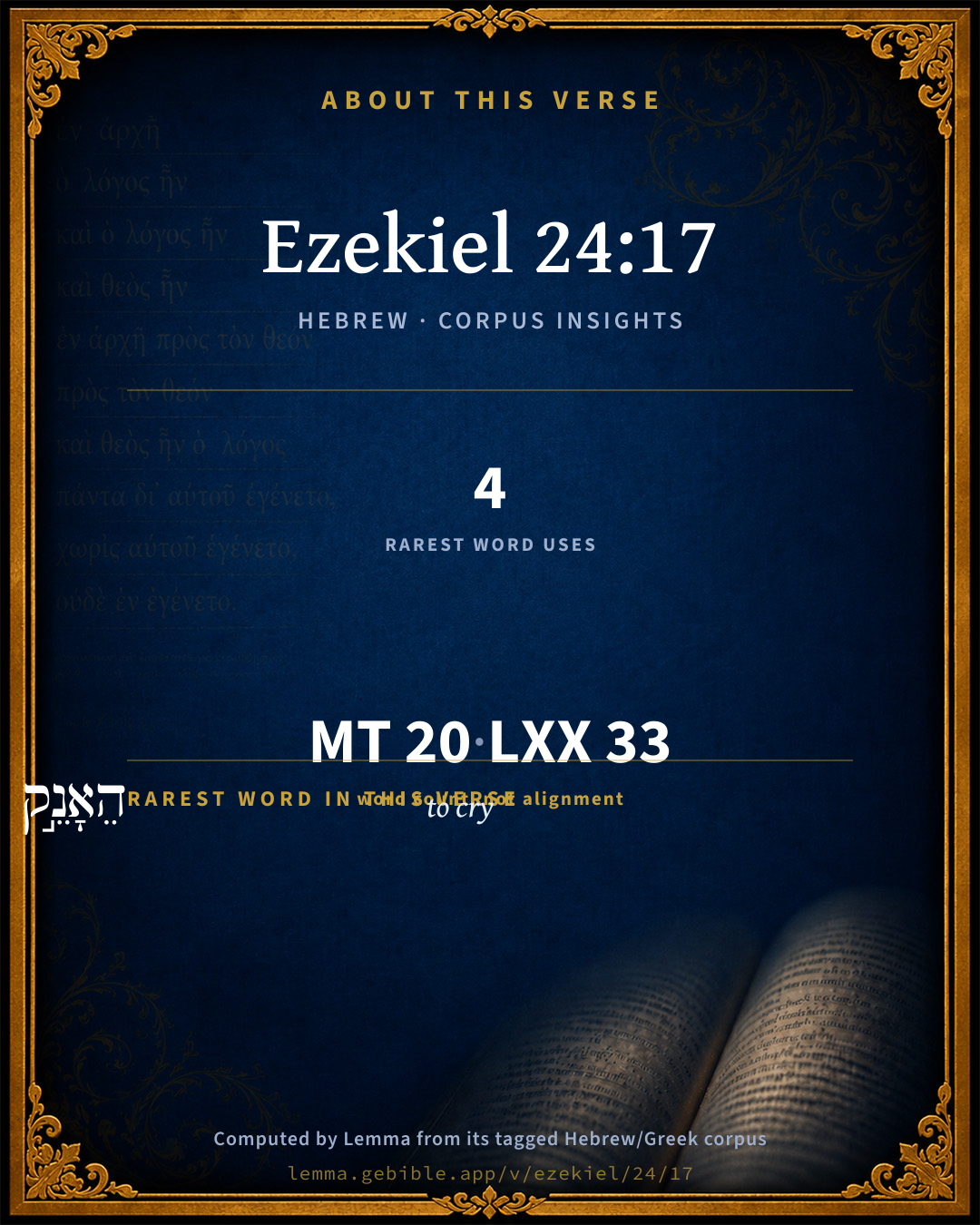
These counts appear in no published source. They are computed here, from the morphology-tagged text and Lemma’s own curated glosses. What Lemma adds →

20
words
17
distinct lemmas
Prophets
section

Notable vocabulary

The rarest word here is הֵאָנֵ֣ק to cry H602 — appearing just 4 times in the whole Hebrew Bible.

Shared distinctive vocabulary

הֵאָנֵ֣ק to cry H602 occurs in 4 verses of the Hebrew Bible. Also found in:

Grammatical profile

  • 8 verbs
  • 7 nouns
  • 2 prepositions
  • 3 particles

Verb forms

  • הֵאָנֵ֣ק Niphal · Imperative
  • דֹּ֗ם Qal · Imperative
  • מֵתִים֙ Qal · Participle Active
  • תַֽעֲשֶׂ֔ה Qal · Imperfect
  • חֲב֣וֹשׁ Qal · Imperative
  • תָּשִׂ֣ים Qal · Imperfect
  • תַעְטֶה֙ Qal · Imperfect
  • תֹאכֵֽל Qal · Imperfect

Repetition

Words recur within this verse — often emphatic in Hebrew:

  • עָלֶ֔יךָ upon H5921 ×2
  • לֹֽא not H3808 ×3

Hebrew & Septuagint length

In English translation the verse runs 32 words from the Hebrew and 46 from the Septuagint (LXX English) — the Septuagint runs noticeably longer here. See the side-by-side →

A rough comparison of the two English renderings, which tokenize alike — not a word-level alignment.

Word counts can differ between the Hebrew and the Greek without any difference in meaning — e.g. the Hebrew direct-object marker אֵת has no separate Greek word, and Greek often adds the article ὁ.

In the original languages it is 20 Hebrew tokens and 33 Greek tokens — but the two are counted differently (Hebrew bundles its prefixes and suffixes into one token; the Greek is in lemma form), so that isn’t a like-for-like length.

Cross-references

13

Topical passages linked to Ezekiel 24:17 in the Treasury of Scripture Knowledge — connected by theme and wording, ordered by reader-vote popularity; previews shown in the World English Bible.

  • Hosea 9:4 They won't pour out wine offerings to Yahweh, Neither will they be pleasing to him. Their sacrifices will be to them like the bread of mourners; All who eat of it will be polluted; For their bread will be for their appetite. It will not come into the house of Yahweh.
  • 2 Samuel 15:30 David went up by the ascent of the [Mount of] Olives, and wept as he went up; and he had his head covered, and went barefoot: and all the people who were with him covered every man his head, and they went up, weeping as they went up.
  • Leviticus 10:6 Moses said to Aaron, and to Eleazar and to Ithamar, his sons, "Don't let the hair of your heads go loose, neither tear your clothes; that you don't die, and that he not be angry with all the congregation: but let your brothers, the whole house of Israel, bewail the burning which Yahweh has kindled.
  • Leviticus 21:10 "'He who is the high priest among his brothers, upon whose head the anointing oil is poured, and that is consecrated to put on the garments, shall not let the hair of his head hang loose, nor tear his clothes;
  • Jeremiah 16:4–7 They shall die grievous deaths: they shall not be lamented, neither shall they be buried; they shall be as dung on the surface of the ground; and they shall be consumed by the sword, and by famine; and their dead bodies shall be food for the birds of the sky, and for the animals of the earth.
  • Leviticus 13:45 "The leper in whom the plague is shall wear torn clothes, and the hair of his head shall hang loose. He shall cover his upper lip, and shall cry, 'Unclean! Unclean!'
  • Psalms 37:7 Rest in Yahweh, and wait patiently for him. Don't fret because of him who prospers in his way, Because of the man who makes wicked plots happen.
  • Psalms 39:9 I was mute. I didn't open my mouth, Because you did it.
  • Psalms 46:10 "Be still, and know that I am God. I will be exalted among the nations. I will be exalted in the earth."
  • Ezekiel 24:22–23 You shall do as I have done: you shall not cover your lips, nor eat the bread of men.
  • Amos 8:3 The songs of the temple will be wailings in that day," says the Lord Yahweh. "The dead bodies will be many. In every place they will throw them out with silence.
  • Micah 3:7 The seers shall be disappointed, And the diviners confounded. Yes, they shall all cover their lips; For there is no answer from God."
  • Habakkuk 2:20 But Yahweh is in his holy temple. Let all the earth be silent before him!"

Cross-references courtesy of OpenBible.info (CC BY 4.0).

Hebrew and Greek witnesses Masoretic Hebrew ↔ Greek Septuagint

The same verse in the two great witnesses to the Old Testament, shown verse-for-verse.

Here the Septuagint runs noticeably longer than the Hebrew — LXX2012 (modern English Septuagint) 46 words vs World English Bible 32. A rough length comparison of the two English translations, not a word-level alignment — read both below.

These are two independent witnesses, not word-aligned to each other, and the Septuagint is shown in lemma (dictionary) form.

Hebrew Ezekiel 24:17 Masoretic · Westminster Leningrad Codex

הֵאָנֵ֣ק דֹּ֗ם מֵתִים֙ אֵ֣בֶל לֹֽא תַֽעֲשֶׂ֔ה פְאֵֽרְךָ֙ חֲב֣וֹשׁ עָלֶ֔יךָ וּנְעָלֶ֖יךָ תָּשִׂ֣ים בְּרַגְלֶ֑יךָ וְלֹ֤א תַעְטֶה֙ עַל שָׂפָ֔ם וְלֶ֥חֶם אֲנָשִׁ֖ים לֹ֥א תֹאכֵֽל

Sigh, but not aloud, make no mourning for the dead; bind your headdress on you, and put your shoes on your feet, and don't cover your lips, and don't eat men's bread.

World English Bible · Public Domain

Greek LXX Ezekiel 24:17 Septuagint · lemma form

στεναγμός αἷμα ὀσφύς πένθος εἰμί οὐ εἰμί ὁ τρίχωμα σύ συνπλέκω ἐπί σύ καί ὁ ὑπόδημα σύ ἐν ὁ πούς σύ οὐ μή παρακαλέω ἐν χεῖλος αὐτός καί ἄρτος ἀνήρ οὐ μή ἐσθίω

You shall groan for blood, and have mourning upon your loins; your hair shall not be braided upon you, and your sandals shall be on your feet; you shall in no wise be comforted by their lips, and you shall not eat the bread of men.

LXX2012 (modern English Septuagint) · Public Domain

On this verse, Haydock's Catholic Bible Commentary discusses the Septuagint’s reading. Read the note in Commentary ↓

Hebrew: Westminster Leningrad Codex (CC BY 4.0). Greek: Septuagint (public domain); English from LXX2012 (modern English Septuagint) (Public Domain). How the Septuagint differs from the Hebrew →

Targum (Aramaic paraphrase)

1

The Targum is the ancient Jewish Aramaic paraphrase of the Hebrew Scriptures — an interpretive translation, not the Hebrew text itself. Onkelos (literal) and Pseudo-Jonathan (expansive) render the Torah, and Jonathan the Prophets. Coverage is partial: where no permissively-licensed English translation exists for a verse, only the Aramaic is shown. This is verse-level text, not a word-by-word alignment to the Hebrew.

  1. Targum Jonathan Prophets (Joshua–Malachi)
    אִידְנַק שְׁתוֹק עַל מֵיתָךְ אֶבְלָא לָא תַעְבֵּיד טוֹטְפָתָךְ יֶהֱוְיָן עֲלָךְ וּמְסַנֵךְ תְּשַׁוֵי בְרִגְלָךְ וְלָא תִתְעַטֵיף עַל שָׂפָם וּלְחֵים אֶבְלִין לָא תֵיכוּל:

    (no public-domain English translation for this verse)

    Targum Jonathan — Aramaic: “Mikraot Gedolot” (public domain). English: “Sefaria Community Translation” (CC0 1.0 (public-domain dedication)); “London "Chaldee Paraphrase," 1871” (public domain). Text via Sefaria.

Commentary

Notes on Ezekiel 24:17 from classic Christian and Jewish commentators (each source and its license shown beneath its notes). The classic Christian expositions comment on the surrounding passage and are grouped to its opening verse, so a note may address several verses; the Jewish commentaries on the Tanakh (Rashi and others) are per-verse, so they appear only where the commentator wrote on this verse.

Lemma curates 59 commentaries, every one of them public domain or Creative Commons licensed, each selected and text-cleaned for this edition rather than reprinted as found. About our sources →

Trapp's Complete Commentary

John Trapp

Eze 24:17 Forbear to cry, make no mourning for the dead, bind the tire of thine head upon thee, and put on thy shoes upon thy feet, and cover not [thy] lips, and eat not the bread of men.

Ver. 17. Forbear to cry.] Heb., Be silent, and so suffocate thy sorrows; Ne plangas, ne plores. Not as if the dead were not to be lamented - tears are the dues of the dead, {a} Mors mea ne careat lachrymis - or that it were unbeseeming a prophet to bewail his dead comfort, but to set forth by this figure the greatness of their ensuing sorrow, bigger than any tears; for, Curae leves loquuntur ingentes stupent.

Bind the tire of thy head upon thee.] Mourners, it seems, used to go bare headed and bare footed, to cover their mustaches, to eat what their friends sent them in at such a sad time to cheer up their spirits. {Jer 16:5; Jer 16:7} The prophet must do none of all this, but keep his sorrows to himself. {b}

{a} Pατροκλον κλαιωμεν: ο γαρ γερας εστι θανοντων.

{b} Singultus devorat.

John Trapp, A Commentary or Exposition upon All the Books of the Old and New Testament (1647–1656) — public domain. Text from a community e-Sword module.

Geneva Bible (1599)

Geneva Bible translators

That is, which the neighbors sent to them that mourned.

For in mourning they went bareheaded and barefooted, and also covered their lips.

Geneva Bible (1599) marginal notes — public domain. Text via Bolls.life.

Jamieson, Fausset & Brown

Robert Jamieson, A. R. Fausset & David Brown

Forbear to cry--or, "Lament in silence"; not forbidding sorrow, but the loud expression of it [GROTIUS].

no mourning--typical of the universality of the ruin of Jerusalem, which would preclude mourning, such as is usual where calamity is but partial. "The dead" is purposely put in the plural, as referring ultimately to the dead who should perish at the taking of Jerusalem; though the singular might have been expected, as Ezekiel's wife was the immediate subject referred to: "make no mourning," such as is usual, "for the dead, and such as shall be hereafter in Jerusalem" (Jer 16:5-7).

tire of thine head--thy headdress [FAIRBAIRN]. JEROME explains, "Thou shalt retain the hair which is usually cut in mourning." The fillet, binding the hair about the temples like a chaplet, was laid aside at such times. Uncovering the head was an ordinary sign of mourning in priests; whereas others covered their heads in mourning (Sa2 15:30). The reason was, the priests had their headdress of fine twined linen given them for ornament, and as a badge of office. The high priest, as having on his head the holy anointing oil, was forbidden in any case to lay aside his headdress. But the priests might do so in the case of the death of the nearest relatives (Lev 21:2-3, Lev 21:10). They then put on inferior attire, sprinkling also on their heads dust and ashes (compare Lev 10:6-7).

shoes upon thy feet--whereas mourners went "barefoot" (Sa2 15:30).

cover not . . . lips--rather, the "upper lip," with the moustache (Lev 13:45; Mic 3:7).

bread of men--the bread usually brought to mourners by friends in token of sympathy. So the "cup of consolation" brought (Jer 16:7). "Of men" means such as is usually furnished by men. So Isa 8:1, "a man's pen"; Rev 21:17, "the measure of a man."

Jamieson, Fausset & Brown — Commentary Critical and Explanatory on the Whole Bible (1871) — public domain (CC PDM 1.0). Text via the HelloAO Bible API.

Adam Clarke's Commentary

Verse 17. Make no mourning] As a priest, he could make no public mourning, Le 21:1, c.

Bind the tire of thine head] This seems to refer to the high priest's bonnet or perhaps, one worn by the ordinary priests: it might have been a black veil to cover the head.

Put on thy shoes upon thy feet] Walking barefoot was a sign of grief.

Cover not thy lips] Mourners covered the under part of the face, from the nose to the bottom of the chin.

Eat not the bread of men.] לחם אנשים lechem anashim, "the bread of miserable men," i.e., mourners; probably, the funeral banquet.

Adam Clarke's Commentary on the Bible (1810–1826) — public domain. Text from a community e-Sword/MySword module.

Ellicott's Commentary for English Readers

(17) The tire of thine head.—This might be either the covering for the head usually worn by the people (see Eze_24:23), or the special “mitre of fine linen” (Exo_39:28) provided for the priests; but as the peculiar priestly garments were worn only when the priests were on duty within the tabernacle (Lev_6:10-11), it is not likely that Ezekiel used them in his captivity. The priests were expressly allowed to mourn for their nearest relations (Lev_21:2-3), and Ezekiel is therefore here made an exception. Among the ordinary signs of mourning was the covering of the head (2Sa_15:30; Jer_14:3), the sprinkling of dust upon it (Eze_27:30; 1Sa_4:12; 2Sa_15:32), going barefoot (1Sa_15:30; Isa_20:2), and covering the lips, or lower part of the face (Mic_3:7). All these things are now forbidden to the prophet in his sorrow.

Eat not the bread of men—i.e., the bread furnished by other men. It was customary for friends and neighbours to send food to the house of mourning, a custom which seems to be alluded to in Deu_26:14; Jer_16:7; Hos_9:4; and out of this custom the habit of funeral feasts appears to have grown in later times.

A Bible Commentary for English Readers, edited by Charles John Ellicott (1878–1897) — public domain. Text from a community e-Sword module.

The Cambridge Bible for Schools and Colleges

gen. ed. J. J. S. Perowne

17. Forbear to cry] sigh in silence; lit. sigh, be silent.

mourning for the dead] Another order was to be expected; two accus. must be assumed.

the tire of thine head] The “tire” is not necessarily the priestly tiara, but the ordinary headdress (Eze_24:23), which would probably be white. Putting off the shoes was a sign of calamity, 2Sa_15:31, and also covering the lower part of the face up to the upper lip. Mic_3:7; Lev_13:45.

the bread of men] Jer_16:7, “Neither shall men break bread for them to comfort them for the dead, neither shall men give them the cup of consolation to drink for their father or for their mother.”

The Cambridge Bible for Schools and Colleges (gen. ed. J. J. S. Perowne; Cambridge University Press, 1878–1918) — public domain. Text from a community e-Sword module.

John Gill's Exposition

So I spake unto the people in the morning,.... Did the duty of his office as a prophet; exhorted and instructed the people, particularly informed them of what had been said to him by the Lord, the evening or night before, concerning the death of his wife, and how he was to behave under such a providence; which he told them of before hand, that, when it came to pass, they might have a further proof of his being a true prophet of the Lord:

and at even my wife died; suddenly, as it was said she should; this shows who is meant by the desire of his eyes, and what by the taking it away;

and I did in the morning as I was commanded; neither moaned, nor sighed, nor wept, nor shed a tear, nor used any of the common ceremonies of mourning, but dressed and ate as at other times, as he was ordered to do; this was the next morning after his wife died. So the Syriac version,

"in the morning of the other day;''

and the Arabic version,

"in the morning of the following day.''

Thus whatever the Lord commands is to be done, though ever so contrary to the customs of men, or to natural inclinations and affections.

John Gill's Exposition of the Whole Bible (1746–1763) — public domain (CC PDM 1.0). Text via the HelloAO Bible API.

Haydock's Catholic Bible Commentary

Silence, for such manifold calamities, if thou canst screen thyself from the enemy, who will otherwise take offence, as he has brought them on. (Haydock) --- Dead. Priests were allowed to mourn only for father or mother, and their unmarried brothers and sisters, Leviticus xxi. 1. Ezechiel (xliv. 25.) adds, Son and daughter. Many think the wife must also be understood, as she is nearer than a brother. The reasons for these prohibitions did not then subsist, as no sacrifice could be offered in Chaldea; and therefore God here specifies what the prophet was not to do, (Calmet) though lawful on other occasions. (Sanctius) --- Tire. Literally, "crown," bandage, (Calmet) or parchment, on which parts of the law were written. Septuagint, "Let (Roman edition adds, not) the hair of thy head be curled (or ruffed; Greek: sumpeplegmenon) upon thee." (Haydock) --- It was usually cut in mourning. (St. Jerome) --- Feet. They were bare, at funerals, and in times of sorrow, 2 Kings xv. 30. --- Face, like David. Hebrew, "the upper lip," which mourners and lepers covered, Leviticus xiii. 45. (Calmet) --- Mourners. Feasts were prepared by the relations, (Josephus, Jewish Wars ii. 1.) and friends sent some food, but no delicacies, to those who mourned, Leviticus v. 9.

George Leo Haydock (1774–1849), Haydock's Catholic Family Bible and Commentary, 1859 edition — public domain. Excludes Psalms (Douay-Rheims chapter numbering differs from Protestant) and Deuterocanonical books (Catholic canon only).

Matthew Poole's English Annotations

Forbear to cry; restrain and curb thy sorrows, neither sigh nor lament.

Make no mourning for the dead; when thou carriest her out to burial, make no mourning for her.

Bind the tire of thine head; adorn and trim up thy head, as thou wast used to do; go not bare-headed, as Lev 10:6; 21:10, a mourner.

Put on thy shoes upon thy feet: in great mournings the Jews went bare-looted, 2Sa 15:30; Isa 47:2, but do not thou so, put on thy shoes.

Cover not thy lips: it was a custom among them to cover either the upper lip, or mustaches, as the leper did, Lev 13:45, and as Mic 3:7; and this also is forbidden the prophet.

Eat not the bread of men; either of mourners, or rather of thy neighbours and friends, who were wont to visit and feast their mourning friends, and sent in both choice and abundance of provision to their houses, Jer 16:7; and this was a custom with Scythians, Grecians, Athenians, and Romans. Eat thou thine own, as if no mourning occasion in thy family.

Matthew Poole's English Annotations on the Holy Bible (1683–1685) — public domain. Text from a community e-Sword/MySword module.

Whedon's Commentary on the Bible

Daniel D. Whedon

17. Forbear to cry — R.V., “sigh, but not aloud.” There could be no funeral dirge, as is so common in all oriental countries, nor were even the universal outward expressions of sorrow in dress permitted to him, nor the funeral feast, the “bread of men.” (See Jer_16:5; Jer_16:7.) He could only”groan and be still” (Targum). For funeral customs see note Eze_27:30-31.

Daniel D. Whedon (gen. ed.), Commentary on the Old and New Testaments (1874–1909) — public domain. Text from a community e-Sword module.

John Wesley's Explanatory Notes

Bind the tire - Adorn thy head, as thou wast used to do; go not bare-headed as a mourner. Thy shoes - ln great mournings the Jews went bare-footed. Cover not thy lips - It was a custom among them to cover the upper lip. Eat not - Of thy neighbours and friends, who were wont to visit their mourning friends, and send in choice provision to their houses.

John Wesley, Explanatory Notes Upon the Whole Bible (1754–1765) — public domain. Text via the GEBible commentary corpus.

Rashi

Rabbi Shlomo Yitzchaki (Rashi)

Melt [Heb. הֵאָנֵק,] melt in silence, soliles demoniz in Old French, to melt.

your glory Tefillin. All these commandments are for mourners, but you shall do the opposite. A mourner is forbidden to wear tefillin or shoes, he is required to wrap his head, and they serve him the first meal from food belonging to others.

Rashi on the Tanakh — English translations: “The Judaica Press complete Tanach with Rashi, translated by A. J. Rosenberg” (CC BY 4.0); “Pentateuch with Rashi's commentary by M. Rosenbaum and A.M. Silbermann, 1929-1934” (public domain); “The Metsudah Tanach series, Lakewood, N.J” (CC BY 4.0); and “The Book of Joshua, Metsudah Publications, 1997” (CC BY 4.0). Text via Sefaria.

Lesson kit

Teaching starters — assembled from the data on this page, not authored interpretation. Every prompt links to the verse data it draws on. Edit before teaching.

Ezekiel, in the Prophets, opens this verse with 20 words (17 distinct Hebrew lemmas). Its most distinctive word is ʼânaq (“to cry”). The Greek Septuagint runs longer here. A historical commentator’s framing appears above. Read the whole chapter for the surrounding context.

Discussion questions

  1. What does “to cry” (ʼânaq) contribute to the verse as a whole?
  2. How does Jeremiah 51:52, which shares the word «to cry», read alongside this verse?
  3. What does the repetition of “upon” (2× in this one verse) do in this verse?
  4. The Septuagint runs longer here than the Hebrew. What might account for the difference?
  5. The translations on this page render this verse differently — a whole-verse word diff, not a word-by-word alignment. What might account for the different wordings?
  6. «הֵאָנֵ֣ק» is a Niphal Imperative verb. How does that grammatical form shape the action described?
  7. Compare how Trapp's Complete Commentary and Geneva Bible (1599) read this verse. Where do they agree or differ?

Things to notice

Reading settings

Reading text

Shown beneath each verse's original-language words.

Old Testament
Old Testament edition

Read the OT as the Masoretic Hebrew (MT) or the Greek Septuagint (LXX).

English shown for the Greek Septuagint (in the Hebrew ↔ Greek comparison).

Comparing translations? Open the Compare panel on any verse page to stack up to four side by side.