Exodus 22:14

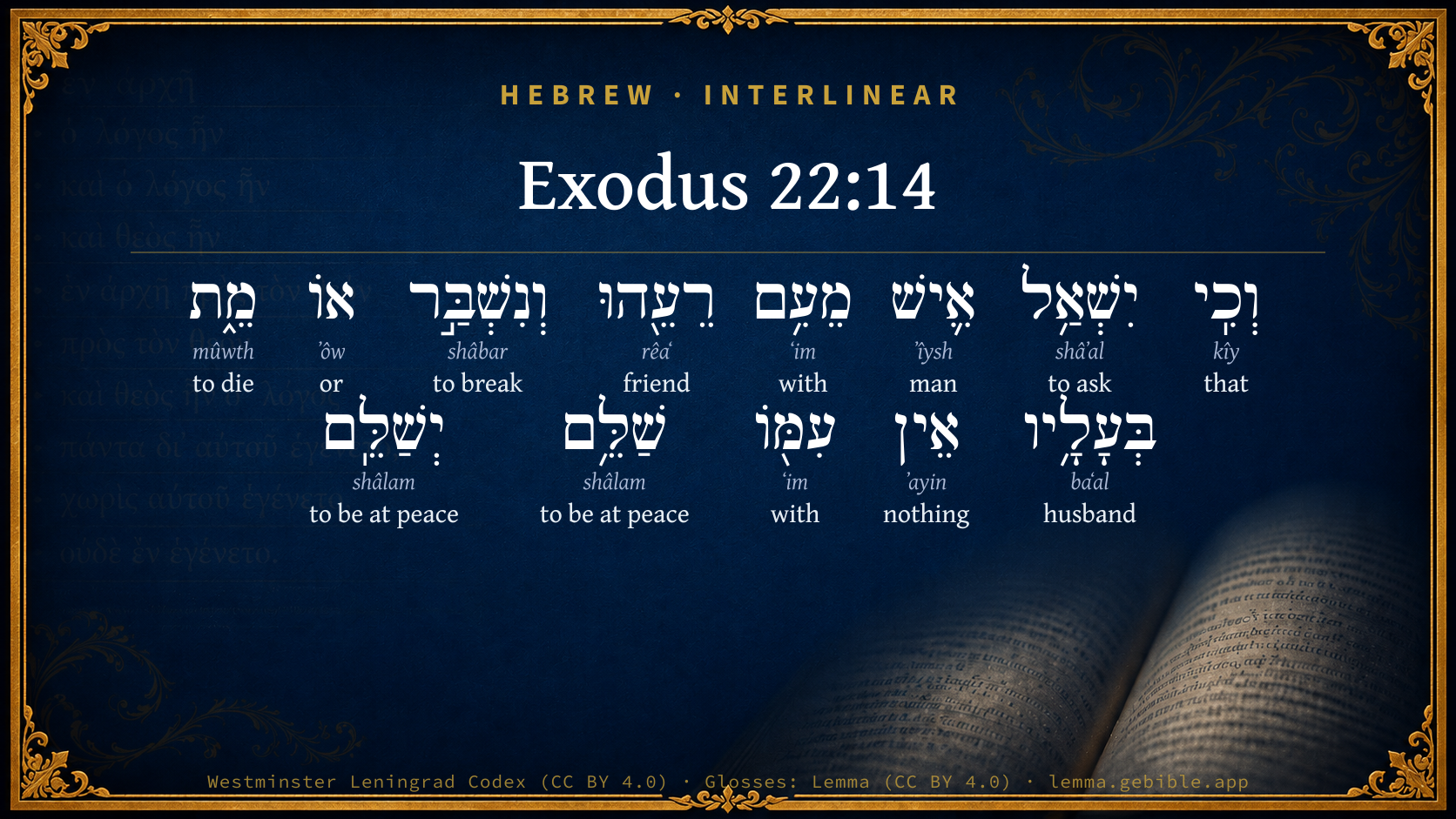
Hebrew (Westminster Leningrad Codex) Exodus 22:14 appears in the Hebrew Old Testament. The text above is from the Westminster Leningrad Codex. Each word links to its Strong’s number, a concise gloss, and parsing drawn from the Open Scriptures Hebrew Bible morphology. Click any word for its full Brown-Driver-Briggs (BDB) entry.
Download image
Cite this verse

Exodus 22:14 (World English Bible). Public Domain. Lemma interlinear Bible study tool, https://lemma.gebible.app/v/exodus/22/14.

Show BibTeX & RIS
BibTeX
RIS
English Translation
"If a man borrows anything of his neighbor's, and it is injured, or dies, the owner of it not being with it, he shall surely make restitution.
World English Bible · Public Domain
Download a study sheet

One document with this verse’s original text, its word-by-word gloss line, the meaning frame, cross-references with their text, attributed commentary, and full source and license credits — printable, and it pastes into notes with its structure intact.

This verse Autodidact and up

Study sheet (.html) Plain text (.txt)

A passage Seminary Student

Up to 50 verses in one chapter. A passage sheet keeps up to 6 commentary sources and 12 cross-references per verse, in the order this page ranks them, and says so on the sheet whenever that leaves anything out. Ask for a single verse and you get the Autodidact verse sheet above.

Everything on this page stays free to read, with no account — the sheet is a download of what is already on screen, not access to it.

Want to remove ads? Support Godless Engineer
Compare translations 3

The same verse in 3 English versions, stacked beneath the original-language interlinear above. Click any original word for its lexicon entry.

Each is an independent rendering of the whole verse — the interlinear is not word-aligned to these translations.

Highlighted words mark where these versions differ — a whole-verse word diff, not a word-by-word alignment.

  • World English Bible Public Domain
    "If a man borrows anything of his neighbor's, and it is injured, or dies, the owner of it not being with it, he shall surely make restitution.
  • King James Version Public Domain
    And if a man borrow ought of his neighbor, and it be hurt, or die, the owner thereof being not with it, he shall surely make it good.
  • unfoldingWord Literal Text CC BY-SA 4.0
    If a man borrows from his neighbor and it is injured or dies without the owner with it, he shall surely compensate.

unfoldingWord Literal Text — © unfoldingWord, licensed CC BY-SA 4.0. Word-aligned USFM3 via Door43 (git.door43.org/unfoldingWord/en_ult).

Versions to compare (up to 4)

3 of 4 selected

Show all 18 translations

Every available English version of this verse, each an independent rendering of the whole verse.

  • World English Bible Public Domain
    "If a man borrows anything of his neighbor's, and it is injured, or dies, the owner of it not being with it, he shall surely make restitution.
  • Berean Standard Bible Public Domain
    If a man borrows an animal from his neighbor and it is injured or dies while its owner is not present, he must make full restitution.
  • Majority Standard Bible Public Domain
    If a man borrows an animal from his neighbor and it is injured or dies while its owner is not present, he must make full restitution.
  • King James Version Public Domain
    And if a man borrow ought of his neighbor, and it be hurt, or die, the owner thereof being not with it, he shall surely make it good.
  • American Standard Version (1901) Public Domain
    And if a man borrow aught of his neighbor, and it be hurt, or die, the owner thereof not being with it, he shall surely make restitution.
  • Revised Version (1885) Public Domain
    And if a man borrow aught of his neighbour, and it be hurt, or die, the owner thereof not being with it, he shall surely make restitution.
  • Geneva Bible (1599) Public Domain
    And if a man borow ought of his neighbour, and it be hurt, or els die, the owner thereof not being by, he shall surely make it good.
  • Douay-Rheims (1899) Public Domain
    If a man borrow of his neighbour any of these things, and it be hurt or die, the owner not being present, he shall be obliged to make restitution.
  • Young's Literal Translation Public Domain
    `And when a man doth ask `anything' from his neighbour, and it hath been hurt or hath died -- its owner not being with it -- he doth certainly repay;
  • Literal Standard Version CC BY-SA 4.0
    And when a man asks for [anything] from his neighbor, and it has been hurt or has died—its owner not being with it—he certainly repays;
  • Unlocked Literal Bible CC BY-SA 4.0
    If a man borrows any animal from his neighbor and the animal is injured or dies without the owner being with it, the other man must surely make restitution.
  • unfoldingWord Literal Text CC BY-SA 4.0
    If a man borrows from his neighbor and it is injured or dies without the owner with it, he shall surely compensate.
  • Darby Bible Public Domain
    -- And if a man borrow anything of his neighbour, and it be hurt, or die, its owner not being with it, he shall fully make it good;
  • World Messianic Bible Public Domain
    “If a man borrows anything of his neighbor’s, and it is injured, or dies, its owner not being with it, he shall surely make restitution.
  • Webster's Bible Public Domain
    And if a man shall borrow aught of his neighbor, and it shall be hurt, or die, the owner of it being not with it, he shall surely make it good.
  • Free Bible Version CC BY-SA 4.0
    If someone borrows a neighbor's animal and it's injured or dies while its owner is not present, they must pay compensation in full.
  • Bible in Basic English Public Domain
    If a man gets from his neighbour the use of one of his beasts, and it is damaged or put to death when the owner is not with it, he will certainly have to make payment for the loss.
  • JPS Tanakh (1917) Public Domain
    (22-13) And if a man borrow aught of his neighbour, and it be hurt, or die, the owner thereof not being with it, he shall surely make restitution.

Literal Standard Version (2020), Covenant Press — licensed CC BY-SA 4.0. Text via the HelloAO Bible API (eBible.org). Unlocked Literal Bible (unfoldingWord) — licensed CC BY-SA 4.0. Text via the HelloAO Bible API (eBible.org). unfoldingWord Literal Text — © unfoldingWord, licensed CC BY-SA 4.0. Word-aligned USFM3 via Door43 (git.door43.org/unfoldingWord/en_ult). Free Bible Version, Dr. Jonathan Gallagher — licensed CC BY-SA 4.0. Text via the HelloAO Bible API (eBible.org).

Word by word

More ways to search: Search by grammar → Find every occurrence → Compare this word →

Practice this passage: Drill this verse → Learn its vocabulary →

בְּעָלָ֥יו
baʻal
H1167
“husbands · his”
Noun, Common, Masculine, Plural, Construct + Suffix, Personal, 3rd Person, Masculine, Singular
Part of Speech
Noun
Type
Common
Gender
Masculine
Number
Plural
State
Construct
Full BDB Definition

Origin: from H1166

TWOT: 262a

owner, husband, lord - owner - a husband - citizens, inhabitants - rulers, lords - (noun of relationship used to characterise - i.e., master of dreams) - lord (used of foreign gods)
  1. וְכִֽי kîy H3588 “and · that” Conjunction + Conjunction
  2. יִשְׁאַ֥ל shâʼal H7592 “to ask” Verb, Qal, Imperfect, 3rd Person, Masculine, Singular
  3. אִ֛ישׁ ʼîysh H376 “man” Noun, Common, Masculine, Singular, Absolute
  4. מֵעִ֥ם ʻim H5973 “from · with” Preposition + Preposition
  5. רֵעֵ֖הוּ rêaʻ H7453 “friend · his” Noun, Common, Masculine, Singular, Construct + Suffix, Personal, 3rd Person, Masculine, Singular
  6. וְנִשְׁבַּ֣ר shâbar H7665 “and · to break” Conjunction + Verb, Niphal, Perfect, 3rd Person, Masculine, Singular
  7. אוֹ ʼôw H176 “or” Conjunction
  8. מֵ֑ת mûwth H4191 “to die” Verb, Qal, Perfect, 3rd Person, Masculine, Singular
  9. אֵין ʼayin H369 “nothing” Particle, Negative
  10. עִמּ֖וֹ ʻim H5973 “with · him” Preposition + Suffix, Personal, 3rd Person, Masculine, Singular
  11. שַׁלֵּ֥ם shâlam H7999 “to be at peace” Verb, Piel, Infinitive Absolute
  12. יְשַׁלֵּֽם shâlam H7999 “to be at peace” Verb, Piel, Imperfect, 3rd Person, Masculine, Singular

About this verse

These counts appear in no published source. They are computed here, from the morphology-tagged text and Lemma’s own curated glosses. What Lemma adds →

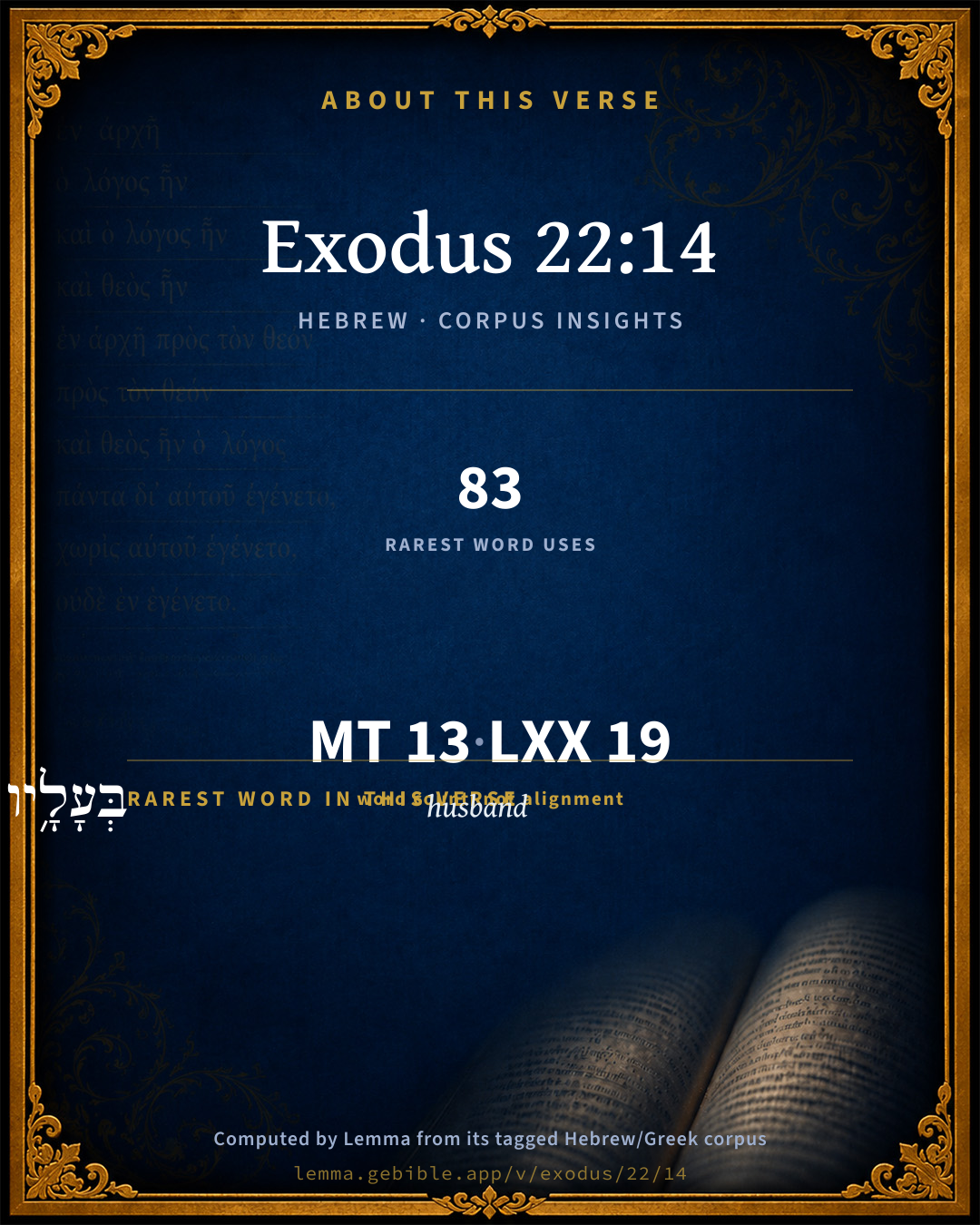
13
words
11
distinct lemmas
Pentateuch
section

Grammatical profile

  • 5 verbs
  • 3 nouns
  • 2 prepositions
  • 2 conjunctions
  • 1 particle

Verb forms

  • יִשְׁאַ֥ל Qal · Imperfect
  • וְנִשְׁבַּ֣ר Niphal · Perfect
  • מֵ֑ת Qal · Perfect
  • שַׁלֵּ֥ם Piel · Infinitive Absolute
  • יְשַׁלֵּֽם Piel · Imperfect

Repetition

Words recur within this verse — often emphatic in Hebrew:

  • שַׁלֵּ֥ם to be at peace H7999 ×2
  • מֵעִ֥ם with H5973 ×2

Hebrew & Septuagint length

In English translation the verse runs 27 words from the Hebrew and 32 from the Septuagint (LXX English) — closely comparable.

A rough comparison of the two English renderings, which tokenize alike — not a word-level alignment.

Word counts can differ between the Hebrew and the Greek without any difference in meaning — e.g. the Hebrew direct-object marker אֵת has no separate Greek word, and Greek often adds the article ὁ.

In the original languages it is 13 Hebrew tokens and 19 Greek tokens — but the two are counted differently (Hebrew bundles its prefixes and suffixes into one token; the Greek is in lemma form), so that isn’t a like-for-like length.

Cross-references

9

Topical passages linked to Exodus 22:14 in the Treasury of Scripture Knowledge — connected by theme and wording, ordered by reader-vote popularity; previews shown in the World English Bible.

  • Deuteronomy 23:19–20 You shall not lend on interest to your brother; interest of money, interest of food, interest of anything that is lent on interest:
  • Exodus 21:34 the owner of the pit shall make it good. He shall give money to its owner, and the dead animal shall be his.
  • Leviticus 24:18 He who strikes a animal mortally shall make it good, life for life.
  • Deuteronomy 15:2 This is the manner of the release: every creditor shall release that which he has lent to his neighbor; he shall not exact it of his neighbor and his brother; because Yahweh's release has been proclaimed.
  • Luke 6:35 But love your enemies, and do good, and lend, expecting nothing back; and your reward will be great, and you will be children of the Most High; for he is kind toward the unthankful and evil.
  • Exodus 22:11 the oath of Yahweh shall be between them both, whether he hasn't put his hand to his neighbor's goods; and the owner of it shall accept it, and he shall not make restitution.
  • Psalms 37:21 The wicked borrow, and don't pay back, But the righteous give generously.
  • Matthew 5:42 Give to him who asks you, and don't turn away him who desires to borrow from you.
  • Nehemiah 5:4 There were also that said, We have borrowed money for the king's tribute [on] our fields and our vineyards.

Cross-references courtesy of OpenBible.info (CC BY 4.0).

Hebrew and Greek witnesses Masoretic Hebrew ↔ Greek Septuagint

The same verse in the two great witnesses to the Old Testament, shown verse-for-verse.

These are two independent witnesses, not word-aligned to each other, and the Septuagint is shown in lemma (dictionary) form.

Hebrew Exodus 22:14 Masoretic · Westminster Leningrad Codex

וְכִֽי יִשְׁאַ֥ל אִ֛ישׁ מֵעִ֥ם רֵעֵ֖הוּ וְנִשְׁבַּ֣ר אוֹ מֵ֑ת בְּעָלָ֥יו אֵין עִמּ֖וֹ שַׁלֵּ֥ם יְשַׁלֵּֽם

"If a man borrows anything of his neighbor's, and it is injured, or dies, the owner of it not being with it, he shall surely make restitution.

World English Bible · Public Domain

Greek LXX Exodus 22:14 Septuagint · lemma form

ἐάν δέ ὁ κύριος εἰμί μετά αὐτός οὐ ἀποτίνω ἐάν δέ μισθωτός εἰμί εἰμί αὐτός ἀντί ὁ μισθός αὐτός

And if any one borrow ought of his neighbor, and it be wounded or die or be carried away, and the owner of it be not with it, he shall make compensation.

LXX2012 (modern English Septuagint) · Public Domain

Hebrew: Westminster Leningrad Codex (CC BY 4.0). Greek: Septuagint (public domain); English from LXX2012 (modern English Septuagint) (Public Domain). How the Septuagint differs from the Hebrew →

Targum (Aramaic paraphrase)

2

The Targum is the ancient Jewish Aramaic paraphrase of the Hebrew Scriptures — an interpretive translation, not the Hebrew text itself. Onkelos (literal) and Pseudo-Jonathan (expansive) render the Torah, and Jonathan the Prophets. Coverage is partial: where no permissively-licensed English translation exists for a verse, only the Aramaic is shown. This is verse-level text, not a word-by-word alignment to the Hebrew.

  1. Targum Onkelos Torah (Genesis–Deuteronomy)
    אִם מָרֵהּ עִמֵהּ לָא יְשַׁלֵם אִם אֲגִירָא הוּא עַל בְּאַגְרֵהּ:

    (no public-domain English translation for this verse)

    Targum Onkelos — Aramaic: “Onkelos Genesis” (public domain); “Onkelos Exodus” (public domain); “Onkelos Leviticus” (public domain); “Onkelos Numbers” (public domain); “Onkelos Deuteronomy” (public domain). English: “Sefaria Community Translation” (CC0 1.0 (public-domain dedication)); “J.W. Etheridge. The Targums of Onkelos and Jonathan Ben Uzziel on the Pentateuch. London: Longmans, Green, 1862” (public domain). Text via Sefaria.

  2. Targum Pseudo-Jonathan Torah (Genesis–Deuteronomy)
    אִין מָרֵיהּ עִמֵּיהּ לָא יְשַׁלֵּם אִין אֲגִירָא הוּא עָאֵל פְּסֵידֵיהּ בְּאַגְרֵיהּ

    If the owner be with it, he shall not make it good: if it had been lent for profit, its loss came on account of its hire.

    Targum Pseudo-Jonathan — Aramaic: “Targum Jonathan on Genesis” (public domain); “Targum Jonathan on Exodus” (public domain); “Targum Jonathan on Leviticus” (public domain); “Targum Jonathan on Numbers” (public domain); “Targum Jonathan on Deuteronomy” (public domain). English: “The Targum of Jonathan ben Uzziel, trans. J. W. Etheridge, London, 1862” (public domain). Text via Sefaria.

Commentary

Notes on Exodus 22:14 from classic Christian and Jewish commentators (each source and its license shown beneath its notes). The classic Christian expositions comment on the surrounding passage and are grouped to its opening verse, so a note may address several verses; the Jewish commentaries on the Tanakh (Rashi and others) are per-verse, so they appear only where the commentator wrote on this verse.

Lemma curates 59 commentaries, every one of them public domain or Creative Commons licensed, each selected and text-cleaned for this edition rather than reprinted as found. About our sources →

Trapp's Complete Commentary

John Trapp

Exo 22:14 And if a man borrow [ought] of his neighbour, and it be hurt, or die, the owner thereof [being] not with it, he shall surely make [it] good.

Ver. 14. And if a man borrow.] God hath so ordered human condition, that one man must be beholden to another.

John Trapp, A Commentary or Exposition upon All the Books of the Old and New Testament (1647–1656) — public domain. Text from a community e-Sword module.

The Biblical Illustrator

Joseph S. Exell

Exo_22:14-15

If a man borrow.

Borrowing

1. God in His law provideth against hurting our neighbours goods by borrowing.

2. Hurt and death may come to things borrowed without the sin of the borrower.

3. In case of the borrowers faultlessness in hurt, no restitution doth God award.

4. In case of wilful hurt and spoil the borrower by Gods law must make it good.

5. Things wilfully hurt which are borrowed by hire must be satisfied by Gods law.

6. Perishing of such in a lawful use of them, Gods law accounts satisfied by their hire (Exo_22:14-15). (G. Hughes, B. D.)

Concerning borrowing

Learn:

1. On the one hand--

(1) To be obliging. If you can do a needy neighbour a good turn by lending advice or material assistance, do so.

(2) Dont make your needy but obliged neighbour answerable for any accident that may occur through your own misfortune or fault.

2. On the other hand--

(1) Be careful not to abuse that which is in kindness lent you; or--

(2) Forget to return it, and thus render evil for good. Book-borrowers should note this. But--

(3) Rather both in principle (2Ki_6:5) and in action suffer the loss than inflict it. (J. W. Burn.)

The Biblical Illustrator, edited by Joseph S. Exell (c. 1880s–1900s) — public domain. Text from a community e-Sword module.

Joseph Benson's Commentary

Exo 22:14-15. If a man (suppose) lent his team to his neighbour, if the owner were with it, or were to receive profit for the loan of it, whatever harm befell the cattle the owner must stand to the loss of it; but if the owner were so kind to the borrower as to lend it him gratis, and put such a confidence in him as to trust it from under his own eye, then, if any harm happened, the borrower must make it good. We may learn hence to be very careful not to abuse any thing that is lent to us; it is not only unjust, but base and disingenuous: we should much rather choose to lose ourselves, than that any should sustain loss by their kindness to us.

Joseph Benson's Commentary on the Old and New Testaments (1811–1818) — public domain. Text from a community e-Sword module.

The Preacher's Complete Homiletical Commentary

Joseph S. Exell (gen. ed.)

CONCERNING BORROWING.—Exo_22:14-15

This is an extension of the preceding principles. Borrowing might be for the purpose of—1, obligation; or 2, trade.

I. If that which was borrowed received hurt in the absence of its owner, Exo_22:14, the owner was to be indemnified.

II. But if, as might be the case when the loan were cattle, and the owner were present, the sum for which it was hired was understood to cover the risk of accident, and the owner bore the loss.

Learn—

i. On the one hand—

(1.) to be obliging. If you can do a needy neighbour a good turn by lending advice or material assistance, do so.

(2.) Don’t make your needy but obliged neighbour answerable for any accident that may occur through your own misfortune or fault.

On the other hand—

(1.) Be careful not to abuse that which is in kindness lent you; or

(2.) (grave though minor inability of life) forget to return it, and thus render evil for good. Book-borrowers should note this. But

(3.) rather both in principle (2Ki_6:5) and in action suffer the loss than inflict it.—J. W. Burn.

SOCIAL EVILS.—Exo_22:16-19

1. Are recognised in the Word of God, and recognised as abominable before God and man. But unfortunately they are not so recognised by Christian communities and governments. Hence their prevalence and their enormities.

2. Are dealt with delicately, but firmly, by the Word of God, Old and New Testament alike. But, from mock modesty and a strange stupidity or inhumanity, are not so dealt with, but are rather encouraged by Christian communities and governments. And the result, of course, is ruin and misery now, and to the third and fourth generation.

3. Should urge every man who takes the Bible as his law, and who loves his fellow-creature, to adopt every legitimate means, at all times, and everywhere, to bring back society and government to the spirit, at any rate, of the legislation here enforced.

I. Contrast the Mosaic precept with the Christian practice with regard to the seducer.

1. Then the penalties fell on the real criminal.

(1.) He must marry his victim; or

(2.) in case the parents should interfere, pay a fine of 50 shekels of silver—the amount of her dowry.

2. Now the penalty falls upon the victim.

(1.) It is true a feeble sentiment (anything but universal) is expressed, but nowhere legally as to the obligation of marriage. But when that obligation is not recognised, the poor creature loses all, loses reputation, position, opportunity for retrieving her character, inherits the scorn of her sex, and, driven mad with woe, sinks into a suicide’s grave.

(2.) While in the second case, the villain holds his head as high as ever, often escapes all penalty, and when that penalty is incurred it is the amount he spends upon his dog. Shame on our Christian society, which adds burdens to that which by itself is too heavy to be borne. Shame on our inhuman and immoral legislation, which dares to put a premium on vice and to let the oppressors go free. (See also Deu_22:23-29).

II.

1. The Mosaic precept concerning the beast was death without mercy.

2. The Christian practice is to put a cloak over his crime or to hurry him away.

Learn—

i. The awful sanctions of personal purity and chastity (1Co_3:16-17; 1Co_6:9-20).

ii. To expend your wrath on the right offender.

iii. Do not shun the society of the offender (Luk_7:27; Joh_4:18; but Gal_6:1; Mar_2:17; cf. Joh_13:15).—J. W. Burn.

DIVINE JUSTICE AND DIVINE COMPASSION

The strictness of the Divine justice is seen in these ancient enactments; but there is also revealed the tenderness of the Divine compassion. The law is severe on evil-doers, in order that well-doers may be encouraged and strengthened. God is just to punish the unjust and the oppressor; but He is compassionate to the weak and helpless. How tenderly He cares for the widow and the orphan. Their mournful cries touch His Divine heart. Here are combined the justice of the ruler and the tenderness of the father. We must be just, but justice must be tempered by mercy, and sweetened by compassion. Let the beautiful humaneness of our religion be always manifested.

I. Irreligion must be checked. The witch is especially mentioned because women are more addicted to these evil practices than men. She is instrumental in the promotion of radical irreligion. She invokes the aid of demoniacal powers. She nurtures all that is evil in man. She is an evil worker for the purpose of getting gain, or securing power, or carrying out her desire for revenge. “Thou shalt not suffer the witch to live.” Perhaps if she repents and forsakes her evil ways, pardon may be granted. It is strange that this enactment is carried out in countries where the Bible is not read. Witchcraft is very generally abhorred. We must avoid all causes which tend to the spread of irreligion.

II. Unnatural abominations promote irreligion. The beastly is opposed to the spiritual. Religion exalts humanity, while irreligion degrades it. “Whosoever lieth with a beast shall surely be put to death.”

III. False sacrifices are the outcome of irreligion. We sometimes use the word religion in a loose sense. And in this way we speak of idolaters as religious. But religion is that which binds the heart of man to the service of his Maker. That man is not religious, in the scriptural sense, at least, who offers sacrifice unto a god made by art and man’s device. There are those who insist on a religious spirit, and say that forms are no matter. But a right spirit will embody itself in a right creed, and express itself in right forms of religious worship. It is ridiculous to affirm that it is of no consequence to what god we offer sacrifices, in what form we worship, so long as the heart is right. “He that sacrificeth unto any god, save unto the Lord only, he shall be utterly destroyed.” Spiritual destruction at least will be the result of erroneous creeds and immoral practices. Erroneous creeds are very often the forced product of spiritual death or decline. The pure in heart shall see God, shall see His truth, and be led into right ways.

IV. Inhumanity is opposed to true religion. “Thou shalt neither vex a stranger, nor oppress him; for ye were strangers in the land of Egypt.” Knobel says, “The persons meant are the Canaanitish and non-Canaanitish strangers, who stayed as individuals among the Israelites; the Canaanites as a whole are, according to this lawgiver also, to be extirpated.” No penalties are laid down now for the non-observance of this command. An appeal is simply made to the former condition of being strangers. The remembrance of our own afflictions ought to make us sympathetic with the afflicted. But in the day of our prosperity we forget the days of adversity, and have not a due consideration for those in adverse circumstances. Vex not the stranger, for thy soul was once vexed in a strange land. Oppress not the foreigner, and he will come to love thee, and to admire that religion which has taught thee compassion.

V. Gentleness towards the weak is highest manhood and noblest religion “Pure religion and undefiled before God and the Father is this, To visit the fatherless and widows in their affliction, and to keep himself unspotted from the world.” An exalted humanity abhors the conduct of him who oppresses the widow and the orphan. Their very helplessness should be their strength. If the oppressor makes them cry, their cries, though only the sighing of crushed hearts, will pierce the heavens. The oppressor will be finally crushed by means of the oppressed. It is the great law of nature and of revelation that as a man sows so shall he reap. Retribution will come sooner or later. The oppressor of widows and orphans shall be killed with the sword, and their wives shall be widows, and their children fatherless. Escape is only in seeming. The prosperity of the wicked cannot be for ever. Oppressors must be destroyed. Tyrants must feel the awful recoil of their tyranny. Let us hasten for forgiveness and for power to amend our ways to Him whose gentleness was such that He did not break the bruised reed.—W. Burrows, B.A.

ILLUSTRATIONS

BY

REV. WILLIAM ADAMSON

Divine Enactments! Exo_22:1-31.

(1) There is a world of difference between a stained glass window and a kaleidoscope. Their relative values are very different, and so is their structure. The pieces of variegated glass are flung anyhow, for the prism to arrange; whereas, those employed in the window are all arranged to give a beautiful, effective, and abiding impression. These separate enactments are not strung together haphazard. On the contrary, they are chords divinely arranged to produce harmony in the world, and give forth strains of Divine adoration in their observance.

(2) If one side of a tree grows, and the other does not, the tree acquires a crooked form. It may be fruitful, but it cannot be beautiful. God would have humanities and nationalities, theocracies and individualities, both rich in the beauties of holiness and the fruits of righteousness. The unequal growth of the Christian graces is undesirable; hence the numerous Divine precautions to make them alike fair, fragrant, and fruitful.

“Stern lawgiving! yet thou dost wear

The Godhead’s most benignant grace;

Flowers laugh before thee on their beds;

And fragrance in thy footing treads;

Thou dost preserve the stars from wrong.”

—Wordsworth.

Seduction-Solatium! Exo_22:16-17. Marriage or money are the only earthly compensations which can be made. Unhappily, Wilson’s “Tales of the Borders” abound with instances, in which this law—still in force—was utterly disregarded altogether in its compensatory aspects. So far are men from any disposition of heart towards the act of restitution, that English law has to be framed and put in force to compel them to make solatium, either by matrimonial contract or pecuniary indemnity. One of the most painful of the annals of British Law Courts is that which concerns the disclosure of man’s heartlessness in regard to the maiden whom he has seduced. Law, however, can only enforce compensation; and it remains for grace to suppress the inclination. St. Benedict relates that when he felt this desir upon him, he rushed from his cave, and flung himself into a thicket of briars and nettles, in which he rolled himself until the blood flowed. This expedient could only be a temporary relief; and the only efficient and permanent method of preventative is “Prayer for divine grace.”

“Terrestrial objects, disenchanted there,

Lose all their power to dazzle or easnare;

One only object then seems worth our care—

To win the race.”

—Elliott.

Witchcraft and Wizardry! Exo_22:18.

(1) The Church of Rome subjected persons suspected of witchcraft to the most cruel torments; but itself is the most notorious offender in this respect. Its pretended miracles from the blood of St. Januarius to the trance of La Pucelle are a concentration of superstitious wizardry. In tens of thousands of cases the victims—often innocent—were burned alive; while others were drowned by the test applied. Rome herself, the apocalyptic wizard clothed in scarlet, is to know the retributive penalty of this law: “She shall not be suffered to live.”

(2) Sad as are the evidences of superstitious wizardry in modern spiritualism of America and England, there is this sure solace, that all witchcraft is doomed sooner or later. It is Carlyle who says, that the burning of a little straw may hide the stars of the sky; but the stars are there, and will reappear. Truth is Eternal.

“Truth, crushed to earth, shall rise again—

The eternal years of God are hers;

But Error, wounded, writhes in pain,

And dies among her worshippers.”

—Bryant.

Witchcraft! Exo_22:18. The river Dart is a bright clear stream, which takes its rise amid the wild beauty of our English Alps—the Dartmoor range. Long years ago, a crowd was gathered. Here were the middle-aged and young farmers and labourers, with mingled fear of all witches, and hatred to witchcraft a part of their very creed. Here also were women with rancorous tongues; little children, with babes in their mothers’ arm, gathered as for a holiday. The squire’s daughter has been condemned to the test of witchcraft; if she sinks, she is guilty; if she rises and escapes, she is innocent. Arrayed in white garments, she is led towards the river through the crowd, whose cruel jests and coarse words are the first gauntlet her pure mind must run. The tender arms were grasped, and the graceful form hurled into the stream, swollen with the unusually heavy rains. Suddenly a cry was raised; the cruel crowd gave way; and a man rushed breathlessly to the river’s brink. It was the maiden’s lover, to whom she was shortly to be united; and having heard of the dreadful ordeal designed, he had hastened to rescue her from the “witch’s test.” Too late! Without a word, he plunged in after her. A gleam of a white robe—a sudden uphang of a man’s strong arm—were all that the superstitious onlookers ever saw more of the maiden or her lover.

“But endless is the list of human ills,

And sighs might sooner fail than cause to sigh.”

—Young.

The Preacher's Complete Homiletical Commentary (gen. ed. Joseph S. Exell; Funk & Wagnalls, c. 1892) — public domain (pre-1929). A full-Bible homiletical/sermon-outline anthology covering 65 of 66 books (2 John is absent from the source module). Text from a community e-Sword module.

Ellicott's Commentary for English Readers

(14, 15) Lending is a species of deposit; but for the benefit, not of the depositor, but of the man with whom the deposit is made. The obligation of the latter to keep intact and to return is therefore even more stringent than in the preceding case. Consequently, if the thing lent were lost or injured, however the loss was brought about, the borrower was justly called upon to make it good. The only exception was, when the lender was still in charge of what he lent, present with it, and able to keep guard over it.

A Bible Commentary for English Readers, edited by Charles John Ellicott (1878–1897) — public domain. Text from a community e-Sword module.

The Cambridge Bible for Schools and Colleges

gen. ed. J. J. S. Perowne

14. barrow (an animal)] No object is expressed in the Heb.: it must be understood from vv. 10–13. The sequel shews that an animal is intended. ‘Borrow’ is lit. ask: so Exo 2Ki_6:5. Cf. on Exo_12:36

be hurt] lit. broken, as v. 10.

14, 15. Compensation for injury to a borrowed animal. If the owner is not with it, the borrower is responsible and must make restitution; if the owner is with it, it is presumed that he might have prevented any ill-usage or injury, and the borrower is not responsible. Cf. Ḥamm. §§ 245–6 (a hired animal).

The Cambridge Bible for Schools and Colleges (gen. ed. J. J. S. Perowne; Cambridge University Press, 1878–1918) — public domain. Text from a community e-Sword module.

John Gill's Exposition

And if a man borrow ought of his neighbour,.... Any beast, as it should seem, as an ox to plough with, an ass, horse, or camel to ride on, though the Jewish writers carry it also to any kind of household stuff:

and if he be hurt or die; if any damage comes to it, or it dies while it is in the borrower's hands, and when employed in that work for which he borrowed it; the Targum of Jonathan is,"and the vessel should be broke, or the beast die:''and the owner thereof being not with it; at the time of its being hurt, or of its death, and so could not be so well satisfied whether used well or not, nor how the damage and death came to it:

he shall surely make it good; pay the full price for it it is worth; which, though it may seem hard, was necessary, in order to make men careful of things they borrowed, and that lenders may not be losers for their kindness.

John Gill's Exposition of the Whole Bible (1746–1763) — public domain (CC PDM 1.0). Text via the HelloAO Bible API.

Haydock's Catholic Bible Commentary

Restitution. It is to be presumed he was guilty of some negligence. (Calmet)

George Leo Haydock (1774–1849), Haydock's Catholic Family Bible and Commentary, 1859 edition — public domain. Excludes Psalms (Douay-Rheims chapter numbering differs from Protestant) and Deuterocanonical books (Catholic canon only).

Matthew Poole's English Annotations

Ought, i.e. any living thing, which may be

hurt or

die, as it follows.

He shall surely make it good: this may seem hard, but all things considered is reasonable; because in doubtful cases, wherein it is not evident whether the borrower was faulty or not, as it is here, it ought to be interpreted in favour of the lender, rather than of the borrower; partly, to oblige the borrower to the greater fidelity and care in such things, which being not his own, men are commonly more careless about; partly, because the benefit being wholly the borrower’s, the loss also in all reason ought to be his, and the lender ought not to suffer for his kindness, lest he should be discouraged from such actions for the future.

Matthew Poole's English Annotations on the Holy Bible (1683–1685) — public domain. Text from a community e-Sword/MySword module.

The Pulpit Commentary

Vers. 14, 15 LAW OF BORROWING. The act of borrowing is connected with that of depositing, since in both cases, the property of one man is committed to the hands of another; only, in the one case, it is at the instance and for the benefit of the man into whose hands the property passes; in the other case, it is at the instance and for the benefit of the other party. This difference causes a difference of obligation. The borrower, having borrowed solely for his own advantage, must take all the risks, and in any case return the thing borrowed, or its value, unless the owner was still, in some sort, in charge of his own property. Things hired are not, however, to be regarded as borrowed. If harm come to them, the owner must suffer the loss.

And it be hurt or die. The thing borrowed might be animate or inanimate; either might be "hurt;" the former might not only be hurt, but "die." Whatever the damage, and whatever the cause, unless in the single rare case of the owner being in charge, the law required the borrower to make good the loss to the owner. This law must have acted as a considerable check upon borrowing.

HOMILETICS.

The duty of borrowers.

The duty of borrowers is very simple. It is to take care that that which they borrow suffers as little hurt as possible while it remains in their possession, and to return it unhurt, or else make compensation to the lender. People will not often be found to question the propriety of these rules; but in action there are not very many who conform to them. It is a common thing to take but little care of what we have borrowed; to keep it an unconscionable time; to neglect returning it until the lender has asked for it repeatedly; to keep it without scruple, if he does not happen to ask for it. Curiously enough, there are particular thingse.g. , umbrellas and books, which it is supposed not to be necessary to return, and which borrowers are in the habit of withholding. Many go further, and feel under no obligation to repay even money which they have borrowed. All such conduct is, however, culpable, since it is tainted with dishonesty. Borrowers should remember

I THAT THEY FAIL IN THEIR DUTY TO THEMSELVES IF THEY DO NOT RESTORE WHAT THEY HAVE BORROWED. Self-respect should prevent them from a line of conduct which assimilates them to thieves, and is wanting in the boldness and straightforwardness that characterise ordinary thieves.

II THAT THEY FAIL EGREGIOUSLY IN THEIR DUTY TO THE LENDER, who has put them under a special obligation to him.

III THAT THEY FAIL IN THEIR DUTY TO MANKIND AT LARGE, since they do their best to deter men from ever lending, and so place difficulties in the way of borrowers. We all need to borrow at times.

IV THAT THEY FAIL IN THEIR DUTY TO GOD, who has declared in his word, that it is "the wicked" who "borroweth and payeth not again". (Psa_37:21)

The Pulpit Commentary (1880–1919), ed. H.D.M. Spence-Jones & Joseph S. Exell — public domain. Text from a community e-Sword module.

John Wesley's Explanatory Notes

If a man (suppose) lent his team to his neighbour, if the owner were with it, or were to receive profit for the loan of it, whatever harm befel the cattle the owner must stand to the loss of it: but if the owner were so kind to the borrower as to lend it him gratis, and put such a confidence in him as to trust it from under his own eye, then, if any harm happened, the borrower must make it good. Learn hence to be very careful not to abuse any thing that is lent to us; it is not only unjust but base and disingenuous, we should much rather chuse to lose ourselves, than that any should sustain loss by their kindness to us.

John Wesley, Explanatory Notes Upon the Whole Bible (1754–1765) — public domain. Text via the GEBible commentary corpus.

Keil & Delitzsch

C. F. Keil & F. Delitzsch

If any one borrowed an animal of his neighbour (to use it for some kind of work), and it got injured and died, he was to make compensation to the owner, unless the latter were present at the time; but not if he were. "For either he would see that it could not have been averted by any human care; or if it could, seeing that he, the owner himself, was present, and did not avert it, it would only be right that he should suffer the consequence of his own neglect to afford assistance" (Calovius). The words which follow, וגו שׂכיר אם, cannot have any other meaning than this, "if it was hired, it has come upon his hire," i.e., he has to bear the injury or loss for the money which he got for letting out the animal. The suggestion which Knobel makes with a "perhaps," that שׂכיר refers to a hired labourer, to whom the word is applied in other places, and that the meaning is this, "if it is a labourer for hire, he goes into his hire, - i.e., if the hirer is a daily labourer who has nothing with which to make compensation, he is to enter into the service of the person who let him the animal, for a sufficiently long time to make up for the loss," - is not only opposed to the grammar (the perfect בּא for which יבא should be used), but is also at variance with the context, "not make it good."

Keil & Delitzsch — Biblical Commentary on the Old Testament (1861–1891) — public domain (CC PDM 1.0). Text via the HelloAO Bible API. (Old Testament only.)

unfoldingWord translationNotes

Door43 World Missions Community

must surely make restitution

"must certainly repay with another animal" or "must certainly pay the owner for the animal"

if the animal was hired

This can be stated in active form. AT: "if someone rented the animal" (See: Active or Passive)

it will be paid for by its hiring fee

The one who borrowed the animal will not have to pay the owner anything more than the hiring or rental fee. This fee will pay for the loss of the animal. This can be stated clearly in the translation. AT: "the money that someone paid to rent the animal will cover the loss of the animal" (See: Assumed Knowledge and Implicit Information)

hiring fee

"rental fee" or "money paid to rent the animal"

unfoldingWord translationNotes — © Distant Shores Media and the Door43 World Missions Community, licensed CC BY-SA 4.0. Source: git.door43.org/Door43/en_tn.

Rashi

Rabbi Shlomo Yitzchaki (Rashi)

אם בעליו עמו BUT IF THE OWNER THEREOF BE WITH IT (lit., with “him”) — whether he be employed in the very kind of work for which the animal has been borrowed, or whether he be employed in any other work of the borrower — provided that he (the owner) was employed by the borrower when the loan was effected it is not necessary, in order to free him from restitution that he should be employed by the bailee at the time when the injury or death took place (Bava Metzia 95b).

אם שכיר הוא IF IT BE HIRED — i. e. if the ox has not been borrowed but hired, בא בשכרו THEN IT CAME FOR ITS HIRE into the hand of this hirer and not by way of loan. For he does not get the entire benefit of the transaction since he is using it only because he has paid hire for it and consequently the owner benefits also; therefore the law applicable to a borrower does not apply in his case — that he should be held liable for loss by accident. Scripture, however, does not state explicity what his (the hirer’s) law actually is — whether he has to be treated as the gratuitous bailee (שומר חנם) or as the bailee for payment (שומר שכר), and therefore the Sages in Israel differ in their opinion as to how the hirer (שוכר) has to make restitution. R. Meir says he is responsible only as a gratuitous bailee, whilst R. Judah says, even as a bailee for payment (Bava Metzia 80b).

Rashi on the Tanakh — English translations: “The Judaica Press complete Tanach with Rashi, translated by A. J. Rosenberg” (CC BY 4.0); “Pentateuch with Rashi's commentary by M. Rosenbaum and A.M. Silbermann, 1929-1934” (public domain); “The Metsudah Tanach series, Lakewood, N.J” (CC BY 4.0); and “The Book of Joshua, Metsudah Publications, 1997” (CC BY 4.0). Text via Sefaria.

Lesson kit

Teaching starters — assembled from the data on this page, not authored interpretation. Every prompt links to the verse data it draws on. Edit before teaching.

Exodus, in the Pentateuch, opens this verse with 13 words (11 distinct Hebrew lemmas). Its most distinctive word is baʻal (“husband”). A historical commentator’s framing appears above. Read the whole chapter for the surrounding context.

Discussion questions

  1. How does “husband” (baʻal) shape what this verse is saying?
  2. How does Deuteronomy 23:19–20, which shares this passage’s theme, read alongside this verse?
  3. What does the repetition of “to be at peace” (2× in this one verse) do in this verse?
  4. These translations render this verse differently. What is at stake in choosing one wording over another?
  5. «יִשְׁאַ֥ל» is a Qal Imperfect verb. How does that grammatical form shape the action described?
  6. Compare how Trapp's Complete Commentary and The Biblical Illustrator read this verse. Where do they agree or differ?

Things to notice

Reading settings

Reading text

Shown beneath each verse's original-language words.

Old Testament
Old Testament edition

Read the OT as the Masoretic Hebrew (MT) or the Greek Septuagint (LXX).

English shown for the Greek Septuagint (in the Hebrew ↔ Greek comparison).

Comparing translations? Open the Compare panel on any verse page to stack up to four side by side.