
Genesis 24:58

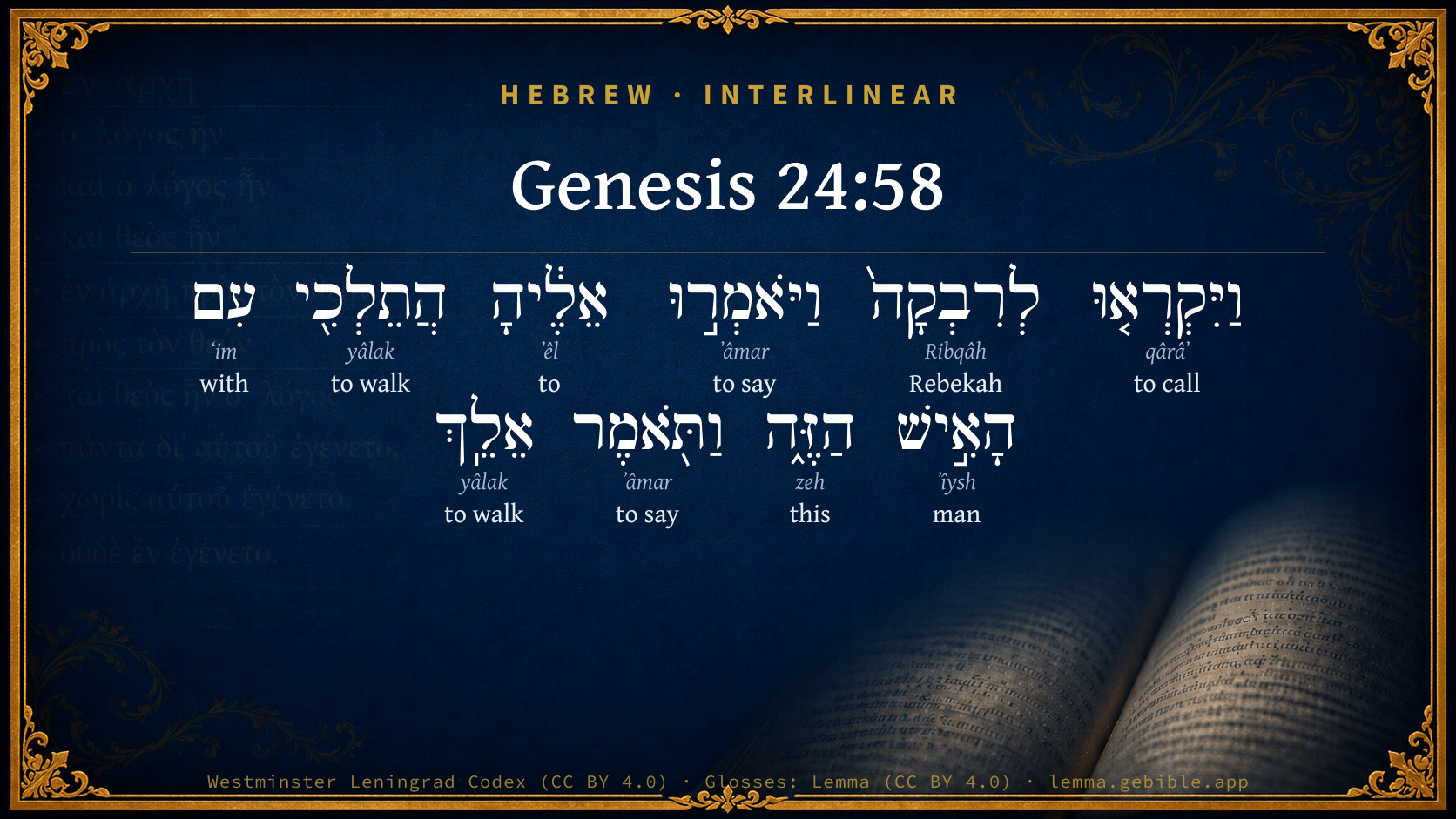
Hebrew (Westminster Leningrad Codex) Genesis 24:58 appears in the Hebrew Old Testament. The text above is from the Westminster Leningrad Codex. Each word links to its Strong’s number, a concise gloss, and parsing drawn from the Open Scriptures Hebrew Bible morphology. Click any word for its full Brown-Driver-Briggs (BDB) entry.
Download image
Cite this verse

Genesis 24:58 (World English Bible). Public Domain. Lemma interlinear Bible study tool, https://lemma.gebible.app/v/genesis/24/58.

Show BibTeX & RIS
BibTeX
RIS
English Translation
They called Rebekah, and said to her, "Will you go with this man?" She said, "I will go."
World English Bible · Public Domain
Download a study sheet

One document with this verse’s original text, its word-by-word gloss line, the meaning frame, cross-references with their text, attributed commentary, and full source and license credits — printable, and it pastes into notes with its structure intact.

This verse Autodidact and up

Study sheet (.html) Plain text (.txt)

A passage Seminary Student

Up to 50 verses in one chapter. A passage sheet keeps up to 6 commentary sources and 12 cross-references per verse, in the order this page ranks them, and says so on the sheet whenever that leaves anything out. Ask for a single verse and you get the Autodidact verse sheet above.

Everything on this page stays free to read, with no account — the sheet is a download of what is already on screen, not access to it.

Want to remove ads? Support Godless Engineer
Compare translations 3

The same verse in 3 English versions, stacked beneath the original-language interlinear above. Click any original word for its lexicon entry.

Each is an independent rendering of the whole verse — the interlinear is not word-aligned to these translations.

Highlighted words mark where these versions differ — a whole-verse word diff, not a word-by-word alignment.

  • World English Bible Public Domain
    They called Rebekah, and said to her, "Will you go with this man?" She said, "I will go."
  • King James Version Public Domain
    And they called Rebekah, and said unto her, Wilt thou go with this man? And she said, I will go.
  • unfoldingWord Literal Text CC BY-SA 4.0
    So they called for Rebekah and said to her, “Will you go with this man?” And she said, “I will go.”

unfoldingWord Literal Text — © unfoldingWord, licensed CC BY-SA 4.0. Word-aligned USFM3 via Door43 (git.door43.org/unfoldingWord/en_ult).

Versions to compare (up to 4)

3 of 4 selected

Show all 18 translations

Every available English version of this verse, each an independent rendering of the whole verse.

  • World English Bible Public Domain
    They called Rebekah, and said to her, "Will you go with this man?" She said, "I will go."
  • Berean Standard Bible Public Domain
    They called Rebekah and asked her, “Will you go with this man?” “I will go,” she replied.
  • Majority Standard Bible Public Domain
    They called Rebekah and asked her, “Will you go with this man?” “I will go,” she replied.
  • King James Version Public Domain
    And they called Rebekah, and said unto her, Wilt thou go with this man? And she said, I will go.
  • American Standard Version (1901) Public Domain
    And they called Rebekah, and said unto her, Wilt thou go with this man? And she said, I will go.
  • Revised Version (1885) Public Domain
    And they called Rebekah, and said unto her, Wilt thou go with this man? And she said, I will go.
  • Geneva Bible (1599) Public Domain
    And they called Rebekah, and saide vnto her, Wilt thou go with this man? And she answered, I will go.
  • Douay-Rheims (1899) Public Domain
    And they called her, and when she was come, they asked: Wilt thou go with this man? She said: I will go.
  • Young's Literal Translation Public Domain
    and they call for Rebekah, and say unto her, `Dost thou go with this man?' and she saith, `I go.'
  • Literal Standard Version CC BY-SA 4.0
    and they call for Rebekah, and say to her, “Do you go with this man?” And she says, “I go.”
  • Unlocked Literal Bible CC BY-SA 4.0
    So they called Rebekah and asked her, “Will you go with this man?” She replied, “I will go.”
  • unfoldingWord Literal Text CC BY-SA 4.0
    So they called for Rebekah and said to her, “Will you go with this man?” And she said, “I will go.”
  • Darby Bible Public Domain
    And they called Rebecca and said to her, Wilt thou go with this man? And she said, I will go.
  • World Messianic Bible Public Domain
    They called Rebekah, and said to her, “Will you go with this man?” She said, “I will go.”
  • Webster's Bible Public Domain
    And they called Rebekah, and said to her, Wilt thou go with this man? And she said, I will go.
  • Free Bible Version CC BY-SA 4.0
    They called Rebekah in and asked her, “Do you want to go with this man now?” “Yes, I'll go,” she replied.
  • Bible in Basic English Public Domain
    And they sent for Rebekah and said to her, Are you ready to go with this man? And she said, I am ready.
  • JPS Tanakh (1917) Public Domain
    And they called Rebekah, and said unto her: 'Wilt thou go with this man?' And she said: 'I will go.'

Literal Standard Version (2020), Covenant Press — licensed CC BY-SA 4.0. Text via the HelloAO Bible API (eBible.org). Unlocked Literal Bible (unfoldingWord) — licensed CC BY-SA 4.0. Text via the HelloAO Bible API (eBible.org). unfoldingWord Literal Text — © unfoldingWord, licensed CC BY-SA 4.0. Word-aligned USFM3 via Door43 (git.door43.org/unfoldingWord/en_ult). Free Bible Version, Dr. Jonathan Gallagher — licensed CC BY-SA 4.0. Text via the HelloAO Bible API (eBible.org).

Word by word

More ways to search: Search by grammar → Find every occurrence → Compare this word →

Practice this passage: Drill this verse → Learn its vocabulary →

לְרִבְקָה֙
Ribqâh
H7259
“to/for · Rebekah”
Preposition + Noun, Proper
Part of Speech
Preposition + Noun
Type
Proper
Full BDB Definition

Origin: from an unused root probably meaning to clog by tying up the fetlock

TWOT: None

Rebekah = "ensnarer" - daughter of Bethuel, sister of Laban, wife of Isaac, and mother of Esau and Jacob
  1. וַיִּקְרְא֤וּ qârâʼ H7121 “and · to call” Conjunction + Verb, Qal, Sequential Imperfect, 3rd Person, Masculine, Plural
  2. וַיֹּאמְר֣וּ ʼâmar H559 “and · to say” Conjunction + Verb, Qal, Sequential Imperfect, 3rd Person, Masculine, Plural
  3. אֵלֶ֔יהָ ʼêl H413 “to · her” Preposition + Suffix, Personal, 3rd Person, Feminine, Singular
  4. הֲתֵלְכִ֖י yâlak H3212 “to walk” Particle, Interrogative + Verb, Qal, Imperfect, 2nd Person, Feminine, Singular
  5. עִם ʻim H5973 “with” Preposition
  6. הָאִ֣ישׁ ʼîysh H376 “the · man” Particle, Definite Article + Noun, Common, Masculine, Singular, Absolute
  7. הַזֶּ֑ה zeh H2088 “the · this” Particle, Definite Article + Pronoun, Demonstrative, Masculine, Singular
  8. וַתֹּ֖אמֶר ʼâmar H559 “and · to say” Conjunction + Verb, Qal, Sequential Imperfect, 3rd Person, Feminine, Singular
  9. אֵלֵֽךְ yâlak H3212 “to walk” Verb, Qal, Imperfect, 1st Person, Common, Singular

About this verse

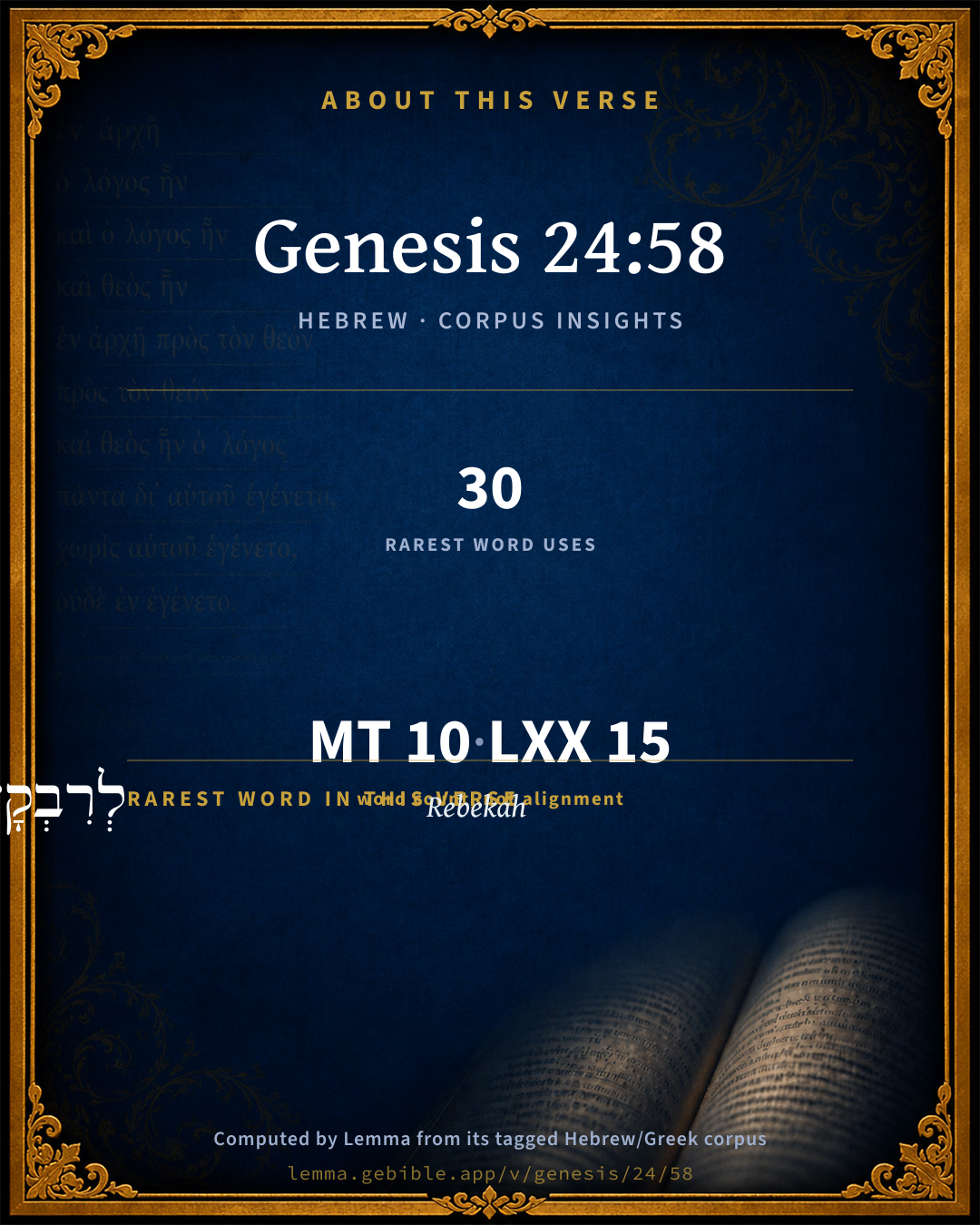
These counts appear in no published source. They are computed here, from the morphology-tagged text and Lemma’s own curated glosses. What Lemma adds →

10
words
8
distinct lemmas
Pentateuch
section

Shared distinctive vocabulary

לְרִבְקָה֙ Rebekah H7259 occurs in 29 verses of the Hebrew Bible. Also found in:

Grammatical profile

  • 5 verbs
  • 2 nouns
  • 1 pronoun
  • 2 prepositions

Verb forms

  • וַיִּקְרְא֤וּ Qal · Sequential Imperfect
  • וַיֹּאמְר֣וּ Qal · Sequential Imperfect
  • הֲתֵלְכִ֖י Qal · Imperfect
  • וַתֹּ֖אמֶר Qal · Sequential Imperfect
  • אֵלֵֽךְ Qal · Imperfect

Repetition

Words recur within this verse — often emphatic in Hebrew:

  • וַיֹּאמְר֣וּ to say H559 ×2
  • הֲתֵלְכִ֖י to walk H3212 ×2

Hebrew & Septuagint length

In English translation the verse runs 18 words from the Hebrew and 20 from the Septuagint (LXX English) — closely comparable.

A rough comparison of the two English renderings, which tokenize alike — not a word-level alignment.

Word counts can differ between the Hebrew and the Greek without any difference in meaning — e.g. the Hebrew direct-object marker אֵת has no separate Greek word, and Greek often adds the article ὁ.

In the original languages it is 10 Hebrew tokens and 15 Greek tokens — but the two are counted differently (Hebrew bundles its prefixes and suffixes into one token; the Greek is in lemma form), so that isn’t a like-for-like length.

Cross-references

2

Topical passages linked to Genesis 24:58 in the Treasury of Scripture Knowledge — connected by theme and wording, ordered by reader-vote popularity; previews shown in the World English Bible.

  • Luke 1:38 Mary said, "Behold, the handmaid of the Lord; be it to me according to your word." The angel departed from her.
  • Psalms 45:10–11 Listen, daughter, consider, and turn your ear. Forget your own people, and also your father's house.

Cross-references courtesy of OpenBible.info (CC BY 4.0).

Hebrew and Greek witnesses Masoretic Hebrew ↔ Greek Septuagint

The same verse in the two great witnesses to the Old Testament, shown verse-for-verse.

These are two independent witnesses, not word-aligned to each other, and the Septuagint is shown in lemma (dictionary) form.

Hebrew Genesis 24:58 Masoretic · Westminster Leningrad Codex

וַיִּקְרְא֤וּ לְרִבְקָה֙ וַיֹּאמְר֣וּ אֵלֶ֔יהָ הֲתֵלְכִ֖י עִם הָאִ֣ישׁ הַזֶּ֑ה וַתֹּ֖אמֶר אֵלֵֽךְ

They called Rebekah, and said to her, "Will you go with this man?" She said, "I will go."

World English Bible · Public Domain

Greek LXX Genesis 24:58 Septuagint · lemma form

καί καλέω ρεβεκκα καί εἶπον αὐτός πορεύομαι μετά ὁ ἄνθρωπος οὗτος ὁ δέ εἶπον πορεύομαι

And they called Rebecca, and said to her, Will you go with this man? and she said, I will go.

LXX2012 (modern English Septuagint) · Public Domain

Hebrew: Westminster Leningrad Codex (CC BY 4.0). Greek: Septuagint (public domain); English from LXX2012 (modern English Septuagint) (Public Domain). How the Septuagint differs from the Hebrew →

Targum (Aramaic paraphrase)

2

The Targum is the ancient Jewish Aramaic paraphrase of the Hebrew Scriptures — an interpretive translation, not the Hebrew text itself. Onkelos (literal) and Pseudo-Jonathan (expansive) render the Torah, and Jonathan the Prophets. Coverage is partial: where no permissively-licensed English translation exists for a verse, only the Aramaic is shown. This is verse-level text, not a word-by-word alignment to the Hebrew.

  1. Targum Onkelos Torah (Genesis–Deuteronomy)
    וּקְרוֹ לְרִבְקָה וַאֲמַרוּ לַהּ הֲתֵיזְלִי עִם גַּבְרָא הָדֵין וַאֲמֶרֶת אֵיזִיל

    (no public-domain English translation for this verse)

    Targum Onkelos — Aramaic: “Onkelos Genesis” (public domain); “Onkelos Exodus” (public domain); “Onkelos Leviticus” (public domain); “Onkelos Numbers” (public domain); “Onkelos Deuteronomy” (public domain). English: “Sefaria Community Translation” (CC0 1.0 (public-domain dedication)); “J.W. Etheridge. The Targums of Onkelos and Jonathan Ben Uzziel on the Pentateuch. London: Longmans, Green, 1862” (public domain). Text via Sefaria.

  2. Targum Pseudo-Jonathan Torah (Genesis–Deuteronomy)
    וּקְרוֹ לְרִבְקָה וַאֲמָרוּ לָהּ הֲתֵיזְלִי עִם גַבְרָא הָדֵין וַאֲמָרַת אִיזֵיל

    And they called Rivekah, and said to her, Wilt thou go with this man? And she said, I will go.

    Targum Pseudo-Jonathan — Aramaic: “Targum Jonathan on Genesis” (public domain); “Targum Jonathan on Exodus” (public domain); “Targum Jonathan on Leviticus” (public domain); “Targum Jonathan on Numbers” (public domain); “Targum Jonathan on Deuteronomy” (public domain). English: “The Targum of Jonathan ben Uzziel, trans. J. W. Etheridge, London, 1862” (public domain). Text via Sefaria.

Commentary

Notes on Genesis 24:58 from classic Christian and Jewish commentators (each source and its license shown beneath its notes). The classic Christian expositions comment on the surrounding passage and are grouped to its opening verse, so a note may address several verses; the Jewish commentaries on the Tanakh (Rashi and others) are per-verse, so they appear only where the commentator wrote on this verse.

Lemma curates 59 commentaries, every one of them public domain or Creative Commons licensed, each selected and text-cleaned for this edition rather than reprinted as found. About our sources →

Trapp's Complete Commentary

John Trapp

Gen 24:58 And they called Rebekah, and said unto her, Wilt thou go with this man? And she said, I will go.

Ver. 58. I will go.] Christ’s Hephzibah is no less willing to go with him: he toucheth her heart, and maketh her so. {Isa 56:6} He commanded his lovingkindness; {Psa 42:8} q.d., Go, Mercy, and seize on them; go, Lovingkindness, and make them take you. Hence it is, that they are a freehearted people; {Psa 110:3} they wait for his law; {Isa 42:4} they love to be his people. {Isa 56:6} The Macedonians were Aυθαιρεστοι volunteers; {2Co 8:3} they had their own free choice.

John Trapp, A Commentary or Exposition upon All the Books of the Old and New Testament (1647–1656) — public domain. Text from a community e-Sword module.

The Biblical Illustrator

Joseph S. Exell

Gen_24:58

They called Rebekah and said unto her, Wilt thou go with this man?

And she said, I will go

The success of the marriage treaty

I. DUE TO THE MANIFEST INTERPOSITION OF PROVIDENCE (Gen_24:50).

II. ACKNOWLEDGED BY SUITABLE ACTS OF DEVOTION.

1. By acts of worship (Gen_24:52).

2. By faith and ready obedience (Gen_24:55; Gen_24:58).

3. By human benedictions (Gen_24:60).

III. FOLLOWED BY A GRATEFUL SENSE OF RELIEF (Gen_24:54). It is the mark of a pious mind when we esteem the commandments of God more than our necessary food. (T. H. Leale.)

The souls answer to the Divine summons

I. A LESSON TO THOSE WHO CARRY THE SUMMONS OF GOD.

1. Let us saturate our work with prayer.

2. We must also wait upon God for direction.

3. Let us say much in praise of our Master.

II. THE SUMMONS ITSELF. Such a call as came to Rebekah is sent to every soul that hears the Gospel. In yonder azure depths lives the great Father God. He has one Son, His only-begotten and well-beloved. He has resolved to choose from amongst men those who as one Church shall constitute His bride for ever. He sends this call to you, not because you are worthy, or wealthy, or beautiful; but because He has so willed in the counsels of His own heart; and He longs that you shall be willing to detach yourself from all that you hold dear.

III. How To DEAL WITH THIS SUMMONS.

1. We must find room for it.

2. We must bear witness.

3. We must not procrastinate, or confer with flesh and blood. (F. B.Meyer, B. A.)

Rebekah

I. HER HOME LIFE.

1. She was fair, chaste, and modest.

2. She was industrious, courteous, and kind.

3. She was deferential and obedient.

II. HER MARRIAGE.

1. Arranged for by proxy, according to Oriental custom.

2. This match was made in heaven. It was pre-ordained--love at first sight: love all through her life.

III. HER MISTAKES.

1. She consents to pass for Isaacs sister at the court of Gerar.

2. She is partial to Jacob.

3. She teaches Jacob how to deceive.

4. By the use of deception she secures the blessing for her favourite son.

IV. HER SORROW.

1. A divided household--the result of favouritism.

2. Esaus marriage with two Canaanitish women.

3. The separation from Jacob: for she never saw him again after his flight to Mesopotamia.

V. REFLECTIONS.

1. The choice of a wife is an appropriate subject of prayer, and worthy of grave deliberation.

2. Is it right for parents to be partial to their children? (Lewis O. Thompson.)

Lessons

1. Gods favour being manifested in His providences, natural and comfortable refreshings may be used.

2. After refreshings needful, return to duty and just employments is beseeming Gods servants.

3. Sedulity and speed concern faithful servants in their trust committed by their masters to them (Gen_24:54).

4. Natural affection will not easily part with near and dear relations (Gen_24:55)

5. Gods call, if apparent, is reason sufficient to take of the delays of natural desire.

6. Nothing but haste with good speed will content faithful servants entrusted (Gen_24:56).

7. Answers from creatures may help to know Gods mind, and so far we are to be consulted (Gen_24:5, Call the damsel and know, &c.).

8. Childrens consent as well as parents must be had in marriage.

9. God sometimes giveth in answers of His will by moving the hearts of creatures (verse58).

10. Fear of God in any measure will yield to Gods will when so revealed.

11. Nearest relations must part to give way to the union of marriage.

12. Such dismission of relations should be suitable to the conditions of men (Gen_24:59).

13. The fear of God will not send away relations from a family without a blessing.

14. Fruitfulness of the womb is a great blessing from God on His people.

15. Tower and prevalency of the Churchs seed over all enemies is a sweet blessing.

16. All this, even to the vanquishing of the gates of hell, is desirable by Gods people (Gen_24:60).

17. Marriage should not be yielded without a blessing, especially in the Church. And they blessed her and sent her away. (G. Hughes, B. D.)

A love story

I. AN EXCELLENT SERVANT. In the early days of the Jews, when a servant loved his master, he sometimes said to him, I will not leave thee: I will serve thee all my days. The master then placed the man-servant against his door-post, and bored his ear through with an awl, as a token that he should serve him for ever. We are not told whether or not Abrahams servant had passed through this ceremony, but it is certain that he was one of the most faithful of servants. Now, beloved brethren, you have not to undergo any outward ceremony in order to become a servant of God. There are some who believe that partaking of the Lords Supper, and being baptized, are processes by which we become the Lords people. On the contrary, when we become His servants, we then, because we are servants, do the Lords will in these two matters. Then, if you would become a servant of God, the first process must be an inward desire. My child, give Me thine heart, saith the Lord. The Christian is a servant of the Lord, and, as such, gives up himself, body, spirit, and soul, to do the will of his Heavenly Father. He is a consecrated vessel filled with the Spirit of the Almighty.

1. This servant of Abraham was a trusted one. All that his master had was placed in his keeping. Beloved servants of the Lord, what a blessing I what a privilege! what an enjoyment I to possess the fulness of God! Seek it; pray for it; believe it; and God shall pour His fulness into your being. Then, surely your lives, like the angels of heaven, shall be shrines for the indwelling of love. The providence of God sent across my path some years ago a thief who had been in prison above twenty times, and who had been twice in penal servitude. I could find no work for him here, because he was well known, and therefore I sent him across the ocean to America, but his character followed him, and he was returned to England. At length we obtained work for him out of Manchester; and he turned out to be a faithful servant. One day the manager of the works was removing his goods to a new house, and the mistress--who did not know what the man had been--called him, saying, John, this basket contains all our silver; will you please be very careful about it, and carry it to the new house. I said to the man, And what did you do? He replied When I got outside, I looked into the basket and saw the silver shining. I lifted it up, and it felt very heavy. Well, what did you do then? He said, I cried, because I was trusted. Of course, he carried it safely. Brethren, God knows the past sin of our lives, yet He takes us into His service and trusts us with human souls, bidding us to take them to the mansion in heaven.

2. The servant of Abraham was under a special vow. And are not all who are servants of God under a vow to render faithful service? A mother whose son was about to leave her to fight the battles between the Northern and Southern States of America, was called into her bedroom on the morning of his departure. She, weeping upon his neck and kissing him, bade him farewell; and drawing from her finger a ring which she prized exceedingly, she kissed it and placed it upon his finger, saying, Promise me, my son, that you will not touch any intoxicating liquors whilst you are away. And he, looking at the ring, on which was the motto, Never forget, kissed his mother and made the vow. When he joined the army, he manfully resisted the temptations of his comrades; but at length enticed beyond his strength, he went with them to the canteen. Lifting the foaming liquor to his mouth, he saw his mothers ring, and his conscience smote him. He dropped the glass upon the table, and rushing out, he prayed to God to forgive him and to help him to keep his promise. On the evening of that day, when the battle was over, he was found wounded and dying with his mothers ring pressed to his lips. Brethren, you also have made a vow not only to your parent, but to your God. And if the promise made to our earthly parents has such a power for good over us, how much more the promise we have made to our Heavenly Father! Brethren, will you not keep the vow? Will you not re-resolve it?

3. Abrahams servant was a believer. O Lord God of my master Abraham. How sweet it is when the employer can lead the employed to God!

4. Abrahams servant believed in the Lords presence. Beloved, our Saviour is not dead. He is here. All who are the Lords servants have the inward testimony that Jesus Christ is a Saviour nigh at hand.

5. He believed in the Lords guidance. If we acknowledge God in all our ways, He has promised to direct our paths. In Abrahams servants, we have an example of a man who trusted God. Brethren, trust Him also. Wherever you go your Father is with you; your path may be dark; but your Father holds your hand. The chart of every days journey is before your God, and when you stand in the sunshine of heaven you shall then see that His hand did really direct your course. Go on!

6. This servant judged his errand to be more important than himself. He would not partake of food until he had told the mission on which he was sent. Brethren, we should not consider ourselves more important than the work which Christ has given us to do. Let us pray for grace to be enabled with Paul to say, For me to live is--not myself--but Christ. Our purpose is to be conformed to the image of Gods dear Son, and to live in the spirit of His loving life.

7. His heart was in it. In crossing over the Atlantic Ocean once, on the second day of the voyage, an unfortunate fellow was pulled up from the hold--a stowaway. Desiring to go to America, and being too poor to pay his passage, he hid himself on board the ship. But the captain said, You must work out your passage now that you are here. He was set to wash the decks, and do other rough work on the ship, but I noticed the man had no heart in it; he did it because he was compelled. How different with the true sailors! When they ran up the rigging they sang out with delight, and did their work with all their heart. It did one good to hear the hearty song of the man up near the top of the mast, but the hang-dog look of the stowaway caused gloom in the midst of sunshine. NOW, brethren, do your work for Christ with all your heart; put your soul into it; do it with enthusiasm. It is the earnest men only who succeed in temporal things; and it is only Gods earnest ones who bring in a plentiful harvest to the heavenly barn. Servants of God, awake! awake! When you speak to people about their souls, let them see that you mean it.

II. AN IMPORTANT QUESTION. Rebekah was asked, Will you go with this man? And now I ask you, will you come with us to heaven? God gives every one of us at some period of our lives an opportunity of becoming His servants. It is said that time and tide come to every man once in his life. I feel persuaded that salvations tide has come to your very heart, and that every one of you may enter Christs lifeboat and sail with us to paradise. This is your opportunity. Do not reject it.

III. THE LOVING ANSWER. Will you not say, as did Rebekah to Abrahams servant, I will go. Have you ever thought when you have read this chapter of the meeting? Isaac was walking in the field at eventide, and whilst he meditated, he lifted up his eyes and beheld the camels on their return, and noticed that all of them carried burdens. His heart filled with joy, and he said, She is come. Will you come? Behold the Lamb of God who taketh away the sins of the world I Trust Him. (W. Birch.)

Isaacs marriage

I. THE DOMESTIC COUNCIL.

1. The family of Bethuel. Evening. Work of the day nearly over. The daughter gone to the well. Her long delay. Growing wonder. Rebekahs return. Shows the presents, and relates the story to her mother. Laban, hearing the tale and seeing the jewels, goes out to the well (Gen_24:29) and invites Eliezer to come into the house (Gen_24:31).

2. Eastern hospitality. Provision for man and beast.

3. The council.

(1) Eliezer states his mission (Gen_24:33-41).

(2) States how he wished for a sign, and had it fulfilled in Rebekah (Gen_24:43-47).

(3) Intimates that God is in this matter (Gen_24:42-48).

(4) Bethuel and Laban reply. They see the hand of God (Gen_24:50), and give their consent (Gen_24:51).

(5) Eliezer again acknowledges the good hand of the Lord (verse

52), and produces more presents.

4. This council conducted with frankness and piety on the one hand, and a due respect for the will of God on the other.

II. THE EARLY DEPARTURE.

1. Eliezer having performed his mission, is anxious to return. Thinks of his master, aged and anxious. Life uncertain.

2. Laban and her mother plead for delay. Suggestive of the lovable character of Rebekah, and her value in the household. Perhaps never more prized than now that she must go. Reminds us of the tenacity with which we cling to dear objects in the moment of separation.

3. Rebekah decides for a prompt departure. Having been a faithful daughter, she would now do her duty in her new relation. Her husband should not hear that she had been an unwilling bride.

4. She bids adieu to home scenes, in company with her nurse; and dowried with the blessing of her family.

III. THE HAPPY MEETING.

1. The home of Abraham. The patriarch following his servants with his prayers. Reliant on God.

2. Isaac waits the issue of this negotiation for his marriage.

3. Goes out into the open country to meditate and pray (see marg. Verse 63). Much in the past and present and future for him to pray and think about.

4. Sees the camels and goes to meet them.

5. The well of the living one that sees me. Happy would it be for the future life of many if their early meetings were ruled by the thoughts suggested by the name of the well near which Isaac first met Rebekah. Much sin and sorrow might be avoided.

6. Rebekahs modesty, the veil, and cordiality. Alights at once.

7. Isaacs welcome. He conducts Rebekah to the tent that had been his mothers. Learn:

I. The advantage of family union in matters of domestic importance.

II. The duty of consulting parents in affairs of such consequence.

III. To be diligent in business, like Eliezer.

IV. To have times and places for meditation and prayer.

V. To remember the Living that sees us in all our intercourse with friends. (J. C. Gray.)

The chief thing to know about a suitor

After Mr. Philip Henry, who came to Worthembury a stranger, had been in the country for some time, his attachment to Miss Matthews, afterwards his wife, became manifest; and it was mutual. Among the other objections urged by her friends against the connection was this, that although Mr. Henry was a gentleman and a scholar, and an excellent preacher, he was quite a stranger, and they did not even know where he came from. True, replied Miss Matthews, but I know where he is going, and I should like to go with him. (Bayleys Family Biblical Instructor.)

The Biblical Illustrator, edited by Joseph S. Exell (c. 1880s–1900s) — public domain. Text from a community e-Sword module.

Geneva Bible (1599)

Geneva Bible translators

Hebrew, her mouth.

Geneva Bible (1599) marginal notes — public domain. Text via Bolls.life.

Adam Clarke's Commentary

Verse 58. Wilt thou go with this man?] So it appears it was left ultimately to the choice of Rebekah whether she would accept the proposals now made to her, unless we suppose that the question meant, Wilt thou go immediately, or stay with us a month longer?

She said, I will go.] It fully appears to be the will of God that it should be so, and I consent. This at once determined the whole business.

Adam Clarke's Commentary on the Bible (1810–1826) — public domain. Text from a community e-Sword/MySword module.

Ellicott's Commentary for English Readers

(58) Wilt thou go with this man?—A woman in the East has little choice in the matter of her marriage, and here, moreover, everything was so plainly providential, that Rebekah, like her father and brother (Gen_24:50), would have felt it wrong to make difficulties, and she expresses her readiness to go at once, though she will never see her relatives again. Of course there would be some little delay for preparation, but none for leave-taking.

A Bible Commentary for English Readers, edited by Charles John Ellicott (1878–1897) — public domain. Text from a community e-Sword module.

John Gill's Exposition

And Isaac went out to meditate in the field at eventide,.... Both the time and place were very proper for meditation: the place, "in the field": where he might view the works of nature, and be led to the Creator of them, and the praise of him, and where he might be alone, and nothing to disturb his thoughts: and the time, "at evening"; after the labour, care, and hurry of the day were over, and before repose at night, and when the air was cool and refreshing, and everything was assisting to, and served to compose the mind, and help thought and contemplation. Onkelos and Jonathan render the word "to pray", and the time and place he chose were very fit for that service; and perhaps his thoughts in prayer might be directed to, and greatly employed in desiring success to his father's servant in the business he was gone on his account, and that he might safely and speedily arrive, and if so, his prayers were quickly answered:

and he lifted up his eyes, and saw, and, behold, the camels were coming; which his servant had took with him in his journey, and was now returning with them, and which Isaac knew full well.

John Gill's Exposition of the Whole Bible (1746–1763) — public domain (CC PDM 1.0). Text via the HelloAO Bible API.

Haydock's Catholic Bible Commentary

I will go, without delay, being well convinced that the good steward was directed by God. Hence she was guilty of no imprudence or levity, in yielding herself up to the divine will, and consenting so readily to the proposed marriage.

George Leo Haydock (1774–1849), Haydock's Catholic Family Bible and Commentary, 1859 edition — public domain. Excludes Psalms (Douay-Rheims chapter numbering differs from Protestant) and Deuterocanonical books (Catholic canon only).

Whedon's Commentary on the Bible

Daniel D. Whedon

58. Wilt thou go — This question was not whether she would accept Isaac in marriage; that had been already settled by those who, according to Oriental customs, had that power, and Rebekah, doubtless, was convinced as well as her parents and brother, that God’s hand was in it. But this question meant, Wilt thou go with this man now, or wait a longer time between the espousal and the marriage?

Daniel D. Whedon (gen. ed.), Commentary on the Old and New Testaments (1874–1909) — public domain. Text from a community e-Sword module.

Rashi

Rabbi Shlomo Yitzchaki (Rashi)

ותאמר אלך AND SHE SAID, I WILL GO — of my own accord even though you do not consent (Genesis Rabbah 60:12).

Rashi on the Tanakh — English translations: “The Judaica Press complete Tanach with Rashi, translated by A. J. Rosenberg” (CC BY 4.0); “Pentateuch with Rashi's commentary by M. Rosenbaum and A.M. Silbermann, 1929-1934” (public domain); “The Metsudah Tanach series, Lakewood, N.J” (CC BY 4.0); and “The Book of Joshua, Metsudah Publications, 1997” (CC BY 4.0). Text via Sefaria.

Lesson kit

Teaching starters — assembled from the data on this page, not authored interpretation. Every prompt links to the verse data it draws on. Edit before teaching.

Genesis, in the Pentateuch, opens this verse with 10 words (8 distinct Hebrew lemmas). Its most distinctive word is Ribqâh (“Rebekah”). A historical commentator’s framing appears above. Read the whole chapter for the surrounding context.

Discussion questions

  1. How does “Rebekah” (Ribqâh) shape what this verse is saying?
  2. How does Genesis 22:23, which shares the word «Rebekah», read alongside this verse?
  3. What does the repetition of “to say” (2× in this one verse) do in this verse?
  4. These translations render this verse differently. What is at stake in choosing one wording over another?
  5. «וַיִּקְרְא֤וּ» is a Qal Sequential Imperfect verb. How does that grammatical form shape the action described?
  6. Compare how Trapp's Complete Commentary and The Biblical Illustrator read this verse. Where do they agree or differ?

Things to notice

Reading settings

Reading text

Shown beneath each verse's original-language words.

Old Testament
Old Testament edition

Read the OT as the Masoretic Hebrew (MT) or the Greek Septuagint (LXX).

English shown for the Greek Septuagint (in the Hebrew ↔ Greek comparison).

Comparing translations? Open the Compare panel on any verse page to stack up to four side by side.