
Esther 6:9

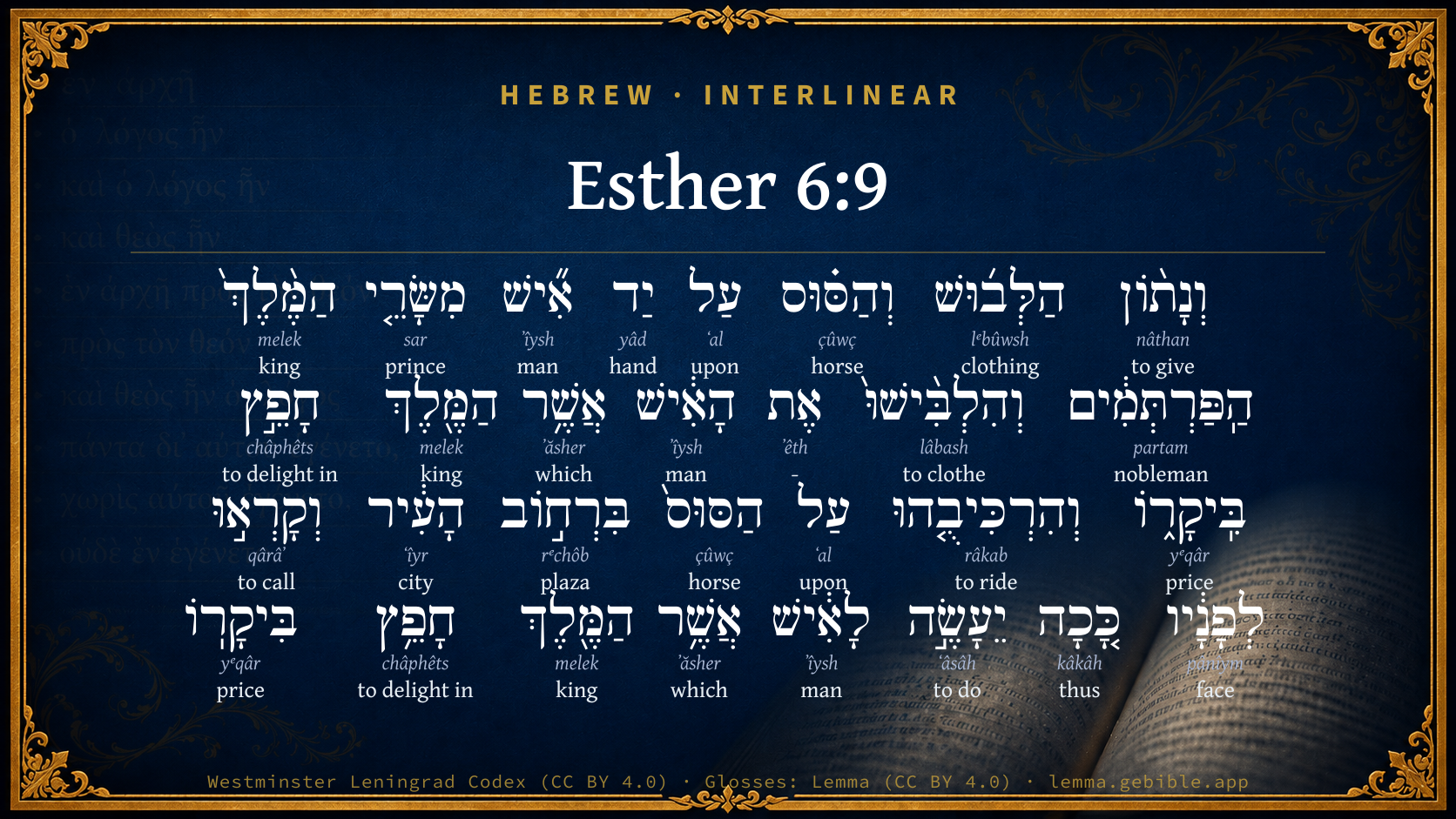
Hebrew (Westminster Leningrad Codex) Esther 6:9 appears in the Hebrew Old Testament. The text above is from the Westminster Leningrad Codex. Each word links to its Strong’s number, a concise gloss, and parsing drawn from the Open Scriptures Hebrew Bible morphology. Click any word for its full Brown-Driver-Briggs (BDB) entry.
Download image
Cite this verse

Esther 6:9 (World English Bible). Public Domain. Lemma interlinear Bible study tool, https://lemma.gebible.app/v/esther/6/9.

Show BibTeX & RIS
BibTeX
RIS
English Translation
and let the clothing and the horse be delivered to the hand of one of the king's most noble princes, that they may array the man therewith whom the king delights to honor, and cause him to ride on horseback through the street of the city, and proclaim before him, Thus shall it be done to the man whom the king delights to honor.
World English Bible · Public Domain
Download a study sheet

One document with this verse’s original text, its word-by-word gloss line, the meaning frame, cross-references with their text, attributed commentary, and full source and license credits — printable, and it pastes into notes with its structure intact.

This verse Autodidact and up

Study sheet (.html) Plain text (.txt)

A passage Seminary Student

Up to 50 verses in one chapter. A passage sheet keeps up to 6 commentary sources and 12 cross-references per verse, in the order this page ranks them, and says so on the sheet whenever that leaves anything out. Ask for a single verse and you get the Autodidact verse sheet above.

Everything on this page stays free to read, with no account — the sheet is a download of what is already on screen, not access to it.

Want to remove ads? Support Godless Engineer
Compare translations 3

The same verse in 3 English versions, stacked beneath the original-language interlinear above. Click any original word for its lexicon entry.

Each is an independent rendering of the whole verse — the interlinear is not word-aligned to these translations.

Highlighted words mark where these versions differ — a whole-verse word diff, not a word-by-word alignment.

  • World English Bible Public Domain
    and let the clothing and the horse be delivered to the hand of one of the king's most noble princes, that they may array the man therewith whom the king delights to honor, and cause him to ride on horseback through the street of the city, and proclaim before him, Thus shall it be done to the man whom the king delights to honor.
  • King James Version Public Domain
    And let this apparel and horse be delivered to the hand of one of the king's most noble princes, that they may array the man withal whom the king delighteth to honour, and bring him on horseback through the street of the city, and proclaim before him, Thus shall it be done to the man whom the king delighteth to honour.
  • unfoldingWord Literal Text CC BY-SA 4.0
    And give this garment and this horse into the hand of a man from the most noble officials of the king. And let them clothe the man whom the king delights to honor, and cause him to ride on the horse in the open square of the city, and proclaim before his face, ‘Thus shall it be done for the man whom the king delights to honor!’”

unfoldingWord Literal Text — © unfoldingWord, licensed CC BY-SA 4.0. Word-aligned USFM3 via Door43 (git.door43.org/unfoldingWord/en_ult).

Versions to compare (up to 4)

3 of 4 selected

Show all 18 translations

Every available English version of this verse, each an independent rendering of the whole verse.

  • World English Bible Public Domain
    and let the clothing and the horse be delivered to the hand of one of the king's most noble princes, that they may array the man therewith whom the king delights to honor, and cause him to ride on horseback through the street of the city, and proclaim before him, Thus shall it be done to the man whom the king delights to honor.
  • Berean Standard Bible Public Domain
    Let the robe and the horse be entrusted to one of the king’s most noble princes. Let them array the man the king wants to honor and parade him on the horse through the city square, proclaiming before him, ‘This is what is done for the man whom the king is delighted to honor!’”
  • Majority Standard Bible Public Domain
    Let the robe and the horse be entrusted to one of the king’s most noble princes. Let them array the man the king wants to honor and parade him on the horse through the city square, proclaiming before him, ‘This is what is done for the man whom the king is delighted to honor!’”
  • King James Version Public Domain
    And let this apparel and horse be delivered to the hand of one of the king's most noble princes, that they may array the man withal whom the king delighteth to honour, and bring him on horseback through the street of the city, and proclaim before him, Thus shall it be done to the man whom the king delighteth to honour.
  • American Standard Version (1901) Public Domain
    and let the apparel and the horse be delivered to the hand of one of the king's most noble princes, that they may array the man therewith whom the king delighteth to honor, and cause him to ride on horseback through the street of the city, and proclaim before him, Thus shall it be done to the man whom the king delighteth to honor.
  • Revised Version (1885) Public Domain
    and let the apparel and the horse be delivered to the hand of one of the king’s most noble princes, that they may array the man withal whom the king delighteth to honour, and cause him to ride on horseback through the street of the city, and proclaim before him, Thus shall it be done to the man whom the king delighteth to honour.
  • Geneva Bible (1599) Public Domain
    And let the raiment and the horse be deliuered by the hand of one of the Kings most noble princes, and let them apparel the man (whome the King will honour) and cause him to ride vpon the horse thorow the streete of the citie, and proclayme before him, Thus shall it be done vnto the man, whome the King will honour.
  • Douay-Rheims (1899) Public Domain
    And let the first of the king's princes and nobles hold his horse, and going through the street of the city, proclaim before him and say: Thus shall he be honoured, whom the king hath a mind to honour.
  • Young's Literal Translation Public Domain
    and to give the clothing and the horse into the hand of a man of the heads of the king, the chiefs, and they have clothed the man in whose honour the king hath delighted, and caused him to ride on the horse in a broad place of the city, and called before him: Thus it is done to the man in whose honour the king hath delighted.'
  • Literal Standard Version CC BY-SA 4.0
    and to give the clothing and the horse into the hand of a man of the heads of the king, the chiefs, and they have clothed the man in whose honor the king has delighted, and caused him to ride on the horse in a broad place of the city, and called before him: Thus it is done to the man in whose honor the king has delighted.”
  • Unlocked Literal Bible CC BY-SA 4.0
    Then let the robes and the horse be given to one of the king's most noble officials. Let them dress the man whom the king takes pleasure in honoring, and let them lead him on the horse through the city streets. Let them proclaim before him, 'This is what is done to the one whom the king takes pleasure in honoring!'”
  • unfoldingWord Literal Text CC BY-SA 4.0
    And give this garment and this horse into the hand of a man from the most noble officials of the king. And let them clothe the man whom the king delights to honor, and cause him to ride on the horse in the open square of the city, and proclaim before his face, ‘Thus shall it be done for the man whom the king delights to honor!’”
  • Darby Bible Public Domain
    and let the apparel and horse be delivered into the hand of one of the king's most noble princes, and let them array the man whom the king delights to honour, and cause him to ride on the horse through the street of the city, and proclaim before him, Thus shall it be done to the man whom the king delights to honour!
  • World Messianic Bible Public Domain
    Let the clothing and the horse be delivered to the hand of one of the king’s most noble princes, that they may array the man whom the king delights to honor with them, and have him ride on horseback through the city square, and proclaim before him, ‘Thus it shall be done to the man whom the king delights to honor!’”
  • Webster's Bible Public Domain
    And let this apparel and horse be delivered to the hand of one of the king's most noble princes, that they may array the man whom the king delighteth to honor, and bring him on horseback through the street of the city, and proclaim before him, Thus shall it be done to the man whom the king delighteth to honor.
  • Free Bible Version CC BY-SA 4.0
    Have the robes and the horse handed over to one of the king's highest officials and nobles. Let him make sure the man the king wishes to honor is dressed in the royal robes and that he rides on the horse through the city streets, and have the official announce before him, ‘This is what is done for the man the king wishes to honor!’”
  • Bible in Basic English Public Domain
    And let the robes and the horse be given to one of the king's most noble captains, so that they may put them on the man whom the king has delight in honouring, and let him go on horseback through the streets of the town, with men crying out before him, So let it be done to the man whom the king has delight in honouring.
  • JPS Tanakh (1917) Public Domain
    and let the apparel and the horse be delivered to the hand of one of the king's most noble princes, that they may array the man therewith whom the king delighteth to honour, and cause him to ride on horseback through the street of the city, and proclaim before him: Thus shall it be done to the man whom the king delighteth to honour.'

Literal Standard Version (2020), Covenant Press — licensed CC BY-SA 4.0. Text via the HelloAO Bible API (eBible.org). Unlocked Literal Bible (unfoldingWord) — licensed CC BY-SA 4.0. Text via the HelloAO Bible API (eBible.org). unfoldingWord Literal Text — © unfoldingWord, licensed CC BY-SA 4.0. Word-aligned USFM3 via Door43 (git.door43.org/unfoldingWord/en_ult). Free Bible Version, Dr. Jonathan Gallagher — licensed CC BY-SA 4.0. Text via the HelloAO Bible API (eBible.org).

Word by word

More ways to search: Search by grammar → Find every occurrence → Compare this word →

Practice this passage: Drill this verse → Learn its vocabulary →

הַֽפַּרְתְּמִ֔ים
partam
H6579
“the · noblemen”
Particle, Definite Article + Noun, Common, Masculine, Plural, Absolute
Part of Speech
Particle + Noun
Type
Common
Gender
Masculine
Number
Plural
State
Absolute
Full BDB Definition

Origin: of Persian origin

TWOT: 1839

noble, nobleman
  1. וְנָת֨וֹן nâthan H5414 “and · to give” Conjunction + Verb, Qal, Infinitive Absolute
  2. הַלְּב֜וּשׁ lᵉbûwsh H3830 “the · clothing” Particle, Definite Article + Noun, Common, Masculine, Singular, Absolute
  3. וְהַסּ֗וּס çûwç H5483 “and · the · horse” Conjunction + Particle, Definite Article + Noun, Common, Masculine, Singular, Absolute
  4. עַל ʻal H5921 “upon” Preposition
  5. יַד yâd H3027 “hand of” Noun, Common, Both, Singular, Construct
  6. אִ֞ישׁ ʼîysh H376 “man” Noun, Common, Masculine, Singular, Absolute
  7. מִשָּׂרֵ֤י sar H8269 “from · princes of” Preposition + Noun, Common, Masculine, Plural, Construct
  8. הַמֶּ֨לֶךְ֙ melek H4428 “the · king” Particle, Definite Article + Noun, Common, Masculine, Singular, Absolute
  9. וְהִלְבִּ֨ישׁוּ֙ lâbash H3847 “and · to clothe” Conjunction + Verb, Hiphil, Sequential Perfect, 3rd Person, Common, Plural
  10. אֶת ʼêth H853 “-” Particle, Direct Object
  11. הָאִ֔ישׁ ʼîysh H376 “the · man” Particle, Definite Article + Noun, Common, Masculine, Singular, Absolute
  12. אֲשֶׁ֥ר ʼăsher H834 “which” Particle, Relative
  13. הַמֶּ֖לֶךְ melek H4428 “the · king” Particle, Definite Article + Noun, Common, Masculine, Singular, Absolute
  14. חָפֵ֣ץ châphêts H2654 “to delight in” Verb, Qal, Perfect, 3rd Person, Masculine, Singular
  15. בִּֽיקָר֑וֹ yᵉqâr H3366 “in/at · price · his” Preposition + Noun, Common, Masculine, Singular, Construct + Suffix, Personal, 3rd Person, Masculine, Singular
  16. וְהִרְכִּיבֻ֤הוּ râkab H7392 “and · to ride · him” Conjunction + Verb, Hiphil, Sequential Perfect, 3rd Person, Common, Plural + Suffix, Personal, 3rd Person, Masculine, Singular
  17. עַל ʻal H5921 “upon” Preposition
  18. הַסּוּס֙ çûwç H5483 “the · horse” Particle, Definite Article + Noun, Common, Masculine, Singular, Absolute
  19. בִּרְח֣וֹב rᵉchôb H7339 “in/at · plaza of” Preposition + Noun, Common, Feminine, Singular, Construct
  20. הָעִ֔יר ʻîyr H5892 “the · city” Particle, Definite Article + Noun, Common, Feminine, Singular, Absolute
  21. וְקָרְא֣וּ qârâʼ H7121 “and · to call” Conjunction + Verb, Qal, Sequential Perfect, 3rd Person, Common, Plural
  22. לְפָנָ֔יו pânîym H6440 “to/for · face(s) · his” Preposition + Noun, Common, Both, Plural, Construct + Suffix, Personal, 3rd Person, Masculine, Singular
  23. כָּ֚כָה kâkâh H3602 “thus” Adverb
  24. יֵעָשֶׂ֣ה ʻâsâh H6213 “to do” Verb, Niphal, Imperfect, 3rd Person, Masculine, Singular
  25. לָאִ֔ישׁ ʼîysh H376 “to/for the · man” Preposition, Determined + Noun, Common, Masculine, Singular, Absolute
  26. אֲשֶׁ֥ר ʼăsher H834 “which” Particle, Relative
  27. הַמֶּ֖לֶךְ melek H4428 “the · king” Particle, Definite Article + Noun, Common, Masculine, Singular, Absolute
  28. חָפֵ֥ץ châphêts H2654 “to delight in” Verb, Qal, Perfect, 3rd Person, Masculine, Singular
  29. בִּיקָרֽוֹ yᵉqâr H3366 “in/at · price · his” Preposition + Noun, Common, Masculine, Singular, Construct + Suffix, Personal, 3rd Person, Masculine, Singular

About this verse

These counts appear in no published source. They are computed here, from the morphology-tagged text and Lemma’s own curated glosses. What Lemma adds →

30
words
21
distinct lemmas
Historical
section

Notable vocabulary

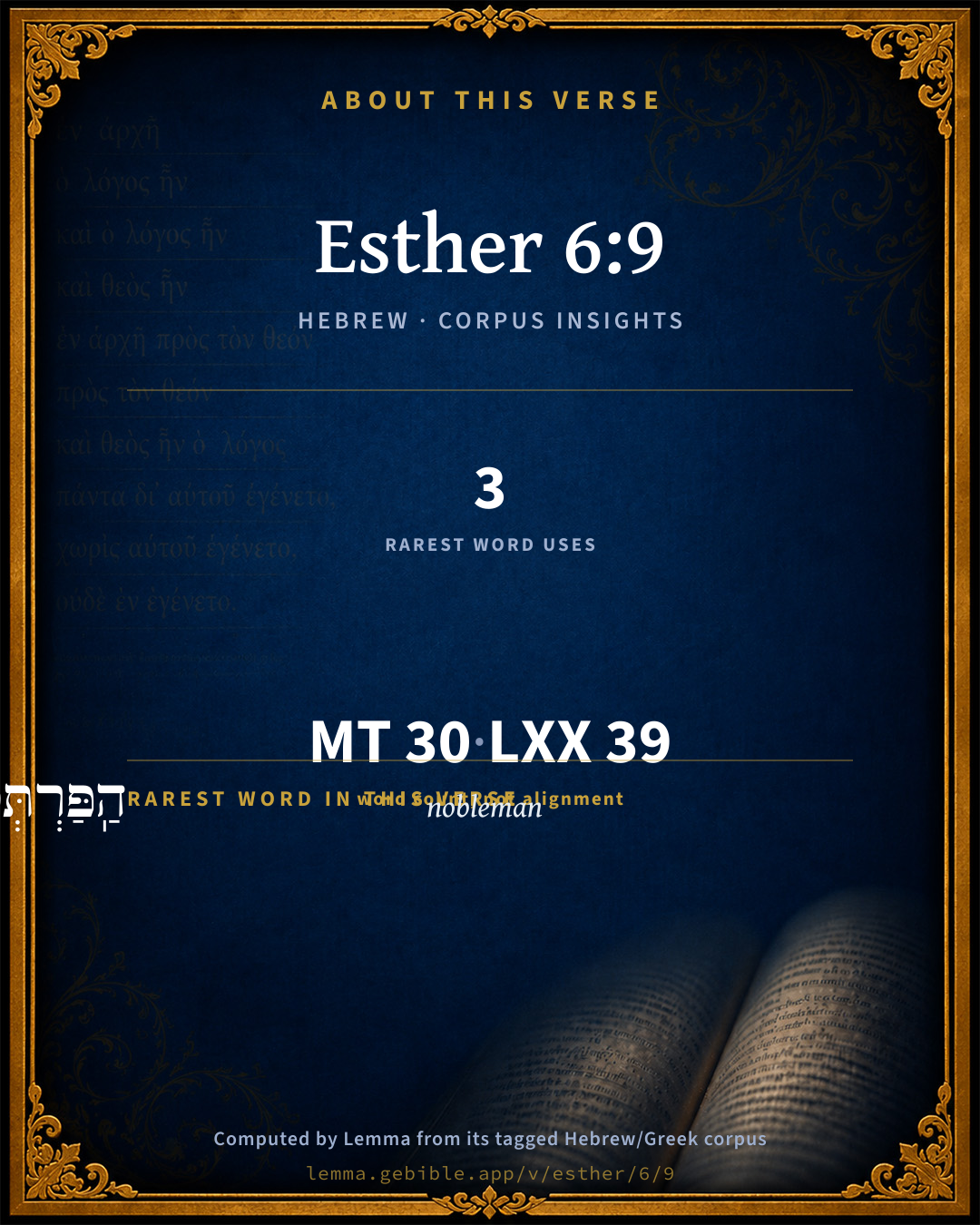
The rarest word here is הַֽפַּרְתְּמִ֔ים nobleman H6579 — appearing just 3 times in the whole Hebrew Bible.

Shared distinctive vocabulary

הַֽפַּרְתְּמִ֔ים nobleman H6579 occurs in 3 verses of the Hebrew Bible. Also found in:

Grammatical profile

  • 7 verbs
  • 17 nouns
  • 2 prepositions
  • 1 adverb
  • 3 particles

Verb forms

  • וְנָת֨וֹן Qal · Infinitive Absolute
  • וְהִלְבִּ֨ישׁוּ֙ Hiphil · Sequential Perfect
  • חָפֵ֣ץ Qal · Perfect
  • וְהִרְכִּיבֻ֤הוּ Hiphil · Sequential Perfect
  • וְקָרְא֣וּ Qal · Sequential Perfect
  • יֵעָשֶׂ֣ה Niphal · Imperfect
  • חָפֵ֥ץ Qal · Perfect

Repetition

Words recur within this verse — often emphatic in Hebrew:

  • אִ֞ישׁ man H376 ×3
  • הַמֶּ֨לֶךְ֙ king H4428 ×3
  • וְהַסּ֗וּס horse H5483 ×2
  • עַל upon H5921 ×2
  • חָפֵ֣ץ to delight in H2654 ×2
  • בִּֽיקָר֑וֹ price H3366 ×2
  • אֲשֶׁ֥ר which H834 ×2

Hebrew & Septuagint length

In English translation the verse runs 64 words from the Hebrew and 51 from the Septuagint (LXX English) — closely comparable.

A rough comparison of the two English renderings, which tokenize alike — not a word-level alignment.

Word counts can differ between the Hebrew and the Greek without any difference in meaning — e.g. the Hebrew direct-object marker אֵת has no separate Greek word, and Greek often adds the article ὁ.

In the original languages it is 30 Hebrew tokens and 39 Greek tokens — but the two are counted differently (Hebrew bundles its prefixes and suffixes into one token; the Greek is in lemma form), so that isn’t a like-for-like length.

Cross-references

3

Topical passages linked to Esther 6:9 in the Treasury of Scripture Knowledge — connected by theme and wording, ordered by reader-vote popularity; previews shown in the World English Bible.

  • Genesis 41:43 and he made him to ride in the second chariot which he had. They cried before him, "Bow the knee!" He set him over all the land of Egypt.
  • 1 Kings 1:33–34 The king said to them, Take with you the servants of your lord, and cause Solomon my son to ride on my own mule, and bring him down to Gihon:
  • Zechariah 9:9 Rejoice greatly, daughter of Zion! Shout, daughter of Jerusalem! Behold, your king comes to you! He is righteous, and having salvation; Lowly, and riding on a donkey, Even on a colt, the foal of a donkey.

Cross-references courtesy of OpenBible.info (CC BY 4.0).

Hebrew and Greek witnesses Masoretic Hebrew ↔ Greek Septuagint

The same verse in the two great witnesses to the Old Testament, shown verse-for-verse.

These are two independent witnesses, not word-aligned to each other, and the Septuagint is shown in lemma (dictionary) form.

Hebrew Esther 6:9 Masoretic · Westminster Leningrad Codex

וְנָת֨וֹן הַלְּב֜וּשׁ וְהַסּ֗וּס עַל יַד אִ֞ישׁ מִשָּׂרֵ֤י הַמֶּ֨לֶךְ֙ הַֽפַּרְתְּמִ֔ים וְהִלְבִּ֨ישׁוּ֙ אֶת הָאִ֔ישׁ אֲשֶׁ֥ר הַמֶּ֖לֶךְ חָפֵ֣ץ בִּֽיקָר֑וֹ וְהִרְכִּיבֻ֤הוּ עַל הַסּוּס֙ בִּרְח֣וֹב הָעִ֔יר וְקָרְא֣וּ לְפָנָ֔יו כָּ֚כָה יֵעָשֶׂ֣ה לָאִ֔ישׁ אֲשֶׁ֥ר הַמֶּ֖לֶךְ חָפֵ֥ץ בִּיקָרֽוֹ

and let the clothing and the horse be delivered to the hand of one of the king's most noble princes, that they may array the man therewith whom the king delights to honor, and cause him to ride on horseback through the street of the city, and proclaim before him, Thus shall it be done to the man whom the king delights to honor.

World English Bible · Public Domain

Greek LXX Esther 6:9 Septuagint · lemma form

καί δίδωμι εἷς ὁ φίλος ὁ βασιλεύς ὁ ἔνδοξος καί στολίζω ὁ ἄνθρωπος ὅς ὁ βασιλεύς ἀγαπάω καί ἀναβιβάζω αὐτός ἐπί ὁ ἵππος καί κηρύσσω διά ὁ πλατεῖα ὁ πόλις λέγω οὕτως εἰμί πᾶς ἄνθρωπος ὅς ὁ βασιλεύς δοξάζω

and let him give it to one of the king's noble friends, and let him array the man whom the king loves; and let him mount him on the horse, and proclaim through the street of the city, saying, Thus shall it be done to every man whom the king honors.

LXX2012 (modern English Septuagint) · Public Domain

Hebrew: Westminster Leningrad Codex (CC BY 4.0). Greek: Septuagint (public domain); English from LXX2012 (modern English Septuagint) (Public Domain). How the Septuagint differs from the Hebrew →

Commentary

Notes on Esther 6:9 from classic Christian and Jewish commentators (each source and its license shown beneath its notes). The classic Christian expositions comment on the surrounding passage and are grouped to its opening verse, so a note may address several verses; the Jewish commentaries on the Tanakh (Rashi and others) are per-verse, so they appear only where the commentator wrote on this verse.

Lemma curates 59 commentaries, every one of them public domain or Creative Commons licensed, each selected and text-cleaned for this edition rather than reprinted as found. About our sources →

Trapp's Complete Commentary

John Trapp

Est 6:9 And let this apparel and horse be delivered to the hand of one of the king’s most noble princes, that they may array the man [withal] whom the king delighteth to honour, and bring him on horseback through the street of the city, and proclaim before him, Thus shall it be done to the man whom the king delighteth to honour.

Ver. 9. And let this apparel and horse be delivered, &c.] All must be done in amplest manner; and if it had been done to himself, as he desired, what had all that been but a magnum nihil, as one saith, a great nothing, a glorious fancy, a rattle, to still his ambition for a while? Forte amplior fuisset, nisi veritas esset rem suspicione neutiquam carere (Lavat.). He, simple man, had wrought himself into the fool’s paradise of a sublime dotage, like as the Spaniards have in their dream of a catholic monarchy, divinitus debita, saith one, sed in Utopia. They were laughed heartily at Captain Drake and his company, when they took Sancta Domingo, A.D. 1585, and in the town hall found the king of Spain’s arms, and under them a globe of the world, out of which arose a horse with his forefeet cast forth with this inscription, Non sufficit orbis, Not enough territory. Pyrrhus, that ambitious king of Epirotes, had the like thought; but was slain at last with a tilestone thrown upon his head by a woman. And a like evil end befell Caesar Borgia, who, in imitation of Julius Caesar, would needs be aut Caesar, aut nullus, either Caesar or nothing, and soon after proved to be et Caesar, et nullus, Both Caesar and nothing. Had Haman but contented himself with his present condition (too good for such a captive), he might have lived in the world’s account happily, and have called himself, as that French king did Tres heureuse, thrice blessed; but that insatiable thirst after honour, that gluttonous, excessive desire after more and more greatness, undid him. So true is that proverb of the ancients, Turdus ipse sibi malum cacat, Of the blackbird’s dung is made the lime wherewith he is taken; so out of the dung of men’s sins doth God make his lime twigs of judgment to take them withal.

To one of the king’s most noble princes] Principibus maioribus paratimis. This would be no small addition to the honour of the man and splendour of the day, like as it was here in England, when Henry II, at the coronation of his eldest son, renounced the name of a king for that day, and, as server, served at the table.

That they may array the man withal] Setting him forth to the greatest advantage, as our Henry VI did, when he crowned the Lord Beauchamp king of the Isle of Wight, and as Xerxes did Demaratus, when for honour’s sake he granted him to enter into Sardis, the chief city of Asia, arrayed like himself, with a straight tiara upon his head, which none might wear but kings only (Sen. 1. 6, de Benef.).

Through the street of the city] Of Susa, that he might be seen and cried up by many, for Honor est in honorante. Honour is in honour. As the meteor liveth in the air, so doth honour in the breath of other men. Plato reckoneth it among those dei ludibria quae sursum ac deorsum sub caelo feruntur, like tennis-balls bandied up and down from one to another.

John Trapp, A Commentary or Exposition upon All the Books of the Old and New Testament (1647–1656) — public domain. Text from a community e-Sword module.

Joseph Benson's Commentary

Est 6:9. And let this apparel, &c., be delivered to one of the king’s most noble princes — To be his attendant. And bring him on horseback through the city — That all the people may be made to take notice of him, and do him reverence. And proclaim before him, Thus shall it be done, &c. — For his honour, and the encouragement of all to seek the king’s favour.

Joseph Benson's Commentary on the Old and New Testaments (1811–1818) — public domain. Text from a community e-Sword module.

Jamieson, Fausset & Brown

Robert Jamieson, A. R. Fausset & David Brown

delivered to the hand of one of the king's most noble princes . . . array the man--On grand and public occasions, the royal steed is led by the highest subject through the principal streets of the city, a ceremony which may occupy several hours.

Jamieson, Fausset & Brown — Commentary Critical and Explanatory on the Whole Bible (1871) — public domain (CC PDM 1.0). Text via the HelloAO Bible API.

Adam Clarke's Commentary

Verse 9. One of the king's most noble princes] Alas, Poor Haman! Never was the fable of the dog and shadow more literally fulfilled. Thou didst gape at the shadow, and didst lose the substance.

Adam Clarke's Commentary on the Bible (1810–1826) — public domain. Text from a community e-Sword/MySword module.

Ellicott's Commentary for English Readers

(9) Noble.—See above, Est_1:3, Note.

Street.—See above, Est_4:6, Note.

A Bible Commentary for English Readers, edited by Charles John Ellicott (1878–1897) — public domain. Text from a community e-Sword module.

The Cambridge Bible for Schools and Colleges

gen. ed. J. J. S. Perowne

9. most noble] the same word as that used in Est_1:3, where see note.

through the street of the city] rather, as in Est_4:6, the broad place of the city, the open space in front of the palace, the most public place in the city. Conversely, in a story of the Thousand and one Nights (ed. König, xi. 19) a local dignitary is led through the city, seated upon a camel backwards, while a crier proclaims in front, ‘Thus are those punished who mix themselves up in affairs without being called to do so.’

The Cambridge Bible for Schools and Colleges (gen. ed. J. J. S. Perowne; Cambridge University Press, 1878–1918) — public domain. Text from a community e-Sword module.

John Gill's Exposition

And let this apparel and horse be delivered to the hand of one of the king's most noble princes,.... The one:

that they may array the man withal whom the king delighteth to honour; and the other to be led in state before him:

and bring him on horseback through the street of the city; on another horse, that all might see what honour was done him:

and proclaim before him; as before Joseph, when advanced next to Pharaoh, Gen 41:43 this was not to be done by an herald, but by a nobleman, to whom the apparel and horse were to be delivered, and was done by Haman, Est 6:11,

thus shall it be done to the man whom the king delighteth to honour; these were the words said in the proclamation, signifying this was the man the king delighted to honour, and this the manner in which he would have it done.

John Gill's Exposition of the Whole Bible (1746–1763) — public domain (CC PDM 1.0). Text via the HelloAO Bible API.

Haydock's Catholic Bible Commentary

Nobles. Literally, "tyrants." (Haydock) --- But this word was not formerly odious; as it only denoted "a prince." Pars mihi pacis erit dextram tetigisse tyranni. (Vigil, Æneid vii.) --- Abuse of power caused it to become hateful. (Tirinus)

George Leo Haydock (1774–1849), Haydock's Catholic Family Bible and Commentary, 1859 edition — public domain. Excludes Psalms (Douay-Rheims chapter numbering differs from Protestant) and Deuterocanonical books (Catholic canon only).

Matthew Poole's English Annotations

Proclaim before him, i.e. cause this to be proclaimed, to wit, by some public officer appointed for that service. Compare Gen 41:43.

Matthew Poole's English Annotations on the Holy Bible (1683–1685) — public domain. Text from a community e-Sword/MySword module.

The Pulpit Commentary

Bring him on horseback through the city, and proclaim before him. Compare the honours given to Joseph in Egypt. (Gen_41:43)

The Pulpit Commentary (1880–1919), ed. H.D.M. Spence-Jones & Joseph S. Exell — public domain. Text from a community e-Sword module.

Rashi

Rabbi Shlomo Yitzchaki (Rashi)

And let the raiment and the horse But he did not mention the crown, for he saw that the king became jealous because he said that they should place the crown on a person’s head.

Rashi on the Tanakh — English translations: “The Judaica Press complete Tanach with Rashi, translated by A. J. Rosenberg” (CC BY 4.0); “Pentateuch with Rashi's commentary by M. Rosenbaum and A.M. Silbermann, 1929-1934” (public domain); “The Metsudah Tanach series, Lakewood, N.J” (CC BY 4.0); and “The Book of Joshua, Metsudah Publications, 1997” (CC BY 4.0). Text via Sefaria.

Lesson kit

Teaching starters — assembled from the data on this page, not authored interpretation. Every prompt links to the verse data it draws on. Edit before teaching.

Esther, in the Historical, opens this verse with 30 words (21 distinct Hebrew lemmas). Its most distinctive word is partam (“nobleman”). A historical commentator’s framing appears above. Read the whole chapter for the surrounding context.

Discussion questions

  1. What does “nobleman” (partam) contribute to the verse as a whole?
  2. Esther 1:3 shares the word «nobleman» with this verse. How do the two illuminate each other?
  3. “man” occurs 3× in this one verse. What is the effect of the repetition?
  4. These translations render this verse differently; the difference is in the English rendering, not the original. What questions does that raise?
  5. The verb «וְנָת֨וֹן» is Qal Infinitive Absolute. How does its form color the action?
  6. Reading how Trapp's Complete Commentary and Joseph Benson's Commentary read this verse, where do the two commentators agree and where do they part?

Things to notice

Reading settings

Reading text

Shown beneath each verse's original-language words.

Old Testament
Old Testament edition

Read the OT as the Masoretic Hebrew (MT) or the Greek Septuagint (LXX).

English shown for the Greek Septuagint (in the Hebrew ↔ Greek comparison).

Comparing translations? Open the Compare panel on any verse page to stack up to four side by side.